
A claim can contain the correct CPT or HCPCS code and still be denied because the number of billed units exceeds Medicare's Medically Unlikely Edit (MUE). These edits catch potential quantity errors, but confusing per-line limits with daily limits can cause preventable denials and lost revenue. Medical coders must understand MUE values, adjudication indicators, modifier rules, and the circumstances supporting appeals. This guide explains how to identify MUE risks, calculate units correctly, resolve legitimate exceptions, and strengthen coding accuracy, clean claim performance, and denial prevention.

1. What Are Medically Unlikely Edits (MUEs) and How Do They Work?
Medically Unlikely Edits are Medicare National Correct Coding Initiative (NCCI) edits that evaluate the number of units of service reported for a particular CPT or HCPCS code. They help identify coding mistakes, duplicate units, and quantities that exceed what would ordinarily be reported for the service.
An MUE value represents the maximum units that would appear on the vast majority of correctly reported claims under the applicable adjudication method.
For example, suppose a code has a hypothetical MUE value of four. A claim reporting six units may trigger an edit, depending on the code's MUE Adjudication Indicator (MAI) and how those units are distributed across claim lines.
The underlying service may have been medically necessary. The coding team must still determine whether the units were calculated correctly, whether the edit applies per claim line or per date of service, and whether the circumstances support further review.
This is why medical coding audits, electronic claim scrubbing, denial analysis, and billing appeal procedures should specifically address MUE errors.
MUE Adjudication Indicator 1: Claim-line edits
An MAI of 1 means the MUE is evaluated separately for each claim line.
Suppose a code has a hypothetical MUE value of three. One claim line containing four units would exceed that value and be denied under the MUE.
When distinct, separately reportable services genuinely justify different claim lines, appropriate modifiers may permit separate line-level adjudication.
However, separating a single service into multiple lines solely to avoid an edit creates incorrect billing.
Modifiers such as 59, XE, XP, XS, XU, 76, 77, and 91 may be relevant in specific circumstances, subject to their individual requirements and payer restrictions.
Coders should review modifier 25 versus 59 guidance, coding practice scenarios, and coding compliance standards before using multiple lines.
MUE Adjudication Indicator 2: Absolute date-of-service edits
An MAI of 2 identifies a date-of-service edit based on binding coding policy, including statutory, regulatory, or applicable subregulatory requirements.
The claim-processing system evaluates the total units of the same code reported for the same beneficiary, provider or supplier, and date of service.
Consider a hypothetical MUE value of two. Reporting two units on one line and two additional units on another produces four total daily units.
The total exceeds the edit regardless of how the quantities were separated.
An MAI 2 denial generally requires investigation of the coding accuracy or the underlying policy. Documentation showing that additional services were performed does not automatically justify exceeding a binding policy limit.
The critical question is whether the claimed units comply with the code definition and governing policy.
This distinction is especially important when investigating claim adjustment reason codes, Medicare billing requirements, and medical coding compliance.
MUE Adjudication Indicator 3: Clinical date-of-service edits
An MAI of 3 also applies across the date of service, but its value reflects a clinical benchmark rather than an absolute policy limit.
In unusual cases, correctly reported units exceeding the MUE may be medically reasonable and necessary.
For example, imagine a hypothetical procedure with an MAI 3 value of five. A patient undergoes eight medically necessary units of that service, with each unit correctly reported and supported by documentation.
The initial claim may be denied because the total exceeds the MUE. During the applicable Medicare review or appeal process, the contractor may allow payment above the edit when the evidence establishes that the units were furnished, coded correctly, and medically reasonable and necessary.
That possibility makes documentation especially valuable for MAI 3 denials.
The appeal should demonstrate the clinical circumstances supporting the quantity rather than relying on a generic statement that the provider performed additional work.
Relevant preparation includes medical necessity appeal templates, billing appeal examples, compliant physician queries, and denial root-cause analysis.
Where to find current MUE values
CMS publishes separate Medicare MUE files for practitioner services, outpatient hospital services, and durable medical equipment supplier services.
These files contain publicly available CPT/HCPCS codes, MUE values, adjudication indicators, and related information.
CMS updates the files at least quarterly. As of November 2026, the published October 1, 2026, files are the current effective Medicare MUE files.
Some Medicare MUE values remain confidential, so the absence of a publicly displayed value does not establish that a code has no MUE.
A reliable coding workflow verifies the correct service category and effective date before evaluating a claim. It should also distinguish Medicare fee-for-service rules from Medicaid and commercial payer policies.
Medicaid uses its own NCCI edit files, and commercial insurers may apply different unit restrictions.
Organizations should combine Medicare billing resources, Medicaid reimbursement guidance, coding accuracy reviews, and billing software validation to maintain current edit logic.
MUE Decision Matrix: 32 Unit-Billing Scenarios, Errors, and Corrective Actions
| Billing Scenario | MUE or Unit Issue | Required Coding Action | Denial Prevention Check |
|---|---|---|---|
| 1. Four units on one line; hypothetical MAI 1 value of three | Claim-line limit exceeded | Verify actual units and whether separate services support distinct lines | Review CPT instructions and modifier eligibility |
| 2. Two lines with three units each; hypothetical MAI 1 value of three | Each line is evaluated separately | Confirm two genuinely distinct reportable services | Prevent artificial line splitting |
| 3. Three plus two units; hypothetical MAI 2 value of four | Combined daily units exceed the policy limit | Recheck code definition and applicable policy | Aggregate same-code daily quantities |
| 4. Three plus two units; hypothetical MAI 3 value of four | Combined daily units exceed the clinical benchmark | Validate medical necessity and consider supported review or appeal | Retain evidence supporting all five units |
| 5. Four units; hypothetical MUE value of four | Units are within the stated MUE | Continue other coding and coverage checks | MUE compliance does not guarantee payment |
| 6. Code missing from a public MUE table | MUE may be confidential or absent | Validate reporting instructions and available payer edits | Avoid assuming unlimited units |
| 7. Practitioner claim checked against hospital file | Wrong MUE setting | Use practitioner-specific edits | Match file to billing provider category |
| 8. Outpatient hospital claim checked against practitioner file | Wrong MUE setting | Use outpatient hospital edits | Check claim type and service setting |
| 9. DME supplier uses practitioner MUE values | Incorrect supplier category | Apply appropriate DME supplier edit file | Verify supplier classification |
| 10. Service date precedes latest MUE change | Wrong effective-date version | Retrieve the edit effective for that date | Archive quarterly versions |
| 11. Same laboratory panel counted by individual analyte | Possible unit overstatement | Apply the panel code descriptor and applicable reporting rules | Verify unique reportable services |
| 12. Repeated laboratory testing on the same day | Potential legitimate repeat service | Verify separate orders, medical necessity, and modifier 91 when applicable | Confirm MAI and distinct-service policy |
| 13. Bilateral surgery reported as two units | Potential incorrect bilateral reporting | Review code descriptor and modifier 50 policy | Check whether one unit is required |
| 14. Bilateral procedure already defined in code descriptor | Duplicate reporting risk | Follow the bilateral descriptor's unit instructions | Prevent unnecessary additional units |
| 15. Surgical units based on each removed lesion | Possible descriptor mismatch | Determine whether coding is per lesion, site, or procedure | Review operative report and code definition |
| 16. Drug code describes each 10 mg; 50 mg administered | Unit conversion | Calculate five units when supported by the code's definition | Verify concentration, dose, and HCPCS descriptor |
| 17. Drug concentration confused with administered dose | Medication unit error | Recalculate from actual administered milligrams | Compare medication administration record and pharmacy data |
| 18. Partially used single-dose drug vial | Administered versus discarded quantity | Evaluate applicable JW/JZ and drug wastage reporting rules | Reconcile administered, discarded, and billed units |
| 19. Two separately administered injections | Potential repeat reporting | Check whether each administration or drug quantity is separately reportable | Review administration records and code definitions |
| 20. Infusion service calculated from every elapsed minute | Possible time-unit error | Apply initial and additional time thresholds | Validate actual infusion start and stop times |
| 21. Anesthesia time reported in billing units | Time conversion and payer methodology | Apply the appropriate anesthesia reporting requirements | Reconcile recorded minutes and billed units |
| 22. Two practitioners provide same-day services | Provider identification and same-service concerns | Review actual rendering professionals and payer aggregation rules | Prevent incorrect provider reassignment |
| 23. Code repeated after an equipment malfunction | Questionable repeat medical necessity | Determine which completed services are separately reportable | Document clinical and technical circumstances |
| 24. Code split across lines using modifier 59 | Potential unsupported bypass attempt | Verify distinct-service criteria and MAI | Remove inappropriate modifier use |
| 25. Code repeated with modifier 76 | Repeat procedure by same professional | Confirm truly repeated service and applicable policy | Review time, indication, and repeat documentation |
| 26. Code repeated with modifier 77 | Repeat procedure by another professional | Verify practitioner circumstances and reporting eligibility | Check separate procedure documentation |
| 27. Diagnosis supports a service but units exceed MAI 2 | Policy-based daily limit | Investigate coding or policy mismatch | Do not assume medical necessity overrides MAI 2 |
| 28. Units exceed an MAI 3 clinical benchmark | Potentially supportable exception | Prepare evidence of actual services, correct coding, and medical necessity | Determine whether reopening or appeal is appropriate |
| 29. MUE denial accompanied by CO-151 | Quantity or frequency support issue | Review payer remittance and actual denial circumstances | Classify root cause before correction |
| 30. Claim scrubber shows outdated edit | Quarterly update failure | Update edit version and retest affected claims | Require documented software version checks |
| 31. Claim denied despite correct units | Possible incorrect edit application | Compare effective edit, provider category, and remittance | Retain evidence supporting reopening or redetermination |
| 32. Frequent MUE overrides on one code | Recurring coding or system-control problem | Audit source documentation and unit methodology | Monitor override patterns and establish corrective training |
Numerical MUE values in these scenarios are hypothetical teaching examples, not verified limits for specific CPT/HCPCS codes. Always use the applicable CMS quarterly file, service category, effective date, and payer instructions. A valid MUE quantity may still be subject to other coding and coverage rules.
2. How to Calculate MUE Units Correctly: Clinical Coding Examples
Case 1: Claim-line versus daily units
Assume a code has a hypothetical MUE value of three.
A physician performs two genuinely distinct qualifying services on the same date. Three units are associated with the first service, and two units with the second.
If the code carries MAI 1, each claim line is evaluated separately against the value of three. Appropriate modifiers and documentation may support two separate lines when applicable.
If the code instead carries MAI 2 or 3, the five units are aggregated for the date of service. Both lines together exceed the hypothetical limit.
This difference can alter the claim outcome without changing the actual clinical work.
Coders should verify the adjudication indicator before considering modifier 59 or X modifiers, follow coding audit procedures, and investigate claim denials.
Case 2: Drug HCPCS units and dose conversion
Drug billing is a significant source of unit errors because the quantity administered may differ from the quantity represented by a single HCPCS unit.
Suppose a hypothetical HCPCS descriptor represents 10 mg of a medication, and the patient receives 70 mg.
The calculation is:
70 mg administered ÷ 10 mg per billing unit = 7 units
Reporting 70 units would multiply the appropriate administered quantity by ten.
The record should identify the actual medication, concentration, administered dose, and any qualifying discarded quantity.
When medication wastage reporting applies, coders must follow the appropriate JW or JZ requirements and avoid double-counting discarded medication.
A reliable workflow connects medical coding compliance audits, CPT and HCPCS coding education, medical necessity documentation, and clean claim analysis.
Case 3: Bilateral procedures and incorrect unit multiplication
Bilateral surgical services frequently create confusion because some procedures are reported using modifier 50 with one unit, while others follow different instructions based on their descriptors and applicable payer policies.
Suppose a surgeon performs a qualifying bilateral surgical procedure whose Medicare reporting instructions require one claim line with modifier 50 and one unit.
Reporting two units because two anatomical sides were treated may produce an MUE denial.
The coder should examine the procedure's descriptor, bilateral surgery indicator, and current NCCI coding policy before determining the reporting format.
Anatomical modifiers such as RT and LT also require evaluation against the specific code and payer instructions.
These distinctions are best practiced through outpatient procedure cases, coding assessments, and medical coding audit checklists.
Case 4: Repeated laboratory testing and modifier 91
A patient undergoes a laboratory test, followed by another medically necessary performance of the same test later that day to evaluate a change in clinical status.
The coder must determine whether both performances are separately reportable.
Modifier 91 may identify qualifying repeat clinical diagnostic laboratory testing, but it should not be used for repeated testing performed merely to confirm initial results or overcome equipment or specimen problems.
The documentation should establish the clinical reason for repeat testing and identify when each test occurred.
If the code has MAI 1, appropriately reported separate lines may undergo separate adjudication. MAI 2 and 3 edits evaluate aggregated daily units.
The coder should still confirm the applicable NCCI and payer rules before claim release.
Use coding practice cases, modifier guidance, medical necessity reviews, and denial investigation tools.
Case 5: Multiple lesions and the meaning of the code descriptor
A surgeon removes several lesions during one encounter. The billing team assumes each lesion automatically represents one unit of the selected CPT code.
That assumption can cause inaccurate reporting because procedure descriptors distinguish services in different ways.
Some codes describe treatment by individual lesion, others by anatomical site, treatment area, procedure, or another defined unit.
Certain services also use add-on codes when additional lesions or procedures qualify.
For example, a lesion excision code may depend on the anatomical site and excised diameter. The coder must evaluate each reportable procedure according to the descriptor and coding conventions.
An accurate claim should reflect the work performed using the appropriate codes and units.
This requires careful operative documentation review, CPT coding knowledge, and practical coding exercises.
Case 6: Infusion time and add-on unit mistakes
Infusion coding requires precise interpretation of the code's time requirements, service hierarchy, and applicable add-on codes.
Suppose a treatment lasts 90 minutes. The coder should evaluate the relevant initial service and additional-time rules rather than automatically reporting 90 units or dividing the total duration into arbitrary intervals.
The service start time, stop time, substance administered, and sequence of services may all influence code assignment.
Incorrect time conversions can create MUE failures even when the treatment was medically necessary.
Practices should link accurate infusion documentation with coding compliance procedures, medical necessity verification, billing software checks, and claim rejection monitoring.
3. Why MUE Denials Occur and When They Can Be Appealed
How MUE denials appear on remittance advice
An MUE denial commonly appears when the payer determines that the reported number or frequency of services exceeds an acceptable limit.
One relevant claim adjustment reason code is CO-151, which indicates that the submitted information does not support the reported number or frequency of services.
However, adjustment codes may also appear in other quantity-related payment disputes. Billing teams should review the full remittance message, associated remark codes, claim history, and payer explanation before confirming an MUE denial.
MUE and procedure-to-procedure edits address different problems. MUEs evaluate reported quantities, while NCCI PTP edits evaluate combinations of procedure codes.
An organization should maintain separate investigation pathways for these issues.
This distinction improves claim adjustment analysis, denial management, billing appeal preparation, and revenue leakage detection.
What happens when an MUE is exceeded?
For MAI 1, if the units on a particular claim line exceed the MUE value, the units on that line are denied under the edit.
For MAI 2 or 3, units for the same code are aggregated across applicable claim lines for the date of service. When the combined quantity exceeds the MUE, the edit can deny all units for that code on the current claim.
Consequently, exceeding the limit by a single unit can have a larger financial effect than the reimbursement associated with that extra unit.
Consider a hypothetical MAI 3 code with an MUE of six. A claim reports seven units, each with an illustrative allowed amount of $150.
The total potential allowed amount associated with those seven units is $1,050, before other payment adjustments.
If the date-of-service MUE denies all seven units, the disputed amount may involve the entire service quantity.
An appropriate review should establish whether the billing represents a legitimate clinical exception, incorrect unit calculation, or another coding mistake.
Billing teams can quantify these problems through denial rate calculations, AR days monitoring, and medical billing appeals.
When an MAI 3 appeal may succeed
An MAI 3 denial offers a potential path for payment above the clinical benchmark when the services were actually furnished, correctly coded, and medically reasonable and necessary.
A persuasive appeal should contain the relevant medical record, service details, quantity calculations, clinical indication, and explanation of why the additional services were required.
For a repeated procedure, the documentation might establish distinct clinical indications, timing, patient response, and the necessity of further intervention.
For medication claims, the evidence may include prescribing information, actual administration details, dosage calculations, and clinical justification.
Each case must follow the applicable contractor's review and appeal instructions.
Strong preparation connects medical necessity appeal documentation, billing appeal templates, compliant physician clarification, and coding accuracy audits.
Why MAI 2 requires a different appeal strategy
MAI 2 values reflect policy-based limits. The first investigation should establish whether the reported code, units, date of service, or applied rule is incorrect.
For example, a biller may discover that the wrong code was used or that two units were reported for a service whose descriptor permits one.
Correcting the underlying error may resolve the problem.
If the units and coding are accurate but exceed the applicable MAI 2 policy limit, the appeal must address the specific policy or adjudication issue. Simply submitting clinical records showing that additional work occurred generally fails to resolve a policy-based restriction.
CMS's appeal framework still permits review of denials, but MAI 2 presents fundamentally different considerations from MAI 3.
Organizations should avoid submitting identical appeal letters for both categories. Use the relevant denial appeal resources, Medicare reimbursement guidance, coding compliance checklists, and claim adjustment references.
Can an Advanced Beneficiary Notice transfer the cost?
An Advanced Beneficiary Notice of Noncoverage (ABN) should not be issued merely because an MUE may deny the claim.
CMS treats an MUE denial as a coding denial. An ABN does not shift liability to the beneficiary for units denied because of an MUE.
This distinction protects patients from inappropriate billing and helps practices maintain compliant financial policies.
Revenue cycle teams should train staff to distinguish MUE denials from separate medical necessity denials that may involve different beneficiary notice requirements.
These controls belong within medical billing compliance audits, denial management procedures, and medical necessity review workflows.
Quick Poll: What Causes the Most MUE Denials in Your Billing Workflow?
4. How to Prevent MUE Denials Before Claim Submission
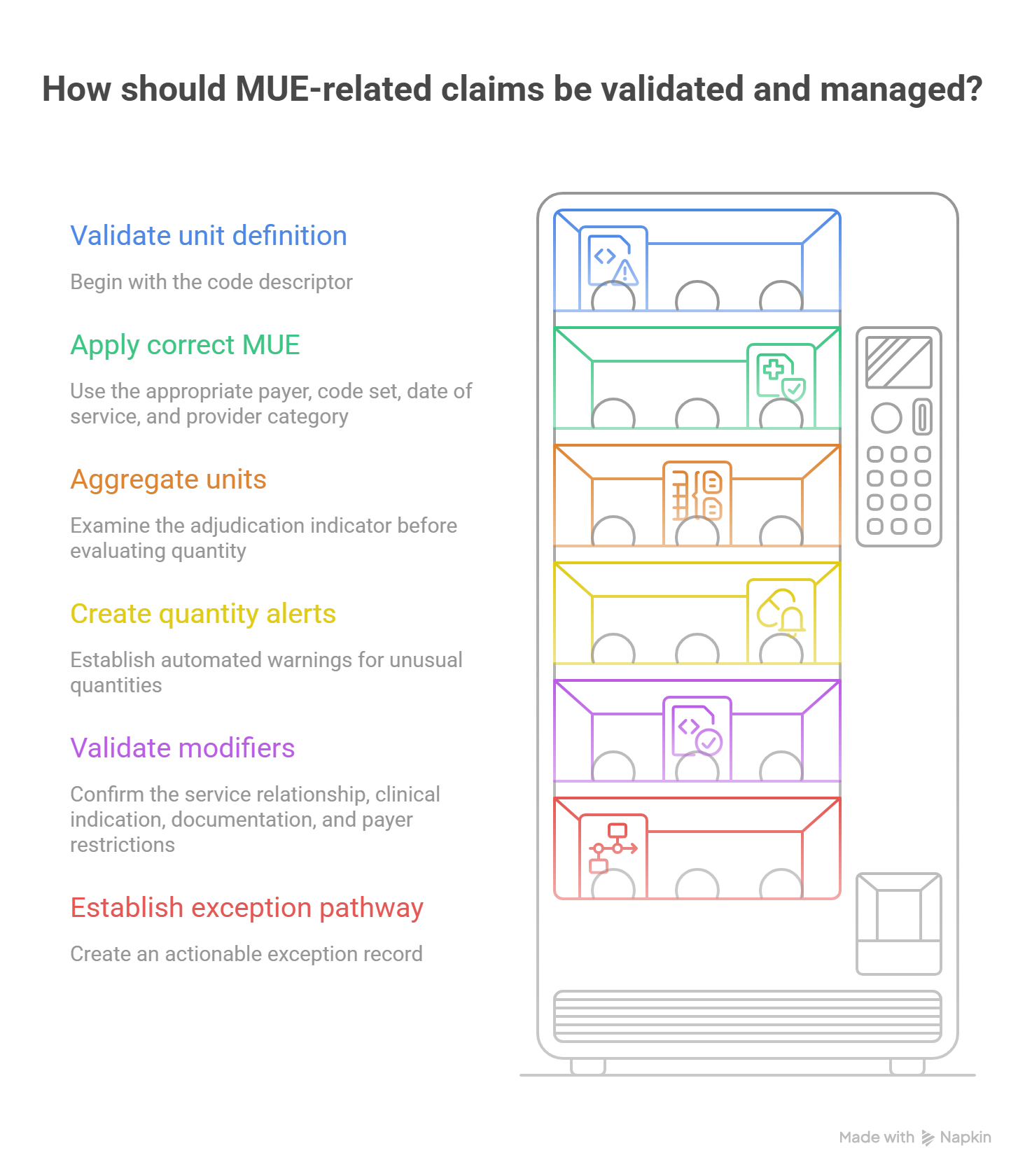
Step 1: Validate the CPT or HCPCS unit definition
Every unit calculation should begin with the code descriptor.
The code may represent one procedure, one treatment area, a defined medication quantity, a specified time interval, or another unit.
For example, reporting one unit per lesion would be incorrect when the selected descriptor defines the reportable service differently.
A reliable coding system should associate each high-risk code with its correct unit methodology.
This is particularly important for medication administration, laboratory testing, bilateral surgery, and repeat procedures.
Use CPT coding resources, practical coding cases, coding audits, and billing productivity analysis to identify recurring calculation mistakes.
Step 2: Apply the correct MUE file and effective date
The claim scrubber should identify the appropriate payer, code set, date of service, and provider category.
For Medicare fee-for-service, verify whether the claim belongs to the practitioner, outpatient hospital, or DME supplier edit category.
Use the MUE version effective on the actual date of service. A future quarterly update should not be applied retroactively unless CMS specifically provides for that treatment.
Maintain an archive of previously effective files for accurate denial investigations.
A reliable update process should identify newly added, deleted, and revised edits, then test affected claims before enabling the changes in production.
Coordinate this work across billing software systems, electronic claims platforms, Medicare billing resources, and coding audit programs.
Step 3: Aggregate units according to the MAI
An MUE validation engine should examine the adjudication indicator before evaluating quantity.
For MAI 1, compare the units on each individual claim line with the code's MUE value.
For MAI 2 and MAI 3, calculate the applicable daily total for the same code, beneficiary, and provider or supplier.
The system should also identify duplicate lines, inconsistent modifiers, and questionable units originating from separate charge-entry systems.
This is particularly important when services are recorded independently by clinical departments and later assembled into a single claim.
An effective workflow connects claim scrubbing, coding compliance checks, and denial prevention analysis.
Step 4: Create high-risk quantity alerts
Certain code families justify additional unit validation because a minor documentation or calculation error can multiply the reported quantity.
A healthcare organization can establish automated warnings for unusual drug doses, excessive time-based units, repeat testing, bilateral reporting, and multiple claim lines using the same code.
Alerts should distinguish a definite coding error from a potential clinical exception.
For example, an MAI 3 threshold exceedance should trigger documentation review. A confirmed drug conversion error should trigger correction of the reported units.
This distinction prevents staff from overriding every alert without investigating its cause.
Targeted monitoring can be incorporated into medical coding accuracy audits, claim denial tracking, and coding productivity reviews.
Step 5: Validate modifiers before releasing claims
Modifiers can communicate clinically relevant distinctions, but their use must reflect the actual service.
For MAI 1 edits, appropriate modifiers may permit separate reporting of qualifying services across claim lines.
A repeated diagnostic procedure may involve modifier 76 or 77, while certain repeat laboratory tests may qualify for modifier 91.
Modifiers 59 and the applicable X modifiers communicate distinct-service circumstances under the relevant coding rules.
The presence of multiple services on the same day does not automatically justify a modifier.
Coders should confirm the service relationship, clinical indication, documentation, and payer restrictions before claim submission.
Use modifier decision guidance, medical coding practice cases, documentation clarification examples, and coding compliance audits.
Step 6: Establish a documented exception pathway
When a claim exceeds an MUE value, the billing system should create an actionable exception record.
That record should identify the CPT/HCPCS code, units billed, applicable MUE value when public, MAI, provider category, service date, and relevant clinical documentation.
An MAI 1 exception should prompt investigation of the claim-line units and potential distinct-service circumstances.
An MAI 2 exception should trigger review of the underlying policy and code definition.
An MAI 3 exception should prompt assessment of whether the unusual quantity is medically necessary and correctly reported.
Assign each exception to an appropriate coding, clinical, or billing reviewer and document the final decision.
This process should integrate coding audit checklists, medical necessity evidence, billing appeal resources, and denial management procedures.
5. MUE Denial Prevention Strategy: Audits, Productivity, and Revenue Recovery
Build an MUE error report by code family
RCM teams should analyze MUE denials according to the specific coding problem that caused them.
Start by identifying the CPT/HCPCS codes generating the highest denial volume and financial exposure.
For each code, separate incorrect unit conversion, duplicate services, inappropriate modifiers, outdated edit values, and legitimately unusual quantities.
A practice with recurring drug-related MUE denials may discover that its billing software incorrectly converts administered doses into HCPCS units. Another practice may identify repeated laboratory codes that lack sufficient documentation for separate reporting.
The corrective action should address the actual source of the problem.
For example, a unit conversion error may require changing charge-entry logic, while a repeated-test documentation problem may require clinician education.
These findings should be incorporated into medical coding audit procedures, claim denial analysis, coding productivity reviews, and clean claim improvement programs.
Measure the financial effect of MUE denials
Consider an illustrative outpatient practice submitting 8,000 claims per month.
Suppose 120 claims receive MUE-related denials, representing $24,000 in initially denied allowed amounts.
The monthly MUE denial rate is:
120 ÷ 8,000 × 100 = 1.5%
Now assume the practice implements an improved pre-submission unit validation process, reducing MUE-related denials to 45 claims per month.
The new rate becomes:
45 ÷ 8,000 × 100 = 0.56%
That represents 75 fewer MUE-denied claims per month, or a 62.5% reduction in denial volume.
The financial benefit depends on how many of those claims would otherwise have been corrected or recovered. Reducing initial denials improves cash flow and administrative efficiency, but the full initially denied amount should not automatically be treated as permanently lost revenue.
A stronger financial model includes recovered payments, prevented write-offs, staff rework time, and the cost of claim correction.
Organizations can track these outcomes through AR days calculations, denial rate worksheets, clean claim rate analysis, and billing appeal performance.
Distinguish preventable errors from legitimate clinical exceptions
A successful MUE program should classify errors by preventability.
Incorrect dose conversions, outdated edit files, duplicate units, and unsupported modifiers represent problems that improved procedures can often prevent.
Properly documented services exceeding an MAI 3 clinical benchmark require a different approach. The organization may need to anticipate the edit, collect the evidence, and prepare an appropriate review or appeal.
Separating these categories prevents unnecessary pressure on coders to reduce correctly reported quantities simply to achieve claim acceptance.
It also prevents excessive appeals for claims that contain genuine billing mistakes.
This distinction supports stronger medical necessity documentation, coding accuracy standards, compliant physician clarification, and denial management processes.
Establish ownership across coding, billing, and clinical teams
MUE prevention requires coordination because unit errors can originate before the claim reaches a coder.
Clinical departments should accurately document procedures, medication administration, service duration, and other quantity information.
Coding teams should apply the correct code descriptors and reporting instructions.
Billing teams should verify claim-line quantities, payer edits, modifiers, and adjudication requirements.
Compliance professionals should investigate recurring errors and identify patterns requiring additional training or system changes.
For example, when the pharmacy administration record indicates a 60 mg dose but the claim contains 60 units of a code describing each 10 mg, the discrepancy should be investigated before submission.
The clinical quantity supports six administered units under that hypothetical descriptor, assuming no additional reportable wastage or other applicable considerations.
Clear responsibilities reduce unnecessary handoffs and improve billing efficiency, claim acceptance, coding accuracy, and denial resolution.
Use MUE patterns to improve coder training
MUE mistakes are useful educational signals because they frequently reveal weaknesses in unit calculation, CPT interpretation, modifier selection, or documentation review.
Training should focus on the specific errors identified in actual audited claims.
For example, a coding team repeatedly confusing MAI 1 with MAI 3 may benefit from exercises requiring it to calculate daily units, distinguish the relevant edit method, and determine whether an exception is supportable.
Another team struggling with drug billing should practice HCPCS dose conversions and wastage documentation using realistic fictional cases.
Education can be supported by medical coding practice scenarios, coding interview assessments, CPC examination questions, and personalized study guides.
Reaudit the affected codes after training to determine whether error rates have improved.
6. FAQs About Medically Unlikely Edits, MUE Values, and Unit Denials
-
MUE stands for Medically Unlikely Edit. It is a Medicare NCCI edit used to identify CPT or HCPCS service quantities exceeding established thresholds.
An MUE evaluates units reported for the same code, beneficiary, provider or supplier, and date of service under the applicable adjudication rules.
The edit can operate at the claim-line level or date-of-service level.
Medical coders should understand MUEs alongside coding accuracy audits, clean claim calculations, and denial management.
-
MAI 1 represents a claim-line edit, meaning each claim line is compared separately with the applicable MUE value.
MAI 2 represents a policy-based date-of-service edit that establishes an absolute limit under the applicable coding policy.
MAI 3 represents a date-of-service clinical benchmark. Certain correctly reported, medically necessary quantities exceeding the benchmark may be considered for payment through appropriate Medicare review or appeal procedures.
Coders should verify these distinctions when evaluating claim adjustment codes, medical billing appeals, and coding compliance requirements.
-
Payment above an MUE depends on the adjudication indicator, applicable rules, and clinical circumstances.
For MAI 1, appropriately documented distinct services may qualify for separate claim-line reporting with valid modifiers.
For MAI 3, Medicare contractors may allow quantities above the clinical benchmark when the services were actually performed, correctly coded, and medically necessary.
MAI 2 limits reflect binding policy and require a different analysis.
Use medical necessity appeal guidance, billing appeal templates, and documentation audits when reviewing disputed claims.
-
Modifier 59 may support separate reporting when the documentation establishes distinct procedural services and the applicable coding rules permit its use.
For an MAI 1 edit, appropriately reported separate claim lines may be adjudicated individually.
For MAI 2 and MAI 3, the claim-processing system aggregates the applicable daily units, so simply adding modifier 59 does not eliminate the date-of-service edit.
Coders should review modifier 25 versus 59 guidance, medical coding practice cases, and coding audit checklists.
-
CMS updates Medicare MUE files at least quarterly.
Changes may include new edits, deleted edits, revised values, or changes in publicly available information.
Practices should update their claim-scrubbing systems according to the effective date of each file and preserve previous versions for historical claim review.
A strong update process combines electronic claims software, Medicare billing resources, coding compliance reviews, and denial monitoring.
-
CMS keeps certain Medicare MUE values confidential as part of its program integrity approach.
Most Medicare MUE values are publicly available, but some remain unpublished.
Medicaid NCCI uses separate edit files, and CMS publishes its Medicaid MUE values without the same confidential-value restriction.
The absence of a Medicare code from a public MUE listing should therefore be investigated rather than interpreted as permission to report unlimited units.
Accurate reporting still requires compliance with CPT/HCPCS instructions and applicable payer policies.
Useful resources include Medicare billing tools, Medicaid billing resources, and coding accuracy procedures.
