
Global surgery periods determine which preoperative, operative, and postoperative services Medicare includes in a surgical procedure's payment. Confusing a 0-day, 10-day, or 90-day global period can lead to duplicate billing, missed reimbursement, incorrect E/M modifiers, and costly audit findings. For medical coders and billing teams, the challenge becomes greater when complications, staged procedures, unrelated visits, or transfers of care occur. This guide explains Medicare's global surgery rules, provides real-world coding examples, clarifies modifier requirements, and identifies documentation controls that protect legitimate reimbursement.

1. What Are 0-Day, 10-Day and 90-Day Global Surgery Periods?
The Medicare global surgical package combines the surgical procedure with services that are routinely necessary before, during, and after the operation. The Centers for Medicare & Medicaid Services (CMS) assigns a global surgery indicator to each applicable procedure under the Medicare Physician Fee Schedule (MPFS).
These indicators determine when related evaluation and management (E/M) services are included in the procedure payment. Applying them correctly requires a reliable medical coding audit checklist, an accurate physician fee schedule reference, and familiarity with E/M modifier decision rules.
0-day global period: Procedure-day services are bundled
A 0-day global period applies to many endoscopic services and minor procedures. The package includes routine care associated with the procedure on the day it is performed, with no additional postoperative days.
For example, a patient undergoes a tangential skin biopsy. The physician's routine evaluation necessary to perform the biopsy is included in the procedure payment.
A significant, separately identifiable E/M service may qualify for separate reporting with modifier 25 when its documentation supports work beyond the usual procedural assessment.
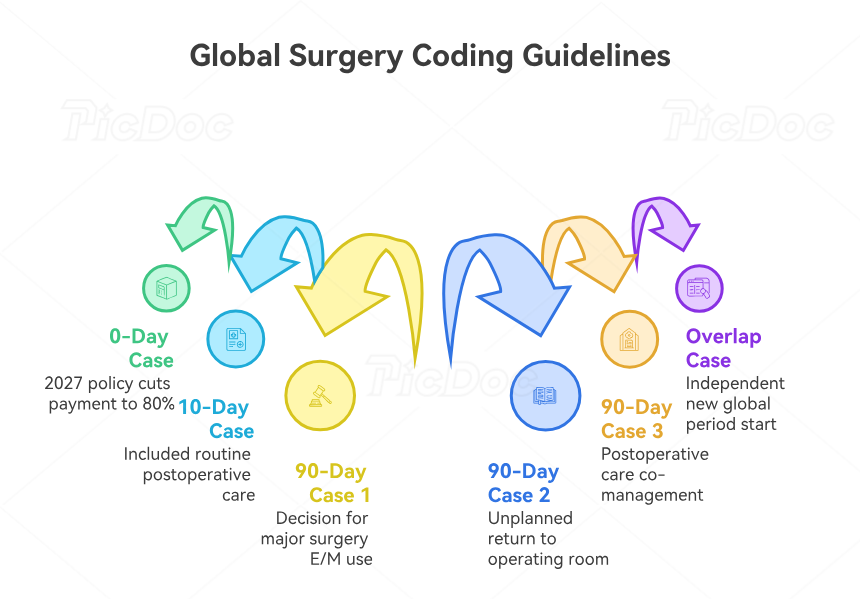
Important 2027 Medicare payment change: Beginning January 1, 2027, CMS finalized a payment reduction when a separately identifiable office/outpatient E/M service is furnished on the same day as a 0-day global procedure by the same physician or an applicable same-practice physician. The highest-valued eligible service is paid at 100% of its applicable fee schedule amount, while the other affected service receives 80%, before other applicable adjustments.
CMS limited this new policy to 0-day procedures. The broader proposed reduction affecting 10-day and 90-day procedures was excluded from the final policy.
Practices should therefore monitor both modifier 25 documentation accuracy and changes in reimbursement performance.
10-day global period: Minor surgeries include ten postoperative days
A 10-day global period includes the procedure date and the following ten calendar days, creating an 11-calendar-day package.
For example, a minor surgical procedure performed on January 5, 2027, with indicator 010 has a postoperative period extending through January 15, 2027.
Routine recovery evaluations, wound assessments, and postoperative services ordinarily included in the package cannot be separately reported merely because another appointment was scheduled.
However, an unrelated condition evaluated during the postoperative period may support a separate E/M service with modifier 24 when the required criteria are met.
These encounters should be evaluated through medical necessity documentation reviews, compliant physician queries, and outpatient coding practice cases.
90-day global period: Major surgeries have a 92-day payment window
A 90-day global period includes one preoperative day, the surgical date, and 90 postoperative calendar days, producing 92 calendar days of bundled coverage.
For a major procedure performed January 5, 2027:
January 4: Preoperative day included in the package, subject to applicable exceptions.
January 5: Surgery day.
January 6 through April 5: The 90 postoperative days.
April 6: The first date after the original postoperative period expires.
The distinction matters because an E/M visit resulting in the initial decision for major surgery on January 4 or January 5 may be separately reportable with modifier 57. Routine preoperative work after the decision is already made generally remains bundled.
Coding departments should apply E/M modifier 24, 25 and 57 rules, evaluate postoperative events through coding compliance audits, and validate relevant claim adjustment reason codes.
Other global surgery indicators coders must recognize
Medicare also uses indicators XXX, YYY, ZZZ, and MMM.
XXX: The global surgery concept does not apply.
YYY: The Medicare Administrative Contractor determines the applicable global period when pricing the service.
ZZZ: The code is related to another service, and its global period follows the applicable primary procedure.
MMM: Maternity procedure reporting follows different rules.
A procedure's global period should always be verified using the fee schedule applicable to its date of service. Specialty assumptions, historical code lists, and EHR defaults can become outdated.
This is particularly important when reviewing medical coding reference resources, maintaining coding certification knowledge, and investigating medical billing denials.
Global Surgery Coding Map: 40 Rules, Scenarios & Billing Actions
| Global Period / Scenario | What Medicare Includes | Billing Risk | Best Practice Action |
|---|---|---|---|
| 1. Indicator 000 | Procedure-day related care. | Routine same-day assessment billed separately. | Require a significant, separately identifiable E/M for modifier 25. |
| 2. Indicator 010 | Surgery day plus 10 postoperative days. | Related follow-up reported inside the package. | Check the original surgery date and postoperative relationship. |
| 3. Indicator 090 | One preoperative day, surgery day and 90 postoperative days. | Bundled visits billed as additional E/M services. | Calculate the 92-day window and review exceptions. |
| 4. Indicator XXX | Global surgery concept does not apply. | Global modifiers applied inappropriately. | Use the service-specific reporting rules. |
| 5. Indicator YYY | Contractor-determined global period. | Incorrect period assumed from the procedure category. | Verify the MAC-assigned period. |
| 6. Indicator ZZZ | Global period associated with the primary service. | Add-on procedure assigned its own postoperative window. | Follow the applicable primary code's global period. |
| 7. Indicator MMM | Maternity-specific reporting structure. | Ordinary 0/10/90 rules incorrectly applied. | Review current maternity coding instructions. |
| 8. Tangential skin biopsy, 11102 | Typically 0-day global care. | Routine biopsy assessment separately billed. | Confirm current MPFS indicator and separate E/M necessity. |
| 9. Diagnostic colonoscopy, 45378 | Typically 0-day global care. | Routine preprocedure assessment unbundled. | Review included procedural services and separate E/M criteria. |
| 10. Large joint injection, 20610 | Typically 0-day global care. | Decision to perform injection billed as separate E/M. | Document additional significant evaluation if applicable. |
| 11. Simple abscess drainage, 10060 | Typically 10-day global care. | Routine wound check billed during recovery. | Verify current indicator and postoperative service relationship. |
| 12. Premalignant lesion destruction, 17000 | Typically 10-day global care. | Related healing assessment reported separately. | Assess whether the visit addresses routine recovery. |
| 13. Benign lesion excision, 11402 | Typically 10-day global care. | Included follow-up E/M charged again. | Review the wound care and actual diagnosis. |
| 14. Knee arthroplasty, 27447 | Typically 90-day global care. | Routine postoperative evaluations separately charged. | Evaluate follow-up care against surgical package rules. |
| 15. Laparoscopic cholecystectomy, 47562 | Typically 90-day global care. | Routine recovery visits unbundled. | Track postoperative days and complication exceptions. |
| 16. Cataract extraction, 66984 | Typically 90-day global care. | Co-management claims use incorrect dates or modifiers. | Verify transfer dates and modifiers 54/55. |
| 17. Same-day E/M with 000 | Routine procedural evaluation included. | Unsupported modifier 25. | Document a significant, separately identifiable E/M service. |
| 18. Same-day E/M with 010 | Decision and routine minor-procedure work included. | Minor procedure incorrectly paired with modifier 57. | Apply modifier 25 only when appropriate. |
| 19. Decision for 090 surgery | Routine preoperative preparation included. | Separately payable first decision visit overlooked. | Evaluate modifier 57 on the day of or day before surgery. |
| 20. Unrelated postoperative E/M | Unrelated care may qualify separately. | Wrong modifier or inadequate evidence. | Use modifier 24 when applicable and document unrelated care. |
| 21. Same-day E/M during another global | Multiple services may overlap. | One modifier fails to describe both circumstances. | Evaluate whether both modifiers 24 and 25 are necessary. |
| 22. Routine wound evaluation | Usually included during 010/090 recovery. | Separate E/M charged for expected healing. | Report as included postoperative care. |
| 23. Routine suture removal | Usually included when related to surgery. | Separate removal charge during global period. | Verify whether removal is part of the original procedure package. |
| 24. Routine dressing changes | Usual surgical recovery care included. | Repeated postoperative service charges. | Apply package rules and verify any separately payable exceptions. |
| 25. Postsurgical pain management | Routine pain management included. | Standard recovery treatment billed separately. | Distinguish routine care from exceptional separately payable services. |
| 26. Nonoperative complication care | Related postoperative management generally included. | Complication assumed to justify separate E/M. | Review whether a return to the operating room occurred. |
| 27. Planned staged surgery | Qualifying additional procedure may be separately paid. | Modifier 58 omitted or incorrectly used. | Confirm staging, relatedness and required documentation. |
| 28. Unplanned related OR return | Separate operative service may qualify. | Modifier 78 omitted or misapplied. | Document unplanned return and related procedure. |
| 29. Unrelated operation during global | Separate surgical reporting may qualify. | Modifier 79 omitted. | Establish clinical independence from the original operation. |
| 30. Same-day distinct procedure | May require separate procedural reporting. | Bundled work incorrectly unbundled. | Apply CPT and NCCI rules before selecting distinct-service modifiers. |
| 31. Surgical care only | Only the surgical portion furnished. | Full global package billed despite planned limited care. | Evaluate modifier 54 and the applicable transfer policy. |
| 32. Postoperative management only | Provider accepts qualifying postoperative care. | Modifier 55 reported using the first visit date. | Use surgery date as claim date and document transfer dates. |
| 33. Preoperative management only | Qualifying preoperative package portion furnished. | Modifier 56 used without proper allocation. | Verify service responsibility and payer reporting rules. |
| 34. G0559 postoperative add-on | Certain 90-day follow-up visits by a different practitioner. | Code reported without qualifying E/M or provider relationship. | Check eligible practitioner, office/outpatient E/M and once-per-global restrictions. |
| 35. Postoperative visit reporting, 99024 | Nonpayment reporting under specified CMS data collection rules. | Code mistaken for separately reimbursable E/M. | Verify applicability of the mandatory reporting program. |
| 36. Different physician, same group/specialty | Often treated as one physician for global payment. | Duplicate routine follow-up claim. | Validate group, specialty and reassignment arrangements. |
| 37. Multiple procedures on one day | Separate services may be affected by multiple-surgery rules. | Incidental components separately charged. | Review bundling, multiple-surgery indicators and operative notes. |
| 38. 2027 modifier 25 payment policy | Eligible same-day E/M with 000 procedure receives adjusted payment. | Incorrect revenue forecast or underpayment assumption. | Apply the finalized 100%/80% payment methodology where applicable. |
| 39. Incorrect global end date | Coverage follows calendar-day counting rules. | Related visits billed before period expires. | Calculate from surgery date and validate overlapping periods. |
| 40. Postoperative claim denial | Payment depends on package inclusion and exceptions. | Appeal submitted without operative or follow-up evidence. | Reconcile original surgery, modifier, diagnosis and service documentation. |
Important: Procedure examples reflect common Medicare Physician Fee Schedule classifications. Verify each CPT code's global indicator for the applicable service year, as assignments and payer policies may change. The table summarizes professional billing considerations; facility billing can follow different payment rules.
2. What Is Included and Excluded From the Global Surgical Package?
Understanding what Medicare includes in the surgical package is essential because two clinically necessary services can be considered components of one bundled payment. An uncomplicated recovery visit and an unrelated medical evaluation may occur on the same date, yet their billing treatment differs.
Services routinely included in global surgery payment
For applicable 10-day and 90-day global procedures, the package generally encompasses:
Preoperative visits beginning within the assigned global window, after the decision to operate, subject to recognized exceptions.
Intraoperative services normally necessary to perform the surgery.
Routine immediate postoperative care, including recovery room management.
Expected postoperative visits related to surgical recovery.
Routine management of postoperative pain.
Related postoperative complications that do not require an unplanned return to the operating or qualifying procedure room.
Routine dressing changes, incision checks, and uncomplicated suture or staple removal.
The practical coding risk occurs when a postoperative appointment is documented as an ordinary E/M visit despite addressing only expected healing.
For example, a patient returns seven days after a minor skin procedure for an uncomplicated incision assessment. If the original procedure carries a 10-day global period, the evaluation is ordinarily included.
A second claim submitted with a general office E/M code can create inappropriate reimbursement exposure.
Revenue cycle teams should examine these patterns using coding compliance checklists, claim denial analysis, medical coding practice cases, and practice billing software controls.
Services that may qualify for separate reimbursement
Several circumstances can justify services outside the ordinary package:
An initial decision for major surgery: When an eligible E/M encounter results in the first decision to perform a 90-day global procedure on the day of surgery or the preceding day, modifier 57 may support separate reporting.
A significant same-day E/M service: Modifier 25 may support a qualifying E/M encounter that goes beyond the work ordinarily associated with a minor procedure.
An unrelated postoperative E/M visit: Modifier 24 can identify evaluation of a condition unrelated to the original surgery by the same physician or appropriate professional during the postoperative period.
Additional surgery: Staged, related, or unrelated procedures may qualify for separate payment under modifiers 58, 78, or 79 when all requirements are satisfied.
Separately payable diagnostic services: Appropriate tests may be reportable during a postoperative period when medically necessary and not otherwise included or prohibited by relevant coding rules.
These decisions should be validated with the E/M modifier guide, modifier 25 versus 59 decision examples, physician documentation query templates, and medical necessity review procedures.
Why different physicians do not always generate separate E/M payments
Medicare generally treats physicians in the same group practice and specialty as one physician for global surgical package purposes.
Suppose one surgeon performs a major operation, while a colleague in the same group and specialty completes a routine postoperative visit.
A different rendering physician does not automatically make the encounter separately payable. The organization must evaluate the original surgery's global period and the relationship of the subsequent service to routine recovery.
If a different physician independently manages an unrelated medical condition, separate billing may be appropriate under the applicable circumstances and payer rules.
Accurate reporting requires understanding professional-fee versus facility coding, verifying the provider information on electronic claims, and applying coding audit standards.
How complication management affects global billing
Complications require particular care because additional clinical complexity does not automatically produce a separately payable service.
A patient who develops a mild postoperative wound problem may require an examination, dressing adjustment, and medication changes. When this care relates to the original operation and is managed without qualifying return to the operating room, the surgeon's related postoperative services generally remain in the package.
If the complication requires an unplanned return to an operating or qualifying procedure room, a separately reportable procedure with modifier 78 may be appropriate.
For complex cases, capture the reason for returning, relationship to the original surgery, location of the procedure, and actual intervention.
Use medical necessity documentation checklists, compliant clinical documentation queries, and coding audit reviews to resolve uncertainty before billing.
3. Global Surgery Modifiers Explained: 24, 25, 57, 58, 78, 79, 54 and 55
Global surgery modifiers are often the determining factor between a correctly paid claim and a denial. Each modifier addresses a specific circumstance, and its placement on the correct claim line is as important as the documentation supporting it.
Modifier 24: Unrelated E/M service during the postoperative period
A patient undergoes knee replacement surgery and returns to the same orthopedic practice three weeks later for evaluation of an unrelated medical condition.
If the encounter involves a medically necessary service unrelated to the original operation and is furnished by the appropriate physician or qualified professional, modifier 24 may support separate E/M reporting.
The medical record should identify the unrelated condition, the evaluation performed, and the management decision. A separate diagnosis can help demonstrate the distinction, although the entire clinical record determines whether the service qualifies.
The postoperative condition relationship should be assessed using the modifier 24, 25 and 57 decision guide, supported by physician clarification templates and coding accuracy reviews.
Modifier 25: Significant same-day E/M with a minor procedure
A patient presents with persistent dizziness and an unrelated skin lesion. The physician conducts a medically necessary evaluation of the dizziness and performs a minor lesion procedure during the same appointment.
The distinct evaluation may justify modifier 25 on the appropriate E/M code when the documented work exceeds the usual assessment associated with the procedure.
CMS does not require different diagnosis codes in every case. The clinical work and documentation establish whether separate reporting is supported.
The 2027 Medicare payment reduction affecting eligible same-day office/outpatient E/M and 0-day procedures makes accurate modifier 25 reporting especially important.
Billing teams should monitor modifier 25 decision examples, medical necessity documentation, clean claim rates, and physician fee schedule reimbursement.
Modifier 57: The decision to perform major surgery
A patient presents to the emergency department with symptoms requiring urgent surgical evaluation. Following a comprehensive assessment, the surgeon makes the initial decision to operate that day.
When the procedure carries a 90-day global period, the decision-making encounter may be separately payable with modifier 57.
The surgeon's documentation must establish that the visit resulted in the initial decision for surgery. An already-scheduled procedure followed by a routine preoperative visit does not establish the same circumstance.
Modifier 57 applies to qualifying major procedures, while 0-day and 10-day procedures use the applicable minor-surgery E/M rules.
This distinction is fundamental in E/M modifier coding, outpatient coding practice scenarios, and coding compliance audits.
Modifier 58: Planned, staged or more extensive procedures
A surgeon performs an initial operation and documents that another related procedure will be necessary as part of the treatment plan.
When the later procedure meets modifier 58 requirements, it may be separately reported during the original postoperative period.
Modifier 58 can apply to procedures planned prospectively, procedures that are more extensive than the original operation, or qualifying therapy following a diagnostic surgical procedure.
A new postoperative period begins following the qualifying procedure reported with modifier 58. This changes how subsequent recovery visits must be evaluated.
The medical record should establish the treatment sequence and the relationship between procedures. Coding managers can validate these decisions through surgical coding practice cases, coding documentation queries, and medical coding audits.
Modifier 78: Unplanned return to the operating room
A patient undergoes major abdominal surgery and develops postoperative bleeding requiring an unplanned return to the operating room.
The surgeon performs an additional procedure to control the bleeding. When the requirements are satisfied, modifier 78 identifies the related operative service during the original postoperative period.
Modifier 78 generally preserves the original postoperative period rather than starting a new one. Medicare payment typically reflects the intraoperative portion of the applicable procedure fee.
The operative report should identify the complication, unplanned return, treatment performed, and relationship to the original surgery. Routine complication management outside the operating room follows different rules.
For accurate reporting, use medical necessity review standards, coding compliance procedures, and surgical documentation exercises.
Modifier 79: Unrelated procedure during the postoperative period
A patient undergoes surgery on the right knee and later requires an unrelated operation for a separate condition while the first surgery's postoperative period remains active.
When performed by the same physician or appropriate qualified professional, the subsequent procedure may qualify for modifier 79.
The medical record must demonstrate that the second service is unrelated to the original operation. A new global period begins for the unrelated procedure when its global indicator establishes one.
The two postoperative windows must then be tracked independently.
Coding departments should validate these cases through modifier decision guidance, coding case reviews, and medical billing audit controls.
Modifiers 54, 55 and 56: Splitting the surgical package
These modifiers identify different portions of a global surgical package:
Modifier 54: Surgical care only.
Modifier 55: Postoperative management only.
Modifier 56: Preoperative management only.
Consider cataract surgery followed by postoperative care transferred to another physician. The surgeon and postoperative practitioner may report the same surgical CPT code using modifiers 54 and 55, respectively, when the transfer arrangement satisfies Medicare's rules.
Both professional claims use the original surgery date as the service date. The postoperative provider should document the dates of responsibility and retain the required transfer agreement.
For 90-day procedures, Medicare also broadened modifier 54 reporting when the surgeon expects to furnish only the surgical portion of the package, including certain arrangements without a formal written transfer. The requirements for modifier 55 remain specific and must be separately verified.
These arrangements require precise electronic claim submission, physician fee schedule interpretation, medical billing software configuration, and documentation compliance monitoring.
Quick Poll: What Is Your Biggest Global Surgery Billing Challenge?
4. Global Surgery Coding Examples: Real-World 0-Day, 10-Day and 90-Day Scenarios
The following examples demonstrate how global surgery indicators influence E/M reporting, postoperative billing, modifier selection, and reimbursement.
Case 1: Skin biopsy with a separate E/M service (0-day)
A patient presents for evaluation of a suspicious skin lesion and management of worsening hypertension. The physician conducts a medically necessary hypertension assessment, adjusts medication, and performs a tangential biopsy of the lesion.
Procedure: CPT 11102, typically assigned a 0-day global period.
Coding decision: The biopsy is reported using its procedure code. A separately identifiable office E/M service may be reported with modifier 25 when its level and documentation are supported.
The record should demonstrate meaningful hypertension evaluation beyond the routine work necessary for the biopsy.
For Medicare services beginning in 2027, the finalized same-day 0-day procedure payment policy may reduce the lower-valued affected service to 80% of its applicable fee schedule amount.
This scenario connects modifier 25 coding accuracy, medical necessity documentation, physician reimbursement rules, and claim accuracy monitoring.
Case 2: Incision and drainage followed by routine wound care (10-day)
A physician performs drainage of a simple abscess, reported with CPT 10060. The patient returns five days later for a routine wound check.
Procedure: CPT 10060, typically carrying a 10-day global period.
Coding decision: When the follow-up involves expected recovery and routine wound evaluation, the physician's postoperative service is included in the original surgical payment.
A separate E/M claim for ordinary healing assessment would generally be inappropriate.
If the patient instead requires evaluation of an unrelated medical condition, the coder must independently assess whether a separate E/M service meets the requirements for modifier 24.
Review these distinctions through medical coding audit checklists, outpatient procedure coding scenarios, and denial analysis worksheets.
Case 3: Major surgery decided during an emergency evaluation (90-day)
A patient arrives with severe abdominal symptoms. The surgeon evaluates the patient, reviews imaging, and decides that urgent surgery is required.
The procedure carries a 90-day global period and is performed later that day.
Coding decision: A qualifying E/M service that results in the initial decision for major surgery may be separately reported with modifier 57.
The documentation must distinguish the decision-making evaluation from routine preoperative preparation.
If the decision had already been established during an earlier encounter, the routine presurgical visit would generally be included.
Medical coders should validate the scenario through the E/M modifier decision guide, coding documentation queries, and medical coding audit procedures.
Case 4: Postoperative bleeding requires another operation (90-day)
A patient undergoes major abdominal surgery. On postoperative day four, significant bleeding requires the surgeon to return the patient to the operating room for an additional procedure.
Coding decision: When the service satisfies the requirements for an unplanned related operative return, the new procedure is reported with modifier 78.
The original global period generally remains in effect.
The claim must describe the procedure actually performed during the return to the operating room. Reporting the original surgical CPT code would be appropriate only if that same procedure was actually repeated.
This case requires particular attention to coding specificity, operative documentation standards, and medical necessity appeal preparation.
Case 5: Cataract surgery with postoperative co-management (90-day)
An ophthalmologist performs cataract surgery, typically associated with a 90-day global period, and arranges for another physician to assume defined postoperative responsibilities.
Coding decision: Under an eligible formal transfer arrangement, the surgeon reports the surgical procedure with modifier 54, and the physician accepting postoperative management reports the same procedure code with modifier 55.
Both claims must use the original surgery date. The responsible postoperative dates and required transfer documentation must be available for review.
Submitting the first postoperative appointment date as the date of service on the modifier 55 claim can cause a rejection.
Billing teams should review electronic claims submission practices, physician fee schedule guidance, claim adjustment reason codes, and coding audit requirements.
Case 6: A new operation creates overlapping global periods
A patient undergoes a major orthopedic procedure and develops an unrelated surgical condition three weeks later.
The same surgeon performs a separately reportable operation for the new condition, satisfying the criteria for modifier 79.
Coding decision: The second operation receives the appropriate modifier, and its assigned global period begins independently.
For subsequent appointments, coders must identify which operation each service concerns. A routine visit associated with either active global period may remain bundled, while a qualifying unrelated service requires separate assessment.
A postoperative tracking system should therefore record the surgical date, CPT code, applicable global indicator, modifier, and associated condition for every active operation.
This process can be incorporated into coding productivity workflows, medical billing software reviews, and coding compliance audits.
5. Global Surgery Billing Checklist: How to Prevent Denials and Audit Findings
Global surgery errors frequently originate before claims reach a payer. Incorrect procedure indicators, incomplete operative notes, missing modifier documentation, and unreliable postoperative tracking can produce repeated denials across entire specialties.
A dependable prevention strategy combines automated claim validation with targeted medical record review.
Step 1: Verify global periods using the current Medicare Physician Fee Schedule
Start with the exact CPT or HCPCS procedure code and its date of service.
Check the assigned global surgery indicator, identify any add-on codes, and determine whether contractor-specific rules apply. Confirm that the billing system uses the correct fee schedule year.
Avoid relying solely on familiar procedure categories. Two procedures performed in the same specialty can have different global indicators.
High-volume codes should receive periodic validation against the physician fee schedule reimbursement guide, Medicare billing reference directory, and medical coding audit standards.
Step 2: Create a patient-specific global surgery tracker
For every applicable procedure, record the surgical date, procedure code, rendering surgeon, group and specialty, global indicator, first and last global dates, and relevant postoperative modifiers.
When another operation occurs, create a separate tracking record. The patient's postoperative history may contain multiple active global periods.
For instance, the patient might be recovering from a 90-day orthopedic operation while also receiving treatment following an unrelated 10-day procedure.
A system that tracks only the most recent surgery can incorrectly release or suppress E/M charges.
The tracker should integrate with medical billing software, electronic claim submission systems, medical coding productivity controls, and claim denial monitoring.
Step 3: Audit modifier documentation before submission
Each postoperative modifier should trigger a specific documentation check.
For modifier 24, confirm the unrelated reason for the E/M encounter. For modifier 25, identify the separately identifiable work. For modifier 57, establish the initial decision for major surgery.
Modifiers 58, 78, and 79 require review of the relationship between the original and subsequent procedures. Transfer modifiers require verification of the providers' responsibilities.
Use compliant physician query templates, E/M modifier examples, modifier 25 versus 59 decision rules, and coding audit checklists to standardize review.
Step 4: Understand HCPCS G0559 and CPT 99024 reporting
Two codes deserve particular attention because they address postoperative care under different circumstances.
HCPCS G0559 is an add-on code introduced in 2025 for certain postoperative office/outpatient E/M visits provided by a practitioner who did not perform the surgery and is outside the surgeon's group practice. It applies to qualifying 90-day postoperative situations and is limited to one use per postoperative period under the applicable requirements.
The practitioner must personally perform the eligible visit, and the related postoperative care must be documented.
CPT 99024 identifies a postoperative follow-up visit ordinarily included in the surgical package. It has a separate claims-based data collection function under Medicare.
Certain practices with ten or more practitioners in Florida, Kentucky, Louisiana, Nevada, New Jersey, North Dakota, Ohio, Oregon, and Rhode Island must report qualifying postoperative visits for specified procedures. This code does not generate an additional E/M payment under that reporting program.
Using either code requires understanding its specific purpose. Organizations should incorporate them into Medicare billing guidance, professional-fee coding training, and coding compliance procedures.
Step 5: Measure the financial impact of postoperative billing errors
Create a monthly report that identifies global-surgery-related denials, preventable write-offs, underpayments, and modifier corrections.
Segment results by global indicator, specialty, payer, surgeon, and denial reason.
One useful metric is the global-surgery denial rate:
\[ \text{Denial Rate}=\frac{\text{Denied Global-Surgery-Related Claims}}{\text{Submitted Global-Surgery-Related Claims}}\times100 \]
A department submitting 400 relevant claims with 28 denials has a 7% denial rate for that claim population. The next analysis should distinguish inappropriate bundled charges, unsupported modifiers, technical rejections, and payer processing errors.
For 2027 planning, separately measure payment variance on eligible same-day 0-day procedures affected by the finalized 100%/80% Medicare payment policy.
The findings should inform clean claim rate monitoring, denial root-cause analysis, accounts receivable benchmarking, and medical billing appeal strategies.
6. FAQs About 0-Day, 10-Day and 90-Day Global Surgery Coding
-
A 0-day global period includes routine procedure-day care without additional postoperative days. A 10-day global includes the procedure date and ten postoperative days. A 90-day global includes one preoperative day, the surgery date, and 90 postoperative days.
The corresponding Medicare indicators are 000, 010, and 090.
Coders should verify the procedure-specific designation through the current Medicare Physician Fee Schedule. Familiarity with physician reimbursement rules, outpatient coding scenarios, and coding compliance audits supports accurate classification.
-
Yes. The surgical date is included in the global package.
For a 10-day postoperative period, the date of surgery and the following ten calendar days create an 11-day package.
For a 90-day procedure, the package also includes the day before surgery, resulting in a total 92-calendar-day window.
Counting errors should be identified through medical coding audits, claim denial analysis, and billing system validation.
-
A significant, separately identifiable E/M service may qualify for separate reporting with modifier 25 when appropriate documentation supports work beyond the procedure's usual care.
The decision to perform a minor procedure is generally included in the procedure payment.
For eligible Medicare services beginning January 1, 2027, the finalized payment adjustment applies to certain same-day office/outpatient E/M services and 0-day global procedures.
Review modifier 25 coding examples, medical necessity requirements, and physician fee schedule reimbursement guidance.
-
A postoperative visit may qualify for separate reporting when the circumstances fall outside the routine global surgical package.
For example, a medically necessary unrelated E/M encounter may support modifier 24. Certain qualifying postoperative services by other practitioners also have separate payment rules.
Routine recovery evaluations by the surgeon or the applicable same-group, same-specialty professional remain included.
Documentation should support the clinical distinction through E/M modifier guidance, compliant provider queries, and coding audits.
-
Modifier 57 identifies a qualifying E/M service that results in the initial decision to perform major surgery.
For Medicare, this generally involves a procedure with a 90-day global period, with the E/M service occurring on the day of or day before surgery.
The evaluation must support the initial operative decision.
Relevant resources include the modifier 24, 25 and 57 decision guide, outpatient coding practice cases, and physician documentation clarification templates.
-
The reporting depends on the relationship between the procedures.
Modifier 58 may apply to qualifying staged or related procedures. Modifier 78 may identify an unplanned return to the operating room for a related procedure. Modifier 79 applies to qualifying unrelated procedures during the postoperative period.
Modifiers 58 and 79 generally initiate new postoperative periods, while modifier 78 ordinarily preserves the original period.
These distinctions should be reinforced through surgical coding practice cases, coding documentation reviews, and medical necessity assessment tools.
