
Choosing between CPT codes 99203, 99204, and 99205 can determine whether a new patient visit is accurately reimbursed, downcoded, or flagged during an audit. The deciding factors are medical decision-making (MDM) complexity or qualifying total time, supported by clear clinical documentation. A lengthy examination, multiple diagnoses, or numerous laboratory tests can still result in incorrect code selection when the underlying MDM criteria are misunderstood. This guide explains the differences, provides 30 practical coding scenarios, and helps medical coders strengthen coding accuracy, documentation compliance, and denial prevention.

1. 99203 vs 99204 vs 99205: The Exact Differences in MDM and Time
CPT codes 99203, 99204, and 99205 describe office or other outpatient evaluation and management services provided to new patients. Each code represents a different level of complexity or qualifying total time.
The coding framework allows the physician or other qualified healthcare professional to select the visit level using either MDM or total time on the date of the encounter, subject to the applicable guidelines.
The verified distinctions are:
99203 — Level 3: Low-complexity MDM or 30–44 minutes of qualifying total time.
99204 — Level 4: Moderate-complexity MDM or 45–59 minutes of qualifying total time.
99205 — Level 5: High-complexity MDM or 60–74 minutes of qualifying total time.
The time ranges are alternatives to MDM-based selection. A visit supporting 99204 through moderate MDM does not require 45 minutes of documented time.
This distinction is crucial in outpatient coding practice cases, medical coding interviews, and coding compliance audits, where coders must demonstrate precisely how a documented encounter supports a particular code.
The two-of-three MDM rule
Medical decision-making consists of three elements:
Number and complexity of problems addressed: The patient's conditions that were evaluated or managed during the encounter.
Amount and/or complexity of data reviewed and analyzed: Qualifying tests, documents, independent history, independent interpretation, and professional discussions.
Risk of complications and/or morbidity or mortality of patient management: The risk associated with diagnostic or treatment decisions, including decisions to initiate or forego certain interventions.
A particular MDM level is supported when at least two of the three elements meet or exceed that level.
For example, consider a patient with a worsening chronic condition who requires prescription drug management. The clinician reviews one previous test, but the documentation supports only limited data.
The problems element is moderate, the data element is limited, and the management risk is moderate.
Correct code: 99204, because two elements support moderate complexity.
Now consider a patient with a potentially life-threatening condition. The problems element is high, data are moderate, and management risk is moderate.
Correct code through MDM: 99204, because only one element reaches high complexity.
This principle prevents automatic selection of 99205 merely because the patient presents with a serious condition. Reviewers should evaluate these decisions alongside medical necessity documentation, physician query procedures, coding audit checklists, and claim denial analysis.
What qualifies as a new patient?
Under CPT guidance, a new patient generally has not received a professional service from the physician or another qualified healthcare professional of the exact same specialty and subspecialty in the same group practice during the previous three years.
Medicare's group-practice interpretation focuses on the same physician specialty, with specific rules addressing previous face-to-face professional services.
Consider a patient who visited a cardiologist within the same group two years ago and now schedules an appointment with another cardiologist in that group. The patient generally remains established for the applicable E/M classification.
Conversely, a previous diagnostic test interpretation without a face-to-face professional service does not automatically establish the patient under Medicare's new-patient definition.
This distinction can directly affect the appropriate code family and reimbursement. It is especially important for multispecialty groups, integrated healthcare organizations, and practices transitioning between professional fee coding and different outpatient service lines.
History and examination requirements
For office/outpatient E/M services, history and physical examination should be medically appropriate to the encounter. Their length does not determine the code level.
A comprehensive history and extensive physical examination can accompany low-complexity MDM. Likewise, a focused examination can be medically appropriate for an encounter supporting high-complexity MDM.
The essential requirement is that the documentation accurately reflects the service provided, the clinical decisions made, and the applicable coding basis.
Organizations should reinforce these principles through coding accuracy reviews, realistic coding assessments, and documentation clarification processes.
99203 vs 99204 vs 99205: 30 New Patient MDM Coding Scenarios
| Clinical Scenario | Problems Addressed | Data Reviewed | Management Risk | Supported Code |
|---|---|---|---|---|
| 1. Stable hypertension, continued lifestyle management, and two qualifying tests reviewed | Low: One stable chronic illness | Limited | Low | 99203: Low MDM |
| 2. Uncomplicated ankle sprain treated conservatively with qualifying X-ray order and result review | Low: Acute uncomplicated injury | Limited, assuming qualifying distinct data elements | Low | 99203: Low MDM |
| 3. Two minor, self-limited skin conditions with limited qualifying data | Low: Two minor problems | Limited | Minimal | 99203: Problems and data support low |
| 4. Stable asthma, no medication changes, and limited review of qualifying results | Low: One stable chronic illness | Limited | Low | 99203: Low MDM |
| 5. Mild uncomplicated musculoskeletal injury requiring low-risk conservative treatment | Low | Minimal | Low | 99203: Problems and risk support low |
| 6. Stable hypothyroidism with prescription continuation and otherwise minimal data | Low | Minimal | Moderate: Documented prescription management | 99203: Only risk reaches moderate |
| 7. Uncomplicated urinary symptoms with a qualifying limited data review and low-risk management | Low: Uncomplicated condition | Limited | Low | 99203: Low MDM |
| 8. Stable chronic knee pain with active conservative management and limited qualifying data | Low | Limited | Low | 99203: Low MDM |
| 9. Acute uncomplicated illness with prescription treatment but no qualifying moderate data | Low | Minimal | Moderate | 99203: Only one moderate element |
| 10. One stable chronic disease, extensive record review but low-risk management | Low | Extensive, assuming two qualifying data categories | Low | 99203: Problems and risk support low |
| 11. Worsening diabetes requiring a documented prescription adjustment | Moderate: Chronic illness with exacerbation | Limited | Moderate | 99204: Moderate problems and risk |
| 12. Two stable chronic conditions with three qualifying data elements | Moderate | Moderate | Low | 99204: Problems and data support moderate |
| 13. Undiagnosed breast mass with uncertain prognosis and prescription management for an associated condition | Moderate: Qualifying undiagnosed problem | Limited | Moderate | 99204: Problems and risk support moderate |
| 14. Acute complicated wrist injury with prescription management | Moderate | Limited | Moderate | 99204: Moderate MDM |
| 15. Worsening COPD requiring prescription adjustment and outpatient management | Moderate | Moderate | Moderate | 99204: All three elements moderate |
| 16. Stable hypertension requiring medication management and extensive qualifying testing analysis | Low | Extensive | Moderate | 99204: Data and risk support moderate |
| 17. Two stable chronic illnesses with documented prescription management | Moderate | Minimal | Moderate | 99204: Problems and risk support moderate |
| 18. New undiagnosed neurological symptoms with uncertain prognosis and three qualifying data elements | Moderate | Moderate | Low | 99204: Problems and data support moderate |
| 19. Acute illness with systemic symptoms requiring prescription management without hospital-level escalation | Moderate | Limited | Moderate | 99204: Moderate MDM |
| 20. High-severity medical problem with moderate data and moderate management risk | High | Moderate | Moderate | 99204: Only one high element |
| 21. Acute complicated injury with independent interpretation of an external test, not separately reported | Moderate | Moderate | Low | 99204: Problems and data support moderate |
| 22. One worsening chronic disease, three qualifying data elements, and low-risk management | Moderate | Moderate | Low | 99204: Two moderate elements |
| 23. Acute condition threatening bodily function with decision to hospitalize | High | Limited | High | 99205: Problems and risk support high |
| 24. Severe chronic disease exacerbation requiring therapy with intensive toxicity monitoring | High | Moderate | High | 99205: High MDM |
| 25. Acute limb-threatening condition with documented decision for emergency major surgery | High | Limited | High | 99205: Problems and risk support high |
| 26. Severe respiratory deterioration requiring a decision to escalate to hospital-level care | High | Moderate | High | 99205: High MDM |
| 27. Life-threatening condition with extensive qualifying data from two independent categories | High | Extensive | Moderate | 99205: Problems and data support high |
| 28. Severe illness requiring a major treatment decision and extensive qualifying data evaluation | High | Extensive | High | 99205: All three elements high |
| 29. Acute organ-threatening condition with a documented decision regarding hospitalization | High | Minimal | High | 99205: High problems and risk |
| 30. Severe chronic illness progression with documented decision for elective major surgery and identified patient-specific risk factors | High | Limited | High | 99205: High problems and risk |
All 30 scenarios are educational examples, not actual patient records. Each assumes the clinical descriptions and stated MDM elements are supported by documentation. The supported code is based on MDM rather than time. Data counting must follow CPT rules for unique tests, external sources, and qualifying interpretation or discussion. Actual encounters may support different codes after complete documentation review.
2. How to Code 99203, 99204, and 99205 Using the Three MDM Elements
Element 1: Number and complexity of problems addressed
The problems element evaluates the clinical conditions actually assessed or managed during the encounter.
A stable chronic illness may support a low level. Two stable chronic illnesses, a chronic illness with exacerbation, or a qualifying undiagnosed problem with uncertain prognosis may support moderate complexity.
High complexity can be supported by a severe exacerbation of chronic illness or an acute or chronic condition posing a threat to life or bodily function in the near term without treatment.
The distinction between a condition appearing on the problem list and a condition actually addressed is particularly important.
For example, a patient may have hypertension, diabetes, depression, and osteoarthritis listed in the medical record. If the physician only evaluates a stable musculoskeletal complaint, the four listed diagnoses cannot automatically be counted as four addressed problems.
Coders should assess the actual clinical decisions, with support from coding audit standards, clinical documentation queries, and outpatient coding examples.
An additional challenge is differentiating mild worsening from severe exacerbation. A diabetic patient experiencing modestly elevated blood glucose with a routine medication adjustment may support moderate problem complexity. A patient experiencing a severe metabolic emergency that threatens bodily function involves substantially different circumstances.
The physician's findings, management decisions, and documented clinical severity should substantiate the classification.
Element 2: Amount and complexity of data reviewed and analyzed
The data element is frequently misunderstood because coders may treat the total number of laboratory values or chart pages as evidence of complexity.
CPT uses specific categories and qualifying data elements.
Limited data, associated with low complexity, can be supported through either an appropriate independent historian or a combination of two qualifying items involving unique tests and external notes.
Moderate data can be supported through one of three categories: three qualifying items from the specified tests, documents, and independent historian combinations; independent interpretation of a test performed by another professional when that interpretation is not separately reported; or qualifying discussion of management or test interpretation with an external professional or appropriate source.
Extensive data requires at least two of those three categories.
For example, a physician reviews an outside specialist's note, orders a metabolic panel, and reviews a distinct previously completed diagnostic study. If each item satisfies the relevant CPT definitions and duplicate-counting restrictions, these may support moderate data.
An independent interpretation that is separately reported cannot also be counted toward the relevant data category in the E/M service.
The same principle applies to an ordered test subsequently reviewed in circumstances where CPT prohibits counting it again as an additional unique test.
For more complex assessments, review CPT coding education, medical coding practice cases, and coding accuracy audits.
Element 3: Risk of patient management
Risk evaluates the potential complications, morbidity, or mortality associated with patient management decisions.
Low risk generally involves diagnostic or treatment decisions with a low potential for morbidity.
Moderate-risk examples include prescription drug management, qualifying surgical decisions, or treatment significantly limited by social determinants of health.
High-risk examples include drug therapy requiring intensive monitoring for toxicity, certain major surgical decisions, decisions regarding hospitalization or hospital-level escalation, and other qualifying management decisions.
Medication management is a major coding distinction.
A clinician who actively evaluates a prescription, continues it based on a documented management decision, or adjusts treatment may support moderate risk. Merely listing medications in the chart does not independently establish prescription drug management.
Likewise, prescribing a medication does not automatically create high risk. Intensive monitoring for toxicity has specific requirements, including the nature of the drug and monitoring.
A clinician's decision regarding hospitalization can support high risk even when the patient declines hospitalization, provided the decision and circumstances are appropriately documented.
The strongest defense against inaccurate risk classification is a clear management plan. Reviewers can investigate uncertain cases through medical coding audit checklists, medical necessity documentation, compliant physician queries, and claim denial analysis.
3. Real MDM Examples: When to Choose 99203, 99204, or 99205
Case 1: Stable hypertension with conservative management — 99203
A new patient presents for evaluation of stable hypertension. The physician reviews relevant clinical history, assesses current blood pressure control, discusses lifestyle management, and orders two distinct qualifying tests.
The patient reports no concerning symptoms, and the clinician makes no prescription treatment changes.
The documented MDM is:
Problems: Low — one stable chronic illness.
Data: Limited — two distinct qualifying tests.
Risk: Low — conservative management without an identified moderate-risk decision.
Correct code: 99203.
Two elements meet low complexity, making 99203 appropriate through MDM.
A lengthy conversation about diet, family history, or preventive counseling does not automatically increase MDM complexity. If a higher code is selected using time, the record must substantiate the qualifying total time.
This distinction is useful when reviewing outpatient coding scenarios, CPC examination questions, and coding audit findings.
Case 2: Worsening diabetes requiring prescription adjustment — 99204
A new patient with type 2 diabetes presents because home glucose readings have increased. The physician evaluates the worsening control, reviews the patient's current treatment, and adjusts a prescription medication.
The documentation supports:
Problems: Moderate — chronic illness with exacerbation or progression.
Data: Limited — a qualifying limited review of test information.
Risk: Moderate — active prescription drug management.
Correct code: 99204.
The problems and risk elements satisfy moderate MDM.
The moderate level is supported by the documented complexity and treatment decisions, even if the encounter lasts less than 45 minutes.
This scenario is particularly valuable for distinguishing 99203 from 99204. Coders who focus only on laboratory volume may overlook the prescription management and clinical progression supporting a higher level.
Relevant training includes medical coding practice cases, coding interview assessments, and clinical documentation audits.
Case 3: Serious clinical condition with only moderate overall MDM — 99204
A new patient presents with a potentially limb-threatening condition. The physician identifies a high-complexity problem, reviews several qualifying diagnostic studies meeting moderate data requirements, and determines that the documented management decisions involve moderate risk.
The MDM elements are:
Problems: High.
Data: Moderate.
Risk: Moderate.
Correct code through MDM: 99204.
Although the clinical problem reaches high complexity, two elements support moderate complexity. The overall MDM therefore remains moderate.
This is a frequent source of overcoding when a coder assumes that a highly serious diagnosis automatically supports 99205.
If the physician additionally makes a documented high-risk management decision, such as hospitalization, the calculation changes. High problems combined with high risk can support 99205.
Reviewers should use medical necessity documentation, physician clarification templates, and coding compliance procedures to verify the actual encounter circumstances.
Case 4: Acute illness threatening bodily function with hospitalization decision — 99205
A new patient presents with severe respiratory deterioration, significant hypoxemia, and findings indicating a threat to bodily function.
The physician assesses the condition and determines that immediate hospital-level evaluation and treatment are necessary. The decision is documented along with the clinical findings.
The MDM elements are:
Problems: High — acute illness threatening bodily function.
Data: Limited or moderate, depending on the actual review.
Risk: High — documented decision regarding hospitalization.
Correct code through MDM: 99205.
Problems and management risk both meet high complexity, satisfying the two-of-three standard.
The physician does not need extensive data to support high MDM when the other two elements independently qualify.
The documented hospitalization decision matters more than the number of diagnostic tests ordered.
For medical coders, this case illustrates the importance of interpreting clinical decisions using coding practice examples, medical coding audit standards, and medical necessity review.
Case 5: Low-complexity encounter with 48 minutes of qualifying time — 99204
A physician evaluates a new patient with a stable chronic condition. The MDM supports low complexity, but the clinician spends additional qualifying time reviewing extensive records, discussing management options, coordinating care, and completing encounter documentation.
The total qualifying physician time on the date of service is accurately documented as 48 minutes.
Correct code using time: 99204.
The documented time falls within the 45–59-minute range for 99204.
Selecting the level through time can be appropriate even when the MDM independently supports only 99203.
However, the calculation must exclude separately reported services, clinical support staff time, and work performed outside the encounter date.
Coders can strengthen time-based coding through documentation audits, coding exam preparation, and medical coding interview practice.
Case 6: Moderate MDM with 63 minutes of qualifying time — 99205
A new patient presents with several chronic conditions requiring substantial evaluation and care coordination. The problems and management risk support moderate MDM.
The physician also spends qualifying time reviewing records, evaluating the patient, developing treatment recommendations, discussing options, and documenting the encounter.
The verified total time on the encounter date is 63 minutes.
Correct code using time: 99205.
A qualifying 60–74 minutes supports 99205 through time, even though the documented MDM supports 99204.
The record should accurately establish the total qualifying time and the nature of the services performed.
This distinction is particularly relevant to medical coding accuracy reviews, complex outpatient coding assessments, and medical billing denial appeals.
Case 7: A medication prescription that does not automatically justify 99204
A new patient presents with an uncomplicated condition. The physician evaluates the symptoms and initiates a prescription medication.
The problems element is low, the data element is minimal, and the documented prescription management supports moderate risk.
The MDM is:
Problems: Low.
Data: Minimal.
Risk: Moderate.
Correct code through MDM: 99203.
Only one element reaches moderate complexity.
This example illustrates why an isolated prescription management decision does not automatically justify 99204.
For an upgrade to moderate MDM, a second element must also reach moderate complexity. Alternatively, qualifying total time may support a different code.
Coders should reinforce this rule through coding practice cases, physician documentation reviews, and denial root-cause analysis.
Quick Poll: What Makes New Patient E/M Coding Most Difficult?
4. Time-Based Coding for 99203, 99204, and 99205: What Counts and What Does Not?
Time-based coding provides an alternative when the total qualifying work performed by the physician or qualified healthcare professional better represents the encounter.
The key distinction is that the time includes qualifying work on the date of the encounter, including eligible face-to-face and non-face-to-face activities.
Which activities can be included?
Qualifying time may include preparing to see the patient, obtaining or reviewing history, performing a medically appropriate evaluation, counseling, ordering medications or tests, communicating with other healthcare professionals when the communication is not separately reported, documenting clinical information, and coordinating care.
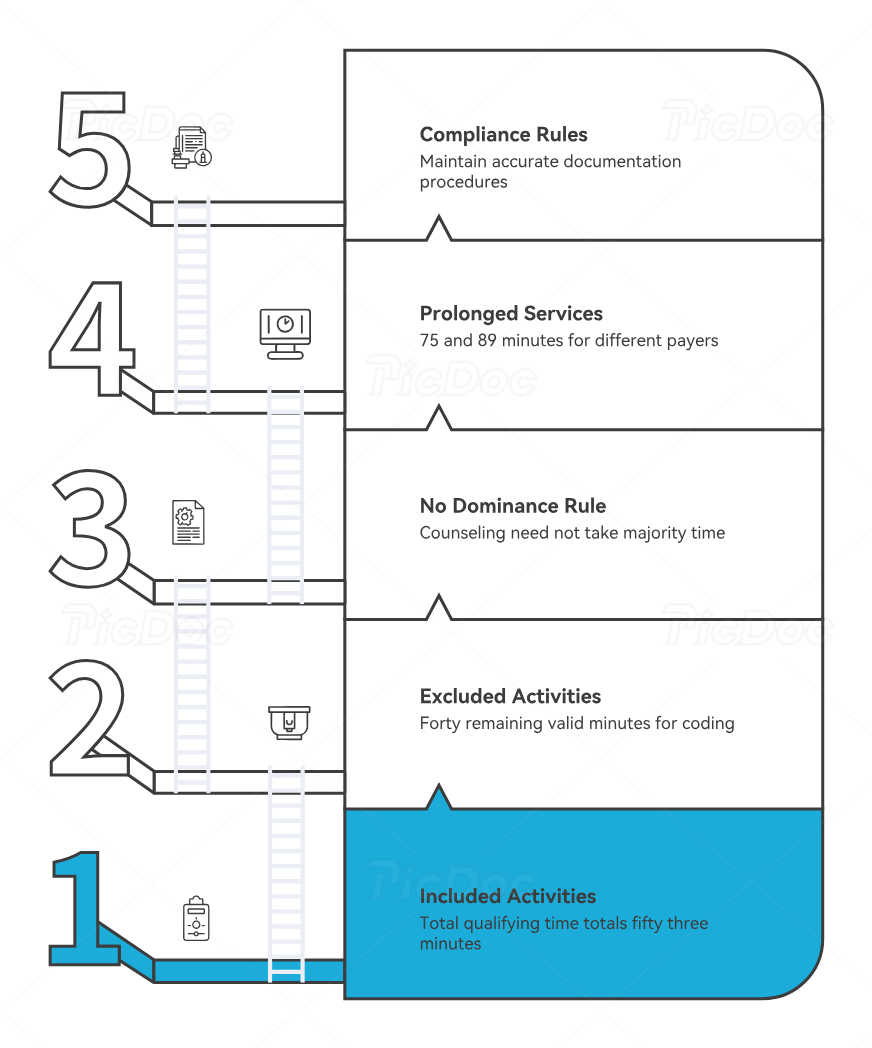
For example, a physician may spend 12 minutes reviewing extensive records before a visit, 28 minutes evaluating the patient, and 13 minutes completing qualifying care coordination and documentation later that same day.
The total is 53 minutes.
Correct code using time: 99204, assuming the activities are eligible, the services are medically appropriate, and the total is accurately documented.
This approach requires accurate documentation rather than reconstruction based on a typical appointment duration.
Medical practices should establish consistent time-recording procedures supported by coding compliance audits, outpatient practice cases, and physician documentation guidance.
Which time must be excluded?
Common errors involve including activities performed by clinical support staff, work performed on a different date, travel, or time attributable to separately billed services.
Suppose the physician documents 55 minutes associated with the patient's care. Ten minutes involved performing and separately reporting a procedure, and five minutes involved work completed on the previous day.
If the remaining 40 minutes are otherwise qualifying E/M time, the time-based selection is 99203.
The original 55-minute total cannot automatically be used to support 99204.
Time spent simultaneously by more than one professional also requires attention to applicable rules governing overlapping activities and the type of E/M service.
A defensible approach is to document total qualifying time accurately while maintaining enough information to explain the activities included.
These distinctions are particularly important for medical coding auditors, professional fee coding specialists, and teams investigating E/M claim downcoding.
Does counseling have to dominate the visit?
Office/outpatient E/M time-based coding does not require counseling or coordination of care to account for more than half the encounter.
A clinician can select the code using qualifying total time, provided the applicable requirements are satisfied.
The documentation should substantiate the services performed and the reported time.
Organizations should avoid templates that automatically insert identical time statements into every encounter. Such patterns create audit exposure when the statements do not reflect actual work.
When does prolonged service coding become relevant?
When qualifying total time exceeds the ordinary upper range of 99205, additional rules may apply for prolonged office/outpatient services.
CPT add-on code 99417 and Medicare HCPCS code G2212 use different reporting thresholds and payer requirements.
For 99205, CPT prolonged-service reporting may begin at 75 qualifying minutes under the applicable CPT framework, while Medicare generally requires at least 89 qualifying minutes before reporting the first G2212 unit.
The underlying 99205 requirements must be satisfied, and the additional time must qualify under the respective policy.
Practices should verify current payer instructions before submitting prolonged-service claims because incorrect thresholds can produce preventable payment disputes.
Use physician fee schedule reimbursement guidance, Medicare billing tools, claim adjustment reason code references, and medical billing appeal resources.
5. Common 99203, 99204, and 99205 Coding Errors That Cause Denials and Downcoding
Mistake 1: Assigning 99205 because the patient has multiple diagnoses
A patient may have six documented chronic conditions, but the code level depends on which conditions the clinician actually addressed and the associated MDM.
Two or more stable chronic illnesses can support moderate problem complexity. Counting additional stable conditions does not automatically establish high complexity.
The coder must assess whether the visit involved severe exacerbation, threatening clinical circumstances, extensive qualifying data, or high-risk management decisions.
Corrective action: Identify each condition actually addressed, determine its documented complexity, and evaluate the remaining MDM elements independently.
Use medical coding audit checklists, clinical documentation queries, and outpatient coding examples to improve consistency.
Mistake 2: Counting every laboratory result as a separate data element
A comprehensive metabolic panel may contain numerous laboratory measurements, but the panel generally represents one unique test for applicable MDM data counting.
Counting each individual component as a separate test can artificially increase the data complexity level.
Similarly, duplicate orders or multiple reviews of the same unique test cannot automatically be counted as additional qualifying data elements.
Corrective action: Identify each unique test according to CPT definitions. Apply the relevant category requirements and exclude duplicate counting.
For example, a qualifying external note, a unique laboratory test, and another distinct qualifying test may support moderate data when properly documented.
Auditors can reinforce these distinctions through CPT study resources, coding practice scenarios, and coding accuracy assessments.
Mistake 3: Treating every prescription as evidence of high complexity
Prescription drug management can support moderate risk when the documentation establishes an actual management decision.
High-risk drug therapy requires additional qualifying circumstances, such as intensive monitoring for toxicity under the relevant criteria.
Routine monitoring of treatment effectiveness, medication reconciliation, or the existence of a prescription does not independently satisfy the requirements for high-risk drug therapy.
A stronger documentation record identifies the management decision, clinical reason, and relevant monitoring plan.
Corrective action: Distinguish ordinary prescription management from drug therapy requiring intensive toxicity monitoring. Then apply the two-of-three MDM rule.
This is a valuable topic for medical coding employment assessments, CPC examination practice, and documentation audits.
Mistake 4: Using a comprehensive history to justify 99204 or 99205
A detailed history and physical examination may be medically appropriate, but the extent of these components no longer determines the office/outpatient E/M visit level.
For example, a clinician may document an extensive review of systems, family history, social history, and physical examination while managing only one uncomplicated condition.
If the encounter supports low MDM and qualifying time does not justify a higher level, 99203 may be appropriate.
Corrective action: Evaluate MDM or total qualifying time independently of history and examination length.
When reviewing claims, focus on the documented medical decisions and the relevant coding basis. Apply coding compliance procedures and medical necessity guidance.
Mistake 5: Reporting new patient codes for established patients
A patient who has not visited a particular physician personally may still qualify as established because another physician in the same group and applicable specialty provided qualifying services within the preceding three years.
Incorrectly assigning a new patient code can lead to denials, payment adjustments, or audit findings.
Corrective action: Verify the patient's service history, group relationship, specialty, and relevant three-year period before choosing the code family.
The equivalent established-patient codes are generally 99213 for low MDM, 99214 for moderate MDM, and 99215 for high MDM, subject to their separate requirements.
Teams can strengthen this process through professional fee coding education, medical coding audits, and denial rate monitoring.
Mistake 6: Applying modifier 25 without separately identifiable E/M work
An office visit may occur on the same date as a minor procedure. However, the E/M service must be significant and separately identifiable from the usual preoperative and postoperative work associated with the procedure when modifier 25 is used.
A physician's routine assessment needed to perform a procedure does not automatically justify separate E/M reimbursement.
Corrective action: Establish the additional evaluation or management work and confirm that it satisfies the applicable requirements.
For example, a physician treating an unrelated chronic condition during the same encounter as a minor procedure may have separately identifiable E/M work, depending on the documentation.
Review modifier 25 versus 59 guidance, E/M modifier decision rules, and medical coding audit procedures.
Mistake 7: Ignoring the difference between preventive and problem-oriented visits
A new patient may attend a preventive examination and also receive evaluation for an active medical problem.
When a significant, separately identifiable problem-oriented E/M service is performed beyond the preventive service, separate reporting may be appropriate under applicable coding and payer rules.
The documentation must distinguish the preventive activities from the additional evaluation and management.
Corrective action: Identify the work attributable to each service and verify whether separate E/M reporting is justified.
This is an important issue in claim accuracy audits, modifier 25 coding, and clean claim rate improvement.
How to audit new patient E/M claims before submission
A reliable E/M audit should reconstruct the code selection from the medical record.
Begin by confirming that the service belongs to the new patient office/outpatient code family. Then identify whether MDM or time supports the reported level.
For MDM-based encounters, record the problems, data, and risk independently. Highlight the two elements supporting the final level.
For time-based encounters, verify the qualifying total time, date-of-service requirements, and exclusion of separately reported activities.
Investigate any claim where the reported level exceeds the documented MDM and qualifying time.
For example, an audit of 150 new patient claims might identify 12 encounters with unsupported MDM levels and three with incomplete time documentation. If all 15 represent distinct claims with coding deficiencies, the sample deficiency rate is 10%.
The next step is categorizing each deficiency by root cause rather than treating all errors as the same problem.
Link audit outcomes with coding productivity standards, denial rate calculations, clean claim performance, and medical billing appeal procedures.
Organizations should audit appropriately coded lower-level visits as well as potentially overcoded higher-level encounters. This helps detect both undercoding and overcoding while improving consistency across the coding team.
6. FAQs About 99203, 99204, and 99205 New Patient E/M Coding
-
The primary distinction is the level of MDM or qualifying total time.
99203 represents low-complexity MDM or 30–44 minutes. 99204 represents moderate-complexity MDM or 45–59 minutes. 99205 represents high-complexity MDM or 60–74 minutes.
MDM requires at least two of the three elements to meet the selected complexity level.
Coders can practice these distinctions through real outpatient coding cases, medical coding interview scenarios, and coding audit exercises.
-
Prescription drug management can support moderate risk, but overall moderate MDM requires at least one additional element to reach moderate complexity.
For example, an uncomplicated condition with minimal data and documented prescription management may support 99203 through MDM because only risk reaches moderate.
When the condition is worsening and the clinician actively manages prescription treatment, moderate problems and moderate risk may support 99204.
Reviewing coding practice questions, clinical documentation guidelines, and coding audit standards can help clarify these decisions.
-
Yes. High-complexity MDM can be supported when the problems addressed and patient management risk both reach high complexity.
For example, a patient presenting with an acute illness threatening bodily function may require a documented decision regarding hospitalization.
Those two elements can support 99205 even when the data component is limited.
Accurate documentation is essential. Use medical necessity reviews, coding audit checklists, and physician clarification templates to verify the qualifying clinical decisions.
-
Yes. When moderate MDM supports 99204, the physician does not need to spend 45 minutes on the encounter.
The 45–59-minute range applies when total time is used as the basis for code selection.
For MDM-based coding, two of the three MDM elements must meet moderate complexity.
This is an important distinction for medical coding exam preparation, coding interview tests, and coding accuracy audits.
-
High-risk management examples include qualifying decisions regarding hospitalization, emergency major surgery, elective major surgery with identified patient or procedure risk factors, and drug therapy requiring intensive monitoring for toxicity.
The high-risk element must be supported by the actual clinical management decision.
For 99205 through MDM, a second element must also support high complexity.
Documentation should explain the reason for the management decision and the clinical circumstances involved.
Coders should reinforce their understanding through medical coding practice cases, medical necessity documentation, and coding compliance reviews.
-
Yes. A new patient encounter with moderate MDM can qualify for 99205 when the physician or qualified healthcare professional documents at least 60 minutes of qualifying total time on the date of service under the applicable rules.
For example, 64 qualifying minutes support 99205 through time.
The calculation must exclude nonqualifying activities, separately reported services, and time performed outside the encounter date.
A strong coding documentation process, audit checklist, and coding productivity review helps verify the reported time.
