
An 835 Electronic Remittance Advice (ERA) reveals exactly how an insurance payer processed a claim, including payments, contractual adjustments, patient responsibility, denials, and recoupments. Misinterpreting CARCs, RARCs, or provider-level adjustments can lead to lost reimbursement, incorrect patient balances, and thousands of dollars in unreconciled payments. This guide explains the complete 835 transaction, provides real payment posting examples, and shows how to investigate problematic remittances, improve denial management, strengthen billing accuracy, and reduce accounts receivable delays.

1. What Is an 835 ERA, and How Does It Explain Insurance Payments?
The 835 is the HIPAA-standard electronic healthcare claim payment and remittance advice transaction. It communicates how a payer adjudicated submitted claims, including approved payment amounts, adjustment reasons, patient responsibility, and claim status.
The adopted standard, ASC X12 835 Version 5010, allows billing systems to process remittances electronically instead of manually transferring payment information from paper statements.
For revenue cycle teams, successful ERA processing requires three separate controls: accurate claim-level posting, correct adjustment classification, and reliable reconciliation against actual funds received.
ERA vs EOB vs EFT: Three different functions
Electronic Remittance Advice (ERA): Supplies structured adjudication information that billing software can import and interpret. It identifies claim payments, adjustment codes, remark codes, and other financial details.
Explanation of Benefits (EOB): Provides a human-readable explanation of how insurance processed a claim. Patient EOBs and provider remittance statements can present related information for different purposes.
Electronic Funds Transfer (EFT): Transfers the payer's funds into the provider's bank account.
An ERA can arrive before or after its corresponding EFT. The billing system should match them using appropriate reassociation information instead of relying solely on the deposit date or payment amount.
CMS requires standardized reassociation information for applicable healthcare EFT transactions. This includes matching TRN information in the ERA and the corresponding ACH payment addenda.
For practices experiencing unexplained deposits, a proper payment reconciliation workflow should connect the remittance, EFT, and internal claim records. This prevents errors in electronic claims processing and reduces unnecessary payment investigations.
The four adjustment group codes that determine financial responsibility
The 835 uses claim adjustment group codes alongside Claim Adjustment Reason Codes (CARCs).
CO — Contractual Obligation: Typically identifies an adjustment that the provider must absorb under contractual or regulatory requirements.
PR — Patient Responsibility: Identifies an amount assigned to the patient, such as a deductible, coinsurance, or copayment. Actual collection remains subject to secondary coverage, contracts, and applicable legal protections.
OA — Other Adjustment: Identifies adjustments outside the other classifications, including certain coordination-of-benefits situations.
PI — Payer Initiated Reductions: Identifies qualifying payer-initiated reductions.
The group code is essential because a CARC explains the adjustment reason while the group code provides its financial context.
For example, CO-45 commonly represents an adjustment associated with the contractual allowance, while PR-1 identifies deductible responsibility.
Posting both amounts as contractual write-offs would distort the collectible balance.
A consistent CARC interpretation process, supported by coding compliance checks, can reduce inappropriate denial write-offs.
Five 835 components every payment poster must recognize
CARCs: Explain why the payer changed the billed amount.
RARCs: Provide additional detail or informational alerts associated with adjudication.
CAS segments: Communicate adjustment group codes, reasons, amounts, and applicable quantities.
CLP and SVC segments: Describe claim-level and service-line adjudication.
BPR, TRN, and PLB segments: Support payment reconciliation, reassociation, and provider-level adjustments.
A billing team must understand how these elements work together. A claim can balance mathematically while still containing an incorrect contractual allowance or an appealable denial.
Organizations should therefore evaluate both transaction accuracy and reimbursement correctness through medical billing audits, fee schedule comparisons, and denial root-cause analysis.
835 ERA: 40 CARC, RARC & Payment Posting Decisions
| Code / Segment | What It Means | Correct Posting Action | Critical Verification |
|---|---|---|---|
| 1. PR-1 | Deductible amount | Record patient responsibility; check secondary coverage. | Validate deductible and earlier collections. |
| 2. PR-2 | Coinsurance amount | Allocate permitted patient responsibility. | Verify plan calculation and secondary insurance. |
| 3. PR-3 | Copayment amount | Post copay responsibility against existing balance. | Check amounts already collected at check-in. |
| 4. CARC 45 | Charge exceeds applicable fee schedule or allowance | Post validated contractual reduction. | Compare actual allowed amount to contract. |
| 5. CARC 97 | Payment included in another service | Route for bundling review if disputed. | Examine CPT rules, NCCI edits, and modifiers. |
| 6. CARC 16 | Claim/service information problem | Hold for administrative correction. | Read accompanying non-alert remark code. |
| 7. CARC 18 | Exact duplicate claim/service | Protect original adjudication and investigate duplicate. | Compare payer control numbers and encounters. |
| 8. CARC 23 | Impact of prior payer adjudication | Reconcile coordination-of-benefits information. | Compare both payer remittances. |
| 9. CARC 29 | Filing time limit exceeded | Route to timely-filing investigation. | Retrieve original transmission and acceptance evidence. |
| 10. CARC 50 | Medical necessity denial | Route to clinical coverage review. | Check diagnosis, LCD/NCD, and medical record. |
| 11. CARC 96 | Noncovered charge | Investigate before assigning liability. | Review benefit policy and related RARCs. |
| 12. CARC 109 | Service not covered by this payer/contractor | Verify correct payer destination. | Check coverage, payer routing, and filing rules. |
| 13. CARC 197 | Authorization or notification absent | Route to authorization review. | Verify approved authorization and covered services. |
| 14. CARC 4 | Procedure code inconsistent with modifier | Hold for coding correction. | Check modifier and CPT-specific instructions. |
| 15. CARC 5 | Procedure or bill type inconsistent with POS | Route to setting verification. | Compare encounter location and submitted claim. |
| 16. CARC 27 | Expenses after coverage termination | Review eligibility and other insurance. | Confirm service date and termination date. |
| 17. CARC 31 | Patient cannot be identified as insured | Send to eligibility/registration queue. | Check member number, DOB, name, and plan. |
| 18. CARC 49 | Routine or preventive service exclusion | Review benefit and screening classification. | Check service purpose and relevant policy. |
| 19. CARC 150 | Documentation does not support service level | Route for coding-level review. | Validate documented E/M or service level. |
| 20. CARC 151 | Documentation does not support service quantity/frequency | Investigate billed units or frequency. | Compare orders, encounter records, and units. |
| 21. CARC 170 | Service denied for provider type | Verify practitioner eligibility. | Check taxonomy, credentials, and payer policy. |
| 22. CARC 24 | Charge covered under capitation arrangement | Reconcile capitation contract treatment. | Check fee-for-service exceptions. |
| 23. CARC 22 | Another payer may be responsible | Send to coordination-of-benefits review. | Determine correct primary payer. |
| 24. RARC N115 | Decision based on Local Coverage Determination | Review with associated CARC. | Check LCD coverage and clinical indications. |
| 25. RARC N386 | Decision based on National Coverage Determination | Identify national coverage issue. | Review NCD and medical documentation. |
| 26. RARC N290 | Rendering provider primary identifier invalid | Route to provider-data correction. | Verify NPI, enrollment, and payer file. |
| 27. RARC N382 | Patient identifier missing or invalid | Route to registration correction. | Compare submitted identifier with payer records. |
| 28. RARC N130 | Plan benefit restrictions apply | Verify coverage before adjustment. | Examine benefit limits and policy wording. |
| 29. RARC M15 | Services bundled into another procedure | Investigate separate reportability. | Check CPT/NCCI rules and documentation. |
| 30. RARC N122 | Add-on code cannot be billed alone | Validate primary code requirements. | Check code pair and original claim. |
| 31. RARC N380 | Original claim processed; corrected claim requested | Use payer correction workflow. | Retain original claim reference. |
| 32. CLP01 | Provider patient-control number | Match adjudication to internal claim. | Check claim crosswalk and patient account. |
| 33. CLP02 | Claim processing status | Direct denial, primary, secondary, or reversal workflow. | Interpret exact claim status value. |
| 34. CLP04 | Claim-level payment amount | Post payment to matching claim. | Reconcile line-level amounts and adjustments. |
| 35. CLP05 | Patient responsibility amount | Reconcile with PR adjustments. | Check other insurance and prior payments. |
| 36. SVC segment | Service-line adjudication details | Post payment at CPT/HCPCS line level. | Match code, modifier, units, and service date. |
| 37. CAS segment | Adjustment group, reason, amount, and quantity | Apply adjustments to correct claim or line. | Prevent duplicate claim- and line-level adjustments. |
| 38. BPR02 | Net remittance payment amount | Reconcile batch to EFT or check. | Account for provider-level adjustments. |
| 39. TRN segment | Payment reassociation trace number | Match ERA to related EFT. | Compare bank addenda and remittance reference. |
| 40. PLB segment | Provider-level adjustments including recoveries and credits | Reconcile separately from current claim payments. | Identify referenced recoupment or interest entry. |
Operational reference based on current X12 CARC/RARC lists and CMS 835 guidance. Descriptions are condensed. Actual adjustment groups, code combinations, signed amounts, dates, payer policy, and patient-liability rules determine posting treatment. Review current official code lists before configuring automated rules.
2. How to Read an 835 ERA: CLP, CAS, SVC, BPR, TRN & PLB Segments
An 835 can contain dozens or hundreds of claims. Understanding its structure allows payment posting teams to trace every dollar from individual service lines to the total remittance.
BPR and TRN: Determine how much the payer actually paid
The BPR segment contains payment details. BPR02 reports the actual remittance payment amount.
The TRN segment provides trace information used to associate the ERA with the corresponding payment.
For example, an ERA might report $8,500 in net payment. When the corresponding EFT arrives, the billing system should match the transaction through the reassociation trace and relevant payer details.
If the bank deposit shows a different amount, investigate the discrepancy before closing the batch.
Posting checkpoint: Compare BPR02 with the associated payment. Separately reconcile claim payments and PLB adjustments to explain the reported net amount.
This prevents errors in accounts receivable reconciliation, improves electronic payment processing, and supports reliable medical billing audits.
CLP: Understand each claim's adjudication
The CLP segment communicates claim-level information.
Its most important elements include CLP01 for the provider's claim reference, CLP02 for processing status, CLP03 for submitted charges, CLP04 for claim payment, CLP05 for patient responsibility, and CLP07 for the payer's claim control number.
A claim submitted for $600 may show a $400 payment and $200 in adjustments. The adjustment details determine whether the remaining amounts represent a contractual reduction, patient responsibility, or another issue.
CLP02 also requires particular attention. A value of 4 identifies a denied claim, while 22 identifies a reversal of previous payment.
Posting checkpoint: Match the CLP information with the original account before updating its balance.
This is especially important for corrected claims, where the payer may use a new reference. Accurate matching reduces duplicate postings and improves claim correction workflows.
CAS: Determine why the charge was adjusted
CAS segments explain the reason and amount of a claim-level or service-line adjustment.
For example, a CAS entry with CO, reason code 45, and an amount of $80 identifies an $80 adjustment associated with the applicable allowance.
A separate CAS entry using PR, reason code 1, and $50 identifies deductible responsibility.
These amounts require different posting treatment.
A contractual adjustment generally reduces the collectible balance according to the payer agreement. A deductible may become patient responsibility after accounting for other insurance and prior collections.
Posting checkpoint: Reconcile every adjustment using its group code and CARC. Preserve supporting RARCs and avoid applying the same adjustment twice at claim and service-line levels.
This helps maintain accurate claim adjustment records, strengthens coding compliance, and prevents inappropriate patient billing disputes.
SVC: Reconcile individual procedure lines
An individual claim can contain multiple CPT or HCPCS services with different adjudication outcomes.
The SVC segment reports service-line adjudication, making it possible to allocate payments and adjustments to the correct procedures.
Consider a claim containing an office visit and a minor procedure. The payer pays the office visit but adjusts the procedure using CARC 97.
Posting only the total claim payment can conceal the specific bundling problem.
Line-level posting allows a coder to determine whether the procedure was correctly bundled or whether separate reporting could have been supported.
Posting checkpoint: Match service lines by procedure code, modifier, units, service date, and relevant claim identifiers.
This is particularly valuable for modifier 25 and 59 reviews, coding audit checklists, and targeted denial investigations.
PLB: Explain why claim payments differ from the net deposit
PLB segments report provider-level adjustments, such as recoveries and interest.
These adjustments can change the remittance amount without changing the payment amounts adjudicated on current claims.
For example, assume the payer reports $5,000 in current claim payments and recovers $700 for an earlier overpayment.
The net remittance is $4,300.
The current claims should retain their adjudicated $5,000 in payments. The $700 recovery should be reconciled against the appropriate prior overpayment record.
Posting checkpoint: Match every PLB adjustment to its reason, reference, signed amount, and supporting recovery documentation.
This prevents current claims from incorrectly appearing underpaid and keeps accounts receivable balances, payment reconciliation reports, and financial audit trails accurate.
Real 835 payment calculation example
Consider one adjudicated claim with the following information:
Submitted charge: $300
CO-45 contractual adjustment: $80
PR-1 deductible: $50
PR-2 coinsurance: $34
Insurance payment: $136
The reconciliation is straightforward: $300 minus $80 in contractual adjustments, minus $50 in deductible, minus $34 in coinsurance, equals $136 in insurance payment.
The billing team records $80 as the supported contractual reduction, $84 as reported patient responsibility, and $136 as the payer's payment.
The $84 should be reviewed for secondary insurance and previous patient collections before a statement is issued.
This calculation confirms arithmetic balance. An independent contract reimbursement review must still establish whether the allowed amount is correct.
3. Complete 835 ERA Payment Posting Workflow: Eight Essential Steps
A dependable payment posting process reconciles financial activity at the service-line, claim, and transaction levels.
Step 1: Receive the ERA and validate the transaction
Retrieve the 835 file from the payer, clearinghouse, or authorized remittance service.
Check the transaction version, payer identity, receiver information, and file integrity.
Establish duplicate detection using relevant transaction identifiers and previously processed remittance records.
A repeated ERA must not create duplicate financial postings.
Maintain an import audit trail that includes receipt date, processing batch, transaction references, and exception status. This supports billing compliance reviews, claims platform validation, and accurate revenue cycle reporting.
Step 2: Match each adjudication to the correct account
Use CLP01, CLP07, and supporting patient and claim identifiers to connect remittance records with original claims.
A corrected claim may have a different payer claim number. Matching logic should account for these relationships without accidentally posting the payment to a different encounter.
Uncertain matches belong in an exception queue.
Critical control: Require manual verification when identifiers conflict or when more than one claim meets the matching conditions.
This protects against unapplied cash, posting errors, and unnecessary claim corrections.
Step 3: Post payments to individual service lines
Use SVC information to allocate payments accurately.
A claim containing multiple procedures may include different allowed amounts and adjustments for each procedure.
For example, a diagnostic service may be paid while an associated procedure is denied as bundled.
Record each outcome against the correct service line. Retain the original billed code and any payer-adjudicated code differences.
This provides meaningful data for medical coding audits, modifier reviews, and denial root-cause analysis.
Step 4: Apply CAS adjustments without creating artificial write-offs
Examine each adjustment group and reason code.
A CO-45 adjustment may be posted according to the verified contractual allowance. PR-1 and PR-2 represent deductible and coinsurance responsibility.
A medical necessity denial or bundling adjustment may require additional review before the account is closed.
Keep contractual adjustments, payer denials, patient responsibility, and coordination-of-benefits adjustments in distinct accounting categories.
This enables accurate CARC reporting, effective denial follow-up, and reliable accounts receivable analysis.
Step 5: Reconcile secondary insurance and patient balances
When the primary payer assigns patient responsibility, check whether secondary coverage exists.
If a primary payer assigns $90 to deductible or coinsurance and the secondary payer subsequently pays $65 toward that responsibility, the remaining potential patient balance is $25 before other adjustments or payments.
Reconcile both adjudications and any amounts collected from the patient.
Avoid sending statements before secondary processing and applicable patient-billing protections have been evaluated.
This reduces incorrect patient balance collections, improves claim reconciliation accuracy, and strengthens billing compliance.
Step 6: Route denials and underpayments to the appropriate teams
Different CARCs require different corrective actions.
CO-16 commonly directs the team toward missing or incorrect information. CARC 50 indicates a medical necessity determination. CARC 97 raises a bundling question, and CARC 197 concerns absent authorization or notification.
These claims should enter different work queues with appropriate deadlines.
Contractual underpayments need a separate workflow because the remittance may appear fully paid even when the amount is lower than expected.
Use denial analysis worksheets, medical necessity checklists, and billing appeal templates to establish consistent follow-up.
Step 7: Reconcile provider-level adjustments
Add the adjudicated claim payments and reconcile the PLB entries using their reported signs.
For example, suppose the current claim payments total $12,000. The payer applies a $1,500 recoupment and includes a $50 interest credit.
The net remittance is $10,550.
The system should retain $12,000 against the current claims, reconcile $1,500 against the applicable recovery account, and account for the $50 interest separately.
This prevents false outstanding balances and improves AR accuracy, payment controls, and reconciliation efficiency.
Step 8: Match the net payment and close the batch
Compare BPR02 against the related EFT or check using the remittance trace and available payment details.
Confirm that the claim-level and service-line adjudications balance, that provider-level adjustments reconcile correctly, and that unresolved exceptions are recorded.
A balanced batch should retain an audit trail showing the original 835 file, posting date, payment reference, adjustment details, and any manual overrides.
Close the routine posting process only after the relevant controls pass.
This establishes a dependable foundation for revenue cycle performance measurement, payment accuracy audits, and denial recovery operations.
Quick Poll: What's Your Biggest 835 ERA Payment Posting Problem?
4. Real 835 ERA Posting Examples: CARCs, RARCs, Denials & Adjustments
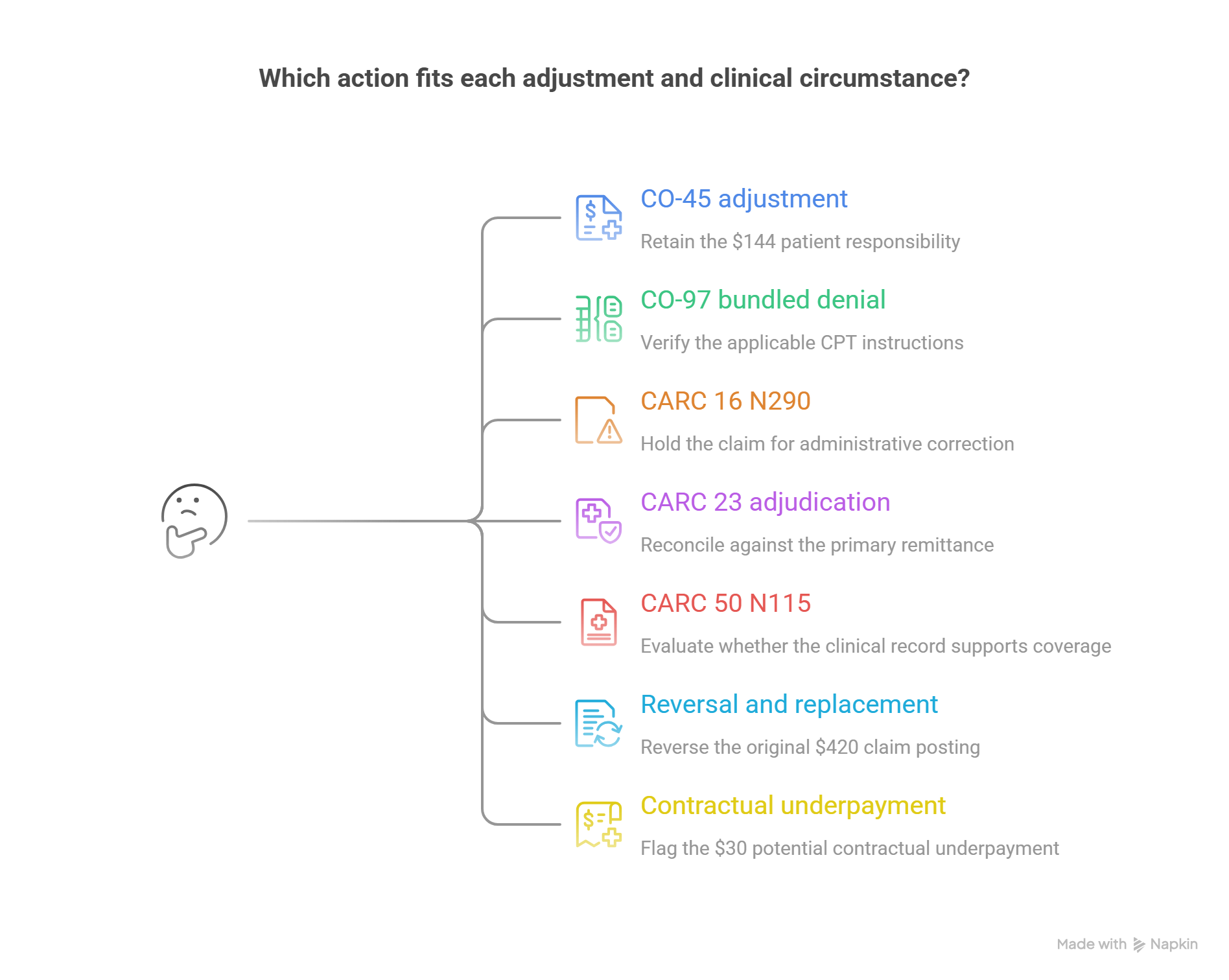
The following examples demonstrate how the same unpaid amount can require very different actions depending on the adjustment codes and underlying clinical circumstances.
Example 1: CO-45 contractual adjustment with deductible and coinsurance
A payer receives a claim with a submitted charge of $500.
The ERA reports $180 under CO-45, $100 under PR-1, and $44 under PR-2. The insurance payment is $176.
The complete reconciliation is $180 in contractual adjustment, $144 in reported patient responsibility, and $176 in insurance payment, totaling $500.
Correct posting: Record the contractual reduction after verifying the allowed amount. Post the insurer's $176 payment and retain the $144 patient responsibility for secondary insurance and collection review.
Common error: Writing off the entire $324 difference between the charge and insurance payment.
That mistake eliminates legitimately reported patient responsibility and understates collections. A separate payment posting audit, contract verification process, and AR balance review can identify the error.
Example 2: CO-97 bundled procedure denial
A surgical claim contains a primary procedure and another service the payer considers bundled.
The payer pays the primary service and reports CARC 97 on the second procedure.
Correct posting: Verify the applicable CPT instructions, procedure-to-procedure edit, and documentation before deciding whether the adjustment is valid.
For example, certain distinct procedures performed on separate anatomical structures may be eligible for independent reimbursement when the relevant NCCI edit allows an appropriate modifier.
If the procedures were correctly bundled, the adjustment should follow the applicable payer agreement. If the denial was incorrect, a corrected claim or appeal may be appropriate.
This requires a modifier coding review, a coding documentation audit, and an appropriate denial recovery workflow.
Example 3: CARC 16 with RARC N290
A payer reports CARC 16 and remark code N290.
CARC 16 identifies an information or submission problem. N290 identifies the rendering provider's primary identifier as incomplete, missing, or invalid.
Correct posting: Hold the claim for administrative correction and verify the rendering NPI, provider enrollment, and relevant claim fields.
A medical necessity appeal would leave the actual claim error unresolved.
This example illustrates the importance of combining CARCs and RARCs before assigning work. Correctly routing the claim supports faster electronic claim corrections, reduces denial resolution time, and prevents unsupported write-offs.
Example 4: CARC 23 and secondary insurance adjudication
A patient has primary and secondary coverage. The primary insurer processes a $400 claim, pays $200, and assigns $50 to patient responsibility after other adjustments.
The secondary insurer receives the primary adjudication and calculates its payment according to coordination-of-benefits rules.
The secondary ERA includes CARC 23, which reflects the effect of prior payer adjudication.
Correct posting: Reconcile the secondary payment and adjustments against the primary remittance. Determine the remaining patient liability only after both payer decisions and previous collections are accounted for.
Automatically interpreting CARC 23 as a new contractual write-off or patient balance can produce incorrect financial results.
A reliable secondary billing workflow should preserve the original payer's adjudication, monitor remaining receivables, and investigate coordination-of-benefits denials.
Example 5: CARC 50 with RARC N115
A diagnostic service receives a medical necessity denial using CARC 50 and RARC N115.
CARC 50 identifies the payer's medical necessity determination. N115 indicates that a Local Coverage Determination informed the decision.
Correct posting: Identify the applicable LCD and evaluate whether the clinical record supports coverage.
If the submitted diagnosis was incorrect, a compliant coding correction may be appropriate. If the payer applied the policy incorrectly, the organization should evaluate its appeal rights.
A valid appeal should connect the patient's documented clinical circumstances to the relevant policy criteria.
Use a medical necessity documentation checklist, appropriate physician clarification procedures, and a supported billing appeal letter.
Example 6: Claim reversal followed by replacement adjudication
A payer initially pays $420. The practice posts the payment and closes the claim.
Later, a new ERA reverses the original adjudication with CLP02 status 22. A replacement adjudication then reports a $360 payment.
Correct posting: Reverse the original $420 claim posting through a controlled transaction, then apply the replacement $360 payment and associated adjustments.
The claim's net recognized insurance payment is now $360, assuming no other adjudications. The $60 difference requires reconciliation through the payer's adjustment or recovery process.
A separate PLB recoupment may affect the actual cash movement. The accounting process must avoid recognizing the same recovery twice.
This is where an accurate payment audit trail, reliable AR reconciliation, and appropriate payer adjustment review become critical.
Example 7: Contractual underpayment hidden by a balanced ERA
A procedure has a verified contracted allowed amount of $240.
The payer adjudicates it using an allowance of $210. The ERA balances perfectly using the payer's reported payment and contractual adjustment.
Correct posting: Preserve the payer's adjudication and flag the $30 potential contractual underpayment for review.
The remittance's arithmetic balance only establishes that the reported fields reconcile. It does not establish that the contractual allowance is correct.
If the claim meets the contract requirements, the practice may have grounds to request reprocessing or payment adjustment.
Build an expected-allowed comparison using the appropriate fee schedule reference, maintain supporting coding documentation, and track confirmed recoveries through the denial and underpayment workflow.
5. How to Automate 835 ERA Posting, Prevent Write-Off Errors & Recover Revenue
Payment posting automation should be evaluated by accuracy, recoverable revenue, and exception resolution. High auto-posting percentages offer limited value when the system accepts incorrect contractual adjustments or leaves unexplained balances.
Establish validated posting rules for common CARC combinations
Begin by identifying the most frequent adjustment combinations across major payers.
Configure predictable adjustments for automated processing only when the relevant fee schedule, liability rules, and contractual requirements have been validated.
For example, CO-45 may qualify for automatic posting when the allowed amount matches the contract. An unusually large CO-45 adjustment should trigger review instead.
Similarly, a PR-2 amount should be reconciled against secondary coverage and previous patient payments before the account is released for collection.
Maintain separate workflows for denials requiring medical necessity documentation, claims requiring coding clarification, and transactions needing billing corrections.
Prevent duplicate posting at the transaction level
ERA files can be retransmitted by payers or clearinghouses.
A billing system that treats every imported file as a new transaction may duplicate payments, contractual adjustments, or reversals.
Use transaction control identifiers, payer information, trace numbers, and prior processing records to identify duplicates.
A valid replacement or reversal must remain distinguishable from an accidental retransmission.
Critical control: Record the original remittance identifier, import timestamp, processed claims, posting batch, and any reversal relationships.
Duplicate prevention should operate before money is applied to patient accounts. It should also be tested during electronic claims system reviews, medical billing audits, and revenue cycle quality assessments.
Build exception queues according to financial risk
A useful exception-management system separates routine work from transactions that could cause material financial errors.
Recommended categories include unmatched claims, invalid adjustment combinations, unexpected contractual allowances, reversals, provider-level recoupments, unresolved secondary claims, and unmatched EFT deposits.
A $15 missing copayment and an unexplained $15,000 provider-level recovery require different review priorities.
Prioritize each exception using the dollar amount, age, contractual filing limits, likelihood of recovery, and potential compliance implications.
A structured denial management process can manage disputes, while AR aging metrics help identify delayed recoveries.
For high-value errors, preserve the original claim adjustment details and relevant payer communication.
Audit patient responsibility before statement generation
Incorrect patient balances represent both a financial and patient-experience risk.
An automated system may transfer PR adjustments immediately after primary adjudication, even when the patient has secondary insurance.
Another system may overlook an amount collected at check-in and send a statement for an already-paid copayment.
Introduce a statement-release control that checks secondary insurance status, prior collections, credit balances, and applicable billing protections.
Accounts with unresolved payer responsibility should remain in the appropriate follow-up workflow.
This control improves payment posting accuracy, limits unnecessary billing disputes, and produces more reliable patient receivable reports.
Monitor five operational metrics
A focused ERA performance dashboard should measure:
Auto-posting accuracy: Percentage of automatically posted transactions confirmed correct through audit.
Unmatched payment rate: Percentage of remittances or deposits awaiting proper reassociation.
Posting correction rate: Percentage of transactions requiring reversal or manual correction.
Underpayment recovery rate: Recoveries compared with confirmed, actionable underpayment opportunities.
Denial routing time: Time from ERA receipt to assignment of an actionable denial to the correct team.
For example, a practice processing 2,000 claim adjudications monthly may initially identify 160 postings requiring correction, producing an 8% correction rate.
After improving the automation rules, the next comparable sample may contain only 50 corrections, reducing the rate to 2.5%.
These figures illustrate a measurement method rather than an expected industry benchmark.
Compare quality improvements with claim acceptance trends, denial rate measurements, and AR days.
A practical 30-day ERA improvement plan
Week 1 — Identify existing problems. Review a representative set of 835 files. Examine posting exceptions, unmatched EFT deposits, unexpected write-offs, PLB recoveries, and patient balance complaints.
Week 2 — Validate automation rules. Compare common adjustment combinations with current CARC/RARC definitions and contractual requirements. Remove unsupported automatic write-off rules.
Week 3 — Correct reconciliation workflows. Strengthen TRN matching, claim reversal handling, secondary insurance reconciliation, and provider-level adjustment review.
Week 4 — Re-audit and measure. Review new posting batches for accuracy. Compare correction rates, unapplied cash, denial routing time, and confirmed recoveries.
Assign ownership for each unresolved exception and record its financial impact.
High-value errors should feed into the organization's coding audit program, while recurring payer problems should inform denial prevention planning and appropriate claim appeal procedures.
The goal is a posting environment where payments reconcile correctly, collectible balances remain visible, and every exception has a traceable resolution.
6. Frequently Asked Questions About 835 ERA, CARCs, RARCs & Payment Posting
-
An 835 ERA is an electronic remittance advice transaction that communicates how a healthcare payer processed claims.
It includes claim payments, adjustments, adjudication status, and supporting explanations.
The 835 uses the ASC X12 standard so medical billing systems can import and reconcile payment information.
This supports accurate insurance payment processing, denial management, and accounts receivable reporting.
-
An 837 transaction submits healthcare claims to a payer. An 835 transaction reports the payer's adjudication and payment information.
The 837 communicates billed services, procedures, diagnoses, charges, and provider information.
The 835 explains how those claims were processed, including payments, adjustments, and financial responsibility.
Organizations should connect the original claim and subsequent remittance using consistent identifiers. This improves claim submission accuracy and strengthens payment reconciliation audits.
-
A CARC explains why the payer adjusted a billed amount.
A RARC adds explanatory information or communicates an informational alert.
For example, CARC 50 describes a medical necessity denial, while RARC N115 identifies an LCD as the basis for the coverage decision.
Reading both helps determine whether the next action involves a claim correction, clinical review, or appeal.
Use the CARC reference directory with the appropriate medical necessity appeal checklist.
-
CO means contractual obligation, PR means patient responsibility, OA means other adjustment, and PI means payer-initiated reductions.
These group codes provide the financial classification of the associated adjustment.
PR amounts may ultimately be billed to the patient when permitted by coverage arrangements and applicable law. CO adjustments generally remain the provider's obligation.
The correct interpretation depends on the full transaction and payer rules.
A billing compliance audit can identify incorrect responsibility transfers and related denial posting errors.
-
CO-45 generally identifies a charge exceeding the applicable fee schedule, maximum allowance, or contracted or legislated fee arrangement.
The adjustment should be evaluated against the applicable payer agreement before posting.
An incorrectly calculated contractual allowance may conceal an underpayment, even when the ERA balances.
Use a physician fee schedule comparison and a focused payment audit to identify discrepancies.
-
PLB identifies a provider-level adjustment that affects the overall payment rather than an individual current claim's adjudication.
Examples include recoveries of previously identified overpayments and applicable interest credits.
A PLB entry can explain why current claim payments total more than the actual EFT deposit.
The posting team should reconcile each adjustment using its reason code, reference, and signed amount.
Proper treatment protects accounts receivable accuracy and prevents inappropriate payment corrections.
