
The difference between 837P and 837I electronic claims determines how healthcare providers report professional services, facility charges, diagnoses, procedures, and reimbursement information to insurance payers. Choosing the wrong claim format can trigger clearinghouse rejections, missing-data errors, delayed payments, and costly revenue cycle disruptions. Medical billers must also understand why hospital encounters sometimes generate separate professional and institutional claims, how X12 segments differ, and what happens when submitted claims fail validation. This guide explains both formats, compares their required data elements, and provides practical billing examples and troubleshooting workflows.
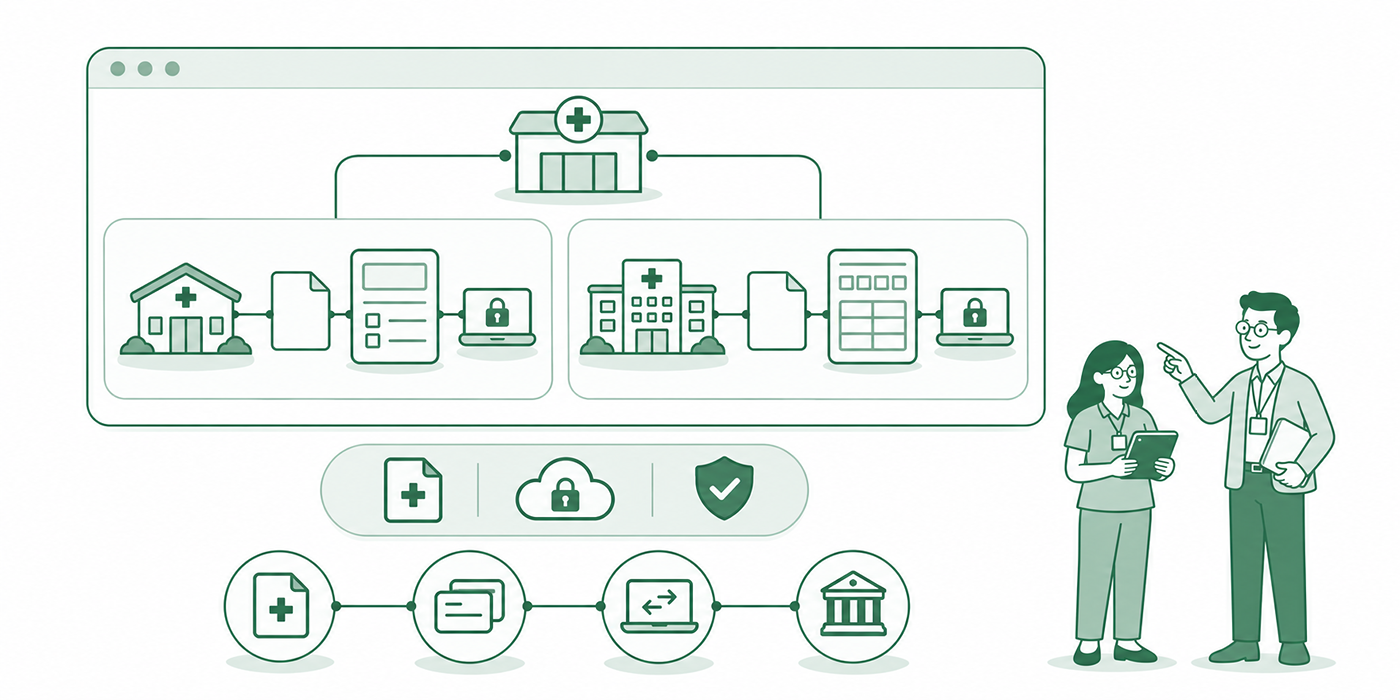
1. What Are 837P and 837I Electronic Claims, and How Do They Differ?
The 837 transaction is the standardized electronic format used to transmit healthcare claims under HIPAA's administrative transaction requirements. Its structure follows ASC X12 specifications, allowing providers, clearinghouses, and payers to exchange billing information using consistent data definitions.
The two primary formats covered here are 837P for professional claims and 837I for institutional claims.
An understanding of these formats is fundamental to electronic claims submission, small medical practice billing, Medicare billing operations, and medical coding compliance reviews.
837P: Electronic professional claims
The 837P transaction reports services and supplies billed by physicians, other qualified healthcare professionals, and eligible suppliers.
Common examples include physician office visits, independent professional interpretations, therapy services, ambulance services, and certain durable medical equipment claims.
The corresponding paper claim form is the CMS-1500, maintained by the National Uniform Claim Committee (NUCC).
The adopted HIPAA transaction implementation is:
005010X222A1
837P service lines commonly contain CPT or HCPCS codes, modifiers, charges, units, diagnosis pointers, service dates, and applicable rendering-provider information.
For example, an established patient's office visit may be billed using CPT 99214, with a corresponding ICD-10-CM diagnosis and place-of-service code.
Accurate service-level coding is essential for maintaining the clean claim rate, evaluating physician fee schedule reimbursement, improving medical coding accuracy, and resolving claim denials.
837I: Electronic institutional claims
The 837I transaction reports facility and institutional services provided by eligible organizations, including hospitals, skilled nursing facilities, home health agencies, hospices, and certain clinics.
Its corresponding paper format is the CMS-1450, commonly called the UB-04, maintained by the National Uniform Billing Committee (NUBC).
The adopted HIPAA implementation is:
005010X223A2
Institutional claims contain information such as the type of bill, revenue codes, statement dates, facility charges, diagnosis codes, and additional data associated with inpatient or outpatient care.
Depending on the claim, these elements can include admission information, discharge status, occurrence codes, condition codes, value codes, and procedure details.
The institutional structure supports different Medicare payment methodologies, including inpatient prospective payment, outpatient prospective payment, and other provider-specific reimbursement arrangements.
Billing teams should understand these differences when working with Medicare reimbursement resources, Medicaid billing software, physician versus facility coding workflows, and medical necessity documentation.
The most important distinction: Who is billing, and for what?
Consider a patient who receives a specialist consultation inside a hospital outpatient department.
The hospital may submit an 837I claim for its facility resources, while the specialist's professional services may be submitted separately through an 837P claim.
These claims represent different billable components of the same encounter. They may use related diagnosis and procedure information, but their payment rules and reporting structures differ.
An institutional encounter can generate both claim types without representing duplicate billing. The services and billing responsibilities must be distinct and supported.
This is a common source of confusion in professional-fee and facility coding, claim adjustment analysis, revenue cycle performance reviews, and coding audit investigations.
Another important exception involves freestanding ambulatory surgical centers. Medicare generally requires these facilities to bill their ASC services using the professional claim format, despite their facility-based operations. Rural Health Clinics and Federally Qualified Health Centers generally use institutional Medicare billing.
Therefore, the provider's enrollment category and applicable payer billing rules must be verified before selecting the electronic format.
837P vs 837I: 42-Point Electronic Claims Comparison & Validation Checklist
| Claim Element | 837P: Professional | 837I: Institutional | What Billers Must Validate |
|---|---|---|---|
| 1. Transaction purpose | Professional and supplier services | Institutional and facility services | Correct billing entity and claim type |
| 2. HIPAA implementation | 005010X222A1 | 005010X223A2 | Correct implementation guide and envelope version |
| 3. Paper counterpart | CMS-1500 | CMS-1450 / UB-04 | Appropriate data mapping between software and claim |
| 4. Paper form standards | NUCC | NUBC | Applicable reporting conventions |
| 5. Physician office services | Commonly used | Only under qualifying institutional arrangements | Provider enrollment and billing eligibility |
| 6. Hospital inpatient services | Separately billed professional services | Hospital facility claim | Professional versus facility responsibilities |
| 7. Hospital outpatient services | Eligible professional services | Hospital outpatient facility charges | Separate components and correct payer rules |
| 8. Freestanding ASC | Generally used for Medicare ASC facility billing | Not the usual Medicare ASC claim format | ASC enrollment and payer requirements |
| 9. Skilled nursing facility | Eligible professional services | Institutional SNF charges | Consolidated billing and benefit rules |
| 10. Home health agency | Separate eligible professional claims | Home health institutional billing | Episode, period and service-specific instructions |
| 11. Hospice provider | Eligible separately billed professional services | Hospice institutional billing | Election status and provider-specific rules |
| 12. RHC and FQHC | Not generally used for Medicare RHC/FQHC facility claims | Usual Medicare claim format | Institutional provider eligibility |
| 13. DMEPOS suppliers | Generally use professional claims | Only where specific rules permit | Supplier type and DME MAC instructions |
| 14. Service line loop | Loop 2400 | Loop 2400 | Correct professional or institutional segment structure |
| 15. Service line segment | SV1 | SV2 | Data placed in the correct service segment |
| 16. CPT / HCPCS | Central procedure reporting element | Reported where required for institutional services | Valid code for service date and setting |
| 17. Revenue codes | Not part of standard professional service lines | Central institutional line element | Revenue code matches service and bill type |
| 18. Place of service | Two-digit POS classification | Uses institutional bill classifications instead | Office, inpatient, outpatient and other locations |
| 19. Type of bill | No UB institutional TOB structure | Facility type, care classification and frequency | Valid TOB for the institutional provider |
| 20. TOB leading zero | Not applicable | Paper TOB includes a leading zero; electronic format omits it | Correct electronic representation |
| 21. Claim frequency | Claim frequency per payer-supported rules | Frequency incorporated into institutional bill type | Original, replacement or void transaction handling |
| 22. Dates of service | Typically reported at professional service-line level | Line dates plus institutional claim periods as applicable | Actual services and billing period consistency |
| 23. Statement covers period | Not used in the same institutional structure | Claim-level statement dates, such as DTP*434 | Accurate from and through dates |
| 24. Admission information | Limited information where applicable | Admission-related fields for applicable claims | Admission date, type and source |
| 25. Discharge status | Not a standard professional classification | Patient discharge status, when required | Disposition consistent with discharge record |
| 26. ICD-10-CM diagnoses | Reported with service-line diagnosis references | Principal and additional diagnoses as applicable | Code specificity, sequencing and validity |
| 27. Principal diagnosis | Diagnosis reporting follows professional claim rules | Principal diagnosis has a defined institutional role | Correct inpatient or outpatient sequencing |
| 28. Diagnosis pointers | Link individual services to reported diagnoses | Different institutional diagnosis reporting rules | Correct associations for professional service lines |
| 29. Present on admission | No standard inpatient POA reporting role | POA indicators where applicable | Current inpatient POA and exemption rules |
| 30. ICD-10-PCS procedures | Not used for professional procedure reporting | Applicable inpatient hospital procedure reporting | Correct inpatient procedure classification |
| 31. Outpatient procedures | CPT / HCPCS codes | Applicable CPT / HCPCS and revenue codes | Proper professional or facility reporting |
| 32. Modifiers | Professional CPT / HCPCS modifier rules | Institutional modifiers where applicable | Component, bilateral, repeat or distinct-service rules |
| 33. Rendering provider | Important professional claim field | Institutional provider roles differ | Correct individual NPI when required |
| 34. Attending provider | Reported under applicable professional claim rules | Key provider role on many institutional claims | Correct attending provider and credentials |
| 35. Operating provider | Individual rendering information where appropriate | Separate operating provider information when required | Operative record consistency |
| 36. Billing provider | Professional practice or supplier | Institutional organization | NPI, tax ID, enrollment and payer registration |
| 37. Service units | Procedure-based service units | Revenue-line units, days or other applicable quantities | Documented units and payer edit limits |
| 38. Charges | Professional service charges | Facility charge lines and totals | Mathematical consistency and charge capture |
| 39. Coordination of benefits | Other payer information under applicable rules | Institutional other-payer information under applicable rules | Primary payment and secondary billing information |
| 40. 999 acknowledgment | Implementation-level acknowledgment | Implementation-level acknowledgment | Transaction acceptance or rejection at the implementation level |
| 41. 277CA acknowledgment | Claim-level front-end acceptance or rejection | Claim-level front-end acceptance or rejection | Individual rejected claims and correction requirements |
| 42. 835 remittance | Professional payment and adjustment information | Institutional payment and adjustment information | Allowed amounts, adjustments, denials and reconciliation |
Important: This comparison describes common Medicare and HIPAA electronic billing requirements. Individual transaction fields may be situational or payer-specific. Validate the applicable ASC X12 implementation guide, payer companion guide, provider enrollment, and current billing instructions before submission.
2. Understanding 837P and 837I X12 Loops, Segments and Required Fields
A successful electronic claim depends on how information is structured inside the X12 transaction. A billing system may display recognizable fields such as CPT code, diagnosis, date of service, and insurance information, but those fields must be translated into specific loops and segments.
Understanding this structure helps billing teams diagnose problems that cannot be resolved by simply changing the information displayed on a claim entry screen.
How X12 claim files are organized
An X12 837 file uses a hierarchical structure containing information about the sender, receiver, billing provider, subscriber, patient when applicable, claim, and individual services.
Important elements include:
ISA/IEA: Define the interchange envelope.
GS/GE: Define the functional group.
ST/SE: Mark the beginning and end of a transaction set.
NM1: Identifies organizations or individuals, depending on the loop.
CLM: Contains claim-level information.
HI: Carries health-related information such as diagnoses.
DTP: Carries dates or date ranges.
LX: Identifies an individual service line.
SV1: Carries professional service-line information.
SV2: Carries institutional service-line information.
These elements appear in defined locations and sequences. Incorrect ordering, missing required segments, invalid qualifiers, or mismatched control information can cause transmission or implementation-level rejection.
Billing professionals who understand these relationships can troubleshoot problems across electronic claims platforms, perform more effective coding audits, improve claim acceptance rates, and investigate recurring billing denial patterns.
837P service lines: Understanding the SV1 segment
The professional SV1 segment identifies an individual professional service. It can carry information such as the procedure code, applicable modifiers, charge amount, service unit information, and diagnosis references.
For example, a professional claim for an established patient office visit may include:
CPT 99214.
One unit of service.
A $175 submitted charge, used here as an illustration.
An applicable service date.
A diagnosis pointer referencing a diagnosis reported at the claim level.
Place-of-service information, such as POS 11 for an office setting.
The amount charged is an illustrative provider charge rather than a Medicare reimbursement rate.
The diagnosis pointer is particularly important. When a claim contains several ICD-10-CM codes, the pointer connects an individual service with its relevant diagnosis information.
A pointer referencing an unavailable or inappropriate diagnosis can trigger processing errors or medical necessity problems.
Providers should verify these relationships through medical coding practice cases, medical necessity documentation reviews, coding interview scenarios, and clean claim rate audits.
837I service lines: Understanding the SV2 segment
Institutional claims use the SV2 segment to communicate facility services and charges.
A hospital outpatient claim may include revenue code 0450 for emergency room services, together with appropriate CPT or HCPCS codes when required.
Revenue codes identify the type of facility resource or service being billed. The corresponding HCPCS code, when required, identifies the specific procedure or service.
For example, a hospital emergency department may report facility evaluation services using an appropriate revenue code and hospital outpatient E/M code under the payer's established facility billing rules.
The provider must verify that the reported service, revenue code, HCPCS code, charge, and units are consistent.
Incorrect revenue-code-to-HCPCS combinations can cause rejection or incorrect payment grouping. A facility can also lose reimbursement when an eligible ancillary service is omitted from its charge capture process.
Effective prevention connects facility coding procedures, institutional claims software, coding compliance checklists, and revenue cycle leakage analysis.
Type of bill versus place of service
One of the most consequential structural differences involves how the setting is identified.
837P uses place-of-service codes, including POS 11 for office services, POS 21 for inpatient hospital services, and POS 22 for an on-campus hospital outpatient setting.
837I instead uses institutional type-of-bill information. The UB-04 displays a four-character code such as 0111 for hospital inpatient billing or 0131 for hospital outpatient billing.
The leading zero is a paper-form placeholder and is omitted in the electronic representation.
For example, institutional bill type 0131 identifies a hospital outpatient original claim in the commonly used coding structure. Its components identify the facility category, classification of care, and bill frequency.
Selecting the wrong type of bill may route a claim into an inappropriate editing or payment pathway.
The impact should be assessed through Medicare billing references, physician fee schedule guidance, medical billing denial analysis, and claim submission platform reviews.
Inpatient diagnosis and procedure reporting requires additional care
Institutional inpatient hospital claims may require information that has no equivalent role in a routine professional claim.
This can include an inpatient principal diagnosis, applicable present-on-admission indicators, ICD-10-PCS inpatient procedures, admission details, and discharge status.
The principal diagnosis must be determined under inpatient coding rules, including the condition established after study to be chiefly responsible for the admission.
Professional physician claims generally use CPT or HCPCS procedure reporting rather than ICD-10-PCS.
Coders should develop separate training pathways for inpatient versus outpatient coding, CCS coding preparation, coding accuracy assessments, and compliant documentation queries.
3. When to Use 837P vs 837I: Real Medical Billing Examples
Determining the correct claim format becomes difficult when a patient receives professional services within a facility, when an organization operates multiple enrolled provider types, or when the same encounter produces more than one payment request.
The following scenarios illustrate how billing responsibilities affect electronic claim selection.
Example 1: Physician office visit with diagnostic testing
A patient visits an independently operated physician practice for diabetes management. During the appointment, the physician performs an examination, adjusts treatment, and orders a medically necessary diagnostic test.
Claim format: 837P
The practice submits professional services using CPT or HCPCS codes, applicable modifiers, diagnosis references, service dates, and the appropriate place of service.
If the diagnostic test is performed and billed by an independent laboratory, that laboratory may submit its own claim under its enrollment and billing arrangements.
The billing team should confirm that each entity reports only the services it furnished or is otherwise authorized to bill.
This distinction helps prevent duplicate charges and supports accurate medical necessity reviews, professional coding audits, small practice billing workflows, and clean claim performance.
Example 2: Hospital emergency department encounter
A patient arrives at a hospital emergency department with severe abdominal pain. The emergency physician evaluates the patient, laboratory testing is performed, and the hospital provides imaging and other resources.
Claim formats: Both 837P and 837I may be required.
The emergency physician or professional billing entity may submit an 837P claim for the professional evaluation.
The hospital submits an 837I claim for the applicable facility services, such as emergency department resources, laboratory services, and imaging technical components.
The professional and facility claims may use related diagnoses and service dates. Their coding, charges, and payment methodologies remain distinct.
For Medicare hospital outpatient billing, facility emergency department visit levels follow hospital-specific guidelines and documentation, while physician E/M services follow professional E/M requirements.
Incorrectly applying physician-level documentation logic to hospital facility visit levels can create compliance problems.
These differences should be covered in professional-fee versus facility coding training, outpatient coding exercises, medical coding audits, and claim adjustment reviews.
Example 3: Inpatient surgery with separate professional fees
A patient is admitted to a hospital and undergoes major abdominal surgery.
Hospital claim: 837I
The hospital reports the institutional stay, applicable room and ancillary charges, diagnoses, inpatient procedure information, and discharge details.
Surgeon's claim: 837P
The surgeon or professional billing organization reports the appropriate professional surgical CPT code and relevant information under physician billing rules.
The hospital's inpatient claim may be paid under a diagnosis-related group methodology, while the surgeon's professional service follows the applicable physician payment arrangement.
An inpatient hospital ICD-10-PCS procedure code does not replace the surgeon's professional CPT code.
For example, a documented laparoscopic operation may require ICD-10-PCS classification on the qualifying hospital inpatient claim and CPT reporting for the surgeon.
Coders should understand these differences through inpatient and outpatient coding comparisons, CCS certification study resources, professional coding workflows, and medical coding compliance reviews.
Example 4: Freestanding ambulatory surgical center
A patient undergoes cataract surgery at a Medicare-certified freestanding ambulatory surgical center.
The ASC bills its covered facility services using the 837P format under Medicare ASC payment rules.
The surgeon separately reports the professional surgical service under the appropriate billing arrangement.
This example demonstrates why classifying every facility as an 837I submitter creates errors.
A hospital outpatient surgical department and a freestanding ASC may perform similar clinical procedures while following different claim submission and reimbursement requirements.
The correct billing pathway depends on the provider's enrollment and payment system.
Staff should verify the applicable Medicare billing rules, physician reimbursement methods, electronic claims platform settings, and medical coding audit criteria.
Example 5: Rural Health Clinic or Federally Qualified Health Center
A Medicare beneficiary receives a qualifying visit at a Rural Health Clinic.
The RHC generally submits an institutional 837I claim for its covered Medicare clinic services, following its specific billing and payment rules.
The organization must use the correct institutional claim classifications and applicable encounter reporting requirements.
Using the professional 837P format simply because an individual physician provided the examination can result in incorrect Medicare billing.
This is particularly relevant for organizations operating multiple locations with different provider enrollment types.
Accurate setup requires coordination among medical billing software administrators, electronic claim submission teams, Medicare reimbursement specialists, and coding compliance auditors.
Example 6: Imaging performed in a hospital outpatient department
A patient undergoes a CT scan at a hospital outpatient facility. A radiologist provides a separately billable professional interpretation.
The hospital may report the applicable facility imaging charge on an 837I claim.
The radiologist may bill the professional interpretation using an 837P claim with modifier 26 when the code and payment arrangement support component billing.
The applicable technical component is billed according to the facility's reporting rules.
The coder should verify whether the service has professional and technical components, whether the imaging code supports component modifiers, and which entity furnished each component.
This distinction can be especially important during medical coding interview assessments, outpatient procedure coding audits, claim denial investigations, and medical necessity documentation reviews.
Quick Poll: What Is Your Biggest Electronic Claims Submission Challenge?
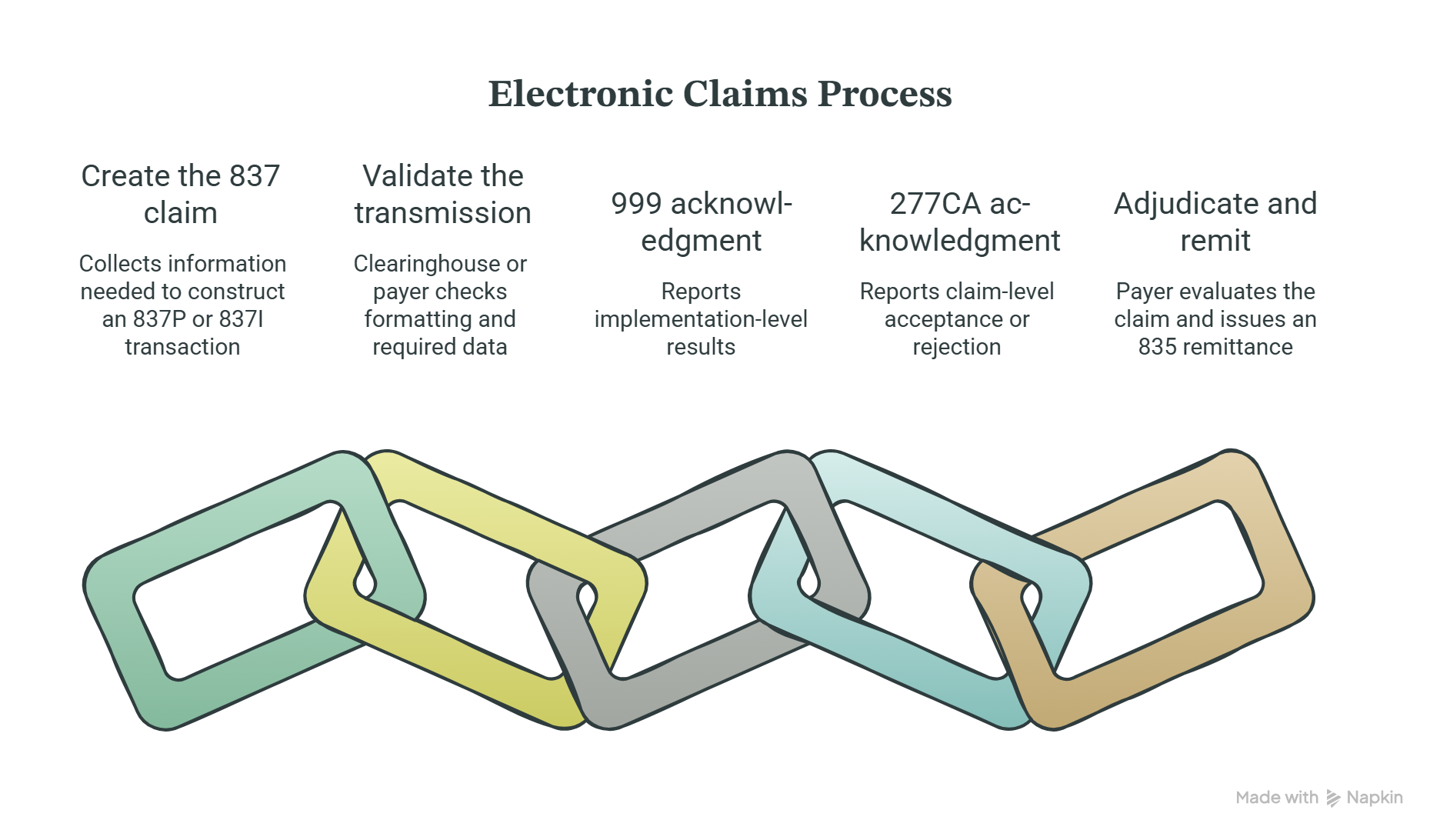
4. Electronic Claim Submission Workflow: 837P, 837I, 999, 277CA and 835 Explained
Sending an 837 transaction is only the beginning of the electronic claims process. A successful transmission does not establish that every claim was accepted for adjudication or approved for payment.
The most expensive workflow failures often occur when billing departments confuse successful file transmission with successful claim processing.
Stage 1: The billing system creates the 837 claim
The practice management system or hospital billing platform collects the information needed to construct an 837P or 837I transaction.
For professional claims, this includes procedure codes, provider information, diagnoses, service dates, charges, and relevant modifiers.
Institutional systems must additionally supply applicable facility-specific data, including revenue codes, type-of-bill information, statement dates, and provider roles.
Before sending the file, the system should evaluate code validity, required fields, and basic relationships between the claim's data elements.
Examples include confirming that the billing provider's NPI is valid, the procedure code is effective for the service date, and an institutional revenue code corresponds to the billed service.
These controls support accurate electronic claims submission, improve the clean claim rate, and reduce problems identified through coding audits and medical necessity reviews.
Stage 2: The clearinghouse or payer validates the transmission
When a claim passes through a clearinghouse, the clearinghouse may apply additional edits before forwarding it to the payer.
These checks can identify missing subscriber information, incompatible transaction versions, invalid provider identifiers, required data omissions, or payer-specific formatting errors.
The clearinghouse's acceptance confirmation must be interpreted according to its actual processing stage.
A claim that has passed clearinghouse validation may still be rejected by the payer.
Billing departments should maintain distinct statuses for clearinghouse acceptance, payer acceptance, adjudication, and payment.
Tracking these stages through billing software platforms, claim adjustment reporting, and accounts receivable monitoring prevents staff from treating an unresolved claim as successfully processed.
Stage 3: The 999 acknowledgment reports implementation-level results
The 999 Implementation Acknowledgment communicates whether an X12 transaction or functional group meets applicable implementation requirements.
An accepted 999 generally indicates successful implementation-level processing. It does not prove that every individual claim passed payer front-end edits.
For instance, a batch can pass implementation validation while containing an individual claim with an invalid provider enrollment relationship.
The transaction may therefore receive a positive 999 acknowledgment but still contain claims that fail subsequent business edits.
The billing team should verify the implementation acknowledgment and continue reviewing the claim-level response.
This distinction is essential when auditing electronic billing systems, investigating claim rejections, and measuring claims submission accuracy.
Stage 4: The 277CA reports claim-level acceptance or rejection
The 277CA Health Care Claim Acknowledgment communicates front-end processing results at the claim level.
A 277CA can identify which claims were accepted into adjudication processing and which were rejected because they failed required edits.
For example, a payer might accept 95 claims from a batch of 100 while rejecting five claims because of invalid patient information, provider identifiers, or other required data.
The accepted claims move into the payer's processing workflow. The rejected claims require investigation and correction.
A billing department should record the original claim control number, rejection category, affected data element, and corrective action taken.
Use claim adjustment and rejection analysis, electronic submission resources, coding audit controls, and clean claim calculations to identify repeated failures.
Stage 5: The payer adjudicates the claim and issues an 835 remittance
After a claim is accepted into adjudication, the payer evaluates coverage, coding, medical necessity, payment rules, contractual arrangements, and applicable patient responsibility.
The 835 Electronic Remittance Advice communicates payment and adjustment information after adjudication.
It can identify allowed amounts, payment amounts, contractual adjustments, patient responsibility, and denial explanations through adjustment and remark codes.
If a claim remains unresolved, a 276/277 claim status inquiry and response may help determine its processing status.
The distinction between rejection and denial determines the next action:
Rejected claim: The claim failed to enter adjudication successfully. Correct the underlying data problem and submit according to the payer's rejected-claim procedure.
Denied claim: The payer adjudicated the claim and issued an adverse payment determination. Investigate the denial and use the appropriate corrected-claim, reconsideration, or appeal process.
Pended claim: The claim remains in processing or requires additional action. Investigate the status and outstanding payer requirements before submitting a duplicate.
Teams handling denials should use billing appeal letter templates, medical necessity appeal procedures, CARC reference guidance, and accounts receivable benchmarks.
5. Common 837P and 837I Rejections: Troubleshooting and Revenue Cycle Controls
Electronic claim rejections can result from incorrect transaction mapping, incomplete provider records, incompatible procedure reporting, institutional billing errors, or payer-specific requirements.
The most effective correction starts by identifying the exact transaction stage where the claim failed.
Error 1: Incorrect professional or institutional claim format
Scenario: A hospital-based billing department sends an institutional facility charge through a professional 837P workflow, despite the provider's enrollment and payer rules requiring institutional submission.
Likely problem: The claim lacks the institutional data structure the payer expects, including applicable type-of-bill and revenue-code information.
Corrective action: Confirm the billing entity's provider type, payer enrollment, and required transaction format. Rebuild the claim using the correct institutional structure.
A claim-format error should be distinguished from a valid arrangement in which the same clinical encounter generates separate professional and facility claims.
Teams can prevent this through professional-fee and facility coding training, electronic billing system audits, practice billing controls, and coding compliance reviews.
Error 2: Invalid billing or rendering provider information
Scenario: A professional claim contains a valid billing organization NPI but identifies a rendering professional whose enrollment or reassignment does not match the payer's records.
Likely problem: Provider identity, enrollment, taxonomy, or another required relationship fails validation.
Corrective action: Compare the billing and rendering provider information against the payer's enrollment records and correct the underlying practice management configuration.
Different payer systems may perform different checks, so the exact rejection details matter.
This type of error should be monitored alongside claim acceptance performance, coding audit findings, and billing software configuration reviews.
Error 3: Institutional revenue code and HCPCS mismatch
Scenario: A hospital submits an outpatient institutional claim containing a revenue code inconsistent with the reported procedure or type of bill.
Likely problem: The payer's editing logic identifies a conflict between the service classification and other claim data.
Corrective action: Verify the official NUBC revenue code, applicable CPT or HCPCS requirements, and payer-specific edit.
The correct resolution may involve adjusting the revenue code, correcting the procedure code, or changing the claim structure when the wrong bill type was selected.
A successful control should compare clinical charge capture against the institutional chargemaster.
Use coding audit procedures, medical necessity reviews, Medicare billing resources, and denial analysis tools to investigate the problem.
Error 4: Missing institutional claim information
Scenario: An inpatient hospital claim is submitted without a required admission detail, discharge status, or claim-level date field.
Likely problem: The hospital billing system fails to populate a required element or sends information inconsistent with the type of bill.
Corrective action: Compare the record against the applicable 837I transaction requirements, institutional coding standards, and payer companion guide.
For example, a billing period must be consistent with the claim's applicable statement dates. A discharge status must reflect the documented patient disposition.
If the claim is rejected before adjudication, correct the missing data and resubmit according to the payer's rejection workflow.
Prevention requires reliable clinical documentation practices, inpatient coding skills, electronic claim validation, and medical coding audits.
Error 5: Incorrect replacement or void claim information
Scenario: An institutional claim has already been adjudicated. The billing office submits a corrected version but fails to use the required bill frequency or original payer claim identifier.
Likely problem: The replacement transaction cannot be properly matched to the previously processed claim.
Corrective action: Apply the payer's corrected-claim requirements, including the appropriate claim frequency and original claim reference.
For institutional claims, bill frequency is part of the type-of-bill structure. Electronic professional claims also support claim frequency and replacement information under their applicable transaction rules.
A replacement claim generally uses frequency code 7 when required by the payer, while frequency code 8 commonly identifies a void or cancellation. Specific instructions must be verified before use.
Confusing a rejected claim with an adjudicated claim requiring correction may lead to another unnecessary rejection.
This distinction should be integrated into billing appeal workflows, claim adjustment code reviews, electronic submission procedures, and accounts receivable management.
Build an eight-point pre-submission validation process
An effective 837 claims audit should verify the following before transmission:
Provider eligibility: Confirm the enrolled billing entity and required professional or institutional transaction.
Payer configuration: Validate the payer identifier, receiver setup, and electronic submission authorization.
Patient information: Verify eligibility, subscriber identifiers, and required demographic information.
Provider identifiers: Check billing, rendering, attending, and operating provider information as applicable.
Clinical coding: Validate ICD-10-CM, CPT, HCPCS, modifiers, and institutional ICD-10-PCS information where appropriate.
Service-level structure: Check professional SV1 fields or institutional SV2 data, including revenue codes and units.
Claim classification: Verify professional place of service or institutional type of bill, dates, and frequency.
Acknowledgment monitoring: Match each transmission to its implementation acknowledgment, claim-level response, and eventual adjudication outcome.
For ongoing quality measurement, calculate the front-end rejection rate as:
\[ \text{Front-End Rejection Rate}=\frac{\text{Claims Rejected Before Adjudication}}{\text{Claims Submitted}}\times100 \]
For example, if a clearinghouse or payer rejects 45 of 1,500 submitted claims before adjudication, the front-end rejection rate is 3%. Define whether resubmissions are counted separately before comparing reporting periods.
Track rejected claims by claim format and root cause. This will reveal whether problems originate in professional coding, institutional data mapping, enrollment, or payer configuration.
Combine this analysis with clean claim rate calculations, denial rate analysis, coding audit checklists, and medical billing performance benchmarks to identify improvements that actually reduce rework.
6. FAQs About 837P vs 837I Electronic Claims
-
An 837P reports professional services and eligible supplier charges, while an 837I reports institutional services and facility charges.
Professional claims generally use CPT or HCPCS procedure codes, modifiers, diagnosis references, and place-of-service information.
Institutional claims use additional billing elements such as revenue codes, type-of-bill information, statement periods, and applicable inpatient or outpatient facility data.
The correct format depends on provider enrollment, service type, and payer requirements.
Billing professionals can improve their understanding through professional versus facility coding guidance, Medicare billing resources, and electronic claims submission tools.
-
Yes. The 837P is the electronic professional claim format corresponding to the CMS-1500, while the 837I corresponds to the institutional CMS-1450, also known as the UB-04.
The electronic transactions contain structured X12 information rather than a visual reproduction of the paper forms. Some details are represented differently in electronic files.
For example, the institutional type of bill has a leading zero on the paper form that is omitted in electronic transmission.
Medical billers should understand both representations when using billing software, performing coding audits, or preparing for medical coding interview assessments.
-
Yes. A hospital encounter can generate separate professional and facility claims when different billable components are furnished.
For example, a hospital may submit an 837I claim for emergency department resources and a professional billing organization may submit an 837P claim for the emergency physician's evaluation.
The claims must accurately reflect the services and billing responsibilities of each entity.
Correct component separation prevents inappropriate duplication and supports accurate professional-fee and facility coding, clean claim monitoring, and medical billing compliance reviews.
-
Facility-based operations do not automatically require institutional claims.
Medicare freestanding ambulatory surgical centers generally submit their facility claims using the 837P transaction. Conversely, Medicare Rural Health Clinics and Federally Qualified Health Centers generally use institutional billing.
Hospitals, skilled nursing facilities, home health agencies, and hospices commonly use 837I for their applicable institutional services.
The billing team must verify provider enrollment and the payer's required payment arrangement.
For accurate classification, review Medicare billing references, billing software directories, and professional versus institutional coding requirements.
-
SV1 is the professional service-line segment used in 837P transactions. It identifies information such as procedure codes, charges, units, and applicable diagnosis references.
SV2 is the institutional service-line segment used in 837I transactions. It contains institutional service information, including revenue codes and applicable HCPCS reporting.
Incorrectly mapping SV1 information into an institutional service structure, or vice versa, can cause implementation or claim-level validation errors.
Billing teams should audit their electronic claims software, strengthen medical coding compliance checks, and monitor claim rejection rates.
-
Revenue codes are part of institutional service-line reporting and are therefore central to the 837I structure. Standard professional 837P service lines do not use institutional revenue codes.
For hospital institutional billing, revenue codes identify the type of accommodation, department, or service associated with a charge.
An institutional service may require both a revenue code and an appropriate CPT or HCPCS code.
Coders must verify the relevant NUBC and payer reporting instructions before submitting a claim.
Use facility billing resources, coding accuracy checklists, and electronic claims submission guidance to validate institutional charge mapping.
