
Choosing between CPT 99214 and 99215 can determine whether an established patient visit is accurately reimbursed or flagged for an E/M coding audit. Both codes cover office and outpatient evaluation and management services, but Level 5 requires stronger evidence of high-complexity medical decision making or qualifying total time. Severe diagnoses, lengthy notes, and medication changes can create misleading impressions of complexity. This guide explains the precise coding thresholds, presents realistic clinical cases, and provides practical documentation strategies to help medical coders distinguish defensible Level 5 claims from encounters that support Level 4.

1. 99214 vs 99215: The Exact Coding Requirements for Established Patient Visits
The difference between 99214 and 99215 depends on the medical decision making (MDM) performed or the physician's or qualified healthcare professional's qualifying total time on the encounter date.
CPT 99214 represents moderate-complexity MDM or 30–39 minutes of qualifying total time. CPT 99215 represents high-complexity MDM or 40–54 minutes of qualifying total time.
Office and outpatient E/M guidelines permit code selection using either method, provided the documented service supports that method.
A provider may perform high-complexity MDM during a relatively short visit. Conversely, a clinically moderate-complexity encounter can qualify for 99215 when the physician personally spends at least 40 minutes on qualifying activities.
These distinctions should be incorporated into every medical coding audit checklist and coding practice assessment.
The Two-of-Three MDM Rule
Medical decision making consists of three elements:
Problems: Number and complexity of problems addressed.
Data: Amount and complexity of information reviewed and analyzed.
Risk: Risk of complications, morbidity, or mortality associated with patient management decisions.
For Level 5, at least two of these three elements must meet the high-complexity threshold.
For example, a patient experiencing a severe exacerbation of heart failure who requires a decision regarding hospitalization may support high complexity through the problems and risk elements.
An encounter involving one serious condition and extensive data review may also qualify when both elements independently satisfy high-complexity requirements.
However, extensive diagnostic testing and ordinary prescription management do not automatically support 99215. The overall MDM level is determined by the required combination of elements.
The medical coding interview scenarios and outpatient coding practice cases can help coders apply this rule consistently.
What Does High-Complexity MDM Actually Mean?
High-complexity MDM often involves serious clinical instability, substantial risk from treatment decisions, or extensive analysis of diagnostic information.
Examples include a chronic disease with severe exacerbation, an illness posing a threat to life or bodily function, a decision regarding hospitalization, or drug therapy requiring intensive monitoring for toxicity.
Each scenario must be evaluated using the actual record. The presence of a serious diagnosis in the patient's history does not establish that the physician addressed it at a high level during the encounter.
During medical coding audits, distinguish actively managed problems from historical conditions, independently reviewed data from copied results, and genuine management risk from hypothetical complications.
Why History and Examination Length Do Not Determine Level 5
Office/outpatient E/M selection no longer uses the old history and physical examination scoring requirements.
The physician must perform and document a medically appropriate history and/or examination, but a lengthy review of systems or comprehensive physical examination cannot independently justify 99215.
A short, clinically focused note may support high-complexity decision making when it clearly identifies the serious problem, management risks, and supporting decisions.
This makes documentation quality especially important for medical coding accuracy and physician clarification workflows.
99214 vs 99215: 36 Clinical Scenarios, MDM Decisions & Audit Rules
| Clinical Scenario | MDM or Time Evidence | Likely Code | Key Coding Decision |
|---|---|---|---|
| 1. Stable diabetes and hypertension with medication management | Moderate problems + moderate risk | 99214 | Two stable chronic illnesses and prescription management. |
| 2. Severe heart failure exacerbation requiring admission decision | High problems + high risk | 99215 | Severe disease progression and hospitalization decision. |
| 3. Controlled asthma with routine medication adjustment | Moderate problems and risk if adjustment addresses exacerbation | 99214 if supported | Routine prescription management alone cannot justify Level 5. |
| 4. Severe asthma attack with impending respiratory failure and transfer decision | High problems + high risk | 99215 | Threat to bodily function and hospital-level care. |
| 5. Three tests reviewed and prescription adjusted for moderate illness | Moderate data + moderate risk | 99214 | Three tests do not automatically establish extensive data. |
| 6. Severe chronic illness with extensive qualifying data review | High problems + extensive data | 99215 | Two high-level elements can qualify without high risk. |
| 7. Moderate illness with independent test interpretation and external management discussion | Extensive data + moderate problems | 99214 if risk moderate | Only one high-level element is insufficient. |
| 8. Severe chronic disease with high-risk treatment requiring intensive toxicity monitoring | High problems + high risk | 99215 | Both severe progression and qualifying treatment risk documented. |
| 9. Stable chronic illness on medication requiring intensive toxicity monitoring | High risk alone; other elements below high | Not 99215 by MDM | An additional high-level element is required. |
| 10. Multiple stable conditions and complicated medication regimen | Moderate problems + moderate risk | 99214 | Medication count does not measure MDM level. |
| 11. Acute illness threatening life with decision for emergency major surgery | High problems + high risk | 99215 | Qualifying emergency major surgery decision. |
| 12. Elective major surgery without identified risk factors | Moderate management risk | 99214 if second moderate element | Major surgery alone does not guarantee high risk. |
| 13. Elective major surgery with identified procedure-specific risk factors | High risk; moderate or high other elements | 99215 only with second high element | Verify another high-level element. |
| 14. Hospitalization considered but rejected following documented clinical assessment | Potential high risk | Depends on other MDM | A documented decision against admission can count. |
| 15. Severe illness, admission recommended, patient declines | High problems + high risk | 99215 | Patient refusal does not erase management complexity. |
| 16. Forty-six minutes qualifying professional time | Time-based selection | 99215 | Qualifies by time even with moderate MDM. |
| 17. Thirty-five minutes with high MDM | High MDM independently supported | 99215 | High MDM does not require 40 minutes. |
| 18. Thirty-nine minutes with moderate MDM | Moderate MDM and time | 99214 | Time remains below the Level 5 threshold. |
| 19. Forty minutes qualifying professional time | Level 5 time threshold met | 99215 | Forty qualifying minutes are sufficient for time selection. |
| 20. Fifty-four minutes qualifying professional time | Within Level 5 base time range | 99215 | No prolonged-service add-on at 54 minutes. |
| 21. Fifty-five minutes under Medicare | Prolonged threshold not met | 99215 alone | Medicare G2212 requires at least 69 minutes. |
| 22. Sixty-nine minutes under Medicare | First G2212 threshold reached | 99215 + G2212 × 1 | Verify payer and prolonged-service eligibility. |
| 23. Forty-six minutes includes 12 minutes of staff-only work | Only 34 professional minutes | 99214 by time | Exclude separately performed clinical staff time. |
| 24. Forty-two minutes includes 14 minutes of separately billed procedure | Only 28 E/M minutes | Use MDM or lower time level | Exclude time attributable to separately reported work. |
| 25. Thirty minutes with comprehensive exam but moderate MDM | Moderate MDM and 30 minutes | 99214 | Exam length does not independently increase the level. |
| 26. Multiple medication refills for stable diseases | Moderate problems + moderate risk if managed | 99214 if supported | Number of prescriptions is not a high-risk threshold. |
| 27. One CBC panel counted as multiple tests | Single unique test | No automatic Level 5 | Count tests by unique CPT-defined service. |
| 28. Same test ordered and reviewed | One unique test contribution | No automatic Level 5 | Avoid double-counting a test's order and results. |
| 29. Severe illness plus independently interpreted test and external management discussion | High problems + extensive data | 99215 | Two qualifying data categories can establish extensive data. |
| 30. High-risk medication decision but routine stable disease and limited data | Only risk meets high level | Not 99215 by MDM | One high-risk element is insufficient. |
| 31. Acute illness with systemic symptoms and prescription management | Moderate problems + moderate risk | 99214 | Systemic symptoms do not automatically imply Level 5. |
| 32. Serious disease with worsening organ function and decision to escalate to hospital-level care | High problems + high risk | 99215 | Document the actual severity and care decision. |
| 33. Moderate problems with extensive data and high-risk management | High data + high risk | 99215 | Problems element does not need to be high. |
| 34. Severe chronic illness with routine prescription management only | High problems + moderate risk | 99214 if data below high | A second high-complexity element is missing. |
| 35. No documented time but high MDM clearly established | High MDM | 99215 | Time documentation is unnecessary when coding by MDM. |
| 36. A lengthy note with copied history and moderate treatment decision | Moderate MDM; time not established | 99214 if supported | Copied documentation cannot independently establish Level 5. |
Illustrative established-patient cases. Final coding depends on complete documentation, correct MDM element classification, qualifying time where used, and applicable payer rules.
2. When High-Complexity Medical Decision Making Supports CPT 99215
High-complexity MDM requires at least two qualifying high-level elements. Understanding how each element is measured allows coders to defend Level 5 selections without relying on diagnosis severity alone.
Element 1: Number and Complexity of Problems Addressed
The problems element reaches high complexity when the encounter involves at least one chronic illness with severe exacerbation, progression, or treatment side effects, or an acute or chronic illness or injury that poses a threat to life or bodily function.
A severe exacerbation represents a substantially greater threat than a routine worsening that can be managed with ordinary outpatient adjustments.
Consider two encounters involving chronic obstructive pulmonary disease.
Level 4 example: The patient experiences increased symptoms without severe instability. The clinician adjusts maintenance treatment and schedules follow-up. When the problem and management risk meet moderate criteria, 99214 is supportable.
Potential Level 5 example: The patient develops severe respiratory compromise, creating an immediate threat to bodily function. The clinician assesses the instability and determines that hospital-level care is necessary. The problems and risk elements can support 99215.
The supporting documentation should explain the observed clinical deterioration and the management response.
For similar comparisons, use outpatient medical coding cases, clinical documentation audit examples, and physician query templates.
Critical distinction: The coder should use the physician's documented assessment of severity. Laboratory abnormalities or diagnostic findings should not independently be converted into an undocumented severe disease classification.
Element 2: Extensive Data Reviewed and Analyzed
Extensive data represents the high-level data threshold. It requires meeting at least two of three qualifying categories.
Category 1: Tests, documents, and independent historian
This category requires a combination of at least three qualifying items, such as review of an external physician's note, review of a unique diagnostic test, ordering a unique test, or an assessment requiring an independent historian.
Category 2: Independent interpretation
The clinician independently interprets a test performed by another physician or qualified healthcare professional, without separately reporting that interpretation.
Category 3: External discussion
The clinician discusses patient management or test interpretation with an external physician, other qualified professional, or appropriate source, and the discussion is not separately reported.
A Level 5 data example could involve reviewing three qualifying unique items, independently interpreting imaging, and discussing management with an external specialist. Categories 1 and 2 already satisfy the extensive-data requirement.
A second example involves independent interpretation of a test and a qualifying discussion with an external physician. Categories 2 and 3 can establish extensive data without meeting Category 1.
Three common data-counting errors require attention.
First, reviewing a complete blood count does not create separate unique-test credit for every reported component. The unique test is determined by its CPT-defined service.
Second, ordering and reviewing the same unique test generally do not create two separate data credits.
Third, independent interpretation does not qualify under the E/M data element when that interpretation is separately reported.
These distinctions matter when completing medical coding interview tests, reviewing coding accuracy documentation, and analyzing outpatient coding scenarios.
Element 3: High Risk of Patient Management
The risk element concerns the consequences of diagnostic testing or treatment decisions made during the encounter. It is evaluated according to management decisions, including qualifying options considered but ultimately not selected.
Examples of high-risk management include:
Drug therapy requiring intensive monitoring for toxicity.
Decision regarding hospitalization or escalation to hospital-level care.
Decision regarding emergency major surgery.
Decision regarding elective major surgery with identified patient or procedure risk factors.
Decision not to resuscitate or to de-escalate care because of poor prognosis.
These examples illustrate the types of decisions that can satisfy high risk, but clinical context and documentation remain essential.
For instance, prescribing medication or increasing its dose generally falls within moderate-risk prescription drug management. High-risk drug therapy requires evidence that intensive monitoring for toxicity is necessary.
Similarly, the presence of cardiovascular disease does not automatically make every treatment decision high risk.
The strongest medical coding audit documentation explains the actual risk considered, why the management decision was clinically necessary, and how the patient's condition influenced the plan.
The Most Common Level 5 Trap: Only One High Element
Consider an established patient with a severe chronic illness. The physician adjusts a prescription, reviews one laboratory result, and schedules follow-up.
The problems element might qualify as high because of documented severe progression. The data and risk elements, however, may remain below high complexity.
A single high-complexity problems element cannot establish 99215 through MDM.
The code may remain 99214 if two elements meet moderate complexity and the time requirements for Level 5 are not established.
The same principle applies when only the risk element reaches high complexity.
Coders should evaluate all three elements instead of selecting the level from the most dramatic diagnosis or management action. The medical coding audit checklist, medical coding practice cases, and coding interview question bank can help identify these one-element errors.
3. 99214 vs 99215: Real Clinical Coding Examples With MDM Explanations
Practical case comparisons show how similar diagnoses can produce different E/M levels depending on the documented work.
For each example, assume the patient is established, the history and examination are medically appropriate, and code selection uses MDM unless a qualifying time-based alternative is stated.
Example 1: Type 2 Diabetes and Hypertension, Both Stable
Clinical scenario: A patient returns for management of type 2 diabetes and hypertension. Both conditions are stable. The physician reviews treatment response, adjusts a prescription, and orders routine monitoring.
Problems: Moderate because two stable chronic illnesses are addressed.
Risk: Moderate because the encounter involves prescription drug management.
Coding decision: CPT 99214.
The two moderate elements support Level 4. A lengthy medication list and multiple chronic diagnoses do not establish high MDM.
This example is useful for medical coding pre-employment preparation and coding audit practice.
Example 2: Severe Heart Failure Exacerbation Requiring Admission
Clinical scenario: An established patient with heart failure presents with rapidly worsening breathlessness, significant fluid overload, and clinical instability. After assessing the findings, the physician determines that hospitalization is necessary and arranges transfer.
Problems: High because the severe exacerbation threatens bodily function.
Risk: High because the clinician makes a decision regarding hospitalization.
Coding decision: CPT 99215.
High problems and high risk independently satisfy two required elements. Extensive data review is unnecessary for this MDM-based selection.
Documentation should establish the clinical deterioration and the reason hospital care was selected.
Use these features when reviewing outpatient clinical coding examples or investigating E/M audit discrepancies.
Example 3: Rheumatoid Arthritis and Intensive Drug Toxicity Monitoring
Clinical scenario: A patient undergoing disease-modifying treatment returns with a documented severe exacerbation of rheumatoid arthritis. The physician evaluates the worsening condition and manages a drug regimen requiring intensive laboratory monitoring for serious toxicity.
Problems: High when the clinician documents severe exacerbation.
Risk: High when the drug therapy genuinely requires intensive monitoring for toxicity.
Coding decision: CPT 99215.
The key distinction involves the required toxicity monitoring. Routine laboratory monitoring or ordinary medication adjustment does not automatically establish high risk.
The note should describe the severity of the disease, medication decisions, and specific monitoring considerations.
This example can strengthen a medical coding portfolio and improve performance on coding interview assessments.
Example 4: Acute Illness With Systemic Symptoms
Clinical scenario: A patient presents with fever, significant fatigue, and a documented acute illness with systemic symptoms. The clinician evaluates the symptoms, orders diagnostic tests, and starts prescription medication. The patient remains suitable for outpatient treatment.
Problems: Moderate when the acute illness meets systemic-symptom criteria.
Risk: Moderate for prescription drug management.
Coding decision: CPT 99214.
Systemic symptoms can support the moderate problems element, but their presence does not automatically create high complexity.
A different assessment may be appropriate if the condition becomes life-threatening or requires high-risk management.
Compare cases using the medical coding practice scenarios and coding documentation checklist.
Example 5: Serious Neurologic Symptoms and Extensive Data Analysis
Clinical scenario: A patient develops a serious new neurologic deficit that the clinician determines poses a threat to bodily function. The physician independently interprets a diagnostic test performed by another clinician and discusses management with an external neurologist.
Problems: High because the illness poses a threat to bodily function.
Data: Extensive when both the independent interpretation and qualifying external discussion satisfy their respective categories.
Coding decision: CPT 99215.
This case reaches Level 5 through the problems and data elements, even without separately establishing high management risk.
The documentation must identify the clinical threat, interpretation performed, and substance of the external discussion.
Developing this reasoning is valuable for coding audit careers and clinical coding interview preparation.
Example 6: High-Risk Surgery Decision With Only Moderate Problems
Clinical scenario: A patient is evaluated for elective major surgery. The physician documents specific patient-related operative risk factors and makes a decision regarding the surgery. The encounter also includes qualifying extensive data analysis.
Problems: Moderate, assuming the condition addressed satisfies moderate but not high criteria.
Data: Extensive, with at least two qualifying data categories.
Risk: High because of the decision regarding elective major surgery with identified risk factors.
Coding decision: CPT 99215.
The data and risk elements independently establish high-complexity MDM.
A major surgery decision without the specified risk factors generally belongs in the moderate-risk examples, so documenting the actual factors is essential.
Use medical coding audit guidance, physician query templates, and outpatient coding examples to validate this scenario.
Example 7: Hospitalization Recommended but Declined
Clinical scenario: A patient presents with severe clinical deterioration. The physician recommends hospital admission after assessing the risk of serious complications. The patient declines, and the clinician documents the discussion and subsequent management plan.
Problems: High if the illness poses a threat to life or bodily function.
Risk: High because the physician makes a qualifying hospitalization decision.
Coding decision: CPT 99215.
The patient's refusal does not erase the complexity of the clinical decision.
Documentation should explain the seriousness of the condition, the recommendation, the patient's response, and the alternative management arrangements.
This distinction commonly matters in coding compliance reviews and physician documentation clarification.
Example 8: Forty-Five-Minute Visit With Moderate MDM
Clinical scenario: A physician spends 45 qualifying minutes on the encounter date reviewing records, evaluating chronic conditions, counseling the patient, adjusting medications, and documenting the plan.
The MDM remains moderate.
Time: 45 qualifying minutes.
Coding decision: CPT 99215 by time.
This case illustrates why coders should evaluate documented qualifying time separately from MDM.
The physician's note should accurately report the total time and exclude separately billed activities.
For timed coding practice, use the medical coding practice cases, coding accuracy audit guide, and coding productivity reference.
4. 99214 vs 99215 Time Requirements: The 40-Minute Rule and Prolonged Services
Time-based E/M coding is often the most straightforward route to a defensible Level 5 claim when the physician's total qualifying work reaches the required threshold.
The relevant time includes qualifying work personally performed by the physician or other qualified healthcare professional on the date of the encounter.
Which Activities Count Toward E/M Time?
Qualifying time may include:
Preparing for the encounter by reviewing medical records and relevant tests.
Obtaining or reviewing a separately obtained patient history.
Performing a medically appropriate examination or evaluation.
Counseling the patient, family, or caregiver.
Ordering medications, tests, or procedures.
Communicating with other healthcare professionals when the activity is not separately reported.
Documenting clinical information in the medical record.
Independently interpreting results when the interpretation is not separately reported.
Coordinating care when the activity is not separately billed.
The 40-minute threshold concerns total qualifying professional work on the date of service, including appropriate non-face-to-face activities.
For example, the physician might spend 10 minutes reviewing outside records, 20 minutes evaluating and counseling the patient, and 12 minutes coordinating and documenting care.
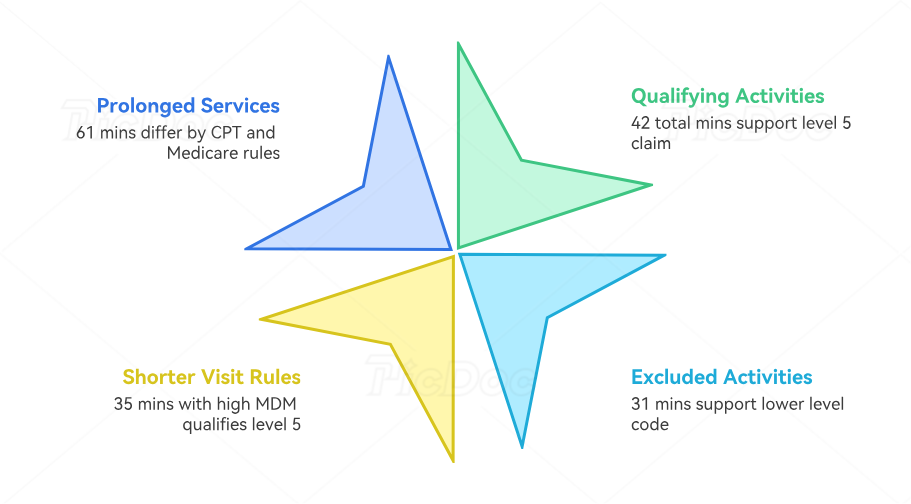
The combined qualifying total is 42 minutes, supporting 99215 by time.
The record should identify the actual total time rather than rely on an automatically generated estimate.
Review time-based cases through medical coding practice scenarios, coding documentation audits, and coding interview preparation.
Which Activities Must Be Excluded?
Time spent performing separately reported procedures cannot also count toward the E/M service.
Routine work performed only by clinical support staff is excluded from the reporting physician's qualifying total. Travel time and unrelated administrative work are likewise excluded.
Consider a physician who documents 46 minutes associated with a visit, including 15 minutes performing a separately billed procedure.
Only 31 minutes remain for E/M time selection, assuming all remaining activities qualify.
That total supports 99214 by time. A higher level may still be appropriate if separately documented MDM supports it.
Such errors can be detected using a medical coding audit checklist and reviewed alongside the modifier 25 versus 59 guide when a separately identifiable E/M service occurs with a procedure.
Can a 35-Minute Visit Be Billed as 99215?
Yes, when the encounter independently supports high-complexity MDM.
A visit can qualify through either MDM or time. The code's time range is not a minimum requirement when MDM determines the level.
For example, a physician may make a high-complexity hospitalization decision for a patient experiencing severe clinical deterioration within a 35-minute encounter.
If two MDM elements reach high complexity and the visit meets other coding requirements, 99215 may be justified.
Conversely, a 35-minute visit involving moderate MDM supports 99214.
This distinction is important in coding interview tests and E/M documentation reviews.
When Can Prolonged Services Be Reported With 99215?
Prolonged-service reporting differs between CPT guidelines and Medicare policy.
For established-patient office/outpatient encounters selected by time:
Under CPT prolonged-service guidelines:
40–54 minutes: 99215.
55–69 minutes: 99215 plus one unit of 99417, when accepted by the payer.
70–84 minutes: 99215 plus two units of 99417.
Under Medicare's G2212 policy:
40–68 minutes: 99215 without G2212.
69–83 minutes: 99215 plus one unit of G2212.
84–98 minutes: 99215 plus two units of G2212.
These thresholds reflect different prolonged-service calculation methods.
Example: A physician spends 61 qualifying minutes on an established-patient office encounter.
Under applicable CPT reporting rules, one unit of 99417 may qualify. Under Medicare's G2212 threshold, 61 minutes supports 99215 alone.
Do not interchange the prolonged-service codes without confirming the payer's policy.
For practical billing, compare the claim against your Medicare billing reference resources, physician fee schedule guidance, and coding audit standards.
5. Documentation, Downcoding, and Audit Strategies for 99215 Claims
Level 5 coding creates additional scrutiny when the documentation does not clearly support high-complexity MDM or qualifying total time.
A reliable audit approach focuses on what the clinician actually evaluated, analyzed, and decided.
The Five-Part Level 5 Documentation Review
1. Verify the patient and service category
Confirm that the patient qualifies as established under the applicable three-year, same-specialty/group criteria and that the encounter belongs to the office/outpatient E/M code family.
2. Identify the coding method
Determine whether the claim is supported by MDM or qualifying time.
If MDM is used, score each element separately. If time is used, confirm the professional's actual qualifying total on the encounter date.
3. Validate problem complexity
Look for a documented severe exacerbation, progression, or genuine threat to life or bodily function when high problem complexity is claimed.
A diagnosis name alone is insufficient evidence of its severity during the encounter.
4. Evaluate data and treatment risk
Identify qualifying data categories and the actual management decisions. Verify that claimed independent interpretations and external discussions meet the applicable criteria.
5. Confirm the final level and correct discrepancies
If two high-level MDM elements are documented, or time supports Level 5, 99215 may be appropriate.
If the documentation supports only moderate MDM and fewer than 40 qualifying minutes, 99214 may be the correct selection.
This workflow integrates naturally with a medical coding audit checklist, physician query templates, and coding accuracy practice cases.
Documentation Example: An Unsupported Level 5 Claim
Physician documentation:
"Patient seen for diabetes, hypertension, and chronic kidney disease. Medications reviewed. Laboratory results discussed. Continue current treatment."
The record identifies several conditions but provides limited evidence of the exact clinical assessment and management work.
It does not establish high problem complexity, extensive qualifying data, or high-risk management from the information shown.
A coding reviewer should determine whether the complete record supports moderate MDM and whether other qualifying information exists.
Do not infer high complexity merely because several chronic conditions appear in the note.
When clarification is warranted, use a compliant physician query, supported by the existing clinical evidence, rather than encouraging a predetermined E/M level.
Documentation Example: A Defensible High-MDM Level 5 Claim
Illustrative physician documentation:
"Patient with worsening heart failure presents with significant respiratory distress and evidence of acute decompensation. After assessment of clinical findings and treatment options, hospital admission is recommended due to the severity of the condition and risk of further deterioration. Discussed the findings and coordinated immediate transfer."
Problems: High due to severe disease progression threatening bodily function.
Risk: High due to the decision regarding hospitalization.
Result: The documented encounter supports high-complexity MDM when the clinical record substantiates the assessment and decision.
This example demonstrates the importance of recording the causal relationship between clinical findings, severity, and management.
Use this approach when developing a medical coding portfolio or preparing for coding auditor responsibilities.
Documentation Example: A Defensible Time-Based 99215 Claim
Illustrative physician documentation:
"I personally spent 46 minutes on the date of this encounter reviewing relevant outside records, evaluating the patient, discussing treatment options, coordinating care, and documenting the management plan. This time excludes separately billed services."
The documented total supports 99215 by time when the claimed activities qualify and were actually performed.
The note does not need to manufacture high-complexity MDM when the time-based method independently supports the code.
Likewise, physicians are not generally required to provide a minute-by-minute activity breakdown under the office/outpatient E/M rules, although payer documentation requirements and organizational policies should be considered.
This is useful for establishing consistent coding documentation procedures and avoiding claim disputes.
Why Payers Downcode 99215 Claims
Downcoding may occur when a payer determines that the submitted service level exceeds the level supported by available information or applicable reimbursement policy.
Common reasons include incomplete documentation, unsupported MDM classification, inadequate time reporting, or inaccurate data counting.
When a payer reduces 99215 to 99214, the billing team should review the remittance, identify the stated rationale, and compare the decision against the complete clinical record.
Do not automatically accept the reduction when the documented encounter satisfies the required criteria.
If the payer's decision is inconsistent with the documentation and applicable policy, prepare a supported reconsideration or appeal.
Use the medical billing appeal templates, CARC directory, and denial root-cause analysis worksheet.
How to Measure Financial Exposure From Level 5 Coding Errors
A coding audit should quantify both unsupported Level 5 claims and properly supported Level 5 visits that were submitted at a lower level.
Consider an illustrative practice that identifies 120 encounters initially reported as 99214 but ultimately validated as supporting 99215.
If the applicable allowed-amount difference is $35 per encounter, the potential difference is:
120 × $35 = $4,200
The actual amount depends on the relevant payer, fee schedule, locality, and claim circumstances.
The same methodology can measure potential overpayments from unsupported Level 5 claims.
Repricing should use applicable physician fee schedule resources, while reimbursement investigations should incorporate the denial rate calculator and clean claim rate analysis.
A Practical Pre-Bill E/M Quality-Control Process
Build a targeted review queue for 99215 claims that contain limited documentation of serious clinical problems, insufficiently described high-risk decisions, or ambiguous time statements.
Reviewers should score problems, data, and risk independently, then verify the final code against the applicable coding method.
Where the documentation is incomplete, use a neutral clarification process.
Where a genuine coding error is identified, correct the claim before submission.
Track findings by physician, service type, error category, and payer outcome. These measurements identify training needs without treating every Level 5 visit as suspicious.
Integrate the results with coding productivity monitoring, medical coding accuracy reviews, and accounts receivable analysis.
6. Frequently Asked Questions About 99214 vs 99215
-
CPT 99214 describes an established-patient office/outpatient E/M encounter involving moderate-complexity MDM or 30–39 minutes of qualifying total time. CPT 99215 requires high-complexity MDM or at least 40 minutes of qualifying time.
High MDM requires at least two high-level elements among problems, data, and risk.
For additional preparation, review medical coding practice cases and the medical coding audit checklist.
-
Yes. High-complexity MDM independently supports 99215 when at least two elements reach the required high level.
For example, a physician treating a severe illness may make a qualifying hospitalization decision during a 30-minute encounter.
A time-based threshold is unnecessary when MDM determines the code.
Practice this distinction through coding interview scenarios and outpatient coding exercises.
-
Ordinary prescription drug management is generally a moderate-risk example.
High risk may apply to drug therapy requiring intensive monitoring for toxicity, but Level 5 MDM still requires a second high-complexity element.
Review the drug's management requirements, documented monitoring, and actual clinical circumstances.
The coding documentation checklist and compliant physician query examples can help resolve unclear cases.
-
Two stable chronic illnesses generally support moderate complexity for the problems element.
They do not independently establish high problem complexity.
However, the overall encounter could qualify for 99215 through high complexity in both the data and risk elements, or by meeting the qualifying time threshold.
Review E/M coding practice scenarios and audit documentation principles.
-
A qualifying hospitalization decision can support high risk.
The overall MDM level still requires another high-complexity element, such as a serious illness posing a threat to life or bodily function or qualifying extensive data analysis.
Document the clinical circumstances, alternatives considered, and reasoning behind the decision.
This is especially important in medical coding audits and physician documentation queries.
-
Forty minutes of qualifying professional time on the date of the established-patient office/outpatient encounter supports 99215 by time.
Qualifying work can include appropriate record review, patient evaluation, counseling, care coordination, and documentation.
Time spent performing separately billed services or staff-only activities must be excluded.
Use medical coding interview preparation and medical coding documentation reviews to practice time-based selection.
