
Two established patients visit the same physician for hypertension. One encounter supports CPT 99213; the other qualifies for 99214. The difference depends on the documented medical decisions, not simply the diagnosis or visit length. Choosing incorrectly can lead to underpayments, payer downcoding, and compliance exposure. This guide explains the exact medical decision-making (MDM) thresholds, documentation requirements, and time rules separating these codes, with worked examples that help coders defend their selections during medical coding audits, claim denial appeals, and reimbursement reviews.

1. CPT 99213 vs 99214: Key Differences in E/M Coding Requirements
CPT 99213 and 99214 represent office or other outpatient evaluation and management services for established patients. Both require a medically appropriate history and/or examination when indicated. The level is selected using either medical decision making or qualifying total physician/qualified healthcare professional time on the encounter date.
The distinction is straightforward:
99213: Low-complexity MDM or 20–29 minutes of qualifying total time.
99214: Moderate-complexity MDM or 30–39 minutes of qualifying total time.
For MDM-based coding, three elements are evaluated: problems addressed, data reviewed and analyzed, and risk of patient management. The encounter must meet or exceed two of the three elements at the selected complexity level.
A coder reviewing two stable chronic illnesses might initially consider 99214 because the problems element reaches moderate complexity. However, if the physician performs no qualifying moderate-risk management and reviews minimal data, the overall MDM may remain low.
Conversely, an encounter involving one worsening chronic illness and documented prescription drug management may satisfy moderate complexity through the problems and risk elements.
These distinctions are frequently tested in medical coding interview assessments, CPC certification questions, outpatient coding practice cases, and coding accuracy reviews.
What Qualifies as Low or Moderate Complexity?
Low-complexity problems include one stable chronic illness, one acute uncomplicated illness or injury, or two or more self-limited or minor problems.
Moderate-complexity problems include two stable chronic illnesses, a chronic illness with exacerbation or progression, an undiagnosed new problem with uncertain prognosis, an acute illness with systemic symptoms, or an acute complicated injury.
The problems element evaluates conditions actually addressed during the encounter. A diagnosis appearing only on the problem list does not automatically count toward MDM.
The data element considers qualifying review, orders, independent interpretations, and clinical discussions. The risk element evaluates the consequences and complexity of management decisions, with prescription drug management being a common example of moderate risk.
For accurate reporting, connect the selected level to the documented clinical work rather than relying on diagnosis count alone. A consistent coding audit checklist, appropriate physician documentation queries, and structured medical coding study resources can help distinguish legitimate 99214 encounters from unsupported level-four billing.
99213 vs 99214: 30 MDM Scenarios and Coding Decisions
| Clinical Encounter | MDM or Time Evidence | Code | Audit Decision |
|---|---|---|---|
| 1. Controlled hypertension follow-up | One stable chronic illness; low-risk management; minimal data | 99213 | Problems and risk support low MDM |
| 2. Diabetes and hypertension monitored together | Two stable chronic illnesses; active prescription drug management | 99214 | Moderate problems plus moderate risk |
| 3. Uncomplicated viral infection | Acute uncomplicated illness; supportive low-risk treatment | 99213 | Low problems and low risk |
| 4. Asthma with an exacerbation | Chronic illness exacerbation; prescription treatment initiated | 99214 | Two moderate MDM elements |
| 5. Stable hypothyroidism, no therapy change | One stable chronic illness; low-risk plan; minimal data | 99213 | Single stable condition supports low problems |
| 6. Hypothyroidism with progression | Worsening chronic illness; clinician adjusts prescription treatment | 99214 | Moderate problems and risk |
| 7. Stable hypertension with medication list review | One stable problem; medication reconciliation only; low-risk management | 99213 | Reconciliation alone does not establish prescription management |
| 8. Hypertension with documented inadequate control | Chronic condition with progression; prescription dose increased | 99214 | Moderate problems plus moderate risk |
| 9. Acute uncomplicated ankle sprain | Uncomplicated injury; low-risk conservative care | 99213 | Low problems and risk |
| 10. Complicated ankle injury | Acute complicated injury; three distinct qualifying data items reviewed or ordered | 99214 | Moderate problems and data |
| 11. Two stable chronic conditions, no active treatment decisions | Moderate problems; limited data and low-risk management | 99213 | Only one moderate element; two elements remain low |
| 12. Two stable chronic conditions with prescription management | Moderate problems; ongoing prescription therapy actively evaluated | 99214 | Moderate problems and risk |
| 13. Uncomplicated cystitis with low-risk management | Acute uncomplicated illness; low-risk approach; minimal data | 99213 | Low problems and risk |
| 14. Diabetes with worsening glycemic control | Chronic illness progression; medication regimen adjusted | 99214 | Moderate problems and prescription risk |
| 15. Stable migraine with conservative plan | One stable chronic illness; low-risk care; minimal data | 99213 | Low MDM supported |
| 16. Migraine with worsening frequency | Chronic illness progression; prescription preventive therapy initiated | 99214 | Two moderate elements |
| 17. Stable eczema with topical nonprescription care | One stable chronic condition; low-risk management | 99213 | Low problems and risk |
| 18. Eczema flare requiring prescription modification | Chronic exacerbation; clinician changes prescription therapy | 99214 | Moderate problems and risk |
| 19. Uncomplicated viral illness with two qualifying tests | Low problems; limited data; low-risk treatment | 99213 | Two or more elements at low level |
| 20. New undiagnosed problem with uncertain prognosis | Moderate problems; three distinct qualifying data elements | 99214 | Moderate problems and data |
| 21. Stable chronic illness with prescription actively managed | Low problems; moderate risk; minimal data | 99213 | One moderate element is insufficient |
| 22. Stable chronic illness with medication management and qualifying external discussion | Low problems; moderate data; moderate risk | 99214 | Data and risk reach moderate |
| 23. Stable back pain, low-risk follow-up | One stable chronic condition; conservative care; 24 qualifying minutes | 99213 | Low MDM and time align |
| 24. Stable back pain requiring lengthy counseling | Low MDM; 33 documented qualifying clinician minutes | 99214 | Time-based selection supports level four |
| 25. One stable chronic illness with limited data review | Low problems; two qualifying data items; low risk | 99213 | All three elements reach low |
| 26. Two stable illnesses with external specialist discussion | Moderate problems; qualifying external management discussion | 99214 | Moderate problems and data |
| 27. Stable chronic condition, 28 documented minutes | Low MDM; 28 qualifying minutes on encounter date | 99213 | Time supports 99213 |
| 28. Low-complexity follow-up, 35 documented minutes | Low MDM; 35 qualifying minutes on encounter date | 99214 | Time independently supports 99214 |
| 29. One stable illness with moderate data review | Low problems; three qualifying data items; low risk | 99213 | Only data reaches moderate |
| 30. Chronic illness exacerbation with treatment limited by SDOH | Moderate problems; diagnosis or treatment significantly limited by documented social determinant | 99214 | Moderate problems and risk, when fully supported |
Illustrative established-patient encounters. All listed MDM decisions assume the documented elements are accurately classified and no additional facts raise or lower the level. Time-based examples assume qualifying physician/QHP time and medically necessary services. Final coding requires the full record and applicable payer rules.
2. How to Apply the Two-of-Three MDM Rule for 99213 and 99214
The most common E/M coding error is treating one moderate-complexity finding as sufficient evidence for 99214. Each of the three MDM elements must be evaluated independently, and the final level is determined by the highest level achieved in at least two elements.
A visit with moderate problems, limited data, and low risk supports low overall MDM, assuming the documentation meets those levels. The encounter reaches moderate MDM only when another element reaches moderate or high complexity.
This principle should guide every medical coding quality review, coder competency assessment, outpatient coding exercise, and physician documentation evaluation.
Element 1: Number and Complexity of Problems Addressed
For 99213, the problems element reaches low complexity when the clinician manages one stable chronic illness, one acute uncomplicated illness or injury, or at least two self-limited or minor conditions.
For 99214, the problems element reaches moderate complexity when the clinician addresses:
Two or more stable chronic illnesses.
One chronic illness with exacerbation, progression, or treatment side effects.
An undiagnosed new problem with uncertain prognosis.
An acute illness with systemic symptoms.
An acute complicated injury.
Example: A patient has controlled hypertension and hyperlipidemia. The clinician actively assesses both conditions. The problems element is moderate because two stable chronic illnesses are addressed.
If both conditions merely appear on the medical history without evaluation or management, the documentation cannot automatically support that moderate problems classification.
A medically complex diagnosis can also coexist with low-complexity decision making during a particular encounter. Coders should distinguish historical disease severity from the decisions actually made that day.
Use compliant physician queries to clarify genuinely ambiguous documentation, reinforce interpretation with medical coding practice cases, and review recurring errors through coding audit checklists.
Element 2: Amount and Complexity of Data Reviewed and Analyzed
The data element frequently determines whether a visit remains at 99213 or reaches 99214, especially when the risk element does not support moderate complexity.
Limited data, the low level, can be supported by either two qualifying items from the tests-and-documents category or an assessment requiring an independent historian.
The qualifying items include review of prior external notes from each unique source, review of results of unique tests, and ordering unique tests.
Moderate data requires meeting at least one of three categories:
Category 1: Any combination of three qualifying items involving unique tests, external notes, or an independent historian.
Category 2: Independent interpretation of a test performed by another physician or qualified healthcare professional, when the interpretation is not separately reported.
Category 3: Discussion of management or test interpretation with an external physician, qualified healthcare professional, or other appropriate source, when the discussion is not separately reported.
For example, a physician managing worsening anemia reviews a previous external specialist note, reviews a qualifying prior test result, and orders a different unique test. These may establish three Category 1 data items, assuming the documentation and nonduplication rules are satisfied.
A single laboratory panel containing many individual results is not necessarily equivalent to multiple unique tests. The applicable CPT test definition and coding rules govern the count.
The same test cannot be counted twice merely because it was ordered during one encounter and the result was later reviewed. An order generally includes the expected review of its result for data-counting purposes.
Document distinct work carefully, especially for coding audit accuracy, coding exam preparation, outpatient coding scenarios, and medical necessity documentation.
Element 3: Risk of Patient Management
Risk represents the potential complications, morbidity, or mortality associated with management decisions made during the encounter. It includes reasonable treatment options that the clinician considered but did not select.
Low risk can involve uncomplicated conservative management. Moderate-risk examples include prescription drug management, certain surgical decisions, and diagnosis or treatment significantly limited by social determinants of health.
Prescription drug management is one of the most important 99214 distinctions.
A documented decision to initiate, adjust, discontinue, or actively continue prescription medication can support moderate risk when it demonstrates actual management of the patient's treatment.
However, the mere presence of a medication list, routine reconciliation, or an automatically generated prescription entry does not independently establish a qualifying management decision.
Consider a physician evaluating a stable chronic condition who actively reviews treatment effectiveness and decides to continue a prescription at its current dosage. That may establish moderate risk, depending on the supporting documentation.
If the problems element is low and the data element is minimal, the overall MDM remains low. Moderate risk is only one element.
This distinction helps prevent unsupported level-four claims and unnecessary downcoding. Practices can validate these decisions using E/M modifier guidance, physician query standards, medical coding audits, and payer denial analysis.
Worked MDM Scoring Example
A physician sees an established patient with diabetes and hypertension. Both conditions are stable and actively managed. The clinician reviews one laboratory result and determines that existing prescription medications should continue after evaluating their effectiveness.
The scoring is:
Problems addressed: Moderate, because two stable chronic illnesses are managed.
Data reviewed: Below moderate, because only one qualifying data item is documented.
Management risk: Moderate, because active prescription drug management occurred.
The final MDM is moderate because two of the three elements reach moderate complexity.
Correct code: 99214.
Now remove the prescription-management decision. Suppose the clinician provides low-risk advice, without another qualifying moderate-risk decision, and reviews only one test result. The problems element remains moderate, but the data and risk elements fall below moderate.
Result: 99213, assuming the record supports low overall MDM.
The clinical conditions are identical. The documented decisions change the code.
3. Real-World 99213 vs 99214 MDM Examples That Coders Must Know
The examples below illustrate how ordinary outpatient documentation affects code selection. Each scenario assumes an established patient and uses MDM as the code-selection method unless otherwise stated.
Case 1: Controlled Diabetes With Routine Follow-Up
Clinical scenario: A patient with stable type 2 diabetes attends a follow-up. The physician reviews blood glucose trends and recommends continued diet and activity measures. No prescription drug management or significant data review is documented.
MDM interpretation: One stable chronic illness establishes low problems. Conservative management supports low risk. The data element is minimal.
Code: 99213.
If the physician actively manages a prescription during the same visit, risk may increase to moderate. The problems element would remain low, so an additional moderate data element would still be needed for 99214 based on MDM.
The distinction matters during medical coding quality audits, risk-adjustment coding reviews, coding competency tests, and documentation clarification.
Case 2: Worsening Hypertension Requiring Medication Adjustment
Clinical scenario: A patient has repeatedly elevated blood pressure readings despite existing medication. The physician evaluates the inadequate control, increases the prescribed dosage, and establishes a follow-up monitoring plan.
MDM interpretation: Worsening hypertension satisfies moderate problems. Active prescription drug management satisfies moderate risk.
Code: 99214.
Three qualifying data items are unnecessary because the problems and risk elements already establish moderate complexity.
Documentation should identify the condition's worsening status, relevant clinical findings, medication decision, and planned monitoring.
This is a useful teaching case for CPC examination preparation, outpatient coding exercises, coding accuracy audits, and reimbursement validation.
Case 3: Two Stable Chronic Conditions Without Moderate-Risk Treatment
Clinical scenario: A physician reviews stable hypertension and osteoarthritis, assesses both conditions, and recommends continued low-risk lifestyle and conservative measures. The data element is limited.
MDM interpretation: Two stable chronic illnesses establish moderate problems. Limited data and low risk remain low-level elements.
Code: 99213.
This is an important audit trap. Two chronic diagnoses can establish the moderate problems element, but overall MDM still requires a second moderate element to reach 99214.
A claim submitted as 99214 solely because two stable chronic illnesses were assessed would lack sufficient MDM support in this scenario.
The case illustrates the importance of coding audit methodology, physician documentation clarity, medical coding practice tests, and claim denial prevention.
Case 4: New Undiagnosed Problem With Uncertain Prognosis
Clinical scenario: An established patient reports an unexplained, clinically concerning symptom pattern. The physician assesses an undiagnosed problem with uncertain prognosis, reviews a qualifying external note, reviews one unique test result, and orders a different unique test.
MDM interpretation: The undiagnosed new problem with uncertain prognosis establishes moderate problems. Three qualifying data items support moderate data.
Code: 99214.
The coder must confirm the problem truly meets the definition of uncertain prognosis. A routine, uncomplicated new symptom does not automatically qualify.
The documentation must also establish which tests were reviewed or ordered and which external note was evaluated.
Use compliant physician query templates, medical necessity checklists, coding audit procedures, and medical coding training examples to evaluate such cases consistently.
Case 5: Stable Asthma With a Prescription Refill
Clinical scenario: A patient with well-controlled asthma attends a follow-up. The physician evaluates treatment effectiveness, confirms control, and renews a maintenance prescription after an active management decision. Minimal data are reviewed.
MDM interpretation: One stable chronic illness supports low problems. Qualifying prescription drug management supports moderate risk. Minimal data remain below low.
Code: 99213, based on the documented MDM.
The prescription renewal supports moderate risk when meaningful clinical management is documented. It does not automatically elevate the overall encounter to 99214.
If the patient's asthma were worsening and the physician adjusted treatment accordingly, the problems element could become moderate, supporting 99214 when combined with moderate risk.
This distinction should be emphasized in medical coding interview preparation, CPC study plans, coding audit reviews, and medical billing claim validation.
Case 6: Management Significantly Limited by Social Determinants of Health
Clinical scenario: A patient has worsening hypertension. The clinician determines that a significant transportation barrier prevents access to necessary monitoring or treatment and modifies the management plan to address that limitation.
MDM interpretation: Worsening chronic illness establishes moderate problems. Diagnosis or treatment significantly limited by a social determinant of health can support moderate risk.
Code: 99214, when both elements are adequately documented.
The record should explain how the barrier materially affected clinical management. Simply listing housing instability, transportation difficulty, or food insecurity does not automatically establish moderate risk.
Accurate classification supports documentation compliance, medical coding accuracy, risk-adjustment reviews, and medical necessity evaluations.
Quick Poll: What Makes 99213 vs 99214 Coding Most Difficult?
Your selection displays tailored audit guidance on this page. Responses are not collected or stored.
4. 99213 vs 99214 Time-Based Coding: When 30 Minutes Changes the Code
Office and outpatient E/M services can be selected using either medical decision making or qualifying total time on the date of the encounter. The two methods are independent, which means a visit with low MDM may still support 99214 when the clinician documents sufficient qualifying time.
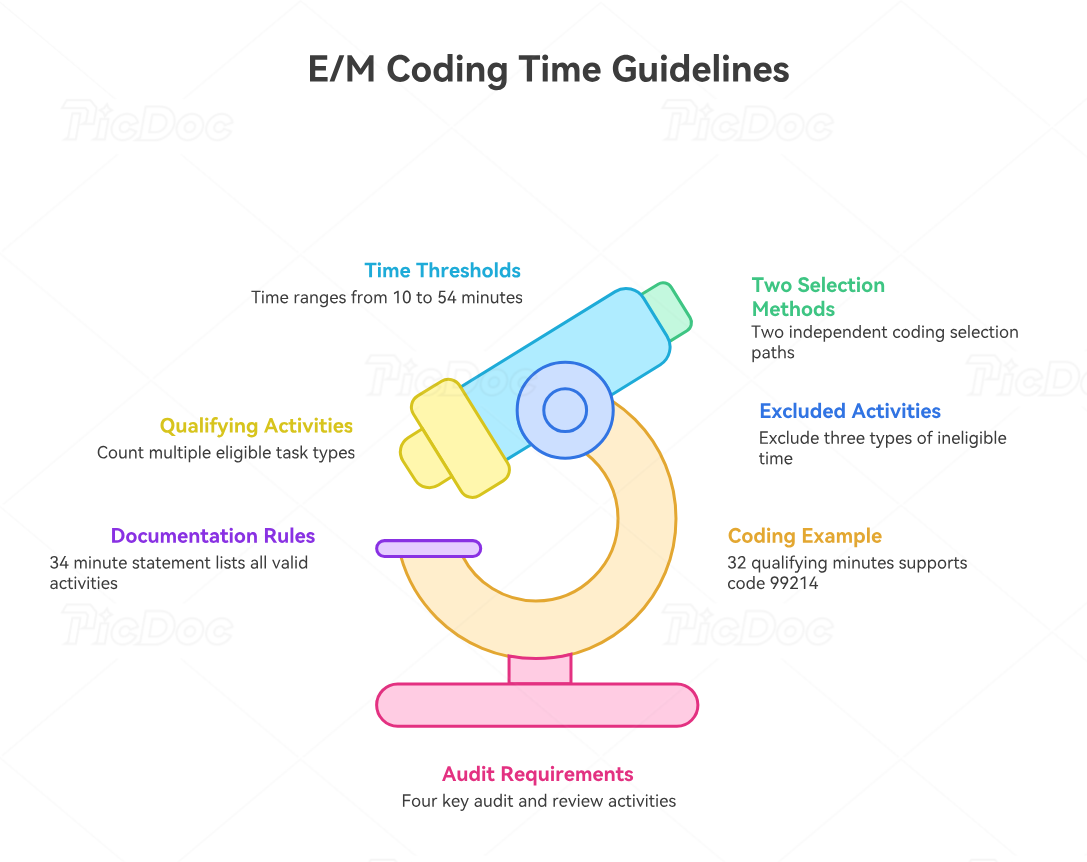
For established patients, the relevant thresholds are:
99212: 10–19 minutes.
99213: 20–29 minutes.
99214: 30–39 minutes.
99215: 40–54 minutes.
The time calculation includes qualifying physician or other qualified healthcare professional work on the encounter date. It may include direct patient contact and certain non-face-to-face activities.
This approach requires accurate time documentation during coding compliance audits, outpatient coding assessments, physician reimbursement reviews, and payer downcoding investigations.
Which Activities Count Toward Total E/M Time?
Qualifying activities can include preparing to see the patient, reviewing clinical records, obtaining or reviewing history, performing a medically appropriate evaluation, counseling, ordering medications or tests, and documenting the encounter.
Time may also include care coordination and communication with other healthcare professionals when that work is part of the E/M service and is not separately reported.
Example: A physician spends 18 minutes examining and counseling a patient, seven minutes reviewing relevant records before the appointment, and seven minutes completing clinical documentation later that day.
Total qualifying time equals 32 minutes.
Code: 99214, when time is used for selection and the service is medically appropriate.
The clinician does not need to spend 30 minutes face-to-face with the patient to qualify for 99214.
However, time spent by clinical staff, work completed on another date, and time attributable to separately billed procedures must be excluded.
The documented total should represent genuine qualifying work. This is essential for medical coding accuracy audits, physician documentation reviews, billing compliance checks, and reimbursement verification.
Time-Based Example: 29 Minutes vs 30 Minutes
Consider two established-patient follow-up visits.
Visit A: The physician documents 29 qualifying minutes. The MDM is low.
Correct code: 99213.
Visit B: The physician documents 30 qualifying minutes. The MDM is also low.
Correct code: 99214, when time is selected as the basis for reporting.
The one-minute difference crosses the applicable CPT threshold, provided all counted time is legitimate and supported.
A clinical note stating only that the appointment lasted approximately half an hour may create uncertainty. A more defensible record identifies the clinician's qualifying total time on the encounter date.
When MDM is used instead, the clinician is not required to meet the corresponding time threshold.
This is why coding practice scenarios, coding auditor training, coding interview preparation, and documentation audits should test both selection methods.
What a Defensible E/M Time Statement Looks Like
A useful time statement identifies the clinician's total qualifying time and connects it to appropriate activities.
For example:
Total physician time on the date of encounter: 34 minutes, including review of relevant records, patient evaluation, counseling regarding treatment options, medication planning, and clinical documentation.
This statement supports time-based review while the rest of the medical record establishes the service performed and its medical necessity.
Documentation should accurately reflect the encounter. Automatically inserting the same time into every note creates audit exposure, particularly when recorded times conflict with clinical workflows.
Time-based coding should be monitored through coding audit checklists, physician documentation education, coding productivity standards, and claim denial analysis.
5. How to Prevent 99213 and 99214 Downcoding, Denials, and Audit Findings
Payer reviews frequently focus on whether the selected E/M level is supported by the documented medical decisions or qualifying time. Even a clinically appropriate service may face a coding dispute when the record fails to establish the reported level.
The most effective preventive approach is to connect each E/M code to its supporting evidence before claim submission.
This requires collaboration between coding teams, physicians, clinical documentation specialists, and billing staff. Recurring issues should be evaluated through medical coding audits, denial root-cause analysis, clean claim monitoring, and medical billing appeals.
Five Documentation Gaps That Create E/M Coding Risk
1. Conditions listed without management evidence. A note showing diabetes, hypertension, and hyperlipidemia does not establish that all three were addressed. The assessment and plan should reflect meaningful evaluation or treatment decisions for counted conditions.
2. Prescription entries without clinical context. A medication list or automatically generated renewal does not adequately explain the clinician's management decision. Documentation should establish the evaluation and resulting treatment decision when prescription drug management is used to support moderate risk.
3. Unsupported data counts. Coders may incorrectly count the same test order and subsequent review as independent qualifying items. A data audit should reconcile unique tests, outside sources, independent historians, and qualifying clinician discussions.
4. Time totals containing excluded work. Staff activities, separately billed procedure time, and work performed on other calendar dates can inflate time-based E/M levels. Review the actual clinician work and applicable exclusions.
5. Modifier 25 used without a separately identifiable service. When a procedure and E/M service occur on the same date, the documentation must support the significant, separately identifiable E/M service required for modifier 25.
These weaknesses can be addressed using E/M modifier decision guidance, modifier 25 versus 59 examples, compliant physician queries, and coding compliance checklists.
Understand the Relationship Between Modifier 25 and G2211
Medicare's office/outpatient E/M visit complexity add-on code G2211 can apply to qualifying longitudinal or ongoing care relationships when its requirements are met.
G2211 does not automatically accompany every 99214 claim, and its use is based on the visit's relationship and inherent complexity rather than the E/M level alone.
Medicare generally restricts G2211 payment when the associated E/M code includes modifier 25. Specific exceptions apply for certain same-day preventive services, including qualifying annual wellness visits, vaccine administration, and other Medicare Part B preventive services.
Coders should verify the current CMS policy and documentation before reporting the add-on code.
Confusing G2211 with an automatic reimbursement enhancement can create claim denials, fee schedule discrepancies, modifier coding errors, and audit findings.
A Practical E/M Audit and Appeal Workflow
When a payer reduces 99214 to 99213, begin by identifying whether the original code was selected through MDM or time.
For MDM-based claims, score all three elements independently and preserve the documentation supporting each one. For time-based claims, verify the qualifying total and associated clinical work.
The audit record should include the original code, payer-adjusted code, documented evidence, reason for the disagreement, corrective action, and eventual appeal outcome.
If the original 99214 is supported, a focused appeal should explain the qualifying MDM elements or time rather than repeating the entire medical note without analysis.
Use established medical billing appeal templates, denial analysis worksheets, medical necessity documentation guidance, and coding accuracy audit procedures to establish a consistent process.
6. Frequently Asked Questions About 99213 vs 99214 Coding
-
CPT 99213 represents low-complexity medical decision making or 20–29 minutes of qualifying total time. CPT 99214 represents moderate-complexity MDM or 30–39 minutes.
Both codes apply to established-patient office or other outpatient E/M services.
The selected level should reflect documented MDM or time and the medical necessity of the visit. Coders can strengthen their knowledge through outpatient coding practice cases, CPC examination resources, coding audit checklists, and medical coding interview examples.
-
Prescription drug management can support moderate risk, but overall MDM requires at least two elements at moderate complexity to qualify for 99214.
For example, one stable chronic illness with documented prescription management and minimal data may still support 99213.
A chronic condition with exacerbation combined with prescription drug management can support 99214 because both problems and risk reach moderate complexity.
Review the documentation using physician query templates, medical coding practice scenarios, and coding audit guidance.
-
Two stable chronic illnesses that are actively addressed meet the moderate problems element.
A second moderate element, such as prescription drug management or qualifying moderate data, is needed to establish moderate overall MDM.
If the other two elements remain low, the encounter generally supports 99213 by MDM.
Accurate classification helps reduce coding audit discrepancies, prevent payer downcoding, and strengthen physician reimbursement compliance.
-
Yes. A qualifying 99214 service can be reported based on moderate medical decision making, regardless of whether the clinician spends 30 minutes.
For example, an established patient with worsening hypertension who requires active prescription drug management may meet moderate MDM in an encounter lasting 18 minutes.
Documenting the two qualifying MDM elements is essential. Use coding compliance review methods, outpatient coding examples, and reimbursement verification procedures to confirm the selected level.
-
Yes, when the clinician performs and documents at least 30 qualifying minutes on the encounter date, and the service satisfies applicable E/M and medical necessity requirements.
The qualifying time can include direct patient contact, clinical record review, counseling, care coordination, and same-day documentation performed by the physician or qualified healthcare professional.
The time of clinical staff and separately billed services must be excluded.
Review potential errors using medical coding audit checklists, physician documentation templates, and payer denial analysis.
-
A detailed history or examination may be clinically appropriate, but office/outpatient E/M levels are selected using MDM or qualifying total time.
The extent of the history and examination should reflect the patient's clinical needs. Additional documentation alone does not increase the MDM level.
This distinction should be reinforced during coding certification preparation, medical coding interview tests, and medical coding accuracy audits.
