
Modifier QW identifies a CLIA-waived laboratory test, but its correct use depends on the test system, applicable CPT or HCPCS code, and facility certification. A missing modifier can trigger a claim denial, while an incorrect one can create serious compliance problems. Even common point-of-care tests may have different billing requirements depending on the device used. This guide explains Medicare's QW rules, identifies tests that require special attention, and provides practical examples to improve medical billing accuracy, prevent claim denials, and strengthen coding compliance.

1. What Is Modifier QW, and When Is It Required for CLIA-Waived Testing?
Modifier QW is a two-character HCPCS Level II modifier meaning CLIA-waived test. It identifies qualifying laboratory procedures performed using test systems classified as waived under the Clinical Laboratory Improvement Amendments of 1988.
CMS uses CLIA edits to determine whether the laboratory performing a service holds the certification appropriate for that test. Modifier QW helps identify applicable tests as waived when the procedure code itself does not automatically communicate that classification.
For medical billing teams, three elements must agree: the procedure code, the actual testing system's waived status, and the certification held by the performing laboratory. A mismatch can create claim rejections, delay accounts receivable collections, and introduce problems identified during medical coding audits.
What does CLIA-waived actually mean?
The Food and Drug Administration (FDA) classifies laboratory test systems according to complexity. Waived tests generally involve simple methodologies with a low risk of erroneous results when performed correctly.
Common examples include certain urine pregnancy tests, blood glucose tests, rapid infectious disease assays, and point-of-care hemoglobin A1c tests.
Waived status is determined by the specific test system and its authorized use. Two devices measuring the same analyte can have different CLIA complexity classifications.
For example, a rapid streptococcal antigen test performed on an FDA-waived device may qualify for waived reporting. A different testing methodology with a moderate-complexity classification cannot become waived simply because the practice appends QW.
This distinction is essential when preparing outpatient coding cases, conducting documentation reviews, and investigating medical necessity denials.
Which laboratories can perform waived tests?
CMS recognizes five principal CLIA certificate types: Certificate of Waiver, Certificate for Provider-Performed Microscopy Procedures, Certificate of Registration, Certificate of Compliance, and Certificate of Accreditation.
All five certificate types permit waived testing, provided the facility meets the applicable requirements.
A Certificate of Waiver allows a site to perform waived tests. It does not authorize routine moderate- or high-complexity laboratory testing. The PPM certificate permits waived tests plus the limited microscopy procedures covered by that certification.
Laboratories performing nonwaived testing generally need the appropriate registration, compliance, or accreditation certificate and must meet additional regulatory requirements.
This distinction matters when an office expands its test menu. A new analyzer can create obligations involving certificate type, staffing, testing procedures, and billing software configuration.
Does every CLIA-waived test need modifier QW?
Some waived laboratory codes are recognized by Medicare without modifier QW. Examples identified in CMS guidance include 81002, 81025, 82270, 82272, and 82962.
Other procedure codes require QW for Medicare to recognize an eligible test as waived. Examples include specific waived test systems billed under 87880, 83036, or 80305.
The billing team must verify the code's current QW requirements and the particular device's FDA categorization.
A dependable workflow begins with the FDA's test-complexity information, continues through the applicable CMS waived-test listing and quarterly updates, and ends with validation against the payer's claim rules.
This reduces the risk of submitting unsupported modifiers and improves first-pass claim acceptance. It also creates clear evidence for coding compliance audits and appropriate billing appeals.
Modifier QW: 35 CLIA-Waived Testing & Claims Decision Examples
| Test / Scenario | QW Decision | Required Verification | Common Billing Risk |
|---|---|---|---|
| 1. CPT 81002: Nonautomated urine dipstick without microscopy | QW generally not required | Confirm exact urine test method and current coding instructions. | Applying QW automatically to an exempt code. |
| 2. CPT 81025: Urine pregnancy test | QW generally not required | Verify urine pregnancy testing and correct procedure code. | Assuming every waived test requires QW. |
| 3. CPT 82270: Qualitative fecal occult blood testing | QW generally not required | Verify method, service, screening versus diagnostic purpose, and coverage. | Using the wrong stool blood testing code. |
| 4. CPT 82272: Other qualitative fecal occult blood testing | QW generally not required | Confirm code definition, circumstances, and Medicare billing instructions. | Confusing different fecal testing services. |
| 5. CPT 82962: Blood glucose by monitoring device | QW generally not required | Confirm monitoring method and applicable coverage requirements. | Adding QW without checking the exception. |
| 6. CPT 85013: Spun microhematocrit | QW generally not required | Check current code validity, method, and CLIA instructions. | Incorrectly treating exemption as universal. |
| 7. CPT 81003: Automated urinalysis without microscopy | QW for eligible waived system when required | Match analyzer and methodology to FDA and CMS listings. | Assuming any automated analyzer is waived. |
| 8. CPT 83036: Hemoglobin A1c | QW when required for waived device | Confirm device-specific CLIA categorization. | Using QW for a nonwaived laboratory method. |
| 9. CPT 87880: Group A streptococcal antigen | QW when required for waived test system | Verify specific kit, methodology, and authorized specimen. | Assuming all rapid strep platforms are waived. |
| 10. CPT 87804: Influenza antigen test | QW when required for waived system | Match device, test format, analytes, and relevant code. | Incorrect units or a mismatched combination assay. |
| 11. CPT 87811: SARS-CoV-2 antigen testing | QW when required for waived system | Confirm FDA-authorized device and relevant Medicare guidance. | Relying on outdated COVID test assumptions. |
| 12. CPT 87812: Combined SARS-CoV-2 and influenza antigen testing | QW for eligible waived system | Verify combination assay and effective waived-test listing. | Using separate single-analyte codes inappropriately. |
| 13. CPT 80305: Presumptive drug testing | QW when required for eligible waived kit | Confirm visual-read methodology and device classification. | Billing per drug rather than according to code rules. |
| 14. CPT 82274: Fecal immunochemical blood testing | QW when required for waived kit | Verify specific product, intended use, and applicable code. | Confusing FIT with other occult blood tests. |
| 15. CPT 87521: Hepatitis C virus testing | QW for specifically approved waived systems | Verify device, molecular method, and relevant effective date. | Assuming all HCV molecular platforms are waived. |
| 16. HCPCS G0567: HCV screening | QW for qualifying waived-laboratory reporting | Apply Medicare's specific coverage and billing instructions. | Missing the 2026 CMS billing clarification. |
| 17. CPT 87494: Chlamydia/gonorrhea molecular assay | QW for specified waived systems | Verify the qualifying test and the January 2026 effective instructions. | Generalizing waiver to other molecular devices. |
| 18. CPT 0352U: Proprietary molecular assay | QW for specifically authorized waived test | Match manufacturer, system, assay, and effective date. | Using a PLA code without product verification. |
| 19. Rapid test performed using a nonwaived device | Do not use QW | Determine actual FDA complexity classification. | Attempting to bypass certification restrictions. |
| 20. Waived device used with an unauthorized specimen | Waived status may be lost | Compare specimen type with authorized instructions. | Reporting modified testing as waived. |
| 21. Manufacturer's procedure modified | Do not assume waiver remains valid | Evaluate the changed methodology and CLIA implications. | Off-label laboratory testing under waiver certificate. |
| 22. Expired CLIA certificate at date of testing | QW cannot cure expiration | Verify certificate validity on service date. | Certification-related denial or compliance issue. |
| 23. Different testing location | Confirm site certification | Match performing location to correct CLIA number or approved exception. | Using headquarters certificate without eligibility. |
| 24. Missing CLIA number on professional claim | Supply CLIA identifier | Validate CMS-1500 Item 23 or correct 837P REF segment. | Credentialing or claim-data rejection. |
| 25. CLIA number belongs to another laboratory | Correct performing-lab data | Verify facility identity, NPI, and certificate. | Provider-certification mismatch. |
| 26. Test sent to an outside reference laboratory | Review performing-lab billing | Identify actual performing lab and any modifier 90 requirements. | Office billing work it did not perform. |
| 27. Repeat waived test medically necessary on same day | Review QW and modifier 91 | Verify medical necessity, separate reportable values, and payer rules. | Duplicate-testing edit. |
| 28. Repeat due to invalid quality control | No extra reportable service solely for rerun | Review QC records and why testing was repeated. | Billing for technical failures. |
| 29. Duplicate test accidentally billed twice | Correct duplicate claim | Compare order, specimen, result, and service records. | Overpayment and duplicate denial. |
| 30. Waived test during an office E/M visit | Evaluate test and E/M separately | Verify each separately reportable service and payer rules. | Assuming QW establishes E/M eligibility. |
| 31. Screening test without applicable coverage criteria | QW cannot establish coverage | Review NCD, LCD, frequency, and beneficiary requirements. | Medical necessity or frequency-limit denial. |
| 32. Multiple analytes on one multiplex cartridge | Select correct combination code | Review CPT descriptor and test methodology. | Unbundling the component analytes. |
| 33. New FDA-waived assay before CMS listing update | Check recognition date | Review FDA status, CMS update, and payer effective date. | Premature use of a new waiver designation. |
| 34. Commercial payer requires QW on a normally exempt code | Follow verified payer policy | Confirm documented payer-specific billing rule. | Applying Medicare rules universally. |
| 35. Denial CO-B7 or N570 involving laboratory certification | Audit CLIA and QW details | Verify certificate type, number, code, and modifier. | Repeated avoidable certification denials. |
Coding reference for educational use. Examples involving QW are conditional on the exact FDA-waived product, method, service date, and applicable Medicare or payer policy. CMS maintains specific QW exceptions. Validate against the current CMS waived-test file, manufacturer instructions, and claim requirements before billing.
2. How to Determine Whether a Test Requires Modifier QW: The Five-Step Decision Process
A reliable QW decision begins with the actual test performed, rather than a commonly used billing code or an existing charge-master template. The same code may represent waived and nonwaived methodologies, making device-specific verification critical.
Step 1: Identify the exact test system and methodology
Record the manufacturer's name, device model, assay, specimen type, and methodology.
A clinic offering rapid infectious disease testing may use a visually read lateral-flow assay, an instrument-read immunoassay, or a molecular platform. These tests can require different procedure codes and complexity classifications despite evaluating the same infection.
Identify the test from the package insert and confirm its current categorization in the FDA's searchable CLIA database.
The strongest coding documentation records the device and method used, while a well-maintained billing software directory or charge master connects the validated procedure to its correct coding configuration.
Step 2: Verify waived status for that particular device
FDA-waived status may apply to a specific manufacturer's test system rather than every assay measuring the same analyte.
Check whether the exact device has waived classification and whether the specimen type and procedural instructions match the approved use.
A common problem occurs when a laboratory replaces its rapid testing device but retains the old code and QW configuration. The new device may have a different complexity classification or require a different methodology code.
That mismatch should be detected before submission through coding compliance reviews, denial trend analysis, and standardized documentation checks.
Step 3: Match the test to the correct CPT or HCPCS code
Procedure code selection depends on the test's methodology, analytes, and technical characteristics.
For example, a urine dipstick without microscopy requires the appropriate urinalysis code based on whether the process is automated. A molecular infectious disease assay should be distinguished from an antigen detection test.
Multiplex testing introduces an additional risk. A single cartridge evaluating several pathogens may correspond to a combination code rather than separate charges for each analyte.
Incorrect code selection can persist even when modifier QW itself is technically appropriate. Train coders using real outpatient scenarios, review coding interview questions, and evaluate procedure coding through medical coding audits.
Step 4: Confirm whether Medicare requires QW for the code
CMS publishes lists of waived tests and quarterly Clinical Laboratory Fee Schedule updates.
The applicable list identifies test systems that qualify for waived reporting and helps determine whether modifier QW is necessary.
Some codes are recognized as waived without QW. Others require QW when performed using qualifying waived systems.
The service date matters. A newly waived test may have a specific effective date, and payer systems may apply updated instructions according to the relevant implementation schedule.
As a useful example, CMS identified CPT 87494QW and 87812QW as new waived-test reporting options effective January 1, 2026. The eligibility applies to the specified waived test systems described in the update.
A formal claim-validation process should use the applicable quarterly file, not a static modifier list copied from a prior year. This reduces clean claim failures and unnecessary appeal activity.
Step 5: Validate the laboratory's certification and payer requirements
Before billing, confirm that the performing laboratory's certificate is valid for the service date, covers the permitted level of testing, and corresponds to the actual performing location.
Then check the payer's instructions for the CLIA number, modifier, procedure code, and related claim information.
A valid waived assay performed at an uncertified or improperly certified location creates a separate compliance problem. Appending QW cannot correct it.
Commercial payers may also have modifier instructions that differ from Medicare's. Record those differences in payer-specific billing guidance rather than changing a universal code rule.
The completed decision should establish five facts: correct device, correct waived status, correct procedure code, correct modifier requirement, and correct laboratory certification.
Organizations can measure compliance through claim acceptance rates, coding audit findings, and denial root-cause reports.
3. Real Modifier QW Coding Examples: Correct Claims, Denials & Compliance Traps
The following scenarios demonstrate how QW rules affect commonly performed point-of-care tests. The examples assume appropriate medical necessity, documentation, and payer coverage unless otherwise stated.
Example 1: Urine Pregnancy Test in an Urgent Care Clinic
Procedure: CPT 81025
Scenario: A patient presents with abdominal pain. The clinician orders a qualitative urine pregnancy test, which is performed and documented during the visit.
Correct coding approach: CPT 81025 is recognized among Medicare's waived-test codes that generally do not require modifier QW.
The practice must still hold the appropriate CLIA certification and correctly document the performed test.
Common error: Automatically appending QW because the test is performed in a waived laboratory.
Some payers may have additional instructions, making payer-specific verification necessary.
When an otherwise valid claim is denied, review whether the problem involves modifier use, certification information, or medical necessity requirements. The findings should inform the practice's coding audit checklist.
Example 2: Rapid Strep Test With a Waived Kit
Procedure: CPT 87880, when the methodology matches the code
Scenario: A primary care office performs a rapid Group A streptococcal antigen test using a specifically FDA-waived test system.
Correct coding approach: Report 87880 with QW when required by the applicable waived-test listing and Medicare instructions.
The record should establish the testing method, qualifying device, and test result.
Common error: Assuming that all rapid streptococcal tests qualify for waiver, regardless of their exact test system.
An instrument-based platform may have different classification requirements. A clinic using that platform must verify its actual waived status.
This example is useful for medical coding practice cases, coding accuracy audits, and identifying billing denial causes.
Example 3: Point-of-Care Hemoglobin A1c Testing
Procedure: CPT 83036
Scenario: A diabetes clinic performs hemoglobin A1c testing using a point-of-care analyzer with an applicable FDA waiver.
Correct coding approach: CPT 83036 with modifier QW may be appropriate when the device qualifies and Medicare requires QW for the specific system.
The office should verify its analyzer model, FDA classification, and current CMS listing.
Common error: A practice purchases a new analyzer and continues to submit 83036-QW without confirming the replacement device's complexity classification.
Testing equipment changes should automatically trigger a charge-master review, updated coding documentation, and validation of the claim submission workflow.
Example 4: Combined COVID-19 and Influenza Testing
Procedure: CPT 87812 for the applicable combined antigen assay
Scenario: An outpatient clinic uses a qualifying waived combination test to detect SARS-CoV-2 and influenza A and B.
Correct coding approach: CMS recognized specific waived test systems reported with 87812-QW beginning January 1, 2026.
The practice must confirm that the assay actually performed matches the code descriptor, manufacturer, and current waived-test requirements.
Common error: Reporting individual COVID-19 and influenza tests separately when the specific multiplex test is appropriately described by the combination code.
Another error occurs when staff assume an assay is waived simply because the device delivers a rapid result.
Review these issues through outpatient coding audits and claim denial analysis.
Example 5: Hepatitis C Screening With HCPCS G0567
Procedure: HCPCS G0567
Scenario: A laboratory performs a qualifying Medicare-covered hepatitis C screening test using the relevant waived testing methodology.
Correct coding approach: CMS clarified in February 2026 that G0567 is payable with QW when billed by qualifying CLIA-waived laboratories and without QW when billed by nonwaived laboratories under the applicable policy. The clarification applies retroactively to June 27, 2024.
This example shows why Medicare code-specific instructions can be particularly important.
Common error: Applying the same QW requirement to every laboratory performing the service without checking the laboratory's certification and CMS instructions.
Organizations with historical HCV screening denials should examine the service date, original claim, laboratory certificate, and applicable CMS clarification.
An eligible claim may warrant a billing reconsideration or appeal, supported by claim adjustment reason analysis.
Example 6: Waived Test Performed Outside the Manufacturer's Instructions
Scenario: A laboratory holds a Certificate of Waiver and uses an FDA-waived test device. Its staff perform the assay on a specimen type outside the test's authorized waived instructions.
Correct coding approach: The modified procedure cannot automatically retain the test's waived classification. Under CLIA, modifying a waived test system's authorized instructions can result in the test being treated as high complexity.
The organization must evaluate the compliance implications before proceeding with or reporting the testing.
Common error: Assuming QW makes any procedure performed on a waived device compliant.
This is a particularly serious issue because the underlying problem involves the testing method and facility certification.
It requires laboratory leadership review, appropriate corrective action, and an assessment of potentially affected claims. These findings should be incorporated into coding compliance reviews and internal documentation procedures.
Example 7: Two Blood Glucose Tests on the Same Day
Procedure: CPT 82962
Scenario: A patient's glucose is measured during an outpatient visit. Later, a genuine clinical change requires a second glucose measurement to guide treatment.
Correct coding approach: CPT 82962 generally does not require QW for Medicare waived-test recognition. Modifier 91 may be appropriate for the medically necessary repeat laboratory service when the requirements are met.
The claim should accurately reflect the separate test results, timing, and clinical rationale.
Common error: Adding QW to justify a second charge or using modifier 91 for a repeat test performed because of an equipment malfunction.
Modifier 91 serves a different reporting purpose from QW. It identifies appropriate repeat clinical diagnostic laboratory testing.
Separate documentation of each test supports medical necessity evaluation and helps prevent duplicate billing denials.
Example 8: A Test Sent to an Outside Laboratory
Scenario: A physician's office collects a specimen and sends it to an independent laboratory for analysis.
Correct coding approach: Identify the laboratory that actually performs the analysis and determine which entity may bill for the service under Medicare and payer rules.
When referring-laboratory billing is permitted, modifier 90 and the performing laboratory's information may be relevant.
Modifier QW depends on the test's qualifying waived status and the applicable reporting policy. Collecting the specimen does not establish that the physician's office performed the laboratory test.
Common error: Billing the analytical test under the office's own CLIA number simply because the specimen was collected there.
This can create incorrect performing-provider information and duplicate billing risk.
Review electronic claims submission rules, maintain a clear billing audit trail, and investigate unusual laboratory claim denials.
Quick Poll: What's causing the biggest CLIA-waived testing problem in your practice?
4. Modifier QW Claims Submission: CLIA Numbers, CMS-1500 Fields & Medicare Denial Codes
Even when a test qualifies for waiver and the modifier is correctly selected, the claim may fail because the performing laboratory's certification information is incomplete or inconsistent.
This makes laboratory identity, CLIA certificate status, and electronic claim configuration essential parts of QW billing.
Where does modifier QW go on a CMS-1500 claim?
Modifier QW accompanies the applicable CPT or HCPCS procedure code.
On the CMS-1500 professional claim form, the procedure code and modifiers are reported in Item 24D.
For electronic 837P claims, the modifier is transmitted within the procedure-code information for the appropriate service line, using the applicable SV101 elements.
For example, a qualifying waived A1c test may be reported as 83036-QW if the device and payer instructions support that combination.
The modifier communicates a test's waived status. It does not substitute for the laboratory's certificate number.
A pre-submission claim scrubber should validate procedure and modifier combinations, while the organization's coding audit checklist should establish which test system was actually used.
Where should the CLIA certificate number be entered?
For Medicare professional claims requiring a CLIA identifier, the CMS-1500 form generally uses Item 23.
Electronic 837P claims report the CLIA number through the appropriate REF segment. A billing laboratory identifier commonly uses qualifier X4, while performing or reference laboratory situations may require an F4-qualified segment according to the applicable claim specifications.
The correct placement depends on whether the submitting provider performed the test directly or the service involved another laboratory.
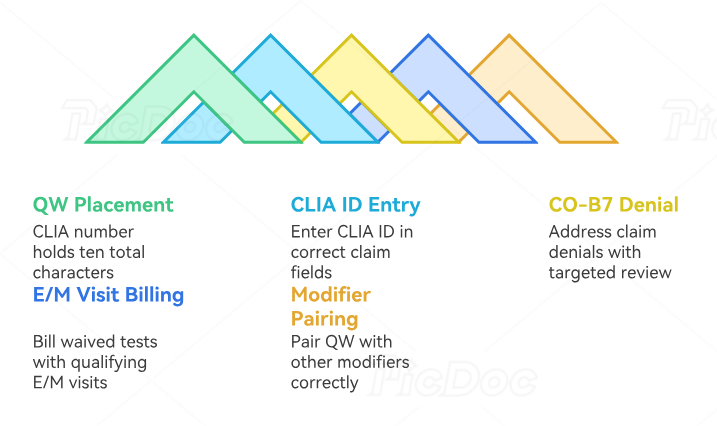
The CLIA identifier is a 10-character certificate number. It must correspond to the appropriate laboratory and be valid for the service date.
A particularly expensive mistake occurs when a multisite medical practice reports the CLIA number belonging to another office.
Each testing location generally needs its own certificate unless it qualifies for a recognized multisite exception.
Billing teams should maintain a location-specific reference file connecting each laboratory's NPI, CLIA number, certificate type, and effective dates. This improves first-pass claim acceptance and simplifies denial investigations.
What does Medicare denial CO-B7 mean?
CO-B7 generally indicates that the provider was not certified or eligible to receive payment for the reported procedure or service on the relevant date.
For laboratory claims, potential causes include an inappropriate CLIA certificate type, invalid certification information, or a QW requirement that was not satisfied.
The related remark code N570 can identify missing, incomplete, or invalid credentialing information.
A denial containing these codes should trigger a focused review of the test, performing laboratory, modifier requirement, and certification information.
For example, a medical office may bill a waived laboratory service correctly but accidentally transmit a CLIA number associated with another site.
The appropriate correction concerns the certificate identification rather than the underlying clinical procedure.
Use the CARC reference directory to investigate the adjustment, then follow the relevant Medicare Administrative Contractor's claim correction or appeal procedures.
Can an office bill for a CLIA-waived test performed during an E/M visit?
A separately reportable laboratory service may be billed during an office visit when all coding, coverage, and payer requirements are satisfied.
QW identifies the qualifying waived-test status. The E/M service must independently satisfy its own documentation and billing requirements.
For example, an office visit involving the evaluation of respiratory symptoms may include a qualifying point-of-care test and a separately reportable E/M service.
The laboratory code should reflect the actual performed assay. The E/M level should reflect the work supported under the applicable E/M guidelines.
Modifier 25 may be relevant to the E/M service in particular circumstances, but it serves a different purpose from QW.
A modifier 25 versus 59 decision guide can help distinguish procedural reporting issues from E/M reporting rules. Practices should also evaluate coding compliance, medical necessity requirements, and payer denial patterns.
How does QW work with modifiers 90 and 91?
Modifier 90 identifies reference laboratory services when applicable. The key issue is determining which laboratory actually performed the test and which entity is permitted to submit the claim.
Modifier 91 identifies an appropriate repeat clinical diagnostic laboratory test performed on the same day to obtain additional medically necessary results.
QW identifies waived testing status and may be relevant alongside another modifier when the applicable reporting requirements support both.
For example, a medically necessary repeat waived test may require evaluation of both the QW requirements and modifier 91 rules.
A repeat test performed because of specimen failure, equipment malfunction, or quality-control problems generally cannot be separately billed merely by adding modifier 91.
These circumstances should be incorporated into medical coding practice cases, claim denial audits, and the organization's billing workflow documentation.
5. The Most Common Modifier QW Errors and How to Prevent Revenue Leakage
Laboratory claim problems should be classified by their underlying cause. A denied waived test can reflect a modifier error, incorrect procedure code, certification mismatch, coverage restriction, or unsupported service.
Treating every rejection as a QW problem leads to repeated corrections and unnecessary rework.
Error 1: Applying QW automatically to every point-of-care test
A common configuration problem involves adding QW to every laboratory service performed at a Certificate of Waiver location.
This approach ignores code-specific exceptions and whether the actual test is waived.
For instance, Medicare generally recognizes CPT 81025 and 82962 as waived without QW. Conversely, certain waived assays reported under 87880 or 83036 may require QW.
Corrective action: Establish a product-level test master that identifies the CPT code, manufacturer, method, waived status, QW requirement, and effective date.
Link the test master to the charge master so staff select the correct code and modifier automatically.
Review exceptions through medical coding audits, and evaluate implementation results using the clean claim rate calculator and denial analysis worksheet.
Error 2: Assuming a test is waived because it is rapid or performed at the bedside
Test complexity is determined by regulatory classification, not convenience, turnaround time, or clinical setting.
A rapid molecular test may qualify for waived testing when its specific system has received the applicable classification. Another device evaluating the same analyte may remain moderately complex.
Corrective action: Require verification of the FDA categorization before adding a new device or test to the clinic's menu.
Maintain supporting documentation for the classification and approved testing instructions.
When a test system changes, update billing software settings, review coding accuracy, and revise relevant staff training materials.
Error 3: Billing waived testing outside the manufacturer's authorized instructions
A Certificate of Waiver requires the laboratory to follow the applicable manufacturer's instructions for waived testing.
Changes to the approved specimen type, testing procedure, or other prescribed conditions can invalidate the basis for waived classification.
This is a particularly serious risk when clinics modify procedures to accommodate available supplies or unfamiliar specimens.
Corrective action: Include a documented review of specimen types, storage conditions, quality-control requirements, operator instructions, and test procedures in the laboratory's quality program.
Investigate deviations immediately and determine whether testing or billing must be suspended while the issue is corrected.
CDC guidance emphasizes that waived testing can still produce clinically consequential errors, especially for tests used to guide anticoagulation or diabetes treatment.
A comprehensive coding compliance audit should therefore evaluate the relationship between test performance and claim accuracy.
Error 4: Using incorrect CLIA information across multiple locations
A medical group may operate several offices, urgent care centers, or testing sites under one corporate organization.
Each location generally requires its own CLIA certificate unless an authorized exception applies.
If the billing system uses one default CLIA number for every location, claims may fail the certification-level edit.
Corrective action: Create a location-specific certification registry that includes the performing laboratory, CLIA number, certificate type, expiration date, NPI relationship, and any authorized multiple-site exception.
Validate the registry whenever a practice opens, closes, relocates, or changes its testing activities.
This helps reduce claim rejections, supports correct electronic claim submission, and prevents unnecessary delays in accounts receivable collections.
Error 5: Confusing a valid QW modifier with guaranteed Medicare coverage
A test may be correctly coded and performed by an appropriately certified laboratory while still failing Medicare coverage requirements.
Coverage can depend on screening eligibility, medical necessity, frequency limitations, diagnosis support, and applicable National or Local Coverage Determinations.
For example, a routine screening assay and a diagnostic assay may have different coverage rules even when similar technologies are involved.
Corrective action: Validate clinical coverage separately from test complexity and modifier eligibility.
When a denial occurs, compare the payer's stated reason with the actual claim and relevant coverage policy.
A supported dispute may require a medical necessity appeal, while other cases may require a coding correction or a billing appeal letter.
Error 6: Failing to distinguish repeat testing from duplicate billing
A medically necessary second laboratory result can be separately reportable when the relevant requirements are satisfied.
A repeat caused by instrument failure, an unacceptable specimen, or routine quality-control activity raises different reporting considerations.
For example, if a glucose test produces a clinically valid result and the patient's condition later changes, a subsequent medically necessary test may qualify for repeat reporting.
If the original test fails to produce a valid result, the additional testing may simply be necessary to complete the original service.
Corrective action: Review separate orders, collection times, test results, and clinical indications before assigning modifier 91 or reporting multiple units.
The same review should evaluate coding documentation, denial reasons, and potential medical necessity deficiencies.
Build a 30-day CLIA-waived billing improvement program
A focused implementation plan can address the highest-risk errors without requiring a complete redesign of the revenue cycle.
Days 1–7: Inventory every point-of-care test. Create a list of devices, assays, manufacturers, methodologies, specimen types, CPT codes, and CLIA certifications. Compare the information with FDA and CMS resources.
Days 8–14: Audit recent claims. Review a targeted sample of waived laboratory claims, including rejected services, frequently reported tests, and claims involving more than one testing location. Identify QW errors separately from other certification or coverage problems.
Days 15–21: Correct system configuration. Update the charge master, modifier defaults, laboratory certification mappings, and payer-specific claim edits. Train the staff responsible for test ordering, performance, coding, and billing.
Days 22–30: Measure and validate. Review a new sample of claims to determine whether the changes reduced avoidable errors. Investigate any residual failures before expanding the test menu.
Useful performance measures include the QW error rate, CLIA-related denial rate, first-pass acceptance percentage, and average time needed to resolve certification denials.
For example, if 24 of 400 laboratory claims are denied for CLIA-related reasons, the observed rate is 6%. If corrective action reduces those denials to 8 among the next 400 comparable claims, the new rate is 2%, representing a four-percentage-point improvement.
This measurement should be paired with a clean claim rate review, denial root-cause worksheet, and AR days analysis.
For lasting improvement, assign clear ownership of device changes, quarterly code updates, certificate renewals, and modifier rules. Include these responsibilities in the organization's coding audit program and ongoing staff education.
6. Frequently Asked Questions About Modifier QW and CLIA-Waived Testing
-
Modifier QW means CLIA-waived test. It identifies certain laboratory services performed using test systems classified as waived under CLIA.
For Medicare, QW is required on specific codes when the qualifying waived status must be communicated through the modifier.
The code and modifier must correspond to the test performed and applicable instructions. These requirements should be checked through medical coding audits and incorporated into electronic claims processing.
-
Medicare recognizes certain waived laboratory codes without QW, including examples such as 81002, 81025, 82270, 82272, and 82962.
Other codes require QW for qualifying waived systems. The correct decision depends on the particular assay, applicable code, and payer instructions.
A reliable coding reference workflow should include current CMS waived-test listings and coding compliance checks.
-
CPT 81025 is among the waived-test codes that Medicare generally recognizes without QW.
The practice still needs appropriate CLIA certification, a correctly documented test, and compliance with applicable billing requirements.
If a payer denies the claim, review its specific policy before modifying the procedure line. A denial analysis worksheet can help identify the actual cause and determine whether a claim correction or appeal is appropriate.
-
CPT 83036 may require QW when hemoglobin A1c testing is performed using a qualifying FDA-waived system and the applicable Medicare billing instructions require the modifier.
A point-of-care analyzer's waived classification must be verified for the specific device and methodology.
The coder should also confirm the appropriate procedure code and certification information. These decisions can be reinforced through outpatient coding cases and a targeted coding audit.
-
CPT 87880 may require QW when the test is performed using a qualifying waived assay.
The exact device and test methodology determine whether waived reporting applies. A rapid turnaround time alone does not establish the classification.
If the testing system is nonwaived, the laboratory must satisfy the certification requirements appropriate to that test.
Verify the specific assay before configuring the billing system or submitting claims through an electronic claims platform.
-
A facility performing clinical laboratory testing on human specimens generally must hold an appropriate CLIA certificate, subject to applicable legal exceptions.
A Certificate of Waiver permits waived testing, and other CLIA certificate types also permit waived testing.
The certificate should be obtained before performing the applicable services and must correspond to the laboratory location or an authorized multiple-site arrangement.
The organization should maintain certificate records as part of its coding compliance program and validate claims before electronic submission.
