
Modifier 76 and modifier 77 determine how medically necessary repeat procedures are reported when the same service is performed more than once. Their correct application depends on who performed the repeated procedure, why another service was necessary, and whether separate reporting is permitted. Confusing these modifiers can trigger duplicate-claim denials, reimbursement delays, and coding audit findings. This guide explains the differences between modifiers 76 and 77, provides real-world radiology, ECG, and surgical coding examples, and outlines the documentation and payer rules needed to support repeat procedure claims.

1. Modifier 76 vs 77: Key Differences and When Each Modifier Applies
The fundamental distinction between these modifiers is the identity of the professional performing the repeated procedure.
Modifier 76 identifies a repeat procedure or service performed by the same physician or other qualified healthcare professional.
Modifier 77 identifies a repeat procedure or service performed by another physician or other qualified healthcare professional.
Both modifiers describe an actual repetition of a procedure. The second service must be separately supported, correctly coded, and consistent with applicable payer policies. Medical coders can strengthen these decisions by reviewing modifier 25 versus 59 coding rules, applying a medical coding audit checklist, and practicing outpatient coding scenarios.
When to use modifier 76
Consider a patient who undergoes a two-view chest X-ray, CPT 71046, at 9:00 a.m. After a deterioration in respiratory status, the same physician performs or reports another complete two-view chest X-ray at 3:00 p.m., under the appropriate billing arrangement.
Assuming both complete services are separately reportable, the claim may contain:
71046: Original chest X-ray.
71046-76: Medically necessary repeat chest X-ray performed by the same physician.
The medical record should explain the clinical change requiring the second examination. Separate examination times and reports help distinguish the repeat from an accidental duplicate claim.
This principle also applies to eligible repeated ECGs, imaging services, and certain procedures. Coding teams should validate the service using medical necessity documentation standards, monitor their clean claim rate, and investigate recurring claim denial patterns.
When to use modifier 77
Now consider a patient who receives an ECG at one outpatient practice and requires another complete ECG later that day at a different practice because of new symptoms. Different physicians perform the two services.
If the second ECG is clinically necessary, identical in coded service, and separately payable under the payer's rules, the second physician may report 93000-77.
The deciding factor is who performed the repeated service. A second physician merely ordering an examination does not automatically establish modifier 77 when the same professional performs both services.
Organizations should verify rendering-provider information through their electronic claims submission system, review coding documentation requirements, and apply medical coding quality controls.
Four questions that determine the correct modifier
Before assigning either modifier, establish the following:
Was the same procedure actually repeated? Compare the full CPT descriptors, including technique, anatomy, extent, and component reported.
Who performed the original and subsequent services? Compare the rendering professionals, accounting for the actual professional or technical component being billed.
Why was repetition necessary? Identify a clinically relevant reason, such as worsening symptoms, a new event, or reassessment following treatment.
Does the payer recognize separate reporting? Review frequency limits, bundling policies, medically unlikely edits, global-period restrictions, and claim-line rules.
A repeat modifier can identify a legitimately distinct service, but it does not independently establish medical necessity or guaranteed reimbursement. This should be reinforced through coding practice cases, coding interview assessments, and routine medical billing compliance reviews.
Modifier 76 vs 77: 35 Repeat Procedure Coding Scenarios
| # | Clinical Scenario | Modifier Decision | Documentation / Billing Requirement |
|---|---|---|---|
| 1 | Same physician repeats a complete chest X-ray after new respiratory symptoms. | 76 | Separate examinations, new clinical indication, same rendering physician. |
| 2 | Different physician repeats an identical chest X-ray after documented clinical deterioration. | 77 | Second performing physician, separate examination and medical necessity. |
| 3 | Same physician repeats a complete ECG to assess a new arrhythmia episode. | 76 | Distinct ECG tracings, times, interpretations and clinical justification. |
| 4 | Another physician performs a new complete ECG during a later encounter. | 77 | Different performer, actual repeat ECG and valid clinical indication. |
| 5 | Same radiologist interprets two separately acquired identical examinations. | 76 | Separate image acquisitions and distinct reports; apply component rules. |
| 6 | Different radiologist interprets a genuinely new second imaging examination. | 77 | Confirm both services, interpretation responsibilities and payer policy. |
| 7 | Different radiologist rereads the same original images solely for routine quality control. | Neither routinely | A routine second reading generally does not support separate payment. |
| 8 | Another physician provides a medically necessary second interpretation of the same original images. | 77 may apply | Exceptional clinical need, separately documented interpretive service and payer approval criteria. |
| 9 | Same physician repeats a head CT after sudden neurological deterioration. | 76 | Two complete scans, distinct times and documented neurological change. |
| 10 | Different physician repeats the same head CT after an acute clinical change. | 77 | Actual second performing service; verify professional and facility billing distinctions. |
| 11 | Two different physicians order imaging, but one professional performs both examinations. | 76 if otherwise eligible | Performing professional determines the distinction, not merely who ordered. |
| 12 | Same physician orders two different radiology procedures. | Neither automatically | Different CPT services require code-specific assessment. |
| 13 | Initial X-ray is one view; the later examination is two views. | Review different codes | Verify actual views, full descriptors and applicable bundling rules. |
| 14 | Same physician repeats an eligible ultrasound during a separate encounter. | 76 may apply | Identical coded study, new clinical indication and separate documentation. |
| 15 | Different physician repeats the same eligible ultrasound in a later encounter. | 77 may apply | Different performer, independently completed study and payer criteria. |
| 16 | Two separately billed ECG interpretations represent one original tracing. | Usually neither | Check whether an exceptional, separately payable second interpretation exists. |
| 17 | Same physician performs two identical procedures during a single continuous session. | Review coding rules | Determine whether the code already represents the complete service or multiple units. |
| 18 | Same physician performs an identical procedure in a later, separate session. | 76 may apply | Confirm two reportable services and any global-period restrictions. |
| 19 | Another physician performs the same procedure in a separate session. | 77 may apply | Document the second physician and why repetition was clinically required. |
| 20 | Same laboratory test is repeated to monitor a changing clinical condition. | 91 generally | Separate medically necessary test results and laboratory-specific rules. |
| 21 | Lab repeats a test because the analyzer malfunctioned. | No repeat modifier for billing | Technical troubleshooting alone does not establish another payable test. |
| 22 | Lab reruns a specimen solely to verify an unexpected result. | 91 generally inappropriate | Review whether the repetition represents quality control rather than a reportable service. |
| 23 | Same surgeon returns to the operating room for a related postoperative complication. | Consider 78 | Confirm global period, relatedness and unplanned return requirements. |
| 24 | Same surgeon performs a planned staged procedure during the postoperative period. | Consider 58 | Document prospective staging or other qualifying circumstances. |
| 25 | Same surgeon performs an unrelated procedure during the postoperative period. | Consider 79 | Demonstrate that the subsequent procedure is unrelated. |
| 26 | Different anatomical sites receive distinct procedures during one encounter. | Anatomic or distinct-service modifier | Review RT, LT, 59 or applicable X modifiers and NCCI policy. |
| 27 | Same procedure is performed separately on paired organs. | Review bilateral coding | Check CPT descriptor, bilateral indicator, anatomical site and units. |
| 28 | Same physician repeats an eligible procedure because symptoms returned hours later. | 76 may apply | Show a new clinical event and separately completed procedure. |
| 29 | Different physician repeats an identical service after a new clinical event. | 77 may apply | Confirm professional identity, new medical necessity and code equivalence. |
| 30 | Same physician submits an identical claim line twice for a single completed procedure. | Neither | Remove the duplicate claim line instead of assigning a modifier. |
| 31 | Repeat procedure lacks an independently documented clinical indication. | Hold for review | Verify clinical necessity and request non-leading clarification when appropriate. |
| 32 | Same physician repeats imaging because the initial images were technically unusable. | Usually neither | Corrective acquisition due solely to technical failure generally is not a new payable service. |
| 33 | Second imaging procedure has a different contrast protocol. | Review actual CPT codes | Different technique may require a different code or may be included in one service. |
| 34 | Three medically necessary identical procedures occur on one day. | 76/77 as applicable | Track performer and time for each repetition; follow payer line-item and unit rules. |
| 35 | Repeat procedure exceeds a medically unlikely edit limit. | Review MUE rules | Determine claim-line versus date-of-service adjudication and supported units. |
Coding note: These are decision scenarios, not automatic reimbursement authorizations. Apply current CPT instructions, Medicare NCCI edits, medically unlikely edits, professional-versus-technical component rules, global surgery policies and individual payer requirements before billing. The modifier is generally attached to the subsequent reportable procedure, not the initial service.
2. Modifier 76 Coding Rules: Repeat Procedure by the Same Physician
Modifier 76 becomes relevant when the same physician or qualified healthcare professional performs an identical reportable procedure again after the original service.
For Medicare outpatient hospital claims, CMS describes its use for repeat services in a separate operative session or encounter on the same day. Professional and commercial payer policies can have additional timing and reporting requirements, so the exact date-of-service rules must be checked.
Rule 1: The repeated procedure must be independently reportable
An additional clinical activity does not always constitute another complete procedure.
For example, if a physician obtains additional X-ray views to complete an examination that was already underway, the services may constitute one study. Similarly, reinserting equipment or making adjustments during a continuous procedure does not automatically generate a second CPT service.
The coder must distinguish the completed procedure from work necessary to finish that procedure. This distinction is especially important in medical coding accuracy audits, outpatient coding assessments, physician documentation queries, and medical necessity reviews.
Rule 2: Document why a second procedure became necessary
A patient receives an ECG at 10:00 a.m. for chest discomfort. The results are evaluated, and treatment begins. At 2:30 p.m., the patient develops a new episode of palpitations, prompting another complete ECG.
The same physician performs and interprets both examinations. If two complete ECG services meet the relevant billing requirements, the coding example is:
93000: First complete ECG.
93000-76: Second complete ECG.
The record should establish the original indication, new symptoms, examination times, and separate results. The medical necessity is supported by the new clinical circumstances, not simply the repetition of an order.
These details are useful when preparing claim denial appeals, reviewing claim adjustment reason codes, and investigating revenue leakage.
Rule 3: Append modifier 76 to the repeat service
The initial claim line should represent the first service without a repeat modifier. The second eligible service receives modifier 76.
When additional identical services occur, the appropriate line structure depends on the payer's instructions and claim-processing edits. Some payers permit combined units under defined circumstances; others require separate claim lines.
Avoid automatically generating several identical repeat-modifier claim lines without reviewing payer requirements, since this may trigger duplicate detection.
A pre-bill review should confirm the units, modifier placement, rendering NPI, and service date through the electronic claims submission platform, supported by clean claim monitoring and denial rate analysis.
Rule 4: Distinguish professional and technical components
Consider two separate chest X-rays performed in a hospital. The facility supplies imaging equipment and technical staff, while a radiologist interprets the studies.
The professional interpretation and technical acquisition may be reported differently. For example, an eligible repeat professional component could require 71046-26-76 under the applicable billing arrangement.
A repeat technical service must independently satisfy the relevant facility and payer requirements. The identity of the interpreting physician cannot automatically determine how every technical component is billed.
Coders should verify the actual component being reported and apply appropriate modifiers in accordance with the physician fee schedule reimbursement rules, professional-fee versus facility coding distinctions, and Medicare billing resources.
Rule 5: Recognize when repeat reporting is inappropriate
A physician performs an X-ray, but the image is unusable because of technical malfunction. The technician repeats the acquisition solely to produce an adequate initial examination.
This situation generally does not support billing two independent complete studies with modifier 76. The extra acquisition represents technical correction rather than a separately necessary clinical procedure.
Similar concerns arise when a test is repeated because of specimen mishandling, equipment failure, or routine quality assurance.
These cases should be reviewed against medical coding compliance standards, medical necessity documentation requirements, and coding practice scenarios.
3. Modifier 77 Coding Rules: Repeat Procedure by Another Physician
Modifier 77 applies when a different physician or qualified healthcare professional performs the same procedure following its initial completion.
The distinction sounds straightforward, but shared medical groups, emergency departments, radiology interpretation workflows, and facility billing responsibilities create common errors.
Rule 1: Identify who actually performed the repeated service
Imagine a patient receiving an ECG at an urgent care clinic in the morning. Later, another physician performs an independently necessary ECG at a separate office following a new episode of chest pain.
If both complete ECG services qualify for separate reporting, the second physician's claim may use 93000-77.
The second service must be an actual repeat. A referral, second order, or consultation alone cannot establish another reportable procedure.
Review the rendering provider, clinical notes, and submitted claim information using the medical coding audit checklist, practice billing system controls, and electronic claim submission guidelines.
Rule 2: Multiple ordering physicians do not establish modifier 77
Suppose Dr. A orders the first X-ray and Dr. B orders the repeat study. Both studies are interpreted by the same radiologist.
The difference between ordering physicians alone does not establish eligibility for modifier 77. The coder must determine who performed the actual reported service.
If the same physician performs both separately payable interpretations, modifier 76 may be the appropriate repeat modifier.
Organizations that use automated modifier rules based solely on ordering-provider identifiers risk systematic errors. These should be identified through coding quality audits, billing denial analysis, and clinical documentation review.
Rule 3: A second interpretation requires additional justification
A radiologist interprets an emergency department X-ray. Another physician subsequently reviews the same image as part of routine quality control.
The second review generally does not create a separately payable interpretation merely because it was performed by a different physician.
Medicare recognizes limited circumstances in which a medically necessary second interpretation may qualify, such as a questionable finding requiring specialized expertise or a second interpretation that materially changes patient management.
For potentially payable second interpretations, the record must establish the unusual clinical circumstances and include a separately documented interpretation and report.
This distinction is essential when auditing radiology coding cases, preparing medical necessity appeals, and reviewing coding documentation compliance.
Rule 4: Shared group practices require additional billing review
Two physicians working for the same medical group may perform separate procedures. The identity of the individual professional matters when determining whether the work was performed by the same or another physician.
However, Medicare and commercial insurers have additional rules concerning provider identity, same-specialty group practices, claim ownership, and service-specific payment.
Therefore, the group tax identification number alone should never be the entire basis for modifier selection.
Coding managers should review both rendering professionals and the relevant payer policy. The correct approach should be incorporated into medical coding training scenarios, billing software configuration, and coding compliance audits.
Rule 5: Confirm the second procedure meets reporting requirements
A patient undergoes diagnostic imaging at one facility. Another facility repeats the examination after the patient develops new symptoms.
The later service may qualify for modifier 77 when the actual rendering professional differs, the same procedure is repeated, and all payer conditions are satisfied.
If the second examination uses a different imaging technique or involves a different service scope, the coder must first determine whether a different CPT code is required.
This prevents a repeated-service modifier from concealing a code-selection error. Apply outpatient coding practice methods, medical billing compliance checks, and physician documentation query standards before finalizing the claim.
Quick Poll: What Causes the Most Repeat Procedure Claim Denials in Your Practice?
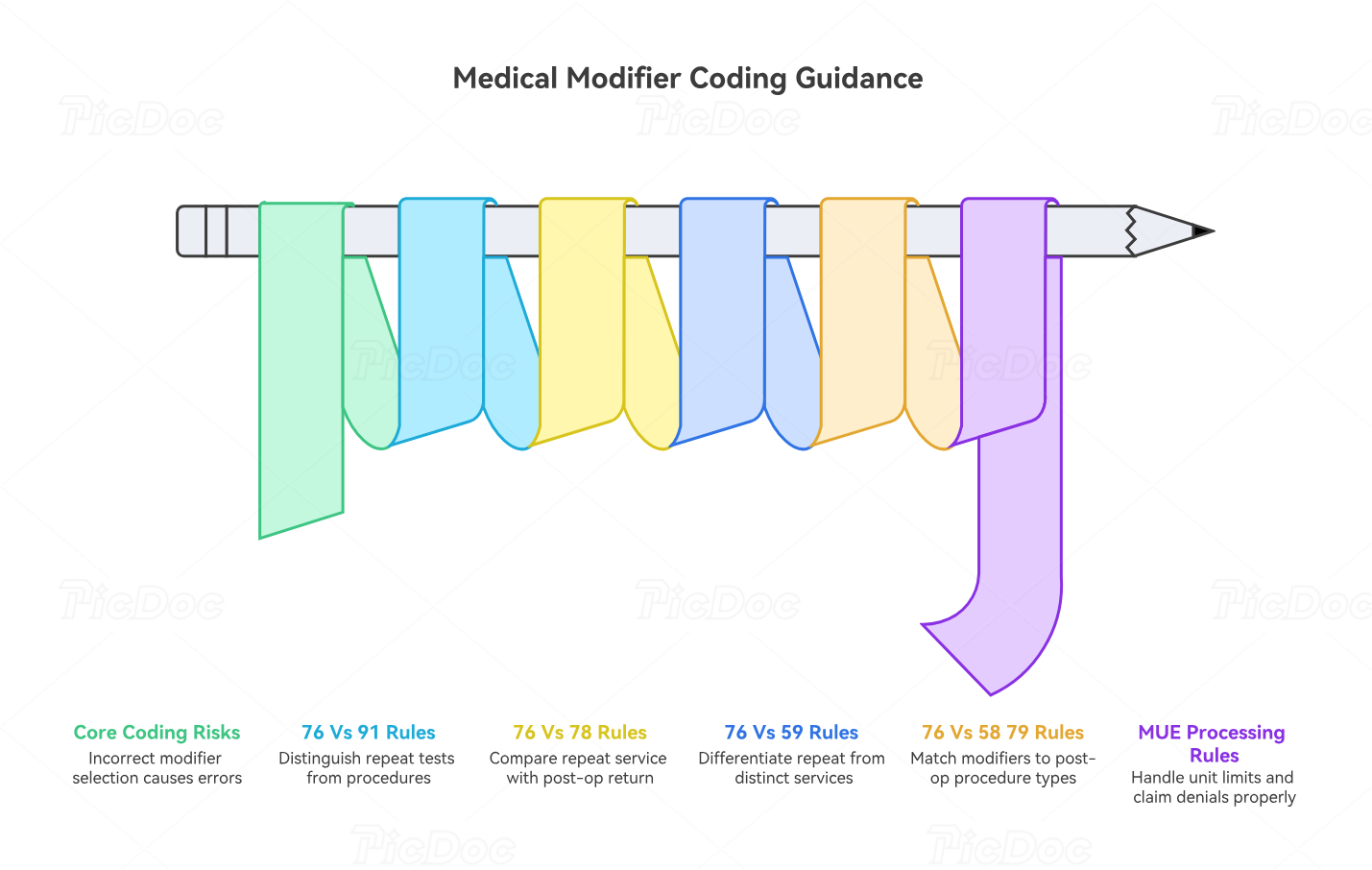
4. Modifier 76 vs 77 vs 78, 91 and 59: Avoiding Costly Coding Errors
Repeat procedure coding becomes more complicated when a second service occurs during a postoperative period, involves clinical laboratory testing, or requires different anatomical reporting.
Selecting a modifier based only on the appearance of two identical CPT codes can lead to improper payment, duplicate denials, and National Correct Coding Initiative (NCCI) conflicts.
Modifier 76 vs modifier 91: Repeated procedures versus laboratory tests
Modifier 91 identifies qualifying repeat clinical diagnostic laboratory testing performed to obtain medically necessary subsequent results on the same day.
Consider a patient undergoing an initial potassium test. The physician orders another potassium measurement several hours later to assess the response to treatment.
When the second test meets the applicable requirements, modifier 91 may distinguish the repeated laboratory service.
A repeat caused solely by specimen deterioration, instrument malfunction, or verification of an initial result generally does not qualify.
This distinction is important for medical coding accuracy assessments, outpatient coding practice cases, medical necessity documentation reviews, and denial rate monitoring.
Modifier 76 vs modifier 78: Repeat service versus postoperative return
Modifier 78 addresses an unplanned return to the operating or procedure room by the same physician or qualified healthcare professional for a related procedure during the postoperative period.
Suppose a surgeon performs an operation and the patient subsequently develops postoperative bleeding requiring an unplanned return to the operating room.
The coder must evaluate modifier 78 based on the global period, relatedness of the second procedure, and circumstances of the return.
If the surgeon simply repeats an identical procedure during a separate reportable session, modifier 76 may be relevant. When the case meets postoperative return criteria, modifier 78 requires specific consideration.
These decisions also involve the principles described in the modifier 24, 25 and 57 E/M guide, medical coding audit checklist, and physician coding query templates.
Modifier 76 vs modifier 59: Repeat service versus distinct procedure
Modifier 59 identifies a distinct procedural service under qualifying circumstances, including independent sessions, anatomical locations, or other supported distinctions.
For example, a physician performs procedures on two separate anatomical sites. Different anatomical modifiers or a qualifying distinct-service modifier may be appropriate depending on the CPT descriptions and NCCI policies.
A repeat procedure modifier describes a different circumstance: an identical service performed again by the same or another professional.
Important NCCI rule: Modifiers 76 and 77 are not NCCI procedure-to-procedure edit bypass modifiers. CMS explicitly excludes them from the modifiers recognized for bypassing those edits.
Therefore, adding modifier 76 or 77 does not automatically resolve a bundled-service denial. A separately reportable service must qualify under the applicable NCCI rules.
Coders should consult the modifier 25 versus 59 decision guide, medical coding compliance checklist, and denial root-cause analysis worksheet when investigating procedure bundling.
Modifier 76 vs modifiers 58 and 79
Modifier 58 identifies qualifying staged, related, or more extensive procedures during the postoperative period. Modifier 79 identifies an unrelated procedure performed by the same physician or qualified professional during that period.
For a planned second-stage operation, modifier 58 may apply. For an entirely unrelated surgical condition treated during an active postoperative period, modifier 79 may be appropriate.
The exact clinical and surgical circumstances determine the selection.
A strong coding workflow reviews surgical documentation, the procedure's global period, and the relationship between services before assigning modifiers. This should be reinforced through coding practice cases, coding documentation queries, and coding compliance audits.
Medically unlikely edits and duplicate-claim processing
Medically unlikely edits (MUEs) limit units of service according to CMS's applicable adjudication rules.
For claim-line MUEs, correctly supported repeat procedures may be reported on separate claim lines using appropriate modifiers. Date-of-service MUEs aggregate relevant units, so adding a modifier to another line does not automatically permit additional units.
Some denials also involve payer-specific duplicate-claim logic, independent of MUE processing.
Billing teams should therefore distinguish a duplicate rejection from a frequency limitation, NCCI edit, or medical necessity denial. This can be achieved through claim adjustment reason code analysis, clean claim rate monitoring, medical billing appeal procedures, and accounts receivable analysis.
5. Repeat Procedure Claim Examples, Documentation Checklist and Denial Prevention
The most reliable way to reduce repeat procedure denials is to examine the entire claim context: the original service, subsequent clinical event, performing professional, separate documentation, and payer processing rules.
Example 1: Two medically necessary chest X-rays by the same physician
Clinical situation: A physician performs a two-view chest X-ray at 8:30 a.m. because of respiratory complaints. The patient's breathing deteriorates later, prompting another complete two-view examination at 4:00 p.m.
Coding approach: Assuming both identical complete services qualify for separate reporting, report 71046 for the original procedure and 71046-76 for the repeat.
Audit focus: Confirm that the medical record contains distinct times, documented clinical deterioration, and separately completed studies. If the professional and technical components are billed separately, validate the applicable component modifiers.
This example can support medical coding interview preparation, outpatient coding case exercises, and coding accuracy assessments.
Example 2: Two ECGs performed by different physicians
Clinical situation: A patient receives a complete office ECG during a morning appointment. Later, worsening symptoms prompt another physician at a different practice to perform another complete ECG.
Coding approach: When the second service is separately reportable and the actual performing physician differs, 93000-77 may be appropriate for the subsequent procedure.
Audit focus: Verify both complete ECGs, the identity of each physician, separate interpretations, and documentation explaining why a second ECG was clinically necessary.
Claims should be checked using electronic billing system controls, medical necessity review standards, and denial trend monitoring.
Example 3: Same radiologist interprets two new studies
Clinical situation: A hospitalized patient undergoes an X-ray in the morning and a separate, identical examination later because of new symptoms. The same radiologist interprets both.
Coding approach: The professional component of the subsequent eligible examination may be identified with modifier 76, together with modifier 26 when appropriate.
Audit focus: Establish that two examinations actually occurred and that each interpretation meets the reporting requirements. A routine reread of the first set of images would require a different analysis.
Train staff through radiology coding practice scenarios, coding audit checklists, and physician fee schedule resources.
Example 4: Second physician reviews an existing X-ray
Clinical situation: An emergency physician interprets an X-ray and documents the findings. A radiologist later reviews the same images as part of a routine departmental process.
Coding approach: Modifier 77 does not independently make the second interpretation payable. Medicare generally permits a second interpretation of the same emergency department X-ray only under unusual, documented clinical circumstances.
Audit focus: Determine whether the later interpretation provided a medically necessary additional service that met the payer's exceptional payment criteria.
Routine quality-control readings should be handled according to applicable facility policy and payer requirements. Review disputed claims through medical necessity appeal guidance, coding documentation review, and billing denial management procedures.
Example 5: Repeat procedure performed after equipment failure
Clinical situation: A diagnostic examination is technically unsuccessful because the equipment malfunctions. The operator repeats the acquisition immediately to obtain an interpretable result.
Coding approach: The additional work generally represents completion or correction of the original service rather than another separately reportable repeat procedure.
Audit focus: Identify whether two independently necessary clinical services occurred or the original service simply required a technical correction.
Organizations can reduce inappropriate billing through medical coding compliance audits, provider documentation training, and outpatient coding practice cases.
Seven-point repeat procedure documentation checklist
Before submitting a claim containing modifier 76 or 77, verify:
The same patient received two independently completed, reportable procedures.
The original and repeated procedures match the applicable CPT service description.
The medical record explains the clinical reason for repeating the service.
Both service times or encounters can be distinguished.
The individual performing each service is accurately identified.
Separate reports, findings, or operative documentation support the subsequent procedure where required.
Payer policies, claim-line requirements, component modifiers, global periods, and applicable NCCI or MUE edits have been checked.
The checklist should be integrated into the medical coding audit workflow, clean claim improvement process, medical necessity documentation review, and coding productivity quality controls.
How to handle a modifier 76 or 77 denial
Begin by identifying the actual payer denial category. A duplicate claim rejection calls for verification of separate services and modifier placement. A medical necessity denial requires evidence explaining the clinical reason for the second procedure. An NCCI edit requires evaluation of the underlying code combination and modifier rules.
For a potentially recoverable claim, assemble the original and repeat procedure records, chronological clinical notes, provider identities, and relevant claim details. Follow the payer's correction, reconsideration, or appeal process as appropriate.
Prioritize repeat procedure denials by dollar impact, frequency, and appeal viability. Use claim adjustment reason code references, denial appeal letter templates, denial rate analysis, and accounts receivable benchmarks to measure whether corrective actions improve reimbursement outcomes.
6. FAQs About Modifier 76 vs 77 and Repeat Procedure Billing
-
Modifier 76 identifies a repeat procedure or service performed by the same physician or other qualified healthcare professional. Modifier 77 identifies a repeated procedure performed by another physician or qualified healthcare professional.
The determination depends on the performing professional and the actual service reported. Both modifiers require appropriate documentation and compliance with payer rules.
Medical coders can strengthen this distinction through coding practice cases, coding interview exercises, and coding compliance audits.
-
Yes. Modifier 76 commonly identifies a medically necessary repeat procedure performed by the same physician or qualified professional on the same day.
For Medicare hospital outpatient reporting, the repeated service generally must occur during a separate operative session or encounter.
The first service is reported without the repeat modifier, while the subsequent eligible service receives modifier 76. Verify the details through electronic claim submission guidance, medical necessity documentation standards, and coding accuracy reviews.
-
Modifier 77 may be applicable when a different physician actually performs a qualifying repeat procedure, including certain circumstances involving physicians in the same group.
However, payer-specific rules concerning provider identity, professional relationships, and billing arrangements can affect claim processing.
Coding teams should verify rendering-provider identities and evaluate the applicable payer policy. Include these situations in medical coding audit reviews, practice billing configuration checks, and coding scenario training.
-
Modifiers 76 and 77 should not be appended to evaluation and management codes.
When multiple E/M services occur, the coder must apply the relevant E/M reporting rules, service settings, and payer-specific policies.
For an E/M service performed alongside a procedure, a different modifier may be appropriate depending on the clinical circumstances. Review the modifier 24, 25 and 57 guide, modifier 25 versus 59 examples, and coding compliance checklist.
-
Modifier 91 generally identifies qualifying repeat clinical diagnostic laboratory testing performed on the same day to obtain subsequent medically necessary results.
For example, repeated potassium testing may be appropriate when clinicians monitor treatment response.
Testing repeated solely because of equipment malfunction, specimen problems, or routine verification generally does not qualify for modifier 91.
Validate the reason for testing through clinical documentation queries, medical coding practice scenarios, and medical necessity audit controls.
-
CMS does not recognize modifiers 76 or 77 as NCCI procedure-to-procedure edit bypass modifiers.
A repeat procedure must independently satisfy the applicable coding and reporting requirements. Modifiers 59, XE, XP, XS, and XU address different qualifying circumstances under NCCI policy.
Coders should review the modifier 25 versus 59 decision guide, apply coding audit standards, and investigate claim denial patterns before changing the modifier.
