
Choosing between POS 02 and POS 10 directly affects Medicare telehealth reimbursement, claim accuracy, and compliance. Since January 1, 2024, Medicare has generally paid eligible home-based telehealth services at the non-facility Physician Fee Schedule rate, while services furnished to patients outside their homes receive the facility rate. Selecting the wrong place-of-service code can therefore produce payment discrepancies, denials, and audit findings. This guide covers CMS billing rules, practical coding scenarios, telehealth modifiers, and 2026–2027 policy changes to help practices improve clean claim rates and revenue cycle performance.

1. POS 02 vs POS 10: What Each Telehealth Place-of-Service Code Means
The distinction between POS 02 and POS 10 depends on where the patient is physically located when the telehealth service occurs. The clinician's location, the practice's mailing address, and the patient's preferred pharmacy do not determine this classification.
CMS defines the two codes as follows.
POS 02: Telehealth Provided Other Than in Patient's Home
POS 02 identifies telehealth services provided when the patient is at a location other than their home.
Examples include a patient receiving a remote consultation while physically present at an eligible physician office, hospital, skilled nursing facility, or other non-home originating site.
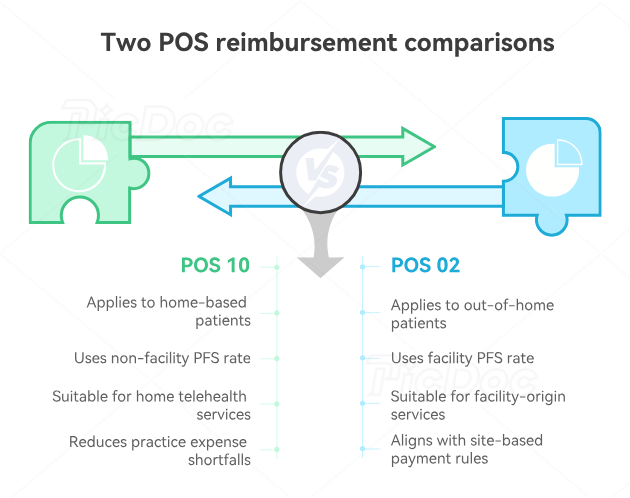
For otherwise payable Medicare professional telehealth services, POS 02 generally produces the facility Physician Fee Schedule payment rate.
This distinction is important because the physician delivering the remote service may be working from a private office or even their own residence. The patient's actual location remains the determining factor.
For example, a cardiologist in a private office remotely evaluates a Medicare beneficiary sitting in a hospital outpatient department. The professional telehealth claim generally uses POS 02, subject to the applicable coverage and billing requirements.
Correct site selection should be included in medical coding audits, electronic claims validation, and medical necessity reviews.
POS 10: Telehealth Provided in Patient's Home
POS 10 identifies telehealth services furnished when the patient is at home, defined by CMS as a private residence rather than a hospital or another facility where the patient receives care.
Typical examples include a patient participating in a covered video visit from their living room, bedroom, or another location within their private residence.
For eligible Medicare Physician Fee Schedule services, POS 10 generally produces the non-facility payment rate.
The distinction matters financially because non-facility practice-expense calculations often differ from facility calculations. The exact payment difference depends on the procedure code, locality, and applicable fee schedule.
For example, a patient receiving an eligible psychotherapy appointment from home generally supports POS 10. A comparable remote appointment with the patient physically present in a medical facility generally supports POS 02.
Practices should verify patient location during the encounter and include it in their coding documentation. This simple control can prevent errors that affect first-pass claim acceptance, denial rates, and subsequent payment appeals.
The key payment difference
Medicare's current standard distinction for eligible professional telehealth claims is:
POS 02: Patient located somewhere other than home; generally paid at the facility PFS rate.
POS 10: Patient located in their home; generally paid at the non-facility PFS rate.
These rules have applied since January 1, 2024. POS 10 originally became effective in 2022, but the specific current Medicare payment treatment began in 2024.
The higher rate, where applicable, must follow the documented patient location. Practices should calculate potential underpayments or overpayments using their applicable physician fee schedule, verify the submitted POS against the clinical record, and monitor discrepancies through accounts receivable reports.
POS 02 vs POS 10: Practical Telehealth Coding Reference Table
The following 35-scenario decision map addresses common encounters, unusual locations, modality questions, billing exceptions, and implementation risks. It is designed to help medical coders identify the appropriate POS and the evidence needed to defend it.
POS 02 vs POS 10: 35 Real-World Telehealth Billing Decisions
| Patient / Service Scenario | POS Decision | Billing Implication | Required Verification |
|---|---|---|---|
| 1. Patient at primary private residence for video visit | POS 10 | Medicare non-facility PFS rate when payable. | Confirm home location and eligible service. |
| 2. Patient at home for covered audio-only behavioral health visit | POS 10 | Home-based telehealth reporting. | Confirm permitted modality and applicable modifier. |
| 3. Patient receives telehealth while physically in physician office | POS 02 | Medicare facility PFS rate when payable. | Verify originating site and professional service. |
| 4. Patient in hospital outpatient department | POS 02 | Facility-rate professional telehealth treatment. | Separate professional and institutional claims. |
| 5. Patient admitted to hospital during specialist teleconsultation | POS 02 | Non-home telehealth location. | Confirm inpatient eligibility and practitioner billing rules. |
| 6. Patient in skilled nursing facility | POS 02 | Non-home originating site for professional telehealth. | Review SNF telehealth and consolidated billing rules. |
| 7. Patient in eligible rural clinic receiving outside specialist consultation | POS 02 | Patient located at clinical originating site. | Review originating-site billing separately. |
| 8. Patient in qualifying community health center | POS 02 | Non-home location for distant professional service. | Verify payer and FQHC-specific requirements. |
| 9. Patient at home, practitioner in hospital | POS 10 | Professional POS follows patient's home location. | Review any special modifier requirement. |
| 10. Patient at home, practitioner at their own home office | POS 10 | Clinician's home does not change patient's POS. | Check provider enrollment and location records. |
| 11. Patient in clinic, remote physician working from home | POS 02 | Non-home patient site controls reporting. | Verify the actual patient location. |
| 12. Patient at home using smartphone rather than desktop computer | POS 10 | Device choice does not alter home POS. | Confirm service and communication requirements. |
| 13. Patient at home using audio-only because video is unavailable | POS 10 if eligible | Modality separately determines telehealth eligibility. | Document video limitations and applicable policy. |
| 14. Patient at home receiving psychotherapy | POS 10 | Home-based behavioral telehealth claim. | Verify code, modality, time, and documentation. |
| 15. Patient in medical clinic receiving psychotherapy remotely | POS 02 | Facility-rate professional telehealth where payable. | Confirm clinic location and service eligibility. |
| 16. Patient receives two telehealth visits, both from home | POS 10 for each | Each eligible professional claim reflects home. | Document separate services and medical necessity. |
| 17. Morning video visit from home, afternoon video visit from clinic | POS 10 / 02 | Different encounter locations support different POS codes. | Preserve encounter-specific patient location. |
| 18. Patient initially at home, later changes physical location mid-visit | Review | One encounter spans differing originating-site circumstances. | Confirm service chronology and MAC or payer guidance. |
| 19. Patient temporarily residing with family in a private home | Usually 10 if it is their home | Private residential status may be relevant. | Determine whether location qualifies as patient's home. |
| 20. Patient in assisted living apartment | Verify 02 vs 10 | Facility classification and residential circumstances matter. | Confirm setting and payer's telehealth site rules. |
| 21. Patient in licensed group home | Verify 02 vs 10 | Home status needs specific assessment. | Document residential arrangement and payer policy. |
| 22. Patient receives video visit while at hotel | Verify location | Temporary lodging may need separate treatment. | Confirm qualifying home definition and payer guidance. |
| 23. Patient receives video visit from homeless shelter | Verify 02 vs 10 | Shelter is a separately identified setting. | Assess residential circumstances and payer rules. |
| 24. Patient receives video visit from workplace | POS 02 | Patient is outside their home. | Verify location and applicable originating-site eligibility. |
| 25. Patient receives video visit while at school | POS 02 | Non-home telehealth location. | Confirm coverage, practitioner eligibility, and payer requirements. |
| 26. Clinician physically examines patient in office | POS 11 generally | In-person service follows office POS reporting. | Check actual setting and visit type. |
| 27. Clinician physically visits patient at home | POS 12 generally | Direct in-home care has its own POS. | Verify in-person service rather than telehealth. |
| 28. Patient sends asynchronous portal message | Service-specific | May qualify as distinct communication technology service. | Verify code-specific POS and payer instructions. |
| 29. Remote physiologic monitoring without synchronous visit | Service-specific | RPM has distinct billing requirements. | Verify monitoring service and reporting rules. |
| 30. Telehealth encounter billed to commercial insurer | Check payer | POS and modifier recognition may differ from Medicare. | Consult current contract and written payer guidance. |
| 31. Telehealth encounter billed to state Medicaid | State-specific | Reimbursement and POS rules vary by state. | Consult state Medicaid and managed-care policy. |
| 32. RHC or FQHC distant-site nonbehavioral telehealth, October 2026 onward | Institutional rules | Individual service code replaces G2025 reporting. | Apply revenue code and 93/95 modifier instructions. |
| 33. Telehealth on qualifying contracted virtual platform, January 2027 onward | 02 or 10 + BB as applicable | New BB reporting requirement does not change POS rate. | Verify contractual platform relationship. |
| 34. Qualifying incident-to telehealth, January 2027 onward | 02 or 10 + BC as applicable | New BC modifier communicates incident-to arrangement. | Confirm incident-to requirements and CMS guidance. |
| 35. POS 02 entered for a patient verified at home | Correct to POS 10 | Potential facility-rate underpayment or accuracy issue. | Verify documentation and use payer's correction process. |
Reference based on CMS professional telehealth place-of-service definitions and current 2026–2027 Medicare policy. Conditional settings require payer or MAC verification. Eligibility, service-specific restrictions, and institutional billing instructions may affect final reporting.
2. How to Choose POS 02 or POS 10: A Practical Telehealth Coding Decision Tree
A dependable decision process identifies the patient's location, confirms that the service qualifies for telehealth reimbursement, and then applies the correct payer-specific claim requirements.
Step 1: Determine where the patient was physically located
Ask the patient to identify their location at the time of the encounter.
A patient may have a home address on file while temporarily staying in a nursing facility, hospital, hotel, or another location. The address stored in the EHR may therefore differ from the site where care was received.
For Medicare professional telehealth services, select POS 10 when the patient was at their qualifying home and POS 02 when the patient was somewhere other than home.
Example: A patient lives in an apartment but attends a video consultation while physically present at an outpatient clinic. POS 02 reflects the location of the encounter.
Documenting the actual location is an important part of medical coding accuracy. It also prevents incorrect claim configuration that can increase denial rates and delay accounts receivable collections.
Step 2: Establish whether the location qualifies as the patient's home
A straightforward private residence typically supports POS 10. More complex residential arrangements require additional investigation.
Patients may reside in assisted living communities, group homes, temporary accommodations, or family members' residences.
The classification should reflect whether the location meets CMS's definition of the patient's home. An assisted living building, for example, may contain private residential units while also operating as a licensed care facility. A coder should investigate the circumstances and applicable payer guidance before selecting POS 10.
For uncertain locations, document the residential arrangement, facility classification, and guidance supporting the final coding decision.
This is especially important for behavioral health practices, senior-care providers, and organizations conducting remote coding audits.
Step 3: Confirm that the service qualifies as Medicare telehealth
POS selection alone does not establish eligibility for payment.
The reported service must qualify under the applicable Medicare telehealth rules, including requirements involving the procedure code, furnishing practitioner, patient location, and communication technology.
CMS maintains a list of eligible Medicare telehealth services. Some services are permanently recognized, while others have temporary status or service-specific restrictions.
For example, an eligible real-time video E/M encounter may follow standard POS 02 or POS 10 reporting. An asynchronous portal interaction or remote physiologic monitoring service has distinct reporting rules and may require a different approach.
Medical coders should check the actual service definition before assigning a telehealth POS.
This decision is particularly relevant when preparing outpatient coding examples, reviewing medical necessity, and validating electronic claims.
Step 4: Verify the communication modality and applicable modifier
A video encounter and an audio-only encounter may share the same POS when the patient is at the same location.
However, the communication method can affect whether the service qualifies for coverage and which modifiers must be reported.
Modifier 93 identifies certain synchronous audio-only telemedicine services. Modifier 95 identifies synchronous real-time audio-video telemedicine services when required.
For Medicare professional claims, apply the current service-specific modifier instructions. Special requirements exist for certain hospital-based services and other billing arrangements.
For RHCs and FQHCs, revised distant-site telehealth billing instructions took effect on October 1, 2026.
This separation of location, modality, and billing arrangement helps prevent inappropriate claim edits and strengthens coding compliance.
Step 5: Validate the payer and professional claim format
Medicare Fee-for-Service guidance provides the baseline for the POS 02 versus POS 10 distinction, but commercial insurers, Medicaid programs, and Medicare Advantage plans may have additional reporting requirements.
Verify the payer's accepted telehealth codes, modifier policy, applicable reimbursement methodology, and location restrictions.
For standard CMS-1500 professional claims, the POS appears in Item 24B. In the electronic 837P format, the place of service is reported in the applicable claim or service-line location field.
The claim should accurately reflect the patient's site at the time care was furnished.
Organizations using multiple electronic claims submission platforms should test how each system transmits POS values. A mismatch between the EHR and clearinghouse can create avoidable denials even when the coder's original selection was correct.
3. POS 02 vs POS 10: Real Telehealth Coding Examples and Difficult Scenarios
The following examples illustrate the decisions that most commonly create confusion in billing departments. Each assumes the service meets the applicable telehealth coverage and practitioner eligibility requirements.
Example 1: Primary Care Video Visit From Home
Clinical scenario: A Medicare beneficiary with hypertension participates in a follow-up video visit from their living room. The physician works from a medical office.
Correct POS: 10
The patient is physically located in their private residence. The physician's office location does not change the POS selection.
If the covered professional service is payable under the Medicare Physician Fee Schedule, POS 10 generally results in the non-facility rate.
The claim still requires appropriate E/M coding, documentation, and any applicable telehealth modifier.
For instance, the clinician may select an established-patient E/M code supported by medical decision-making or qualifying total time. The correct level should be established through the applicable 99213 versus 99214 decision rules and relevant coding documentation requirements.
Example 2: Remote Specialist Consultation While the Patient Is in a Hospital
Clinical scenario: A hospital patient receives a real-time video consultation from a specialist working at another location.
Correct POS: 02 for an otherwise eligible professional telehealth claim
The patient is in a hospital, which is outside the home classification.
The billing team must determine whether the specific inpatient or outpatient professional service is eligible for telehealth reporting and whether any special billing restrictions apply.
Professional and institutional claims should be evaluated separately. A hospital's facility billing rules can differ from the distant practitioner's professional claim requirements.
This distinction matters when reviewing claim submission errors, preparing medical necessity appeals, and performing compliance audits.
Example 3: Psychotherapy Delivered to a Patient at Home
Clinical scenario: A licensed and eligible mental health practitioner conducts a 45-minute psychotherapy session using real-time audio-video technology. The patient participates from home.
Correct POS: 10
POS 10 identifies the patient's home location. The appropriate psychotherapy procedure code depends on the actual service and documented time.
Medicare provides permanent telehealth flexibilities for certain behavioral health services, although other requirements must still be satisfied.
As of the current 2026–2027 extension, the relevant in-person visit requirements remain suspended through December 31, 2027.
For mental health practices, clear documentation should establish the patient location, communication method, clinical service, and time requirements.
These facts support coding accuracy audits, medical necessity documentation, and defensible billing appeals.
Example 4: A Patient Receives Telehealth While Staying With Relatives
Clinical scenario: An elderly patient temporarily lives with their daughter while recovering from illness. The patient participates in a video appointment from the daughter's private residence.
POS decision: Evaluate whether the residence qualifies as the patient's home.
If the daughter’s residence genuinely functions as the patient's home during the encounter, POS 10 may be appropriate.
The determination should be supported by the patient's documented residential circumstances and applicable Medicare or payer guidance.
The patient's permanent mailing address may differ from their actual living arrangement.
This issue becomes especially important for practices serving patients with changing living circumstances. A location-verification procedure can reduce questionable POS coding decisions and related payment corrections.
Example 5: Telehealth in a Skilled Nursing Facility
Clinical scenario: A skilled nursing facility patient receives a remote consultation from an eligible physician.
Correct POS: 02 for the distant practitioner's qualifying professional telehealth service
The patient's physical location is a skilled nursing facility.
The claim must also comply with the specific telehealth service requirements, applicable billing restrictions, and any relevant facility or consolidated billing provisions.
The facility may have separate reporting obligations when it serves as an eligible originating site.
The distant practitioner's claim and the facility's claim should be evaluated independently to prevent overlapping or unsupported charges.
For organizations managing nursing facility encounters, this distinction belongs in the coding audit checklist and denial root-cause worksheet.
Example 6: Audio-Only Telehealth When a Patient Cannot Use Video
Clinical scenario: A Medicare beneficiary at home cannot operate video technology. An eligible practitioner provides a covered service using a real-time audio-only connection.
Correct POS: 10, when the service qualifies for audio-only coverage
The patient's home location supports POS 10. The communication method determines whether audio-only reporting is permitted.
Medicare's current flexibilities extend qualifying audio-only telehealth access through December 31, 2027. Permanent provisions also permit certain home-based services to use audio-only technology when the practitioner can provide audio-video communication and the patient cannot use or does not consent to video.
The claim must follow the applicable audio-only modifier instructions.
Medical records should document the communication method and any circumstances required for eligibility. This supports medical necessity reviews and helps resolve telehealth denial disputes.
Example 7: Same Patient, Two Locations, One Date
Clinical scenario: A patient completes a morning telehealth appointment from home. Later that day, they receive a different, separately reportable telehealth service while physically present at an outpatient clinic.
Correct POS: 10 for the home encounter and 02 for the clinic encounter.
Each service line should reflect the physical location associated with its encounter.
The billing team must also establish that both services qualify for separate reporting. Depending on the circumstances, same-day service restrictions, procedure-to-procedure edits, and other billing requirements may apply.
A change in POS does not independently justify billing two services.
Review the encounter dates, times, locations, diagnoses, and actual clinical work. These details help avoid duplicate claim denials and support medical coding audit findings.
Example 8: Telehealth From an Assisted Living Facility
Clinical scenario: A resident participates in a virtual follow-up from an apartment within an assisted living community.
POS decision: Review the setting and payer-specific home classification.
The facility's licensing status, the nature of the patient's private living space, and the applicable program rules can affect the assessment.
The coding team should document whether the patient's location qualifies as their private residence under the relevant telehealth policy or is classified as another facility setting.
When the circumstances are unclear, consult the Medicare Administrative Contractor or other applicable payer before establishing a standardized POS rule.
This type of issue should be flagged in coding compliance reviews, particularly when facility names are automatically imported into the claim's billing software.
Quick Poll: What is your biggest POS 02 vs POS 10 telehealth billing problem?
4. How POS 02 and POS 10 Affect Medicare Reimbursement, Modifiers & 2027 Rules
The financial consequences of POS selection extend beyond simple claim formatting. For eligible professional telehealth services, the POS determines which Medicare Physician Fee Schedule practice-expense payment category generally applies.
POS 10 reimbursement: The non-facility payment rate
Beginning January 1, 2024, Medicare began paying eligible professional telehealth services furnished to patients at home using the non-facility PFS rate.
That rate can exceed the facility rate because of differences in the practice-expense component of physician payment.
Consider a hypothetical service with these Medicare allowed amounts:
Non-facility rate: $118
Facility rate: $94
Difference per service: $24
If 100 qualifying home-based telehealth claims were incorrectly submitted with POS 02 instead of POS 10, the hypothetical difference in allowed amounts would be $2,400.
These figures are illustrative. Actual reimbursement depends on the CPT or HCPCS code, geographic locality, applicable conversion factor, payer rules, and other adjustments. Some services may have equal or otherwise different payment amounts across settings.
Practices should compare their actual physician fee schedule reimbursement with the original claim details before pursuing corrections.
A focused review can reveal potential revenue leakage, incorrect accounts receivable balances, and recurring POS coding errors.
POS 02 reimbursement: The facility payment rate
For qualifying professional Medicare telehealth services furnished to patients outside their homes, POS 02 generally produces the facility PFS rate.
The rate difference reflects Medicare's payment methodology rather than a judgment about the clinical value of the service.
For example, a qualifying consultation provided remotely to a patient physically present in a hospital outpatient department generally supports POS 02.
A physician may have performed the same clinical work as during a home-based encounter, but the patient's physical location determines the applicable POS classification.
Billing teams should verify the patient site before assessing the payment result. Unsupported changes from POS 02 to POS 10 can introduce overpayment and compliance risks.
For questionable payments, use a structured coding audit checklist and appropriate claims correction procedures.
Telehealth modifiers 93, 95, FQ, BB, and BC
POS codes and telehealth modifiers communicate different information.
Modifier 93 identifies synchronous telemedicine furnished through telephone or another real-time interactive audio-only telecommunications system.
Modifier 95 identifies synchronous telemedicine furnished through real-time interactive audio and video technology.
Modifier FQ is associated with applicable Medicare audio-only reporting, particularly under specified RHC and FQHC billing arrangements.
Modifier requirements depend on the service, billing provider, payer, and date of service. Medicare professional telehealth claims generally rely on POS 02 or POS 10 for location reporting, while particular services and institutional arrangements may require additional modifiers.
Two additional modifiers become important on January 1, 2027:
Modifier BB: Required for certain telehealth services furnished through a virtual platform under a qualifying contract or payment arrangement with the entity owning that platform.
Modifier BC: Required for qualifying telehealth services furnished incident to a physician's or practitioner's professional service.
CMS established these reporting requirements in the CY 2027 Medicare Physician Fee Schedule final rule published November 9, 2026.
The BB and BC modifiers do not independently change the payment rate. Practices must verify their applicability and implement the appropriate claim-reporting instructions by the effective date.
For organizations using contracted telehealth platforms, this creates an immediate need to review billing software configuration, coding compliance controls, and electronic claims submission.
Important October 2026 change for RHCs and FQHCs
Rural Health Clinics and Federally Qualified Health Centers have special Medicare billing rules.
For dates of service beginning October 1, 2026, CMS requires RHCs and FQHCs to report individual CPT or HCPCS codes for qualifying distant-site nonbehavioral telehealth services instead of the previously used G2025 code.
These claims require the appropriate revenue code and either modifier 93 for qualifying audio-only services or modifier 95 for synchronous audio-video services.
Behavioral health visits and other RHC/FQHC services remain subject to their applicable payment and billing methodologies.
This distinction is essential because institutional RHC/FQHC claims should follow the specific program instructions rather than automatically copying standard professional POS reporting.
A practice transitioning its billing should test the individual service codes, modifiers, revenue codes, and payer edits. Review the outcomes through denial rate analysis, clean claim monitoring, and medical coding audits.
Medicare telehealth flexibilities through December 31, 2027
Federal legislation enacted in February 2026 extended several Medicare telehealth flexibilities through December 31, 2027.
These include expanded originating-site access, suspension of geographic restrictions for qualifying nonbehavioral telehealth, an expanded range of eligible practitioners, and continued audio-only access under applicable conditions.
Beginning January 1, 2028, certain statutory restrictions may again apply unless subsequent legislation changes them. Behavioral health services have additional permanent provisions and specific exceptions.
Billing departments should monitor these dates while maintaining the correct distinction between patient location and service eligibility.
The updated policies should be incorporated into coding training materials, compliance reviews, and medical billing workflows.
5. Common POS 02 and POS 10 Billing Errors: Audit Checklist and Prevention Workflow
The most damaging telehealth POS errors often originate before the claim reaches a medical coder. Registration staff, scheduling templates, EHR defaults, and automated claim-mapping rules can all introduce an incorrect location.
A successful prevention program identifies where the error enters the workflow and establishes controls that detect it before submission.
Error 1: Automatically applying POS 02 to every telehealth encounter
Some practice management systems continue to use POS 02 as their default telehealth location.
This configuration can create inaccurate claims when patients receive covered services from home.
Corrective action: Configure telehealth claims to require the patient's documented location rather than automatically applying one POS to every encounter.
The encounter should include a clear home-versus-non-home selection, with additional review when the location is ambiguous.
Monitor results through a clean claim rate calculator and a focused coding accuracy audit.
Error 2: Using the practitioner's physical location
A physician may conduct telehealth appointments from a hospital, home office, or separate medical facility.
The location used for POS 02 versus POS 10 reporting should correspond to the patient's actual site.
For example, a cardiologist working from home who remotely evaluates a patient at a clinic generally reports POS 02 for an eligible professional telehealth service.
Corrective action: Separate the practitioner-location field from the patient-location field within the EHR.
This distinction should be included in coding practice cases and reviewed during claims processing audits.
Error 3: Using the patient's registered home address
A patient's permanent residential address may be accurate for registration but irrelevant to the location of a particular encounter.
Patients frequently receive telehealth from hospitals, clinics, nursing facilities, and other settings.
Corrective action: Require staff to verify and document where the patient is physically located at the beginning of each telehealth encounter.
For complicated cases, record enough information to determine whether the location qualifies as a private residence or another site.
This supports clinical documentation quality and reduces preventable denial rework.
Error 4: Confusing audio-only eligibility with the place-of-service code
The POS describes the patient location, while the communication modality determines whether the encounter satisfies applicable telehealth rules.
An eligible audio-only encounter with the patient at home may use POS 10. A covered video service with the patient at a non-home location generally uses POS 02.
Corrective action: Create separate EHR fields for the communication method and physical patient location. Apply the correct code and modifier requirements after confirming both.
Test these fields through medical coding audits and electronic claim validation.
Error 5: Treating every virtual service as Medicare telehealth
An asynchronous message, remote monitoring service, telephone communication, and real-time video E/M encounter can represent different types of billable services.
The applicable procedure code, coverage policy, and reporting instructions determine the correct claim format.
Corrective action: Verify the service's eligibility and coding rules before applying POS 02 or POS 10.
For high-volume practices, configure separate charge-master pathways for synchronous Medicare telehealth and other communication-based services.
This distinction improves medical necessity reviews and supports accurate claim rejection analysis.
Build a 30-day POS coding quality improvement plan
Week 1: Identify current errors. Export recent telehealth claims, including CPT or HCPCS code, POS, payer, rendering provider, payment amount, and denial status. Compare a sample against actual patient-location documentation.
Week 2: Investigate financial consequences. Separate incorrect POS 02 claims from incorrect POS 10 claims. Evaluate potential underpayments and overpayments using applicable fee schedule rates and supported claim data.
Week 3: Correct workflows. Update EHR location prompts, payer-specific claim edits, documentation templates, and clearinghouse validation rules. Test the October 2026 RHC/FQHC requirements where applicable.
Week 4: Re-audit new claims. Verify whether corrected workflows produce accurate POS values, fewer denials, and more consistent payment outcomes. Establish ownership for January 2027 BB and BC modifier changes.
A practical initial audit could include 100 telehealth claims across specialties, patient locations, and major payers.
If 18 claims contain confirmed POS errors, the sample error rate is 18%. Following corrective action, a new sample can measure whether the rate improves.
Categorize findings into registration errors, documentation gaps, coding mistakes, payer configuration problems, and incorrect payment adjustments.
The findings should feed into a standard medical coding audit checklist, a denial root-cause analysis worksheet, and an accounts receivable performance review.
For historically underpaid claims, determine whether a corrected claim or another payer-recognized adjustment is appropriate. Unsupported payments should be investigated through the organization's compliance process.
This provides a defensible method for improving claim accuracy, reducing denial-related costs, and protecting long-term revenue cycle performance.
6. Frequently Asked Questions About POS 02 and POS 10 Telehealth Billing
-
POS 02 identifies telehealth services furnished when the patient is located somewhere other than home. POS 10 identifies telehealth services furnished when the patient is located in their qualifying private residence.
For otherwise payable Medicare Physician Fee Schedule telehealth claims, POS 02 generally receives the facility rate, while POS 10 generally receives the non-facility rate.
The patient's physical location should be confirmed during the encounter and supported by the medical record. Organizations should review these decisions through coding audits and clean claim monitoring.
-
For many Medicare professional services, the non-facility rate associated with POS 10 exceeds the facility rate associated with POS 02.
The precise difference depends on the procedure code, locality, and current Physician Fee Schedule. Some codes may have identical facility and non-facility allowances.
Practices should compare actual amounts through the physician fee schedule reimbursement guide and monitor discrepancies using accounts receivable analysis.
-
POS 10 applies when the patient receives the qualifying telehealth service from home.
A practitioner working from home may provide a service to a patient located in a hospital or medical office. In that situation, POS 02 generally applies to an eligible professional telehealth claim.
Accurately separating clinician and patient locations prevents incorrect claim defaults and strengthens coding compliance.
-
Yes, when the patient is at home and the service qualifies for audio-only telehealth coverage under the applicable rules.
The communication method must satisfy service-specific Medicare requirements, and modifier 93 or another applicable modifier may be required.
The documentation should identify the communication method and support the billed service.
This information is important when investigating medical necessity denials and evaluating telehealth claim errors.
-
For an eligible professional Medicare telehealth service, POS 02 generally applies when the patient is physically located in a skilled nursing facility.
The service must satisfy relevant telehealth coverage and any nursing facility-specific billing rules.
The organization should review whether additional institutional or consolidated billing requirements affect the claim.
A targeted coding audit checklist can help prevent errors in electronic claim submission.
-
The correct POS depends on the patient's residential arrangement, facility classification, and applicable payer guidance.
Some assisted living arrangements involve private residential units, while others involve facility-based care structures that require more careful evaluation.
Document the exact setting and verify whether it meets the payer's home definition before assigning POS 10.
When uncertain, seek clarification from the applicable Medicare Administrative Contractor or payer and retain the decision in the coding compliance record.
