
Two physicians can provide the same CPT 99214 service and receive different Medicare professional payments because one treats the patient in an office while the other works in a hospital outpatient department. The difference starts with place-of-service coding. POS 11 identifies an office setting, while POS 22 identifies an on-campus hospital outpatient setting. An incorrect selection can cause overpayments, underpayments, claim denials, and facility billing disputes. This guide explains Medicare payment rules, provider-based departments, claim examples, and practical controls for medical coding audits and reimbursement accuracy.

1. POS 11 vs POS 22: Definitions, Billing Differences, and Medicare Payment Rules
Place-of-service codes identify the setting associated with a service on a professional claim. Medicare uses them to determine whether certain services receive facility or nonfacility payment rates under the Medicare Physician Fee Schedule (MPFS).
POS 11 — Office: A location where healthcare professionals routinely provide ambulatory examinations, diagnosis, and treatment, outside settings separately classified as hospitals or other designated facilities.
POS 22 — On-Campus Outpatient Hospital: A department on a hospital's main campus providing diagnostic, therapeutic, or rehabilitation services to patients who do not require inpatient admission.
The distinction affects the resources included in the physician's payment. For many physician fee schedule services, POS 11 triggers the nonfacility rate, while POS 22 triggers the facility rate.
The nonfacility rate typically reflects additional practice expenses incurred by the physician's office. In a hospital outpatient department, the hospital generally bears substantial facility-related costs, so the professional payment typically reflects fewer practice expenses.
This is why accurate POS reporting belongs in every medical coding audit checklist, clean claim review, payer denial investigation, and reimbursement analysis.
Why Hospital Ownership Alone Cannot Determine POS
A hospital may own a physician practice that operates as a separate, non-provider-based office. When the patient receives services in that qualifying office setting, POS 11 may apply.
Conversely, a physician providing services in a hospital's on-campus outpatient department generally reports POS 22 for a registered hospital outpatient.
Three facts should be confirmed before assigning the code:
Patient status: Was the patient registered as a hospital outpatient for the service?
Department classification: Was the service performed through a qualifying hospital outpatient department or a separate physician office?
Campus designation: Was the hospital outpatient department on campus or off campus?
For an off-campus hospital provider-based department, POS 19 is generally the appropriate outpatient hospital designation.
These distinctions become particularly important when healthcare organizations acquire practices, relocate clinics, or change billing arrangements. The electronic claim platform must reflect the actual billing structure, while coding compliance reviews should independently verify department status.
POS 11 vs POS 22: 32 Real-World Billing Decisions
| Service or Billing Scenario | POS Code | Reason | Critical Audit Check |
|---|---|---|---|
| 1. Independent primary care office visit | 11 | Patient receives care in a standard physician office | Verify practice address and nonfacility status |
| 2. Independent cardiology office consultation | 11 | Office-based professional encounter | Confirm the patient was not registered as a hospital outpatient |
| 3. Independent dermatology clinic visit | 11 | Freestanding office setting | Validate office location and billing entity |
| 4. Physician office in a hospital-owned medical building | 11 if qualifying | Separate non-provider-based office can retain office classification | Verify formal department status rather than ownership alone |
| 5. Hospital-owned, non-provider-based physician office | 11 | Operates as a qualifying office rather than hospital department | Confirm classification and registration workflow |
| 6. Primary care visit in an on-campus hospital outpatient department | 22 | Registered hospital outpatient receives departmental care | Verify outpatient registration and on-campus status |
| 7. On-campus hospital cardiology clinic | 22 | Hospital outpatient professional service | Match hospital department records to professional claim |
| 8. On-campus hospital orthopedic outpatient clinic | 22 | Professional service furnished to hospital outpatient | Confirm facility rate assignment |
| 9. On-campus hospital outpatient oncology consultation | 22 | Registered outpatient in hospital department | Distinguish consultation from infusion facility charges |
| 10. On-campus provider-based endocrinology clinic | 22 | Hospital outpatient department | Confirm provider-based classification |
| 11. Off-campus hospital provider-based cardiology clinic | 19 | Hospital outpatient department away from main campus | Verify off-campus status and provider-based requirements |
| 12. Off-campus hospital provider-based imaging clinic | 19 | Eligible off-campus hospital outpatient setting | Review service-specific technical and professional reporting |
| 13. Independent physician office across the street from a hospital | 11 | Separate office remains a nonhospital setting | Confirm ownership and registration facts |
| 14. Private specialist rents separate non-provider-based space on campus | 11 | Qualifying independent office space | Document the office's non-provider-based status |
| 15. Physician sees registered outpatient in on-campus hospital department | 22 | Hospital outpatient status determines facility reporting | Verify registration and actual department |
| 16. Physician treats registered hospital inpatient | 21 | Inpatient hospital setting | Confirm formal inpatient admission status |
| 17. Patient receiving emergency care in hospital emergency department | 23 | Hospital emergency room setting | Confirm ED location and patient status |
| 18. Service in qualifying freestanding ambulatory surgical center | 24 | ASC is a distinct place-of-service category | Verify ASC setting and procedure |
| 19. Visit at independent urgent care facility | 20 | Qualifying urgent care setting | Confirm the facility is distinct from an office or ED |
| 20. Service at federally qualified health center | 50 | FQHC has a separate POS category | Check FQHC claim and payment rules |
| 21. Service at qualified rural health clinic | 72 | RHC-specific setting | Verify RHC participation and billing methodology |
| 22. Physician visits patient in private residence | 12 | Patient receives care at home | Confirm actual patient location |
| 23. Eligible telehealth encounter with patient at home | 10 generally | Patient participates from home | Verify payer and date-specific telehealth rules |
| 24. Eligible telehealth encounter with patient at nonhome location | 02 generally | Telehealth outside patient's home | Review payer and originating-site requirements |
| 25. 99214 performed in independent physician office | 11 | Nonfacility professional setting | Verify nonfacility MPFS rate |
| 26. 99214 performed in on-campus hospital outpatient clinic | 22 | Facility professional setting | Verify facility MPFS rate and separate eligible hospital charges |
| 27. 99213 at off-campus hospital provider-based clinic | 19 | Off-campus hospital outpatient department | Check department location and payer site-neutral policies |
| 28. Hospital outpatient visit followed by independent office visit | 22 and 11, respectively | Separate encounters in different qualifying settings | Check service dates, medical necessity, and duplicate billing |
| 29. Same physician works in office and hospital clinic on different days | 11 or 22 by encounter | Each professional claim reflects relevant patient setting | Confirm schedule-to-location mapping |
| 30. Hospital acquires independent practice but billing status is unchanged | 11 if still qualifying | Acquisition alone does not establish provider-based status | Verify effective date of any status change |
| 31. Clinic converts to an on-campus provider-based department | 22 from applicable transition date | Hospital outpatient reporting applies once the department qualifies | Verify documented compliance and effective date |
| 32. Hospital outpatient physician visit with separate facility claim | 22 on professional claim | Professional and institutional claims follow separate rules | Reconcile CPT, facility charges, registration, and payer terms |
Examples apply to typical Medicare professional-claim classification. Registration, provider-based status, service type, and payer rules can change the reporting decision. POS 19 and 22 are used for applicable hospital outpatient services; specialized settings may require different codes.
2. How POS 11 and POS 22 Affect Medicare Reimbursement and Facility Fees
Medicare's Physician Fee Schedule contains separate facility and nonfacility payment amounts for many professional services. The difference primarily reflects how practice expenses are recognized when the clinician works in a physician office versus a facility that supplies its own infrastructure.
For an eligible service delivered in POS 11, the nonfacility rate generally includes applicable resources associated with the office setting. For the same service delivered to a registered hospital outpatient in POS 22, the professional claim generally receives the facility rate.
This distinction is central to Medicare reimbursement calculations, coding accuracy measurement, denial rate analysis, and revenue leakage detection.
Example 1: CPT 99214 in POS 11 Versus POS 22
Assume a hypothetical payer allows the following amounts for the same established-patient E/M service:
CPT 99214, POS 11: $135 professional allowance
CPT 99214, POS 22: $95 professional allowance
Separate eligible hospital outpatient facility service: $125 allowance
In the office scenario, the physician practice receives a $135 allowed professional payment, subject to the applicable contractual and patient-responsibility terms.
In the hospital outpatient scenario, the physician's professional allowance is $95. The hospital may separately bill an eligible institutional service, potentially producing a combined allowed amount of $220.
The difference illustrates why a smaller professional payment does not necessarily mean the overall encounter costs less.
These are illustrative amounts rather than actual Medicare fee schedule rates. Real payment depends on the year, locality, HCPCS code, payment system, facility status, payer policy, and other adjustments.
For accurate analysis, compare the relevant physician fee schedule, identify the corresponding electronic claims submissions, examine claim adjustment codes, and review medical billing denials.
Why POS 11 Usually Has a Higher Professional Payment
Medicare professional reimbursement incorporates work, practice expense, and malpractice expense relative value units. The practice expense component can differ depending on whether the service takes place in a facility or nonfacility setting.
In a standard physician office, the practice typically provides examination rooms, office equipment, clinical personnel, and other resources. The nonfacility payment reflects the applicable resource allocation.
In a hospital outpatient department, the hospital generally furnishes substantial facility resources. The professional payment uses the facility practice expense methodology for eligible services.
Certain services have identical facility and nonfacility professional payment amounts, so coders should confirm the applicable rate rather than assume every procedure has a differential.
Misclassifying POS 22 as POS 11 can result in an excessive professional payment. Misclassifying POS 11 as POS 22 can cause an underpayment.
Both errors deserve attention during coding compliance reviews, accounts receivable analysis, payer adjustment investigations, and medical billing appeals.
Professional Claims Versus Hospital Facility Claims
A physician providing an eligible office/outpatient E/M service in a hospital outpatient department may report CPT 99213 or 99214 on a professional claim with POS 22.
The hospital may separately report an eligible outpatient clinic service under its institutional billing rules. For Medicare outpatient clinic visits, HCPCS G0463 is commonly used to describe the hospital's assessment and management clinic service.
These claims serve different billing purposes and require their own supporting documentation.
For example:
Professional claim
Procedure: 99214
Place of service: 22
Billing entity: Eligible physician or professional group
Hospital institutional claim
Procedure: G0463, when applicable
Billing entity: Hospital outpatient department
Claim type: Institutional, using the applicable hospital billing rules
The hospital's ability to receive a separate facility payment depends on coverage, service circumstances, and current payment policies. G0463 should not be added automatically to every outpatient encounter.
Hospitals must also distinguish the facility's reporting requirements from the professional claim's POS coding.
This is particularly important when evaluating clean claim rates, physician reimbursement, denial management services, and medical coding audits.
3. POS 11 vs POS 22 Coding Examples: Hospital-Owned Clinics, Provider-Based Departments, and Claim Errors
Choosing the correct POS requires more than identifying the hospital's name on a practice sign. Coders must establish the patient's billing status, the legal and operational classification of the department, and the actual service arrangements.
An independent practice can operate near a hospital without becoming a hospital outpatient department. A hospital-owned office may remain a non-provider-based physician practice. A properly established provider-based department may require outpatient hospital reporting.
The distinctions should be recorded in the organization's location master file and periodically verified through coding audits, electronic claims quality checks, physician fee schedule reviews, and payer denial analysis.
Case 1: Independent Physician Office Located Inside a Hospital Building
A cardiologist leases a separately operated office within a hospital building. Patients register directly with the physician practice, and the space is not a hospital provider-based department.
Correct POS: 11, assuming the arrangement meets the applicable office-setting requirements.
The building's physical location alone does not make the encounter a hospital outpatient service.
The auditor should verify the office's organizational classification, patient registration, payer enrollment, and service location. If the documentation instead establishes that the practice operates as a provider-based hospital department, the appropriate hospital outpatient POS would apply.
Case 2: Hospital-Owned Primary Care Practice Without Provider-Based Status
A hospital acquires a primary care group and continues operating the practice as a qualifying non-provider-based physician office. The practice continues furnishing physician office services without hospital outpatient registration.
Correct POS: 11, assuming all relevant conditions remain satisfied.
Changing ownership does not automatically authorize hospital outpatient billing.
Before changing POS configurations after an acquisition, verify billing system settings, claim submission requirements, coding compliance controls, and payer reimbursement agreements.
Case 3: On-Campus Hospital Provider-Based Cardiology Department
A patient registers as a hospital outpatient and receives an established-patient cardiology evaluation in an on-campus hospital outpatient department.
The cardiologist documents moderate-complexity MDM supporting CPT 99214.
Professional claim: 99214 with POS 22.
The hospital may submit a separate institutional claim for its qualifying outpatient services.
Both billing teams should reconcile the patient's registration, encounter date, professional documentation, and applicable facility charges. Inconsistent records can create claim rejections, medical necessity denials, reimbursement discrepancies, and audit findings.
Case 4: Off-Campus Hospital Provider-Based Department
A hospital operates a provider-based endocrinology department away from its main campus. Patients receive hospital outpatient services at this location.
Correct professional POS: 19.
The location's hospital affiliation supports hospital outpatient reporting, while its off-campus designation differentiates POS 19 from POS 22.
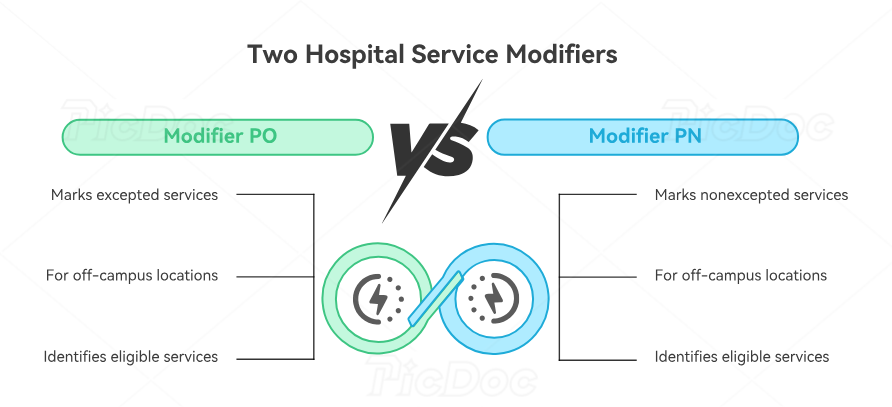
The hospital institutional claim may also require modifier PO or PN depending on the department's excepted or nonexcepted status and the applicable Medicare rules.
Modifier PO and PN requirements belong to the relevant hospital outpatient institutional billing process. They should not be confused with the professional claim's POS 19 designation.
When auditing this arrangement, validate Medicare billing requirements, facility payment policies, claim adjustment patterns, and coding compliance documentation.
Case 5: One Physician Works at Two Locations
A physician sees patients at an independent office on Monday and at an on-campus hospital outpatient clinic on Wednesday.
Both locations use the same electronic health record and the same physician billing group.
The Monday office encounter generally uses POS 11. The Wednesday hospital outpatient encounter uses POS 22 when the patient is registered as a hospital outpatient.
A billing system that assigns one default POS to the physician's entire schedule will generate errors.
A more reliable approach maps POS to each qualifying service location and encounter, with separate controls for hospital outpatient registration.
Test the configuration through coding accuracy audits, claim submission reviews, denial root-cause tracking, and accounts receivable monitoring.
Quick Poll: What Is Your Biggest POS 11 vs POS 22 Billing Challenge?
Select an answer and submit to see tailored guidance. Responses remain on this page and are not stored or aggregated.
4. Provider-Based Billing Rules, POS 19 vs 22, and Patient Financial Responsibility
Provider-based billing creates some of the most consequential place-of-service decisions because a department's formal classification affects claim structure, payment methodology, and patient liability.
Under Medicare's provider-based requirements, a hospital department must satisfy applicable operational and regulatory criteria. These can involve licensure, clinical integration, financial integration, administrative control, hospital oversight, and other requirements based on whether the department operates on or off campus.
Hospital ownership, shared branding, or use of the same electronic health record cannot independently establish provider-based status.
This should be verified whenever a practice changes ownership, relocates, or joins a hospital system. Documentation supporting the decision is important for Medicare billing compliance, coding audit readiness, physician payment analysis, and denial prevention.
POS 19 vs POS 22: Why Campus Designation Matters
POS 19 and POS 22 both identify outpatient hospital settings, but they distinguish the department's location relative to the hospital campus.
POS 19 identifies an off-campus outpatient hospital department.
POS 22 identifies an on-campus outpatient hospital department.
Medicare's provider-based regulations generally define the hospital campus using the area adjacent to the main hospital buildings, certain structures within 250 yards, and locations specifically determined to be part of the campus.
The applicable campus determination should be verified rather than inferred from a street address, building name, or driving distance.
The professional claims for both qualifying settings generally receive the facility-rate treatment under the Medicare Physician Fee Schedule. However, the hospital institutional payment rules can differ significantly, especially for certain off-campus departments.
Review these distinctions when auditing hospital reimbursement, payer claim adjustments, billing software configurations, and coding compliance procedures.
When to Use Modifiers PO and PN
The distinction between professional POS codes and institutional hospital modifiers is essential.
Modifier PO identifies applicable excepted services furnished in an off-campus hospital provider-based department.
Modifier PN identifies applicable nonexcepted services furnished in an off-campus hospital provider-based department.
These modifiers are associated with hospital outpatient institutional reporting under Medicare's applicable rules.
The classification can affect how the hospital's institutional services are paid, including site-neutral payment adjustments.
A physician reporting CPT 99214 for an eligible encounter in an off-campus hospital outpatient department generally uses professional POS 19. The hospital evaluates whether its institutional services require modifier PO or PN.
A professional POS 19 claim does not automatically establish which modifier applies to the corresponding hospital claim.
This distinction should appear in claim-editing workflows, hospital coding audits, fee schedule reviews, and denial management investigations.
Why Patients May Receive Two Bills
A patient receiving care in a qualifying hospital outpatient department may receive a professional charge and a separate hospital outpatient facility charge.
For Medicare, those services can also create separate cost-sharing obligations, subject to the specific payment and coverage rules.
Consider a patient who previously attended a physician office that later becomes a qualifying hospital provider-based department. The patient's clinical visit may appear similar, but the billing arrangement can change.
The physician's professional service may be paid at the facility rate, while the hospital may submit a separate institutional claim for eligible services.
The patient should receive accurate information about the billing arrangements. Medicare's provider-based regulations impose specific written notice obligations for certain off-campus hospital outpatient departments when a beneficiary may incur additional hospital coinsurance.
Failure to handle these obligations appropriately can generate financial complaints and compliance concerns.
Practices should reconcile patient estimates, facility charges, and professional claims through medical billing quality controls, claims processing resources, coding audits, and insurance denial reviews.
5. How to Prevent POS 11 and POS 22 Claim Denials, Overpayments, and Audit Findings
A reliable place-of-service process identifies the correct setting before the claim is generated. The billing team should not have to reconstruct the patient's registration status after a denial arrives.
The strongest control is a maintained location master file connected to scheduling, patient registration, charge capture, and claim submission systems.
A complete location record should identify the physical service address, relevant department, provider-based classification, campus designation, hospital affiliation, billing entity, and effective dates of changes.
This allows billing software to assign the appropriate POS while supporting independent coding audit verification, claim denial prevention, and reimbursement accuracy assessments.
Five POS Billing Errors That Require Immediate Investigation
1. POS 11 reported for a registered hospital outpatient. This can produce an incorrect nonfacility professional payment. Confirm the patient's status, outpatient department, and applicable facility-rate requirement.
2. POS 22 reported for an ordinary physician office. This can produce an incorrect facility-rate professional payment and may signal an unsupported hospital outpatient billing designation.
3. POS 22 used for a qualifying off-campus hospital department. The correct professional code is generally POS 19, requiring verification of the campus classification and any related institutional payment rules.
4. One physician assigned the same POS at every location. This error is common in multisite practices when physician identifiers determine POS rather than encounter-level location data.
5. Hospital and physician records disagree about outpatient status. A hospital facility claim and a physician POS 11 claim for the same encounter may indicate a classification inconsistency requiring investigation.
Each error has different potential consequences. Resolve the underlying registration or configuration failure rather than merely replacing the POS code on an individual denied claim.
Connect findings to denial rate measurements, claim adjustment reason codes, coding audit documentation, and medical billing appeal procedures.
How to Calculate the Financial Impact of Incorrect POS Billing
Suppose a hypothetical payer allows $145 for an office E/M service and $105 for the same professional service in a hospital outpatient setting.
The payment difference is $40 per claim.
An audit identifies 90 hospital outpatient encounters incorrectly submitted with POS 11 instead of POS 22. If all 90 received the higher nonfacility allowance, the preliminary professional-payment discrepancy would be:
90 claims × $40 = $3,600 potential overpayment.
This calculation is useful for estimating audit exposure, but the confirmed amount must be based on actual claim payments, the appropriate locality and fee schedule, contractual terms, and any adjustments or repayments.
A similar error in the opposite direction can create underpayments.
For a complete investigation, reconcile Medicare fee schedule amounts, claim payment adjustments, accounts receivable balances, and appropriate corrected-claim or appeal requirements.
Build a Seven-Step Pre-Bill POS Validation Process
A practical revenue-cycle workflow should include the following controls:
Verify patient status. Confirm whether the patient is an office patient, registered hospital outpatient, or inpatient.
Validate the service location. Compare the scheduled department with the actual encounter location.
Check department classification. Confirm whether the location is a provider-based hospital department or qualifying physician office.
Determine campus status. Distinguish on-campus outpatient departments from off-campus departments.
Apply the correct professional POS. Populate CMS-1500 Item 24B or the corresponding 837P place-of-service field accurately.
Reconcile institutional and professional claims. Identify conflicting records and unsupported duplicate charges.
Monitor payment results. Compare facility and nonfacility allowances, investigate denials, and verify corrective actions.
For professional claims, the reported service-facility location information should also be checked against the relevant physical service address. CMS-1500 Item 32 and corresponding electronic location data can help identify mismatches.
The patient registration exception deserves particular care. For Medicare services furnished to registered hospital inpatients or outpatients, the appropriate hospital setting generally governs professional POS reporting even when the clinician's face-to-face encounter occurs elsewhere.
Before releasing a corrected claim, verify the documented service, appropriate billing classification, and payer-specific requirements.
These checks support clean claim rate improvement, coding compliance audits, claim denial resolution, and revenue cycle performance.
6. Frequently Asked Questions About POS 11 vs POS 22
-
POS 11 identifies a qualifying physician office, while POS 22 identifies an on-campus hospital outpatient department.
For many Medicare professional services, POS 11 triggers the nonfacility Physician Fee Schedule rate and POS 22 triggers the facility rate.
The correct designation depends on the patient's service setting and applicable hospital outpatient status. Validate the decision using Medicare billing resources, fee schedule guidance, and coding audit procedures.
-
Yes. A hospital-owned practice that operates as a qualifying non-provider-based physician office may report POS 11.
Ownership alone does not establish hospital outpatient department status.
Coders should verify the practice's operational classification, hospital outpatient registration arrangements, and provider-based requirements. These decisions should be documented in coding audit records and reflected in the billing software configuration.
-
POS 19 generally applies to a qualifying off-campus hospital provider-based department. POS 22 applies to an on-campus hospital outpatient department.
Both generally trigger facility-rate professional reimbursement under Medicare, but institutional payment rules can differ.
Verify the campus designation, department classification, and any relevant off-campus hospital billing requirements. Review physician reimbursement guidance, claim submission processes, and medical coding audit checklists.
-
For many services, the hospital furnishes resources that would otherwise be supplied by a physician office. The professional facility rate consequently reflects a different practice expense allocation.
The hospital may also submit a separate eligible institutional claim.
The professional payment difference should be evaluated using the actual Medicare Physician Fee Schedule, appropriate claim adjustment information, and revenue cycle analysis.
-
Yes. CPT 99214 describes the professional E/M service, while the POS code identifies the applicable setting.
A qualifying office encounter uses POS 11. An eligible encounter with a registered patient in an on-campus hospital outpatient department uses POS 22.
The underlying 99214 documentation requirements remain applicable in both settings. Billing teams should evaluate the location using coding compliance controls, physician reimbursement guidance, and claim denial tracking.
-
A qualifying hospital outpatient department may submit an eligible institutional facility claim in addition to the professional claim.
Medicare hospital outpatient clinic services commonly involve HCPCS G0463 when its requirements are met.
The validity and payment of a separate facility charge depend on the services furnished, patient status, applicable payment system, and payer policies. Investigate questionable charges through medical coding audits, hospital reimbursement analysis, and insurance denial management.
