
Medicare Advantage risk adjustment in 2027 brings heightened scrutiny to diagnosis accuracy, encounter eligibility, and medical record validation. CMS is retaining the V28-based model while tightening which submitted diagnoses contribute to risk scores, particularly those from unlinked chart reviews and audio-only encounters. For medical coders, clinical documentation specialists, and revenue cycle teams, the financial exposure extends beyond missed HCCs to unsupported diagnoses, payment recoveries, and RADV audit findings. This guide explains the finalized 2027 requirements, high-risk documentation scenarios, validation checkpoints, and practical controls needed to protect coding accuracy and compliance.

1. HCC Risk Adjustment in 2027: What CMS Finalized and Why It Matters
The central 2027 development is CMS's decision to continue using the 2024 CMS-HCC risk adjustment model, commonly called V28, rather than implement the newly recalibrated model proposed in January 2026. The 2024 model completed its three-year phase-in for 2026 payments, and CMS retained that model for 2027.
This distinction matters because coding teams preparing for an entirely new HCC classification could waste training resources while overlooking more consequential changes to diagnosis eligibility. The immediate priorities are correctly applying the existing model, validating clinical evidence, and strengthening HCC risk adjustment coding skills, coding audit controls, physician documentation queries, and claim accuracy monitoring.
V28 continues, but diagnosis eligibility changes
The V28 clinical classification contains 266 hierarchical condition categories, including 115 payment HCCs in the 2024 CMS-HCC model. A diagnosis contributes to risk adjustment only when the applicable ICD-10-CM mapping, model rules, encounter eligibility, and other payment conditions are satisfied.
For payment year 2027, CMS finalized two particularly important diagnosis-source changes:
Unlinked chart review records: Diagnoses submitted on chart review records without links to qualifying encounters are generally excluded from risk score calculations. An exception applies when a beneficiary switches between Medicare Advantage organizations under different parent organizations, subject to CMS requirements.
Audio-only encounters: Diagnoses associated solely with audio-only services identified using modifiers 93 or FQ are excluded under the finalized policy. Eligibility must be evaluated according to CMS's encounter-level filtering rules.
CMS's July 2026 operational update scheduled these exclusions to begin with the payment year 2027 midyear risk adjustment model run rather than the initial run. Organizations should still review affected 2026 dates of service and reconcile the results of subsequent processing.
For providers, this increases the importance of timely encounter submission and accurate diagnosis association. A condition documented in a valid clinical record may fail to contribute to risk adjustment when the transmitted data does not satisfy eligibility requirements.
These failures require investigation through electronic claims and encounter submission workflows, medical coding accuracy audits, denial root-cause analysis, and practice billing system reviews.
The 2027 financial impact makes diagnosis validation a priority
CMS projected an average 2.48% increase in Medicare Advantage payments for 2027 under its finalized rate announcement. Within that calculation, diagnosis-source changes contribute an estimated 1.53% downward adjustment on average. Individual organizations can experience different effects depending on their diagnosis submission patterns.
A plan heavily dependent on unlinked chart reviews may face greater exposure than one consistently submitting eligible encounter-linked diagnoses. Conversely, submitting additional unsupported conditions creates potential overpayment liabilities.
Risk adjustment managers should therefore separate three questions: whether a diagnosis was clinically supported, whether it passed CMS eligibility rules, and whether it actually influenced the risk score.
A robust coding compliance review should evaluate each independently. Complementary coding case simulations, documentation clarification procedures, financial variance analysis, and coding productivity standards can help identify where the process breaks down.
The coding calendar requires two separate reference points
Payment year 2027 generally relies on qualifying diagnoses from calendar year 2026, with payment calculations and adjustments following CMS's applicable processing schedule.
Meanwhile, fiscal year 2027 ICD-10-CM codes became effective October 1, 2026. Consequently, the 2026 diagnosis collection year crosses two ICD-10-CM fiscal-year code sets.
Organizations must maintain date-specific diagnosis coding and payment-year-specific HCC mappings. Applying a current ICD-10-CM mapping indiscriminately to historical encounters can create incorrect results.
The same control should extend to coding certification study materials, risk adjustment practice cases, medical coding documentation audits, and electronic coding system configurations.
HCC V28 Documentation & Audit Risk Map: 40 High-Value Validation Checks
| Condition / Risk Area | Documentation Risk | What an Auditor Checks | Best Practice Action |
|---|---|---|---|
| 1. Diabetes with complications | Complication missing or incorrectly linked | Provider diagnosis, ICD-10-CM linkage rules and specificity | Verify the documented complication and applicable coding conventions. |
| 2. Diabetic CKD | Renal disease incompletely classified | Diabetes, CKD stage and applicable combination-code requirements | Capture documented CKD stage and verify diabetes linkage rules. |
| 3. Diabetic neuropathy | Symptoms coded without diagnostic support | Provider diagnosis and applicable clinical assessment | Review neuropathy documentation and code specificity. |
| 4. Diabetic retinopathy | Severity or laterality omitted | Ophthalmology findings and provider documentation | Identify retinopathy type, severity and applicable laterality. |
| 5. CKD stages 3–5 | Stage absent or inconsistent | Current provider diagnosis and documented stage | Clarify stage discrepancies through compliant queries. |
| 6. ESRD and dialysis | CKD, ESRD and dialysis status confused | Diagnosis, treatment status and model-specific rules | Separate ESRD status, treatment and related complications. |
| 7. Heart failure | Unspecified or outdated heart failure type | Current diagnosis, acuity and clinical evaluation | Capture supported acuity and type without inferring from tests alone. |
| 8. Cardiomyopathy | Historical diagnosis copied forward | Current assessment and management | Distinguish active disease from historical references. |
| 9. Morbid obesity | BMI treated as independent proof | Provider diagnosis and coding guidance | Require an established diagnosis and separately capture eligible BMI information. |
| 10. Malnutrition | Severity inferred from laboratory results | Qualified provider diagnosis and relevant clinical evidence | Clarify documented type and severity without coding from laboratory values alone. |
| 11. COPD | Inactive problem-list diagnosis | Current respiratory assessment and treatment | Check disease status, exacerbation and current management. |
| 12. Respiratory failure | Hypoxemia substituted for respiratory failure | Provider diagnosis, acuity and clinical circumstances | Verify the documented respiratory failure diagnosis and type. |
| 13. Oxygen dependence | Status incorrectly substituted for disease | Underlying diagnosis and current oxygen use | Report supported status separately where appropriate. |
| 14. Active malignancy | History of cancer reported as active | Current cancer status, treatment and specialist findings | Distinguish active malignancy from personal history. |
| 15. Metastatic cancer | Secondary site incompletely identified | Documented primary and secondary sites | Capture each supported malignancy site under current guidelines. |
| 16. Immunodeficiency | Medication use presumed to prove diagnosis | Provider-established condition and etiology | Verify the clinical diagnosis and applicable specificity. |
| 17. HIV disease | Asymptomatic status and HIV disease confused | Provider diagnosis and current coding guidelines | Apply HIV-specific sequencing and reporting instructions. |
| 18. Major depressive disorder | Remission, recurrence or severity unclear | Documented episode status and provider assessment | Resolve missing clinical distinctions before assignment. |
| 19. Bipolar disorder | Current episode or remission status unclear | Provider assessment and diagnosis specificity | Verify the supported bipolar classification. |
| 20. Dementia | Severity or behavioral details inconsistent | Provider diagnosis and applicable classification instructions | Capture documented type, severity and associated disturbances. |
| 21. Parkinsonian disorders | Parkinsonism incorrectly equated with Parkinson's disease | Exact established neurological diagnosis | Follow disease-specific terminology and code instructions. |
| 22. Acute stroke | Prior stroke mistakenly coded as acute | Timing, imaging, clinical assessment and current diagnosis | Distinguish acute stroke, history and residual effects. |
| 23. Stroke sequelae | Residual impairment undocumented | Documented deficit and its relationship to prior stroke | Code supported sequelae and applicable laterality. |
| 24. Hemiplegia | Laterality or dominant side omitted | Current functional deficit and documentation | Apply supported laterality and dominance rules. |
| 25. Seizure disorders | Remote seizure history reported as active epilepsy | Current neurological diagnosis and treatment | Differentiate epilepsy, seizures and historical conditions. |
| 26. Amputation status | Acquired absence and active complication confused | Amputation level and current complications | Capture supported status and complications separately. |
| 27. Peripheral vascular disease | Ulceration or severity unsupported | Vascular diagnosis and documented associated findings | Verify combination-code requirements and disease specificity. |
| 28. Pressure injuries | Site or stage inconsistently documented | Location, stage and permissible documentation sources | Apply official staging and diagnosis-source rules. |
| 29. Non-pressure chronic ulcers | Depth or tissue involvement unsupported | Site, severity and qualified documentation | Record ulcer specificity and underlying conditions. |
| 30. Transplant complications | Transplant status alone used to imply complication | Provider-established complication and affected organ | Distinguish transplant status from documented active complications. |
| 31. Sickle cell disease | Trait and disease confused | Confirmed condition and crisis status | Identify the exact sickle cell classification. |
| 32. Inflammatory bowel disease | Complications unsupported or unspecified | Disease type, anatomical involvement and complications | Capture supported specificity and current disease status. |
| 33. Rheumatoid arthritis | Laboratory results treated as a diagnosis | Provider-established inflammatory disease | Verify sites, manifestations and applicable code specificity. |
| 34. Substance use disorders | Use, abuse, dependence and remission confused | Established diagnosis and current status | Apply provider terminology and official coding conventions. |
| 35. Pulmonary embolism | History of embolism coded as acute disease | Current diagnosis, treatment and clinical timing | Separate active embolism from personal history. |
| 36. Cirrhosis | Underlying liver condition or complications unclear | Provider diagnosis and associated manifestations | Verify disease type and separately reportable complications. |
| 37. Hepatitis | Acute, chronic and resolved infection confused | Confirmed infection status and clinical documentation | Select the appropriate infection classification and status. |
| 38. Sepsis | Unconfirmed infection or historical sepsis reported as active | Provider diagnosis and encounter-specific evidence | Apply setting-specific diagnosis and sequencing rules. |
| 39. Unlinked chart reviews | Diagnoses lack an eligible encounter association | CRR linkage, submission data and exception eligibility | Reconcile linked records and document any valid exception. |
| 40. Audio-only encounters | Modifier 93 or FQ leads to diagnosis-source exclusion | Service-line modifiers and encounter eligibility | Review applicable encounter-level filtering and source rules. |
| 41. Telehealth encounters | Incorrect assumption that all telehealth diagnoses qualify | Service type, modality, provider and CMS eligibility rules | Verify each diagnosis against eligible telehealth encounter criteria. |
| 42. Annual diagnosis recapture | Prior-year HCCs carried forward without current support | Current-year diagnosis and qualifying encounter | Validate conditions annually using legitimate clinical documentation. |
| 43. Provider authentication | Unsigned or incomplete medical records | Signature, credentials, date and record integrity | Resolve authentication deficiencies under applicable requirements. |
| 44. Diagnosis source eligibility | Nonqualifying provider or service supplies diagnosis | Provider specialty, service eligibility and submission details | Verify the allowable provider and encounter before risk scoring. |
| 45. HCC hierarchy conflicts | Multiple conditions incorrectly treated as additive | Hierarchy, model mapping and applicable interactions | Apply official hierarchy logic and verify actual score contribution. |
Important: These are clinical documentation and process-validation scenarios. Individual diagnoses do not automatically map to a payment HCC. Confirm each ICD-10-CM code using the applicable 2027 CMS-HCC software, official mappings, coding guidelines and encounter eligibility requirements.
2. V28 Documentation Requirements: How to Build an Audit-Defensible Diagnosis
HCC coding quality depends on whether the medical record establishes a reportable diagnosis and whether that diagnosis was submitted through an eligible source. A detailed problem list alone cannot resolve missing clinical evidence, incorrect code assignment, or transmission defects.
Apply the MEAT framework without treating it as an automatic payment rule
MEAT stands for Monitoring, Evaluating, Assessing or Addressing, and Treating. It is a practical documentation-review framework that helps determine whether an encounter reflects meaningful consideration of a patient's condition.
For example, a physician documenting chronic heart failure may describe medication adjustments, weight changes, edema assessment, and continued cardiology follow-up. These details help demonstrate current evaluation and management.
However, MEAT is an educational mnemonic rather than a universal CMS rule requiring every letter or one particular action for each diagnosis. Coders must apply the official ICD-10-CM guidelines, encounter eligibility criteria, and relevant medical record validation rules.
The appropriate workflow combines HCC case-based coding exercises, medical coding audit standards, compliant documentation queries, and medical necessity documentation reviews.
Distinguish current diagnoses from copied-forward medical history
A common compliance weakness occurs when an active HCC is assigned from a problem list containing outdated conditions.
Consider a patient who suffered a stroke three years ago. The current encounter discusses persistent left-sided weakness but contains no evidence of a new acute stroke.
The coder should evaluate the documentation for appropriate residual-effect coding. Carrying forward an acute cerebrovascular diagnosis would misrepresent the patient's current condition.
The same problem occurs with resolved pulmonary embolism, historical cancer, previous sepsis, and inactive complications. Build targeted risk adjustment practice scenarios, require auditor review of historical diagnoses, and clarify ambiguous documentation using physician query examples.
Capture specificity without inferring diagnoses from clinical indicators
Diagnostic specificity affects coding accuracy and may influence HCC assignment, but coders must remain within the information permitted by official coding guidelines.
A low eGFR can support a documentation query about kidney disease, but the laboratory value cannot independently establish a CKD stage for the coder. Likewise, an abnormal echocardiogram cannot independently determine the precise heart failure diagnosis.
Some code elements, including certain ulcer stages and BMI information, may be assigned using documentation from qualified clinicians other than the diagnosing provider under specific ICD-10-CM rules. The underlying diagnosis must still meet applicable provider-documentation requirements.
The safest approach is to identify the precise missing element and use a neutral, non-leading query. This improves coding specificity, supports coding audit accuracy, strengthens clinical documentation clarification, and reduces preventable medical necessity documentation issues.
Recognize how HCC hierarchies affect actual risk scores
V28 groups certain related conditions within hierarchies that prevent inappropriate additive risk scoring.
A patient with multiple diagnoses can have several codes mapped within a condition hierarchy while only the applicable higher-ranked category contributes to the relevant risk adjustment calculation. Other qualifying conditions and model interactions may still influence the final score.
Therefore, counting all mapped diagnoses as separate payment contributors can materially overstate financial expectations.
Coding analysts should use the CMS 2027 model software to evaluate the actual beneficiary-level impact, reconcile apparent differences through coding accuracy reviews, and train coders through complex HCC examples.
3. RADV Audits and Diagnosis Validation: Where 2027 Exposure Is Highest
Risk Adjustment Data Validation audits evaluate whether diagnoses submitted for Medicare Advantage payment are supported by qualifying medical records. This creates a different exposure from an ordinary claim rejection: an unsupported diagnosis can affect payments already received.
Under applicable regulations, CMS may extrapolate contract-level RADV audit findings for payment year 2018 and subsequent years. Organizations therefore need to consider both individual diagnosis errors and the broader financial implications of weaknesses identified in sampled records.
What current RADV enforcement demonstrates
CMS initiated payment year 2020 RADV audits in March 2026, payment year 2021 audits in May, and payment year 2024 audits in August. Its published schedule also identifies additional payment-year audits planned across late 2026 and 2027.
Separate HHS Office of Inspector General reviews continue identifying significant problems in submitted diagnoses. In one 2026 review focusing on acute stroke, OIG found that the selected diagnosis codes for all 97 sampled enrollees lacked support in the associated physician records. The report estimated $462 million in potential net overpayments across the relevant Medicare Advantage population for 2021.
That finding illustrates a specific vulnerability: historical diagnoses can continue moving through reporting systems even when the underlying documentation supports a different clinical status.
Risk adjustment leaders should conduct focused HCC case reviews, expand coding compliance checks, use documentation clarification templates, and evaluate recurring errors using a denial root-cause worksheet.
Build an audit-ready record with complete traceability
For every diagnosis selected for validation, retain a traceable record linking the beneficiary, service date, rendering provider, medical record, diagnosis code, encounter submission, and applicable model mapping.
Verify that the documentation is appropriately authenticated, identifies the correct patient, supports the diagnosis, and comes from a qualifying source.
Records should be retrieved through a controlled process that preserves their integrity. If an auditor requests a specific record, staff must be able to locate the authentic document and explain the associated submission without reconstructing clinical information after the fact.
These controls should align with the organization's medical coding audit checklist, electronic submission procedures, medical record documentation standards, and coding auditor training.
Separate overcoding, undercoding, and technical exclusion
Three failures require different corrective actions.
Overcoding: A submitted diagnosis lacks sufficient support, reflects an inactive condition, or uses unsupported specificity. The response may require coding correction, investigation of overpayments, and improvements to documentation controls.
Undercoding: A supported, reportable condition was omitted or assigned incorrectly. The organization should assess the documentation and submission process while respecting applicable deadlines and correction rules.
Technical exclusion: A supported diagnosis is transmitted through an ineligible source, such as an unlinked chart review record outside a permitted exception. The organization must evaluate submission lineage and eligibility.
Using one generic remediation process for all three leads to unnecessary work and unresolved risk. A better system classifies errors through coding quality audits, electronic claim submission reviews, clinical query protocols, and risk adjustment coding exercises.
Quick Poll: What Is Your Biggest HCC V28 Audit Risk for 2027?
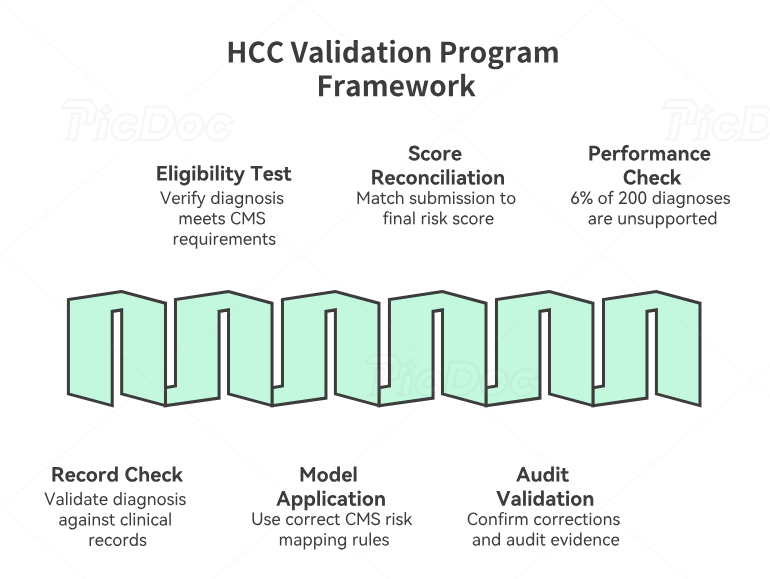
4. HCC Validation Workflow for 2027: From Medical Record to Confirmed Risk Score
An effective validation program should allow a reviewer to trace every payment-relevant HCC backward to an eligible encounter and forward to the processed risk score. This requires controls at the documentation, coding, submission, and payment reconciliation stages.
Checkpoint 1: Validate the diagnosis against the clinical record
Review the current encounter, provider diagnosis, applicable clinical status, and ICD-10-CM classification.
For example, a patient prescribed an inhaler may have COPD, asthma, or another respiratory condition. Medication alone cannot establish the diagnosis. The coder must evaluate the documented condition and apply the appropriate code.
Use HCC documentation practice cases, medical coding audit procedures, and compliant physician queries to determine whether additional clarification is required.
Checkpoint 2: Test diagnosis eligibility
Confirm that the service and provider meet applicable CMS requirements. Review the encounter date, type, source, service-line information, and provider credentials.
For 2027, special attention should be given to audio-only encounters and chart review linkage. A submitted diagnosis may be clinically correct while being ineligible for risk-score calculation.
Reconcile encounter records through the organization's electronic submission platform, review billing system configurations, and document recurring errors through coding compliance audits.
Checkpoint 3: Apply the correct model and mapping year
Use the CMS model software and ICD-10-CM mappings corresponding to the relevant payment and diagnosis periods.
Confirm that the diagnosis maps to the intended category, survives applicable hierarchy rules, and contributes to the beneficiary's modeled risk score when appropriate.
This check is critical when the organization relies on historical crosswalks or spreadsheets that were created before V28 implementation.
Managers can develop a personalized coding reference guide, test mappings through HCC coding practice scenarios, and verify interpretation through coding audit reviews.
Checkpoint 4: Reconcile submission acceptance and risk-score contribution
Maintain separate status fields for documented, coded, submitted, accepted, risk-adjustment-eligible, and payment-contributing diagnoses.
A diagnosis that passes encounter acceptance checks may still produce no additional score contribution because of hierarchy rules, duplicate representation, or another applicable model condition.
Use a beneficiary-level comparison between internal calculations and the relevant CMS risk-score output. Record discrepancies by cause rather than relying on aggregate RAF differences.
The results can inform coding accuracy monitoring, financial variance analysis, and medical coding productivity assessments.
Checkpoint 5: Validate corrections and audit evidence
For unsupported diagnoses, determine whether correction and overpayment procedures apply. For omitted supported diagnoses, verify eligibility and the applicable submission deadline before considering additional reporting.
Retain audit evidence supporting the original finding, correction decision, responsible reviewer, and submission outcome.
The documented process should integrate coding audit checklists, clinical clarification procedures, claim adjustment monitoring, and risk adjustment training cases.
Checkpoint 6: Measure validation performance
Create a monthly dashboard covering the percentage of reviewed diagnoses supported by records, unresolved documentation queries, eligible encounter linkage, and completed corrective actions.
Track unsupported diagnoses separately from missing diagnoses. Otherwise, improvements in HCC capture may conceal growing compliance exposure.
For instance, if 12 of 200 audited submitted diagnoses are unsupported, the sample's diagnosis-level unsupported rate is 6%. Examine whether those errors cluster within particular providers, conditions, or submission sources.
Use denial analysis techniques, coding auditor competencies, and coding quality checklists to determine which corrective actions produce measurable improvement.
5. High-Risk HCC Coding Scenarios: Practical Examples and Audit Solutions
The following cases illustrate errors that can occur even in experienced risk adjustment departments.
Case 1: Active cancer versus personal history
A patient completed cancer treatment several years ago and attends a routine follow-up. The provider documents no evidence of current disease.
The problem list still contains the original malignancy diagnosis, which an automated coding process captures as active cancer.
The coder must determine whether the medical record supports current malignancy or an appropriate history code, following the applicable ICD-10-CM guidelines. A specialist record may be particularly useful when establishing treatment and disease status.
The organization should include these distinctions in risk adjustment coding exercises, require medical record audits, and use documentation queries where the provider's assessment is ambiguous.
Case 2: CKD stage inferred from laboratory results
A patient with diabetes has laboratory results suggesting significant kidney impairment. The provider's assessment documents chronic kidney disease without a stage.
Assigning an advanced CKD stage solely from laboratory results can produce unsupported specificity.
The coder should apply the valid documented diagnosis and applicable diabetes-with-CKD coding conventions, requesting clarification when the missing stage affects code assignment.
Training should combine HCC practice cases, compliant query examples, and coding documentation reviews.
Case 3: Acute stroke carried forward as an active condition
A patient was hospitalized for an ischemic stroke in 2024. During a 2026 office visit, the physician evaluates persistent weakness from the prior stroke.
An automated coding system retrieves the historical acute stroke diagnosis and submits it as current.
This creates serious audit exposure because the clinical encounter supports assessment of residual impairment rather than a newly occurring acute stroke.
The corrective process should evaluate supported sequela coding, identify the source of the copied diagnosis, and verify affected submissions.
Use medical coding audit procedures, practical coding case reviews, and clinical documentation clarification tools to prevent recurrence.
Case 4: Supported HCC excluded because of chart review linkage
A physician documents a qualifying chronic condition during a valid encounter. A retrospective reviewer identifies the diagnosis, but the additional record is submitted without an encounter link.
Under the finalized 2027 policy, an unlinked chart review diagnosis generally cannot contribute to the Part C risk score unless the limited MA parent-organization switch exception applies.
The clinical documentation may be accurate, yet the submission structure prevents payment recognition.
The immediate investigation should determine whether an eligible encounter exists, whether the records can be appropriately associated under CMS requirements, and whether a timely correction is possible.
This requires coordination among electronic submission teams, coding compliance auditors, and practice billing system administrators.
Case 5: Multiple mapped diagnoses fail to produce the expected RAF increase
A patient has several documented conditions within the same HCC hierarchy. An internal spreadsheet calculates a separate payment contribution for each one.
The actual CMS score differs because hierarchical logic suppresses certain lower-ranked categories.
The analyst must verify the mapping, hierarchy, model segment, and applicable demographic and interaction factors before interpreting the difference as a missing diagnosis.
A corrected calculation should be validated through HCC coding examples, coding audit reviews, and the official CMS model software.
How to prioritize HCC audit remediation
Assign each discovered issue a severity based on compliance exposure, potential score impact, frequency, and ease of correction.
Unsupported active cancer or acute stroke diagnoses should receive urgent review because they may affect past payments and can generate significant audit exposure. Missing encounter links deserve immediate technical investigation, particularly when submission deadlines are approaching.
Documentation gaps can be grouped by specialty and provider for targeted education. Historical diagnosis carryover should trigger a broader review of problem-list reconciliation and automated capture logic.
Maintain a corrective action register through the coding audit checklist, measure trends through denial root-cause analysis, and use risk adjustment case simulations to verify that the corrective action improves actual coding decisions.
6. FAQs About 2027 HCC Risk Adjustment Coding and V28 Compliance
-
CMS finalized continued use of the 2024 CMS-HCC model, known as V28, for Medicare Advantage Part C payments in 2027. The proposed recalibration using more recent diagnosis and expenditure data was deferred.
The most consequential finalized changes involve diagnosis-source eligibility, including unlinked chart reviews and audio-only encounters.
Medical coders should prioritize HCC coding practice cases, coding audit standards, clinical documentation queries, and the applicable CMS 2027 model software.
-
For most non-PACE Medicare Advantage organizations, diagnoses from unlinked chart review records are excluded from risk score calculations under the finalized policy. A limited exception applies to qualifying beneficiaries who move between MA organizations under different parent organizations.
CMS subsequently scheduled implementation of the exclusions for the payment year 2027 midyear model run.
Organizations should review existing chart review inventories, identify eligible encounter associations, and validate correction opportunities using electronic submission workflows, risk adjustment audit procedures, and billing system controls.
-
The finalized 2027 policy excludes diagnoses associated solely with audio-only services identified by modifiers 93 or FQ from applicable risk score calculations.
The actual determination depends on CMS's encounter-level filtering rules, including whether other qualifying services appear on the record.
Audio-video telehealth encounters must be evaluated separately under applicable eligibility rules. Coding teams should review claim submission accuracy, medical coding documentation standards, and HCC validation scenarios.
-
For the prospective CMS-HCC model, qualifying diagnoses generally need to be reported during the relevant data collection period to contribute to the following payment year's risk score.
A prior-year HCC does not automatically establish a qualifying diagnosis for a later data collection period. Clinical documentation should reflect the patient's actual condition and care.
Providers should evaluate and document conditions according to clinical relevance, while coders apply applicable reporting requirements.
Training can incorporate HCC annual recapture scenarios, provider clarification templates, and documentation audit procedures.
-
MEAT is a useful educational framework for assessing whether documentation reflects monitoring, evaluation, assessment, or treatment of a condition.
CMS eligibility and validation requirements are governed by applicable official rules. A diagnosis should be evaluated against the appropriate documentation, coding, provider, and encounter requirements rather than a rigid MEAT checklist alone.
Organizations should use medical coding audit guidance, compliant physician query examples, and risk adjustment coding exercises to reinforce accurate interpretation.
-
Yes. Unsupported diagnoses can lead to improper payment findings and applicable repayment obligations. Under federal regulations, CMS may extrapolate contract-level RADV audit findings for payment year 2018 and later years.
The financial impact depends on the audit methodology, applicable requirements, and findings.
Organizations should prioritize high-risk diagnoses, maintain retrievable source records, and establish documented correction procedures. Regular coding accuracy audits, HCC practice assessments, and coding auditor development can strengthen internal review capabilities.
