
The CMS Prior Authorization API requirements arriving in 2027 will change how healthcare organizations verify coverage requirements, submit authorization requests, and track payer decisions. For medical billers and revenue cycle management (RCM) teams, the biggest opportunity is reducing avoidable delays between scheduling, clinical documentation, authorization, and payment. However, automation introduces new responsibilities around data accuracy, payer connectivity, and exception handling. This guide explains the CMS-0057-F requirements, practical implementation steps, and how to strengthen prior authorization workflows, claim acceptance, denial prevention, and revenue recovery.

1. What CMS-0057-F Actually Requires in 2027
The CMS Interoperability and Prior Authorization Final Rule, CMS-0057-F, establishes new electronic data exchange requirements for specified health plans. Its Prior Authorization API allows provider systems to determine whether authorization is required, retrieve payer documentation requirements, submit requests, and receive decisions electronically.
For RCM leaders, the important distinction is between regulatory compliance and operational readiness. The obligation to implement the API primarily falls on impacted payers. Medical practices must assess whether their existing EHR, billing platform, or clearinghouse can use those interfaces effectively.
A practice that still relies on multiple payer portals may continue experiencing delays despite payer-side implementation. Reviewing electronic claims platforms, small-practice billing systems, Medicare billing resources, and authorization procedures helps identify the integration gaps.
Which payers must comply?
The rule applies to Medicare Advantage organizations, state Medicaid fee-for-service programs, state Children's Health Insurance Program (CHIP) fee-for-service programs, Medicaid managed care plans, CHIP managed care entities, and Qualified Health Plan issuers on the Federally-facilitated Exchanges.
Compliance dates vary by payer category. For Medicare Advantage and state Medicaid and CHIP fee-for-service programs, the API requirements generally begin January 1, 2027. For Medicaid and CHIP managed care entities, they apply beginning with rating periods starting on or after January 1, 2027. For applicable Marketplace plans, implementation follows plan years beginning on or after that date.
Original Medicare fee-for-service falls outside this specific list of impacted payers. Other commercial insurers may also be outside the rule's direct scope.
RCM teams should therefore maintain a payer-by-payer implementation inventory rather than applying the same workflow to every insurance product. This is particularly important when combining Medicare reimbursement processes, Medicaid billing software, electronic claim submission, and prior authorization verification.
The 2026 rules already affecting billing teams
Several CMS-0057-F process requirements began in 2026, ahead of the API implementation deadline.
For the applicable impacted payers, excluding Qualified Health Plan issuers on the Federally-facilitated Exchanges from these specific shortened decision deadlines, standard prior authorization decisions generally must be issued within seven calendar days. Expedited decisions generally must be issued within 72 hours, and decisions must be made sooner when the patient's medical condition requires it.
CMS also requires impacted payers to provide specific reasons for denied prior authorization requests for covered non-drug items and services. Annual public reporting of certain authorization metrics began in 2026, with the initial reporting deadline of March 31, 2026.
These requirements offer immediate opportunities to strengthen authorization tracking, denial root-cause analysis, medical necessity appeals, and accounts receivable management.
What the 2027 API must communicate
The Prior Authorization API must support identifying requirements and exchanging requests and responses. A response must communicate an approval with the date or circumstance when authorization ends, a denial with a specific reason, or a request for additional information.
A response requesting further documentation requires a different RCM action from an approval or denial. Teams should preserve that distinction in their work queues and avoid treating every response as a completed authorization.
The original CMS-0057-F requirements focus on non-drug items and services. CMS proposed additional requirements for drug prior authorization in CMS-0062-P in April 2026. Those proposals should be tracked separately from already-finalized requirements.
One particularly important 2027 update: The finalized 2027 Medicare Physician Fee Schedule makes the Electronic Prior Authorization measure optional for MIPS eligible clinicians during the 2027 performance period, with 10 bonus points available for qualifying reporting. The measure becomes required in 2028 under the finalized policy. Eligible hospitals and critical access hospitals also have an optional electronic prior authorization measure in 2027, followed by required participation in 2028 under their applicable program rules.
This creates a practical reason to coordinate billing operations, clinical documentation quality, Medicare payment processes, and coding compliance reviews before the transition.
CMS Prior Authorization API 2027: 36-Point RCM Readiness and Action Map
| Workflow or Data Element | 2027 Requirement or Operational Change | What RCM Teams Must Do | Risk If Missed |
|---|---|---|---|
| 1. Payer applicability | CMS-0057-F applies to specified payer categories. | Identify impacted payers by product and legal entity. | Incorrect assumptions about available API services. |
| 2. Implementation date | Compliance timing varies by payer type. | Track calendar-year, plan-year, and rating-period dates. | Premature retirement of working authorization channels. |
| 3. Plan identification | Requirements can differ across products within a payer. | Map member coverage to the correct plan and benefit. | Authorization requested under the wrong product. |
| 4. Member identifiers | Accurate identity supports electronic request matching. | Validate member ID and patient demographic information. | Failed matching or unresolved submissions. |
| 5. Eligibility status | Coverage can change between scheduling and service. | Reverify eligibility at appropriate workflow checkpoints. | Approval attached to inactive coverage. |
| 6. Covered service discovery | The API identifies covered items and services requiring authorization. | Check requirements before scheduling or furnishing the service. | Preventable authorization-related denials. |
| 7. Benefit classification | The original rule focuses on non-drug items and services. | Maintain separate routing for drug authorization workflows. | Sending requests through unsupported pathways. |
| 8. CPT and HCPCS mapping | Service coding influences coverage requirements. | Verify planned procedure codes and code-set versions. | Approval for the wrong service. |
| 9. Diagnosis mapping | Clinical information supports authorization review. | Verify documented ICD-10-CM codes and clinical relevance. | Missing medical necessity evidence. |
| 10. Ordering provider | Provider identity may be needed for the request. | Validate ordering-provider identifiers and details. | Identity mismatch or rejected submission. |
| 11. Rendering provider | Authorization scope may depend on who furnishes care. | Confirm the intended rendering provider and location. | Approval mismatched to the completed service. |
| 12. Facility details | Service location may affect coverage and approval. | Verify facility and place-of-service information. | Payment disputes involving the treatment setting. |
| 13. Units and frequency | Approvals may limit quantity or visit frequency. | Capture authorized units, frequency, and service limits. | Claims exceeding approved scope. |
| 14. Documentation requirements | The API must identify payer documentation requirements. | Build required-document checklists into intake. | Repeated requests for missing information. |
| 15. Clinical notes | Clinical evidence supports medical necessity decisions. | Ensure submitted notes substantiate the requested service. | Insufficient-documentation denials. |
| 16. Supporting attachments | Electronic workflows may exchange necessary documentation. | Verify attachment completeness and correct patient association. | Review delays and lost evidence. |
| 17. Standard request priority | Applicable standard decisions generally have a seven-calendar-day maximum. | Record receipt date and monitor approaching deadlines. | Delayed care and missed escalation opportunities. |
| 18. Expedited priority | Applicable urgent requests generally require a decision within 72 hours. | Document urgency and follow qualifying expedited procedures. | Inappropriate routing of time-sensitive care. |
| 19. Request creation | The API supports electronic authorization requests. | Standardize submission fields and pre-submission checks. | Incomplete or duplicated requests. |
| 20. Submission confirmation | Electronic exchange needs reliable acknowledgment handling. | Record transaction references and submission evidence. | Requests believed submitted but never received. |
| 21. Pending status | Some requests remain under review. | Maintain active work queues and follow-up ownership. | Unmonitored scheduling delays. |
| 22. Additional-information response | API responses may request further information. | Route requests to the correct clinical or administrative owner. | Cases stalled despite an electronic response. |
| 23. Approval response | Approvals must specify an end date or ending circumstance. | Capture authorization scope and validity before service. | Claims submitted outside approval limits. |
| 24. Denial response | Denials must include a specific reason. | Classify reasons and identify corrective or appeal options. | Repeated submissions without resolving the cause. |
| 25. Authorization reference | Operational systems need to connect decisions to encounters. | Preserve available authorization identifiers and payer references. | Approved cases becoming difficult to reconcile. |
| 26. Effective dates | Approval validity affects service scheduling. | Compare authorized dates with the planned date of service. | Expired or premature utilization. |
| 27. Service changes | Clinical plans may change after an authorization request. | Recheck approval when procedures, units, or settings change. | Services furnished outside the authorized scope. |
| 28. Provider changes | A change in provider or facility may affect approval. | Confirm whether modification or a new request is needed. | Authorization mismatch at billing. |
| 29. Claim linkage | Authorization decisions need operational reconciliation. | Connect the approved request to the corresponding claim. | Authorization-related billing denials. |
| 30. Denial appeals | Specific denial reasons support targeted follow-up. | Track appeals, evidence, deadlines, and outcomes. | Lost recovery opportunities. |
| 31. Payer-to-payer exchange | Specified authorization data can move between impacted payers under applicable rules. | Check available history during coverage transitions. | Unnecessary duplication and continuity problems. |
| 32. Provider Access API | Eligible providers can receive specified payer data subject to applicable conditions. | Coordinate patient matching, attribution, and opt-out handling. | Incomplete information or inappropriate data access. |
| 33. API outage management | Electronic interfaces can experience failures. | Maintain approved fallback channels and reconciliation procedures. | Unsubmitted requests and duplicate manual work. |
| 34. HIPAA safeguards | Electronic exchange must protect health information. | Review access, vendor agreements, security controls, and audit logs. | Privacy incidents and compliance exposure. |
| 35. Performance reporting | Impacted payers have specified annual authorization reporting obligations. | Compare available payer metrics with internal turnaround data. | Failure to identify problematic payer trends. |
| 36. Staff readiness | Electronic authorization changes work-queue responsibilities. | Train registration, authorization, coding, billing, and appeals teams. | Automation gains lost to unresolved exceptions. |
The regulatory requirements described here apply to the relevant impacted payers. Many provider-side activities are recommended operational controls rather than separate CMS-0057-F mandates on medical billing staff. Decision deadlines and API availability must be interpreted according to payer type and applicable regulation.
2. How the 2027 Prior Authorization API Changes the Billing Workflow
The most useful operational improvement is the ability to access payer authorization requirements through connected software before staff begin assembling a request.
Traditional prior authorization workflows frequently require registration teams to verify insurance, authorization specialists to locate payer policies, clinical staff to assemble documentation, and billing teams to confirm that approved details match the final claim.
When those activities occur in disconnected systems, information can become outdated between scheduling and claim submission.
Electronic authorization can reduce these handoffs, provided the organization has accurate clinical data, functional system integration, and clear exception responsibilities.
Step 1: Discover coverage requirements before scheduling
The first step is determining whether a specific service requires prior authorization under the patient's actual insurance product.
A connected system should evaluate the payer, plan, requested service, relevant codes, and other information required by that payer's implementation.
For example, an imaging center may receive an order for a lumbar spine MRI. Staff need to identify the correct payer product, applicable procedure code, and current authorization requirements before confirming the appointment.
An automated discovery result should be linked to the encounter and recorded with its retrieval date. If the order changes, the organization should reassess the requirements.
This supports stronger prior authorization checklists, medical necessity screening, coding accuracy validation, and denial prevention.
Step 2: Retrieve payer-specific documentation requirements
A major source of authorization delays is discovering missing documentation after submitting the request.
The 2027 API framework allows connected systems to identify documentation requirements earlier in the process. Depending on the implementation, structured questions and supporting clinical data can help staff assemble a more complete submission.
Three HL7 Da Vinci implementation guides are particularly relevant:
Coverage Requirements Discovery (CRD): Helps identify coverage and authorization requirements.
Documentation Templates and Rules (DTR): Supports collecting required information through structured documentation workflows.
Prior Authorization Support (PAS): Supports exchanging authorization requests and responses.
CMS-0057-F recommends these implementation guides, while the subsequent ONC HTI-4 final rule establishes related certification criteria for health IT. Organizations should distinguish payer API obligations from requirements applicable to certified health IT modules.
For coding and billing teams, these technical details matter because a service may have correct CPT and diagnosis codes while lacking the clinical evidence necessary for authorization.
A robust intake process combines medical coding audit standards, physician query templates, medical necessity documentation, and electronic billing workflows.
Step 3: Submit requests through an integrated system
Electronic submission should allow authorized staff to prepare and transmit requests using information already captured within the EHR or practice management system.
The operational benefit comes from reducing repeated data entry and preserving consistent information across the ordering, authorization, and billing stages.
However, RCM teams must verify that the software distinguishes a successfully transmitted request from one actually accepted or received by the payer. A local system confirmation does not necessarily establish successful payer receipt.
Each request should have a traceable submission record, including the patient, payer product, requested service, responsible provider, submission time, and available transaction identifier.
Duplicate submissions should be detected before a second request is created.
These controls are especially useful when practices operate several billing software platforms, coordinate Medicaid reimbursement, manage electronic claims systems, and track billing productivity.
Step 4: Route payer responses into meaningful work queues
The API response categories have direct implications for staff assignments.
Approved: Verify the authorized service, validity period or ending circumstance, and any other available approval limitations. Match the decision against the scheduled encounter.
Denied: Capture the specific reason and route the case to the appropriate team for correction, reconsideration, or appeal.
Additional information requested: Assign responsibility for the missing information and track the request until it reaches a final disposition.
A system that receives electronic responses but leaves them unreviewed in a generic inbox can continue producing scheduling delays.
RCM leaders should integrate these responses with denial management workflows, medical necessity appeal procedures, prior authorization checklists, and revenue cycle performance monitoring.
Step 5: Reconcile the final approval against the claim
An authorization may be approved correctly and still fail during billing if the completed service differs from the approved request.
Consider a patient authorized for three therapy visits who ultimately receives five. The RCM workflow must identify whether additional authorization is required before submitting charges beyond the approved scope.
Similar problems arise when the rendering provider changes, treatment moves to another facility, or the procedure performed differs from the originally requested service.
The claim preparation process should compare the actual service, dates, units, payer, and relevant approval terms.
Automated reconciliation can improve clean claim performance, reduce authorization-related denials, strengthen claim submission accuracy, and protect accounts receivable performance.
An approval remains subject to applicable coverage, eligibility, claim-processing, and payment requirements. Receiving an authorization therefore does not guarantee reimbursement.
3. Prior Authorization Deadlines, Denials, and CMS Compliance Rules That RCM Teams Must Understand
Seven calendar days versus 72 hours: how to manage decision deadlines
The shortened decision periods established under CMS-0057-F began in 2026 for the applicable payers and non-drug services.
For a standard request, the generally applicable maximum is seven calendar days. For an expedited request, it is 72 hours. Payers must also act as quickly as the patient's medical condition requires, and certain existing program-specific procedures and exceptions remain relevant.
These periods should be tracked from the payer's receipt of the request according to the applicable rules. Staff should preserve confirmation of receipt rather than relying solely on when someone clicked Submit.
The seven-day period uses calendar days, which creates potential scheduling problems around weekends and holidays. Internal work queues should flag approaching deadlines before a scheduled procedure becomes vulnerable to cancellation.
This is particularly important when coordinating authorization requirements, ambulance reimbursement workflows, Medicaid billing processes, and medical necessity documentation.
The CMS-0057-F shortened deadlines do not apply to Qualified Health Plan issuers on the Federally-facilitated Exchanges under those specific provisions. RCM teams should apply the decision deadlines governing each payer product.
When expedited authorization is appropriate
Expedited review should reflect a qualifying urgent clinical need rather than administrative inconvenience.
A procedure scheduled for tomorrow may create an operational deadline, but scheduling pressure alone does not automatically establish the clinical circumstances for an expedited request.
Clinical staff should document the relevant urgency, and the authorization team should use the payer's applicable expedited process.
Requests involving urgent care also require awareness of existing emergency treatment and coverage rules. Staff should avoid creating inappropriate administrative barriers to care.
Clear separation between clinical urgency and scheduling priority helps organizations maintain defensible documentation standards, authorization procedures, coding compliance controls, and denial investigation practices.
Specific denial reasons should change how appeals are prepared
One of the most useful CMS-0057-F provisions is the requirement for impacted payers to provide a specific reason for denied authorization requests for covered non-drug services.
A denial stating that clinical criteria were unmet creates different corrective actions from one involving missing diagnostic imaging, insufficient conservative treatment documentation, or an ineligible service.
The authorization team should capture the actual denial reason, applicable policy, available appeal instructions, and the evidence needed to respond.
For example, if an imaging request is denied because required prior treatment documentation is missing, the team should first determine whether that treatment occurred and whether supporting records exist. If the record lacks the required clinical information, clarification may be necessary. Coding changes should always reflect what was genuinely documented and performed.
This approach combines medical necessity denial appeals, billing appeal letter templates, clinical query standards, and denial root-cause analysis.
How to use payer-reported authorization metrics
CMS requires impacted payers to publicly report specified prior authorization performance measures, including approval and denial information and decision turnaround measures.
RCM teams can compare payer-reported results with their own operational experiences. A payer's overall reported turnaround may conceal poor performance for particular specialties, facilities, or service categories.
Create an internal payer scorecard that records submission volume, response times, documentation requests, denials, appeals, and final outcomes.
For analytical consistency, separate the time a request spends awaiting payer action from delays caused by missing provider documentation or incomplete patient information.
Use the resulting findings to investigate avoidable claim denials, assess authorization efficiency, monitor financial collections, and improve billing operations.
FHIR versus X12 278: what actually changes
Fast Healthcare Interoperability Resources, or FHIR, provides the technical foundation for the new electronic authorization API framework.
The existing HIPAA standard for electronic prior authorization transactions is X12 278. HHS established enforcement discretion allowing covered entities using a qualifying all-FHIR Prior Authorization API under CMS-0057-F to proceed without X12 278 as part of that API implementation.
The enforcement discretion has a defined scope. It does not universally eliminate the existing HIPAA transaction standard or give one party authority to force another covered entity to use an alternative standard.
For RCM operations, this means vendor architecture may involve FHIR-based interfaces, existing X12 transactions, or supported combinations.
The practical focus should remain on whether the organization's electronic billing platform, practice management system, authorization workflow, and claims monitoring process exchange accurate information without creating additional administrative work.
Quick Poll: What Is Your Biggest Prior Authorization Challenge Heading Into 2027?
4. What Medical Billers and RCM Teams Need to Change in Their Daily Workflows
Registration teams must capture information that supports authorization matching
Electronic authorization depends on accurate patient, payer, and provider information. A wrong member ID, outdated insurance product, or incorrect provider identifier can prevent the system from matching an authorization request.
Registration teams should verify coverage before initiating the authorization process and identify whether the patient has multiple active coverage arrangements.
Where relevant, staff should also confirm the correct ordering provider, intended rendering provider, and facility.
These controls help avoid problems that later appear as claim rejections, denial patterns, incorrect reimbursement, and authorization failures.
A useful registration quality measure is the percentage of authorization requests requiring correction because of patient or insurance identification errors.
Authorization specialists must become exception managers
The traditional authorization specialist often spends considerable time checking payer websites, transferring documentation, following up on status, and contacting insurance representatives.
As electronic interfaces mature, more of this work can be handled through connected software. The specialist's responsibilities increasingly involve interpreting payer responses, resolving missing information, coordinating clinical documentation, and preventing authorization-related claim errors.
Every exception should have an assigned owner, an internal response target, and a documented resolution pathway.
For example, a request for additional clinical information should be routed to the appropriate clinical team rather than remaining in an authorization specialist's general inbox.
Training should emphasize prior authorization workflow design, physician clarification procedures, medical necessity requirements, and denial management skills.
Medical coders must validate proposed services against clinical documentation
Authorization requests are sometimes prepared before the complete procedure is known. Planned codes may differ from the final codes supported by the service actually performed.
This creates an important coordination point between medical coders and authorization staff.
Coders should verify that requested procedures and diagnoses align with available clinical documentation, especially when the authorization involves specialized services.
They should also flag discrepancies affecting units, procedure descriptions, or coding changes that could alter authorization requirements.
Coding teams can strengthen these skills using outpatient practice scenarios, CPT coding resources, coding audit checklists, and medical necessity documentation guidance.
Billing teams must implement authorization-to-claim reconciliation
The most valuable new control for many practices is a pre-submission comparison between approved authorization information and the completed claim.
At minimum, the reconciliation process should assess the patient, payer product, service, date, provider, location, and authorized quantity when those elements apply to the approval.
Suppose an orthopedic practice receives authorization for a procedure at an outpatient facility. The patient subsequently undergoes treatment at a different location.
Before billing, the team should determine whether the authorization remains valid for the changed circumstances and whether the payer requires an amendment.
The same principle applies when a requested procedure changes because of updated clinical findings.
Authorization reconciliation should be integrated into clean claim validation, electronic submission systems, coding compliance processes, and denial prevention programs.
Denial teams must distinguish authorization denials from claim denials
A prior authorization denial occurs before or in connection with determining whether a planned service meets the payer's authorization requirements. A claim denial occurs during the payer's processing of a submitted claim.
These events may involve similar medical necessity or coverage questions, but they have different transaction histories, procedural options, and deadlines.
Combining them into a single generic denial category can conceal the source of revenue loss.
An RCM team should distinguish authorization requests denied initially, requests approved after additional information, requests approved after appeal, and claims denied despite a valid authorization.
Separate classifications improve denial root-cause analysis, appeal preparation, medical necessity review, and revenue cycle forecasting.
IT teams must establish ownership of failures between systems
A payer API returning an error, an EHR failing to send documentation, and a practice management system failing to display an approval are separate technical problems.
The organization needs a clear escalation path for each.
IT should monitor connectivity, interface failures, data transformation issues, system permissions, and integration changes. Billing operations should verify whether failed transactions were resubmitted and whether duplicate requests were created.
For larger organizations, an implementation team should include representatives from scheduling, authorization, coding, billing, clinical operations, and information technology.
Smaller practices may assign multiple responsibilities to one employee, but each critical task should still have a named owner.
This creates a stronger foundation for billing system integrations, electronic transactions, authorization tracking, and billing performance analysis.
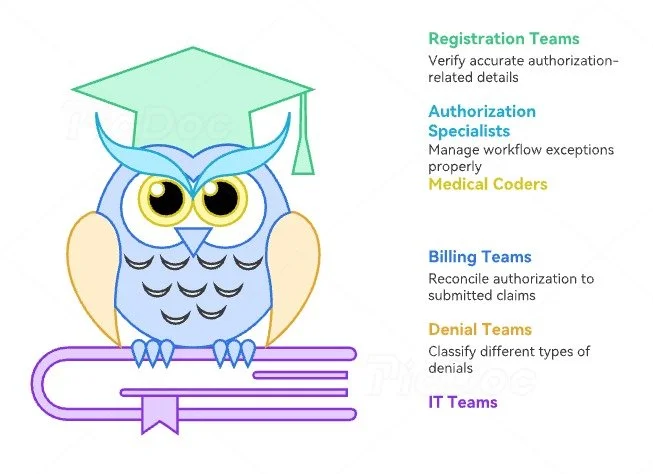
5. A 90-Day CMS Prior Authorization API Implementation Plan for RCM Leaders
A successful transition requires more than connecting an API. Organizations need reliable data exchange, redesigned staff responsibilities, effective exception handling, and methods for measuring financial results.
A phased implementation approach helps identify weaknesses before they disrupt scheduling or revenue collection.
Days 1–30: Audit payers, vendors, and existing workflows
Start by documenting every major payer product, its applicable CMS-0057-F requirements, the available authorization submission channels, and its expected API implementation date.
Ask each EHR, billing software, and clearinghouse vendor whether its platform can perform coverage requirements discovery, collect documentation, submit electronic requests, receive responses, and retain authorization evidence.
Request specific answers about supported payers, production availability, software upgrades, additional fees, and integration limitations.
Next, examine recent authorization cases to identify how often staff encountered missing documentation, repeat submissions, expired approvals, or denied claims.
Use these findings alongside authorization workflow checklists, billing software directories, denial rate analysis, and accounts receivable benchmarks.
Deliverable: A payer readiness inventory, vendor capability assessment, baseline performance report, and prioritized implementation schedule.
Days 31–60: Test actual electronic authorization scenarios
Begin controlled testing with payer and vendor partners that support the intended workflows.
Choose service categories with adequate volume and reasonably consistent documentation. Test complete requests, missing-information responses, denials, approval limits, and changes after approval.
A useful test should confirm that an authorization request submitted electronically is accurately represented in the receiving system and that its response reaches the correct internal work queue.
Include failure scenarios. For example, determine what happens when a connection drops after transmission but before the practice receives confirmation.
The system should allow staff to investigate the original transaction before submitting a duplicate.
Also verify that relevant authorization information is available to the billing team when the claim is prepared.
Testing should incorporate coding accuracy validation, electronic claims workflows, medical necessity requirements, and denial resolution procedures.
Deliverable: Documented test results, validated exception scenarios, staff training materials, and a working fallback procedure.
Days 61–90: Launch controlled workflows and monitor outcomes
Begin with selected payer products and service categories that have passed testing.
Assign responsibility for reviewing incomplete requests, unresolved statuses, nearing deadlines, and authorization-to-claim mismatches.
Monitor performance daily during initial deployment, then transition to routine oversight as results stabilize.
Compare electronic and manual authorization workflows using consistent definitions. Distinguish staff effort from overall payer decision time because a faster submission process does not necessarily produce an immediate payer decision.
Continue using denial performance analysis, clean claim calculations, billing productivity benchmarks, and revenue cycle monitoring.
Deliverable: A production-ready authorization process with documented performance, escalation ownership, and a plan for expanding to additional payers.
Six performance metrics every RCM manager should monitor
1. First-submission completeness rate
Divide authorization requests accepted for review without missing-information follow-up by total requests submitted. For example, 460 complete requests out of 500 produce a 92% first-submission completeness rate.
This measure helps determine whether electronic documentation collection is improving actual submission quality.
2. Median authorization turnaround time
Measure elapsed time between confirmed payer receipt and final decision for each request. Report standard and expedited cases separately.
The median helps describe typical performance, while additional measures such as the 90th percentile reveal unusually slow cases.
3. Additional-information request rate
Divide requests that receive at least one request for additional documentation by the total number of requests submitted.
Investigate recurring causes by specialty, provider, payer, and service category.
4. Authorization-related claim denial rate
Divide claims denied specifically for authorization-related reasons by the relevant population of submitted claims.
Keep this measure separate from denials caused by medical necessity, eligibility, coding, or other payment issues.
Detailed investigation should connect with claim adjustment reason codes, denial management resources, medical billing appeal templates, and denial rate calculations.
5. Authorization-to-claim match rate
Measure the proportion of applicable claims whose payer, service, date, quantity, provider, and location align with the relevant authorization requirements.
Investigate mismatches before claim release wherever possible.
6. Staff handling time per authorization
Calculate total active staff time spent preparing, submitting, monitoring, correcting, and resolving requests, divided by completed authorization cases.
Including rework is essential. A workflow that reduces initial preparation time but increases subsequent corrections may produce disappointing savings.
How to calculate financial impact
Consider a practice handling 1,200 authorization requests per month.
Suppose redesigned electronic workflows save an average of six minutes of active staff time per request after accounting for routine exception handling.
That equals 120 staff hours saved monthly.
At an illustrative fully loaded labor cost of $28 per hour, the value of released staff capacity is $3,360 per month.
If additional software and integration costs total $1,500 per month, the illustrative net labor-capacity value is $1,860 monthly before considering other operational expenses and reimbursement changes.
This calculation represents capacity value. Actual cash savings depend on staffing arrangements and whether the organization can reduce overtime, avoid additional hiring, or redeploy staff productively.
Additional benefits may arise from fewer authorization-related denials, reduced rescheduling, and faster progression from completed services to payment.
These effects should be measured separately using clean claim rate analysis, denial root-cause worksheets, AR days calculations, and physician reimbursement benchmarks.
For RCM leaders, the strongest evidence of a successful transition is a measurable reduction in administrative effort accompanied by accurate authorizations, fewer preventable payment problems, and reliable continuity of patient care.
6. FAQs About the CMS Prior Authorization API Requirements for 2027
-
Under CMS-0057-F, the API requirements begin January 1, 2027, for Medicare Advantage organizations and state Medicaid and CHIP fee-for-service programs. Medicaid and CHIP managed care entities generally follow rating periods beginning on or after January 1, 2027, while applicable Qualified Health Plans on Federally-facilitated Exchanges follow plan years beginning on or after that date.
Medical practices should verify individual payer readiness and software availability before changing their existing authorization workflows, billing platforms, and electronic submission procedures.
-
CMS-0057-F primarily establishes API implementation responsibilities for specified payers. Medical billing teams should prepare to use available electronic authorization capabilities, although the rule does not universally require every provider to abandon existing submission methods.
Separate Promoting Interoperability requirements may affect particular eligible clinicians and hospitals. Under the November 2026 finalized policies, the Electronic Prior Authorization measure is optional for qualifying reporting in 2027 and required beginning in 2028, subject to applicable program requirements.
Teams should coordinate authorization procedures, Medicare billing resources, and software integration planning.
-
For applicable non-drug authorization requests under the CMS-0057-F process provisions, the general maximum is 72 hours for expedited requests and seven calendar days for standard requests. The patient's medical condition may require a quicker decision.
These shortened deadlines began in 2026 and exclude Qualified Health Plan issuers on the Federally-facilitated Exchanges under the specific provisions establishing these periods.
RCM staff should document payer receipt and monitor the applicable deadline through their authorization checklist, denial management procedures, and medical necessity review process.
-
The API can help identify documentation requirements earlier and make authorization decisions easier to communicate and track. Medical necessity determinations continue to depend on applicable coverage criteria and clinical evidence.
An approval may also contain limitations that affect later billing.
Organizations should strengthen medical necessity documentation, coding audit procedures, physician clarification workflows, and denial root-cause analysis to prevent recurring problems.
-
The original CMS-0057-F Prior Authorization API requirements focus on non-drug medical items and services.
In April 2026, CMS issued CMS-0062-P proposing additional electronic prior authorization requirements for drugs, including drugs covered under medical and pharmacy benefits. Those proposed provisions have separate regulatory status and should be checked before implementation.
RCM teams handling medical-benefit drugs should continue verifying the applicable payer rules, especially when coordinating HCPCS coding, medical necessity, and prior authorization requirements.
-
Yes. An authorization approval does not guarantee payment because the final claim remains subject to applicable coverage, eligibility, coding, billing, and reimbursement requirements.
Authorization-related denials may also occur when the completed service exceeds approved units, falls outside the permitted dates, or differs from the originally authorized procedure.
A strong pre-claim review process connects clean claim validation, coding accuracy audits, denial analysis, and billing appeal preparation.
