
Modifier 59 and the four X modifiers, XE, XP, XS, and XU, help identify separately reportable services that would otherwise trigger National Correct Coding Initiative (NCCI) procedure-to-procedure edits. Choosing incorrectly can cause bundled-service denials, delayed reimbursement, and compliance exposure. The challenge is proving exactly why two services qualify as distinct. This guide explains the decision rules, examines real CPT coding scenarios, and provides practical methods for improving modifier accuracy, preventing claim denials, and strengthening coding audits.

1. Modifier 59 vs XE, XP, XS & XU: What Each Modifier Actually Means
The Centers for Medicare & Medicaid Services (CMS) established the X modifiers to describe distinct procedural circumstances more precisely. Medicare guidance recommends using the appropriate specific modifier whenever possible and reserving modifier 59 for circumstances where another modifier cannot describe the documented distinction.
These modifiers frequently become relevant when two CPT or HCPCS codes appear together on a claim and an NCCI procedure-to-procedure (PTP) edit ordinarily prevents separate payment.
The correct assignment depends on the clinical circumstances, the applicable edit, and the documented relationship between the services. A detailed coding audit checklist helps establish these facts, while coding practice cases develop the judgment needed to apply the rules consistently.
Modifier 59: Distinct procedural service
Modifier 59 identifies an independent procedural service under qualifying circumstances involving a separate session, anatomical site, lesion, injury, or other recognized procedural distinction.
Medicare recommends using a more descriptive modifier when one applies. For example, a separate encounter can be identified with XE, while a separately treated structure can support XS.
Modifier 59 remains relevant in specific situations addressed by NCCI guidance, including appropriately separated timed services and certain diagnostic procedures performed independently of therapeutic procedures.
Frequent use of modifier 59 deserves targeted coding compliance review because it may indicate overreliance on a generic modifier or inadequate clinical documentation.
Modifier XE: Separate encounter
XE indicates that qualifying distinct services occurred during separate patient encounters on the same date of service.
For example, a patient undergoes cardiovascular stress testing in the morning and returns later for a separately indicated rhythm electrocardiogram. If both services satisfy the relevant reporting requirements and the patient had genuinely separate encounters, XE may explain why an otherwise bundled code pair is separately reportable.
The record should establish encounter separation through clinical notes, timestamps, and the circumstances requiring the second service.
A different procedure time alone may be insufficient. This distinction is particularly important when reviewing outpatient coding scenarios and analyzing same-day claim denials.
Modifier XP: Separate practitioner
XP identifies a distinct service performed by a different practitioner.
A different rendering provider's involvement must be clinically meaningful and satisfy the relevant payer and NCCI requirements. Separate practitioner names alone cannot establish that two overlapping or bundled procedures are independently reportable.
For example, when two clinicians perform genuinely separate procedures during a patient's care, the claim may warrant XP consideration if the applicable edit permits a modifier and the practitioner distinction explains separate reporting.
Verify rendering-provider identity, individual responsibilities, documentation, and billing relationships. These details are particularly valuable during coding audits, claims processing reviews, and modifier denial investigations.
Modifier XS: Separate structure
XS identifies a qualifying distinct service performed on a separate organ or anatomical structure.
An important example involves colonoscopy procedures performed on separately identified lesions. A snare removal and a biopsy involving different lesions may support separate reporting, depending on the applicable NCCI instructions.
The anatomical relationship must be clinically sufficient. Adjacent tissues and contiguous structures within the same operative area often fall under a single anatomical site for NCCI purposes.
Coders should verify exact locations through operative reports, clinical diagrams, and documentation review. Where available, more specific anatomical modifiers such as RT, LT, or digit modifiers may be appropriate.
Modifier XU: Unusual non-overlapping service
XU identifies a service that is distinct because its work does not overlap the usual components of the primary service.
CMS describes limited circumstances involving independent diagnostic services before or after therapeutic procedures. The diagnostic work must satisfy specific conditions, including independent clinical purpose and exclusion from the primary procedure's ordinary components.
A routine confirmation study, expected procedural monitoring, or inherently included diagnostic step generally cannot support XU.
The central question is whether the clinical record establishes separately reportable work beyond the primary service's normal requirements. That determination should be supported by a coding audit, appropriate physician clarification, and the relevant NCCI policy.
Modifier 59 vs XE, XP, XS & XU: 35-Scenario Coding Decision Map
| Clinical / Billing Scenario | Decision | Reason | Documentation / Compliance Check |
|---|---|---|---|
| 1. Two procedures during genuinely separate visits on the same day | XE | Separate patient encounters may justify distinct reporting. | Verify encounter boundaries, separate clinical need, and eligible PTP edit. |
| 2. Procedures performed one after another during one continuous visit | XE unsupported | Different times alone do not establish separate encounters. | Identify actual patient encounter separation. |
| 3. Two different practitioners deliver independently reportable services | Consider XP | Different practitioner may explain a qualifying distinction. | Check each practitioner's work, billing relationship, and PTP policy. |
| 4. Two practitioners share components of one bundled procedure | No XP | Sharing work does not establish independent services. | Identify the inclusive procedure and provider responsibilities. |
| 5. Distinct procedures involve separate organs | Consider XS | Different organs may constitute separate anatomical sites. | Check whether a more specific anatomical modifier applies. |
| 6. Same-side skin biopsy 11102 and destruction 17000 at qualifying separate sites | XS or 59 | CMS recognizes qualifying site separation. | Identify each lesion and confirm distinct anatomical regions. |
| 7. Skin biopsy 11102 and destruction 17000 on opposite sides | RT / LT | Specific side modifiers can express the distinction. | Confirm precise locations and payer requirements. |
| 8. Skin biopsy and destruction of the same lesion | No 59 / XS | Procedures concern the same treated lesion. | Review bundling and actual services performed. |
| 9. Colonoscopy 45385 snare removal and 45380 biopsy on separate lesions | XS or 59 | Separate qualifying lesions can support both procedures. | Record distinct polyp locations and techniques. |
| 10. Colonoscopy 45385 and 45380 involving the same polyp | No 59 / XS | Biopsy and removal of the same lesion remain bundled. | Review operative documentation and pathology mapping. |
| 11. Colonoscopy 45385 and 45380 during separate encounters that day | XE or 59 | Different encounters may support reporting. | Verify encounter separation and repeat-procedure medical necessity. |
| 12. Nail debridement 11720 and callus paring 11055 on qualifying separate toes | XS or 59 | Independent treatment sites may satisfy CMS requirements. | Document exact toe and lesion positions. |
| 13. Codes 11720 and 11055 on distal skin of the same toe | No 59 / XS | CMS treats this adjacent tissue as one anatomical site. | Check distal interphalangeal joint location. |
| 14. Callus proximal to the distal interphalangeal joint and nail debridement | XS or 59 | CMS permits a qualifying proximal-location exception. | Document precise anatomical boundary. |
| 15. Stress test 93015 and rhythm ECG 93040 at different encounters | XE or 59 | CMS permits reporting when the ECG occurs separately. | Show separate encounter, ECG interpretation, and report. |
| 16. Rhythm ECG 93040 during stress test 93015 encounter | No 59 / XE | Rhythm monitoring is included in stress testing. | Confirm ECG was part of stress testing. |
| 17. Manual therapy 97140 and testing 97750 in separate qualifying time blocks | 59 | CMS permits distinctly timed, non-overlapping services. | Record treatment minutes and separate test documentation. |
| 18. Codes 97140 and 97750 using overlapping minutes | No 59 | Shared minutes cannot support two timed services. | Audit actual minutes rather than appointment length. |
| 19. Procedure 47370 and ultrasound guidance 76942 for that ablation | Bundled | Guidance is integral to the reported ablation. | Confirm whether imaging supported the same procedure. |
| 20. Code 76942 for an unrelated qualifying procedure during the encounter | 59 / XU review | Independent guidance may be separately reportable. | Identify unrelated procedure and applicable edit. |
| 21. Cardiac catheterization 93453 and fluoroscopy 76000 for that procedure | Bundled | Required fluoroscopy forms part of catheterization. | Check imaging purpose in procedure report. |
| 22. Code 76000 for an unrelated procedure alongside 93453 | 59 / XU review | Unrelated imaging may qualify if otherwise reportable. | Verify independent clinical purpose and code rules. |
| 23. Retina treatment 67210 and choroid treatment 67220 in the same eye/session | No 59 / XS | CMS treats ipsilateral posterior structures as contiguous. | Confirm operative site and same-session relationship. |
| 24. Shoulder arthroscopy 29827 and 29820 on the same shoulder/session | Bundled | Same-shoulder arthroscopy edit cannot be bypassed this way. | Confirm ipsilateral treatment. |
| 25. Shoulder arthroscopy 29827 and 29820 on opposite shoulders | RT / LT | Contralateral procedures may support separation. | Assign appropriate side modifiers and verify reporting. |
| 26. Iliac procedures 34833 and 34820 on the same side | Do not unbundle | Specific CPT instructions prohibit this combination. | Review code-specific exclusion instructions. |
| 27. Distinct diagnostic study establishes need for subsequent therapy | Consider XU / 59 | Independent diagnostic work may be separately reportable. | Confirm study was not inherent to treatment. |
| 28. Routine diagnostic monitoring during a therapeutic procedure | No XU | Expected monitoring is part of the primary service. | Review the normal procedural package. |
| 29. Independent diagnostic study after completed treatment | Consider XU / 59 | Separate clinical purpose may support reporting. | Confirm study is not routine post-procedure verification. |
| 30. Routine imaging immediately following a procedure to confirm results | No XU | Expected verification work is generally included. | Consult code and NCCI-specific imaging policy. |
| 31. Different diagnoses attached to two bundled CPT codes | No automatic bypass | Diagnosis differences alone cannot establish distinct services. | Review site, encounter, work, and applicable PTP edit. |
| 32. NCCI edit has modifier indicator 0 | No bypass | NCCI-associated modifiers cannot override indicator 0. | Verify correct code pair, version, and indicator. |
| 33. NCCI edit has modifier indicator 1 | Conditional | Modifier permitted when supported by clinical circumstances. | Validate separate work and preferred modifier. |
| 34. NCCI edit has modifier indicator 9 | Review edit status | Edit was deleted retroactively to its implementation. | Check current and historical edit files. |
| 35. Separate E/M service accompanies a procedure | 25 / 57 / other | E/M services follow separate modifier and global-period rules. | Assess significant E/M work and applicable surgery rules. |
Educational NCCI decision reference based on CMS modifier guidance and documented code-pair examples. Conditional rows require verification against the applicable date-of-service edit, CPT instructions, payer policy, and medical record. A possible modifier does not guarantee separate payment.
2. Modifier Decision Tree: How to Choose the Correct Modifier Before Submitting a Claim
The most reliable modifier selection process starts with the NCCI edit itself. Coders should establish whether a claim requires a modifier before deciding which one to assign.
This prevents two expensive mistakes: adding unnecessary modifiers to otherwise valid code combinations and attempting to bypass edits that prohibit separate reporting.
Step 1: Check whether an NCCI PTP edit exists
Look up the two CPT or HCPCS codes in the applicable Medicare NCCI PTP edit file. CMS updates these files quarterly, making the date of service essential when determining which edit applies.
Each edit identifies a Column 1 code, a Column 2 code, and a correct coding modifier indicator (CCMI).
The indicator determines whether an NCCI-associated modifier can potentially bypass the edit:
Indicator 0: An NCCI-associated modifier cannot bypass the edit.
Indicator 1: A modifier may permit separate reporting when the clinical circumstances satisfy the applicable requirements.
Indicator 9: The edit was deleted retroactively to its implementation date.
An indicator of 1 gives the coder permission to evaluate the circumstances. Documentation must establish why both services qualify for separate reporting.
This check should form part of every medical coding audit, particularly when denial analysis reveals frequent bundling rejections. The same workflow can be incorporated into coding practice cases.
Step 2: Determine whether the procedures occurred during separate encounters
If the patient had genuinely separate encounters on the same date, XE may be appropriate.
The record should establish when each encounter occurred, why the second service was necessary, and whether the patient received a distinct clinical evaluation or procedure.
For example, consider a patient who undergoes an outpatient diagnostic procedure in the morning, leaves the facility, and returns because of a new clinical concern that requires another separately reportable service.
The facts may support XE if the relevant PTP edit allows a modifier. A different encounter also requires reviewing other applicable modifiers, including global surgery modifiers, when relevant.
Key audit question: Can a reviewer identify two distinct patient encounters using the clinical record?
When the record contains only a continuous treatment session, consider the other modifier criteria and applicable NCCI exceptions. This distinction strengthens modifier documentation, improves claim accuracy, and reduces preventable denial rework.
Step 3: Determine whether separate anatomical structures were treated
When the documented distinction involves separate anatomical sites, review XS and any more specific anatomical modifiers.
This assessment must account for how CMS defines different anatomical sites under NCCI rules.
For example, separate lesions in different qualifying anatomical regions may support separate reporting. Treating contiguous structures within the same operative field generally does not establish sufficient separation.
Review procedure reports for lesion location, laterality, surgical site, and treatment technique.
If an anatomical modifier such as RT, LT, or a digit-specific modifier more accurately identifies the distinction, use the applicable specific modifier.
Anatomical specificity is especially important for outpatient medical coding, operative report auditing, and medical necessity documentation.
Step 4: Assess whether practitioner separation is meaningful
When two practitioners are involved, examine XP.
CMS defines XP by the involvement of a separate practitioner. However, the claim must still satisfy the applicable code-pair rules.
The coder should determine whether the practitioners performed separately reportable services, how their work was divided, and whether any service represents an inherent component of another.
For example, separate physicians participating in the same procedure may be subject to assistant-surgeon, co-surgeon, team-surgery, or other established reporting requirements.
The appropriate modifier depends on the actual circumstances.
Key audit question: Does the practitioner distinction justify independent reporting under the applicable coding and billing rules?
Review rendering-provider details alongside the electronic claim record. When documentation is unclear, use compliant clarification procedures before determining the final modifier.
Step 5: Evaluate whether the service qualifies as unusual and non-overlapping
XU requires a more detailed analysis of the work performed.
CMS recognizes certain situations where diagnostic work is independently reportable in relation to therapeutic work, including qualifying diagnostic services that lead to a treatment decision or occur after treatment for an independent clinical reason.
The record should demonstrate how the diagnostic service differs from routine procedural components.
Consider whether the service was clinically independent, medically necessary, and excluded from the primary procedure's usual work.
For diagnostic imaging, this assessment must consider imaging guidance, monitoring, and routine post-procedure verification.
A focused coding compliance review should capture the NCCI policy supporting the exception. This is especially useful when preparing denial appeals or evaluating medical necessity objections.
Step 6: Reserve modifier 59 for qualifying circumstances
When the documented facts establish a distinct procedural service and a more specific modifier does not appropriately describe the circumstances, modifier 59 may be suitable.
CMS provides specific guidance permitting modifier 59 for separately performed timed services. Other recognized exceptions may involve independent diagnostic work.
The coder must still evaluate all applicable CPT instructions and NCCI restrictions.
A standardized decision process reduces unsupported modifier use and supports stronger coding accuracy scores. Teams can reinforce the workflow with medical coding interview scenarios and monitor its financial effect through denial rate analysis.
3. Real Modifier 59, XE, XP, XS & XU Coding Examples: Correct and Incorrect Decisions
The following examples illustrate situations addressed in CMS guidance and practical scenarios where modifier eligibility requires additional validation.
Each example focuses on the clinical facts that determine the coding decision.
Example 1: Colonoscopy With Biopsy and Snare Polypectomy
CPT codes: 45385 and 45380
Clinical scenario: During colonoscopy, a gastroenterologist removes a polyp from the sigmoid colon using a snare. A separate lesion in the ascending colon is biopsied.
Coding decision: Modifier XS or 59 may support separate reporting of CPT 45380 with CPT 45385 when the two procedures involve separate lesions and meet the applicable NCCI requirements.
CMS specifically recognizes this type of separate-lesion circumstance.
The procedure report should identify each lesion's location and the technique performed. Pathology labels can provide supporting information when correlated with the operative report.
Incorrect variation: The physician biopsies a polyp and subsequently removes that same polyp with a snare during the encounter. Using XS or 59 to obtain payment for both procedures would conflict with the NCCI restriction for the same lesion.
This example demonstrates why operative report documentation, coding case analysis, and accurate claim submission are essential.
Example 2: Nail Debridement and Callus Removal
CPT codes: 11720 and 11055
Clinical scenario: A podiatrist debrides a patient's toenails and separately pares a hyperkeratotic lesion on a qualifying different toe.
Coding decision: XS or 59 may be appropriate when the anatomical sites satisfy CMS separation criteria.
The documentation must identify the treated nail or nails, the location of the hyperkeratotic lesion, and their anatomical relationship.
CMS provides an important restriction: treatment of the nail, nail bed, and adjacent distal soft tissue of the same toe generally constitutes treatment of one anatomical site.
Incorrect variation: A provider debrides a nail and pares a callus on the distal portion of the same toe. Appending XS to create separate payment is inappropriate when both services involve the site defined as contiguous by CMS.
Podiatry organizations should include this distinction in their coding audit checklist, especially when reviewing repeat bundling denials and documenting medical necessity.
Example 3: Cardiovascular Stress Test and Separate Rhythm ECG
CPT codes: 93015 and 93040
Clinical scenario: A patient undergoes cardiovascular stress testing. Later that day, during a separate encounter, the clinician performs, interprets, and reports a rhythm ECG for a distinct clinical indication.
Coding decision: Modifier XE or 59 may support reporting the separate rhythm ECG when the requirements are satisfied.
CMS specifically identifies this code pair as an example where genuine encounter separation can permit distinct reporting.
Incorrect variation: The rhythm ECG is performed as part of the cardiovascular stress testing encounter. Since the ECG activity is included within the stress test service, reporting the two together using XE would be inappropriate.
The record should demonstrate the independent encounter and ECG interpretation.
This example is particularly useful for medical coding interview preparation, clinical documentation review, and investigations of cardiology claim denials.
Example 4: Manual Therapy and Physical Performance Testing
CPT codes: 97140 and 97750
Clinical scenario: A physical therapist performs 15 minutes of manual therapy followed by 15 minutes of physical performance testing, including the required written report.
Coding decision: CMS recognizes modifier 59 as an appropriate option for distinctly separated timed services when the applicable reporting requirements are satisfied.
The therapy documentation must establish the actual minutes and individual work performed.
CMS also provides an example involving 10 minutes of manual therapy, 15 minutes of physical performance testing, and another five minutes of manual therapy. The separate time blocks can support the required 15 minutes of manual therapy when all other requirements are met.
Incorrect variation: The therapist reports both codes using the same 15-minute period. The same treatment minutes cannot independently support both timed services.
A useful coding productivity review can identify repeated problems with overlapping service minutes. These should also be tested through coding practice cases and tracked in denial root-cause analysis.
Example 5: Liver Tumor Ablation and Ultrasound Guidance
CPT codes: 47370 and 76942
Clinical scenario: A surgeon performs laparoscopic radiofrequency ablation of a liver tumor and uses ultrasound guidance for needle placement during that procedure.
Coding decision: The ultrasound guidance is integral to the reported ablation. CMS prohibits separate reporting of 76942 for this purpose, including when modifiers 59, XE, XP, XS, or XU are appended.
Potentially reportable variation: During the encounter, ultrasound guidance is performed for another procedure that is genuinely unrelated to the liver ablation.
The separate guidance service may qualify for reporting when the applicable coding rules and NCCI requirements are satisfied.
XU or 59 requires careful consideration because the record must establish the independent procedural work.
In complex surgery, coding audits should compare the procedures' clinical purposes against the NCCI edit rationale. This helps prevent inappropriate modifier-related appeals and improves first-pass claim acceptance.
Example 6: Arthroscopic Surgery on the Same Shoulder
CPT codes: 29827 and 29820
Clinical scenario: During the same operative session, a surgeon performs arthroscopic rotator cuff repair and partial synovectomy on the same shoulder.
Coding decision: CMS prohibits using modifiers 59, XE, XP, XS, or XU to bypass this code-pair edit when the procedures are performed on the same shoulder.
The fact that the surgeon performed two named procedures does not establish independent reportability.
Different-side variation: If the procedures are performed on opposite shoulders, the appropriate RT and LT modifiers may permit the distinct reporting circumstances recognized by CMS.
The operative record should establish laterality, separate work, and the relevant procedure details.
This example belongs in every orthopedic coding audit and is useful when training coders through real surgical coding cases.
Example 7: Different Practitioners During the Same Procedure
Modifier under consideration: XP
Clinical scenario: A surgeon performs a procedure while another physician performs work associated with that same operation.
Coding decision: The responsibilities and reporting rules must be examined before assigning XP.
If the second physician's work represents assistance, co-surgery, or another established surgical relationship, applicable surgical modifiers and code-specific reporting requirements govern the claim.
XP may be relevant where the clinical record establishes genuinely distinct work performed by another practitioner and the edit permits the modifier.
An audit should examine procedure ownership, each practitioner's documented services, and the relevant billing relationship.
This example is particularly relevant to coding interview scenarios, coding compliance audits, and claim rejection investigations.
Example 8: Independent Diagnostic Work Before Therapeutic Treatment
Modifier under consideration: XU
Clinical scenario: A provider performs a separately reportable diagnostic procedure that establishes information necessary to decide whether to proceed with a therapeutic procedure.
Coding decision: XU or 59 may be considered when the diagnostic service is separate from the therapy's usual components and satisfies the specific CMS conditions.
The diagnostic service must occur independently, provide information supporting the treatment decision, and fall outside the normal procedural package.
An appropriately documented diagnostic test that establishes the need for treatment may meet these conditions.
A routine diagnostic component required to perform the therapeutic procedure generally remains included.
This distinction frequently affects medical necessity reviews, clinical documentation queries, and NCCI-related appeals.
Quick Poll: What is your biggest modifier 59 and X{EPSU} billing problem?
4. Modifier Documentation Requirements: What Must Be in the Medical Record?
Modifier-related denials often originate from incomplete documentation. The clinical record may establish that two services occurred while leaving insufficient evidence of why they qualify for independent reporting.
The documentation standard should correspond directly to the modifier's purpose.
Documentation required for XE
For separate encounters, the record should identify the timing, purpose, and clinical circumstances of each encounter.
Relevant evidence may include separate encounter notes, check-in and discharge details, the clinical reason for returning, and independent procedure reports.
The documentation should allow a reviewer to distinguish the two encounters without relying solely on different timestamps.
A second appointment or procedure time may support the record, but the complete circumstances determine eligibility.
Organizations should incorporate encounter separation into coding audit procedures and their electronic claims workflows.
Documentation required for XP
For XP, identify the individual practitioners, their services, and the relationship between the separately reported procedures.
A useful record establishes who performed each service, the independently reportable work involved, and why that distinction satisfies the coding requirements.
The claim must also accurately identify the appropriate rendering and billing providers.
When the documentation is incomplete, a compliant physician query may resolve the missing clinical facts.
Billing teams should review XP claims through a coding compliance checklist, particularly in practices where several specialists participate in procedures.
Documentation required for XS
For XS, document the exact anatomical relationship between the procedures.
Relevant details include organ, location, laterality, separate lesions, procedure techniques, and specific treatment sites.
For colonoscopy, the report should distinguish the locations and treatment methods of individual lesions. For podiatry, it may need to identify individual toes and the relationship of treated tissue to the distal interphalangeal joint.
These details help reviewers apply the anatomical distinctions identified in NCCI policy.
Incomplete lesion mapping can create avoidable claim denials, especially when the claim contains an otherwise appropriate modifier combination.
Documentation required for XU
XU requires evidence of independently performed, non-overlapping work.
The record should establish the clinical purpose of the additional service, the relationship to the primary procedure, and why the work falls outside the usual procedural components.
For a diagnostic study performed before treatment, document what information the study provided and how it informed the treatment decision.
For a diagnostic study performed afterward, explain the separate clinical indication and why the study was beyond routine post-procedure verification.
The strongest documentation directly supports the clinical circumstances recognized in NCCI guidance. It can also strengthen medical necessity appeals and reduce unsupported claims identified during coding audits.
Where should modifier 59 or an X modifier appear on the claim?
For Medicare NCCI purposes, CMS permits modifiers 59, XE, XP, XS, and XU to be appended to either the Column 1 or Column 2 code of an eligible PTP pair.
Many billing workflows traditionally identify the Column 2 code as the line requiring modifier review. The applicable CMS and payer reporting instructions should guide final placement.
Modifier order and submission requirements may differ among payers.
Avoid appending modifier 59 and an X modifier together to describe the same distinct circumstance on the same claim line.
Always review the specific payer's modifier processing rules before submission.
These operational details should be included in claim scrubber validation, clean claim measurement, and the organization's coding audit process.
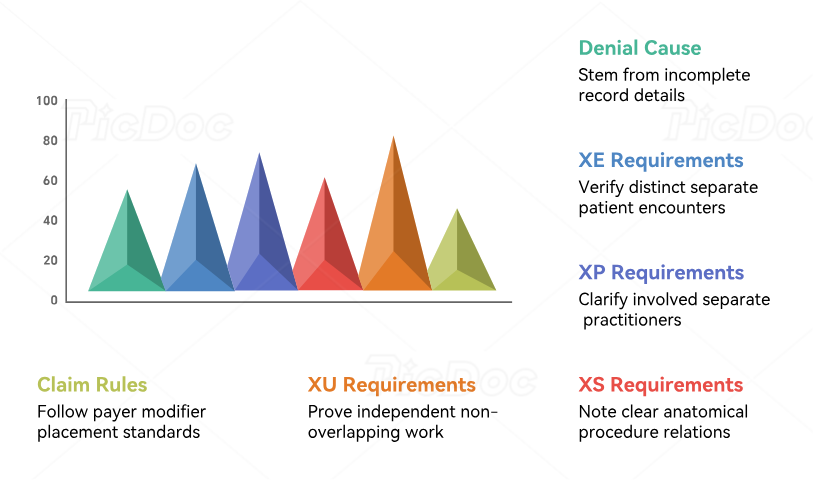
5. How to Prevent Modifier 59 and X Denials, Overpayments & Audit Findings
A strong modifier compliance program monitors both underpayment and overpayment risks.
Underpayments can occur when independently reportable services are incorrectly bundled. Overpayments can arise when modifiers improperly separate services that should be included within one procedure.
The organization must identify the underlying coding problem before deciding whether to correct a claim or appeal a denial.
Separate four types of modifier-related problems
1. Code-pair edit problem: Two procedures trigger an NCCI edit. The coding team must confirm the applicable modifier indicator and whether the clinical circumstances support an exception.
2. Documentation problem: The claim may describe distinct services, but the clinical record does not establish the necessary encounter, anatomical, practitioner, or non-overlapping work distinction.
3. Payer processing problem: A payer may recognize the modifiers differently or apply additional billing rules. The team should verify the payer's written policy and claim-submission requirements.
4. Medical necessity or coverage problem: The payer may accept the coding combination but deny a service for coverage-related reasons. These require a separate analysis of applicable policies and documentation.
A structured denial root-cause worksheet helps classify each issue, while the CARC directory supports interpretation of payer adjustments.
For appropriate disputes, billing appeal templates can structure the argument around the specific coding rule and clinical evidence.
Build a modifier-specific audit sample
Start with high-frequency code combinations involving modifier 59, XE, XP, XS, or XU.
A practical initial sample could include 50 claims, distributed across the modifiers and specialties most frequently used by the practice.
For each claim, examine the PTP edit, modifier indicator, clinical documentation, code placement, payer requirements, and final adjudication.
Consider these hypothetical results from a 50-claim review:
37 claims supported the selected modifier.
6 claims contained insufficient documentation.
4 claims used a less appropriate modifier.
3 claims attempted to bypass edits without a qualifying exception.
This produces 13 claims requiring corrective review, or a 26% initial exception rate. The result is an illustrative example, and sample findings should not automatically be generalized to the organization's entire claim population.
The most useful next step is to categorize errors by origin. A concentrated documentation problem requires a different intervention from a software configuration problem.
Combine the findings with medical coding accuracy audits, coding productivity analysis, and clean claim tracking.
Create modifier-specific billing edits
A claim scrubber can flag combinations that repeatedly produce unsupported or missing modifier decisions.
Useful edits include:
Flagging a 59 or X modifier attached to an NCCI pair with modifier indicator 0.
Identifying unusual combinations of 59 and X modifiers on the same line.
Flagging XE claims that lack evidence of separate encounters.
Identifying XS claims that require more specific anatomical modifiers.
Detecting overlapping minutes in physical therapy reporting.
Highlighting repeated use of XU for diagnostic work normally included within another procedure.
These controls require careful configuration to avoid excessive false positives.
A billing software review can help identify appropriate claim-processing capabilities. Track the outcome through denial rate monitoring and accounts receivable analysis.
Use a defensible process for appeals
When an NCCI-related denial appears incorrect, establish which issue caused it before initiating an appeal.
Verify the original CPT codes, applicable code-pair edit, modifier indicator, payer policy, and submitted modifiers.
Then compare the record with the specific condition that allows separate reporting.
For example, an appeal involving 45385 and 45380 should identify the distinct lesions and explain why their separate treatment satisfies the applicable NCCI policy.
An appeal involving 93015 and 93040 should establish separate encounters and the independently reported ECG service.
Where evidence supports the original billing, a structured denial appeal letter can present the relevant clinical facts. Where the documentation is insufficient, the organization should follow compliant record clarification and correction procedures.
Track appeal outcomes through denial analysis and use recurring findings to improve coding training.
Establish a 30-day corrective action plan
During the first week, identify the most frequently denied modifier code pairs and compare them against the applicable NCCI edits.
During the second week, audit representative claims and classify the underlying problems.
During the third week, update coding guidance, refine documentation requirements, and correct claim scrubber rules.
During the fourth week, review new claims to determine whether the interventions reduced denials and unsupported modifier assignments.
Maintain separate measures for modifier-related rejection rates, audit accuracy, corrected-claim volume, and average resolution time.
This approach turns modifier education into measurable operational improvement and supports stronger revenue cycle performance, more reliable coding compliance, and lower denial-related rework.
6. Frequently Asked Questions About Modifier 59, XE, XP, XS & XU
-
Modifier 59 broadly identifies qualifying distinct procedural services. The X modifiers identify more specific circumstances: XE for a separate encounter, XP for a separate practitioner, XS for a separate structure, and XU for an unusual non-overlapping service.
Medicare recommends selecting the appropriate specific modifier whenever possible.
The correct modifier must be supported by the medical record and the applicable NCCI requirements. Practicing realistic modifier coding examples and completing a documentation audit can improve selection accuracy.
-
Using 59 and XS together to identify the same distinct procedural circumstance is unnecessary and may conflict with payer reporting instructions.
XS specifically identifies qualifying separate anatomical structures. When the clinical distinction is anatomical and XS applies, Medicare recommends the more specific modifier.
For multiple modifier requirements, verify the applicable coding and payer rules.
A focused modifier audit can identify overlapping modifier assignments before electronic claim submission.
-
XE describes separate patient encounters occurring on the same date of service.
CMS specifically defines XE for this circumstance.
A patient may have multiple services during one encounter, but separate service times alone do not necessarily establish XE eligibility.
The record should demonstrate genuine encounter separation. This information is valuable in outpatient coding cases and claim denial reviews.
-
XP may be considered when the distinction involves work performed by a separate practitioner.
However, the specific NCCI edit, reporting rules, nature of the work, and billing relationship determine eligibility.
The involvement of two physicians should be evaluated against the appropriate surgical, diagnostic, or professional billing rules.
Document each practitioner's services and review the claim through a coding audit checklist.
-
XS or 59 may be appropriate for certain procedures performed on qualifying separate lesions, including the colonoscopy example involving CPT 45385 and 45380.
CMS limits the general anatomical separation principle to different organs, different anatomical regions, and certain non-contiguous lesions in different regions of the same organ.
The applicable code-specific instructions remain essential.
Precise lesion identification supports medical coding accuracy and reduces unsupported modifier assignments during operative coding audits.
-
XU applies when a service is distinct because it does not overlap the usual components of the primary service.
Different procedure descriptions alone do not establish eligibility.
CMS provides limited circumstances involving independent diagnostic procedures performed before or after therapeutic services.
The coder must establish the specific qualifying circumstance and verify the applicable NCCI edit. These cases benefit from physician documentation clarification and coding compliance review.
