
The 2027 Medicare Physician Fee Schedule introduces significant changes to physician reimbursement, E/M modifiers, practice expense calculations, and Medicare billing requirements. Effective January 1, 2027, the final rule establishes lower conversion factors, replaces G2211 with new modifiers, and changes payment for certain same-day procedures. For medical coders, billing managers, and practice administrators, these updates require immediate attention to claim configuration, documentation, and revenue forecasting. This guide explains the finalized changes, identifies reimbursement risks, and provides practical steps to prepare your Medicare billing workflow for 2027.

1. 2027 Medicare Physician Fee Schedule Final Rule: Conversion Factors and Payment Changes
CMS released the 2027 Medicare Physician Fee Schedule (MPFS) final rule on November 4, 2026, with Federal Register publication on November 9, 2026. The policies generally become effective January 1, 2027.
The immediate concern for physician practices is the reduction in Medicare conversion factors. These figures directly affect the calculation of payments under the Medicare physician fee schedule, although the actual change for each CPT service also depends on its relative value units and geographic adjustments.
2027 Medicare Conversion Factors: The Final Numbers
Qualifying Advanced APM Participants (QPs)
2026 conversion factor: $33.57
2027 conversion factor: $32.95
Year-over-year change: -1.83%
Non-Qualifying APM Participants (Non-QPs)
2026 conversion factor: $33.40
2027 conversion factor: $32.63
Year-over-year change: -2.31%
The differences arise partly because a temporary 2.50% conversion-factor increase applied in 2026 expires for 2027. Statutory updates of 0.75% for qualifying APM participants and 0.25% for other practitioners, together with a budget-neutrality adjustment, contribute to the final values.
For practices, the consequences extend beyond a headline reimbursement percentage. A service's payment may rise or fall depending on its revised RVUs, place-of-service designation, and applicable Medicare billing requirements.
How Medicare Calculates Physician Payments
The simplified formula is:
Medicare PFS Payment = [(Work RVU × Work GPCI) + (Practice Expense RVU × PE GPCI) + (Malpractice RVU × MP GPCI)] × Conversion Factor
GPCI represents the geographic practice cost index. Additional payment policies and adjustments may apply to particular services.
Consider a hypothetical service with 3.00 total geographically adjusted RVUs.
At the 2027 non-QP conversion factor, its illustrative payment is:
3.00 × $32.63 = $97.89
At the 2026 non-QP conversion factor, the same assumed RVUs produce $100.20.
That is a $2.31 decrease per service, before accounting for code-specific RVU changes or other adjustments. Across 5,000 identical services, the illustrative difference becomes $11,550.
For an accurate forecast, combine physician reimbursement calculations with your actual Medicare utilization data, rather than applying a single percentage to every claim.
Why Specialty-Level Reimbursement Can Differ
Specialties have different combinations of physician work, equipment, clinical labor, malpractice expense, and facility-based services. Changes to practice expense RVUs can therefore redistribute payments between specialties even when they use the same conversion factor.
A surgical practice should investigate changes to its frequently billed procedures and global surgery policies. A primary care practice should examine office visits, longitudinal care modifiers, and chronic care services. Diagnostic providers should review professional and technical component valuations.
Use Medicare payment reference tools alongside your clean claim rate analysis to distinguish fee-schedule reductions from avoidable billing losses.
2027 Medicare Physician Fee Schedule: Payment, Coding & Compliance Action Map (35+ Rows)
| 2027 Change | Finalized Policy | Revenue Impact | Required Billing Action |
|---|---|---|---|
| 1. Final rule status | CMS-1848-F published November 9, 2026. | Confirms 2027 payment policies. | Use final rather than proposed specifications. |
| 2. Effective date | General implementation January 1, 2027. | Changes claims by service date. | Configure date-sensitive billing rules. |
| 3. Non-QP conversion factor | $32.63 versus $33.40 in 2026. | 2.31% lower conversion factor. | Reprice high-volume CPT codes. |
| 4. QP conversion factor | $32.95 versus $33.57 in 2026. | 1.83% lower conversion factor. | Verify practitioner QP status. |
| 5. QP statutory update | 0.75% update incorporated into rate setting. | Differentiates QP payments. | Validate eligible clinicians. |
| 6. Non-QP statutory update | 0.25% update incorporated into rate setting. | Lower statutory update than QPs. | Use correct conversion factor. |
| 7. Temporary 2026 increase | One-year 2.50% increase expires. | Contributes to lower 2027 rates. | Remove the temporary assumption from forecasts. |
| 8. Budget neutrality | Approximately -0.12% conversion-factor adjustment. | Affects overall rate setting. | Use final published factors. |
| 9. Work RVUs | Code-specific values reflected in final addenda. | Can change individual procedure payment. | Compare 2026 and 2027 RVUs. |
| 10. Geographic indices | Geographic adjustments remain integral to payment. | Locality affects allowed amounts. | Reprice by Medicare locality. |
| 11. Practice expense methodology | Changes to indirect cost allocation. | Redistributes PE RVUs. | Review specialty and site-level effects. |
| 12. IPCI phase-out | Indirect practice cost index phased out over two years. | Changes historical PE constraints. | Model phased RVU impacts. |
| 13. PE stabilizer | Replaces IPCI with volatility mitigation. | Can moderate transitional effects. | Use actual final PE values. |
| 14. Indirect PE allocation | Uses work RVUs and clinical labor PE RVUs, with exclusions. | Changes resource-based payment distribution. | Examine affected code families. |
| 15. Same-day E/M payment | Reduction finalized for qualifying 0-day global procedures. | Lower-valued applicable service paid at 80%. | Identify eligible claim combinations. |
| 16. Modifier 25 | Separate E/M documentation remains essential. | Affected visits may face payment reduction. | Audit modifier 25 encounters. |
| 17. Ten-day global procedures | Excluded from finalized new same-day reduction. | Avoid incorrect application of new reduction. | Check global indicator 010. |
| 18. Ninety-day global procedures | Excluded from finalized new same-day reduction. | Existing global package rules still apply. | Check global indicator 090. |
| 19. G2211 transition | Complexity add-on transitions to modifier B1. | Changes claim-line structure. | Update code and modifier mapping. |
| 20. Modifier B1 | 16% increase to associated eligible E/M payment. | Percentage-based longitudinal care recognition. | Validate E/M eligibility and documentation. |
| 21. Modifier B2 | 32% increase for eligible ACO-associated E/M services. | Larger qualified E/M adjustment. | Verify ACO participation and eligibility. |
| 22. ACO beneficiary attribution | B2 may be used for qualifying services to beneficiaries beyond assigned populations. | Expands potential eligible encounters. | Validate billing practitioner and program participation. |
| 23. RTM established patient | Established-patient requirement finalized. | Affects monitoring eligibility. | Validate patient relationship. |
| 24. RPM initiating visit | Separately reportable initiating visit required at onset, subject to transition clarification. | Adds an initiation compliance checkpoint. | Document monitoring discussion and clinical need. |
| 25. RTM initiating visit | Initiating visit required for new monitoring episodes. | Affects enrollment workflow. | Confirm practitioner visit before billing begins. |
| 26. Monitoring contractors | Direct-employment requirement delayed to 2029. | Allows additional transition time. | Plan staffing and vendor compliance. |
| 27. Monitoring code bundling | Proposed replacement with four G-codes not finalized. | Existing code structure remains relevant. | Follow finalized code-specific instructions. |
| 28. Shared medical appointments | New separate coding and payment pathway. | Creates an additional reportable service category. | Review G0686 eligibility and session documentation. |
| 29. SMA additional time | G0687 add-on code for qualifying additional time. | Recognizes extended group-session work. | Verify time and unit limits. |
| 30. Clinical staff ACP | New HCPCS G0572 and G0573. | Separately recognizes qualifying staff time. | Check direct supervision and documented time. |
| 31. Practitioner ACP | 99497 and 99498 reflect practitioner-performed time. | Separates practitioner and staff work. | Prevent overlapping time reporting. |
| 32. Psychiatric CoCM | Work RVU and clinical labor refinements finalized. | Changes behavioral health service valuation. | Reprice eligible CoCM codes. |
| 33. SBIRT and cessation services | Included in final year of timed behavioral health transition. | Changes applicable valuations. | Review affected codes and units. |
| 34. Vaccine adverse effect care | New add-on coding and payment finalized. | Recognizes qualifying additional work. | Verify code, clinical activities, and documentation. |
| 35. RHC preventive services | Qualified DSMT and MNT visits recognized as stand-alone billable RHC visits. | Expands qualifying RHC billing. | Check supervision and practitioner requirements. |
| 36. RHC/FQHC telehealth | Specified statutory flexibilities extend through 2027. | Preserves qualifying remote-service pathways. | Check modality, dates, and service category. |
| 37. Clinical laboratory rates | Private-payer-based reductions limited to 15% annually through 2029. | Limits annual reductions for affected tests. | Use CLFS rates rather than PFS calculations. |
| 38. Traditional MIPS sunset | Traditional reporting ends beginning with 2031 performance year. | Changes longer-term reporting strategy. | Plan transition to eligible reporting pathways. |
| 39. Global surgery data collection | Specified MACRA-related data collection is paused. | Reduces applicable reporting burden. | Review affected reporting procedures. |
| 40. Code-level repricing | Final RVU and modifier-adjusted files published. | Reveals actual specialty-specific changes. | Reconcile top CPT codes before go-live. |
2. 2027 CPT, HCPCS, and E/M Coding Changes That Directly Affect Reimbursement
The most operationally significant coding changes involve same-day E/M services, the transition from G2211 to new modifiers, and expanded service coding for longitudinal care and advance care planning.
These changes require updates to your medical coding audit process, modifier decision workflows, and electronic claim submission configuration.
Modifier 25: The New 80% Payment Rule
For 2027, CMS finalized a new payment reduction when a separately identifiable office/outpatient E/M visit occurs on the same day as a procedure with a zero-day global period, furnished by the same physician or another applicable practitioner in the same specialty and practice.
The higher-valued applicable service receives 100% of its otherwise applicable payment, while the lower-valued applicable service receives 80%.
Example:
A practice reports an eligible E/M visit with an illustrative allowed amount of $120 and a qualifying zero-day procedure valued at $80.
Under the simplified new policy:
E/M visit: $120
Procedure: $64
Combined payment: $184
Without this particular reduction, their combined illustrative payment would have been $200. The difference is $16.
Actual claims may involve additional payment adjustments. Practices should validate calculations against final CMS pricing files.
Importantly, the finalized reduction applies to zero-day global procedures. CMS excluded 10-day and 90-day global procedures from this new policy after narrowing its original proposal.
Coders must still establish that the E/M is significant and separately identifiable. The modifier 25 versus 59 decision guide and modifier 24, 25, and 57 comparison can help distinguish eligible visits from routine procedure-related work.
For medical practices performing high volumes of injections, minor procedures, or office-based interventions, a targeted coding accuracy audit should quantify the expected reduction.
G2211 Transitions to Modifier B1
CMS finalized replacing the separately reported G2211 complexity add-on with modifier B1, appended to an eligible E/M base code.
The new modifier increases the payment associated with that E/M service by 16%, subject to applicable requirements.
A hypothetical qualifying E/M service with a $150 payment would receive an illustrative $24 increase, producing $174 before other applicable adjustments.
This requires an important system change: billing templates previously configured to append G2211 as a separate service line must be reviewed for the new modifier-based reporting method.
Practices should revise claim scrubber rules, confirm applicable Medicare reimbursement policies, and audit documentation supporting the ongoing practitioner-patient relationship.
Modifier B2: A Larger Adjustment for Eligible ACO Practitioners
CMS also finalized modifier B2 for qualifying practitioners participating in specified Accountable Care Organization arrangements, including the Medicare Shared Savings Program and LEAD Model.
B2 increases payment for the associated eligible E/M visit by 32%.
Under the finalized policy, eligible participating practitioners may use B2 for qualifying services furnished to beneficiaries beyond those specifically assigned or aligned to the ACO.
That creates substantial compliance and revenue implications. Eligibility depends on the practitioner's participation and the applicable service requirements.
Billing teams should verify practitioner status, configure B2 eligibility controls, and validate modifier reporting against the final CMS specifications. Use medical billing reference resources and a structured coding compliance review before deployment.
New Coding for Shared Medical Appointments
CMS finalized separate coding and payment for shared medical appointments.
HCPCS G0686 describes qualifying shared medical appointments involving 2–10 patients for up to 60 minutes. G0687 is an add-on for qualifying additional time, subject to its unit restrictions.
The operational risk is treating these services as ordinary individual office visits or assuming every group session automatically qualifies.
Practices need session-level attendance records, documented medical necessity, correct time attribution, and compliance with the final code requirements.
Use the medical coding practice case framework and documentation audit checklist to prepare staff for new service categories.
Advance Care Planning: Clinical Staff Versus Practitioner Time
New HCPCS codes G0572 and G0573 recognize eligible advance care planning activities performed by clinical staff under direct supervision.
Existing CPT codes 99497 and 99498 remain associated with qualifying time personally spent by the billing practitioner.
The coding challenge is distinguishing professional time from clinical staff time, preventing duplicate time reporting, and establishing the correct supervision requirements.
Organizations should update coding documentation protocols, use physician clarification workflows when records are unclear, and test new codes before production submission.
3. How 2027 Medicare Reimbursement Changes Affect Practice Expenses, Remote Monitoring, and Specialty Payments
Conversion-factor reductions represent only one source of payment change. CMS also finalized modifications to practice expense methodology and several service-specific reimbursement policies.
A comprehensive forecast should distinguish changes within the Physician Fee Schedule from services reimbursed under other Medicare systems. Use Medicare billing directories to identify the appropriate payment mechanism.
Practice Expense RVUs: Why the Same Service Can Change Differently Across Settings
Practice expense accounts for resources such as clinical labor, supplies, equipment, and indirect operating expenses.
For 2027, CMS finalized a two-year phase-out of the indirect practice cost index, replacing it with a stabilizing mechanism intended to reduce short-term volatility.
CMS also revised how indirect practice expense is allocated, using both work RVUs and clinical labor practice expense RVUs for applicable services, with exceptions for 10-day and 90-day global procedure codes.
These changes can affect the relative value of services across specialties and settings.
A practice with equipment-intensive procedures needs a different analysis from a practice dominated by office visits. A diagnostic provider should separately examine professional versus facility coding, physician payment calculations, and individual technical component valuations.
Use the final CMS code-level RVU files rather than relying on specialty-wide averages.
Remote Physiologic and Therapeutic Monitoring Requirements
CMS finalized important revisions affecting remote physiologic monitoring (RPM) and remote therapeutic monitoring (RTM).
Beginning in 2027, RTM services are subject to an established-patient requirement. A separately reportable initiating visit is also required at the onset of new RPM or RTM services.
The initiating visit may occur in person or through qualifying telehealth. The billing practitioner must discuss monitoring with the patient and establish its clinical appropriateness.
CMS clarified that patients already receiving remote monitoring before January 1, 2027, generally do not need a new initiating visit solely to continue existing services, provided other requirements remain satisfied.
A separate proposal restricting payment for monitoring performed by contracted rather than directly employed clinical staff was finalized with implementation delayed until January 1, 2029.
For 2027, practices should audit patient initiation records, staff responsibilities, qualifying visit documentation, and monitoring units. Establish checks in the prior authorization workflow where applicable, and use coding audit controls to detect unsupported claims.
Behavioral Health and Chronic Care Services
The 2027 final rule updates valuation for psychiatric Collaborative Care Model services, including physician work and behavioral health care manager labor inputs.
Smoking and tobacco cessation services and structured assessment, brief intervention, and referral to treatment services also enter the final year of a timed behavioral health valuation transition.
CMS additionally finalized coding and payment for specified activities associated with diagnosing and treating vaccine adverse effects beyond ordinary E/M work.
The correct response is to identify the specific services actually performed, check their final descriptors, and document time and medical necessity where required.
Behavioral health organizations should review medical coding accuracy standards, verify reimbursement changes by CPT code, and analyze denial root causes after implementation.
Telehealth, Rural Clinics, and Laboratory Payment Distinctions
Certain Medicare telehealth flexibilities extend through December 31, 2027, under applicable legislation. Rural Health Clinics and Federally Qualified Health Centers also receive relevant extensions for qualifying services.
The final rule recognizes Diabetes Self-Management Training and Medical Nutrition Therapy as stand-alone billable visits under the RHC benefit when the specified requirements are satisfied.
Separately, Clinical Laboratory Fee Schedule changes limit annual payment reductions based on private-payer rate data to 15% through 2029 for affected tests.
These changes belong in separate reimbursement models. Applying the physician conversion factor directly to a Clinical Laboratory Fee Schedule service produces an incorrect forecast.
Maintain distinct Medicare billing reference workflows, check reimbursement methodologies, and route unusual denials through a structured claim adjustment review.
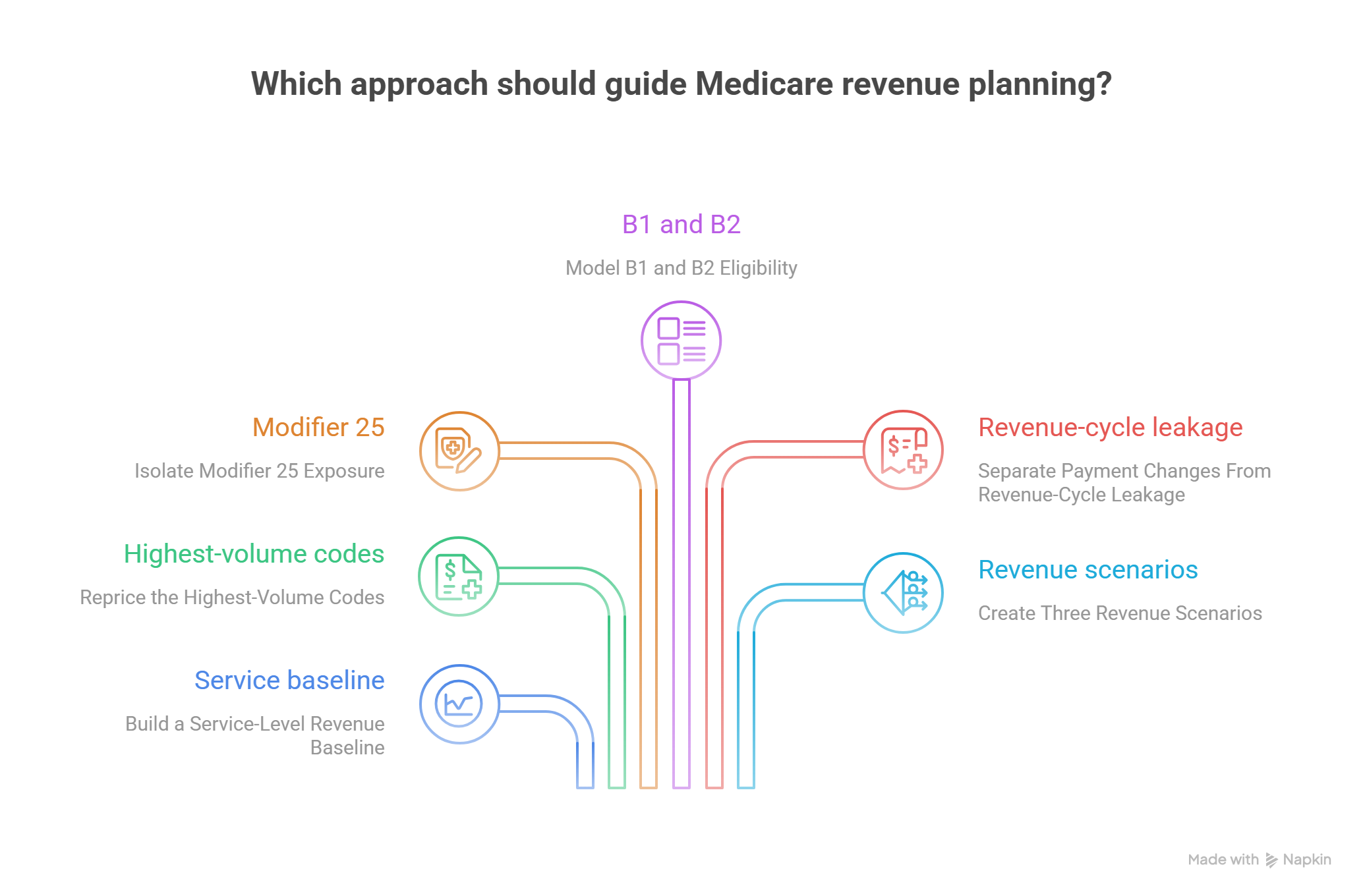
4. How to Calculate Your Practice's 2027 Medicare Revenue Impact
The most accurate approach is to reprice actual historical utilization using final 2027 policy and payment files.
A specialty-wide percentage may be useful for initial budgeting, but it cannot identify which individual procedures are becoming less profitable or which eligible services may receive additional reimbursement.
Step 1: Build a Service-Level Revenue Baseline
Export 12 months of Medicare claims with CPT/HCPCS codes, modifiers, service dates, units, place of service, provider identifiers, Medicare locality, and allowed amounts.
Separate services billed under the physician fee schedule from laboratory, institutional, and other payment systems.
Use your physician reimbursement reference and Medicare billing directory to verify the correct payment basis.
Step 2: Reprice the Highest-Volume Codes
Begin with codes representing approximately 80% of Medicare allowed revenue. This is a prioritization method, rather than a CMS threshold.
For each code, compare 2026 and 2027 values using the proper conversion factor, final RVUs, geographic indices, and applicable payment policies.
Calculate:
Annual Payment Difference = (2027 Expected Allowed Amount − 2026 Comparable Allowed Amount) × Expected Units
Document service-mix and volume assumptions separately.
Then compare those results with your clean claim rate and accounts receivable days to assess actual cash-flow exposure.
Step 3: Isolate Modifier 25 Exposure
Extract encounters where an eligible office/outpatient E/M service and a zero-day global procedure appear on the same date for the same patient under the relevant practitioner and practice relationship.
Determine which service is lower-valued and calculate the new 80% payment treatment.
For example, a practice performing 2,000 affected encounters annually with an average $12 reduction per encounter would face an illustrative $24,000 annual decrease, holding volume and other factors constant.
Use modifier decision guidance, the coding audit checklist, and denial trend analysis to separate legitimate reductions from incorrect claim processing.
Step 4: Model B1 and B2 Eligibility
Identify historical G2211 utilization and determine which eligible services could qualify under the modifier-based approach.
For B2, verify qualifying ACO participation and the applicable practitioner requirements.
Forecast the percentage-based payment impact using the actual eligible E/M code mix. Avoid assuming both modifiers can be reported together or applying their percentages indiscriminately.
Cross-check the model against the final CMS modifier-adjusted RVU files and your Medicare payment calculations.
Step 5: Separate Payment Changes From Revenue-Cycle Leakage
A 2027 fee reduction and a denied claim require different corrective actions.
Create separate categories for scheduled fee changes, coding denials, authorization failures, eligibility issues, underpayments, and delayed claims.
Measure each category through a denial rate calculator, CARC review process, and medical billing appeal workflow.
This prevents teams from appealing correctly adjudicated reductions while overlooking genuine underpayments.
Step 6: Create Three Revenue Scenarios
Build a baseline scenario using unchanged volume and the final 2027 payment rates.
Add a downside scenario that includes potential shifts in utilization, unresolved documentation problems, or slower collections. Create an operational improvement scenario reflecting realistically achievable reductions in claim errors and missed eligible services.
Track projected Medicare allowed revenue, collection timing, and administrative cost separately.
Use A/R days analysis, clean claim monitoring, and billing software evaluation to connect reimbursement forecasts with cash-flow planning.
5. 2027 Medicare Billing Compliance Checklist: What Must Be Ready Before January 1
A successful transition depends on synchronized changes across coding, billing software, provider education, compliance auditing, and financial reporting.
Update Code Sets, Fees, and Claim Edits
Load the appropriate 2027 CPT/HCPCS resources, Medicare fee schedule files, and effective-date configuration into your billing systems.
Verify implementation through test claims involving a regular E/M service, a modifier 25 same-day procedure, B1 or B2 where eligible, and any newly adopted services.
The goal is to identify configuration problems before they appear as production denials.
Use electronic claims submission resources, clean claim testing, and coding audit controls to validate every affected workflow.
Train Providers on Documentation That Determines Payment
Educate physicians and qualified healthcare professionals about separately identifiable E/M work, longitudinal care documentation, and service-specific time requirements.
For modifier 25, the documentation must support the E/M service independently of routine work included in the procedure.
For remote monitoring, the record should establish the initiation requirements and clinical management activities.
Use compliant physician query examples, modifier guidance, and coding practice cases to train staff on real clinical situations.
Review Contracts and Payment Variance Rules
Identify contracts that explicitly reference Medicare rates or use Medicare-based reimbursement formulas.
Determine whether they reference a particular fee schedule year, a percentage of Medicare, or another negotiated methodology.
Update contract modeling where permitted and investigate differences between expected and adjudicated payments.
Use physician payment benchmarks, claim adjustment reason codes, and underpayment appeal documentation to support reconciliations.
Prepare for Quality Payment Program Changes
The 2027 final rule also addresses Quality Payment Program reporting.
CMS finalized the sunset of traditional MIPS reporting beginning with the 2031 performance period, providing additional transition time toward MIPS Value Pathways or applicable alternative payment model reporting pathways.
Practices should distinguish the performance year from the later payment adjustment year. For example, 2027 MIPS performance generally relates to 2029 payment adjustments, while 2027 payment adjustments reflect earlier performance.
Verify eligibility and reporting requirements through current CMS QPP guidance, and assess the implications for your medical coding compliance procedures and risk-adjustment documentation practices.
Establish a Post-Implementation Revenue Audit
During the first 30–60 days of 2027, sample actual Medicare remittances and compare them against correctly calculated expected payments.
Prioritize high-dollar procedures, common E/M codes, new modifiers, and service categories affected by the final rule.
Flag unexpected CARCs and RARCs, rejected modifiers, missing add-on payments, inaccurate unit reporting, and place-of-service discrepancies.
Create ownership and deadlines for each issue using the denial root-cause worksheet, medical necessity appeal documentation, and A/R monitoring guide.
A measurable implementation target is to reconcile the highest-value affected claims first, resolve systemic configuration errors before they multiply, and document all corrective actions for future audits.
6. Frequently Asked Questions About the 2027 Medicare Physician Fee Schedule
-
CMS finalized a conversion factor of $32.95 for qualifying APM participants and $32.63 for non-qualifying practitioners. These represent decreases of approximately 1.83% and 2.31%, respectively, from 2026.
Individual CPT payments may change differently because of revised RVUs and geographic adjustments. Use the physician fee schedule reimbursement guide and Medicare billing tools for code-level calculations.
-
The final rule generally takes effect on January 1, 2027. Some provisions have different implementation dates, including the remote monitoring direct-employment requirement delayed until January 1, 2029.
Billing systems must distinguish service dates and effective dates to avoid inaccurate claim processing. Review electronic claims submission systems and coding audit requirements before switching production rules.
-
CMS finalized a payment reduction affecting qualifying office/outpatient E/M services billed alongside zero-day global procedures. The higher-valued applicable service receives 100% payment, while the lower-valued applicable service receives 80%.
The finalized policy excludes 10-day and 90-day global procedures from this new reduction. Correct documentation remains necessary for separately identifiable E/M services. Review the modifier 25 decision guide and E/M modifier comparison.
-
CMS finalized the transition from separately reported HCPCS G2211 to modifier B1 for applicable E/M services. B1 provides a 16% increase to the associated eligible E/M payment.
A separate B2 modifier provides a 32% increase for qualifying services furnished by eligible practitioners in specified ACO arrangements.
Practices should update claim configuration, validate eligibility, and examine the final modifier specifications through Medicare billing resources and coding audit procedures.
-
The effect depends on specialty-specific service mix, revised work and practice expense RVUs, facility versus non-facility settings, and applicable payment adjustments.
Practices performing large volumes of eligible same-day E/M and zero-day global procedures should specifically model the new 80% payment rule.
For a defensible estimate, analyze actual CPT utilization through physician reimbursement calculations, supported by claims analysis tools.
-
New RPM and RTM services generally require a separately reportable initiating visit, while RTM becomes subject to an established-patient requirement. CMS also finalized valuation changes.
The direct-employment restriction for clinical staff providing monitoring services will take effect in 2029, allowing additional transition time.
Practices should review monitoring documentation, billing practitioner involvement, and applicable supervision requirements. Use the medical coding audit checklist and billing workflow resources.
