
The 2027 CPT code update introduces 453 editorial changes, including 299 new codes, 74 revised codes, and 80 deletions, effective January 1, 2027. For medical coders, these changes affect everything from maternity care and surgical procedures to diagnostic imaging, sleep medicine, and AI-assisted services. Practices that overlook deleted codes, revised reporting requirements, or updated documentation standards risk claim rejections, payment delays, and preventable compliance findings. This guide explains the most consequential changes, identifies high-risk coding scenarios, and provides practical steps for implementing the 2027 code set accurately.

1. CPT 2027 Changes at a Glance: What Every Medical Coder Should Review First
The American Medical Association released the CPT 2027 code set on September 9, 2026. The 453 changes affect more than individual code selections. Revised guidelines, deleted service bundles, and additional reporting distinctions require practices to reassess documentation, software configuration, charge capture, and claim validation.
The most significant operational risks occur when a familiar code remains in a billing template after deletion or when a revised code demands information that existing clinical documentation does not capture. Both problems can survive routine proofreading and emerge only during a medical coding compliance audit or after the practice experiences a decline in its clean claim rate.
The three categories of CPT changes
New codes: These introduce reporting options for services that previously lacked sufficient specificity or required different coding approaches. Each new code must be reviewed for its descriptor, parenthetical instructions, add-on requirements, documentation criteria, and payer recognition. A technically valid CPT code can still require additional coverage verification through the appropriate Medicare billing resources.
Revised codes: Existing code numbers may carry updated descriptors, reporting instructions, or clinical definitions. Their familiarity creates a compliance risk because coders may continue applying earlier interpretations. A revised procedure should receive the same scrutiny as an unfamiliar code during coding practice case reviews.
Deleted codes: Retired codes require a documented transition strategy, especially when established combinations of services are replaced by separately reported procedures. Organizations should identify affected claims, prevent retired codes from being assigned to inappropriate dates of service, and verify that replacement workflows meet current electronic claims submission requirements.
Which specialties face the greatest changes?
The AMA identified several major areas requiring attention in 2027:
Obstetrics: The traditional global maternity coding structure gives way to phase-specific reporting for antepartum care, labor, delivery, and postpartum services.
Cardiac surgery: Three new codes address left ventricular assist device procedures, accompanied by updated reporting guidelines.
Hernia surgery: Nine new codes expand diaphragmatic hernia repair reporting.
Urology: Prostate biopsy coding receives new and revised distinctions involving biopsy techniques.
Rehabilitation and therapy: Biofeedback reporting adopts a time-based structure.
Radiology: Updated imaging codes and guidelines include changes involving head and neck magnetic resonance angiography.
Sleep medicine: Six new codes address unattended sleep studies.
Artificial intelligence: Ten additional AI-related CPT codes expand the existing classification to 43 codes.
Coding managers should compare these changes against their actual procedure volumes. A small practice that performs hundreds of affected procedures monthly may have greater financial exposure than a hospital department performing only a handful. Use a denial rate root-cause analysis to identify existing vulnerabilities and a medical coding productivity review to estimate the additional review capacity needed during implementation.
The following reference map identifies confirmed code-level changes and specialty-specific implementation priorities. The maternity section includes all 35 codes on the AMA's published new, revised, and deleted list, followed by other important 2027 updates.
CPT 2027 Code Changes Map: New, Revised & Deleted Codes (40+ Rows)
| Code / Category | 2027 Status | What Changes | Required Coding Action |
|---|---|---|---|
| 59050 | Deleted | Legacy maternity-related service code retired. | Review the current service and select the applicable 2027 reporting pathway. |
| 59400 | Deleted | Global routine vaginal maternity package eliminated. | Separate antepartum E/M, labor, delivery and postpartum services when applicable. |
| 59409 | Deleted | Former vaginal delivery-only code retired. | Evaluate new vaginal delivery codes 59431 or 59432. |
| 59410 | Deleted | Delivery and postpartum combination retired. | Apply the delivery code and appropriate postpartum E/M reporting rules. |
| 59425 | Deleted | Antepartum-only package for 4–6 visits retired. | Report 2027 prenatal encounters individually using appropriate E/M codes. |
| 59426 | Deleted | Antepartum-only package for 7 or more visits retired. | Update prenatal templates for encounter-based E/M reporting. |
| 59430 | Deleted | Standalone postpartum care package retired. | Select E/M codes based on documented postpartum encounters. |
| 59510 | Deleted | Global cesarean maternity package eliminated. | Identify primary versus repeat cesarean and separately report eligible care phases. |
| 59514 | Deleted | Former cesarean delivery-only code retired. | Evaluate 59502 or 59503 according to prior cesarean history. |
| 59515 | Deleted | Cesarean delivery with postpartum package retired. | Use applicable delivery and postpartum reporting rules. |
| 59525 | Deleted | Previous cesarean hysterectomy add-on code retired. | Review new standalone hysterectomy code 59504. |
| 59610 | Deleted | Global vaginal birth after cesarean package retired. | Evaluate 59432 and any separately reportable labor management. |
| 59612 | Deleted | Previous VBAC delivery-only code retired. | Review eligibility for 59432. |
| 59614 | Deleted | VBAC delivery and postpartum package retired. | Apply phase-specific delivery and E/M rules. |
| 59618 | Deleted | Global cesarean care following attempted VBAC retired. | Review repeat cesarean code 59503 and applicable labor management. |
| 59620 | Deleted | Former cesarean delivery following attempted VBAC code retired. | Evaluate 59503 with separately documented labor services. |
| 59622 | Deleted | Cesarean after attempted VBAC with postpartum care retired. | Separate applicable reporting components. |
| 59080 | New | Initial-day straightforward labor management. | Verify documented labor status and initial-day criteria. |
| 59081 | New | Initial-day complex labor management. | Document clinical factors supporting complex management. |
| 59082 | New | Subsequent-day straightforward labor management. | Confirm continued management on a subsequent date. |
| 59083 | New | Subsequent-day complex labor management. | Verify the subsequent day and clinical complexity. |
| 59431 | New | Vaginal delivery without a previous cesarean delivery distinction. | Confirm delivery method and included services. |
| 59432 | New | Vaginal delivery after a previous cesarean. | Verify prior cesarean history in the medical record. |
| 59433 | New | Separate third-degree obstetric laceration or episiotomy repair. | Document injury degree and qualifying repair. |
| 59434 | New | Separate fourth-degree obstetric laceration or episiotomy repair. | Verify the documented degree and repair performed. |
| 59502 | New | Primary cesarean delivery. | Verify absence of a previous cesarean delivery. |
| 59503 | New | Repeat cesarean delivery. | Confirm prior cesarean history and documented procedure. |
| 59504 | New | Hysterectomy performed with cesarean delivery. | Verify separate procedural documentation and applicable modifiers. |
| 59623 | New | Uterine tamponade procedure. | Identify the intervention and distinguish it from other hemorrhage management. |
| 59051 | Revised | Maternity-related reporting instructions updated. | Review the current descriptor and revised guidelines before assignment. |
| 59300 | Revised | First- or second-degree obstetric repair reporting clarified. | Verify that the repair was performed by an eligible clinician other than the delivery clinician. |
| 59412 | Revised | Obstetric procedure reporting updated. | Compare the 2026 and 2027 descriptors and instructions. |
| 59414 | Revised | Obstetric procedure descriptor or guidance updated. | Review revised inclusions and reporting criteria. |
| 59898 | Revised | Maternity-related code description updated. | Check the revised descriptor and code-specific guidance. |
| 59899 | Revised | Unlisted maternity procedure reporting context updated. | Review current unlisted-procedure instructions and payer documentation requirements. |
| 55706 | Deleted | Previous prostate biopsy reporting option retired. | Reassess biopsy approach and current procedure-specific alternatives. |
| 55712 | Deleted | Previous prostate biopsy code retired. | Reevaluate target-only fusion biopsy reporting under the new structure. |
| 55713 | Deleted | Previous prostate biopsy code retired. | Update urology templates and automated charge selection. |
| 55715 | Revised | Additional targeted prostate biopsy lesion reporting updated. | Verify the primary procedure, lesion count and add-on instructions. |
| 55716 | New | Additional targeted-lesion reporting option in the prostate biopsy family. | Confirm qualifying base procedure and separately supported target. |
| 90901 | Revised | General biofeedback training structured around an initial 15-minute service. | Capture direct-contact time and verify personnel requirements. |
| 90903 | New | Additional 15-minute general biofeedback training code. | Check base-code reporting and documented additional time. |
| Diaphragmatic hernia repair | 9 new codes | Expanded options for operative approach and hernia characteristics. | Capture traumatic status, operative route and relevant repair details. |
| Left ventricular assist devices | 3 new codes | Expanded reporting for selected LVAD procedures. | Review procedure phase, device work and updated guidelines. |
| Unattended sleep studies | 6 new codes | More specific reporting for contemporary testing technology. | Verify recorded channels, parameters and interpretation services. |
| Head and neck MRA | Updated codes/guidance | New reporting guidance includes an imaging reference table. | Confirm imaging anatomy, technique and applicable code instructions. |
| AI-related procedures | 10 new codes | Expanded AI-related CPT reporting categories. | Identify the actual clinical service and review Appendix S terminology. |
Important: This is a selected implementation reference, not the complete 453-change CPT data file. Exact code descriptors, add-on instructions, payer coverage and effective-date rules should be confirmed against the official CPT 2027 code set and relevant payer publications.
2. New CPT Codes for 2027: Where Documentation and Reimbursement Requirements Change
New CPT codes frequently introduce distinctions that were previously invisible to billing systems. Their practical value depends on whether the documentation supports the additional specificity and whether coding software can distinguish one service from another.
Maternity care: The biggest structural change
The global maternity overhaul creates separate reporting pathways across pregnancy. Beginning January 1, 2027, antepartum and postpartum care generally use appropriate encounter-based E/M codes. Labor management and delivery receive their own coding structures.
This affects more than obstetric billing staff. Registration teams, medical assistants, clinicians, and coding departments must coordinate documentation changes because the billing outcome now depends on identifying who performed each service, when care occurred, and which phase was involved. Organizations using a medical coding audit checklist should create a dedicated maternity review section and validate provider documentation through appropriate compliant physician queries.
Consider a patient receiving prenatal care in December 2026, continuing care in January 2027, and delivering in February. The practice must distinguish the 2026 antepartum reporting rules from the 2027 encounter-based approach.
Under the AMA's transition guidance, four to six qualifying antepartum visits occurring in 2026 are reported using 59425, while seven or more use 59426. Three or fewer routine encounters follow the appropriate 2026 E/M guidance. Antepartum encounters furnished in 2027 are reported using applicable E/M codes.
A blanket conversion of every outstanding maternity claim to the 2027 structure would create reporting errors. Billing teams should maintain date-specific rules in their practice billing software and conduct transition testing before submitting January claims.
New labor management codes require clinical justification
Codes 59080–59083 distinguish initial from subsequent labor management days and straightforward from complex management.
Straightforward management requires specific clinical criteria, including an uncomplicated singleton vertex presentation, routine monitoring, stable maternal conditions, and no previous cesarean. A prior cesarean, multiple gestation, or clinical deterioration can support complex labor management when documented.
An additional complication arises when labor and delivery occur on the same calendar date. The applicable labor management and delivery services may both be reported under CPT guidance. Coders must still review included services, physician responsibilities, and payer-specific modifier policies using the principles demonstrated in the E/M modifier decision guide and modifier 25 versus 59 coding examples.
Diaphragmatic hernia repair: Nine additional coding options
The new diaphragmatic hernia codes reflect procedural distinctions involving traumatic status and surgical approach, including open, laparoscopic, and thoracoscopic techniques.
The operative report must identify the actual defect, repair technique, approach, and applicable prosthetic work. Assuming every minimally invasive repair belongs to the same code family can create incorrect assignments.
Surgical coders should create specialty-specific examples for their coding practice case library, while managers should verify that professional-fee and facility coding workflows apply the correct reporting rules for their respective settings.
AI, imaging, and sleep medicine: Technology now requires more precise reporting
The ten additional AI-related codes expand the relevant CPT classifications to 43. Code selection requires an understanding of the actual service being performed and applicable AI-related terminology. The existence of an AI-enabled product alone does not establish eligibility for a separately reportable service.
For unattended sleep studies, six new codes reflect distinctions involving testing technology and the parameters captured. Medical coders should inspect device specifications, recorded channels, and interpretation documentation.
Similarly, head and neck magnetic resonance angiography requires careful review of updated radiology guidance. Technical and professional components must be evaluated under applicable billing rules.
A productive training strategy is to assign coders examples involving incomplete device information, ambiguous imaging protocols, and missing interpretation records. These cases expose documentation weaknesses before they affect the clean claim percentage or increase accounts receivable days.
3. Revised and Deleted CPT Codes: Hidden Risks in Familiar Billing Workflows
Revisions are especially dangerous when staff recognize a code number and assume the reporting logic remains unchanged. Deletions create a more immediate problem because retired codes may trigger invalid-code rejections on claims with 2027 dates of service.
Deleted maternity codes: Prevent automatic carryover
The AMA has identified 17 maternity code deletions. These include frequently used global codes 59400, 59510, 59610, and 59618, alongside antepartum, delivery-only, postpartum, and cesarean-related codes.
The critical distinction is between the date a service occurred and the date a claim is submitted. A claim submitted in January 2027 for a service performed in December 2026 must be evaluated under the applicable 2026 coding rules. A January 2027 service requires the applicable 2027 codes.
This distinction belongs in every medical billing denial prevention workflow and claim adjustment reason code review.
For maternity care spanning the calendar-year transition, retain the actual service dates, number of routine prenatal visits, rendering provider, delivery details, and postpartum encounter records. Validate claim combinations against the AMA's transition guidance and payer contracts.
Prostate biopsy revisions: Technique and lesion count become decisive
Prostate biopsy coding changes include retirement of codes 55706, 55712, and 55713 and revisions affecting the existing family. Code 55716 adds another reporting option for additional targeted lesions.
The key documentation elements include:
The biopsy route, such as transrectal or transperineal.
Whether regional sampling, targeted sampling, or both were performed.
Imaging guidance and fusion technology used.
Number of separately targeted lesions.
Whether an add-on code requires a specific primary procedure.
A common audit concern is confusing multiple tissue cores with multiple distinct targeted lesions. These quantities describe different clinical details and can affect code selection.
Coders encountering ambiguous procedural documentation should follow the physician query templates for coding clarification and conduct targeted coding accuracy reviews.
Biofeedback revisions: Time becomes an essential coding variable
The revised 90901 code describes an initial 15-minute general biofeedback training service, while new add-on code 90903 addresses additional qualifying 15-minute intervals.
Coders must verify the nature of the biofeedback service, direct patient-contact time, rendering professional, and documented additional intervals. Codes 90912 and 90913 remain relevant to their specific service family.
A 30-minute appointment cannot automatically be translated into 30 minutes of billable professional contact. Time spent on unrelated activities, administrative tasks, or nonqualifying portions of the encounter must be evaluated against the applicable instructions.
Therapy departments should integrate these distinctions into their coding productivity monitoring and medical necessity documentation reviews.
Revisions can also affect modifier use
Changes to bundled procedures, separately reportable services, and new add-on codes may alter the circumstances in which modifiers are appropriate.
For instance, the 2027 maternity structure permits separate reporting of labor management and delivery when applicable. CPT guidance does not impose a universal modifier for those services simply because they occur together, although individual payer requirements can differ.
Reviewing the modifier 24, 25, and 57 decision guide alongside modifier 25 versus modifier 59 examples helps establish a consistent process for evaluating separate services. Every modifier must remain supported by the specific clinical facts and applicable coding instructions.
A successful 2027 transition requires coders to identify the appropriate reporting pathway and compliance teams to confirm that the record supports it.
Quick Poll: What Is Your Biggest CPT 2027 Coding Concern?
4. How to Prepare for CPT 2027 Changes: A Practical Implementation Checklist
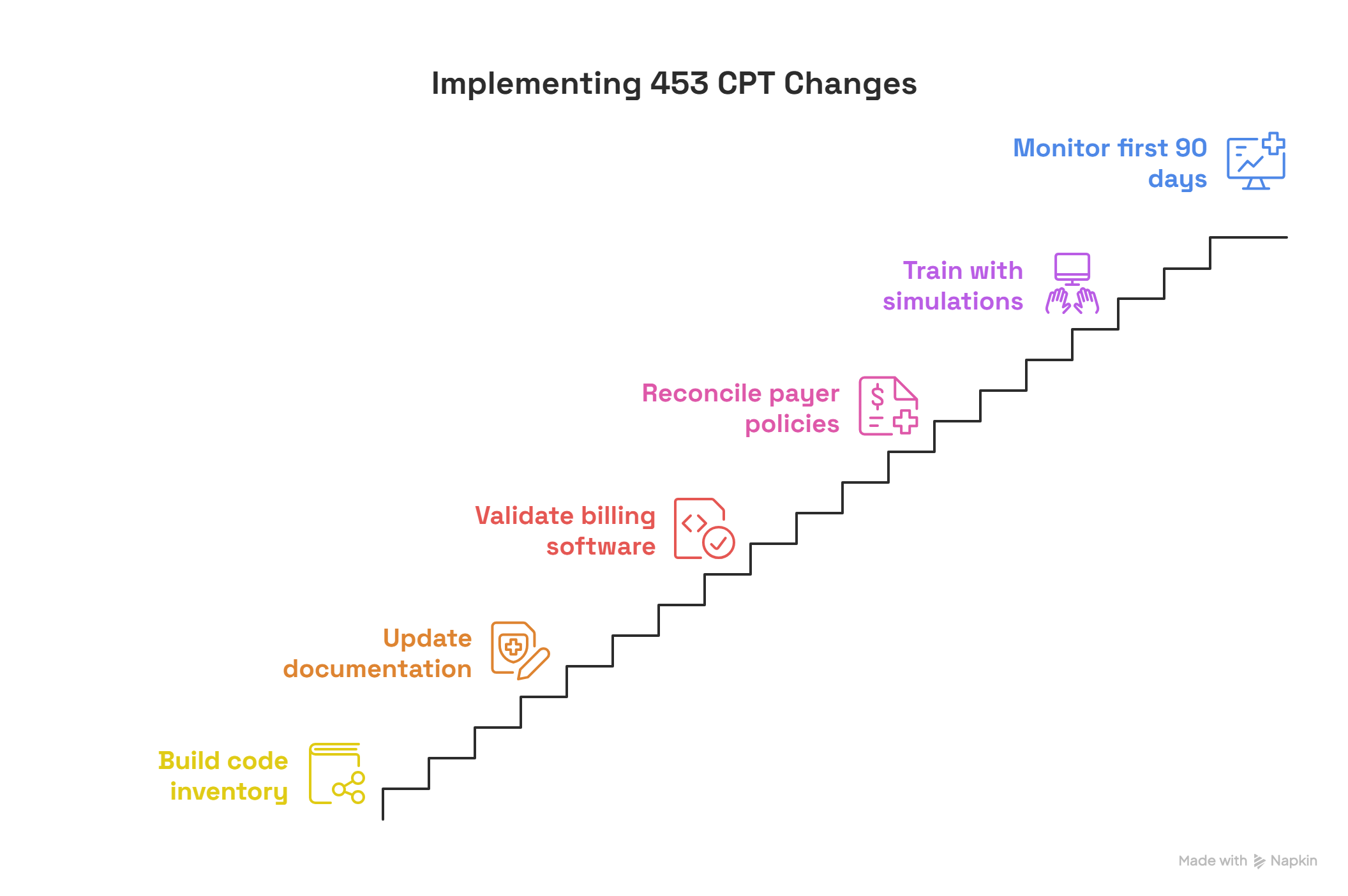
Implementing 453 CPT changes requires coordinated work across coding, clinical documentation, billing technology, payer relations, and revenue cycle management. The most effective approach prioritizes the specific code families a practice uses and assigns measurable responsibilities to each department.
Step 1: Build a specialty-specific code change inventory
Export the previous 12 months of CPT utilization and compare active codes against the official 2027 additions, revisions, and deletions.
Assign each affected code a change category, annual claim volume, historical denial rate, reimbursement exposure, and responsible reviewer. High-volume deleted codes deserve immediate attention because their continued use can affect the clean claim rate, extend accounts receivable days, and increase reliance on denial management services.
For every code replacement, document the clinical service, available reporting alternatives, required documentation, and effective date. Maintain the original source and reviewer approval in the coding audit workpapers.
Step 2: Update clinical documentation before changing billing templates
A new procedure code can require details absent from the current electronic health record template.
For example, labor management documentation must support straightforward or complex classification, while prostate biopsy coding depends on sampling method and lesion information. Biofeedback documentation requires qualifying time information.
Provide clinicians with targeted templates and compliant physician query examples. Coordinate these updates with prior authorization requirements and medical necessity documentation standards wherever procedural changes affect medical record requirements.
A useful acceptance test asks whether an independent coder can assign the correct 2027 code using only the completed clinical record.
Step 3: Validate the charge description master and claims software
Update active CPT dictionaries, electronic charge capture, order sets, superbills, encoder mappings, and automated claim edits.
Confirm that deleted codes remain available for legitimate historical claim corrections while being restricted for inappropriate 2027 service dates. Configuration changes should preserve the original service date and applicable historical coding rules.
Test the revised workflows across electronic claim submission systems, small practice billing platforms, and applicable Medicaid billing software.
Step 4: Reconcile payer policies and reimbursement
CPT code validity, payer coverage, and reimbursement represent separate decisions.
Use the finalized 2027 Medicare Physician Fee Schedule to assess Medicare professional payment, then verify specialty-specific payer policies. Check whether individual codes are priced, bundled, subject to coverage requirements, or affected by modifier instructions.
Compare the findings against the physician fee schedule reimbursement guide, applicable Medicaid reimbursement resources, and the payer's published billing policies.
For a high-volume affected procedure, model the financial difference using expected service volume, allowed amount, units, and denial probability.
Step 5: Train through specialty-specific case simulation
Replace generic update presentations with actual documentation scenarios.
Create exercises involving a 2026–2027 maternity transition, a complicated labor encounter, a revised prostate biopsy procedure, and timed biofeedback services.
Require coders to identify the applicable code, relevant instructions, supporting documentation, and possible edits. The approach can draw on 50 outpatient coding practice scenarios, practical coding interview assessments, and coding specialty training resources.
Use initial assessment results to identify training priorities and document competency improvements.
Step 6: Monitor the first 90 days of implementation
Track affected claims separately from the practice's overall performance. Otherwise, problems involving a small group of revised codes may disappear inside acceptable organization-wide averages.
Monitor the claim denial rate, clean claim performance, revenue collection delays, and recurrent claim adjustment reason codes.
Set a review cadence for high-risk code families. Each recurring failure should generate a documented corrective action, updated reference instruction, and verification that the problem has been resolved.
5. CPT 2027 Coding Examples: High-Risk Cases That Can Trigger Errors
The following scenarios demonstrate how the 2027 updates affect everyday coding decisions. Each example highlights the information that must be verified before a claim is finalized.
Case 1: Prenatal care crosses from 2026 into 2027
A patient receives five qualifying routine antepartum visits in late 2026 and continues prenatal care in January 2027.
Under the AMA's transition guidance, the five qualifying 2026 visits are reported using 59425. The appropriate E/M code is then selected for each qualifying antepartum encounter occurring in 2027.
The coder must preserve the actual dates, count the eligible 2026 visits, and select the correct E/M level for each 2027 service. The E/M documentation must support medical decision making or time.
Errors involving incomplete visit counts should be examined through the coding audit checklist, while documentation deficiencies should be addressed using compliant provider clarification workflows.
Case 2: A repeat cesarean follows complex labor management
A patient with a previous cesarean attempts vaginal delivery but ultimately requires another cesarean.
For qualifying 2027 services, code 59503 identifies the repeat cesarean. Appropriate labor management may also be reported when documented, with complex classification supported by the previous cesarean and applicable criteria.
The operative report and labor record must establish which services occurred, who performed them, and whether separate reporting requirements were satisfied.
Potential modifier issues should be reviewed using the E/M modifier decision guide, modifier 25 and 59 examples, and the payer's current policy.
Case 3: Prostate biopsy documentation identifies multiple targets
A urologist performs a fusion-guided prostate biopsy involving regional sampling and targeted biopsies.
The coding decision depends on the documented route, type of sampling, and separately identified target lesions. The number of tissue cores collected cannot substitute for the number of qualifying targeted lesions.
An incomplete report may require a compliant physician query. If the organization repeatedly encounters this issue, coders should complete focused urology coding practice cases and update their audit procedures.
Case 4: Biofeedback treatment includes undocumented time
A therapist schedules a 45-minute biofeedback appointment, but the record identifies only the appointment duration.
The coder must determine the qualifying service, professional contact time, and applicable reporting intervals before selecting 90901 and any eligible additional-time code.
When the documented duration includes unrelated activities, the total appointment length may overstate the reportable service.
The appropriate response is to strengthen time capture, review the relevant coding documentation checklist, and evaluate any affected medical necessity denial patterns.
Case 5: An unattended sleep study lacks technical details
A home sleep study is completed and interpreted, but the documentation identifies only the device brand and a general study description.
Correct code selection may require information about the channels and physiological parameters recorded, along with whether interpretation services were performed.
The billing department should obtain the technical specifications and supporting documentation before assigning the procedure code. Recurring failures warrant updates to electronic claims submission workflows, claim denial root-cause analysis, and clinical documentation clarification practices.
How to measure whether 2027 coding changes are being implemented correctly
Select a representative sample of affected claims and measure three outcomes: code accuracy, documentation completeness, and payer acceptance.
For example, if an audit finds three incorrect claims in a sample of 50, the observed claim-level error rate is 6%. Investigate whether the errors involve deleted codes, unsupported procedure distinctions, modifier conflicts, or insufficient documentation.
Compare the findings with coding accuracy audit standards, coding productivity expectations, and denial trend analysis.
The objective is to identify systematic weaknesses before they generate large volumes of rejected or incorrectly reimbursed claims.
6. FAQs About CPT 2027 Code Changes
-
The 2027 CPT code set contains 453 editorial changes, consisting of 299 new codes, 74 revised codes, and 80 deleted codes. Most annual changes take effect January 1, 2027, although certain CPT categories follow separate release schedules.
Medical coders should compare the complete code set against their specialty-specific utilization rather than focus only on headline changes. Resources such as the medical coding study guide, coding exam reference books, and coding audit checklist can support a structured review process.
-
Deleted codes generally become invalid for applicable 2027 dates of service. Claims containing these codes can fail coding validation or clearinghouse edits before reaching medical necessity adjudication.
Historical claims must be evaluated using the rules applicable to their service dates. Billing departments should update their electronic claims submission systems, monitor claim adjustment reason codes, and establish recovery procedures using medical billing appeal templates where an actual adverse payer determination requires an appeal.
-
The 2027 maternity framework separates antepartum, labor management, delivery, and postpartum reporting. Traditional global maternity codes are retired for the new effective period.
Antepartum and postpartum care generally use appropriate E/M codes, while new procedure codes identify labor management and delivery services.
For pregnancies spanning 2026 and 2027, practices should follow the AMA's transition guidance and verify payer-specific requirements. Strengthening physician documentation queries, understanding E/M modifier requirements, and applying coding compliance audits will help identify implementation problems.
-
Qualifying antepartum care furnished in 2026 follows the applicable 2026 coding rules, even when delivery occurs in 2027.
For example, the AMA's transition guidance permits reporting 59425 for four to six qualifying routine antepartum visits performed in 2026, while subsequent 2027 antepartum encounters follow the new E/M reporting requirements.
Coders should preserve visit dates and clinical documentation. Incorrect cross-year reporting can affect claim acceptance rates, increase accounts receivable delays, and generate additional work for denial management teams.
-
The addition of ten AI-related CPT codes expands reporting options for qualifying clinical services. Reimbursement depends on the exact procedure, payer coverage, reporting requirements, and applicable payment policies.
A medical organization should verify the service performed, review the official CPT instructions, and confirm relevant payer requirements before submitting claims.
This review can be integrated into existing Medicare billing resources, physician fee schedule analysis, and prior authorization workflows.
-
The medical record should clearly identify biopsy approach, sampling technique, imaging guidance, fusion technology when applicable, and the number of qualifying targeted lesions.
These details help determine the appropriate primary and add-on codes within the revised prostate biopsy family.
If information is missing, coders should use a compliant physician query and document the resolution. Organizations can improve accuracy through outpatient coding case exercises, focused coding audit procedures, and periodic coding productivity reviews.
