
The FY 2027 ICD-10-CM update took effect on October 1, 2026, introducing 190 new reportable diagnosis codes, invalidating 30 codes, and revising four code titles. These changes affect diagnosis selection, clinical documentation, claim validation, and reimbursement workflows. A diagnosis code accepted in September may trigger an October rejection if the billing system uses outdated files. This guide examines the changes that deserve immediate attention, explains their coding implications, and provides practical strategies for strengthening coding accuracy, preventing claim denials, and improving first-pass claim acceptance.

1. What Changed in ICD-10-CM for Fiscal Year 2027?
The FY 2027 ICD-10-CM classification applies to healthcare services from October 1, 2026, through September 30, 2027. CMS and the CDC's National Center for Health Statistics published the updated diagnosis code files, conversion information, addenda, and official coding guidelines. Organizations should use the applicable code-set version for the encounter or discharge date rather than the date a claim happens to be submitted.
The official update contains 190 new reportable codes, 30 codes that became invalid for reporting, and four revised code titles. The resulting classification contains 74,879 reportable diagnosis codes. Some invalidated codes remain in the Tabular List as nonreportable parent categories, so technical comparisons of all classification entries can produce different totals.
For billing departments, these changes create four immediate risks:
Outdated diagnosis mappings: An old code may remain in a practice management system even after its reporting status changes. This can reduce the clean claim rate and increase the volume of avoidable denials.
Incomplete documentation: Newly available specificity may depend on laterality, anatomical location, genetic findings, pregnancy characteristics, or toxic exposure circumstances. A structured physician query can resolve genuinely missing details.
Incorrect automated replacements: A deleted code may correspond to several new alternatives. Automatic one-to-one substitutions can introduce errors that a focused coding audit would detect.
Historical claim errors: A corrected September 2026 claim may still require the earlier code set. Using the latest code indiscriminately can complicate denial appeals.
The specialty changes that deserve priority
Cardiology practices should review the expanded dilated cardiomyopathy and arrhythmia classifications. Orthopedic and podiatry teams face more specific reporting for plantar fasciitis, plantar fascial fibromatosis, and osteomyelitis. Obstetric coding gains additional detail for ectopic pregnancies and continuing pregnancies after vanishing twin syndrome.
Oncology and genetics teams must evaluate codes for hereditary cancer predisposition syndromes, including Lynch syndrome and BRCA-associated familial cancer syndromes. These changes demand particular attention to the distinction between a documented clinical diagnosis and a laboratory finding.
Practices can prioritize implementation using three variables: frequency of the affected diagnosis, potential reimbursement consequences, and probability of insufficient documentation. The same risk-based approach supports better coding productivity and more targeted medical coding audits.
Before making workflow changes, compare your current diagnosis master with the official FY 2027 files. Review electronic claims submission, check Medicare billing resources, and establish a controlled method for updating old clinical templates. The objective is to identify every place where an outdated diagnosis can enter the revenue cycle.
FY 2027 ICD-10-CM Code Changes: Clinical Meaning and Required Coding Action
The following reference table highlights 35 changes affecting medical coding, documentation, and claim processing. It includes selected new codes, invalidated codes, and revised descriptions, along with the specific checks that help prevent incorrect code assignment.
ICD-10-CM 2027 Code Changes: 35+ High-Impact Examples
| FY 2027 Code | Change & Meaning | Coding Risk | Required Action |
|---|---|---|---|
| C78.31 | New: Secondary malignancy of larynx | Metastatic site classified too broadly | Confirm laryngeal involvement and primary-versus-secondary status. |
| C78.32 | New: Secondary malignancy of pharynx | Pharyngeal metastasis loses site specificity | Verify physician documentation of the metastatic location. |
| C79.83 | New: Secondary malignancy of oral cavity | Incorrect selection of another secondary site | Verify the oral cavity site and applicable neoplasm instructions. |
| D69.11 | New: Glanzmann thrombasthenia | Specific platelet disorder reported generically | Confirm the documented disorder before assigning the new code. |
| E89.830 | New: Post bariatric hypoglycemia | Hypoglycemia reported without its procedural context | Confirm the post-bariatric relationship in the clinical record. |
| I42.01 | New: Familial-genetic dilated cardiomyopathy | Inherited disease reported as unspecified cardiomyopathy | Verify provider-established familial or genetic diagnosis. |
| I42.81 | New: Arrhythmogenic cardiomyopathy | Specific cardiomyopathy grouped with other disorders | Review the cardiologist's final diagnostic statement. |
| I47.22 | New: Catecholaminergic polymorphic ventricular tachycardia | Distinct arrhythmia classified too broadly | Confirm documented CPVT rather than an unconfirmed suspicion. |
| I49.81 | New: Brugada syndrome | Established syndrome assigned an older generic arrhythmia code | Distinguish diagnosed Brugada syndrome from an isolated ECG pattern. |
| J34.830 | New: Maxillary odontogenic sinusitis | Dental-origin infection coded as nonspecific sinusitis | Verify dental origin and maxillary sinus location. |
| J4B | New: Pulmonary mycetoma | Specific fungal condition classified generically | Check the documented diagnosis and additional coding instructions. |
| K6A.01 | New: Prevesical abscess | Pelvic abscess location insufficiently identified | Review operative findings, imaging, and provider diagnosis. |
| K74.0A | New: Moderate hepatic fibrosis | Fibrosis severity lost in code selection | Verify documented moderate fibrosis and relevant staging details. |
| M04.3 | New: VEXAS syndrome | Complex syndrome dispersed across nonspecific diagnoses | Confirm provider-established VEXAS diagnosis and associated conditions. |
| M67.A01 | New: Plantar fasciitis, right foot | Laterality missing or confused with fibromatosis | Verify right-sided plantar fasciitis and the precise diagnosis. |
| M72.21 | New: Plantar fascial fibromatosis, right foot | Fibromatosis confused with plantar fasciitis | Confirm the condition and right-foot involvement. |
| M86.8X61 | New: Other osteomyelitis, right lower leg | Old broad site code used after expansion | Confirm exact anatomical site, laterality, and osteomyelitis type. |
| O00.31 | New: Cesarean scar ectopic pregnancy without intrauterine pregnancy | Ectopic pregnancy subtype reported incorrectly | Verify implantation site and intrauterine pregnancy status. |
| O31.42X1 | New: Continuing pregnancy after vanishing twin syndrome, second trimester, fetus 1 | Wrong trimester or fetus character | Confirm trimester and the applicable fetus designation. |
| QA1.71 | New: Lynch syndrome | Hereditary syndrome inferred from incomplete genetic information | Confirm the documented clinical diagnosis and Tabular instructions. |
| QA1.790 | New: Familial cancer syndrome with pathogenic BRCA1 mutation | Mutation finding incorrectly equated with a diagnosed syndrome | Verify provider documentation supporting the syndrome. |
| T52.821A | New: Toxic effect of cycloparaffins, accidental, initial encounter | Incorrect substance, intent, or encounter character | Verify exposure substance, circumstances, and active treatment. |
| T59.821A | New: Toxic effect of hexamethylene diisocyanate, accidental, initial encounter | Industrial toxic exposure grouped too broadly | Confirm chemical identity, intent, and treatment phase. |
| T65.851A | New: Toxic effect of medetomidine, accidental, initial encounter | Incorrect toxic-effect classification | Verify the substance and whether toxic-effect rules apply. |
| Z68.18 | New: Adult BMI 18.4 or less | Old BMI category remains on claim templates | Use the documented BMI with the FY 2027 category boundaries. |
| Z77.32 | New: Contact with or suspected exposure to burn pits in war theater | Important exposure history missing | Confirm documented exposure and its relevance to the encounter. |
| Z77.41 | New: Contact with or suspected exposure to low-level blast overpressure | Specific exposure recorded generically | Distinguish documented low-level exposure from other classifications. |
| Z86.17 | New: Personal history of Clostridioides difficile infection | Historical infection confused with active infection | Confirm resolved infection and current reason for care. |
| D69.1 | Invalidated: Qualitative platelet defects | Former reportable code retained in templates | Choose D69.11 or D69.19 as supported by documentation. |
| I42.0 | Invalidated: Dilated cardiomyopathy | Legacy code submitted after October 1 | Select the appropriate new dilated cardiomyopathy child code. |
| M72.2 | Invalidated: Plantar fascial fibromatosis | Outdated code or diagnostic confusion | Review M72.20–M72.22 and distinguish plantar fasciitis. |
| Z68.1 | Invalidated: Adult BMI 19.9 or less | Old category fails current specificity requirements | Select Z68.18 or Z68.19 using the documented BMI. |
| L02.232 | Revised title: Carbuncle of back, excluding buttock and flank | Flank documentation classified incorrectly | Check revised site boundaries and applicable flank code. |
| L03.312 | Revised title: Cellulitis of back, excluding buttock and flank | Old descriptions obscure anatomical distinctions | Recheck the precise site before code assignment. |
| L03.322 | Revised title: Acute lymphangitis of back, excluding buttock and flank | Incorrect location selected | Match the clinical site to the updated classification. |
| Z29.14 | Revised title: Prophylactic rabies immune globulin encounter | Outdated terminology in code descriptions | Update descriptions and verify appropriate encounter coding. |
Reference: FY 2027 ICD-10-CM code-description addendum, effective October 1, 2026. Selected examples only. Confirm all code assignments against the complete official Tabular List, instructional notes, and clinical documentation.
2. New ICD-10-CM 2027 Codes: Where Diagnosis Specificity Has Expanded
The most significant additions affect specialties where the prior classification grouped clinically distinct conditions together. Understanding the new diagnosis families can improve outpatient coding accuracy, support more precise clinical documentation review, and reduce errors discovered during insurance denial analysis.
Cardiology: Cardiomyopathy and arrhythmia classifications
The old I42.0 code for dilated cardiomyopathy has been replaced by more specific reportable choices, including I42.00 for unspecified dilated cardiomyopathy, I42.01 for familial-genetic dilated cardiomyopathy, and I42.09 for other dilated cardiomyopathy.
This distinction is especially important for cardiology practices receiving genetic testing information. A family history or positive test result needs clinical interpretation before a diagnosis is established. The coder should follow the documented diagnosis and applicable classification instructions, using compliant physician queries when clarification is necessary.
The new I42.81 code identifies arrhythmogenic cardiomyopathy, while I47.22 identifies catecholaminergic polymorphic ventricular tachycardia. I49.81 provides a dedicated code for Brugada syndrome. These changes can affect coding audit findings, medical necessity reviews, and diagnosis-driven payer edits.
Musculoskeletal coding: Plantar fasciitis, fibromatosis, and osteomyelitis
A major distinction concerns plantar fasciitis and plantar fascial fibromatosis.
New plantar fasciitis codes M67.A01, M67.A02, and M67.A09 identify the right, left, and unspecified foot. Plantar fascial fibromatosis is separately represented by M72.20, M72.21, and M72.22.
These conditions require precise diagnostic selection because heel pain alone may support several possible diagnoses. Coders reviewing outpatient practice cases should distinguish a confirmed plantar fasciitis diagnosis from documented fibromatosis.
The osteomyelitis expansion also adds anatomical and laterality specificity within the M86.8X family. A lower-leg diagnosis, for example, may now require distinguishing the right side from the left. This creates opportunities for improved reporting but also increases the importance of provider documentation, coding quality checks, and accurate diagnosis entry before claim submission.
Obstetrics: Ectopic pregnancy and vanishing twin syndrome
FY 2027 introduces more detailed options for interstitial, cervical, cornual, and cesarean scar ectopic pregnancies. Certain codes also distinguish whether an intrauterine pregnancy is present.
Continuing pregnancy after vanishing twin syndrome receives substantial additional specificity under O31.4-. Codes distinguish trimester and applicable fetus identification.
For obstetric departments, the documentation checklist should capture the diagnosed pregnancy complication, trimester, relevant fetal designation, and associated clinical circumstances. The coder must consult the complete Tabular List when selecting the appropriate character.
Incorrectly assigning an unspecified option despite available documentation weakens coding accuracy. Selecting a specific code without adequate support creates a separate compliance risk. Structured documentation clarification helps address both problems.
Oncology and genetic disorders: QA1 codes
The FY 2027 code set introduces QA1 classifications for selected inherited neoplasm predisposition syndromes. Examples include QA1.71 for Lynch syndrome and QA1.790 for familial cancer syndrome with pathogenic BRCA1 mutation.
Clinical documentation must establish the applicable syndrome. Genetic test reports, family history, and cancer diagnoses provide important context, but the coder must follow the official rules for provider-established diagnoses and any Tabular instructions.
This matters to organizations involved in risk adjustment coding and coding audits, because a genetic finding and a documented hereditary syndrome can have different coding implications. Any potential effect on reimbursement or risk-adjustment models must be validated against the specific program's current mappings.
Other additions that deserve attention
Post-bariatric hypoglycemia, dental-origin sinusitis, VEXAS syndrome, toxic chemical exposures, and military environmental exposures receive additional coding options.
New adult BMI categories also replace the previously reportable Z68.1 code with separate categories for BMI 18.4 or less and BMI 18.5–19.9.
For practices using automated diagnosis selection, each expanded category should trigger a review of documentation standards, billing software configuration, and relevant medical necessity requirements.
3. Deleted and Revised ICD-10-CM Codes: What Must Be Replaced?
The FY 2027 update invalidates 30 previously reportable diagnosis codes. Some are removed entirely from the classification, while others become nonreportable parent entries because more specific codes have been introduced.
For practices using a large diagnosis preference list, the greatest risk comes from retaining codes that appear familiar to providers but can no longer be submitted for current encounters.
The highest-priority deleted codes
I42.0 — Dilated cardiomyopathy: This code has been replaced by I42.00, I42.01, and I42.09. Automatic migration to the unspecified code may preserve claim validity but lose available specificity. A targeted coding audit checklist can identify records supporting a more precise diagnosis.
D69.1 — Qualitative platelet defects: The classification now distinguishes Glanzmann thrombasthenia from other qualitative platelet defects. Hematology documentation should support the appropriate new code, with physician queries reserved for genuine clinical ambiguity.
M72.2 — Plantar fascial fibromatosis: This code is invalid for FY 2027 reporting. The replacement family identifies foot laterality. Coders must also distinguish fibromatosis from plantar fasciitis, particularly in high-volume outpatient coding workflows.
Z68.1 — Adult BMI 19.9 or less: This category is replaced by Z68.18 and Z68.19. Electronic templates storing only the old category must be updated. The recorded BMI should be consistent with the medical documentation and official coding audit standards.
M86.8X1–M86.8X8 — Other osteomyelitis: Several previously reportable anatomical-site codes have been expanded. Their replacement options require appropriate anatomical detail and, in many cases, laterality. Legacy code lists should be examined before electronic claim submission.
Four revised code descriptions
The four revised titles involve L02.232, L03.312, L03.322, and Z29.14.
The first three clarify back-site classifications by excluding the flank. This distinction deserves attention when reviewing infection-related diagnoses, because the precise anatomical location can change the appropriate code.
Z29.14 receives a terminology correction, changing the description to prophylactic rabies immune globulin.
A title revision can affect the accuracy of clinical search results and the descriptions displayed in billing software. Practices should compare revised titles and Tabular notes while completing coding compliance reviews.
How to handle historical claims
A code that became invalid on October 1, 2026, may remain appropriate for an earlier service date. When correcting or resubmitting historical claims, the diagnosis code must correspond to the code set effective for that encounter or inpatient discharge.
For example, a September 28, 2026 outpatient claim may appropriately use the earlier I42.0 classification. An October 5, 2026 encounter requires the FY 2027 classification.
When a payer rejects an older corrected claim, review the applicable date, the original claim, and the relevant claim adjustment reason code. The correct response may involve correcting a claim edit or submitting a supported billing appeal, rather than replacing a historically valid diagnosis.
Maintaining separate current and historical code sets is particularly important for organizations monitoring accounts receivable aging and investigating denial patterns.
Quick Poll: What's your biggest ICD-10-CM 2027 coding problem?
4. ICD-10-CM 2027 Official Guideline Updates That Change Coding Decisions
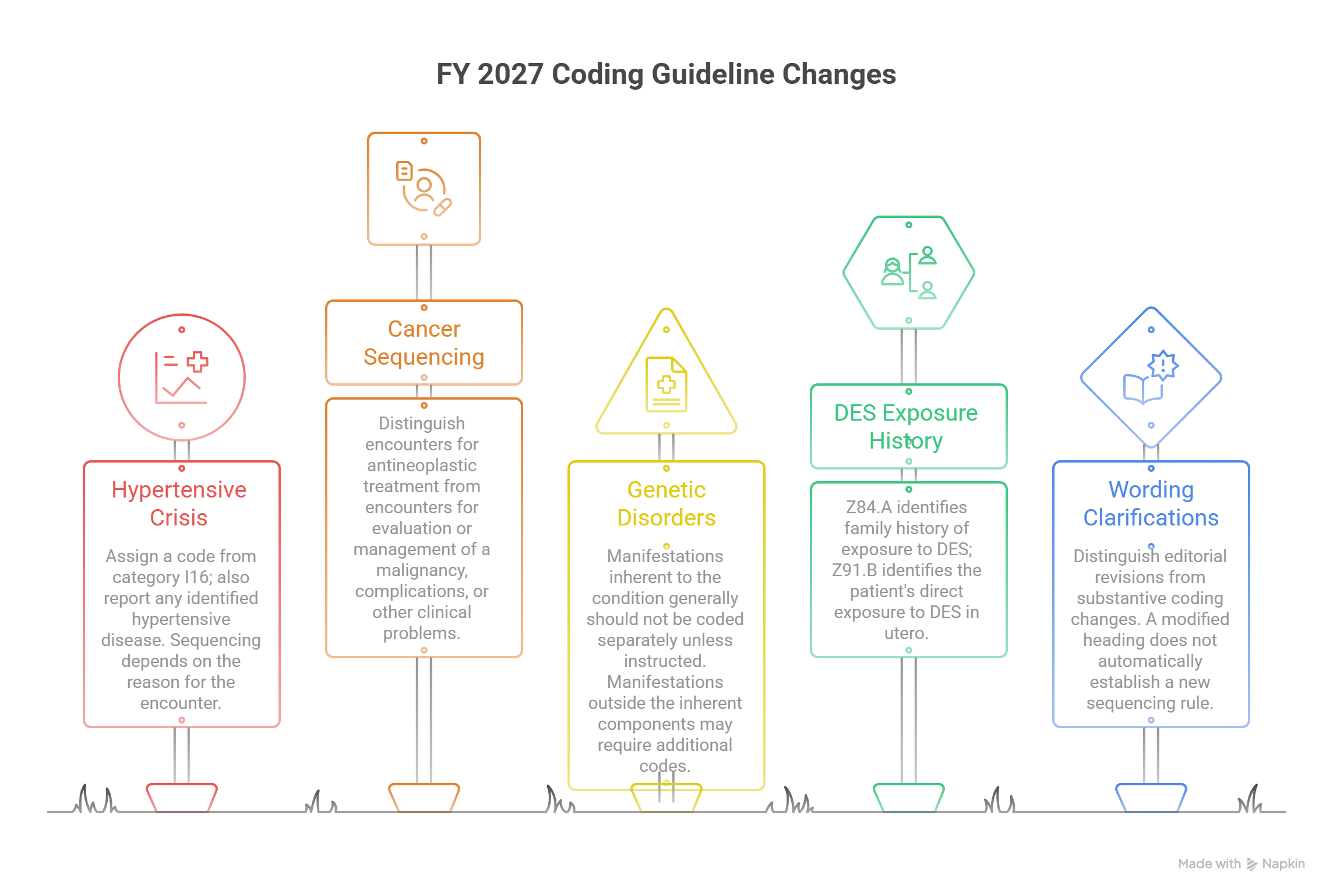
The FY 2027 Official Guidelines for Coding and Reporting contain changes involving hypertension, cancer treatment, genetic disorders, exposure history, and clarifying terminology.
For medical coders, reviewing these changes is essential because correct code selection requires applying both the current classification and the applicable guidelines. They also provide useful material for coding certification preparation, coding interview assessments, and formal documentation audits.
Hypertensive crisis and resistant hypertension
Section I.C.9.a.10 clarifies that when a patient has documented hypertensive urgency, hypertensive emergency, or unspecified hypertensive crisis, a code from category I16 is assigned.
The coder must also report any identified hypertensive disease, including applicable codes from I10–I15 or I1A. Sequencing depends on the reason for the encounter.
For example, a patient presenting with a hypertensive emergency who also has documented resistant hypertension may require evaluation of the hypertensive crisis code, the underlying hypertension diagnosis, and I1A.0 when supported.
The appropriate sequencing and additional diagnosis assignment should be validated against the complete record and current Tabular instructions.
This matters when conducting medical coding audits, preparing medical necessity appeals, or evaluating questionable claim denials.
Cancer treatment sequencing terminology
Section I.C.2.e now specifically refers to antineoplastic chemotherapy, immunotherapy, and radiation therapy.
This clarification helps establish the intended scope of the encounter guidance when treatment is directed against a neoplasm.
Coders must distinguish encounters primarily for the administration of antineoplastic treatment from encounters for evaluation or management of a malignancy, complications, or other clinical problems.
A patient admitted for antineoplastic therapy may require different sequencing from a patient admitted because of an unrelated acute condition. The applicable code assignment depends on the reason for the encounter and the specific guideline instructions.
These distinctions become especially important during outpatient coding reviews, claim denial investigations, and medical necessity documentation checks.
Genetic disorders now receive explicit Chapter 17 guidance
Chapter 17 now explicitly includes genetic disorders within the Q00–QA1 range.
The guideline explains that a congenital malformation, chromosomal abnormality, or genetic disorder can be reported throughout the patient's lifetime when the condition is diagnosed and documented.
This is particularly relevant to hereditary neoplasm predisposition syndromes. The age at which the diagnosis is established does not prevent assignment of an appropriate Chapter 17 code.
However, manifestation coding remains important. When a unique code identifies a disorder, manifestations inherent to the condition generally should not be coded separately unless instructed. Manifestations outside the inherent components may require additional codes.
For clinical coding teams, this calls for more careful documentation review, targeted physician queries, and better familiarity with complex risk adjustment cases.
Diethylstilbestrol exposure: Family history versus direct exposure
The FY 2027 guidelines add clarifying instructions for two existing codes involving diethylstilbestrol, commonly abbreviated DES.
Z84.A identifies family history of exposure to DES when a family member's exposure could place the patient at increased risk of a related condition.
Z91.B identifies the patient's direct exposure to DES in utero, such as when the patient's mother was exposed during pregnancy.
This distinction matters because the patient's own exposure history and an affected relative's exposure history represent different clinical information.
Organizations handling screening and surveillance visits should capture the relevant exposure relationship accurately. The documentation may influence medical necessity reviews and subsequent claim appeal documentation.
Sepsis and other wording clarifications
The FY 2027 guidelines revise the sepsis-related heading to focus on sepsis, severe sepsis, and septic shock. Other wording clarifications address hypertensive heart disease and treatment terminology.
These editorial revisions should be distinguished from substantive coding changes. A modified heading does not automatically establish a new sequencing rule.
The correct approach is to compare the FY 2027 guidelines with the preceding edition and examine the actual instruction. This method strengthens coding compliance, prevents unnecessary documentation changes, and improves the quality of coding education.
5. How to Implement the ICD-10-CM 2027 Changes Without Increasing Denials
A successful ICD-10-CM implementation requires coordinated updates across the EHR, coding software, practice management system, claim scrubber, clearinghouse, and payer-specific billing workflows.
The most effective approach is a controlled validation process that distinguishes code availability, clinical documentation, billing acceptance, and historical claim handling.
Step 1: Build a version-controlled diagnosis crosswalk
Start with the FY 2026 April release and compare it against the FY 2027 October release.
For every affected code, record the old code, applicable new codes, effective date, change type, and documentation elements needed for selection.
The crosswalk should identify one-to-many replacements separately from simple description revisions. A deleted diagnosis may have several valid replacements, and clinical documentation must determine the final assignment.
Use the conversion table as a starting point, then validate each result through coding audits and applicable clinical clarification procedures.
Step 2: Test high-risk clinical scenarios
Select cases from cardiology, podiatry, obstetrics, oncology, and other specialties affected by the update.
Include scenarios where the same old code can now lead to several possible new codes. Test incomplete documentation, laterality differences, and historical service dates.
Consider three practical examples:
Example A: Dilated cardiomyopathy. The medical record documents familial-genetic dilated cardiomyopathy. The coder should evaluate I42.01 instead of applying the unspecified replacement simply because the old system used I42.0.
Example B: Plantar heel pain. The clinician documents plantar fasciitis of the left foot. The coder should review M67.A02 and avoid confusing the condition with plantar fascial fibromatosis.
Example C: Adult BMI reporting. A documented adult BMI of 18.3 falls within Z68.18. A BMI of 19.2 falls within Z68.19. The code must correspond to the recorded measurement and applicable guidelines.
These examples can be incorporated into medical coding practice cases, used for coding interview tests, and evaluated through a formal coding quality checklist.
Step 3: Validate the claim submission pathway
A code may be present in the EHR while remaining unavailable or incorrectly configured in another connected system.
Test the diagnosis through the entire workflow: encounter documentation, code assignment, claim generation, clearinghouse acceptance, and payer adjudication.
Monitor whether new codes pass format and validity checks. Also review payer coverage policies and medical necessity edits separately from code-set validity.
The electronic claims submission directory can help teams review platform options, while the CARC reference directory supports more structured analysis of downstream adjustment reasons.
Step 4: Create an audit sample that reflects actual risk
Instead of reviewing only random encounters, include a targeted sample of changed-code encounters.
A practical initial review might cover 60 records, divided among high-volume specialties, invalidated code replacements, newly specific diagnoses, and corrected historical claims.
The sample size should increase for high-volume organizations or when early reviews reveal concentrated errors.
Measure the percentage of correct diagnosis assignments, documentation sufficiency, and the frequency of code-validity rejections.
For example, if 12 of 60 reviewed claims contain a confirmed diagnosis coding error, the sample error rate is 20%. The resulting findings should identify whether errors originated from documentation, coding decisions, software mappings, or claim processing.
Pair this analysis with coding productivity standards, denial root-cause analysis, and clean claim measurement.
Step 5: Train the people responsible for the highest-risk errors
A coder may need help identifying the correct replacement family. A physician may need to document new specificity. A billing specialist may need to distinguish a code-validity rejection from a coverage denial.
Training should therefore be role-specific.
Create short clinical examples using the affected specialty's most common diagnoses. For coders, include realistic practice cases with rationales. For experienced staff, use audit scenarios involving multiple possible code assignments.
New employees may benefit from a personalized medical coding study guide, while certified professionals can maintain their skills through appropriate continuing education providers and certification renewal planning.
Step 6: Monitor financial and operational outcomes
Following implementation, compare pre-update and post-update claim performance.
Track invalid-code rejection rates, diagnosis-related payer denials, average resolution time, corrected-claim volume, and claim acceptance trends.
A rising denial rate concentrated within a single specialty may indicate an incomplete code crosswalk or documentation problem. Increased rework without a corresponding denial increase may suggest inefficient manual validation.
Combine denial rate analysis with accounts receivable monitoring and clean claim tracking.
For unresolved claims, use a structured appeal letter template where an appeal is appropriate, and verify the underlying medical necessity documentation.
6. Frequently Asked Questions About ICD-10-CM 2027 Changes
-
The FY 2027 ICD-10-CM code set became effective on October 1, 2026, and generally applies through September 30, 2027.
For outpatient services, use the diagnosis code set applicable to the date of service. For inpatient hospital coding, the applicable release is generally determined by the discharge date.
Billing teams should maintain date-sensitive code validation in their claims submission systems and review the applicable version when processing historical denials.
-
The FY 2027 update includes 190 new reportable diagnosis codes, 30 invalidated reportable codes, and four revised code titles.
Some technical comparisons list additional nonreportable category and subcategory entries, resulting in different counts. The 190 additions and 30 invalidations are the relevant figures for reporting-code changes.
For implementation, use the official code files and conversion information, then verify the results against coding compliance requirements.
-
A diagnosis code valid for the original encounter may remain appropriate when a historical claim is corrected or resubmitted.
For example, a September 2026 outpatient encounter should be coded using the applicable FY 2026 release, even if the corrected claim is submitted in January 2027.
When a payer rejects a historically valid diagnosis, review the claim adjustment reason and determine whether a correction, reconsideration, or formal appeal is required.
-
FY 2027 introduces I42.00 for unspecified dilated cardiomyopathy, I42.01 for familial-genetic dilated cardiomyopathy, and I42.09 for other dilated cardiomyopathy.
The correct selection depends on the documented diagnosis. Genetic testing or a family history should be reviewed in context rather than used to independently establish the condition.
A focused documentation audit can identify cases requiring a compliant physician query.
-
Plantar fasciitis uses the new M67.A code family, with separate codes for the right foot, left foot, and unspecified foot.
Plantar fascial fibromatosis uses the expanded M72.2 family, including M72.20, M72.21, and M72.22.
Correct coding requires distinguishing the clinical conditions and selecting the documented laterality. These are useful examples for outpatient coding practice and accuracy audits.
-
Code assignment should follow the provider-established diagnosis and the official classification instructions.
A pathogenic genetic finding may be clinically relevant, but the coder must distinguish the laboratory result, documented hereditary syndrome, family history, and any current malignancy.
When documentation leaves the diagnosis unclear, a compliant physician query can establish the necessary clarification. Review the relevant codes through a clinical coding audit.
