
AI is reshaping medical coding workflows in 2027, from clinical documentation extraction to automated claim validation and denial prevention. However, assigning accurate codes still requires careful interpretation of medical records, payer requirements, and coding guidelines. For healthcare organizations, the challenge is identifying which tasks can safely run without manual intervention and which require professional oversight. This guide examines 38 workflows, explains where automation delivers measurable value, and connects coding accuracy, claim quality, denial prevention, and coding productivity to real operational decisions.
1. What Medical Coding AI Can Realistically Automate in 2027
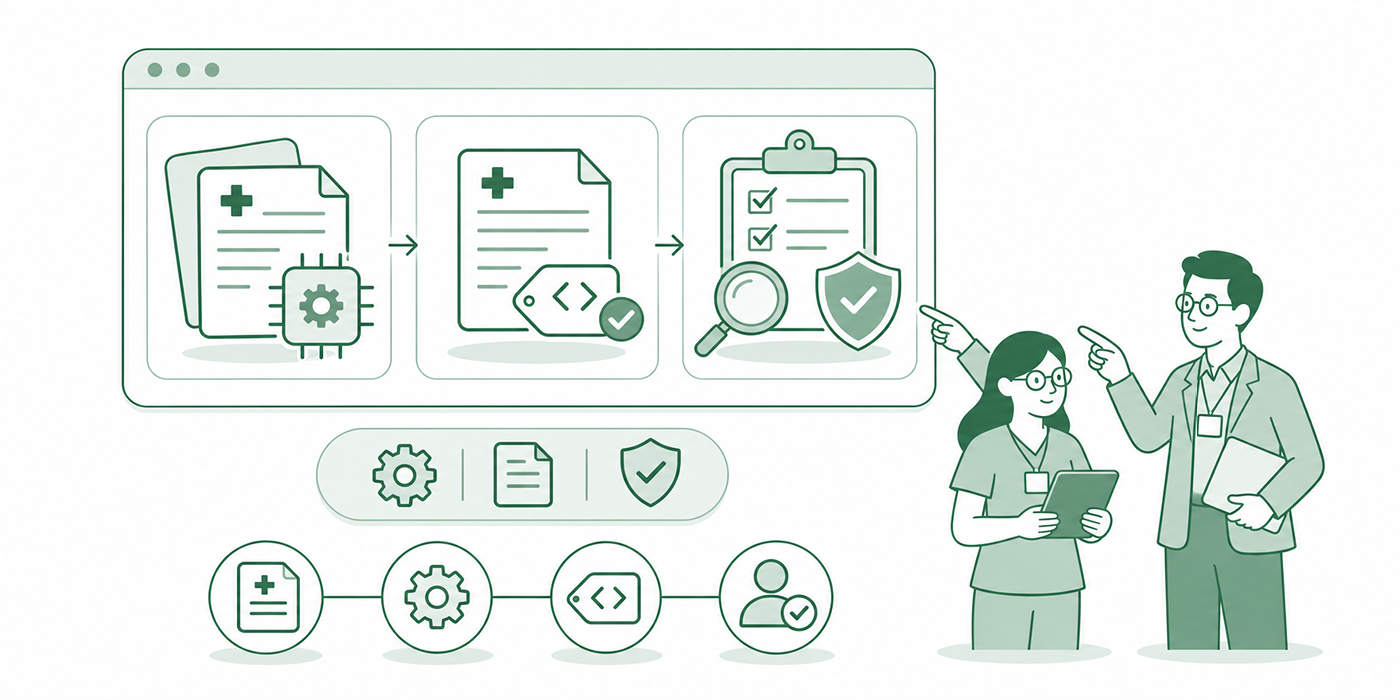
Medical coding automation has reached different levels of maturity across the revenue cycle. Software can reliably perform many structured validations, assist with clinical abstraction, and independently process certain standardized encounters when appropriate safeguards are in place.
The difficulty emerges when an AI system must determine what clinical documentation actually supports. A documented diagnosis, a suspected condition, and an abnormal laboratory finding have different implications for coding. Understanding those distinctions requires knowledge of ICD-10-CM guidelines, documentation clarification, risk adjustment requirements, and coding compliance audits.
Three levels of coding automation
Level 1: Rules-based automation. These systems validate defined conditions such as required claim fields, code validity, duplicate charges, procedure edit combinations, and authorization information. Their primary advantage is that individual decisions can be reproduced and checked against specific rules. They are particularly useful for improving clean claim rates, reducing avoidable denials, and strengthening electronic claims submission.
Level 2: AI-assisted coding. Natural language processing and machine learning identify diagnoses, procedures, anatomical details, and clinical evidence. The system generates recommendations that coding professionals evaluate before release. Effectiveness depends heavily on the quality of source documentation and whether suggestions are supported by identifiable evidence. This approach is useful for outpatient coding scenarios, E/M modifier reviews, and clinical documentation improvement.
Level 3: Autonomous coding. Eligible encounters proceed through code assignment without routine manual coding. This model requires validated encounter eligibility, controlled exceptions, reliable audit trails, and measurable performance thresholds. Its suitability is typically stronger for repetitive, consistently documented services than for complicated inpatient coding, disputed medical necessity cases, or complicated modifier decisions.
Why 2027 requires special attention
The fiscal year 2027 ICD-10-CM update became effective October 1, 2026. The American Medical Association released the 2027 CPT code set with 299 new codes, 74 revisions, and 80 deletions, effective January 1, 2027. These changes require automation systems to maintain code-set versions and apply the appropriate rules for each encounter's applicable date.
The AMA also identified 43 AI-related CPT codes in the 2027 set, including 10 newly added codes. These codes describe certain AI-enabled medical services. Their existence should be considered separately from whether AI can automate the coding of claims.
For operational planning, the most useful question is how many claims can be processed accurately, compliantly, and profitably. Measure this through coding accuracy audits, claim rejection analysis, accounts receivable benchmarks, and specialty-specific productivity.
2027 Medical Coding AI Automation Map: 38 Tasks, Capabilities & Review Requirements
| Coding Task | Automation Potential | What AI Can Do | When Human Review Is Needed |
|---|---|---|---|
| 1. Medical record intake | High | Collect and organize EHR documentation. | Missing records or failed document imports. |
| 2. Document classification | High | Identify operative reports, progress notes, and discharge summaries. | Incorrect document classification or attribution. |
| 3. Patient matching | High | Compare identifiers across connected platforms. | Conflicting identifiers or uncertain matches. |
| 4. Duplicate encounter detection | High | Flag matching encounter IDs and repeated charges. | Legitimate repeat services may resemble duplicates. |
| 5. Clinical entity extraction | High | Extract diagnoses, procedures, symptoms, and anatomy. | Clinical context changes the meaning of extracted terms. |
| 6. Negation detection | Moderate | Identify negated findings and ruled-out conditions. | Ambiguous or contradictory documentation. |
| 7. ICD-10-CM suggestions | Moderate | Recommend codes from documented conditions. | Reportability, specificity, sequencing, and guideline interpretation. |
| 8. Laterality extraction | High | Locate right, left, and bilateral references. | Contradictory anatomical descriptions. |
| 9. Historical diagnosis detection | Moderate | Flag current versus historical condition references. | Unclear clinical relevance or reporting eligibility. |
| 10. Outpatient diagnosis sequencing | Moderate | Suggest a first-listed diagnosis. | Uncertain encounter purpose or conflicting documentation. |
| 11. Inpatient principal diagnosis | Limited | Identify and rank candidate diagnoses. | Admission circumstances, competing diagnoses, and official sequencing rules. |
| 12. Inpatient secondary diagnoses | Moderate | Identify potentially reportable conditions. | Assessment against inpatient reporting criteria. |
| 13. Present-on-admission indicators | Moderate | Extract documented onset information. | Uncertain timing, exemptions, or conflicting evidence. |
| 14. Routine CPT suggestions | High in narrow workflows | Recommend procedures from standardized service records. | Missing procedural elements or code-specific exceptions. |
| 15. E/M level assistance | Moderate | Organize MDM elements and qualifying time. | Unsupported complexity, inappropriate time, or uncertain risk assessment. |
| 16. Time-based service calculations | High for arithmetic | Calculate durations and identify potential thresholds. | Qualifying time and overlapping-service restrictions. |
| 17. ICD-10-PCS recommendations | Limited | Suggest root operations and procedure attributes. | Operative objective, approach, body part, device, and qualifier. |
| 18. Modifier 25 | Limited | Detect E/M and procedure combinations. | Whether separately identifiable E/M work is supported. |
| 19. Modifier 59 and X modifiers | Limited | Detect possible distinct-service scenarios. | Documentation supporting a permissible edit exception. |
| 20. Modifiers 24 and 57 | Limited | Identify global-period and surgical-decision situations. | Clinical circumstances and modifier-specific requirements. |
| 21. NCCI edit screening | High | Detect procedure-to-procedure edit pairs. | Whether an exception is supported and permitted. |
| 22. MUE screening | High | Identify potentially excessive service units. | Clinically justified units and applicable exceptions. |
| 23. Drug HCPCS unit calculations | Moderate | Calculate units from structured doses and code definitions. | Actual administration, wastage, and payer-specific requirements. |
| 24. HCC identification | Moderate | Flag candidate risk-adjusted diagnoses. | Documentation validity, encounter relevance, and model-year rules. |
| 25. Medical necessity screening | Moderate | Compare documented conditions against available coverage policies. | Policy exceptions and clinical evidence. |
| 26. Prior authorization validation | High for status checks | Detect missing, expired, or mismatched authorization records. | Disputed approval scope, units, dates, or services. |
| 27. Charge reconciliation | High for detection | Compare documented services against recorded charges. | Unclear omissions, duplicated charges, or legitimate variations. |
| 28. Missing documentation detection | High for detection | Flag missing signatures, reports, and required details. | Whether clarification or additional documentation is necessary. |
| 29. Physician query drafting | Moderate | Prepare neutral clarification drafts with clinical indicators. | Compliance, clinical relevance, and nonleading language. |
| 30. Annual code-set validation | High | Flag deleted, inactive, and date-incompatible codes. | New clinical coding rules requiring interpretation. |
| 31. Payer-specific claim edits | High with maintained rules | Apply configured payer and plan requirements. | Policy conflicts, missing rule updates, or unclear exceptions. |
| 32. Claim scrubbing | High | Detect formatting errors, missing fields, and edit conflicts. | Unresolved clinical or billing exceptions. |
| 33. Electronic claim submission | High for approved claims | Transmit validated claims and track acknowledgments. | Submission failures, exceptions, and release authorization. |
| 34. Denial classification | High for categorization | Group adjustment codes and recurring denial patterns. | Ambiguous denial causes and payer-specific remedies. |
| 35. Appeal letter preparation | Moderate | Draft case summaries and organize supporting evidence. | Final factual review, deadline verification, and appeal strategy. |
| 36. Coding audit sampling | High | Prioritize high-risk claims and select review samples. | Independent sampling and final compliance determinations. |
| 37. Coder education recommendations | Moderate | Identify repeated errors and propose training topics. | Accuracy of examples and coding guidance. |
| 38. Revenue cycle reporting | High | Calculate performance trends and operational measures. | Data integrity, metric definitions, and interpretation. |
Automation potential describes the practical suitability of each workflow. Actual performance depends on the platform, documentation, coding setting, payer rules, and independent validation.
2. Task-by-Task Breakdown of Medical Coding AI Capabilities
Clinical documentation extraction and diagnosis recognition
Clinical documentation extraction is one of the most practical applications of AI. Natural language processing identifies relevant information within progress notes, discharge summaries, operative reports, and other documentation. A coding professional can receive a structured summary instead of searching manually through every page.
The biggest weakness is contextual interpretation. Consider a patient with a historical diagnosis of pneumonia who currently presents with shortness of breath. An AI system might identify both terms, but current diagnosis assignment requires evaluating the actual encounter documentation and applicable outpatient rules. Effective systems distinguish active diagnoses, historical conditions, ruled-out conditions, and symptoms.
To test this capability, organizations should compare AI recommendations with expert-reviewed outpatient coding cases, assess unsupported diagnosis patterns through medical coding audits, and evaluate ambiguous notes using compliant physician query examples.
Recommended approach: Automate extraction and initial code suggestions. Escalate conflicting, unsupported, or clinically ambiguous diagnoses before claim release.
CPT coding and evaluation and management services
AI can recommend CPT codes for services with consistent documentation, including certain diagnostic tests and straightforward procedures. E/M coding requires more sophisticated evaluation because code selection may depend on medical decision-making or qualifying time under the applicable guidelines.
For medical decision-making, a system must evaluate problems addressed, the amount or complexity of data reviewed and analyzed, and patient management risk. Merely counting diagnoses or tests can produce incorrect results. Time-based E/M coding introduces additional concerns about eligible activities and qualifying time.
AI-supported workflows should be validated against coding practice scenarios, CPT coding resources, E/M modifier decisions, and coding accuracy standards.
For inpatient ICD-10-PCS, automated suggestions face additional complexity involving root operation, body part, approach, device, and procedure objective. An expert must ensure that the proposed procedure accurately represents what was performed.
Recommended approach: Permit autonomous assignment only for narrowly defined services that have passed appropriate validation. Route unusual procedures and uncertain E/M levels for professional review.
Modifier detection and National Correct Coding Initiative edits
AI can identify code combinations that trigger procedure-to-procedure edits and flag claims where modifiers may be relevant. The challenge is determining whether the record supports the exception.
For example, when an E/M service and a minor procedure occur during the same encounter, modifier 25 may be appropriate only when a significant, separately identifiable E/M service is documented. Similarly, modifier 59 requires circumstances supporting a distinct procedural service and compliance with applicable edit rules.
The presence of an edit modifier indicator permitting an exception does not establish that the exception is justified. Documentation must support the specific circumstances.
Medical practices should combine modifier 25 versus modifier 59 guidance, modifier 24, 25, and 57 examples, claim denial analysis, and coding compliance reviews.
Recommended approach: Automate edit detection and exception routing. Require defensible clinical evidence for modifier assignment.
HCC coding and risk adjustment analysis
AI can scan longitudinal medical records for diagnoses potentially relevant to Hierarchical Condition Categories. This capability can reduce abstraction time for risk adjustment teams handling large patient populations.
However, historical conditions, problem-list entries, and laboratory findings may lack sufficient support for current reporting. A model may also identify a condition that belongs to a different model year or carries different risk adjustment implications.
A strong HCC workflow should verify documentation support, encounter eligibility, applicable model requirements, and appropriate code selection.
Organizations can train reviewers using HCC practice scenarios, risk adjustment career resources, documentation clarification methods, and coding audit checklists.
Recommended approach: Use AI to surface candidate diagnoses and supporting evidence. Retain stringent controls for reportability and unsupported diagnosis capture.
Claim scrubbing, eligibility checks, and authorization verification
Administrative validation offers substantial automation potential because many requirements can be translated into explicit checks.
AI-assisted systems can identify missing identifiers, invalid codes, authorization mismatches, inconsistent dates, and duplicate charges before submission. This can reduce repetitive billing work and improve first-pass claim processing.
The crucial limitation is whether the underlying rules remain current. A practice serving multiple payers needs reliable policy maintenance, including plan-specific authorization requirements and effective dates.
Connect automated checks with prior authorization workflows, electronic claims submission platforms, Medicare billing resources, and clean claim rate monitoring.
Recommended approach: Automate repeatable administrative checks while retaining a clear exception workflow for inconsistent authorization or coverage information.
Denial classification, appeals, and revenue recovery
AI can categorize denied claims, recognize recurring payer patterns, organize supporting records, and generate draft appeal language. These capabilities are useful when staff spend significant time searching remittance records and assembling similar documentation repeatedly.
The risk arises when an automated system assigns the wrong denial cause. For example, a claim may contain a valid code but fail because authorization covered a different service. Changing the code without confirming the service performed could create another problem.
AI should identify the precise cause before recommending correction, resubmission, appeal, or further investigation.
Revenue cycle teams should combine claim adjustment reason code references, medical billing appeal templates, medical necessity appeal guidance, and denial root-cause analysis.
Recommended approach: Automate classification, prioritization, and evidence assembly. Require human approval for disputed facts and clinically sensitive appeal arguments.
3. Medical Coding Decisions That Still Require Human Judgment
Diagnosis conflicts and uncertain clinical conditions
Medical records often contain competing diagnoses that require careful interpretation. A patient admitted with respiratory failure may also have pneumonia, heart failure, or another condition contributing to the admission. Selecting the principal diagnosis requires evaluating the circumstances of admission, the applicable inpatient guidelines, and the provider's final documentation.
A system that simply prioritizes the diagnosis mentioned most frequently may produce an incorrect result.
Outpatient coding introduces different requirements. Uncertain diagnoses generally cannot be reported as established diagnoses in outpatient settings. An AI model must recognize this distinction and select the appropriate coding pathway.
Coders should strengthen these judgments through outpatient coding practice cases, CCS examination preparation, documentation queries, and coding audit exercises.
Escalation trigger: Conflicting diagnoses, unclear encounter purpose, uncertain conditions, or missing documentation affecting reportability.
Clinical documentation integrity and provider queries
AI can detect documentation gaps and prepare clarification requests. However, provider queries must follow established compliance standards.
The August 2026 AHIMA/ACDIS update specifically addresses technology-generated queries. AI-assisted queries must satisfy the same compliance principles that apply to human-generated clarification requests, including appropriate clinical evidence and nonleading language.
For example, when laboratory findings and progress notes appear inconsistent, an AI system might suggest a clarification. It should avoid presenting an unsupported diagnosis as the expected answer or directing providers toward higher reimbursement.
Every query should preserve relevant clinical indicators, supporting documentation, and the provider's response. Organizations can reinforce this process with 25 compliant physician query examples, medical coding audit checklists, and HCC documentation scenarios.
Escalation trigger: Queries involving disputed conditions, incomplete clinical indicators, ambiguous provider responses, or potentially leading wording.
Payer exceptions and medical necessity disputes
An AI system may correctly assign a CPT code while failing to recognize a particular payer's coverage restrictions.
A medical necessity determination may depend on diagnosis coverage, required documentation, frequency limitations, prior treatment, or other policy conditions. A simple code match cannot establish that all requirements are met.
Organizations should require automation to identify the payer, plan, applicable policy version, and supporting documentation before making coverage-related recommendations.
These controls should integrate physician fee schedule guidance, Medicare billing tools, Medicaid reimbursement resources, and medical necessity appeal procedures.
Escalation trigger: Conflicting policies, unverified coverage exceptions, retrospective authorization disputes, or incomplete evidence.
AI-generated evidence and unsupported coding recommendations
Generative AI can produce plausible explanations containing inaccurate details. A coding system might reference a diagnosis absent from the final note or incorrectly describe a procedure.
This is especially concerning when AI-generated summaries become the basis for additional automated decisions. One unsupported condition may influence diagnosis sequencing, medical necessity, risk adjustment, and subsequent claims analysis.
A strong review system should require every recommended code to reference verifiable source documentation. Audit logs should distinguish original medical-record evidence from AI-generated interpretations.
Coding professionals can develop these abilities through coding accuracy audits, real-world interview scenarios, risk adjustment cases, and medical coding portfolio projects.
Escalation trigger: Missing source evidence, fabricated clinical details, unsupported code specificity, or contradictory AI explanations.
Quick Poll: What Is Your Biggest AI Medical Coding Concern for 2027?
4. How to Test AI Medical Coding Software Before Allowing Autonomous Claims
Healthcare organizations should evaluate AI coding software through controlled testing that reflects their actual encounter complexity, payer mix, and documentation quality. Vendor demonstrations often use carefully selected examples, making independent validation essential.
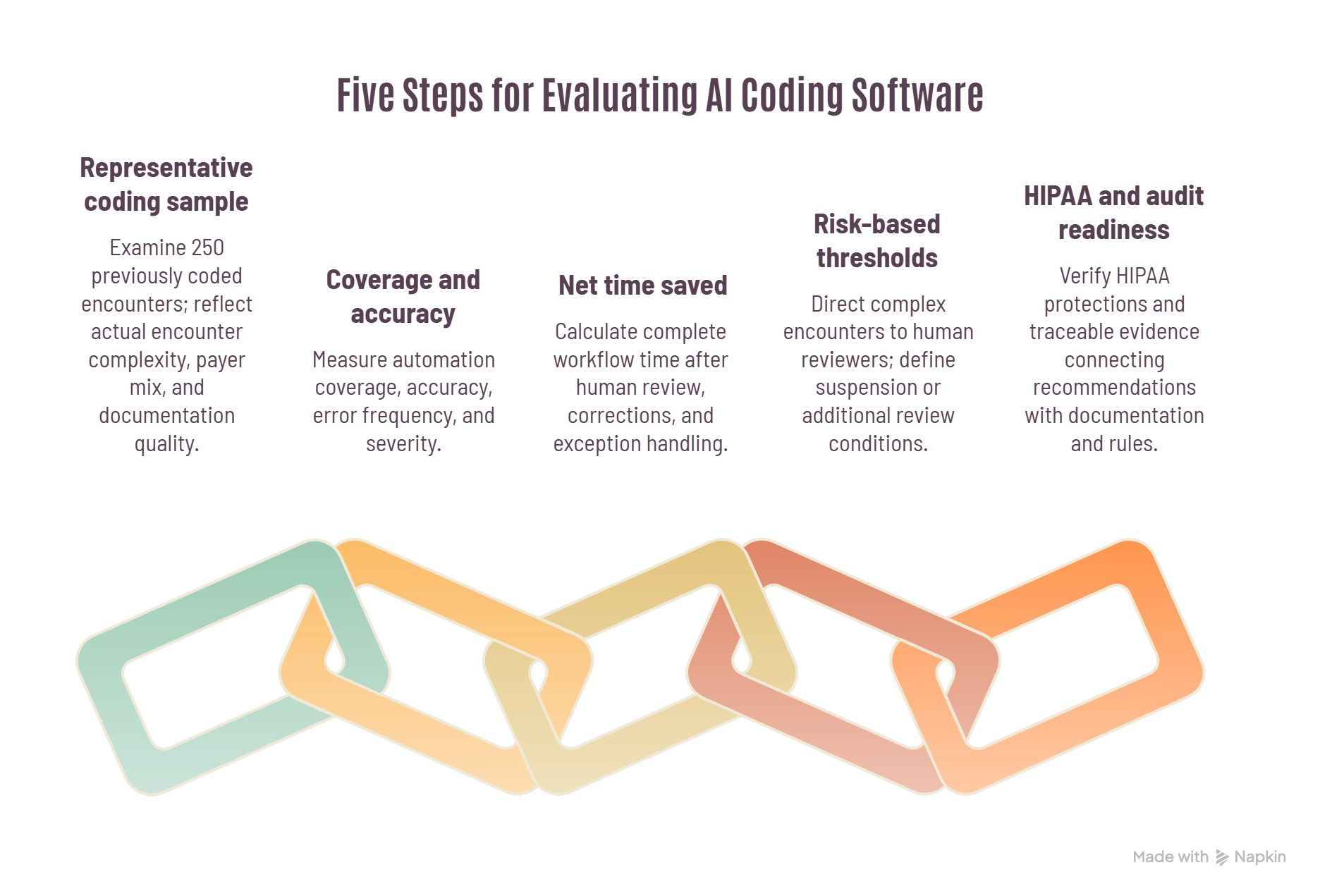
Step 1: Establish a representative coding sample
A practical preliminary pilot could examine 250 previously coded encounters. Include routine office visits, complicated procedures, incomplete records, unusual diagnosis combinations, and historical denials.
The sample should reflect the work the practice intends to automate. A system tested primarily on radiology encounters cannot automatically be assumed to deliver equivalent results for complex surgical cases.
Use expert-reviewed outpatient coding scenarios, modifier decision examples, risk adjustment cases, and audit validation procedures.
A 250-encounter sample can help identify operational weaknesses, but larger, statistically appropriate samples are necessary to establish reliable accuracy estimates, especially for uncommon, high-severity errors.
Step 2: Separate automation coverage from coding accuracy
Suppose a hypothetical AI system evaluates 250 encounters, processes 225 without initial manual intervention, and produces 210 fully correct coding outcomes among those 225.
The automation coverage is 90%, calculated by dividing 225 by 250.
Accuracy within the automatically processed group is approximately 93.3%, calculated by dividing 210 by 225.
However, only 210 of the original 250 encounters were both automatically processed and subsequently verified as correct. That represents 84% of the total.
This distinction matters because the remaining 15 automatically processed encounters contained errors. Their financial consequences depend on the specific mistakes involved.
A wrong diagnosis code on a low-value claim and an unsupported diagnosis affecting risk adjustment create different levels of exposure. An organization must therefore measure both error frequency and severity.
Track performance using coding accuracy checklists, denial rate analysis, clean claim calculations, and revenue cycle benchmarks.
These illustrative figures explain the measurement method and do not represent vendor performance or industry benchmarks.
Step 3: Calculate the total time saved after corrections
An organization processing 1,000 encounters might save four minutes per encounter through automated chart review and code recommendations.
That creates approximately 66.7 hours of gross processing time saved.
If human review, corrections, and exception handling consume 35 additional hours, the net operational saving is approximately 31.7 hours before accounting for software fees, integration costs, and revenue effects.
The calculation becomes more meaningful when the practice measures the complete workflow rather than initial coding speed.
Compare coding productivity benchmarks, claim denial expenses, billing efficiency, and accounts receivable performance.
The critical metric is net time saved per accurately completed encounter, with financial and compliance outcomes evaluated separately.
Step 4: Introduce risk-based automation thresholds
Rather than releasing every AI-coded claim automatically, establish separate processing pathways according to complexity and demonstrated accuracy.
Low-complexity encounters with complete documentation and validated coding rules may qualify for automatic release. Encounters involving conflicting diagnoses, unusual procedures, complex modifiers, or questionable medical necessity should be directed to human reviewers.
Organizations should establish documented performance requirements before deployment and define conditions that trigger suspension or additional review.
For example, a sudden increase in modifier-related denials should prompt investigation of the relevant coding rules and affected claims.
Support these controls with modifier decision guides, medical necessity checklists, prior authorization verification, and coding compliance audits.
Step 5: Verify HIPAA protections and audit readiness
AI coding platforms may process protected health information, making data governance a significant purchasing consideration.
Where a vendor creates, receives, maintains, or transmits protected health information on behalf of a covered entity, applicable HIPAA business associate requirements must be addressed. Security assessments should cover permitted data use, access restrictions, subcontractors, retention, incident response, and contractual safeguards.
The practice should also require traceable evidence connecting coding recommendations with original documentation, the applicable code set, and current billing rules.
Independent coding compliance reviews, documentation clarification controls, claims submission oversight, and denial monitoring provide essential evidence when evaluating automated coding performance.
5. Medical Coding Skills That Will Become More Valuable as AI Adoption Expands
Automation is changing the responsibilities associated with coding work. Activities involving repetitive data extraction and predictable validation are increasingly suitable for software, while complex clinical interpretation, auditing, documentation integrity, and revenue analysis remain valuable professional capabilities.
Coders who understand both the technology and the rules governing accurate code assignment can contribute to implementation, quality control, and exception management.
Advanced coding audits and error investigation
Medical coding auditors evaluate whether codes are properly supported, sequenced, and compliant with relevant guidelines.
AI creates additional demand for this expertise wherever organizations need to verify automatically processed encounters, investigate recurring errors, and assess compliance risks.
Professionals considering a medical coding auditor career should develop skills in analyzing incorrect code assignments, documenting audit findings, and recommending corrective actions.
A practical medical coding portfolio can demonstrate these capabilities through fictional or properly de-identified case reviews. Candidates should also practice real coding interview scenarios and understand coding accuracy evaluation.
Clinical documentation integrity and diagnosis validation
Coding professionals with strong clinical documentation skills can help organizations identify unsupported diagnoses, missing specificity, and conflicts that automated systems struggle to resolve.
This expertise becomes particularly important when AI generates coding recommendations based on extensive clinical records.
Professionals should practice interpreting clinical evidence and constructing appropriate clarification requests using compliant physician query templates, HCC risk adjustment cases, medical necessity documentation, and coding practice exercises.
The ability to distinguish documented conditions from inferred diagnoses is especially important in AI-assisted environments.
Specialty coding and complex reimbursement knowledge
Specialty coding knowledge allows professionals to evaluate cases that fall outside standardized automation workflows.
Surgical coding, inpatient procedures, advanced E/M services, risk adjustment, and specialty-specific reimbursement policies require detailed knowledge of documentation and coding conventions.
Professionals considering inpatient versus outpatient coding should evaluate the technical complexity and training requirements of each environment.
Other development options include professional fee coding, risk adjustment specialties, and advanced specialty career paths.
These competencies are useful for resolving coding exceptions and reviewing outputs from specialty-specific AI systems.
Data analysis and revenue cycle performance
Coding professionals who can interpret operational data may be better positioned to help organizations evaluate automation effectiveness.
Important competencies include analyzing coding errors, distinguishing claim rejections from payer denials, interpreting productivity metrics, and identifying reimbursement problems.
A coder who can explain how a coding change affects clean claim performance, denial patterns, receivables, and productivity standards provides value beyond basic code selection.
These abilities also support coding quality assurance, revenue integrity, and workflow improvement roles.
Certification, continuing education, and AI readiness
Medical coding certifications remain useful indicators of foundational knowledge, although employers may assess additional competencies when hiring for automated coding environments.
Candidates can strengthen their preparation using CPC examination strategies, coding exam resources, personalized study plans, and certification practice questions.
Experienced coders should maintain credentials through appropriate certification renewal procedures and relevant continuing education opportunities.
For career planning, the practical priority is developing expertise that enables coders to evaluate complex documentation, correct automation failures, and demonstrate measurable improvements in coding quality.
6. FAQs About AI Automation in Medical Coding in 2027
-
AI can process selected coding workflows with limited manual intervention, particularly when services are repetitive and documentation is standardized. Complex cases involving conflicting diagnoses, specialty procedures, documentation disputes, and uncertain coding rules require additional expertise.
The impact on employment will depend on organizational adoption and specialty requirements. Professionals can prepare by developing medical coding auditing skills, specialty coding knowledge, and practical coding assessment abilities.
-
Structured, repeatable tasks are among the strongest candidates. These include duplicate detection, missing-field validation, code-set checks, claim scrubbing, document classification, and straightforward coding recommendations.
Organizations can assess their effectiveness through clean claim rate calculations, electronic claim submission monitoring, claim adjustment code analysis, and coding productivity measurement.
-
Accuracy varies according to the software, specialty, clinical documentation, and types of encounters being processed. There is no single reliable percentage representing all AI coding systems.
Organizations should independently validate code assignment, clinical support, sequencing, modifiers, and compliance. Relevant measures include independently verified accuracy, critical-error frequency, and correctly processed autonomous encounters.
Use medical coding audit checklists, coding practice cases, and denial root-cause analysis to establish relevant performance measures.
-
AI systems can identify encounters where modifiers may be appropriate and check associated billing edits.
However, modifier 25 requires documentation supporting a significant, separately identifiable E/M service, while modifier 59 and applicable distinct-service modifiers require appropriate supporting circumstances.
Practices should validate decisions through modifier 25 versus 59 examples, E/M modifier decision guidance, and coding compliance audits.
-
AI can reduce certain preventable errors by detecting missing information, code conflicts, authorization problems, and incorrect claim configurations before submission.
Its impact should be measured by comparing denial trends, first-pass acceptance, and downstream corrections before and after implementation.
Practices can connect denial rate calculations, clean claim monitoring, prior authorization verification, and medical billing appeal procedures to evaluate measurable improvements.
-
HIPAA compliance depends on how the software operates, what information it processes, and whether the organization and its vendors implement the required safeguards.
Where a vendor performs functions involving protected health information on behalf of a covered entity, applicable business associate obligations must be satisfied.
Organizations should review vendor contracts, security controls, access permissions, data retention, and incident procedures. Coding-specific safeguards should include clinical documentation auditing and compliant documentation clarification.
