
Starting January 1, 2027, maternity coding undergoes its biggest restructuring in decades. The American Medical Association has approved 17 deleted codes, 12 new codes, and six revised codes, replacing traditional global obstetric packages with separate reporting for prenatal visits, labor management, delivery, and postpartum care. This changes how practices document services, attribute provider work, and manage reimbursement. For medical coders handling CPT coding, physician reimbursement, coding audits, and claim denials, understanding these changes before implementation is essential.

1. CPT 2027 Maternity Coding Changes: What Is New, Revised, and Deleted?
The 2027 CPT restructuring divides maternity services into four independently reportable phases: antepartum care, labor management, delivery care, and postpartum care. Previously, global obstetric codes could combine months of prenatal visits, delivery, and postpartum services into a single reporting structure.
Under the new framework, prenatal and postpartum encounters generally follow standard evaluation and management (E/M) rules, labor management receives dedicated daily codes, and delivery procedures are reported separately.
This creates several immediate challenges for medical billing departments, electronic claims submission systems, coding compliance teams, and reimbursement analysts.
The Five Changes With the Greatest Billing Impact
1. Global obstetric codes disappear. Established codes such as 59400, 59510, 59610, and 59618 are deleted for 2027. Billing systems must stop generating these codes for services governed by the new rules while maintaining appropriate processing for earlier dates of service.
2. Prenatal visits receive individual E/M codes. Deleted antepartum-only codes 59425 and 59426 give way to encounter-specific reporting. Each visit requires documentation supporting its assigned level, increasing the importance of coding accuracy reviews and physician documentation clarification.
3. Labor management becomes separately identifiable. New CPT codes 59080–59083 distinguish initial versus subsequent management days and straightforward versus complex labor. This requires precise records of admission, labor progression, clinical interventions, and provider responsibilities.
4. Delivery coding becomes more specific. New vaginal and cesarean codes distinguish previous cesarean history and primary versus repeat cesareans. Additional codes identify higher-degree laceration repairs and hysterectomy performed during a cesarean encounter.
5. Postpartum care becomes encounter-based. Routine postpartum services on the delivery date remain included in the delivery code. Subsequent inpatient and outpatient care generally follows E/M reporting, affecting claim processing workflows, payer reimbursement verification, and denial prevention procedures.
The following reference map identifies all 35 affected CPT codes and provides a specific implementation action for each. Code descriptions are paraphrased for quick review; use the final licensed CPT 2027 codebook and payer instructions for official reporting requirements.
CPT 2027 Maternity Care Changes: 35-Code Reference Map
| CPT Code | 2027 Status | Coding Significance | Required Billing Action |
|---|---|---|---|
| 59050 | Deleted | Legacy fetal monitoring service code. | Remove from 2027 code selection; distinguish routine labor monitoring from separately reportable specialist services. |
| 59400 | Deleted | Former complete vaginal obstetric package. | Replace global-package logic with phase-specific services. |
| 59409 | Deleted | Former vaginal delivery-only option. | Use the applicable new vaginal delivery code. |
| 59410 | Deleted | Former vaginal delivery plus postpartum package. | Separate delivery from eligible later postpartum E/M encounters. |
| 59425 | Deleted | Former antepartum-only reporting for four to six visits. | Use encounter-level E/M for 2027 prenatal care; reconcile 2026 transition services. |
| 59426 | Deleted | Former antepartum-only reporting for seven or more visits. | Replace visit-count billing with individual prenatal E/M coding. |
| 59430 | Deleted | Former postpartum-only reporting. | Report eligible 2027 postpartum encounters using the appropriate E/M code. |
| 59510 | Deleted | Former global cesarean maternity package. | Identify primary or repeat cesarean and separately classify other care phases. |
| 59514 | Deleted | Former cesarean delivery-only reporting. | Replace with the applicable 59502 or 59503 code. |
| 59515 | Deleted | Former cesarean delivery with postpartum package. | Report delivery and qualifying subsequent postpartum care separately. |
| 59525 | Deleted | Former cesarean-associated hysterectomy reporting. | Review the new distinct hysterectomy code 59504 and associated cesarean code. |
| 59610 | Deleted | Former global package for vaginal birth after cesarean. | Use the new VBAC delivery code and report other care phases when appropriate. |
| 59612 | Deleted | Former VBAC delivery-only reporting. | Transition to 59432 when the documented delivery qualifies. |
| 59614 | Deleted | Former VBAC delivery with postpartum reporting. | Separate VBAC delivery from eligible later postpartum encounters. |
| 59618 | Deleted | Former global package for cesarean following attempted VBAC. | Report repeat cesarean and separately supported labor management. |
| 59620 | Deleted | Former cesarean delivery-only code following attempted VBAC. | Use 59503 for the qualifying repeat cesarean. |
| 59622 | Deleted | Former cesarean plus postpartum code following attempted VBAC. | Separate repeat cesarean, labor management, and eligible postpartum services. |
| 59080 | New | Initial day of straightforward labor management. | Confirm all straightforward criteria and the initial facility management day. |
| 59081 | New | Initial day of complex labor management. | Document complexity, including previous cesarean or additional clinical risk. |
| 59082 | New | Subsequent day of straightforward labor management. | Verify continued labor management and the relevant calendar date. |
| 59083 | New | Subsequent day of complex labor management. | Validate complexity and distinguish it from duplicate initial-day reporting. |
| 59431 | New | Vaginal delivery without prior-cesarean VBAC classification. | Confirm delivery method and included routine repair work. |
| 59432 | New | Vaginal delivery after previous cesarean. | Confirm prior cesarean history and VBAC documentation. |
| 59433 | New | Repair of third-degree episiotomy or laceration. | Confirm documented degree and separately reportable repair. |
| 59434 | New | Repair of fourth-degree episiotomy or laceration. | Verify the injury classification and qualifying repair. |
| 59502 | New | Primary cesarean delivery. | Confirm this is the patient's first cesarean delivery. |
| 59503 | New | Repeat cesarean delivery. | Verify prior cesarean history, including failed TOLAC scenarios. |
| 59504 | New | Hysterectomy performed at the cesarean encounter. | Identify the operating clinician and review appropriate multiple-procedure reporting. |
| 59623 | New | Uterine tamponade procedure for postpartum hemorrhage. | Validate the mechanical intervention and separate procedure documentation. |
| 59412 | Revised | Existing external cephalic version code affected by revised language. | Review the 2027 descriptor and updated maternity section instructions. |
| 59051 | Revised | Existing fetal monitoring-related code affected by revisions. | Check the final descriptor and distinguish consultant work from labor management. |
| 59414 | Revised | Existing separate placental delivery code affected by revisions. | Check whether the service is distinct from included placental delivery care. |
| 59300 | Revised | First- or second-degree repair performed by an unrelated clinician. | Confirm who performed the repair and whether separate reporting applies. |
| 59898 | Revised | Existing obstetric procedure code with revised descriptor or guidance. | Review the final 2027 wording before updating coding rules. |
| 59899 | Revised | Existing unlisted maternity procedure code affected by revisions. | Validate unlisted-code use, documentation, and payer submission requirements. |
Effective January 1, 2027. Based on the AMA's published CPT maternity-care change list. This reference summarizes reporting implications and does not replace official CPT descriptors or payer-specific instructions.
2. How to Code Antepartum Care in 2027: E/M Visits, Documentation, and Pregnancy Diagnoses
Beginning January 1, 2027, routine prenatal encounters are reported individually using the appropriate E/M code. The former 59425 and 59426 visit-count structure ends for 2027 services, requiring coders to evaluate each encounter according to the clinician's work.
A practice that previously submitted one antepartum package for eight prenatal visits must now determine which E/M services were performed at each appointment. This increases the importance of coding accuracy audits, physician documentation standards, medical necessity evaluation, and electronic claims submission accuracy.
Select the E/M Level Using MDM or Total Time
For eligible office visits, established-patient E/M codes 99212–99215 and new-patient codes 99202–99205 remain relevant. The correct code depends on the documented service, patient status, applicable setting, and standard E/M requirements.
When selecting a code based on medical decision making, evaluate the number and complexity of problems addressed, the amount or complexity of data evaluated, and the risk of patient management. Two of the three elements generally determine the overall MDM level.
The AMA's 2027 guidance explains that normal pregnancy may qualify as a problem addressed within E/M medical decision making, with its categorization reflecting the distinct nature of pregnancy. However, the problems-addressed element alone cannot establish the entire E/M level. Coders must assess the additional MDM elements.
For time-based selection, document total qualifying clinician time on the date of the encounter. Relevant work can include medical record review, examination, counseling, care coordination, and documentation. Time spent performing separately reported procedures cannot be counted again.
These distinctions are especially important when applying medical coding practice cases, E/M coding decision principles, coding audit checklists, and documentation query procedures.
Case Example: Routine Pregnancy Versus Complicated Pregnancy
Scenario A: Uncomplicated prenatal follow-up. A patient attends a scheduled appointment for pregnancy assessment, fetal heart rate evaluation, laboratory review, and counseling. The clinician documents the problems addressed, relevant clinical findings, management decisions, and qualifying time. The coder selects the supported E/M level using the documented MDM or total time.
Scenario B: Prenatal visit involving gestational hypertension. The physician evaluates blood pressure trends, reviews relevant testing, modifies the management plan, and discusses increased monitoring. The coder evaluates the additional clinical work under E/M rules and identifies the appropriate pregnancy-complication diagnosis.
The existence of gestational hypertension does not automatically establish a particular E/M level. Documentation must support the work performed.
For scenario-based preparation, combine outpatient coding exercises, physician query examples, coding exam resources, and structured coding compliance checks.
Use ICD-10-CM Pregnancy Diagnoses Correctly
For routine outpatient prenatal care without complications, a diagnosis from category Z34 is generally appropriate as the first-listed diagnosis. When the pregnancy involves a condition classified in Chapter 15, select the relevant obstetric diagnosis instead.
Z34 codes must not be reported together with Chapter 15 obstetric codes. Appropriate Z3A codes may provide additional information about gestational age when applicable.
These diagnosis decisions directly affect medical necessity documentation, billing accuracy reviews, payer reimbursement processing, and denial root-cause analysis.
The AMA also identifies HCPCS modifier TH as a potential way to distinguish qualifying maternity-related E/M services when applicable. Its use should follow relevant payer requirements.
3. How to Code Labor Management in 2027: Initial Days, Subsequent Days, and Complexity
Labor management receives four dedicated CPT codes in 2027, creating separate reporting for professional management of labor and the eventual delivery procedure.
The four codes are:
59080: Initial-day straightforward labor management.
59081: Initial-day complex labor management.
59082: Subsequent-day straightforward labor management.
59083: Subsequent-day complex labor management.
This distinction matters because delivery outcomes do not describe every service performed throughout labor. A patient may undergo induction, require prolonged observation, develop complications, and ultimately receive a cesarean. Under the revised structure, the documentation can support distinct labor management and delivery reporting.
These decisions affect coding audit accuracy, claim edit configuration, physician reimbursement analysis, and medical necessity review.
Straightforward Versus Complex Labor: The Decision Rule
Straightforward labor management requires the specified uncomplicated characteristics, including singleton vertex presentation, routine maternal and fetal monitoring, uncomplicated labor progression or routine induction, stable conditions requiring no additional management, and no previous cesarean.
If the patient fails one of the required straightforward criteria, complex labor management may apply.
Examples include multiple gestation, nonvertex presentation, prior cesarean delivery, fetal monitoring requiring intervention, and maternal conditions that require additional management during labor.
A prior cesarean is especially important. Even if a patient attempting vaginal birth after cesarean progresses without an acute complication, the previous cesarean history qualifies the labor management as complex under the revised criteria.
When validating such encounters, use coding compliance review methods, physician clarification procedures, high-risk case evaluation, and relevant coding reference materials.
Initial and Subsequent Days: How Calendar Dates Affect Reporting
Labor management is generally reported once per calendar date under the applicable provider and facility reporting rules. Initial-day management identifies the first qualifying labor-management date. Subsequent-day codes apply when labor management continues on later dates.
Consider a patient admitted Monday afternoon who continues laboring Tuesday morning and delivers Tuesday evening.
If the Monday and Tuesday services represent distinct qualifying management days, Monday may support 59080 or 59081, while Tuesday may support 59082 or 59083, based on the documented complexity.
However, the AMA provides a specific exception for continuous physician or qualified healthcare professional attendance spanning midnight. When that attendance constitutes one continuous visit, the service is reported once on one of the two calendar dates.
A simple midnight crossover therefore should never trigger an additional labor-management charge without reviewing continuity and the applicable reporting rules.
When Labor Management and Delivery Occur on the Same Day
When the same clinician appropriately performs labor management and delivery on the same date, both services may be reported under CPT 2027.
A scheduled cesarean without labor generally does not qualify for labor-management coding. Likewise, a patient evaluated for false labor and discharged may require the applicable E/M code rather than a labor-management code.
Routine fetal monitoring performed by the clinician managing labor is included in labor management. Separately identifiable consulting services require their own documentation and applicable reporting rules.
CPT does not universally mandate a particular modifier merely because labor management and delivery occur on the same date. Payer-specific editing requirements still matter.
Review modifier selection rules, E/M modifier guidance, payer claim adjustments, and denial management procedures before implementing automated edits.
Quick Poll: Which CPT 2027 Maternity Coding Change Worries You Most?
4. How to Code Vaginal Delivery, Cesarean Delivery, VBAC, and Obstetric Repairs in 2027
Delivery coding becomes more precise under CPT 2027, particularly for patients with previous cesareans, complicated vaginal deliveries, multiple gestations, and surgical repairs.
The most consequential change is that delivery codes represent the delivery service itself. Labor management can be separately reported when performed, and later postpartum encounters receive their own appropriate reporting.
This introduces new responsibilities for procedure coding verification, medical coding audits, physician reimbursement analysis, and claim denial prevention.
Vaginal Delivery: When to Use 59431 Versus 59432
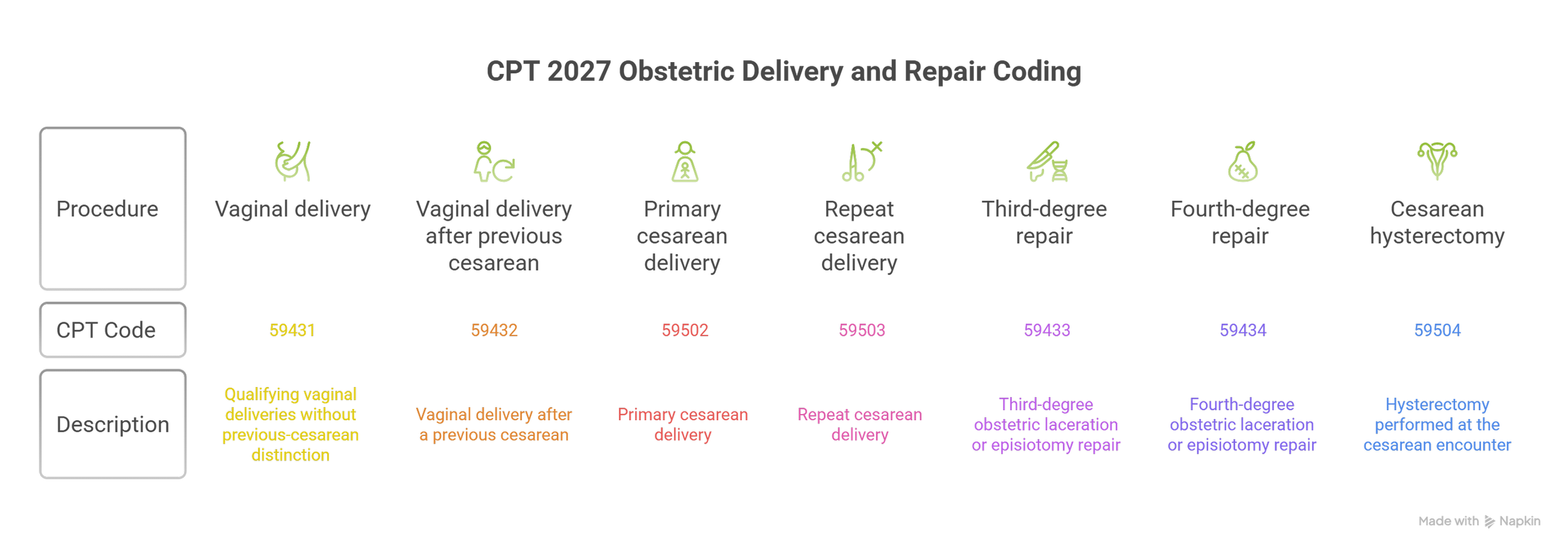
CPT 59431 applies to qualifying vaginal deliveries without the previous-cesarean distinction. CPT 59432 identifies vaginal delivery after a previous cesarean.
Both codes include routine delivery components such as delivery of the placenta, qualifying first- or second-degree laceration or episiotomy repair performed by the delivering clinician or group, and routine postpartum care on the same date.
Case example: A patient previously delivered by cesarean and now has a successful vaginal birth. The delivery is reported with 59432. If the clinician also provides qualifying labor management, the applicable complex labor-management code may be separately reported.
Vacuum-assisted vaginal deliveries also fall under the applicable vaginal delivery codes. Modifier 22 may be considered when documented procedural work substantially exceeds the usual work associated with the service.
Coders should verify these decisions through procedure-specific coding practice, modifier compliance guidance, documentation clarification procedures, and coding audit standards.
Cesarean Delivery: Primary Versus Repeat Procedures
CPT 59502 identifies a primary cesarean delivery, while 59503 identifies a repeat cesarean delivery.
The patient's previous delivery history determines the distinction.
A patient who previously delivered vaginally and undergoes their first cesarean generally qualifies for the primary cesarean code. A patient with an earlier cesarean who undergoes another cesarean generally qualifies for repeat cesarean coding.
Case example: A patient with a previous cesarean attempts a vaginal delivery. During labor, fetal concerns necessitate another cesarean. The resulting procedure is reported with 59503, while separately qualifying labor management is evaluated under the complex labor-management codes.
The operative note should document the procedure, clinical circumstances, previous cesarean history, and any separately reportable surgical services.
For billing validation, combine procedure coding reference materials, audit documentation checks, claim reimbursement analysis, and denial investigation workflows.
Third- and Fourth-Degree Laceration Repairs
CPT 2027 introduces separate reporting for third- and fourth-degree obstetric laceration or episiotomy repairs:
59433: Third-degree repair.
59434: Fourth-degree repair.
First- and second-degree repairs performed by the delivering clinician or their group remain included in the applicable vaginal delivery code. The revised 59300 code addresses qualifying first- or second-degree repairs performed by an unrelated clinician.
These distinctions prevent incorrect separate charges and help ensure that more extensive repair work is appropriately captured.
A detailed operative or procedure note should specify the injury degree, anatomical involvement, repairing clinician, and procedure performed.
Review questionable assignments through coding audit verification, documentation query examples, medical coding practice scenarios, and medical necessity documentation controls.
Multiple Gestations, Mixed Deliveries, and Cesarean Hysterectomy
Multiple gestations introduce additional reporting requirements.
For labor management, a multiple gestation qualifies as complex, with one applicable labor-management code generally reported per qualifying calendar date.
For delivery, a cesarean code is ordinarily reported once for the cesarean delivery event, regardless of the number of fetuses delivered through that procedure. Vaginal delivery is reported per fetus delivered vaginally.
Case example: One twin is delivered vaginally and the other by cesarean during the same session. The applicable vaginal delivery code and cesarean delivery code may both be reported. When the same clinician performs both procedures, the AMA specifies modifier 51 for the secondary procedure.
For cesarean hysterectomy, new CPT 59504 separately identifies the hysterectomy performed at the cesarean encounter. The code may be reported by the same clinician who performs the cesarean or an appropriate separate clinician. When the same physician performs both procedures, the AMA directs use of modifier 51 with 59504.
These cases deserve targeted complex coding audits, modifier reviews, surgical reimbursement verification, and claim adjustment monitoring.
5. Postpartum Coding in 2027 and the Critical 2026–2027 Billing Transition
Postpartum care moves to standard E/M reporting for qualifying services delivered after the calendar date of delivery. This affects hospital discharge management, routine follow-up appointments, telehealth care, and evaluation of postpartum complications.
For practices accustomed to billing 59430 or using global delivery packages, this change requires revised charge-capture processes and documentation templates.
Incorrect transition handling could affect clean claim rates, accounts receivable performance, medical necessity appeals, and insurance denial management.
Reporting Postpartum Services by Setting
Delivery date: Routine immediate postpartum care remains incorporated into the vaginal or cesarean delivery service. Separate reporting depends on whether another distinct service qualifies under applicable rules.
Subsequent inpatient days: Maternal inpatient postpartum care may be reported with applicable subsequent hospital E/M codes, including 99231–99233. Hospital discharge management may be reported with 99238 or 99239, as supported.
Outpatient postpartum encounters: Routine postpartum follow-up, blood pressure assessments, and medically necessary evaluations are reported with appropriate E/M codes. This may include office visits, qualifying telehealth services, and other applicable settings.
A nurse-only encounter may qualify for 99211 when the requirements for that service are satisfied.
For postpartum coding, ensure that physician documentation, E/M selection, payer reimbursement requirements, and coding compliance procedures are aligned.
New CPT 59623: Uterine Tamponade for Postpartum Hemorrhage
CPT 59623 identifies qualifying uterine tamponade procedures performed to manage postpartum hemorrhage.
The intervention may involve a balloon, catheter, vacuum device, or packing material used for mechanical bleeding control. The clinical record must establish that the procedure occurred and document the applicable intervention.
Medication administration alone does not satisfy the requirements of a mechanical uterine tamponade procedure.
This distinction matters when assessing procedure documentation accuracy, medical necessity support, claim payment differences, and coding-related denial trends.
Transition Scenario 1: Prenatal Care Begins in 2026 and Continues in 2027
Suppose a patient receives five routine antepartum visits during 2026, followed by three prenatal encounters in January 2027.
Under the AMA's transition guidance, the five qualifying 2026 visits are reported using 59425. The three 2027 prenatal visits are individually evaluated and reported with their appropriate E/M codes.
For 2026 antepartum services, one to three qualifying routine visits generally use individual E/M reporting, four to six use 59425, and seven or more use 59426.
The date of service for a 2026 antepartum-only package should reflect the final encounter included in that reported service, subject to applicable payer instructions.
This example highlights the need to reconcile encounter dates carefully when updating billing software, electronic claim workflows, coding audit records, and payer reimbursement processes.
Transition Scenario 2: Delivery Occurs December 31, 2026, With Postpartum Care in 2027
If a patient delivers on December 31, 2026, the applicable 2026 maternity delivery code is reported under the rules effective for that delivery.
The AMA's specific transition guidance permits eligible postpartum services provided on or after January 1, 2027, to be reported separately using appropriate E/M codes with HCPCS modifier TH. Payer-specific transition requirements must also be checked.
This guidance is particularly important for patients receiving postpartum care weeks after delivery. Billing systems should retain the original 2026 delivery reporting while properly identifying services performed in 2027.
Confirm the applicable rules through medical coding audit procedures, claims submission resources, payer denial management, and reimbursement guidance.
Transition Scenario 3: Labor Begins in 2026 but Delivery Occurs January 1, 2027
A patient admitted December 31, 2026, who delivers January 1, 2027, presents a more complicated transition.
If the labor-management encounter represents qualifying continuous attendance across midnight, AMA guidance permits one appropriate initial-day labor management code, 59080 or 59081, on January 1.
When the attendance is not continuous, the December 31 service may instead be evaluated under the applicable 2026 hospital E/M rules, with additional payer-specific review.
The appropriate 2027 delivery code is selected for the January 1 delivery.
Five Revenue-Cycle Controls to Implement Before January 2027
Remove deleted codes from 2027 charge-capture templates. Preserve historical code handling for pre-2027 services and adjustments.
Update prenatal and postpartum documentation templates. Include the elements necessary for E/M selection and review.
Create labor-management decision support. Capture initial versus subsequent days, complexity criteria, clinician responsibility, and continuous attendance.
Test delivery claim combinations. Include VBAC, repeat cesarean, mixed-mode multiples, higher-degree laceration repairs, and cesarean hysterectomy.
Obtain payer-specific transition instructions. Validate modifier requirements, fee schedules, claim edits, and adjudication policies before high-volume submission.
These controls should be tested against clean claim rate metrics, denial rate analysis, coding audit checklists, and accounts receivable trends.
6. Frequently Asked Questions About CPT 2027 Maternity Care Changes
-
Yes, when a maternal-fetal medicine (MFM) specialist provides a qualifying consultation without assuming responsibility for labor management, separately reportable E/M services may be appropriate.
The specialist's documentation must support the consultation and service reported. If responsibility for labor management formally transfers, the labor-management reporting rules must be evaluated.
These distinctions are important for physician coding audits, medical necessity documentation, reimbursement verification, and claim denial prevention.
-
Routine fetal monitoring performed by the clinician managing labor is included in the labor-management service. A qualified consulting clinician who performs a separately identifiable fetal monitoring interpretation may have an appropriate reporting option under the revised CPT framework.
Coders should verify the clinician's role, documented interpretation, and applicable code requirements before submitting a separate charge.
Use coding reference resources, audit checklist procedures, documentation clarification guidance, and claim edit verification to prevent duplicate reporting.
-
When a patient presents with contractions and is evaluated for false labor before discharge, the applicable E/M service generally provides the appropriate reporting framework.
For an encounter managed entirely in the emergency department, the appropriate emergency department E/M code may apply.
The distinction requires reviewing the setting, clinical assessment, treatment, patient disposition, and whether qualifying labor management actually occurred.
These scenarios are useful for medical coding practice cases, physician documentation queries, coding accuracy reviews, and medical necessity verification.
-
Modifier 25 may be appropriate when a separately identifiable E/M encounter occurs at an initial location before the patient is subsequently admitted for qualifying labor management on the same date.
For example, a clinician evaluates a patient at an outpatient facility, and the patient later requires admission for labor management. The E/M encounter and labor-management service may qualify for separate reporting under the AMA's specific guidance.
The coder must confirm the circumstances and supporting documentation.
For additional guidance, review modifier 25 selection principles, E/M modifier decision examples, coding compliance requirements, and payer claim adjustment resources.
-
CPT labor-management codes 59080–59083 use a daily reporting structure rather than time-based selection. Therefore, prolonged service code 99418 is not appropriately added to those labor-management services.
After delivery, qualifying inpatient postpartum E/M services may support prolonged-service reporting when the applicable requirements are satisfied.
This distinction affects E/M coding accuracy, medical coding audits, physician reimbursement analysis, and coding-related denial prevention.
-
An eligible assistant surgeon continues to use the appropriate assistant surgeon modifier, including modifier 80 when its requirements apply.
The relevant delivery code is now 59502 for primary cesarean or 59503 for repeat cesarean. Documentation must establish the assistant's participation, and payer requirements determine whether the service is payable.
Practices should verify surgical coding rules, physician payment policies, medical necessity documentation, and claim adjustment requirements.
