
A medical coder can achieve 96% code accuracy while still making mistakes on one in every five patient records. That discrepancy can distort performance reviews, conceal reimbursement risks, and trigger the wrong corrective actions. A reliable medical coding accuracy calculator must separate record-level accuracy, code-level errors, documentation deficiencies, and financial impact. Whether you are preparing a medical coding audit, investigating claim denials, improving your clean claim rate, or reviewing coding productivity standards, the calculation methodology determines which problems you actually uncover.

1. How to Calculate Medical Coding Accuracy, Audit Scores, and Error Rates
Medical coding accuracy measures the proportion of audited coding work that meets the applicable coding and documentation requirements. The most important decision is choosing what constitutes one correct unit. Auditors commonly measure complete records, individual code assignments, or predefined coding opportunities.
For a coding compliance audit, record-level accuracy answers whether an entire encounter was coded correctly. Code-level accuracy identifies the proportion of individual decisions meeting the audit standard. These measures support different decisions about coding training, outpatient case performance, and revenue leakage.
Formula 1: Record-Level Coding Accuracy
Record Accuracy (%) = (Fully Correct Records ÷ Total Records Audited) × 100
Suppose an auditor reviews 50 patient encounters and identifies seven records containing at least one confirmed coding error.
Fully correct records = 43
Record accuracy = 43 ÷ 50 × 100 = 86%
Record error rate = 7 ÷ 50 × 100 = 14%
This approach treats each encounter as one unit. A record with an incorrect E/M modifier and a record containing several unsupported diagnoses each count as one inaccurate record. Consequently, additional measurements are necessary when evaluating modifier errors, HCC coding deficiencies, and medical necessity problems.
Formula 2: Code-Level Coding Accuracy
Code Accuracy (%) = (Correct Coding Decisions ÷ Total Audited Coding Opportunities) × 100
Assume the same 50 encounters contain 250 audited coding opportunities, with 239 correct decisions and 11 confirmed errors.
Code accuracy = 239 ÷ 250 × 100 = 95.6%
Code error rate = 11 ÷ 250 × 100 = 4.4%
The denominator must explicitly account for omitted codes and unsupported additional codes under the organization's established methodology. Otherwise, missing diagnosis codes can disappear from the calculation, while incorrect modifiers and unsupported risk-adjustment diagnoses produce inconsistent penalties.
Interactive Medical Coding Accuracy Calculator
Enter your audit totals below to calculate both accuracy measures and their corresponding error rates. The initial values demonstrate how identical records can produce different scores.
Medical Coding Accuracy Calculator
Calculate record accuracy, code accuracy, and corresponding error rates.
Record Error Rate: 14.0%
Code Accuracy: 95.6%
Code Error Rate: 4.4%
Results reflect the counts entered. Define coding opportunities consistently, including omissions and extra-code penalties, before comparing audits. Calculations run in the browser.
A score of 95.6% may look satisfactory, yet the 86% record accuracy indicates that 14% of the sampled encounters had at least one defect. That distinction becomes particularly important when assessing claim denial patterns, documentation quality, reimbursement accuracy, and coding auditor performance.
A third measurement, financial error rate, requires separate dollar-value calculations. Counting inaccurate encounters alone cannot establish whether those errors caused overpayments, underpayments, or zero reimbursement changes.
Medical Coding Audit Score Map: 32 Essential Measures
| Audit Measure | Meaning or Formula | What It Identifies | Required Audit Action |
|---|---|---|---|
| 1. Audit Universe | All eligible encounters within the defined scope | The population to which findings may relate | Document dates, settings, payers, and exclusions |
| 2. Sampling Frame | The complete list from which records are selected | Missing or duplicated eligible records | Reconcile the list against source-system totals |
| 3. Sampling Unit | The encounter, claim, code, or other defined audit unit | What each observation actually represents | Use one clearly defined unit per calculation |
| 4. Records Audited | Number of eligible encounters reviewed | Actual audit volume | Exclude duplicate selections and document replacements |
| 5. Fully Correct Records | Encounters containing zero confirmed coding errors | Complete-record quality | Apply the same defect definition to every record |
| 6. Record Accuracy | Correct records ÷ audited records × 100 | Percentage of completely accurate encounters | Report separately from code accuracy |
| 7. Record Error Rate | Inaccurate records ÷ audited records × 100 | Frequency of encounters with defects | Investigate recurrence across providers |
| 8. Coding Opportunities | Total eligible coding decisions under the chosen method | Denominator for opportunity-level scoring | Account for omissions and extra-code penalties consistently |
| 9. Correct Decisions | Opportunities meeting the reference standard | Accurate individual coding work | Validate disputed decisions before final scoring |
| 10. Code Accuracy | Correct decisions ÷ audited opportunities × 100 | Overall code-level correctness | Separate diagnosis, procedure, and modifier results |
| 11. Code Error Rate | Incorrect opportunities ÷ total opportunities × 100 | Frequency of code-level defects | Classify every variance by cause |
| 12. Wrong Diagnosis | Incorrect diagnosis selected | Clinical classification or specificity problems | Recheck documentation and current coding guidelines |
| 13. Omitted Code | Reportable code missing from the original assignment | Underreporting or incomplete capture | Trace documentation and workflow handoffs |
| 14. Unsupported Extra Code | Assigned code lacks a valid reporting basis | Overcoding and compliance exposure | Remove unsupported assignments through approved correction processes |
| 15. Sequencing Error | Codes reported in an incorrect order | Principal diagnosis or claim-ordering defects | Check applicable sequencing rules |
| 16. Modifier Variance | Missing, incorrect, or unsupported modifier | Distinct-service and E/M billing risks | Review code-pair edits and modifier documentation |
| 17. E/M Level Variance | Reported visit level differs from supported level | Potential overcoding or undercoding | Reassess the applicable E/M selection criteria |
| 18. Procedure Code Error | Incorrect CPT, HCPCS, or applicable procedure code | Procedure and service misclassification | Verify the documented service and code-set rules |
| 19. Documentation Deficiency | Record lacks information needed to support a decision | Evidence gaps that limit code assignment | Flag for documentation improvement and appropriate clarification |
| 20. Missed Query Opportunity | Clarification should have been considered | Unresolved conflicting or incomplete documentation | Apply compliant query criteria without leading providers |
| 21. Medical Necessity Issue | Insufficient support for coverage criteria | Potential payment and coverage risk | Review payer policy and documentation |
| 22. DRG Variance | Audited grouping differs from the original | Inpatient classification and payment risk | Revalidate diagnosis sequencing and procedures |
| 23. HCC Support Error | Risk-adjustment diagnosis lacks required support | Risk-score integrity concerns | Apply program-specific documentation rules |
| 24. POA Discrepancy | Present-on-admission indicator assigned incorrectly | Inpatient reporting quality defects | Review timing evidence and POA guidance |
| 25. Coding-Related Rejection | Claim fails a submission or payer edit | Front-end processing disruption | Review edits, claim fields, and corrections |
| 26. Coding-Related Denial | Payer denies a claim because of a coding-related issue | Revenue cycle consequences | Map denial codes to confirmed root causes |
| 27. Overpayment | Amount paid above the properly supported payment | Potential repayment obligations | Validate payment differences and follow applicable rules |
| 28. Underpayment | Amount paid below the properly supported payment | Potential recoverable revenue | Check corrected-claim and appeal deadlines |
| 29. Gross Financial Variance | Total absolute value of overpayments and underpayments | Total observed dollar discrepancies | Report independently of net financial variance |
| 30. Net Financial Variance | Total overpayments minus total underpayments | Directional difference across audited payments | Preserve separate overpayment and underpayment totals |
| 31. Weighted Accuracy | Earned weighted points ÷ available weighted points × 100 | Accuracy under a predefined risk-weighting policy | Publish weights before scoring and retain the unweighted result |
| 32. Re-Audit Improvement | Follow-up accuracy minus baseline accuracy | Change after corrective intervention | Use comparable samples and report percentage-point change |
2. How to Interpret Medical Coding Audit Results and Identify Hidden Errors
A coding accuracy percentage becomes useful when it explains which decisions failed, how frequently they failed, and which operational controls could have prevented them. A single overall score cannot distinguish a training problem from an inconsistent physician documentation process, an incorrectly applied modifier rule, a payer-specific reimbursement issue, or an incomplete prior authorization workflow.
Example: A 50-Record Audit With 250 Coding Opportunities
Consider a hypothetical outpatient audit with the following results.
Diagnosis coding: Of 150 audited diagnosis opportunities, 145 are correct. Diagnosis accuracy equals 96.67%. The five errors involve unsupported specificity, missed reportable conditions, or incorrect code selection. Auditors should investigate whether the failures originate in medical terminology interpretation, inadequate documentation clarification, weak coding reference resources, or inconsistent risk-adjustment coding practices.
Procedure coding: Of 60 CPT/HCPCS opportunities, 56 are correct, producing 93.33% accuracy. Four errors may indicate incorrect service selection, missed procedure components, or confusion between professional and facility billing requirements. Compare the affected encounters against outpatient coding practice cases, professional-fee versus facility coding guidance, Medicare billing resources, and relevant fee schedule rules.
Modifier coding: Of 40 modifier opportunities, 38 are correct, producing 95% accuracy. Two incorrect modifier decisions can still have meaningful consequences when they involve separately identifiable E/M services or distinct procedures. Targeted review of modifier 25 versus modifier 59, modifiers 24, 25, and 57, claim adjustment reason codes, and the denial management process can determine which failures are preventable.
Across all three categories, the calculation remains 239 correct opportunities divided by 250 audited opportunities, or 95.6% accuracy. The seven defective records establish the separate 86% encounter-level result.
Calculate the Financial Impact Separately
Suppose the same sample reveals $800 in validated overpayments and $500 in underpayments.
Gross financial variance = $800 + $500 = $1,300.
Net overpayment = $800 − $500 = $300.
If $40,000 in paid reimbursement was reviewed, the gross financial variance relative to reviewed payments equals 3.25%. This is a descriptive dollar-discrepancy measure for the sample, not a substitute for a formally defined payer payment-error metric.
The distinction affects revenue leakage analysis, accounts receivable investigations, underpayment recovery efforts, and medical necessity appeals.
Keep overpayments and underpayments visible as separate figures. Offsetting them in a net total can conceal substantial compliance exposure.
When a Weighted Accuracy Score Is Appropriate
Some organizations give greater weight to coding decisions associated with material reimbursement or compliance risk. The weights must be established before auditors review individual performance.
For example, suppose an audit has 20 high-risk opportunities worth three points each and 80 routine opportunities worth one point each. Total available points equal 140. Two high-risk errors and four routine errors remove ten points, leaving 130 earned points.
Weighted accuracy = 130 ÷ 140 × 100 = 92.86%.
Unweighted accuracy for those same 100 opportunities is 94%.
Weighted scoring can support coding auditor prioritization, HCC risk analysis, documentation compliance reviews, and medical necessity risk management. Preserve the unweighted score alongside it so managers can distinguish actual defect frequency from the organization's risk priorities.
3. How Many Medical Records Should You Audit for Reliable Accuracy Results?
Audit sample size determines how much confidence managers should place in the observed score. Reviewing ten encounters may uncover a recurring coding problem, but the resulting percentage can fluctuate sharply because each record represents 10% of the sample.
A coder scoring 90% across ten records has one inaccurate encounter. At 100 records, the same accuracy percentage represents ten inaccurate encounters and provides more information about error patterns. The results still depend on record selection, audit scope, and the consistency of coding quality reviews, practice-case evaluation, auditor training, and performance measurement standards.
Choose Your Sample Based on the Audit Objective
Random sampling selects records using a documented random process from a defined population. It supports more general conclusions about the population when the sampling method and sample size are appropriate.
Stratified sampling divides the population into meaningful groups, such as provider, specialty, payer, service type, or encounter complexity. Records are then selected within those groups. This helps prevent a high-volume, low-complexity service from overwhelming analysis of complex outpatient encounters, inpatient coding differences, risk-adjustment cases, and specialized professional-fee claims.
Targeted sampling deliberately selects high-risk encounters, such as previously denied claims, unusual modifier combinations, or repeatedly queried diagnoses. It is useful for investigating specific defects, but the results should be labeled as targeted findings. A sample selected because claims appear problematic cannot establish the overall coding error rate of the entire practice without an appropriate statistical design.
Avoid Four Sampling Errors That Distort Results
First, define the sampling frame before selecting charts. Excluding encounters from one payer or omitting corrected claims can bias the results, especially when the audit investigates Medicare reimbursement, Medicaid payment variations, claim submission systems, or payer denial trends.
Second, preserve the original coding state. Auditors need to know what the coder submitted before later corrections, queries, or billing edits changed the record. Otherwise, a reprocessed claim may incorrectly appear to have been accurate at first submission.
Third, distinguish a preliminary audit from a statistically designed estimation. Neither a 30-record review nor a fixed percentage of monthly charts automatically produces a representative sample. Formal overpayment extrapolation requires a defensible sampling methodology, appropriately defined population, statistical assessment, and applicable regulatory procedures.
Fourth, standardize how auditors handle disagreements. A disputed diagnosis should remain provisional until the reference standard is resolved. Use documented compliant physician queries, current coding reference materials, consistent modifier decision rules, and established audit documentation procedures.
Set an Accuracy Target That Can Be Defended
An accuracy target of 95% is commonly referenced in coding quality programs, but it should be treated as an organizational benchmark rather than a universal legal threshold. A 95% code-level score cannot be fairly compared with a 95% completely correct-record score because their denominators and scoring severity differ.
Set separate targets for record accuracy, code accuracy, critical errors, and corrective-action completion. Review them by specialty and audit complexity so that coder productivity expectations, coding quota pressure, denial outcomes, and revenue-cycle performance can be interpreted together.
Quick Poll: What Is Your Biggest Coding Accuracy Audit Problem?
Your selection displays tailored guidance on this page. Responses are not collected or aggregated.
4. How to Reduce Coding Errors and Improve Audit Accuracy
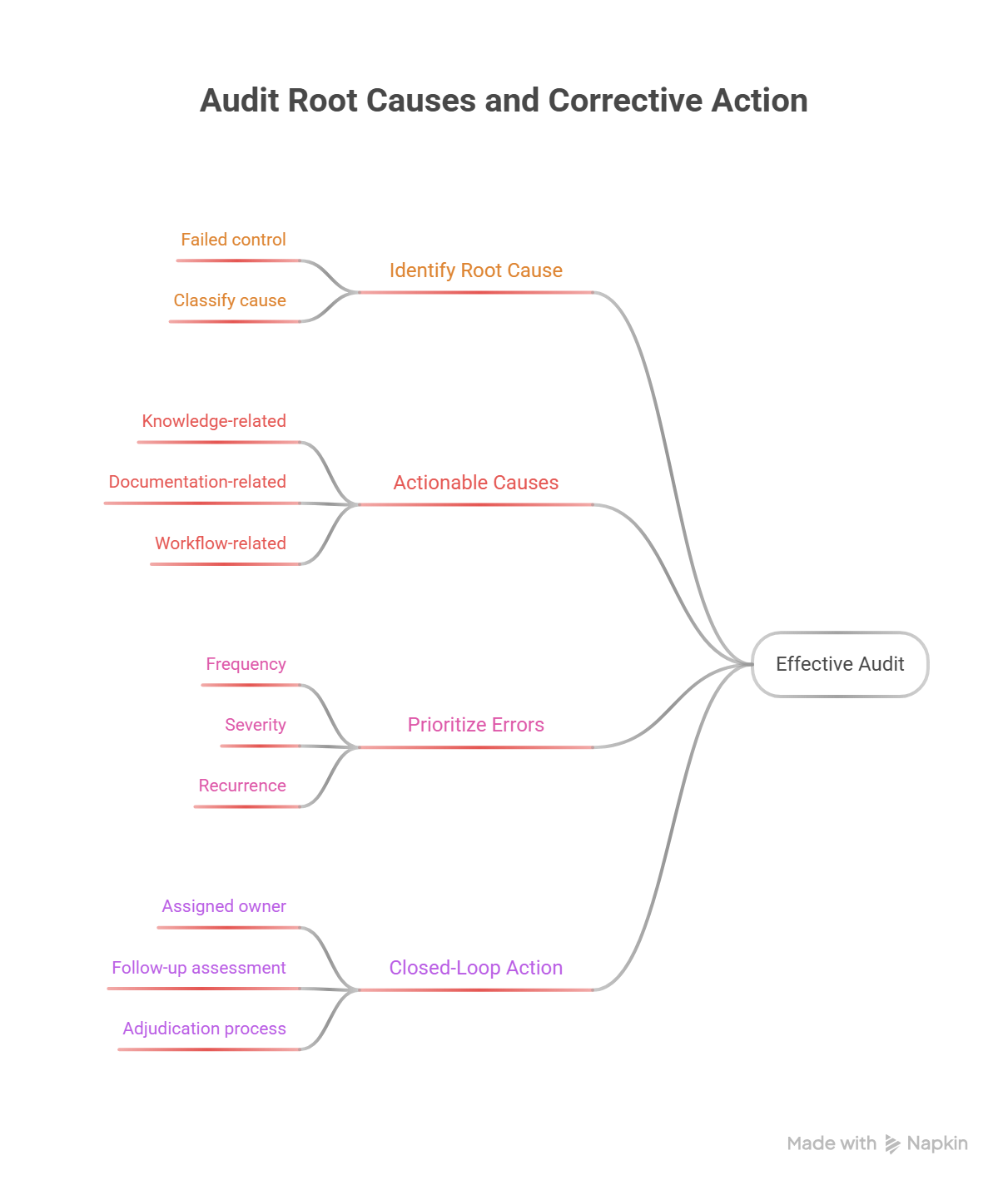
An effective audit identifies the control that failed before assigning responsibility for the error. If an incorrect diagnosis resulted from missing provider documentation, retraining the coder on the diagnosis code may have little effect. If the problem arose from misinterpreting a coding convention, requesting additional documentation may also be unnecessary.
Classifying the root cause determines whether corrective action should target coding knowledge, physician query practices, claim processing controls, or denial management procedures.
Assign Every Error to an Actionable Root Cause
Knowledge-related errors arise when the coder misunderstands coding rules, specificity requirements, code sequencing, or modifier selection. Corrective action should include focused exercises with explanations, followed by independent reassessment using comparable cases.
For example, recurring modifier mistakes warrant exercises involving modifier 25 and modifier 59 distinctions, E/M modifier selection, outpatient coding scenarios, and structured coding interview assessments.
Documentation-related errors occur when available records fail to support necessary code assignments or contain ambiguities requiring clarification. These findings should be reported separately from clearly incorrect coder decisions. Appropriate action may involve compliant physician queries, medical necessity documentation review, HCC diagnosis validation, and targeted coding compliance monitoring.
Workflow-related errors result from incomplete handoffs, outdated system configurations, missing information, or inconsistent charge capture. Identify the exact process stage where information was lost or incorrectly transformed. Investigate recurring failures against electronic claim submission workflows, prior authorization requirements, medical billing software options, and payer adjustment codes.
Prioritize Errors Using Frequency, Severity, and Recurrence
An audit identifying 20 low-impact errors and two high-risk unsupported diagnoses requires more careful prioritization than simply sorting categories by frequency.
A practical prioritization framework considers three dimensions. Frequency measures how often an error occurs. Severity evaluates its potential clinical, compliance, or financial consequences. Recurrence indicates whether the issue persists after corrective intervention.
For instance, recurring unsupported HCC assignments may warrant immediate review even when relatively few cases are affected. Repeated medical necessity denials may require documentation intervention. Meanwhile, frequent low-value claim rejections can consume operational resources and increase accounts receivable days.
Build a Closed-Loop Corrective Action Process
Every confirmed finding should have an assigned owner, root-cause classification, supporting evidence, correction deadline, and follow-up assessment.
Consider a coder whose modifier accuracy improves from 88% to 96% after education. That represents an eight-percentage-point improvement. The department should verify whether subsequent audits used comparable case types and whether the original defect pattern declined.
Follow-up testing can combine modifier decision examples, practical coding cases, audit checklist controls, and denial root-cause tracking.
Allow coders to challenge preliminary findings through a documented adjudication process. Where two qualified auditors interpret a coding rule differently, resolve the underlying rule and update the scoring reference before determining individual performance consequences.
5. How to Build a Monthly Coding Accuracy Dashboard That Supports Better Decisions
A useful coding audit dashboard should connect accuracy results with their causes, business consequences, and corrective actions. It should also preserve the definitions and sampling methods behind each measurement.
A dashboard showing only a 95% average provides little explanation when coding-related denials are increasing, accounts receivable is deteriorating, claim submission errors persist, or medical necessity appeals repeatedly involve the same documentation gaps.
Structure the Dashboard Around Five Reporting Areas
Audit coverage: Record the number of eligible encounters, audited encounters, sampling methodology, audit period, and percentage of the eligible universe reviewed. Identify any targeted samples separately.
Accuracy performance: Report fully correct records, record accuracy, code accuracy, and error rates by diagnosis, procedure, and modifier category. Include separate scores for E/M coding accuracy, HCC coding performance, outpatient case accuracy, and facility-versus-professional coding where applicable.
Financial consequences: Display confirmed overpayments, underpayments, gross discrepancies, and coding-related denial amounts. Reconcile discrepancies with physician fee schedule calculations, Medicaid payment references, claim adjustment information, and appeal documentation requirements.
Root-cause distribution: Group confirmed defects into knowledge gaps, documentation deficiencies, workflow problems, and payer-specific coding issues. Use consistent definitions so a decline in one category reflects actual improvement rather than reassignment of error labels.
Corrective-action effectiveness: Track completed education, resolved system issues, accepted coder rebuttals, outstanding provider documentation issues, and re-audit findings. Link each corrective action to the original defect category.
How to Compare Monthly Results Without Misleading Management
Suppose a department reports 92% record accuracy in January and 96% in February. Management might reasonably question whether the improvement resulted from better performance or a change in the sampled workload.
Compare audit periods using consistent eligibility criteria, case complexity, scoring policies, and sampling methods. When these factors change, disclose the difference.
The same principle applies when assessing productivity quotas, coding workplace stress, coding auditor responsibilities, and professional coding development.
For monthly reporting, retain both the current score and the preceding trend, supported by sample counts. Flag score changes in percentage points, document unresolved findings, and identify the errors with the greatest demonstrated compliance or financial risk.
The strongest dashboard tells managers exactly where to investigate, which actions have been completed, and whether those actions produced measurable improvement.
6. Frequently Asked Questions About Medical Coding Accuracy Calculators
-
Many coding quality programs use 95% as an operational accuracy benchmark, although acceptable targets depend on the scoring methodology, case complexity, and organizational policy.
A department reporting 97% code accuracy may still experience substantial encounter-level defects if multiple coding decisions occur within each record. Compare the result against the established coding audit methodology, applicable coding productivity standards, claim denial performance, and the organization's specific compliance risks.
-
Divide the number of inaccurate audited units by the total number of audited units, then multiply by 100.
If 12 of 80 records contain confirmed errors, the record-level error rate is 15%, and record accuracy is 85%. For code-level measurement, count incorrect coding opportunities against all audited opportunities under the defined scoring system.
Validate errors using outpatient coding case examples, modifier selection guidance, audit verification procedures, and documentation clarification practices.
-
Yes. Consider an audit involving 20 records and 200 coding opportunities. If 190 decisions are correct, code accuracy is 95%. If the ten errors appear across ten different encounters, only ten records are completely correct, producing 50% record accuracy.
This is why reviewers should evaluate complete-record defects when reviewing HCC documentation, E/M modifier assignments, procedure coding cases, and denial-related coding defects.
-
The appropriate number depends on the intended inference, total population, expected variability, acceptable uncertainty, and available resources. A small educational audit can use a focused sample to identify training needs, while population-level estimates require an appropriate statistical design.
Document sample selection before reviewing records. Use targeted coding practice cases for competency development and a suitable sampling method for general coding compliance evaluation. Separate reviews targeting HCC coding risks or modifier errors from general accuracy estimates.
-
Yes, when the omitted code was reportable and supported under the applicable coding requirements. A scoring method that examines only submitted codes can conceal omissions.
Auditors must define how omitted codes enter the denominator, especially when measuring risk-adjustment diagnoses, physician documentation deficiencies, outpatient procedure completeness, and medical necessity support.
-
Calculate the difference between the reimbursement actually paid and the properly supported payment for each audited claim, applying the relevant payment methodology.
Report validated overpayments and underpayments separately. Their combined absolute value represents the gross discrepancy within the reviewed sample.
Reconcile findings using physician reimbursement guidance, Medicaid rate references, claim adjustment code descriptions, and appropriate billing appeal procedures.
