
Medical coding pre-employment tests can determine whether a qualified applicant reaches the interview stage or loses the opportunity to someone with stronger practical skills. Employers may evaluate ICD-10-CM sequencing, CPT modifiers, documentation accuracy, reimbursement knowledge, and decision-making under time pressure. This guide provides 50 realistic practice questions with answers, explanations, and common error traps. Whether you are preparing for your first medical coding job or transitioning into medical coding auditing, these exercises will help identify the skills that require improvement before your assessment.

1. What Employers Look for in Medical Coding Pre-Employment Tests
Hiring assessments frequently combine code-selection exercises with documentation review, modifier decisions, and claim troubleshooting. A candidate who memorizes code definitions may struggle when presented with an incomplete physician note or competing diagnosis choices.
Employers evaluating medical coding interview performance may focus on five competencies.
Accuracy: Can you identify supported diagnoses and procedures without adding undocumented conditions?
Code validation: Can you use the Alphabetic Index, Tabular List, and applicable instructions correctly?
Compliance: Can you recognize questionable modifier use, unsupported diagnoses, and improper documentation?
Efficiency: Can you complete cases within reasonable time limits while preserving accuracy?
Judgment: Can you recognize when clarification is required instead of guessing?
For a practical starting point, use 50 outpatient coding scenarios alongside the medical coding audit checklist. Candidates targeting an inpatient coding position should additionally practice principal diagnosis selection, inpatient uncertain-diagnosis rules, and ICD-10-PCS.
A practical scoring framework
This article contains 50 questions across four assessment categories. Give yourself one point for each correct answer and record the reason behind every mistake.
A reasonable self-assessment framework is:
45–50 correct: Strong foundational readiness; investigate the remaining errors.
40–44 correct: Solid preparation with identifiable weaknesses.
35–39 correct: Additional focused practice recommended.
Below 35 correct: Rebuild core coding and compliance skills before taking a timed simulation.
These ranges are preparation benchmarks created for this guide. Individual employers establish their own passing scores, coding specialties, and test formats.
A candidate who answers 43 questions correctly in 50 minutes has demonstrated different strengths from someone who answers 43 correctly in 90 minutes. Record both accuracy and completion time using a personal coding productivity benchmark.
The most useful preparation combines exam reference books, a personalized medical coding study guide, and documented examples of your reasoning. Review current code sets before attempting an employer's assessment because diagnosis codes, procedure codes, and payer edits change over time.
Medical Coding Employment Test: Skills, Error Traps & Best Actions (30+ Rows)
| Tested Skill | Employer Test Scenario | Common Error | Best Practice Action |
|---|---|---|---|
| 1. Code-set validity | Encounter after annual ICD update | Selecting an outdated code | Verify the code set effective on the service date. |
| 2. Outpatient uncertainty | Provider writes suspected pneumonia | Coding an unconfirmed disease | Report supported symptoms or findings. |
| 3. First-listed diagnosis | Multiple conditions in one encounter | Selecting by perceived severity alone | Identify the condition chiefly responsible for the outpatient service. |
| 4. Principal diagnosis | Completed inpatient admission | Confusing admission symptoms with final diagnosis | Apply the inpatient after-study definition. |
| 5. Tabular validation | Code selected through the Index | Skipping instructional notes | Confirm the code and instructions in the Tabular List. |
| 6. Excludes1 | Conflicting diagnosis combination | Ignoring an exclusion note | Apply the note and evaluate the unrelated-condition exception where relevant. |
| 7. Excludes2 | Two separately documented conditions | Assuming dual coding is prohibited | Determine whether both are reportable. |
| 8. Code first | Etiology and manifestation codes | Incorrect sequencing | Follow mandatory sequencing instructions. |
| 9. Additional codes | Condition needs further identification | Reporting only one required code | Review Use additional code notes. |
| 10. Laterality | Right-sided injury documented | Using unspecified laterality | Select the supported side-specific code. |
| 11. Seventh character | Injury follow-up encounter | Assuming every later visit uses subsequent encounter | Determine the treatment phase. |
| 12. Hypertension and CKD | Both conditions documented | Missing a presumed relationship | Apply ICD-10-CM with-convention instructions and exceptions. |
| 13. Diabetes combination coding | Diabetes with a documented complication | Missing a required complication code | Confirm the combination code and additional-code requirements. |
| 14. History versus active disease | Previously treated cancer | Automatically assigning active malignancy | Review current treatment and disease status. |
| 15. Sequela | Persistent deficit after prior injury | Coding the original injury as acute | Apply residual-effect and sequela instructions. |
| 16. Postprocedural complication | New condition after surgery | Assuming every postoperative condition is a complication | Confirm documentation and required causal relationship. |
| 17. E/M medical decision making | Office visit with several conditions | Counting diagnoses without assessing complexity | Evaluate the three MDM elements. |
| 18. E/M time | Visit coded using total time | Including unrelated staff or procedure time | Count qualifying professional time on the encounter date. |
| 19. Modifier 25 | E/M with same-day procedure | Automatically adding the modifier | Verify significant, separately identifiable E/M work. |
| 20. Modifier 59 | Two procedures subject to an edit | Using the modifier to force payment | Establish a supported distinct service and allowed edit bypass. |
| 21. X modifiers | Different encounter or anatomical site | Choosing a vague modifier | Evaluate XE, XP, XS, or XU and payer acceptance. |
| 22. Modifier 57 | E/M results in major surgery decision | Confusing decision-making with routine preoperative care | Confirm timing and major-surgery criteria. |
| 23. Modifier 24 | Unrelated E/M during postoperative period | Failing to establish unrelatedness | Support the visit's separate clinical purpose. |
| 24. Modifier 78 | Unplanned related return to operating room | Treating an unrelated procedure as related | Verify postoperative relationship and setting. |
| 25. Modifier 79 | Unrelated procedure in global period | Misclassifying a related complication procedure | Document the independent indication. |
| 26. Professional and technical components | Diagnostic test interpretation | Billing a component already included elsewhere | Check code eligibility and 26 or TC reporting. |
| 27. NCCI PTP edits | Bundled procedures appear together | Assuming a modifier always permits both | Review the active edit and modifier indicator. |
| 28. Medically Unlikely Edits | Unusual service units | Submitting unsupported quantities | Validate documented units and MUE rules. |
| 29. Place of service | Office versus outpatient hospital | Choosing POS from provider specialty | Verify the actual service location. |
| 30. Claim adjustment codes | Remittance identifies nonpayment | Appealing without reading adjustment details | Review group code, CARC, RARC, and payer policy. |
| 31. Claim rejection | Transaction fails initial processing | Treating rejection as adjudicated denial | Correct the submission defect and resubmit. |
| 32. Physician queries | Conflicting clinical information | Suggesting an unsupported diagnosis | Use a neutral, clinically supported clarification query. |
| 33. HIPAA safeguards | Patient records used in assessment | Sharing identifiable medical information | Use authorized access and approved secure channels. |
| 34. Audit accuracy | Errors discovered in a coding sample | Confusing accuracy with error rate | Define the scoring unit and calculate both correctly. |
2. ICD-10-CM Diagnosis Coding Questions (Questions 1–15)
These questions evaluate diagnostic reasoning, sequencing, and documentation interpretation. Candidates who have practiced outpatient coding cases should attempt each question before reading the answer.
Question 1. A physician documents "rule out pneumonia" during an outpatient visit. What should the coder report?
Answer: Report documented symptoms, signs, or other confirmed conditions to the highest degree of certainty available.
Explanation: Outpatient coding rules prohibit reporting an uncertain diagnosis as established. If the patient presented with a documented cough and fever, the applicable symptom codes may be appropriate. Review medical coding practice scenarios and documentation audit requirements to strengthen this distinction.
Question 2. A patient presents with abdominal pain, and the physician confirms acute appendicitis. Should abdominal pain also be coded?
Answer: Generally, omit symptoms routinely associated with the confirmed diagnosis unless applicable instructions or circumstances support separate reporting.
Explanation: Assign the confirmed condition using the current ICD-10-CM classification and appropriate specificity. Separate reporting becomes relevant when a symptom is clinically distinct or independently reportable. This principle frequently appears in practical medical coding assessments and coding accuracy reviews.
Question 3. What is the correct process for selecting an ICD-10-CM diagnosis code?
Answer: Identify the documented diagnosis, locate the term in the Alphabetic Index, and verify the selected code in the Tabular List.
Explanation: Check inclusion notes, exclusions, additional-code instructions, laterality, and required characters. An encoder suggestion requires the same verification. Build this sequence into your personal coding study guide, then apply it to realistic outpatient cases.
Question 4. What is the difference between an Excludes1 and an Excludes2 note?
Answer: Excludes1 generally identifies conditions that should not be coded together for the same clinical circumstance. Excludes2 indicates that the excluded condition is not included in the code and may be reported separately when both conditions exist.
Explanation: An Excludes1 note can have an exception for genuinely unrelated conditions. Evaluate the specific documentation and official instructions. This distinction belongs in every coding audit checklist and exam preparation reference.
Question 5. An ICD-10-CM category contains a "Code first" instruction. What must the coder do?
Answer: Assign the required underlying condition before the dependent code, following the applicable sequencing instructions.
Explanation: Code first instructions establish ordering requirements, particularly for certain etiology-manifestation relationships. A correct code pair in the wrong sequence can still produce an inaccurate claim. Practice diagnosis sequencing exercises and use medical coding audit procedures to identify these errors.
Question 6. The physician documents a right-sided injury, but the coder selects an unspecified-side diagnosis. What is wrong?
Answer: The assigned code fails to capture documented laterality when a supported side-specific code is available.
Explanation: Verify the correct code family, anatomy, and any required seventh character before correcting the selection. Repeated unspecified coding can create inaccurate clinical data. Candidates developing a medical coding portfolio should demonstrate precise laterality selection in their outpatient practice cases.
Question 7. A patient returns for active treatment of an injury first evaluated elsewhere. Must the seventh character indicate a subsequent encounter?
Answer: No. Where the injury category uses encounter characters, initial-encounter designation generally applies during active treatment, even when another provider previously evaluated the injury.
Explanation: Subsequent-encounter designation generally applies during routine healing or recovery. The treatment phase determines the selection. This distinction is useful in coding interview assessments and outpatient injury coding practice.
Question 8. A patient has hypertension and chronic kidney disease. Should the coder assume a relationship?
Answer: The ICD-10-CM "with" convention generally presumes the relevant relationship when these conditions appear together in the classification, unless documentation clearly establishes they are unrelated.
Explanation: Apply the appropriate hypertensive CKD code and additional CKD stage code as instructed. Avoid relying on informal clinical assumptions. Review related cases through risk-adjustment coding practice and coding documentation review.
Question 9. A patient has type 2 diabetes and documented diabetic CKD. What coding issue requires attention?
Answer: Confirm the applicable diabetes-with-CKD combination code and report the CKD stage code when required.
Explanation: Diabetes complication coding frequently requires multiple codes to communicate the complete condition. Validate the documented stage and instructions before finalizing. This is especially important in HCC coding exercises and medical coding audit reviews.
Question 10. The patient underwent treatment for cancer years ago. Can the coder automatically report active malignancy?
Answer: Determine whether the malignancy remains active, whether treatment is directed at the site, and whether the documentation supports a personal history code.
Explanation: Prior treatment alone does not establish current active disease. Review current clinical documentation and applicable history guidelines. Misclassification can distort risk-adjustment coding results and create avoidable findings during a medical coding audit.
Question 11. What is sequela coding, and when is it appropriate?
Answer: Sequela coding identifies a residual condition resulting from an earlier injury or illness after the acute phase has ended.
Explanation: The residual condition is generally coded first, followed by the appropriate sequela code when instructed, subject to category-specific exceptions. Examine the documentation for the actual residual effect. Apply this method in diagnostic coding scenarios and coding interview exercises.
Question 12. A physician documents an infection after surgery. Can the coder automatically classify it as a postprocedural infection?
Answer: Verify the provider's documentation establishing the required complication relationship and follow the specific code-category rules.
Explanation: Chronological proximity alone does not always establish a complication. Clarification may be necessary when the record is ambiguous. Use compliant physician query templates and the documentation review checklist to resolve uncertainty appropriately.
Question 13. When is an unspecified diagnosis code acceptable?
Answer: When the available clinical documentation lacks the detail required for a more specific supported code, and the unspecified code is valid.
Explanation: Avoid creating specificity from assumptions. When the missing detail is clinically meaningful and reasonably obtainable, consider a compliant clarification request. Practicing physician query scenarios strengthens the judgment required for coding accuracy audits.
Question 14. How does principal diagnosis selection differ from first-listed outpatient diagnosis selection?
Answer: The inpatient principal diagnosis is the condition established after study to be chiefly responsible for admission. Outpatient first-listed diagnosis selection follows outpatient reporting rules and the reason for the encounter.
Explanation: Inpatient uncertain diagnoses may qualify for coding under specific discharge rules that do not apply to outpatient encounters. Candidates comparing inpatient and outpatient coding careers should practice both frameworks using coding reference resources.
Question 15. Two providers document conflicting diagnoses in the same record. What is the appropriate response?
Answer: Review the complete documentation, applicable coding rules, and organizational escalation procedures. Request clarification when the conflicting information prevents accurate code assignment.
Explanation: Selecting whichever diagnosis produces higher reimbursement creates compliance exposure. A properly constructed non-leading physician query protects documentation integrity. Include the resolved discrepancy in the coding audit trail.
3. CPT, E/M, and Modifier Questions (Questions 16–30)
Modifier questions are particularly challenging because selecting a technically valid modifier requires understanding why the service qualifies. Work through the scenarios using the modifier 25 versus 59 decision guide and the E/M modifier comparison guide.
Question 16. How are office and outpatient E/M visit levels selected?
Answer: For eligible office/outpatient E/M codes, selection generally uses medical decision making or qualifying total time on the date of the encounter.
Explanation: The three MDM elements are problems addressed, data reviewed or analyzed, and management risk. The supported level generally requires meeting two of the three elements. Practice through medical coding interview questions and outpatient coding assessments.
Question 17. An established patient office visit involves 35 minutes of qualifying provider time. Which E/M code may be appropriate when selecting by time?
Answer: CPT 99214, assuming the service otherwise meets the code requirements and the time is correctly documented.
Explanation: The established-patient office visit time range for 99214 is 30–39 minutes. Exclude separately reported procedure time and nonqualifying staff activities. Candidates should verify the current code descriptors using coding reference materials and reinforce the rule through coding practice cases.
Question 18. A patient receives a minor procedure and a significant, separately identifiable E/M service on the same day. Which modifier may apply?
Answer: Modifier 25 may be appended to the E/M service when documentation supports separately identifiable work beyond the usual service associated with the procedure.
Explanation: The additional E/M work must meet the applicable requirements. A separate diagnosis is not always required. Use the modifier 25 versus 59 decision tree and E/M modifier examples to distinguish legitimate reporting from routine procedural work.
Question 19. A patient receives only routine evaluation associated with a minor procedure. Should modifier 25 automatically be added?
Answer: The coder should evaluate whether documentation supports a significant, separately identifiable E/M service. Routine procedural assessment alone generally does not qualify.
Explanation: Automatically attaching modifier 25 increases the risk of unsupported billing. Review the modifier 25 decision guide alongside the medical coding compliance checklist.
Question 20. Two procedures occur at separate anatomical sites, and an NCCI edit exists. What must the coder verify before using modifier 59?
Answer: Confirm that the procedures qualify as distinct, that documentation supports the distinction, and that the applicable edit allows an appropriate modifier.
Explanation: A modifier cannot override every NCCI edit. Check whether a more specific modifier is appropriate. The modifier 59 coding examples and medical coding audit checklist help evaluate this evidence.
Question 21. What do modifiers XE, XP, XS, and XU identify?
Answer: XE identifies a separate encounter, XP a separate practitioner, XS a separate structure, and XU an unusual non-overlapping service.
Explanation: These modifiers communicate specific circumstances that may justify reporting distinct services under applicable payer rules. Verify documentation and payer acceptance before use. Reinforce the distinctions using the modifier 59 decision tree and real coding scenarios.
Question 22. An E/M encounter results in the initial decision to perform major surgery. Which modifier may apply?
Answer: Modifier 57 may apply to the qualifying E/M service on the day of or day before major surgery, subject to the applicable payer rules.
Explanation: For Medicare, major surgery generally involves a 90-day global period. Documentation must support the decision-making service. Compare the situations using the modifier 24, 25, and 57 guide and the coding audit checklist.
Question 23. A patient is in a postoperative global period and receives an unrelated E/M service from the same provider. Which modifier is relevant?
Answer: Modifier 24 may apply when the E/M service is unrelated to the original procedure and the documentation supports that distinction.
Explanation: An unrelated clinical problem can justify a separately reportable visit under applicable rules. The E/M modifier decision guide explains this situation, while documentation audit practice helps assess the evidence.
Question 24. A patient returns unexpectedly to the operating room for a procedure related to the original surgery during the postoperative period. Which modifier may apply?
Answer: Modifier 78 may apply when the circumstances meet the requirements for an unplanned related procedure during the postoperative period.
Explanation: The relationship to the original procedure and the qualifying operative setting must be established. Compare related and unrelated postoperative services through medical coding practice cases and coding compliance reviews.
Question 25. A surgeon performs an unrelated procedure during the global period of an earlier surgery. Which modifier may apply?
Answer: Modifier 79 may apply to the unrelated procedure or service performed by the same provider during the postoperative period.
Explanation: Determine whether the new service is clinically independent of the earlier surgery and ensure the operative documentation supports its purpose. These distinctions frequently challenge candidates preparing for medical coding interviews and professional coding audits.
Question 26. What is the purpose of modifiers 26 and TC?
Answer: Modifier 26 identifies the professional component of an eligible service, while TC identifies the technical component when separately reportable.
Explanation: The professional component typically concerns interpretation, and the technical component concerns equipment, supplies, or technical resources associated with the service. Confirm code eligibility and billing circumstances. Review professional-fee versus facility coding and the medical billing resources directory.
Question 27. What does an NCCI modifier indicator of zero mean?
Answer: A modifier indicator of zero means an NCCI PTP-associated modifier cannot bypass that specific edit.
Explanation: Reporting both procedures with modifier 59 does not automatically establish separate payment eligibility. Check the active edit, payer rules, and correct coding principles. Practice edit analysis using the modifier decision tree and coding audit checklist.
Question 28. What does an NCCI modifier indicator of one mean?
Answer: An indicator of one means an appropriate modifier may bypass the edit when the documentation and applicable rules support the circumstances.
Explanation: Permission to use a modifier depends on the clinical facts. Verify whether the procedures involved separate sites, encounters, practitioners, or qualifying services. The modifier 59 examples and coding accuracy reviews provide useful preparation.
Question 29. What is an add-on CPT code, and how should it be reported?
Answer: An add-on code describes qualifying additional work associated with an eligible primary service and generally requires an appropriate primary code.
Explanation: Check the CPT instructions and applicable payer policies for permitted primary-code combinations. Reporting an add-on code without its required primary code may cause rejection or denial. Practice claim validation through clean claim rate analysis and coding accuracy exercises.
Question 30. A claim reports an unusually high number of units for a procedure. Which coding control should be reviewed?
Answer: Review the code's unit definition, documentation, and applicable Medically Unlikely Edit rules.
Explanation: MUEs are designed to identify potentially incorrect units of service. Review whether the service qualifies for any applicable exceptions or reporting procedures. Candidates should understand how unit errors affect claim rejection and denial trends and coding audit outcomes.
4. HCPCS, Claims, and Denial Questions (Questions 31–42)
Coding knowledge becomes more valuable when candidates understand how code selection affects claim processing. These scenarios connect coding decisions with clean claim performance, denial management, and payment accuracy.
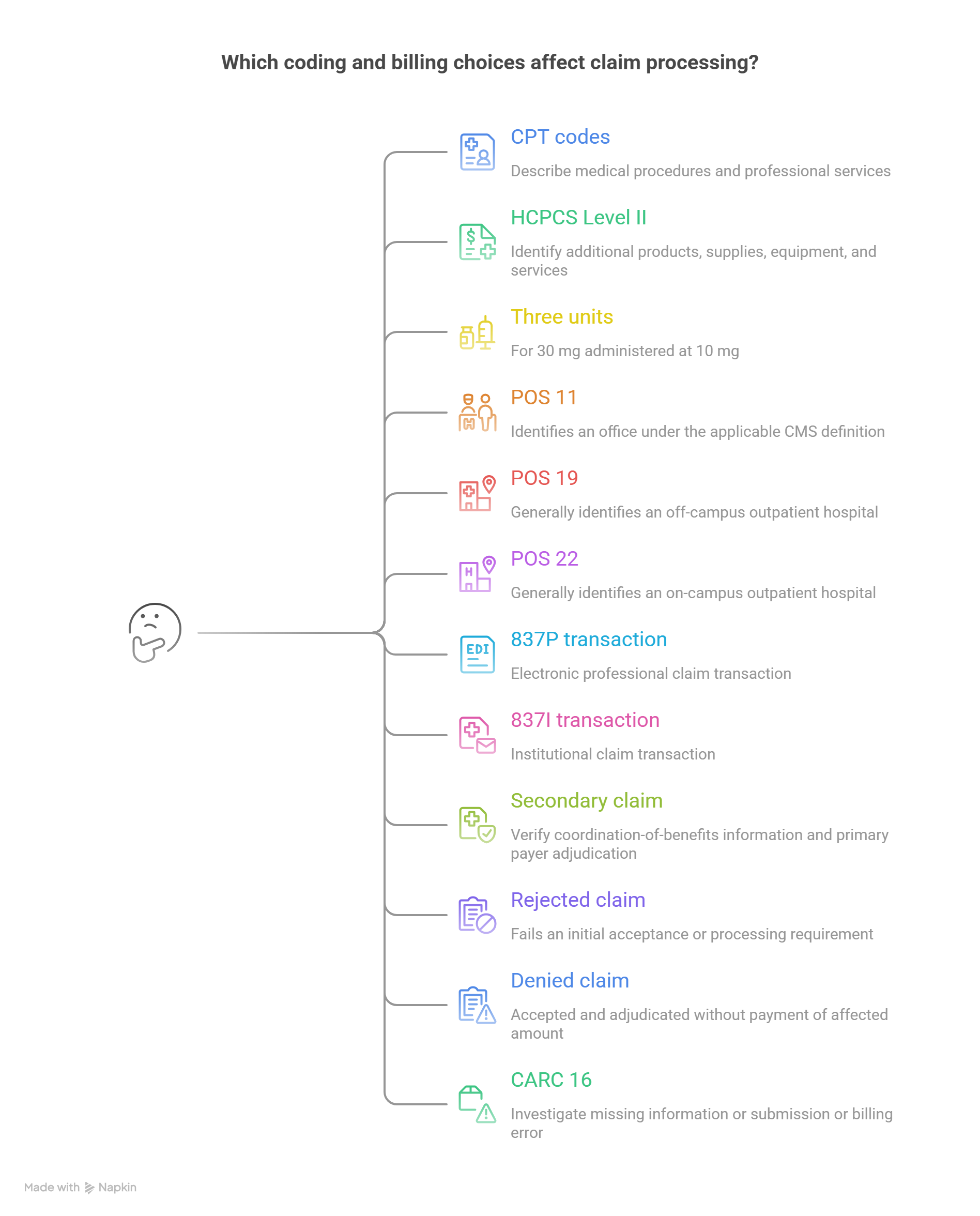
Question 31. What is the difference between CPT and HCPCS Level II codes?
Answer: CPT codes primarily describe medical procedures and professional services. HCPCS Level II codes identify additional products, supplies, equipment, and services, including many items outside CPT.
Explanation: Both systems contribute to appropriate claim reporting. A coding candidate should know which code set applies to a documented service. Explore Medicare billing resources and physician reimbursement guidance for practical context.
Question 32. A drug code describes each 10 mg administered. The record documents 30 mg administered. How many units correspond to that amount?
Answer: Three units, assuming that 10 mg is the verified billing unit and the code applies to the documented drug.
Explanation: Confirm the exact HCPCS descriptor, administered amount, and payer-specific reporting rules. Review wastage rules separately when applicable. Unit conversion mistakes affect claim submission accuracy and may contribute to denials or payment discrepancies.
Question 33. Which place-of-service code generally identifies a physician's independent office?
Answer: POS 11 identifies an office under the applicable CMS definition.
Explanation: Select the place of service using the actual service location. Facility ownership and setting distinctions can affect the correct designation. Check physician fee schedule guidance and Medicare billing tools when practicing these scenarios.
Question 34. What is the difference between POS 19 and POS 22?
Answer: POS 19 generally identifies an off-campus outpatient hospital, while POS 22 generally identifies an on-campus outpatient hospital.
Explanation: Correct selection depends on the location's applicable classification. Verify the actual setting rather than relying on the organization name. Place-of-service errors may affect physician reimbursement calculations and clean claim performance.
Question 35. What is the difference between an 837P and an 837I claim transaction?
Answer: The 837P is the electronic professional claim transaction, while the 837I is the institutional claim transaction.
Explanation: Their data structures reflect different billing requirements. Candidates should understand which transaction supports a particular provider and service type. Review electronic claims submission systems and professional-fee versus facility coding.
Question 36. A patient has primary and secondary insurance. What should the billing team verify before submitting a secondary claim?
Answer: Confirm coordination-of-benefits information, primary payer adjudication, and the secondary payer's submission requirements.
Explanation: Accurate secondary billing depends on appropriate primary payment and adjustment information. A missing or inaccurate primary remittance can disrupt secondary processing. Review claim adjustment reason codes and claims submission workflows.
Question 37. What distinguishes a rejected claim from a denied claim?
Answer: A rejected claim generally fails an initial acceptance or processing requirement. A denied claim has been accepted into the payer's processing system and adjudicated without payment of the affected amount.
Explanation: Rejections typically require correction and resubmission. Denials require reviewing the adjudication reason and deciding whether correction, reconsideration, or appeal is appropriate. Use the denial root-cause worksheet and billing appeal templates to practice these workflows.
Question 38. A remittance reports CARC 16. What should the biller investigate?
Answer: CARC 16 generally indicates that a claim or service lacks information or contains a submission or billing error needed for adjudication.
Explanation: Examine associated remittance advice remark codes and payer instructions to identify the exact deficiency. Avoid guessing the missing information. The CARC reference directory and medical billing appeal resources help organize the next action.
Question 39. A claim contains an adjustment indicating that the payment is included in another service. What should the coder check?
Answer: Review bundling rules, the underlying procedure relationship, and whether separate reporting is supported.
Explanation: CARC 97 commonly indicates that the benefit for a service is included in payment for another service or procedure. Check the code pair and modifier eligibility before pursuing an appeal. The modifier 25 versus 59 guide and denial analysis worksheet are useful here.
Question 40. Does an approved prior authorization guarantee claim payment?
Answer: Payment remains subject to applicable coverage, eligibility, documentation, coding, and claim adjudication requirements.
Explanation: Authorization confirms a particular approval decision under the payer's requirements. The claim must still satisfy other applicable conditions. Review the prior authorization workflow checklist and medical necessity denial documentation guide to prevent avoidable mistakes.
Question 41. A claim contains an incorrect billing-provider NPI or tax identification number. What should happen next?
Answer: Verify the provider's enrollment and billing details, correct the affected fields, and follow the applicable payer correction or resubmission process.
Explanation: Incorrect provider identifiers can interfere with claim acceptance, matching, or payment. Verify the billing and rendering provider information against the payer's records. Use an established claim submission workflow and track errors through a clean claim rate calculator.
Question 42. A payer denies a claim for timely filing. What information should the billing team collect?
Answer: Retrieve the applicable filing deadline, service date, original submission evidence, acceptance history, and any documented exceptions.
Explanation: Determine whether the denial resulted from late submission, an earlier rejection, or a processing discrepancy. An appeal should be supported by evidence and the payer's rules. Use billing appeal letter templates and monitor the financial impact through accounts receivable days analysis.
5. Coding Audit, Compliance, and Accuracy Questions (Questions 43–50)
Employers evaluating experienced applicants may place significant weight on whether candidates can defend their code choices. These questions test the ability to recognize unsupported coding, protect patient information, and resolve documentation problems.
Question 43. A provider submits a higher-level E/M code than the documented service supports. What should the coder do?
Answer: Identify the appropriate supported level, document the discrepancy, and follow the organization's correction and escalation process.
Explanation: E/M selection requires qualifying MDM or time evidence under the applicable rules. Unsupported higher-level reporting creates compliance risk. Strengthen this skill with coding audit procedures and medical coding interview exercises.
Question 44. Multiple notes contain identical copied documentation that appears inconsistent with the current visit. How should the coder respond?
Answer: Review whether the current encounter independently supports the reported diagnoses and services. Escalate inconsistencies and seek clarification when required.
Explanation: Carried-forward documentation may not establish that a condition was evaluated or managed during the present encounter. Use compliant physician query examples and medical coding audit standards to evaluate questionable notes.
Question 45. How should a coder query a physician about an unclear diagnosis?
Answer: Present relevant clinical indicators and request clarification in a neutral, non-leading manner, following organizational and applicable professional guidance.
Explanation: Appropriate queries preserve clinical accuracy while avoiding pressure to select diagnoses associated with higher reimbursement. Review 25 compliant query examples and strengthen your coding documentation review skills.
Question 46. A coder assigns an unspecified diagnosis even though documentation supports a more specific valid code. How should an auditor classify the mistake?
Answer: The case contains a code-selection accuracy error involving documented specificity.
Explanation: Determine whether the error affects laterality, severity, anatomy, stage, or another required detail. The correction should follow the applicable classification instructions. Practice through medical coding accuracy scenarios and professional audit checklists.
Question 47. An auditor reviews 50 records and finds three incorrectly coded records. What is the record-level accuracy rate?
Answer: 94%.
Explanation: Forty-seven records are correct, so 47 divided by 50 multiplied by 100 equals 94%. The record-level error rate is 6%. Different audit methodologies may score code-level, claim-level, or record-level accuracy. Define the denominator before interpreting results. Use coding audit methods and coding productivity benchmarks for a balanced performance review.
Question 48. A coder's accuracy is 95%, but completed records per hour remain significantly below the employer's target. What should be evaluated?
Answer: Review case complexity, workflow interruptions, documentation quality, reference-search efficiency, and the appropriateness of the productivity target.
Explanation: A fair review separates factors controlled by the coder from system delays and difficult cases. The coding productivity standards guide and productivity pressure experiences provide useful context.
Question 49. A chronic condition appears on the problem list but receives no mention in the current encounter assessment. Can it automatically be included for risk adjustment?
Answer: The coder must verify that the diagnosis meets the documentation, encounter, and program-specific reporting requirements.
Explanation: A historical problem-list entry alone may fail to establish reportability for a current risk-adjustment encounter. The supported diagnosis and applicable data-submission rules control. Practice with HCC coding scenarios and documentation audit workflows.
Question 50. A prospective employer sends an assessment containing identifiable patient information through an unapproved personal email account. What should the candidate do?
Answer: Avoid further disclosure and request an authorized, secure method or appropriately de-identified assessment materials. Follow applicable reporting and privacy procedures.
Explanation: Coding tests should protect patient confidentiality and comply with relevant privacy requirements. Employers may assess whether candidates recognize insecure information handling. Demonstrating compliance judgment can strengthen a medical coding portfolio and support a transition toward coding audit roles.
How to Convert Your Test Results Into a Better Hiring Outcome
After completing all 50 questions, organize incorrect answers into four categories: diagnosis selection, procedure/modifier coding, claims knowledge, and compliance.
For each error, record the original answer, corrected answer, authoritative coding instruction, and reason for the mistake. This turns a simple practice test into a targeted training system.
Candidates struggling with diagnostic coding should complete additional outpatient coding scenarios. Applicants missing modifier questions should revisit the modifier decision tree. Those making claim-processing errors can practice with the denial rate worksheet and billing appeal scenarios.
Then complete a timed reassessment using fresh cases. Compare both accuracy and completion time against your initial results.
For interviews, prepare to explain three specific examples demonstrating accurate coding, documentation judgment, and error correction. Applicants lacking employment experience can present these examples through an appropriately de-identified medical coding project portfolio and a skills-focused medical coder resume.
6. Frequently Asked Questions
-
Employers may assess ICD-10-CM diagnosis assignment, CPT procedure selection, HCPCS knowledge, E/M coding, modifiers, and documentation interpretation. Some also include claim edits, medical necessity, risk adjustment, and compliance scenarios. The assessment depends on the setting and job responsibilities.
For example, an outpatient clinic may prioritize E/M and modifier questions, while an inpatient facility may emphasize principal diagnosis, secondary diagnoses, and ICD-10-PCS. Review medical coding interview scenarios and the inpatient versus outpatient coding comparison to prepare for the specific position.
-
There is no universal question count. Employers may use short multiple-choice tests, timed chart-coding assessments, practical exercises, or a combination.
Ask the recruiter whether the test includes reference materials, which coding setting is covered, which code-set year applies, and how long the assessment lasts. Prepare with 50 outpatient practice cases and a structured coding study guide.
-
Yes. Certification can establish foundational knowledge, while practical readiness depends on accurate application of coding rules. Employers may evaluate entry-level candidates using the same fundamental documentation and code-selection principles as experienced applicants.
Build evidence through medical coding portfolio projects, coding interview practice, and a resume that demonstrates coding skills.
-
Some employers permit codebooks, approved encoders, or designated references. Others restrict external materials to evaluate independent knowledge or consistent test conditions.
Confirm permitted resources before beginning. Practice navigating medical coding reference books and solving outpatient coding cases with the same restrictions the employer specifies.
-
Passing thresholds vary by organization, job level, specialty, and assessment design. Employers may weigh serious compliance errors more heavily than minor errors, and some assess speed separately.
Ask how results are scored and whether unanswered questions affect performance. Use a medical coding audit checklist to investigate mistakes and compare your progress with relevant coding productivity standards.
-
Divide preparation into diagnostic coding, CPT and modifier decisions, claim troubleshooting, and timed practice. Spend more time on the categories where errors consistently occur.
Review the modifier 24, 25, and 57 guide, complete targeted coding assessment scenarios, and perform a final coding accuracy review. Revisit only your unresolved mistakes during the last study session.
