
Medical Necessity Denial Appeal Template + Documentation Checklist
Medical necessity denials are expensive because a clinically appropriate service can still go unpaid when the record fails to show why this patient needed this service on this date. Teams handling medical billing fundamentals, claim denial management, CARC analysis, and physician reimbursement need an appeal process that connects payer criteria directly to clinical evidence. This guide provides a reusable appeal template, documentation checklist, rebuttal strategy, and prevention workflow.

1. Identify Exactly Why the Payer Says the Service Was Not Medically Necessary
Before writing an appeal, determine what the payer actually disputed. “Medical necessity denied” is a category, not a complete explanation. The denial may involve the diagnosis, frequency, severity threshold, conservative-treatment requirement, documentation gap, site of service, failed prerequisite therapy, missing test result, or a payer-specific coverage criterion.
Start with the remittance advice, denial notice, applicable CARC/RARC, and payer policy. Teams already using a CARC reference, structured denial-management workflow, reliable electronic claims submission, and strong medical billing knowledge should capture the precise denial rationale before anyone touches the letter.
For Medicare, coverage generally depends on whether an item or service is reasonable and necessary within the Medicare benefit framework. National Coverage Determinations can establish national requirements, while Local Coverage Determinations can establish coverage rules within a Medicare Administrative Contractor's jurisdiction when national policy does not control the issue.
That means the appeal reviewer should locate the policy version effective on the date of service, rather than relying on today's policy or a staff member's memory. Practices reviewing professional-fee coding, CPT coding accuracy, coding audit findings, or claim denials should save that policy with the appeal file.
Next, convert the payer rule into a criterion-by-criterion checklist.
If the policy requires documented symptoms, failed conservative treatment, objective findings, duration of symptoms, and a particular test result, identify where each item appears in the medical record. This is much stronger than attaching 60 pages and expecting the payer to find the argument.
CMS's current E/M compliance guidance emphasizes documenting the reason for the encounter, relevant history and findings, assessment or diagnosis, rationale for diagnostic services, plan of care, and support for the CPT, HCPCS, and ICD-10-CM codes reported. CMS also describes medical necessity as a central payment criterion.
The final question before appealing is crucial:
Was the original claim correct?
If the diagnosis, procedure code, modifier, units, or place of service was wrong, a corrected claim may be more appropriate than defending an inaccurate submission. This distinction is critical for teams handling coding interview-style case analysis, medical coding audits, CPT coding, and denial appeals.
| Checklist Item | What to Verify | Why It Matters | Appeal Action |
|---|---|---|---|
| 1. Denial notice | Exact reason and disputed service | Defines what must be rebutted | Quote or summarize the precise issue |
| 2. Claim number | Correct payer claim identifier | Prevents misrouting | Place prominently in appeal |
| 3. Date of service | Exact DOS under review | Determines applicable policy version | Use date-specific coverage rules |
| 4. CPT/HCPCS code | Service billed correctly | Wrong coding weakens the appeal | Validate before defending claim |
| 5. ICD-10-CM diagnosis | Diagnosis matches documentation | Coverage often depends on indication | Confirm supported specificity |
| 6. Modifier | Modifier is supported and relevant | Can change payer interpretation | Verify documented criteria |
| 7. Units | Quantity/time/dose accurately reported | Excess units can trigger necessity denials | Recalculate independently |
| 8. Payer medical policy | Policy governing the service | Defines coverage requirements | Attach relevant section |
| 9. Policy effective date | Version valid on DOS | Policies change | Archive correct version |
| 10. NCD | Applicable national Medicare policy | May control coverage nationally | Map documentation to criteria |
| 11. LCD | Applicable local Medicare policy | May establish local requirements | Verify MAC jurisdiction |
| 12. Presenting symptoms | Symptoms supporting service | Shows clinical reason for treatment | Point to exact note section |
| 13. Symptom duration | Required duration documented | Some policies set time thresholds | State dates or duration clearly |
| 14. Severity | Clinical severity meets criterion | Mild disease may not qualify | Use objective supporting facts |
| 15. Functional impairment | Documented impact on function | Often strengthens necessity argument | Describe relevant limitation |
| 16. Physical findings | Relevant examination findings | Supports diagnosis and severity | Index exact findings |
| 17. Diagnostic results | Lab, imaging or testing required by policy | May be decisive evidence | Attach relevant report |
| 18. Conservative treatment | Required prior therapies attempted | Many policies require step therapy | List treatment, dates and response |
| 19. Failed treatment | Why previous management was insufficient | Supports escalation of care | Document outcome, not merely attempt |
| 20. Contraindications | Why usual alternative could not be used | Can support policy exception | Tie contraindication to patient facts |
| 21. Treatment plan | Service fits documented care plan | Shows clinical rationale | Include relevant plan language |
| 22. Physician rationale | Why service was chosen | Connects evidence to decision | Obtain focused statement if appropriate |
| 23. Authorization | Approval scope, dates and units | Prior approval can be relevant evidence | Attach authorization record |
| 24. Previous related services | Treatment chronology | Shows progression and prior management | Create concise timeline |
| 25. Relevant medications | Therapies relevant to condition | Can support failed/conservative management | Include indication and response when documented |
| 26. Provider signature | Record properly authenticated | Authentication may affect review | Verify payer requirements |
| 27. Medical records index | Relevant pages identified | Reduces reviewer search burden | Reference evidence by page/date |
| 28. Appeal deadline | Submission remains timely | Strong evidence cannot rescue an expired appeal right | Record deadline immediately |
| 29. Submission proof | Portal, fax or mail confirmation | Protects against receipt disputes | Save confirmation with appeal |
| 30. Requested outcome | Exact action payer should take | Prevents vague reconsideration request | Request reversal and reprocessing clearly |
2. Use This Medical Necessity Denial Appeal Letter Template
The best appeal letter is usually shorter than the medical record and more specific than the denial notice. Its job is to show the reviewer where the payer's coverage criterion is satisfied. Teams handling medical billing appeals, physician reimbursement, CARC-based denial review, and medical coding audits can adapt this structure to the payer and service.
Re: Medical Necessity Appeal
Patient: [Patient Name]
Member ID: [Member ID]
Claim Number: [Claim Number]
Date of Service: [Date]
Service/CPT or HCPCS: [Service]
Provider: [Provider Name]We request reconsideration of the medical necessity denial for the service provided on [date of service].
The denial states that [briefly state payer's exact reason]. The patient's medical record demonstrates that the service met the applicable coverage requirements because [state the strongest patient-specific facts].
Specifically, the record documents [symptoms/severity], [relevant examination or diagnostic findings], and [previous treatment or conservative management]. The patient experienced [response, failure, progression, functional limitation, or contraindication], supporting the clinical need for [service].
The applicable payer policy requires [summarize the relevant criteria]. The submitted documentation satisfies these criteria as follows: [criterion one and evidence], [criterion two and evidence], and [criterion three and evidence].
Supporting documentation includes [progress note], [diagnostic report], [treatment history], [authorization if applicable], and [relevant policy section]. The most relevant evidence appears on [identify dates/pages where appropriate].
Based on the documented clinical findings and applicable coverage criteria, we request reversal of the medical necessity denial and reprocessing of the claim for payment.
Sincerely,
[Name/Title]
[Practice/Organization]
[Contact Information]
The strongest paragraph is the one that maps policy requirement → patient evidence. Avoid generic statements such as “the physician believed the treatment was necessary.” Clinical judgment matters, but the appeal becomes stronger when it shows measurable facts that satisfy the policy.
For instance, a team reviewing CPT coding rules, medical terminology, professional-fee coding, or medical coding interview cases should distinguish “diagnosis present” from “coverage criteria met.”
If a policy requires six weeks of conservative therapy, show which therapy, when it began, how long it continued, and what happened. If imaging findings are required, identify the relevant findings. If functional impairment matters, describe the documented limitation. If a standard treatment was contraindicated, explain the specific reason recorded in the chart.
Medicare's first-level redetermination process similarly asks appellants to identify the disputed service, date of service, and reason for disagreement, while submitting documentation that supports the argument.
3. Build a Documentation Packet That Proves Each Coverage Criterion
Sending the entire chart without organization can bury the strongest evidence.
Create a policy-to-documentation map. In the left column of your internal worksheet, list every coverage requirement. In the right column, identify the exact note date, test, report, treatment history, or page that proves it. This makes the appeal easier to prepare and easier for the payer to review.
Practices managing medical billing denials, electronic claims workflows, medical coding productivity, and coding audits should resist turning appeal preparation into document dumping.
Focus on five evidence layers.
Diagnosis and severity: Establish what condition was being treated and how severe it was. A diagnosis code alone may fail to show why a higher-intensity service was necessary. Review ICD-10 specificity, medical terminology, coding accuracy, and audit defensibility before submission.
Prior treatment: Show what was already tried, for how long, and why it failed or was insufficient. A statement that “conservative treatment failed” carries less evidentiary value than a dated history showing treatment and outcome.
Objective evidence: Include the diagnostic findings that actually relate to the coverage criterion. CMS coverage policies commonly require documentation sufficient to support medical necessity, including relevant history, examination findings, diagnostic tests, and other records describing evaluation and treatment.
Clinical rationale: Connect the findings to the selected service. This is where the treating clinician's assessment and plan become particularly valuable. Teams developing medical coding careers, coding audit expertise, higher-level coding specialties, or professional coding skills should learn to spot missing clinical links before claims leave the practice.
Policy evidence: Attach or cite only the relevant section. A forty-page payer policy adds little if the reviewer must discover which paragraph supports your argument.
The packet should tell a coherent story: condition → severity → prior management → evidence → clinical decision → service.
4. Match Your Rebuttal to the Specific Medical Necessity Denial
Different denial rationales require different arguments. A generic medical necessity letter is weakest when the payer has identified a specific unmet condition.
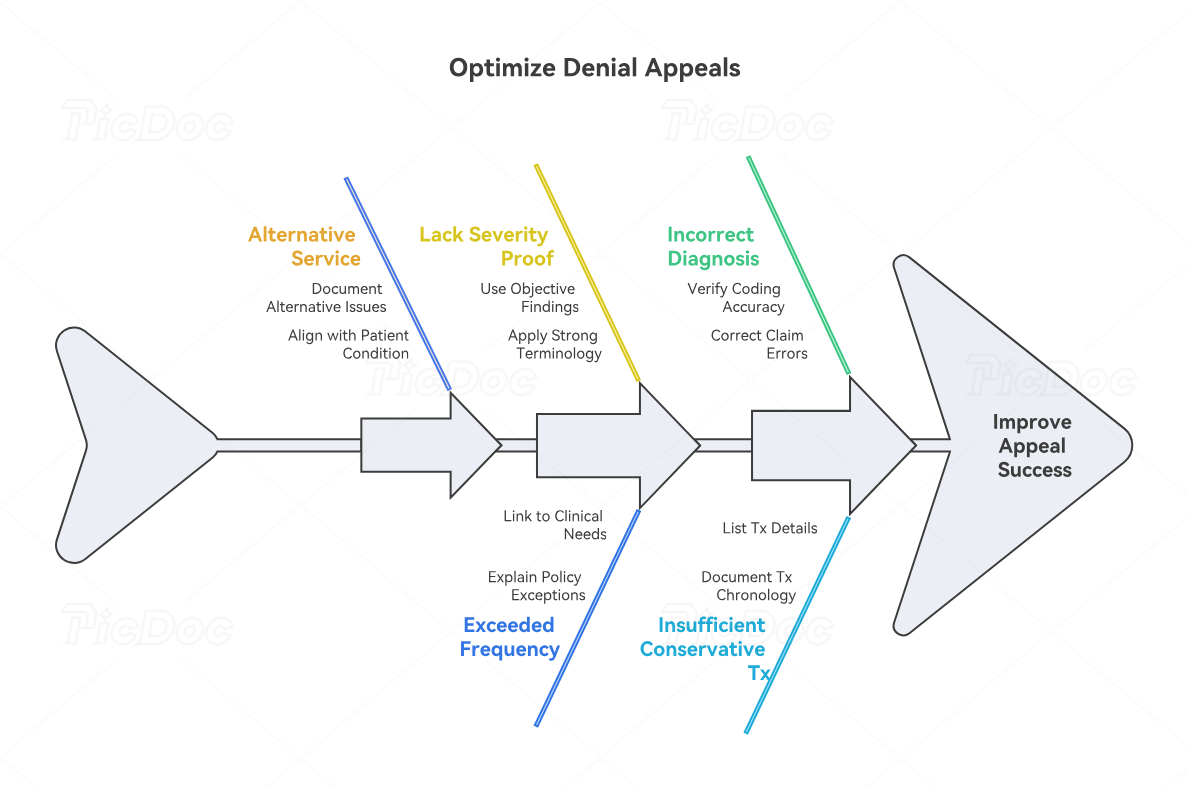
The payer says the diagnosis does not support the service
First verify that the diagnosis was coded correctly. Review the assessment, current ICD-10 documentation, CPT service, applicable claim denial information, and payer policy. If the original diagnosis was inaccurate, correct the claim through the appropriate payer route rather than constructing an appeal around an error.
If the diagnosis was correct, show why the documented clinical findings satisfy the policy despite the payer's initial conclusion.
The payer says conservative treatment was insufficient
List what was tried, when, duration, response, adverse effects, and reason for discontinuation. Practices handling medical billing appeals, physician reimbursement, medical coding audits, and claim submissions should maintain treatment chronology where policies routinely require step therapy.
The payer says records do not prove severity
Identify objective findings rather than relying on adjectives such as “severe.” Include documented functional limitation, examination findings, test results, symptom progression, or treatment failure when relevant.
This is where stronger medical terminology, coding interview preparation, auditor-level documentation review, and CPT knowledge become directly useful.
The payer says frequency exceeded policy
Explain why the additional service met an exception or remained clinically necessary under the policy. Show previous dates of service and current clinical circumstances. Frequency alone should never be defended without addressing the specific policy limit.
The payer says an alternative service should have been used
Document the reason the alternative was ineffective, inappropriate, unavailable, contraindicated, previously failed, or inconsistent with the patient's documented condition. This can be particularly important in Medicaid reimbursement, workers' compensation billing, ambulance reimbursement, and commercial denial management, where coverage structures differ significantly.
The principle across all five scenarios is the same: answer the payer's actual argument rather than merely restating yours.
5. Submit the Appeal Correctly and Prevent the Same Denial From Returning
A perfect clinical argument can still fail operationally if it misses the deadline, goes to the wrong payer address, lacks a required form, or cannot be tied to the original claim.
For Original Medicare fee-for-service, a redetermination request generally must be filed within 120 days after receipt of the initial determination. CMS requires identifying information, the disputed service and date, and an explanation of disagreement; supporting documentation should accompany the request.
Commercial plans, Medicare Advantage plans, Medicaid programs, and other payers can have different processes. Medicare Advantage plans, for example, use standardized denial and appeals requirements under Part C, including formal notices of denied coverage or payment.
Maintain a payer-specific appeal profile containing deadline, portal, fax or mailing destination, required form, medical-record limits, reconsideration path, and escalation rules. This should sit alongside your electronic claims platform, denial-management system, billing software, and CARC/RARC workflow.
Then track outcomes beyond “appeal sent.”
Measure overturn rate, recovered dollars, average days to resolution, appeals submitted within deadline, denials written off, and recurrence of the same medical necessity problem. A successful appeal can still reveal a broken upstream process.
For example, if 80% of appeals win because the payer needed evidence that was already available before initial submission, the organization should investigate whether that evidence could have been captured or communicated earlier. Teams experiencing coding productivity pressure, medical coding stress, outsourcing pressure, and recurring denial workloads gain more by removing repeat failures than by increasing appeal volume.
Feed every recurring denial into corrective action:
missing severity → provider documentation education;
missing conservative treatment → structured treatment-history capture;
wrong diagnosis → coding review;
payer-specific criterion missed → prebill payer edit;
outdated policy → coverage-library update;
records submitted without decisive evidence → appeal-packet redesign;
recurring high-risk service → targeted coding audit.
CMS specifically maintains compliance resources designed to help providers understand common denial issues and documentation needed to support medical necessity.
Winning the current appeal recovers one claim. Fixing the source can protect hundreds of future claims.
6. FAQs About Medical Necessity Denial Appeals
-
A medical necessity denial occurs when the payer determines that the submitted service does not satisfy its coverage requirements for being reasonable, necessary, appropriate, or otherwise payable under the plan's rules. For Medicare, reasonable-and-necessary coverage can be governed by national or local policy. Teams working in medical billing, claim denials, coding audits, and physician reimbursement should identify the exact failed criterion before appealing.
-
Prioritize documentation that proves the disputed coverage criteria: diagnosis, symptom severity, examination findings, relevant test results, duration, failed treatment, functional limitation, contraindications, and the clinician's treatment rationale. CMS emphasizes documentation supporting the reported diagnosis, services, rationale, and plan of care. This is why medical terminology, CPT knowledge, professional coding, and auditing skills directly affect appeal quality.
-
Send what the payer requires, while making the decisive evidence easy to locate. A large record can still produce another denial when the argument is buried. Create an indexed packet and identify the dates, pages, tests, and notes satisfying each criterion. This improves denial-management efficiency, reduces coding workload pressure, strengthens billing operations, and supports audit readiness.
-
Verify whether the payer expects a corrected claim, reopening, reconsideration, or appeal. Defending an inaccurate diagnosis can weaken the case. Review the current documentation, ICD-10 coding principles, CPT relationship, electronic claim process, and payer denial instructions before choosing the route.
-
A focused physician statement can strengthen an appeal by explaining clinical reasoning, but it should be supported by the underlying medical record and applicable policy criteria. The strongest appeal combines physician rationale with contemporaneous findings, treatment history, testing, and coverage requirements. That approach is valuable in medical coding audits, professional coding, denial management, and reimbursement review.
-
For Original Medicare fee-for-service, the first-level redetermination generally must be requested within 120 days after receipt of the initial determination. Other payers and Medicare Advantage plans can use different deadlines. Always follow the denial notice. Practices should integrate deadlines into electronic billing systems, denial workflows, billing software, and CARC tracking.
