
CPT Codes for Emergency Medicine: Clear Definitions & Examples
Emergency Department coding is brutal because the work is fast, messy, and high stakes. One missing sentence can flip a correct charge into a denial, a downcode, or a compliance problem. The hard part is not “knowing CPT.” The hard part is proving medical necessity and decision-making under pressure, especially for higher-level E and M, critical care, and procedures done back to back. This guide gives you a practical CPT reference for emergency medicine with clear definitions, documentation requirements, and real-world examples so you can code confidently, protect reimbursement, and reduce rework.

1) Why emergency medicine CPT coding is a denial magnet
ED charts are prime denial targets because payers know two things. First, documentation is often templated and rushed. Second, ED claims include high-value services like Level 4 to 5 E and M and critical care. The result is predictable. Denials for medical necessity, missing elements, bundling, and modifier misuse.
If you want an ED claim to survive, think like a reviewer. Their question is not “did the patient look sick.” Their question is “does the record prove the complexity, risk, and resources used.” This is why denial-proof workflows matter and why teams reference frameworks like coding denials management best practices and the systemic issues discussed in medical coding error rate reporting.
Emergency medicine also has a bundling problem. Procedures, E and M, imaging interpretation, and critical care can overlap. If you do not separate time, work, and medical decision-making clearly, you invite payer edits. Those edits become productivity killers, which is why high-output shops track impacts using coding productivity benchmarks and push denial prevention to stop revenue leakage.
The last risk is compliance. ED coding touches “gray zone” areas like critical care time, separately reportable procedures, and modifier selection. If your documentation is thin, you can end up in audit territory. That is why ED coders should stay aligned with trends covered in compliance audit data and the enforcement realities from compliance violations and penalties.
2) ED E/M CPT codes: clear definitions with documentation examples
Emergency medicine E and M codes are not chosen by “how busy the shift was.” They are supported by medical decision-making and risk. Most ED physician billing centers around 99282 to 99285. The fastest way to get downcoded is to write a long note with weak decision-making. A short note with strong MDM is safer than a long note that says nothing.
99282 to 99285 in plain language
99282 is low complexity. Think single, limited problem with minimal data and low risk.
Documentation that wins: a clear problem, limited differential, minimal testing, clear discharge plan.
99283 is low to moderate. The patient needs workup, but risk is still low overall.
Documentation that wins: decision points, why tests were chosen, why discharge is safe.
99284 is moderate. The patient has a problem that requires broader evaluation, more data, or moderate risk decisions.
Documentation that wins: multiple differentials, interpretation of results, response to treatment, and a documented risk-based disposition.
99285 is high. This is where you must prove high-risk conditions, intensive workup, complex data, or high-risk disposition decisions.
Documentation that wins: high-risk differential, escalation, consults, aggressive management, and clear reasoning.
Denials often occur when the MDM is implied but not written. That pattern matches broader issues discussed in common coding errors and the quality drift described in coding error rate reporting. If you want fewer reworks, tie your ED templates to the measurable standards in coding productivity benchmarks and the prevention mindset from denials management best practices.
Example phrasing that protects higher-level E/M
A reviewer wants to see “why this could be dangerous” and “what you did about it.”
“High-risk differential includes X, Y, Z. Ordered tests A, B, C to rule out time-sensitive causes.”
“Reviewed imaging and labs. Findings support diagnosis. Disposition chosen due to documented risk.”
“Patient improved after interventions, but risk remains due to X. Discussed return precautions and follow-up.”
This is also where clean claim submission matters. If your documentation is strong but your workflow is inconsistent, you still get denial friction. That is why ED coders benefit from the systems mindset in revenue cycle efficiency benchmarks and the leakage prevention focus in revenue leakage insights.
3) High-frequency ED procedure CPT codes with examples
ED coding gets complicated because procedures stack. You can have E and M, laceration repair, splinting, sedation, and ECG interpretation in the same encounter. If you do not separate the work clearly, you invite bundling edits and compliance risk.
Laceration repair: what to document to avoid downcoding
The code choice is driven by repair complexity, location, and total length. The most common denial trigger is missing length and missing complexity elements. If you bill intermediate or complex repair, your note must say what made it intermediate or complex. “Closed with sutures” is not enough.
Write it like this:
Location and total length measured
Anesthesia method
Wound preparation and irrigation
Closure layers and materials
Complications and follow-up
If your system shows repeated laceration downcodes, treat it as a process problem. This is where teams use analysis approaches similar to medical coding error rate reporting and build prevention loops aligned with denials management best practices.
Splinting and fracture-related services: where coders get burned
Splint application is often separately billable when properly documented, but the record must prove pre and post neurovascular status. If you bill fracture care, you must prove definitive management. Many denials happen when a note reads like “splint and discharge,” but the claim bills fracture care.
The clean approach:
Diagnosis and imaging summary
Type of immobilization
Pre and post NV exam
Reduction details if performed
Follow-up instructions and referral plan
This is also where compliance reviews focus, especially when billing patterns look aggressive. Keep your documentation aligned with insights from compliance audit trends and risk awareness from compliance penalties and violations.
Critical care and procedures: prevent time overlap disputes
If a patient receives critical care and also has separately billable procedures, you must document critical care time clearly and avoid counting time spent performing billable procedures inside critical care time. The denial trigger is unclear time logic.
Best practice note elements:
Total critical care time
Why the patient was critically ill
Key interventions and reassessments
Procedures documented separately with their own start and end details
These disputes show up as revenue friction and rework, feeding into patterns seen in revenue leakage insights and the operational drag tracked by productivity benchmarks.
4) Denial-proof ED coding: modifiers, bundling traps, and compliance red flags
ED claims are not denied because the coder “did not know CPT.” They are denied because payers see patterns they can challenge fast.
Modifier problems that trigger instant payer edits
The biggest modifier issues in the ED typically fall into three buckets:
Using modifiers without documenting the separate work
Using the wrong modifier to force payment
Using a modifier repeatedly across the same provider or site
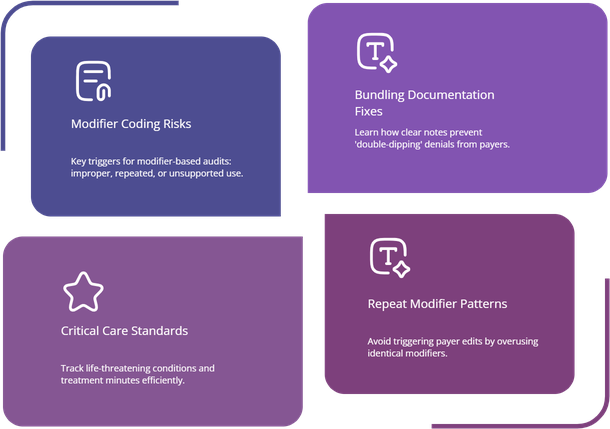
When you attach a modifier, your note should answer one question: what is clearly distinct about the service. If that is not in the record, you are relying on hope. That is exactly the type of risk environment described in compliance audit trend analysis and the penalty patterns outlined in compliance violations and penalties.
Bundling and “double-dipping” accusations
A common denial narrative is that the E and M is not separately supported because “the work is included in the procedure.” You prevent this by documenting the separately identifiable evaluation that led to the decision to perform the procedure, plus the management beyond the procedure.
For example, a laceration repair alone does not justify a high E and M. But a complex injury evaluation, neurovascular assessment, imaging decision, tetanus planning, antibiotic decision, and discharge risk counseling can justify it, if documented clearly.
This connects directly to denial reduction strategy in denials management best practices and the operational cost of rework highlighted by coding productivity benchmarks.
Critical care disputes
Critical care is one of the most valuable and most challenged services in emergency medicine. The payer is looking for proof that the patient had a life-threatening or organ-threatening condition and that the physician spent qualifying time providing critical care services.
The safest documentation pattern:
State the life threat in plain language
List critical interventions and reassessments
Document time clearly
Separate procedure documentation and avoid time overlap
This is also where revenue integrity matters. Incorrectly documented critical care can create audit exposure and repayment risk, which is why ED leaders align critical care billing oversight with the insights from coding audit trends and the financial impact thinking in coding accuracy and hospital revenue.
5) ED coding workflow: how to reduce rework and increase clean-claim rates
If you want ED coding to scale, you need a system, not hero coders. The workflow that wins is built around proof-first documentation and denial prevention.
Build an ED coding checklist by encounter type
Create encounter templates that force the minimum proof elements for the service billed. This is how you reduce variability, especially across remote coders, which is a pain point discussed in remote workforce trends.
For E and M, your checklist should capture:
Differential diagnosis and reasoning
Tests ordered and why they were necessary
Independent interpretation or review summary
Risk discussion and disposition reasoning
For procedures, your checklist should capture:
Indication and consent
Technique and supplies
Findings and complications
Patient tolerance and follow-up plan
When you enforce this, you reduce the error patterns described in common coding errors and the recurring quality issues measured in coding error rate reporting.
Track denial reasons and fix the template, not the coder
If your ED denial reasons repeat, the fix is usually a documentation prompt, not a training lecture. For example:
Missing critical care time → add a time field and required attestation
Laceration length missing → add a length prompt
Pre/post NV missing for splints → add a checkbox field
This is how you shrink denial volume using the same prevention mindset in denials management best practices and protect financial performance by reducing revenue leakage.
Use productivity metrics without sacrificing compliance
ED coding teams often chase speed and then lose money to denials. The goal is clean throughput. Use metrics aligned with coding productivity benchmarks while staying anchored in compliance safeguards from audit trend reporting. When coders know exactly what proof to capture, speed improves without quality collapse.
6) FAQs
-
The most common ED billing typically includes the emergency department E and M series, especially higher-acuity levels, plus frequent procedures like laceration repair, splinting, I and D, ECG interpretation, sedation, and airway or line procedures in critical cases. The exact mix depends on facility acuity and provider scope, but the consistent rule is proof-driven coding. If the chart does not show medical decision-making and risk, payers can downcode rapidly. Teams reduce that risk using workflows aligned with coding error rate reporting and prevention systems from denials management best practices.
-
A defensible 99285 needs high-level MDM, not a long template. Your note should show a high-risk differential, significant data review, and risk-based management decisions. Think escalation, consults, complex interpretation, or disposition decisions that carry real risk. The payer must be able to see why this visit was high risk, not infer it. This is where many downcodes originate, matching patterns discussed in common coding errors and the broader findings from medical coding error rate reporting.
-
Document the separately identifiable evaluation that led to performing the procedure and the management beyond the procedure itself. If your note only contains a procedure note, the payer can argue the E and M is included. Strong ED documentation clearly separates assessment, decision-making, and risk counseling from the procedural steps. This strategy directly aligns with payer-facing controls in denials management best practices and helps reduce avoidable revenue leakage.
-
The biggest mistake is time ambiguity and time overlap with separately billable procedures. Critical care requires a life-threatening or organ-threatening condition plus qualifying time spent directly managing that condition. If the chart lacks a time total, clear critical interventions, and separation from procedure time, you invite audit risk. This is why critical care is frequently scrutinized in environments informed by coding audit trends and the enforcement patterns in compliance penalties and violations.
-
At minimum, document location, total length, repair complexity, anesthesia, wound prep, irrigation, closure materials, and aftercare. For intermediate or complex repairs, you must explicitly document layered closure or complexity elements. Without that, payers can downcode to simple repair or deny the higher code. Fixing this is usually a template problem, which is why teams tie recurring issues to prevention loops informed by coding error rate reporting and operational controls from coding productivity benchmarks.
-
Build checklists that force proof elements, then use denial reason data to improve templates. That turns rework into prevention. Track clean-claim rates and denial reasons alongside throughput so speed does not destroy quality. This approach mirrors the scaling discipline in coding productivity benchmarks and the systems mindset behind revenue cycle efficiency metrics.
-
Coders who grow fastest build a personal library of denial triggers and documentation fixes for ED E and M, procedures, and critical care. They can explain why a code is supported, not just select it. They also use continuing education to stay current and demonstrate measurable improvements, supported by how continuing education accelerates coding careers and broader career strategy thinking like the CPC career roadmap.
