
Comprehensive CPT Coding Guide for Cardiology Procedures
Cardiology coding is where small documentation gaps turn into big denials. One missing element like medical necessity language, interpretation ownership, or laterality and access details can flip a clean claim into rework. This guide is built for coders and billers who need speed without sacrificing accuracy. You will learn how to code common cardiology procedure families, what documentation must prove, how to prevent payer edits, and how to avoid the most expensive pitfalls that show up in denial trends and compliance audits covered by AMBCI resources on coding denials management, medical coding error rates, and compliance audit trends.

1. Cardiology CPT Coding Red Flags That Trigger Audits and Recoupments
Most cardiology audits do not start because a procedure was wrong. They start because patterns look risky. Payers flag cardiology claims when coding behavior signals inconsistency, overreach, or weak documentation discipline. Understanding these red flags lets coders correct issues before they turn into audits, extrapolated recoupments, or compliance penalties.
One major red flag is high modifier density. Excessive use of modifiers like those applied to same-day E/M visits, separate interpretations, or unbundled services tells payers that claims may be pushing boundaries. If modifier use is not backed by clearly separate documentation, it mirrors the audit exposure patterns documented in AMBCI’s analysis of billing compliance violations and penalties and the escalation pathways outlined in compliance audit trends.
Another audit trigger is procedure-heavy billing with weak medical necessity language. Cardiology payers expect a clean story connecting symptoms, risk factors, diagnostics, and interventions. When advanced imaging, caths, or device services appear without strong necessity statements, claims start resembling the revenue risk patterns described in impact of coding accuracy on hospital revenue and revenue leakage analysis.
Inconsistent interpretation ownership is another common trigger. ECGs, echoes, stress tests, and monitoring services must clearly show who interpreted the study. When multiple providers appear across the chart without clear role separation, payers see duplicate billing risk. This exact issue drives denial volume and rework tracked in coding denials management and contributes to productivity loss highlighted in coding productivity benchmarks.
Auditors also look closely at high-dollar procedure clusters. When caths, interventions, imaging add-ons, sedation, and same-day E/M services appear together frequently, the expectation is flawless documentation. Any missing element, like access detail, lesion mapping, or sedation time, weakens the entire claim cluster and raises recoupment risk. These clusters are a known pressure point in the error patterns summarized in medical coding error rates.
Finally, template-driven documentation without clinical variation raises suspicion. Cardiology notes that look identical across patients suggest cloning, even if services were appropriate. This is why AMBCI emphasizes documentation integrity through resources like clinical documentation integrity terminology. Templates should enforce required proof points, not erase clinical nuance.
The takeaway is simple. Cardiology CPT coding stays audit-resistant when documentation clearly proves why the service was needed, what was done, who interpreted it, and how it changed care. When those four elements are consistently present, denial rates fall, audit exposure shrinks, and productivity improves across the revenue cycle.
2. How Cardiology CPT Coding Actually Breaks and How to Fix It
Cardiology is not hard because the procedures are complex. It is hard because billing logic is strict and payer edits are unforgiving. When the note does not prove the service at the component level, payers deny. When documentation is complete but inconsistent, auditors escalate. This is why cardiology teams benefit from the same operational discipline discussed in AMBCI reporting on coding productivity benchmarks, revenue cycle management efficiency, and revenue leakage in medical billing.
Three failure points explain most cardiology CPT denials:
1) Component confusion
Many cardiology services split into technical and professional components, or have supervision and interpretation requirements. The claim fails when two providers bill the same component or when interpretation is missing. These mistakes mirror the systemic issues covered in medical coding error rates and the avoidable denial patterns explained in coding denials management.
2) Documentation that tells a story but proves nothing
Cardiology notes can be rich clinically yet weak for billing. Payers do not pay for intent. They pay for documented performance, findings, and medical necessity. If you want your coding to hold up under scrutiny, use the documentation integrity mindset in AMBCI’s clinical documentation integrity terms and align your documentation to audit expectations described in compliance audit trends.
3) Bundling and modifier misuse
A cath case might include diagnostic imaging, intervention, access guidance, sedation, and post procedure E/M. Most downcoding comes from bundling rules and modifiers used as habits. Modifier errors are a top driver of denial appeal workload and compliance exposure, tied directly to billing compliance violations and penalties and the patterns discussed in top medical coding errors.
3. Cardiology Coding by Procedure Family With Documentation Requirements
This section gives you a practical way to code by service family. It is designed for speed and defensibility, so you can reduce rework and protect throughput, just like the efficiency focus in coding productivity benchmarks and the operational insights in revenue cycle efficiency benchmarks.
ECG and rhythm monitoring
ECG coding is the classic trap where claims look simple but fail due to missing interpretation. Your checklist should include:
Indication tied to symptoms or risk
Confirmation the test was performed
Signed interpretation with findings and impression
Clear ownership of professional component
If two providers interpret the same ECG, payer logic can deny or recoup. Use the risk control mindset from compliance audit trends and build a workflow that reduces duplication, similar to the process thinking in coding software terminology.
For ambulatory monitoring, speed killers are missing date ranges, missing final report, and missing correlation to symptoms. If the physician changes meds based on a finding but does not document that link, the service looks weak on appeal. Denial reduction strategies for this kind of gap are covered in coding denials best practices.
Echocardiography and Doppler
Echo services are heavily audited because they are high volume and have common overbilling risk. Your documentation must show:
Covered indication such as murmur evaluation, heart failure assessment, valve disease follow up
Required measurements and interpretations
EF statement where applicable
Impression that ties to clinical decision making
Avoid add ons that are not supported in the report. If the note does not explicitly reflect Doppler or color findings, billing those components invites downcoding. This is a recurring theme in top coding errors and the system wide patterns in coding error rates.
TEE adds procedural elements, sedation considerations, and risk documentation. If your organization uses templates, ensure they capture time and monitoring requirements while staying privacy safe under HIPAA compliance changes.
Stress testing and imaging
Stress tests fail when supervision and interpretation roles are unclear. The procedure documentation needs:
Protocol used and duration
Symptoms and hemodynamic response
ECG changes and risk conclusions
Reason for termination
Final interpretation signed by responsible clinician
If imaging is involved, you also need imaging specific documentation and reporting. Many denials are caused by mismatches between ordered test type and performed protocol. Tight operational control reduces these errors, consistent with the outcomes tracked in revenue cycle management efficiency and revenue protection discussed in impact of coding accuracy on hospital revenue.
Cardiac cath, coronary interventions, and structure work
In cath and interventional cardiology, documentation detail is money. Your claim strength comes from:
Access site and laterality where relevant
Coronary anatomy and lesion descriptions
Hemodynamics and diagnostic findings
What was diagnostic versus what was therapeutic
Devices used and outcomes, including residual stenosis
Most coder pain comes from reading long procedure notes that do not clearly state what was actually treated. If the note does not map treated vessel segments to intervention, your coding becomes guesswork and your denial risk spikes, aligning with the denial workload described in coding denials management and the rework drivers in coding productivity benchmarks.
Structural heart procedures add layers of pre procedure workup and medical necessity criteria. If the chart does not show severity and clinical rationale, payers can challenge even a technically perfect procedure note. This is where documentation integrity principles from clinical documentation integrity terms protect reimbursement.
4. Modifiers, Bundling, and Same Day Billing in Cardiology Without Getting Burned
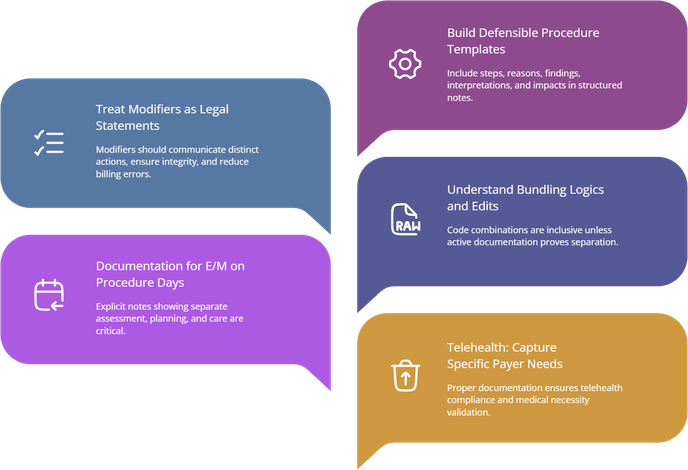
If you want fewer denials, stop treating modifiers like shortcuts. Treat them like legal statements. They tell the payer you did something distinct, necessary, and properly documented. Misuse leads to denials, audits, and in worst cases recoupments discussed in billing compliance violations and penalties and audit patterns in compliance audit trends.
Same day E/M with a procedure
A separate E/M is billable only when there is separate work beyond the inherent pre and post procedure service. A defensible note typically includes:
A distinct assessment or new problem evaluation
Decision making that is not just consent and procedural planning
A plan that extends beyond the procedure itself
If the E/M note is cloned, vague, or only repeats the procedure note, it is not defensible. This is one of the denial patterns that inflate rework and slow teams, tying into coding productivity benchmarks and the broader efficiency goals in revenue cycle management efficiency.
Bundling logic and documentation strategy
Bundling edits are not random. They are triggered by code combinations that payers consider inclusive, unless documentation proves a separate service is allowed. Your defense is not argument. Your defense is documentation structure. Build procedure templates that explicitly include:
What was performed
Why it was necessary
What findings were obtained
Who interpreted and signed
What changed clinically because of the results
This documentation pattern also supports compliance readiness and reduces the kinds of systemic errors tracked in coding error rates and the avoidable mistakes described in top coding errors.
Telehealth and remote cardiology services
Cardiology is increasingly hybrid. Remote monitoring, virtual follow ups, and telemedicine consultations are growing. The coding risk is that teams copy clinic workflows into telehealth without capturing what payers need. For telehealth, ensure:
Modality and patient consent documentation
Provider location requirements met per policy
Clear medical necessity for remote service
Privacy controls consistent with HIPAA compliance changes
If your team is remote, you also need operational standards for handoffs and review documentation, matching the workforce shifts discussed in remote workforce trends and the practical pressure points discussed in workforce shortages and solutions.
5. QA Checklist and Career Proofing Skills for Cardiology CPT Coding
Cardiology coding quality is not just about getting paid. It is about building a reputation for accuracy under pressure. That reputation is what unlocks higher responsibility roles and better pay, supported by career paths in CPC career roadmap, growth strategies in continuing education, and foundational guidance in starting a career in medical billing and coding.
A denial resistant cardiology QA checklist
Use this checklist on any cardiology claim that includes imaging, monitoring, or an invasive procedure:
Indication is clearly documented and matches the performed test.
Interpretation is present, signed, and clearly assigned to one provider.
Component billing is correct and not duplicated.
Laterality, access, and anatomic specifics are documented when relevant.
For interventions, treated sites and outcomes are clearly mapped.
Modifier use is supported by separate documentation.
Any sedation billing has time, monitoring, and observer requirements documented.
This checklist directly reduces the errors tracked in medical coding error rates, reduces denial work described in denials management, and protects revenue outcomes tied to coding accuracy and hospital revenue.
Build the two skills that make you valuable in cardiology
Skill one is documentation translation.
Great coders can translate procedure narratives into billable elements quickly and consistently. That aligns with CDI concepts in clinical documentation integrity terms and reduces the back and forth that kills efficiency measured in revenue cycle management benchmarks.
Skill two is denial pattern recognition.
Instead of fixing claims one by one, learn to spot the top denial triggers and prevent them upstream. AMBCI denial research in coding denials management and quality error data in coding error rate reporting are the right mental model. You are not coding claims. You are coding patterns.
6. FAQs
-
The biggest mistake is billing a service component without proof that the required interpretation or supervision occurred. Cardiology is full of split roles, and claims fail when two parties bill the same piece or when the report does not show a signed interpretation. This mistake shows up as both denials and audit risk, which is why AMBCI tracks the operational impact through coding denials management and compliance exposure through compliance audit trends. Fix it by forcing a standard that every diagnostic service has a clear owner, a signed impression, and a documented reason for the test.
-
Start by identifying who supervised the stress portion, who performed the imaging component if present, and who documented the final interpretation. Then confirm the note includes protocol, duration, symptoms, ECG response, and termination reason. When imaging is added, confirm the imaging report aligns with the performed protocol and includes a clear clinical impression. Split role confusion is a frequent denial driver in coding denials management and a contributor to the systemic error patterns in medical coding error rates. A clean workflow is to treat supervision and interpretation as separate checkboxes that must both be documented.
-
A defensible echo claim shows medical necessity, required measurements, a clear interpretation, and a final impression that connects to clinical decision making. EF documentation and valve findings are common payer focal points. The most common downcoding happens when add on components are billed without report support, which aligns with the avoidable issues summarized in top medical coding errors. Use CDI discipline from clinical documentation integrity terms and quality guardrails informed by compliance audit trends.
-
Denials drop when procedure notes map anatomy and actions clearly. You need access site, treated vessel and lesion detail, devices used, outcomes, and an explicit statement of what was diagnostic versus therapeutic. If the note is long but not specific, it creates coder guesswork and denial exposure, the exact rework spiral described in coding denials management and the throughput pressure measured in coding productivity benchmarks. Build templates that force vessel mapping and outcomes, and use denial data to train providers on what is missing.
-
It is appropriate only when the E/M service is separately identifiable and goes beyond the inherent pre and post procedure work. The note must show a distinct assessment, distinct decision making, and a plan that is not simply procedural documentation. When coders bill same day E/M out of habit, it becomes a compliance and audit target linked to the risk landscape described in billing compliance violations and penalties. Use the operational discipline that supports revenue cycle efficiency and avoid shortcuts that create downstream appeal workload.
-
Remote monitoring documentation should show the transmission date, what was reviewed, what was found, what was clinically done, and a signed interpretation. Telehealth documentation should also include modality, consent where required, medical necessity, and privacy safe handling aligned with HIPAA compliance changes. Remote workflows must be structured to prevent gaps, especially as teams shift roles and processes under trends discussed in remote workforce analysis and the pressure captured in coding workforce shortages.
-
Speed comes from fewer reversals. Build a checklist for interpretation ownership, medical necessity, and procedure mapping. Use templates that capture required proof points, and learn denial patterns so you can prevent them instead of fixing them later. This approach matches the productivity plus quality mindset in coding productivity benchmarks and the revenue protection logic in revenue leakage insights. Pair that with structured learning through continuing education so your speed is built on confidence, not guessing.
