
ICD-11 Codes for Neurological Disorders: Essential Reference
Neurology claims are where small documentation gaps become big denials. ICD 11 raises the bar because it is built for clinical specificity, not vague diagnosis labels. If neuro coding stays “close enough,” you will see it in medical necessity edits, avoidable rework, and leakage across the revenue cycle. This reference gives you a practical way to code neurological disorders in ICD 11 without guessing. You will learn how to translate provider language into the right ICD 11 concept, what payers look for in neuro charts, and how to protect reimbursement with compliant queries and clean supporting detail across stroke, epilepsy, dementia, MS, Parkinsonism, neuropathies, and headache.

1) ICD-11 neurology coder playbook: build denial proof charts in 10 minutes
If you want neuro claims to stop bleeding time, you need a repeatable playbook that turns messy notes into claim proof documentation fast. The goal is not “perfect documentation.” The goal is billable clarity that survives payer scrutiny, reduces rework, and keeps productivity stable, which is exactly what the teams tracking coding productivity benchmarks and coding error rate analysis are trying to operationalize.
Step 1: Decide what you are coding: diagnosis, symptom, or history
Before you even open the ICD-11 tool, answer one question: is the provider treating a confirmed diagnosis, documenting a symptom while working it up, or referencing a historical condition? This single decision prevents the most expensive mistake in neuro: coding “active disease” when the chart only supports “possible” or “past.” That mistake is one of the denial drivers behind top coding errors and it creates audit risk that shows up in medical coding audit trends. If the assessment is still differential, code the symptom and clearly align it to the reason for encounter, then wait for confirmation.
Step 2: Pull the “type split” from the assessment, not the problem list
Neuro coding breaks when coders rely on copy forward problem lists. Stroke type, headache phenotype, seizure classification, dementia etiology, neuropathy cause, and Parkinsonism subtype should come from the assessment and plan, not a stale list entry. Payers do not care that the problem list says “CVA.” They care that the clinical story supports the coded concept. If your organization is trying to reduce leakage, this step directly supports the prevention strategy in denials management best practices and lowers the repeat work that fuels revenue leakage.
Step 3: Run a 5 point “proof test” for medical necessity
For any high risk neuro diagnosis, you should be able to point to five proof elements in the note. If you cannot, the code is not safe yet.
Objective finding (imaging, EEG, neuro exam, testing result)
Timing (acute, chronic, resolved, recurrent, onset date or duration)
Deficit or symptom pattern (what makes this diagnosis true clinically)
Functional impact (ADLs, safety risk, work restrictions, therapy need)
Plan (treatment, monitoring, follow up, referral, risk discussion)
This is how you prevent neuro charts from failing the “where is the evidence” test. It also aligns your coding with revenue integrity logic tied to RCM efficiency benchmarks and supports long term performance outcomes discussed in coding accuracy and hospital revenue.
Step 4: Use “one sentence queries” that force specificity without leading
Weak queries create weak documentation. Strong queries are short, neutral, and anchored to what is already in the chart. That protects compliance while improving code accuracy, which matters in environments exposed to compliance violations and penalties. Use templates like:
“Can you confirm whether this is acute, subacute, or prior based on imaging and clinical findings?”
“Please clarify the most likely etiology documented in your assessment.”
“Can you specify laterality and level supported by exam or imaging?”
“Is this diagnosis confirmed or still under evaluation? Please document final impression.”
These queries reduce back and forth and prevent the “guess and fix later” workflow that destroys productivity.
Step 5: Build a personal “neuro denial library” and update it weekly
If you want to level up as a coder, track the denial reasons you see most in neurology and map each to a documentation fix. You are building a library of patterns: missing imaging evidence, unclear acuity, missing severity, unclear diagnosis status, unspecified type. This moves you from reactive coding to preventive coding. It also gives you measurable outcomes you can use for career growth, especially when paired with continuing education career acceleration and a stronger long term roadmap like the one outlined in the CPC career roadmap.
2) Why ICD 11 makes neurological coding harder and more profitable when done right
ICD 11 is not just a new list of codes. It changes how you think about diagnoses. Neurological disorders often carry multiple layers: cause, timing, severity, laterality, complications, functional impact, and treatment status. ICD 11 expects you to capture more of that story in a structured way. When you do, you reduce denial risk and strengthen downstream revenue cycle performance.
This is not theory. The fastest way neuro claims break is when coding depends on implied meaning. Providers assume the clinical story is obvious. Coders cannot assume. “Stroke” without timing and imaging support becomes a denial setup. “Seizures” without epilepsy confirmation becomes a documentation and medical necessity problem. “Dementia” without severity and function creates audit exposure.
If you want a denial resistant workflow, build it around prevention, using the same logic found in denials management best practices and the leakage control mindset from revenue leakage insights. When you treat neuro specificity as a measurable KPI, you also align your work with what impacts payment, as shown in coding accuracy and hospital revenue and the financial effects documented in coding error rate reporting.
ICD 11 also increases the need for CDI alignment. Neuro cases are packed with clinical indicators, but only if the note contains them clearly: onset, duration, neuro exam, imaging results, response to meds, and function. When CDI and coding operate separately, neuro claims become denial magnets. That risk is not abstract. It connects to the patterns seen in coding audit trend data and the enforcement reality tracked in compliance violations and penalties.
The upside is real. Neuro is one of the best lanes to prove value because the difference between vague coding and precise coding is measurable. It shows up in fewer denials, faster clean claims, and more confident reimbursement analysis, supported by RCM efficiency metrics and service line reimbursement comparisons like hospital reimbursement by specialty.
3) How to select the correct ICD 11 neuro code without memorizing the entire index
The fastest way to code neuro in ICD 11 is to stop chasing “the code” and start chasing the coded concept. ICD 11 is concept driven. Your workflow should be: capture the clinical statement, validate objective support, then select the ICD 11 entity that matches the confirmed diagnosis.
If your team still treats ICD 11 as a direct ICD 10 copy process, you will create mismatch errors that show up as quality failures and chart rework. Those failures do not stay isolated. They scale across the team and hit throughput, which is why high output environments track performance using coding productivity benchmarks and denial reduction systems using denials management best practices.
Use this practical method on every neuro chart:
1) Confirm diagnosis status.
Is it confirmed, suspected, ruled out, or historical? If you skip this step, you will code active conditions that were never diagnosed. That creates audit exposure and repayment risk aligned with compliance violations and penalties. If the provider is still working it up, code the symptom and the reason for encounter. Then code the confirmed diagnosis when it exists.
2) Capture the neuro “type split.”
Neuro has type splits that change everything. Ischemic vs hemorrhagic stroke. TIA vs stroke. Epilepsy vs single seizure. Migraine vs tension headache. Dementia etiology. Neuropathy cause. If the type is missing, the claim looks weak.
3) Capture attributes that change meaning.
In neuro, attributes are what make the diagnosis payable. Look for laterality, acuity, severity, functional impact, etiology linkage, deficits, and treatment status. If the note contains none of that, you are not doing ICD 11 coding. You are labeling.
4) Validate clinical indicators before finalizing.
Stroke should have imaging and neuro deficits. Epilepsy should have recurrence and treatment plan. Dementia should have testing or functional impairment. Missing indicators mean the right next step is a compliant query, not a hopeful code. Tie this mindset to audit readiness workflows in coding audit trend data and revenue integrity thinking in RCM efficiency metrics.
5) Build a reusable neuro worksheet.
If you code neuro regularly, you should not rely on memory. Create a worksheet with diagnosis families, required documentation, common modifiers, and denial triggers. This is especially critical for remote teams where quality variation can rise, as documented in remote workforce trends.
4) Neurology documentation checklist that prevents denials in ICD 11
Most neuro denials are not coding errors. They are documentation failures that make the code look unsupported. To reduce rework, use a denial prevention checklist inside your workflow and review it alongside patterns outlined in common medical coding errors and the measured risk shown in coding error rate reports.
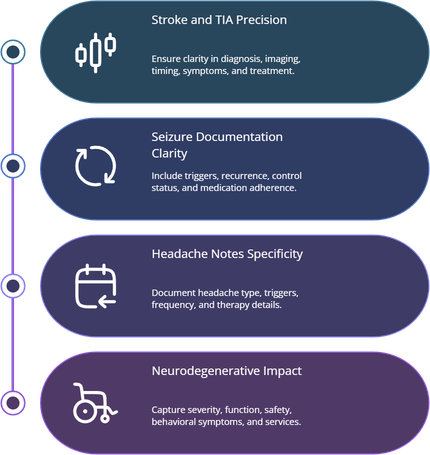
Stroke and TIA: what must be documented
Clear final diagnosis: stroke vs TIA vs rule-out
Onset timing and symptom progression
Imaging evidence and interpretation
Neurologic deficits and current residuals
Treatment plan and monitoring level
The denial trap is contradiction. If the problem list says “history of stroke” but the assessment treats it as acute, your claim becomes internally inconsistent. That inconsistency triggers edits and delays.
Seizure and epilepsy: what payers expect
Provoked vs unprovoked with cause if provoked
Recurrence history supporting epilepsy
Control status: controlled, uncontrolled, breakthrough
Medication plan and adherence statements
EEG or imaging references if performed
When documentation stays vague, payer logic treats high cost therapy as unsupported. That drives denials and delayed payment, and it directly contributes to the patterns discussed in revenue leakage analysis.
Headache disorders: where specificity prevents medical necessity failures
Headache coding is often treated casually. That is a mistake, especially when advanced therapies are involved. A note that only says “headache” is a medical necessity red flag. Your note should support phenotype, frequency, triggers, and therapy history.
Neurodegenerative disorders: severity and function are not optional
For dementia, Parkinsonism, ALS, and MS, severity and functional impact justify care intensity. Documentation should support diagnosis basis, functional limitations, treatment response, safety risk, behavioral symptoms when present, and supportive services.
Neuropathy and radiculopathy: etiology, pattern, and level matter
Neuropathy should have cause and distribution. Radiculopathy should have level and laterality. If those details are missing, the claim looks incomplete. This is one of the highest frequency denial setups because it is easy to spot and easy to challenge.
5) The highest risk neurological diagnosis families and how to code them safely in ICD 11
Neurology is not one risk profile. Some diagnoses are routinely challenged because the payer can easily ask, “Where is the proof?” The safest strategy is to treat these families as documentation dependent and build a repeatable capture method.
Stroke and cerebrovascular conditions
The danger zone is labeling. “CVA” in a note without imaging detail and deficits is not a safe coded concept. ICD 11 expects you to capture stroke type and timing based on documented evidence. Your coding should reflect confirmed stroke type, current deficits, and status.
Use this practical protection rule: if the note does not clearly show the objective basis, do not finalize the stroke concept. Use a compliant query. This aligns with the risk control logic used in coding audit trend data and the penalty realities in compliance violations and penalties.
Epilepsy and seizure disorders
Seizure coding becomes messy when providers use shorthand. “Seizure disorder” may mean epilepsy, or it may mean a single event. ICD 11 wants clarity. Your job is to distinguish the event from the chronic diagnosis. Document seizure type, recurrence pattern, control status, and treatment plan.
This is where poor documentation creates rework loops that crush throughput. If your team is tracking performance, you will see neuro charts drive rework volume, exactly the kind of friction measured in coding productivity benchmarks.
Dementia, delirium, and cognitive disorders
Dementia coding fails when notes lack severity and functional impact. Payers challenge vague dementia labels because care intensity needs justification. Document etiology, severity, behaviors, and ADL impact. For delirium, document acute onset and underlying cause so it cannot be confused with chronic dementia.
This matters because cognitive disorder coding is a frequent audit target. Keep your documentation aligned with audit readiness systems and compliance safety thinking from medical coding audit trends and the risk patterns described in common coding errors.
MS, Parkinsonism, ALS, and other neurodegenerative disorders
These conditions require documentation that shows type, progression, and impact. The coding risk is labeling disease without documenting current status. ICD 11 is built to capture nuance, but it cannot invent documentation. Make sure the note contains functional limitations, treatment response, and current deficits.
Accurate capture helps avoid revenue distortions and strengthens financial reporting tied to RCM efficiency metrics and the revenue impact analysis in coding accuracy and hospital revenue.
Neuropathy and radiculopathy
Neuropathy is one of the most overused vague diagnoses. ICD 11 wants cause and pattern. Radiculopathy wants level and laterality. Missing those details is a denial setup because the payer can argue the diagnosis is unsupported.
If you want a practical denial prevention system, tie neuropathy documentation to your broader denial reduction workflow and apply the same prevention strategy used in denials management best practices.
6) FAQs(Frequently Asked Questions)
-
The biggest shift is moving from code memorization to concept selection. ICD 11 expects you to code what is clinically confirmed and supported, not what is implied. In neuro, that means you must identify diagnosis status, type splits, and attributes like acuity, severity, and functional impact. If the note does not contain the required evidence, the correct move is a compliant query or symptom coding, not guessing. This approach reduces denials and improves chart consistency across the team, which directly supports the improvements discussed in coding error rate analysis.
-
Code symptoms when the provider has not confirmed a final diagnosis, the workup is ongoing, or the assessment lists multiple differentials without conclusion. Neuro is full of “rule out” language, and coding a definitive diagnosis prematurely creates audit exposure. If a note says “possible stroke” or “rule out MS,” your safer path is symptom coding plus the documented reason for encounter until confirmation exists. This aligns with compliance protection patterns tracked in medical coding audit trends and reduces exposure to issues found in common coding errors.
-
The highest impact details are onset timing, imaging confirmation, stroke type, documented deficits, and current status. The payer wants to see that the diagnosis is not just a label but a clinically supported condition with measurable findings. Contradictions between the problem list and the assessment are a common denial trigger. If the chart lacks clear imaging evidence or acuity detail, use a compliant query to avoid forced coding. This strategy connects to the prevention mindset in denials management best practices and reduces the leakage pressure described in revenue leakage insights.
-
A single seizure is an event. Epilepsy is a chronic condition supported by recurrence risk, seizure pattern, and treatment context. Your documentation should clarify whether the seizure was provoked or unprovoked, whether there is a history of recurrent events, and what the provider’s final diagnosis is. If the provider uses shorthand like “seizure disorder,” you should query for confirmation and seizure type. This reduces rework cycles that damage throughput, which is why neuro workflows benefit from the performance discipline in coding productivity benchmarks.
-
The biggest failures are missing severity, missing etiology, and missing functional impact. Dementia needs documented evidence of cognitive impairment and how it affects daily life, safety, or care needs. Without that, the diagnosis looks unsupported and becomes an audit target. A strong note includes dementia type, stage or severity, behavior symptoms if present, and clear impact on ADLs. This is directly tied to compliance risk patterns in compliance violations and penalties and audit attention seen in coding audit trend data.
-
Because they are frequently coded without cause, distribution, level, or laterality. “Neuropathy” alone is too vague. “Radiculopathy” without level and side looks incomplete. Payers challenge these diagnoses because the documentation is often thin and contradictions are common. Your best defense is a consistent capture checklist that forces the note to state etiology or pattern for neuropathy and level and laterality for radiculopathy. This mirrors the prevention strategy outlined in common medical coding errors and supports denial reduction through denials management best practices.
-
Better specificity reduces avoidable denials, decreases rework, and improves clean claim rates. It also strengthens medical necessity support and produces cleaner data for reimbursement analysis and service line planning. That is why neuro coding precision connects directly to performance patterns discussed in RCM efficiency metrics and the financial impact shown in coding accuracy and hospital revenue.
-
Build a portfolio of repeatable case studies. Pick a neuro family like stroke, epilepsy, dementia, neuropathy, and headache. Create a checklist of required documentation, common denial triggers, and compliant query templates. Track your error rate reduction and denial prevention wins so you can speak in KPI language during interviews. This aligns with how emerging roles are measured in modern coding teams and supports a professional growth path similar to the career development focus in career roadmap for medical coders and the strategic progression outlined in continuing education impact.
