
ICD 11 Mental Health Coding Dictionary Clear Definitions and Examples
Mental health claims get denied for reasons that have nothing to do with the clinician’s skill. They get denied because the story does not map cleanly to a code set, because documentation misses one key detail, or because coders do not use ICD 11’s structure the way payers expect. ICD 11 changes how you think, not just what you type. This dictionary is built to make ICD 11 mental health coding fast, defensible, and consistent, with plain language definitions, documentation examples, and practical coding tips that hold up in audits and denial reviews like the ones covered in AMBCI’s reporting on coding denials management, coding error rates, coding productivity benchmarks, and compliance audit trends.

1. How ICD 11 Changes Mental Health Coding in Real Life
If you treat ICD 11 like ICD 10 with new numbers, you will lose time and you will lose appeal battles. ICD 11 is built around structured specificity. It rewards coders who think in clinical concepts and then express those concepts with the right level of detail. That is why AMBCI focuses so heavily on upstream drivers like clinical documentation integrity terms, downstream outcomes like impact of coding accuracy on hospital revenue, and operational reality like coding productivity benchmarks and revenue cycle management efficiency metrics.
Here is the pain point most teams miss. Mental health notes often read like a narrative, but payer edits behave like a checklist. When your code selection implies severity, chronicity, or risk, but the note does not explicitly support it, you trigger the exact denial patterns covered in coding denials management and the quality issues tracked in top medical coding errors. ICD 11 gives you tools to make the claim match the story, but only if you capture the story in a way the code set can express.
To get ICD 11 mental health coding right consistently, focus on five levers:
Choose the diagnosis that matches the visit’s primary purpose.
Confirm the note contains time anchors and functional impact.
Use ICD 11 specificity only when documentation supports it.
Keep risk and safety language consistent across sections.
Build a feedback loop using audits, denials, and productivity data, like the approach in compliance audit trends and billing compliance violations and penalties.
2. How to Use This Dictionary to Code Faster and Prevent Denials
A dictionary is only valuable if it changes outcomes. Use this one as a daily workflow tool, not as a reference you forget exists.
Start every mental health encounter with a two minute extraction:
What is being treated today. Symptoms, disorder, or both.
What is the provider stating as current, not historical.
What severity clues exist. Function, risk, intensity, frequency.
What comorbidities are actively managed today.
What external factors are documented. Substance use, trauma, meds.
Then use the dictionary rows like a checklist. If the note says “severe,” look for the functional proof. If it says “psychotic features,” look for MSE evidence. If it says “substance induced,” look for timing and causal language. This is the exact mindset that reduces errors tracked in medical coding error rates and improves appeal success discussed in denials best practices.
When you need deeper ICD 11 mechanics, keep your team aligned with AMBCI’s ICD 11 official coding guidelines explained and operational guardrails like HIPAA compliance changes, especially when you use tools that process PHI.
3) Documentation to Code Workflow for Common Mental Health Encounters
Mental health coding has a unique risk. The visit can be clinically meaningful, but the documentation can be too vague to support the code details the payer expects. The fix is a repeatable workflow.
Step 1: Translate narrative into billable elements
Your billable elements are not the entire story. They are the pieces of the story that support code selection and medical necessity:
Current diagnosis statement and clinical reasoning
Symptom cluster and functional impairment
Time anchors, onset, duration, course
Risk assessment, safety planning, protective factors
Treatment plan and what changed today
This is where many teams fail because they treat documentation as a box to check. If you want the code to hold up in an audit, the assessment must match the plan. That alignment is the foundation of clinical documentation integrity, and it is also what reduces the compliance exposure described in billing compliance violations and financial audits terminology.
Step 2: Prove the level of specificity you want to code
ICD 11 lets you be very specific. But specificity without support is how you create denials.
If the note includes severity, capture the evidence:
“Unable to maintain work attendance”
“Avoids leaving home, panic 4 times per week”
“Sleep disrupted, appetite loss, weight change”
“Safety plan created, lethal means counseling”
Those phrases do more than paint a picture. They make the claim defensible and reduce the patterns described in coding denials management. They also reduce the avoidable rework that destroys throughput, which is exactly why AMBCI tracks coding productivity benchmarks and revenue cycle efficiency.
Step 3: Avoid three high risk traps in mental health coding
Trap 1: Coding a diagnosis when the note is only symptoms.
If the provider documents “anxiety” but never confirms a disorder, payers can challenge the diagnosis coding. Use your internal query process and keep it compliant, based on the principles in coding software terminology and CDI terminology.
Trap 2: Confusing current episode with history.
A problem list might contain bipolar disorder, but today’s visit might address insomnia and grief. Code the focus, and support it with documentation. This is one of the most common sources of errors summarized in common coding errors.
Trap 3: Overstating risk.
Coding related to self harm or severe risk requires clear documentation. Overstating risk can create compliance exposure, which ties into the broader compliance landscape covered in HIPAA changes and compliance violations and penalties.
4. High Stakes Scenarios ICD 11 Mental Health Coders Must Handle Cleanly
Mental health coding gets hard when conditions overlap and when payers expect documentation logic, not just a label. These are the scenarios that quietly destroy reimbursement and inflate rework.
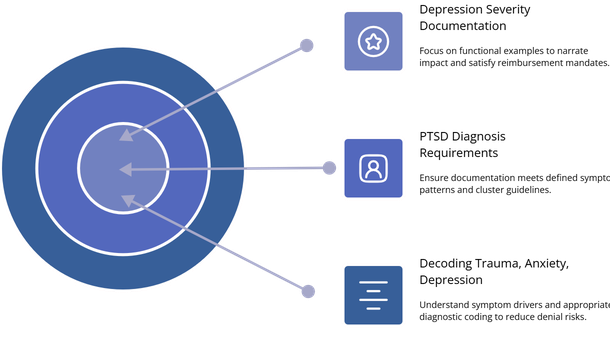
Trauma, anxiety, and depression in one note
Many notes include trauma history, anxiety symptoms, and depressive symptoms. Coding the wrong primary diagnosis can distort the claim narrative.
What to look for:
Which symptoms are driving the treatment plan today
Whether trauma exposure is documented with qualifying details
Whether the note supports required symptom clusters
Whether the provider ties symptoms to trauma or treats them separately
If you code PTSD without documentation of the required symptom pattern, you invite denials that show up later as avoidable work in denials management. If you code depression severity without functional proof, you contribute to the system wide issues tracked in coding error rates and downstream revenue impact covered in coding accuracy and hospital revenue.
Substance involvement and mental state changes
Substance use can create anxiety, mood symptoms, sleep disruption, and even psychosis. The coding risk is causation. Payers challenge “substance induced” claims when the note does not clearly connect timing and symptoms.
What to require in documentation:
Substance type and timing relative to symptoms
Whether symptoms persist outside use
Evidence of withdrawal or intoxication
Provider statement of causal relationship if present
Because substance related claims intersect with compliance and audit attention, keep your process aligned with broader compliance guidance like fraud, waste, and abuse terminology and audit patterns found in financial audit guidance. This also protects your team from the penalty landscape summarized in compliance violations and penalties.
Remote visits, telemedicine, and documentation shortcuts
Remote mental health visits often have good clinical work, but weaker structure. Missing MSE elements, missing time anchors, and vague risk language become frequent.
If your organization delivers mental health services by telehealth, treat documentation quality like a measurable KPI. It impacts denial rates, audit risk, and throughput. AMBCI’s research on telemedicine reimbursement trends, remote workforce trends, coding productivity benchmarks, and HIPAA changes is directly relevant here.
5. Quality Assurance Checklist to Keep ICD 11 Mental Health Coding Defensible
If you want fewer denials and fewer auditor escalations, build a small QA checklist that mirrors payer logic. Use it consistently. Measure it. Train to it.
A coder focused QA checklist
Is the primary diagnosis clearly stated and supported by assessment.
Does documentation include time anchors that meet diagnostic thresholds.
Is functional impairment documented in real world terms.
Is severity supported by evidence, not only adjectives.
Are risk elements consistent across HPI, MSE, and plan.
Are comorbidities coded only if assessed or managed today.
If postcoordination is used, do the added details have explicit support.
This is how you reduce the error patterns described in top coding errors and the system wide trends tracked in coding error rate reporting. It also supports cleaner revenue capture and reduces leakage described in revenue leakage insights and revenue cycle efficiency benchmarks.
Make your QA measurable and useful
Mental health coding quality improves fastest when QA ties to business metrics:
Denial rate by diagnosis family
Rework hours per coder per week
Query rate and query turnaround time
Percent of charts missing time anchors
Percent of charts missing impairment statements
This is exactly the kind of operational measurement that supports growth, hiring, and career mobility. If your goal is to progress faster, use AMBCI’s career guidance like starting a career in billing and coding, career roadmap for CPC, and professional development through continuing education. Quality plus speed is what employers reward, and it aligns with the realities highlighted in workforce demographics and workforce pressure described in coding workforce shortages.
6. FAQs (Frequently Asked Questions)
-
Start by mastering the concepts that drive denial outcomes, not by memorizing codes. Build a daily habit: read the assessment, extract the visit focus, find the time anchors, confirm functional impairment, then match specificity only when the documentation supports it. Use a consistent QA checklist and track your personal error types, because repetition is how mistakes become permanent. If you need a structured anchor for ICD 11 rules, keep AMBCI’s ICD 11 official coding guidelines explained open during chart review. Pair that with denial feedback from denials management best practices and pattern awareness from common coding errors.
-
Treat severity as a claim you must prove. If the note says “severe,” you should see functional consequences, frequency, duration, and impact on safety or self care. Without that proof, use a less specific option or query for clarification. Overcoding severity can increase denials, create audit flags, and waste hours in rework. That is why AMBCI emphasizes quality risk through coding error rate reporting and compliance pressure through audit trends. When you build discipline around severity support, you protect revenue outcomes described in coding accuracy and revenue impact.
-
Code comorbidities only when they are assessed, addressed, or impact the plan in that encounter. A long problem list is not a coding instruction. If a clinician mentions a condition but does not evaluate it, manage it, or connect it to medical decision making, coding it can look like risk inflation. Comorbidity discipline is one of the easiest ways to reduce rework and prevent denials, which ties directly to the operational outcomes discussed in coding productivity benchmarks and denials management. It also reduces compliance exposure in the penalty landscape covered in compliance violations and penalties.
-
Trauma related coding depends on specific exposure and symptom patterns. The note should confirm a qualifying trauma event, then describe symptom domains such as reexperiencing, avoidance, hyperarousal, and functional impairment. You also want time anchors that support duration expectations. If those elements are missing, do not force a trauma code to fit. Code what is supported and query if needed. This reduces the audit and denial pain described in audit trend reporting and error patterns described in top coding errors. Strong documentation integrity also aligns with the CDI fundamentals in CDI terminology guidance.
-
Suicide risk documentation must be specific and consistent. Separate passive thoughts from active intent. Capture plan, means, protective factors, and safety planning if present. Never code self harm behavior or high risk states without explicit provider documentation that supports it. Overstating risk can create compliance exposure and can distort the clinical record. Keep your process grounded in documentation integrity and compliant communication, supported by AMBCI resources on HIPAA compliance changes, risk awareness in billing compliance penalties, and audit readiness principles in financial audit guidance.
-
The biggest denial drivers are predictable. Coding a diagnosis without support when the note only documents symptoms. Coding historical diagnoses as current episodes. Adding severity or specifiers without evidence. Coding “substance induced” without timing and causation language. And allowing risk documentation to conflict across the note. Each of these creates a mismatch between what the code implies and what the chart proves. Those mismatches show up in the real world patterns AMBCI documents in denials management best practices, systemic data like coding error rates, and operational consequences like productivity benchmarks. Fixing them is less about speed and more about a repeatable process.
-
Productivity improves when your workflow reduces decision friction. Use a dictionary and a checklist so you are not reinventing logic each chart. Focus on capturing the few details that drive specificity and defensibility: time anchors, impairment, risk alignment, and visit focus. Do not chase extra specificity that is not supported, because it creates rework later. The best coders are not fast typers. They are fast decision makers who minimize reversals. This is exactly the skill set reflected in AMBCI’s coding productivity benchmarks and the revenue protection goals in revenue leakage insights. If you want long term career growth, pair speed with quality using continuing education.
