
Complete Reference for Coding Query Process Terms
Coding queries are where documentation quality becomes codable truth—without crossing compliance lines. When queries are inconsistent, leading, or poorly tracked, you get the worst of both worlds: under-coded acuity and audit exposure. This reference turns the coding query process into a controlled workflow: standardized terms, compliant query formats, escalation rules, response handling, and audit-ready evidence. If you’re tired of “provider won’t answer,” “query feels risky,” or “coders interpret differently,” this guide gives you the vocabulary and operating system to run queries professionally, defend decisions, and protect revenue integrity.
1. Coding Query Process: The Real Purpose, the Real Risk, and the Real Standard
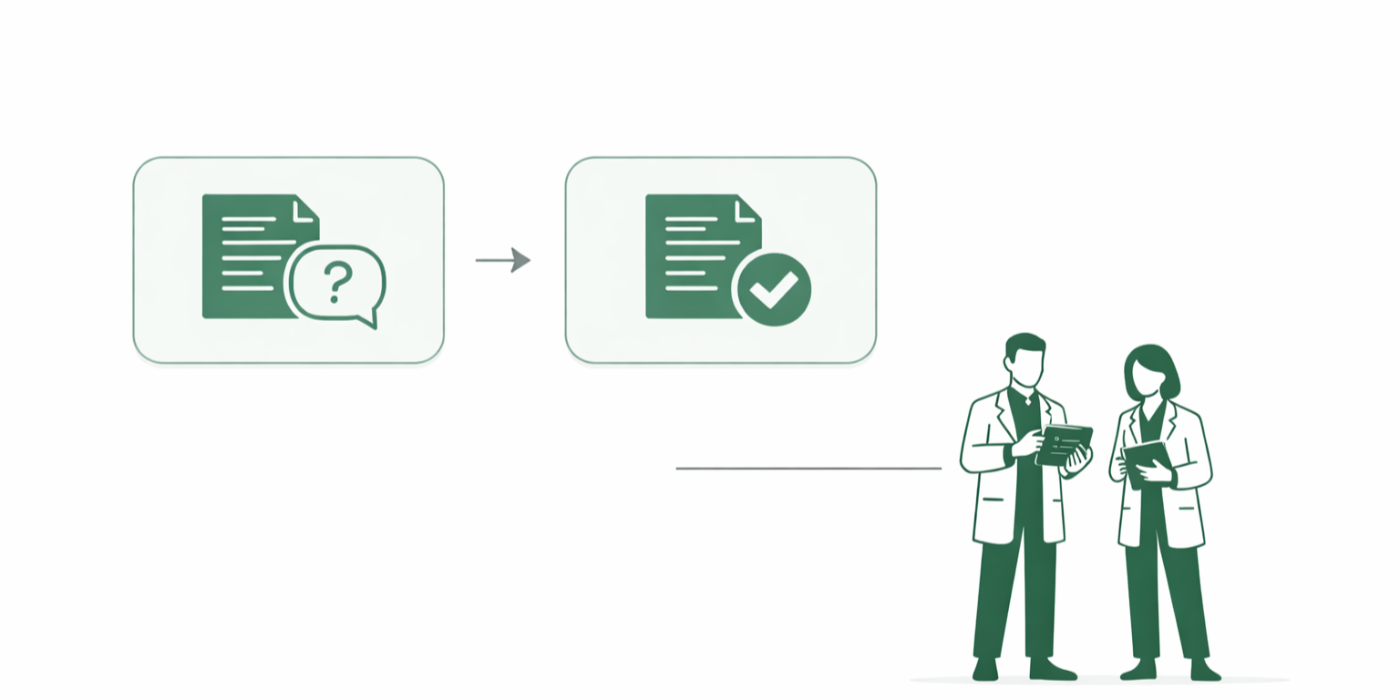
A coding query is not a “please document this code” request. It’s a clarification mechanism used when clinical documentation is incomplete, conflicting, ambiguous, or missing required specificity to support accurate coding. A query becomes necessary when the note prevents a coder from assigning the most accurate code without guessing—and guessing is exactly what triggers compliance risk under medical coding regulatory compliance.
High-performing query programs solve three problems at once:
Accuracy: You turn vague notes into codable diagnoses, correct laterality, stage, severity, and causal linkages that matter to billing outcomes and quality reporting. Strong documentation expectations are non-negotiable for defensibility under Medicare documentation requirements for coders.
Consistency: You prevent coder-to-coder variation and “interpretation culture,” which is how organizations drift into error patterns that show up later as denials, edits, and payer disputes—especially when edits and modifiers logic is misunderstood in understanding coding edits & modifiers.
Compliance: You avoid leading providers or manufacturing diagnoses. A compliant query is designed to clarify documentation, not steer outcomes—exactly the type of guardrail emphasized in medical coding regulatory compliance.
A professional query process also connects to revenue integrity mechanics. If a payer downcodes, denies, or retroactively adjusts a claim, you need to understand what the payer is telling you using CARCs and RARCs, and you need a documentation trail that supports your billed story. That’s why query management is not “extra admin”—it’s core to preventing silent leakage described in medical coding revenue leakage prevention.
The practical standard to teach your team is simple:
If the record does not allow a confident, compliant code assignment, you query.
If the record supports it, you code it—then protect the downstream flow through clean submission and reconciliation terms in clearinghouse terminology guide.
| Term | What It Means | Why It Matters | Best Practice Action |
|---|---|---|---|
| Query | Clarification request for incomplete/ambiguous documentation | Prevents guess-coding and supports accuracy | Query only when the record lacks enough support to code confidently core |
| Query Trigger | Specific documentation gap that requires clarification | Keeps queries consistent and defensible | Standardize triggers (laterality, stage, linkage, etiology, type) |
| Clinical Indicator | Evidence supporting a condition (symptoms, labs, imaging, treatment) | Shows query is grounded, not speculative | List indicators in the query to justify why clarification is needed |
| Leading Query | Query that steers provider to a preferred diagnosis/answer | High compliance risk | Avoid leading language; offer balanced options or open-ended format risk |
| Non-Leading Query | Neutral request for clarification | Protects integrity and audit defensibility | Use objective indicators and neutral wording |
| Open-Ended Query | Provider responds in their own words | Reduces leading risk; may slow response | Use for diagnosis determination, etiology, and complex linkage |
| Multiple-Choice Query | Provider selects from options + “other/clinically undetermined” | Faster turnaround; must be balanced | Include “unable to determine” and “other” to avoid steering |
| Concurrent Query | Sent during the encounter or shortly after | Improves timeliness and accuracy | Prioritize concurrent for time-sensitive billing and clean claims |
| Retrospective Query | Sent after discharge/encounter closes | Higher risk of poor recall and delayed billing | Limit and control; require strong indicators and clear necessity |
| CDI Query | Query focused on clinical specificity, severity, or diagnoses | Improves documentation quality upstream | Align CDI and coding standards; keep one shared policy |
| Coding Query | Query initiated to support code assignment | Prevents inconsistent coding interpretation | Use standardized templates and definitions |
| Escalation | Route for unanswered/contested queries | Prevents dead-end delays | Set timing rules and escalation to department lead or CDI champion |
| Query Turnaround Time (TAT) | Time from query sent to provider response | Directly affects DNFB and cash flow | Track by provider/service line; publish weekly scorecards |
| DNFB | Discharged Not Final Billed | Unanswered queries can inflate DNFB | Use TAT thresholds and escalation before DNFB grows ops |
| Query Closure | Formal end of a query (answered/declined/expired) | Needed for tracking and auditing | Require closure status and reason; don’t leave “open forever” |
| Provider Decline | Provider refuses or cannot clarify | Common in complex cases | Allow decline options; document “clinically undetermined” appropriately |
| Query Audit Trail | Record of indicators, wording, response, and coding outcome | Defends against compliance challenges | Store query text, indicators, timestamps, provider identity, final code |
| Query Policy | Written standard for when/how to query | Prevents ad-hoc risky behavior | Publish one policy shared by CDI and coding; train annually |
| Query Template | Standard format for common scenarios | Boosts consistency and speed | Create templates for sepsis, AKI, respiratory failure, malnutrition, CHF |
| Provider Education Loop | Feedback on recurring documentation gaps | Reduces query volume over time | Monthly “top 10 query reasons” training per service line |
| Indicator-Based Query | Query rooted in objective findings | Less likely to be labeled speculative | Reference facts: vitals, labs, imaging, consult notes, treatment |
| Conflicting Documentation | Different notes disagree (e.g., “AKI” vs “no AKI”) | Blocks accurate coding | Query for clarification; cite both statements as indicators |
| Incomplete Documentation | Missing specificity needed for code selection | Causes undercoding or coding errors | Query for laterality, stage, type, etiology, complication linkage |
| Clinical Validation Query | Clarifies whether condition is supported clinically | Prevents coding unsupported diagnoses | Use neutral language; ask whether criteria are met or ruled out |
| Present on Admission (POA) | Whether condition existed at admission (facility context) | Impacts reporting and payer logic | Query if timing unclear and affects coding/reporting |
| Principal/Primary Diagnosis Clarification | Determining main reason for encounter | Can affect DRG/claim logic | Query when documentation conflicts or sequencing is unclear |
| Etiology Query | Clarifies cause (e.g., “anemia due to CKD”) | Drives specificity and correct code selection | Use open-ended or balanced options; include “unknown” |
| Linkage Query | Clarifies relationship (with/due to/complication) | Prevents missed complication codes | Ask provider to confirm linkage when clinically supported |
| Sequela vs Active Condition | Determining if residual effect vs current disease | Changes codes and justification | Query when “history of” vs active treatment is unclear |
| Query Fatigue | Provider overwhelmed by high query volume | Drives non-response and resentment | Reduce noise using education + better templates + targeted triggers |
| Query Prioritization | Ranking queries by billing/clinical impact | Prevents delays and DNFB spikes | Prioritize principal dx, major complications, medical necessity-critical gaps |
| Denial Prevention Query | Query to support coverage/medical necessity | Reduces denials and recoupments | Target documentation elements tied to payer rules and necessity |
| Coder Override Prohibition | Rule that coder cannot “infer” provider intent | Protects compliance | If it’s not documented, don’t assume—query or code conservatively |
| Query Analytics | Metrics: volume, reasons, TAT, response rate, outcomes | Turns queries into a managed program | Report monthly: top triggers, providers with slow TAT, training wins |
| Response Authentication | Ensuring response is attributable to provider | Audit defensibility | Use EHR workflow that timestamps and identifies responder |
| Query Retention | How long query records are stored | Needed for payer/audit defense | Align retention with compliance policy; ensure retrieval is easy |
2. Query Types, Formats, and Compliance Guardrails That Keep You Safe
A compliant query process starts with one principle: clarify documentation, don’t create it. The moment a query feels like “please say X,” you’ve shifted from clarification to persuasion—exactly what compliance reviewers look for when assessing risk under medical coding regulatory compliance.
The three formats you should standardize (and when each wins)
1) Open-ended
Best for diagnosis determination, etiology, and complex relationships because it reduces the chance you “guided” the answer. It’s also useful when documentation is conflicting and you need the provider to reconcile the story using clinical judgment anchored to clinical documentation improvement terms.
Downside: slower. Providers may respond vaguely. That’s where your template quality matters.
2) Multiple-choice (balanced)
Best for routine specificity gaps like laterality, stage, type, severity, and linkage—when you can list reasonable options plus “other” and “clinically undetermined.” This supports consistent coding and helps reduce downstream edits discussed in understanding coding edits & modifiers.
Guardrail: options must be balanced. If you only present one “good” answer and one “bad” answer, it can read as leading.
3) Yes/No with explanation (use sparingly)
Useful only when you’re confirming a narrow fact (e.g., “Was X ruled out?”). Overused yes/no queries can become steering mechanisms and increase audit exposure under Medicare documentation requirements.
Always require a free-text explanation for “yes” so the record shows actual clinical rationale.
The “clinical indicator” rule that prevents speculative querying
Every query should cite the clinical indicators that triggered it: labs, imaging, symptoms, treatment, consult notes, vitals, or provider statements. This is how you demonstrate the query is grounded. It’s the same logic you use to defend services under medical necessity criteria: a payer does not accept “we believed it,” they accept “here’s the documented support.”
The line you must not cross: coding from hints
If the record suggests a diagnosis but doesn’t confirm it, you do not code it. You query—or you code what is documented. That rule protects you from the downstream pain of payer recoupments and adjustments that show up later as CARCs and RARCs. It also prevents the organization from “scaling errors,” the most expensive form of leakage described in revenue leakage prevention.
High-risk query scenarios that demand extra discipline
Sepsis vs SIRS/infection: must use objective indicators and neutral language, tied to clinical validation logic.
Respiratory failure: requires clear evidence, not just “O2 given.”
Malnutrition: must align with documented assessments and criteria.
AKI vs CKD progression: must reconcile conflicting statements and labs carefully.
These are the cases where robust CDI language helps create consistent standards, using CDI terms dictionary.
3. Operational Workflow: How Queries Move Through the System Without Breaking Billing
A query program fails operationally when it’s treated as an afterthought. Professionals treat queries as an integrated part of claim accuracy, charge integrity, and timely billing. If you’re building the workflow, design it like a revenue-control system:
Step 1: Trigger identification (with standardized reasons)
Coders and CDI should share a controlled list of triggers (e.g., laterality missing, stage unclear, conflicting dx, unspecified organism, unclear principal dx). This reduces randomness and protects consistency. It also supports upstream education that shrinks query volume—one of the fastest ways to reduce burnout without sacrificing accuracy.
Tie your trigger list to your documentation standards in Medicare documentation requirements and your compliance boundaries in coding regulatory compliance.
Step 2: Drafting the query (templates + indicators + neutrality)
A professional query includes:
Why you are querying (gap or conflict)
Clinical indicators (objective support)
Neutral question format (open-ended or balanced options)
Response options including “clinically undetermined”
Time sensitivity marker when it impacts claim finalization
This structure aligns with the discipline you need for clean submissions, where errors can be stripped downstream by clearinghouse rules in clearinghouse terminology or payer edits discussed in coding edits & modifiers.
Step 3: Routing and ownership (who must answer and by when)
Queries die when ownership is unclear. Your workflow should define:
Eligible responder (attending, treating provider, or responsible clinician)
Expected turnaround time thresholds
Escalation path (service lead, CDI champion, coding manager)
“No response” closure rule
If query delays are inflating DNFB or slowing cash, treat it like a measurable revenue issue and track it as a KPI, similar to metric discipline in revenue cycle KPIs. Query delays are not “documentation problems”—they are throughput failures that create billing latency.
Step 4: Response handling (what changes, what doesn’t)
Once a provider responds:
The response must be integrated into the record per policy.
Coding must reflect the clarified documentation, not what the coder hoped for.
If the provider declines or states “unable to determine,” you code conservatively and close the query appropriately.
This is where many teams create compliance risk by “coding anyway” or by accepting unclear answers. The correct approach mirrors the “don’t infer” principle reinforced in coding regulatory compliance.
Step 5: Claim finalization and reconciliation (prove it was counted)
After coding updates, verify downstream acceptance—because missing diagnoses don’t matter if they never reach the payer. Connect the dots through:
EHR to claim transmission terms in clearinghouse terminology
When you do this consistently, you reduce the “we coded it but didn’t get paid” mystery that drives distrust in coding teams.
4. Query Analytics and QA: Metrics That Turn “Asking Questions” Into a Controlled Program
If you can’t measure your query program, you can’t improve it—and you can’t defend it. Strong query analytics do two things: (1) improve documentation quality over time, and (2) reduce compliance risk by proving your queries are standardized and justified.
The core query metrics every professional team tracks
1) Query volume by trigger
If “unspecified anemia” or “CHF type” dominates, you have a documentation training problem, not a coder performance problem. Use CDI terminology alignment from CDI terms to create training content that clinicians recognize as clinically relevant.
2) Provider response rate and turnaround time
Response latency directly increases billing delays. Treat TAT like a revenue KPI, the same way you track performance using revenue cycle metrics & KPIs. If the organization won’t address TAT, expect downstream cash pressure.
3) Query outcome distribution
You need to know whether queries produce:
clarified diagnoses
clarified specificity
“clinically undetermined”
provider decline
no response / expiration
A high “clinically undetermined” rate can be valid, but it often signals noisy triggers, weak indicators, or too-late retrospective querying.
4) Financial and denial correlation
Track what happens after a query drives a coding change. If denials and adjustments still increase, your issue may be edits, payer rules, or submission pathways—especially when outcomes show up as CARCs and RARCs.
If claims are being stripped or modified, your team must understand claim flow and terminology in clearinghouse terminology and apply practical edit literacy from coding edits & modifiers.
QA controls that reduce both error and audit exposure
A mature query program includes review gates such as:
Template approval: standardized, neutral templates are reviewed by coding compliance.
High-risk query review: sepsis, respiratory failure, malnutrition, AKI, encephalopathy templates get periodic audits.
Leading language spot checks: random sample review for steering phrases.
Query-to-code audit: confirm coding matches documentation changes, not coder assumptions.
These controls align with the same defensive posture used in coding regulatory compliance and reduce the long-tail risk of clawbacks and repayment demands.
How to reduce query volume without losing accuracy
The best query program aims to need fewer queries over time. The practical levers:
service-line education based on top triggers
smart templates integrated into clinician workflows
concurrent querying to reduce retrospective ambiguity
documentation prompts tied to medical necessity clarity, using medical necessity criteria
alignment with charge workflows to prevent missing work, using charge capture terms
When you reduce unnecessary queries, providers stop tuning out—and the queries that remain get faster, higher-quality answers.

5. Denial-Smart Querying: How Queries Protect Medical Necessity, Clean Claims, and Remittance Defense
Many teams treat queries as “diagnosis cleanup,” but queries also protect coverage and payment logic—especially when documentation is the difference between paid and denied. Denials often happen because the record fails to prove why the service was necessary, even if the care was appropriate.
Use queries to strengthen medical necessity narrative
When the documentation is clinically thin, a payer can deny or reduce payment because the claim lacks support. A query can clarify:
the condition driving the service
severity and functional impact
failed conservative treatment
complication status
planned next steps
That aligns directly to coverage logic described in medical necessity criteria, and it improves claim resilience by reducing ambiguous coding that triggers edits discussed in coding edits & modifiers.
Build remittance-ready defense
When payers adjust or deny, your team must interpret the remittance signal correctly using CARCs and RARCs. If you can’t map adjustments back to documentation decisions, you can’t improve the system—your team will just “work harder” while leakage persists.
Where query programs often fail in the real world
Queries are created but not tracked: no closure, no audit trail, no accountability.
Providers answer outside the record: emails or messages that aren’t integrated into documentation. That’s a compliance dead end under Medicare documentation requirements.
Coders treat query responses as permission slips: coding becomes detached from actual documentation.
Claims still deny because the problem was actually clearinghouse edits, payer rules, or coordination issues—areas clarified in clearinghouse terminology and sometimes complicated by payer coordination logic in coordination of benefits.
How to make queries and revenue integrity reinforce each other
The best organizations connect query analytics to broader revenue integrity dashboards: denial categories, adjustments, timeliness, and clinical documentation trends. This is where query programs stop being “coding admin” and become real prevention systems—matching the philosophy in revenue leakage prevention and KPI discipline in revenue cycle metrics.
6. FAQs
-
Send a query when the documentation does not allow a confident, compliant code assignment—especially when specificity, etiology, or linkage changes the correct code. Code conservatively only when the record supports a less specific but accurate option and querying would be speculative or unnecessary. This aligns with compliance expectations in medical coding regulatory compliance and defensibility standards in Medicare documentation requirements.
-
A leading query steers the provider toward a preferred diagnosis or outcome, which can appear like documentation manipulation. That’s dangerous because it increases audit exposure and undermines coding integrity. Neutral wording, balanced options, and clear clinical indicators keep queries defensible under coding regulatory compliance.
-
Use open-ended for diagnosis determination, complex etiology, and nuanced linkage. Use balanced multiple-choice for routine specificity gaps (stage, type, laterality, severity) as long as you include “other” and “clinically undetermined.” For consistency, align query formats with CDI language in CDI terms dictionary.
-
Reduce noise by standardizing triggers, improving templates, and running provider education based on top query reasons. The goal is fewer queries because documentation improves, not fewer queries because coders stop clarifying. Tie training to clinical relevance and coverage expectations in medical necessity criteria.
-
Because unanswered queries block final coding and claim release. Treat query turnaround time like a revenue KPI and enforce escalation rules. Pair analytics with broader reporting discipline from revenue cycle metrics & KPIs to create accountability.
-
The response must be attributable to the provider, integrated into the record per policy, and the coder must code based strictly on clarified documentation. Then verify downstream acceptance through claim flow terms in clearinghouse terminology so documentation improvements actually translate into paid outcomes.
