
Healthcare Billing Acronyms: Comprehensive Dictionary & Examples
Healthcare billing acronyms are where revenue cycle teams silently bleed money: a front desk misunderstands “COB,” a biller miscues “CARC/RARC,” a coder misreads “CDI,” and suddenly you’re chasing avoidable denials, writing off patient balances you could’ve collected, and burning hours on rework that never shows up on a dashboard. This dictionary doesn’t just define acronyms—it explains how each one hits cash, compliance, and throughput, with practical examples you can apply inside charge capture, claim edits, remits, and audits. If you want cleaner claims and faster reimbursement, you need a shared acronym language that maps directly to action.
Before you scroll: bookmark this and train your team on it. Every “small” acronym mistake becomes a big collections problem when it repeats across hundreds of claims.

1) Healthcare Billing Acronyms: How to Use This Dictionary Like a Revenue-Pro
Acronyms aren’t “jargon”—they’re operating signals. When your team doesn’t share the same definition of “ERA,” “EOB,” or “COB,” you don’t just get confusion—you get preventable cash delays and compliance exposure. A new biller might treat a CARC as “unfixable” when it’s actually a documentation miss you can close with a CDI query. A coder might assume a payer denial is “coding,” when it’s really eligibility or authorization—and suddenly you’re appealing the wrong thing, losing timely filing windows, and inflating A/R with work that will never pay.
This is why AMBCI’s billing dictionary ecosystem matters: you don’t want disconnected definitions; you want definitions that connect to actions. If your team is already training on remits, pair this guide with AMBCI’s deep dive on EOB workflows in the Explanation of Benefits (EOB): Comprehensive Guide and the practical remittance decoding in the Remittance Advice Remark Codes (RARCs) dictionary. Then layer on denial logic with the Guide to Claim Adjustment Reason Codes (CARCs) so your team stops treating payer responses like a mystery novel and starts treating them like a fixable queue.
Here’s the high-value method: use this dictionary to build a shared “If you see X, do Y” playbook. Every acronym should map to one of four outcomes: (1) pay faster, (2) deny less, (3) appeal smarter, (4) stay audit-ready. If it doesn’t map, you’re learning trivia instead of improving collections.
2) Acronyms by Workflow Stage: Front Desk → Coding → Claims → Remits → Patient AR
If you want this dictionary to actually change outcomes, organize it by workflow stage. That’s how leaders stop “training” and start improving KPIs.
Front desk / registration acronyms (where denials are born): COB, NPI, TIN, DOS, POS, OON, PA. These determine whether the claim is even eligible to be paid. If your registration team doesn’t understand the consequences, you’re building denials on purpose. Pair your front-end training with operational clarity from AMBCI’s medical necessity criteria guide so staff understands why “coverage” and “medical necessity” are not the same thing.
Coding / documentation acronyms (where audits are won or lost): Dx, Px, ICD, CPT, HCPCS, CDI, CC/MCC, DRG, HCC. These control what you’re claiming and whether the record supports it. If your coders aren’t consistent with documentation linkage, you’ll see patterns like “medically unnecessary” denials, downcoded payments, and payer recoupments. Reinforce the compliance side with AMBCI’s guide to medical coding regulatory compliance and the audit language in the medical coding audit terms dictionary.
Claims / edits acronyms (where rejection vs denial matters): EDI, CMS, PFS, and all your edit logic. Here’s the revenue cycle truth: a rejection is a formatting/route failure (often fixable immediately), while a denial is a payer adjudication decision (often slower). If you treat rejections like denials, you slow down cash for no reason. Learn the edit mindset with AMBCI’s guide to coding edits and modifiers so your team stops guessing why claims failed.
Remits / posting acronyms (where underpayments hide): ERA, EOB, CARC, RARC, AR. If you auto-post without tight mapping rules, you will silently accept underpayments and wrong contractual adjustments. That’s not “efficiency”—it’s automated revenue leakage. Align this with AMBCI’s revenue cycle metrics & KPIs glossary so your team can measure the impact of better posting logic, not just “number of claims processed.”
Right before your next deep-dive, lock in the acronyms your organization struggles with most—and make the pain visible.
3) High-Stakes Acronyms That Decide Payment, Denials, and Audit Risk
Some acronyms are “reference.” Others are money. These are the ones that decide whether you get paid, how fast, and how defensible the claim is when someone audits you.
PA (Prior Authorization): This is where organizations hemorrhage revenue with perfectly documented services that never had a valid authorization captured correctly. The pain point isn’t just missing auth—it’s mismatched auth: wrong CPTs, wrong DOS ranges, wrong units, wrong rendering provider. That’s why PA must be treated as a structured dataset, not a note. Create a pre-service checklist tied to order entry and scheduling, and audit “auth number presence + correctness” weekly. If you want to formalize how these failures create downstream rework, anchor the concept with AMBCI’s broader operational framing in charge capture terms and prevent the “we did the work but didn’t get paid” cycle.
POS (Place of Service): POS errors look small but price big. Billing POS 11 vs 19/22 vs 21 can change allowable amounts, documentation requirements, and payer logic. If your POS isn’t being driven by scheduling and location master data, you’re relying on humans to be perfect—humans won’t be perfect. Tie POS to appointment types and facilities, then report on POS-based denials monthly.
NPI/TIN: Payment routing and enrollment integrity live here. The biggest pain point: a provider is credentialed at one location but services are billed under another; the system defaults to the wrong billing entity; the payer either rejects or pays at an unexpected rate. That’s why you need a controlled crosswalk between provider, location, payer plan, billing NPI, rendering NPI, and TIN. If your practice management system can’t enforce it, build clearinghouse edits and exception queues and document your fixes like a compliance program.
CDI: CDI isn’t just “make docs better.” CDI is how you reduce denials, defend audits, and prevent downcoding. The expensive mistake is letting CDI be reactive (“only after denial”). A smart workflow uses CDI to improve first-pass correctness—the claim should be right the first time. Integrate CDI with medical necessity by using structured criteria from AMBCI’s medical necessity criteria guide and audit defense from the medical record retention terms resource. If you can’t produce documentation reliably, you can’t win disputes reliably.
4) Acronym Examples in Real Billing Scenarios
Definitions are easy. Scenarios are where your team either gets it—or keeps making the same expensive mistake.
Scenario 1: COB loop destroys timely filing
Patient has primary commercial and secondary Medicaid.
Front desk records COB but marks Medicaid as primary because “that’s what the card looked like.”
Claim goes to Medicaid, denies “other insurance primary.”
Now you refile to commercial—except the timely filing window is tight, and the patient is calling daily.
Fix: Train registration on COB logic, verify primacy through eligibility tools, and require proof points in the account. Then reference AMBCI’s COB definitions guide as the official workflow language so staff can’t “interpret” COB differently.
Scenario 2: CARC/RARC misread causes bad write-off
ERA returns with CARC indicating adjustment due to missing info; RARC indicates documentation required.
Poster writes it off as “contractual” because the mapping table is wrong.
You just converted a recoverable denial into permanent revenue loss.
Fix: Update CARC/RARC mapping, create a denial workqueue, and build an appeal packet template. Your “dictionary” should be operationalized using AMBCI’s CARC guide and RARCs dictionary.
Scenario 3: NPI/TIN mismatch leads to rejection storm
New provider joins; credentialing is in progress.
Scheduling starts booking; claims submit with rendering NPI not enrolled under the billing TIN.
Clearinghouse rejects; staff resubmits repeatedly with the same data.
Fix: Create a “provider onboarding billing gate” and an exception queue tied to enrollment status. Your system must stop claims that cannot be paid yet.
Scenario 4: CDI gap triggers medical necessity denial
Procedure billed correctly, but documentation doesn’t support severity or failed conservative treatment.
Denial comes back for medical necessity.
Fix: CDI prompts for required elements at documentation time, not appeal time. Use AMBCI’s clinical documentation improvement (CDI) terms dictionary to standardize query language and reduce provider friction.
5) Build a “No Acronym Left Behind” Training System
If you want this blog to create real outcomes, don’t treat it like content. Treat it like a training system.
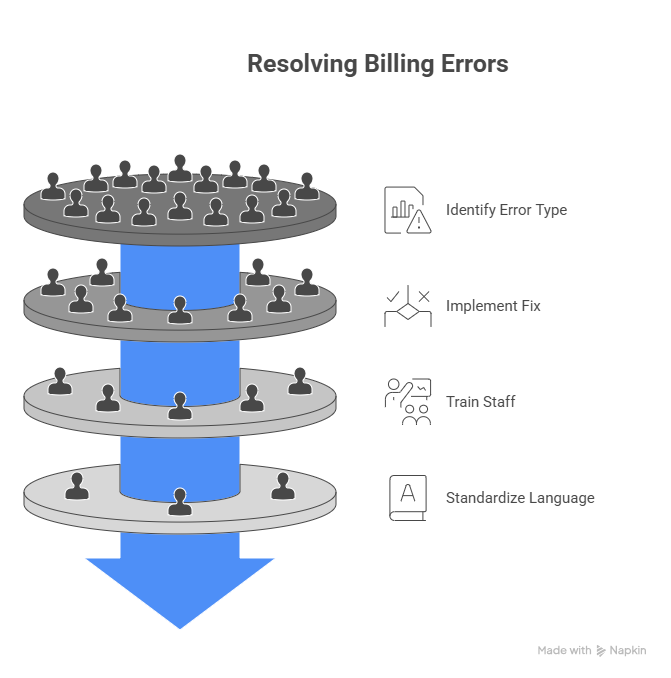
Step 1: Choose your top 20 “money acronyms.” These are the acronyms that influence: eligibility, authorization, coding validity, edits, remits, and appeals. Your first list should include COB, PA, POS, DOS, NPI, TIN, CPT, ICD, HCPCS, CDI, ERA, EOB, CARC, RARC, AR. Then add specialty-specific ones based on your denial patterns.
Step 2: Map acronyms to failure modes. Every acronym should have: what it means, where it breaks, what the denial looks like, what fix prevents recurrence, what evidence you store. That’s how you become audit-ready, not just “trained.”
Step 3: Turn definitions into checklists. The difference between average and elite revenue cycle teams is that elite teams don’t rely on memory. They rely on checklists, edits, and enforced workflows. Use AMBCI’s broader operational knowledge base like revenue leakage prevention to connect acronym training to measurable savings.
Step 4: Track improvement using KPIs. If acronym training works, you should see improvement in first-pass resolution, reduction in top denial categories, reduced rework hours, improved clean claim rate, and fewer appeals per 1,000 claims. Tie measurement to AMBCI’s RCM metrics & KPIs resource so leaders can prove ROI.
If your team says “we already know acronyms,” but denials are rising and AR days are creeping up, you don’t have an acronym problem—you have a process enforcement problem. Fix that and your collections will show it.
6) FAQs: Healthcare Billing Acronyms (High-Value Answers)
-
An EOB is the payer’s explanation of how a claim was processed, typically formatted for the patient and sometimes sent to providers. An ERA is the electronic remittance file (usually the 835) that drives payment posting—allowed amounts, adjustments, denials, and patient responsibility. If your team treats them as interchangeable, you’ll mis-post payments and miss underpayment patterns. Align your workflows using AMBCI’s EOB guide and the remittance decoding resources for RARCs and CARCs.
-
Because they tell you why the payer adjusted or denied the claim and what needs to change to get paid. Without a CARC/RARC-driven denial taxonomy, teams appeal blindly, resubmit incorrectly, or write off recoverable balances. The best teams map top CARC/RARC pairs to standardized fixes and templates so denials become predictable work—not chaos.
-
COB, PA, NPI/TIN, POS, and DOS. These decide eligibility routing, authorization validity, enrollment/payment routing, site-of-service rules, and timely filing exposure. If you want fewer downstream denials, invest training and system enforcement here first, then connect it to charge capture integrity via AMBCI’s charge capture terms.
-
CDI makes documentation support the coded story—specific diagnoses, severity, linkage, and medical necessity rationale—before the claim goes out. That reduces “not supported” denials and strengthens audit defense. It also prevents “silent downcoding,” where payers pay less because the record doesn’t justify a higher-paying code. Standardize CDI language with AMBCI’s CDI terms dictionary and keep your evidence strong with medical record retention guidance.
-
Train by workflow, not alphabet. Start with front-end “clean claim” acronyms (COB, PA, NPI/TIN, POS, DOS), then claims/edits (EDI, modifiers/edit logic), then remits (ERA/EOB/CARC/RARC), then compliance (CDI, audit terminology). Pair each acronym with a real example and one best-practice action. Use AMBCI’s RCM terms resource as the anchor so training stays connected to outcomes.
-
You’ll see it in: higher clean claim rate, fewer rejections, lower top-denial volume, improved first-pass resolution, reduced AR days, fewer appeals per 1,000 claims, and fewer write-offs tied to avoidable root causes. If those numbers don’t move, training isn’t being enforced—your workflows and edits need tightening. Track outcomes using AMBCI’s RCM metrics & KPIs glossary and review trends monthly.
