
Guide to Accurate Medical Billing & Reimbursement
Accurate medical billing and reimbursement isn’t “clean claims” as a slogan—it’s a controlled system that prevents small data defects from turning into denials, underpayments, refunds, and compliance exposure. Most teams don’t lose money because they don’t work hard; they lose money because eligibility evidence is weak, charge capture isn’t reconciled, documentation doesn’t satisfy medical necessity, and remittance is posted without a denial intelligence loop. This guide turns reimbursement accuracy into repeatable checkpoints you can audit, measure, and improve using remittance language like the EOB, CARCs, and RARCs.

1) Reimbursement Accuracy: The “Leak Points” That Quietly Destroy Net Collections
Reimbursement accuracy means your organization can prove that each claim reflects what happened clinically, meets payer rules, was submitted correctly, and was paid correctly. When you can’t prove it, payers decide the narrative—and your team spends weeks doing avoidable rework. The fastest way to diagnose leakage is to stop using “denial rate” as the only signal and instead follow the money from intake → coding → claim submission → remittance → follow-up, using a shared language anchored in the revenue cycle metrics & KPIs glossary, the claim adjustment reason codes (CARCs), and the remittance advice remark codes (RARCs).
Most “inaccurate reimbursement” is actually one of these failures:
Front-end truth is missing. Eligibility is treated as “active/not active” instead of stored evidence, which later conflicts with coordination of benefits (COB) and the payer’s remittance story in the EOB.
Charge capture isn’t reconciled. Teams “post what was coded,” but never verify whether all billable services were captured—classic revenue loss disguised as normal volume variation. Build this discipline with the charge capture terminology guide and continuously hunt patterns using revenue leakage prevention.
Medical necessity isn’t operationalized. If documentation doesn’t satisfy necessity criteria, reimbursement becomes optional for the payer—especially when notes don’t map cleanly to policy triggers. Use a measurable approach grounded in medical necessity criteria and standardized provider prompts from the CDI terms dictionary.
Submission integrity is assumed. Clearinghouse routing, claim edits, and provider mapping break silently, creating rejections and “timely filing” disasters. Strengthen the pipeline with the clearinghouse terminology guide and a shared definition set from the medical claims submission terminology guide.
Payment accuracy isn’t verified. Underpayments aren’t always “denials”—they’re often incorrect allowed amounts, bundling behavior, or posting errors that bury recoverable revenue. Your verification toolkit starts with the EOB, then drills into CARCs, RARCs, and contract/benchmark logic tied to Medicare reimbursement concepts and physician fee schedule terms.
If you want reimbursement accuracy that holds up in audits and appeals, you need a checkpoint map that makes every “leak point” measurable and fixable.
2) Front-End Accuracy: Eligibility, COB, and Charge Capture That Prevents Downstream Chaos
If reimbursement is wrong, it’s usually because the front end lied—not maliciously, but because your workflows weren’t designed to capture truth as a structured record. Eligibility must be captured with the same seriousness as a clinical chart entry because it becomes your defense when the payer shifts responsibility in the EOB and documents that shift with CARC and RARC logic.
Turn eligibility into evidence, not a phone call
Eligibility should be stored as: plan/product, effective dates, network status, accumulators, and benefit rules. When you don’t store it, you can’t dispute payer “member not eligible” or “coverage terminated” messaging—especially when COB was wrong or changed mid-year. Build intake discipline using COB definitions and treat eligibility disputes like formal evidence work, anchored to the EOB you ultimately receive.
Charge capture is the most “invisible” reimbursement error
Denials are loud. Missed charges are silent. If your organization doesn’t reconcile what occurred clinically to what was charged, you’ll underbill with perfect compliance and never see a denial spike. Build a charge capture control plan using the charge capture terms guide and institutionalize “leak hunting” with revenue leakage prevention. Then track progress with measurable definitions from RCM metrics & KPIs (clean claim rate, denial rate by category, days to first submission, and underpayment recovery).
Prevent the “wrong payer/wrong responsibility” spiral
If COB is wrong, you don’t just get denied—you end up rebilling, issuing refunds, and triggering recoupment risk. That’s why COB verification isn’t optional; it’s a revenue protection step every time the patient returns, changes jobs, adds a spouse plan, or updates demographics. Build scripts and policies rooted in COB clear definitions and validate accuracy against remittance narratives in the EOB guide.
3) Coding + Documentation Integrity: Medical Necessity, Modifiers, and Compliance Without Guessing
Coding accuracy isn’t “knowing codes.” It’s ensuring the claim communicates the clinical story in a way that satisfies payer policy and survives scrutiny. Most “coding errors” are actually documentation errors that force coders to choose between undercoding (revenue loss) and risk (unsupported billing). Tight reimbursement starts by making medical necessity operational using medical necessity criteria and standardized documentation prompts from the CDI terms dictionary.
Make medical necessity measurable
Medical necessity must be supported by documented facts: severity, functional impact, objective findings, prior treatments, and why this service now. When teams don’t standardize these elements, denials repeat because the note style never changes. Use medical necessity criteria to create checklists per service line, and train consistent language using the CDI dictionary. Then confirm impact through remittance patterns in the EOB and denial language from CARCs.
Modifiers and edits: force justification, not habits
Payers deny when modifiers are used as superstition. If the chart doesn’t explicitly justify the modifier, you’re inviting bundling edits, downcodes, or denials. Create a “modifier justification” rule using the framework in coding edits & modifiers and ensure coders can defend each modifier with documentation facts—not preference.
Compliance is part of accuracy, not a separate department
You can’t call reimbursement “accurate” if it’s not defensible under audit. That means integrating compliance guardrails into normal workflows: medical necessity evidence, correct claim submission, clean charge capture, and consistent posting. Train staff on compliance concepts using the regulatory compliance guide, audit discipline from the medical coding audit terms dictionary, and risk language from FWA terms. When those concepts live inside daily operations, audits become documentation retrieval—not panic.
4) Claim Submission Accuracy: Clearinghouse Controls, Clean Data, and First-Pass Acceptance
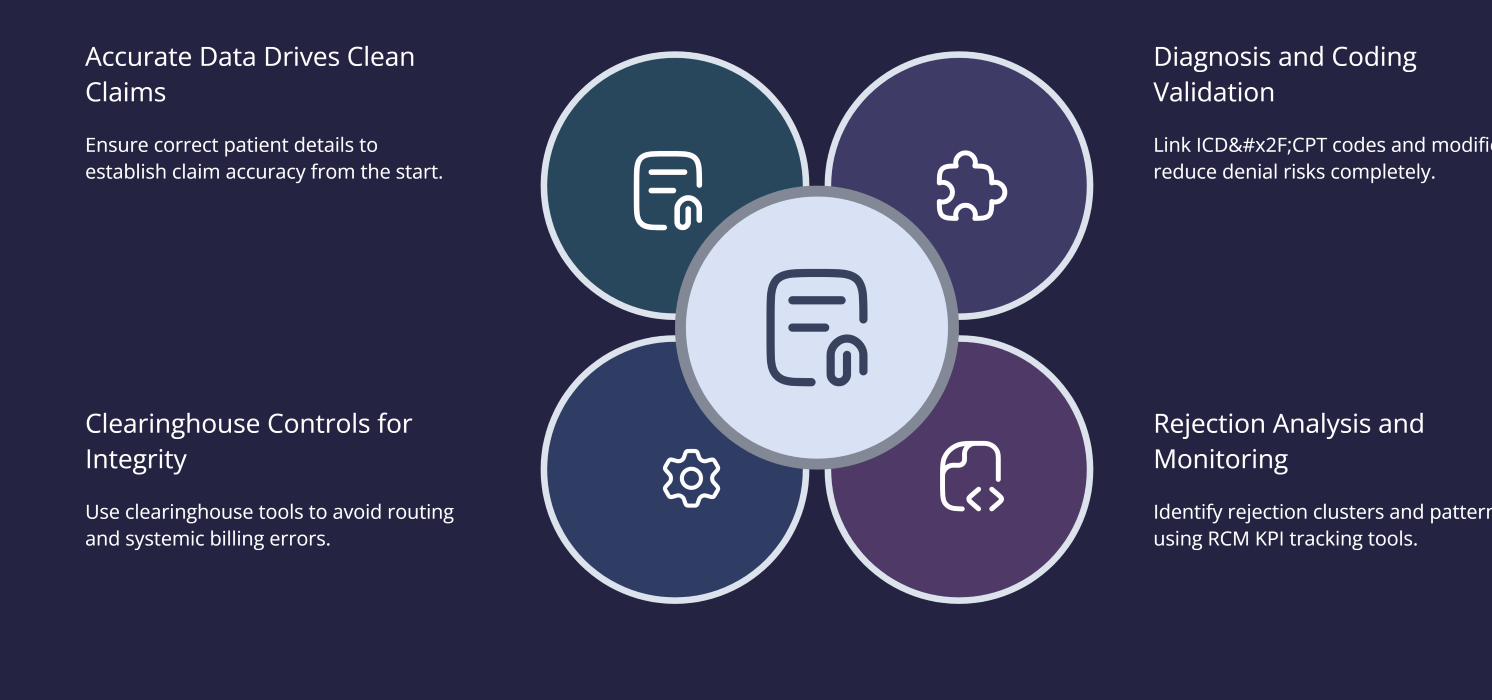
A claim that’s “almost correct” is the most expensive kind—because it generates rejection cycles, manual fixes, and delayed payment while inching toward timely filing limits. Claim submission accuracy is a system: clean data + routing integrity + edit discipline + fast rejection resolution. Build shared operational language using the medical claims submission terminology guide and infrastructure awareness from the clearinghouse terminology guide.
Clearinghouse problems are “systemic reimbursement errors”
When payer IDs change, endpoints shift, or attachments stop passing through, your whole pipeline can break while staff keeps “working harder.” That’s why you need monitoring by payer: rejection volume, rejection reason clusters, and days-to-first submission—all defined consistently using RCM KPIs. When something spikes, you troubleshoot routing using the clearinghouse guide, not by guessing.
Clean claim is a measurable output, not a vibe
Your clean-claim process should explicitly validate: patient identifiers, provider mapping, ICD/CPT logic, modifier support, auth placement, and COB correctness. If you need a “why” language for rejection/denial patterns, use remittance vocabulary from the EOB and map downstream reasons through CARCs. Reimbursement accuracy improves when rejections become rare, predictable, and quickly corrected—before they age.
Tie submission discipline to reimbursement benchmarks
Even if your payer mix is commercial-heavy, your team benefits from understanding reimbursement mechanics through standardized reference points like Medicare reimbursement fundamentals and physician fee schedule terms. Not because Medicare is “the same,” but because it trains staff to think in allowed amounts, adjustments, and payment logic—skills that translate directly when you audit underpayments.
5) Remittance Accuracy: Posting, Denials, Underpayments, and the Revenue-Recovery Loop
Reimbursement isn’t accurate until you verify the payment is correct and posted correctly. Many organizations “post and move on,” which hides underpayments, misapplies patient responsibility, and destroys the signal you need to improve upstream processes. Remittance accuracy starts with standardized interpretation of the EOB and consistent translation of adjustment language via CARCs and RARCs.
Posting errors are reimbursement errors
If your staff posts contractual adjustments incorrectly, underpayments get buried, patient balances get inflated, and AR becomes meaningless. Standardize posting rules using the EOB guide plus code dictionaries like CARCs and RARCs. Then trend the outcomes using standardized RCM metrics & KPIs so your numbers drive operational fixes, not debate.
Denials should reduce over time—or your process isn’t learning
Every denial category should map back to a control you can strengthen:
eligibility/COB control via COB rules
medical necessity control via medical necessity criteria and CDI prompts
submission integrity via claim submission terms and clearinghouse terms
coding/edit discipline via edits and modifiers
That loop is what stops repeat denials, reduces AR aging, and stabilizes cash.
Underpayment detection is where “accuracy” becomes profit
Underpayments often look like normal contractual adjustments until you compare paid vs expected allowed. You don’t need perfect contract tech to start; you need focus:
top payers + top CPTs
variance thresholds
escalation templates and documentation
Train staff on allowed-amount logic using physician fee schedule terms and broad reimbursement mechanics from Medicare reimbursement. Then build a monthly “leakage review” using revenue leakage prevention so recoveries aren’t random—they’re operationalized.
6) FAQs: Accurate Medical Billing & Reimbursement (High-Value Answers)
-
-
Make medical necessity a checklist and documentation standard, not a coder judgment call. Build service-line checklists from medical necessity criteria and deploy consistent prompts using the CDI terms dictionary. Then verify progress by tracking denial reasons in CARCs.
-
A denial problem is a payer decision (often reason-coded) that requires correction/appeal. A posting problem is an internal error that misassigns responsibility or hides patterns—making everything else harder. Standardize interpretation and posting using the EOB guide and map adjustments with CARCs + RARCs.
-
Build a pre-bill validation checklist and monitor first-pass acceptance by payer. When rejections spike, troubleshoot routing/formatting via the clearinghouse terminology guide and standardize data definitions using the claim submission guide. Track outcomes with RCM KPIs.
-
Reconcile clinical activity to charges and look for patterns: missed units, missing add-ons, and services that appear in documentation but not in billing. Use the charge capture terms and institutionalize monthly reviews using revenue leakage prevention.
-
Start small: top payers + top CPTs, compare paid allowed to historical baselines, and flag anomalies. Train staff to understand allowed amount logic using physician fee schedule terms and broad reimbursement mechanics using Medicare reimbursement. Tie recoveries to a monthly “leakage” workflow using leakage prevention.
-
Clean claim rate, rejection rate by payer, denial rate by root-cause category, appeal win rate, underpayment recovery rate, and days-to-first submission. Use standardized definitions from the RCM metrics & KPIs glossary so the team can’t “win” by changing definitions instead of fixing processes.
