
Medical Coding Practice Cases: 50 Outpatient Scenarios With Answers & Rationales
Outpatient coding becomes difficult when documentation forces several decisions at once: what condition is established, what stays uncertain, which diagnosis belongs first, whether a procedure is separately reportable, and whether a modifier is actually defensible. These 50 cases are designed to train those decisions rather than reward code memorization. They are useful alongside a disciplined CPC exam study plan, targeted CPC practice questions, stronger medical terminology preparation, and realistic medical coding interview tests.
Coding note: These are educational scenarios with CPT service descriptions paraphrased. Always verify the code set applicable to the date of service, current NCCI edits, payer policy, documentation, and medical necessity. As of September 2026, FY2026 ICD-10-CM files apply through September 30, 2026; FY2027 files take effect October 1, 2026.

1. How to Work These 50 Outpatient Coding Cases Like a Real Coder
Treat each scenario as a miniature chart. Before reading the answer, identify five elements: reason for encounter, confirmed condition, unresolved condition, services actually performed, and documentation that changes coding. This approach matters whether you are learning professional-fee versus facility coding, deciding between inpatient and outpatient coding, or building enough practical reasoning for your first medical coding job.
Outpatient diagnosis coding has one particularly important trap: diagnoses documented as probable, suspected, questionable, rule-out, or similar uncertain language are coded to the highest degree of certainty available for that encounter, such as symptoms, signs, abnormal findings, or another documented reason for the visit. This distinction deserves dedicated practice because candidates moving from CPC preparation into coding productivity expectations eventually need to make these decisions quickly without converting speed into unsupported coding.
For every wrong answer, classify the failure. Did you miss documentation? Choose an unspecified code when specificity existed? Code a suspected diagnosis? Misread an E/M scenario? Ignore an NCCI issue? Append a modifier automatically? That error analysis is far more valuable than simply completing another 50 questions. Students recovering from a failed CPC attempt should especially record the reasoning behind each miss, while career changers with no healthcare background should flag terminology or anatomy gaps separately from coding-rule gaps.
Outpatient Coding Practice Map: 30 Decisions You Must Learn to Make
| Decision Point | What the Coder Must Determine | Common Error | Best Practice Action |
|---|---|---|---|
| Reason for visit | What chiefly drove today's services | Coding every problem equally | Identify the encounter's clinical focus first |
| Confirmed diagnosis | Whether the provider established the condition | Promoting suspicion into certainty | Read the final assessment language carefully |
| Uncertain diagnosis | Whether outpatient uncertainty rules apply | Coding “rule out” disease | Report the highest established certainty |
| Symptom coding | Whether a symptom remains reportable | Adding routine symptoms to confirmed disease | Check whether the symptom is integral |
| First-listed diagnosis | Which condition chiefly explains the services | Choosing the most severe historical diagnosis | Follow encounter purpose and coding guidelines |
| Specificity | Whether site, laterality, stage, or type is documented | Using unspecified too early | Extract every supported detail before lookup |
| Index lookup | Correct main term and subterm | Jumping straight to a remembered code | Start through the Alphabetic Index |
| Tabular verification | Instructions affecting final assignment | Stopping after index lookup | Verify notes, characters, and exclusions |
| Diabetes manifestation | Whether a complication changes the diabetes code | Defaulting to uncomplicated diabetes | Identify the documented manifestation |
| CKD stage | Whether stage is documented | Omitting the stage code | Capture CKD relationship and stage |
| History vs active disease | Whether disease currently exists | Coding treated cancer as active | Separate current disease from history |
| Screening | Whether the patient is asymptomatic | Using screening codes for diagnostic workups | Determine why the test was ordered |
| Preventive visit | Preventive service versus problem management | Combining unrelated work into one service | Separate preventive and problem documentation |
| E/M level | Supported MDM or qualifying time | Choosing a level from diagnosis count alone | Apply current E/M criteria |
| Modifier 25 | Whether E/M work is separately identifiable | Appending 25 whenever a procedure occurs | Prove separate E/M work in documentation |
| Modifier 59/XS | Whether procedures are genuinely distinct | Using a modifier only to force payment | Document the distinct site or circumstance |
| Modifier 91 | Why a lab test was repeated | Using it for equipment or specimen problems | Confirm medical necessity for repeat testing |
| Modifier 24 | Whether postoperative E/M work is unrelated | Using 24 for routine follow-up | Establish a separate unrelated condition |
| Bilateral procedure | Correct bilateral reporting method | Automatically billing two units | Check code and payer reporting rules |
| Bundling | Whether one service is integral to another | Unbundling every documented task | Check current NCCI edits |
| Lab panels | Whether a panel code applies | Billing panel components redundantly | Compare performed tests with panel requirements |
| ECG components | Who owns tracing and interpretation | Reporting the global code without both components | Match code to actual service components |
| Drug administration | Administration service versus drug product | Reporting only one element | Review both administration and supply coding |
| Vaccination | Product, administration, and diagnosis requirements | Using only the vaccine product code | Verify payer-specific vaccine rules |
| Diagnostic test | Whether a final interpreted diagnosis exists | Keeping pre-test symptoms after definitive result | Use final interpretation available at coding |
| BMI reporting | Whether related diagnosis and BMI are documented | Coding BMI as a standalone disease | Connect BMI reporting to documented condition |
| Nicotine use | Current dependence versus former use | Using history code for active smoking | Read current status precisely |
| Aftercare | Whether encounter is treatment, surveillance, or aftercare | Reusing the original acute diagnosis | Code the current encounter purpose |
| Preoperative exam | Whether the encounter is chiefly preprocedural | Listing the surgical condition first automatically | Apply preprocedural sequencing guidance |
| Medical necessity | Whether diagnosis supports billed service | Treating a correct code as automatically payable | Check coverage and payer policy separately |
2. Outpatient Practice Cases 1–15: Diagnosis Selection, Symptoms, Chronic Disease, and Specificity
Case 1: Acute Cough With No Established Cause
A patient has coughed for five days. Examination is unrevealing. The physician documents acute cough and states that a viral illness is possible.
Answer: R05.1, Acute cough.
Rationale: The possible viral illness remains uncertain. Report the established symptom to the highest supported specificity. This is a core distinction for candidates practicing CPC diagnosis questions, developing medical terminology skills, or preparing for coding interview assessments.
Case 2: Chest Pain With Negative Initial Workup
A patient presents with chest discomfort. The physician does not establish a cardiac, gastrointestinal, or musculoskeletal cause and documents chest pain, unspecified.
Answer: R07.9.
Rationale: Code the symptom actually established during the encounter. A suspected cardiac disorder cannot replace it. This distinction matters in outpatient coding careers, professional-fee coding, and eventual coding audit work.
Case 3: Dysuria With “Possible UTI”
The patient reports painful urination. Urinalysis is ordered, and the provider writes “possible UTI.”
Answer: R30.0, Dysuria, based on the information available at the visit.
Rationale: “Possible” does not establish the infection in an outpatient encounter. Code the confirmed symptom. This type of decision often separates superficial memorization from the reasoning tested in CPC exam preparation, medical coding interviews, and first-job coding assessments.
Case 4: Provider Diagnoses Acute Pharyngitis
The patient has sore throat and congestion. The rapid strep test is negative. The provider's final assessment is acute pharyngitis, unspecified.
Answer: J02.9.
Rationale: The provider established pharyngitis, so coding the symptom alone would understate the documented diagnosis. Learners who repeatedly miss this distinction should add it to a personalized medical coding study plan and practice it alongside CPC question explanations.
Case 5: Acute Upper Respiratory Infection
A patient has congestion, rhinorrhea, and cough. The provider documents acute upper respiratory infection, unspecified.
Answer: J06.9.
Rationale: The documented diagnosis controls. Routine signs and symptoms generally are not separately coded when they are integral to the established condition. Understanding that relationship helps with CPC exam success, coding interview preparation, and high-accuracy work under medical coding productivity standards.
Case 6: Essential Hypertension Follow-Up
An established patient returns for management of documented essential hypertension without a more specific hypertensive condition.
Answer: I10.
Rationale: The record establishes essential hypertension and gives no supported hypertensive complication requiring a different assignment. When practicing chronic-disease cases, connect diagnosis selection with physician reimbursement fundamentals, professional-fee coding, and medical billing versus coding workflows.
Case 7: Type 2 Diabetes Without Documented Complication
The provider documents type 2 diabetes mellitus, controlled, with no manifestation or complication documented.
Answer: E11.9.
Rationale: Do not manufacture a complication from medication use, laboratory history, or assumptions. Coding must follow supported documentation. That discipline becomes especially important in risk adjustment coding, coding auditing, and higher-level medical coding specialties.
Case 8: Type 2 Diabetes With Hyperglycemia
The assessment states type 2 diabetes with hyperglycemia.
Answer: E11.65.
Rationale: The combination code captures diabetes with hyperglycemia. Adding an unrelated generic hyperglycemia code would duplicate what the diabetes code already communicates. Combination-code reasoning is particularly valuable for risk adjustment careers, CPC exam practice, and eventual auditing responsibilities.
Case 9: Type 2 Diabetes With CKD Stage 3a
The provider documents type 2 diabetes and CKD stage 3a.
Answer: E11.22 + N18.31.
Rationale: The diabetes code captures the diabetic CKD relationship, while the additional CKD code identifies the documented stage. Students who want to progress from general outpatient work into higher-paying coding specialties, risk adjustment, or medical coding auditing need to become comfortable with multi-code relationships like this.
Case 10: Hyperlipidemia Without Further Specification
The assessment documents hyperlipidemia without specifying a type.
Answer: E78.5.
Rationale: Use the specificity the record supports. An unspecified code can be correct when the documentation itself lacks a more precise diagnosis. This principle prevents students from over-interpreting charts while preparing for CPC practical questions, coding interviews, and real-world coding productivity pressure.
Case 11: Acquired Hypothyroidism, Unspecified
The physician lists hypothyroidism and provides no more specific type.
Answer: E03.9.
Rationale: Avoid assigning an etiology the provider never established. The habit of separating chart facts from assumptions is critical for candidates entering coding with no healthcare experience, clinicians moving from nursing into medical coding, and professionals transitioning from medical assisting into coding.
Case 12: GERD Without Esophagitis
The provider documents gastroesophageal reflux disease without esophagitis.
Answer: K21.9.
Rationale: Select the diagnosis that matches the documented disease and its stated complication status. Students should practice extracting such qualifiers quickly because medical coding jobs can combine accuracy requirements with charts-per-hour targets and formal audit review.
Case 13: Unspecified Constipation
The clinician documents constipation without an identified subtype or cause.
Answer: K59.00.
Rationale: Code the established condition to documented specificity. Avoid inventing a subtype from symptoms or treatment. This same evidence-first discipline supports stronger CPC exam performance, better coding interview test performance, and defensible outpatient coding.
Case 14: Low Back Pain Without Additional Specificity
An office patient reports low back pain. No sciatica or other specific condition is documented.
Answer: M54.50.
Rationale: A more specific neurological or structural diagnosis requires actual documentation. Practice resisting assumptions while working through CPC study material, medical terminology concepts, and real coding assessments.
Case 15: Right Knee Pain
The patient presents with right knee pain. No arthritis, injury, or other definitive condition is established.
Answer: M25.561.
Rationale: Laterality is available, so preserve it. Small specificity details frequently separate a defensible claim from an avoidable coding error, especially under productivity expectations, coding audit review, and medical coding interview tests.
3. Outpatient Practice Cases 16–25: E/M Levels, Office Procedures, and Diagnostic Testing
Case 16: Stable Hypertension Follow-Up
An established patient returns for routine hypertension management. The condition is stable, no extensive data are reviewed, and documentation supports low medical decision making.
Answer: 99213 + I10.
Rationale: Choose office E/M level from current MDM or qualifying time rules, rather than diagnosis count. Learning that distinction is essential for professional-fee coding, understanding the physician fee schedule, and avoiding downstream claim adjustment problems.
Case 17: Diabetes With Hyperglycemia and Medication Adjustment
An established patient has type 2 diabetes with hyperglycemia. The clinician adjusts prescription medication, and the overall record supports moderate MDM.
Answer: 99214 + E11.65.
Rationale: The E/M level follows the documented MDM framework, while the diagnosis reflects diabetes with hyperglycemia. This type of two-layer reasoning frequently appears in coding interview tests, CPC questions, and professional coding roles.
Case 18: New Patient With Uncomplicated Allergic Rhinitis
A new patient is evaluated for uncomplicated allergic rhinitis. Documentation supports low MDM.
Answer: 99203 + J30.9.
Rationale: New-patient status changes the available E/M family, while the documented condition determines diagnosis coding. Students often benefit from combining CPT-focused study, CPC exam strategy, and coding interview practice when E/M families remain confusing.
Case 19: Preventive Visit Plus Separately Managed Hypertension
A 45-year-old established patient receives a preventive examination. During the same visit, the physician separately evaluates worsening hypertension and changes therapy. Documentation clearly separates the problem-oriented work.
Answer: 99396 plus the supported problem-oriented E/M code with modifier 25, such as 99214-25 when moderate MDM is met.
Rationale: The separate problem service must stand on its own clinically and documentationally. Modifier 25 belongs on the E/M service. CMS likewise requires a significant, separately identifiable E/M service when modifier 25 is used. Understanding this avoids common denial-management problems, professional-fee coding errors, and audit exposure.
Case 20: Medicare Subsequent Annual Wellness Visit Plus Problem E/M
An eligible Medicare beneficiary receives a subsequent annual wellness visit. The clinician also performs a significant, separately identifiable evaluation of a new symptomatic problem.
Answer: G0439 plus the supported office E/M code with modifier 25.
Rationale: Documentation must support both services individually. Medicare recognizes separately identifiable medically necessary E/M work alongside qualifying preventive services under applicable rules. This scenario connects Medicare reimbursement knowledge, medical billing concepts, and denial prevention.
Case 21: Rapid Strep Test
A patient with acute pharyngitis receives a rapid streptococcal antigen test in the office.
Answer: 87880 for the test, plus the appropriate diagnosis such as J02.9 when that is the provider's documented assessment. Report an E/M service only when its requirements are independently met.
Rationale: A diagnostic test does not automatically erase or guarantee a separately payable visit. Understanding service components helps students studying CPT principles, claims submission, and medical billing concepts.
Case 22: Office ECG for Palpitations
A patient presents with palpitations. The practice performs the ECG tracing and the physician provides the interpretation and report.
Answer: 93000 + R00.2, assuming all global-code components are performed and documented.
Rationale: If the practice supplies only the tracing or only the professional interpretation, the appropriate component code changes. This is precisely the kind of operational detail that matters in professional-fee coding, physician reimbursement, and coding interview tests.
Case 23: Nebulizer Treatment During Asthma Exacerbation
The provider documents asthma with acute exacerbation and administers an inhalation treatment in the office.
Answer: 94640 may describe the inhalation treatment when its requirements are met, with the appropriate asthma diagnosis, such as J45.901 when the provider documents unspecified asthma with acute exacerbation.
Rationale: Report an additional E/M only when separately supported. This makes a useful modifier-25 drill for CPC preparation, professional coding, and coding audit preparation.
Case 24: Nonautomated Urine Dipstick Without Microscopy
A physician evaluates dysuria and performs a manually read urine dipstick without microscopy.
Answer: 81002 + R30.0, assuming the described test was actually performed.
Rationale: The method matters. Automated and nonautomated urinalysis services do not share the same coding pathway. Students who struggle with subtle procedural differences should strengthen CPT navigation, CPC exam strategy, and practical coding-test skills.
Case 25: Office Venipuncture
Blood is drawn by venipuncture during an outpatient encounter and sent for ordered laboratory testing.
Answer: 36415 may be reportable for collection when payer rules and service circumstances permit; the laboratory tests themselves require their own supported coding.
Rationale: Collection and testing represent different services. Understanding that distinction is useful when studying electronic claims submission, billing solutions for medical practices, and claim adjustment reason codes.
4. Outpatient Practice Cases 26–40: Modifiers, NCCI Logic, Preventive Services, and Laboratory Coding
Case 26: Separate E/M Service With a Minor Procedure
An established patient presents for evaluation of a new skin complaint. After a medically necessary evaluation, the physician performs a minor procedure. Documentation demonstrates significant work beyond the usual pre- and post-procedure activity.
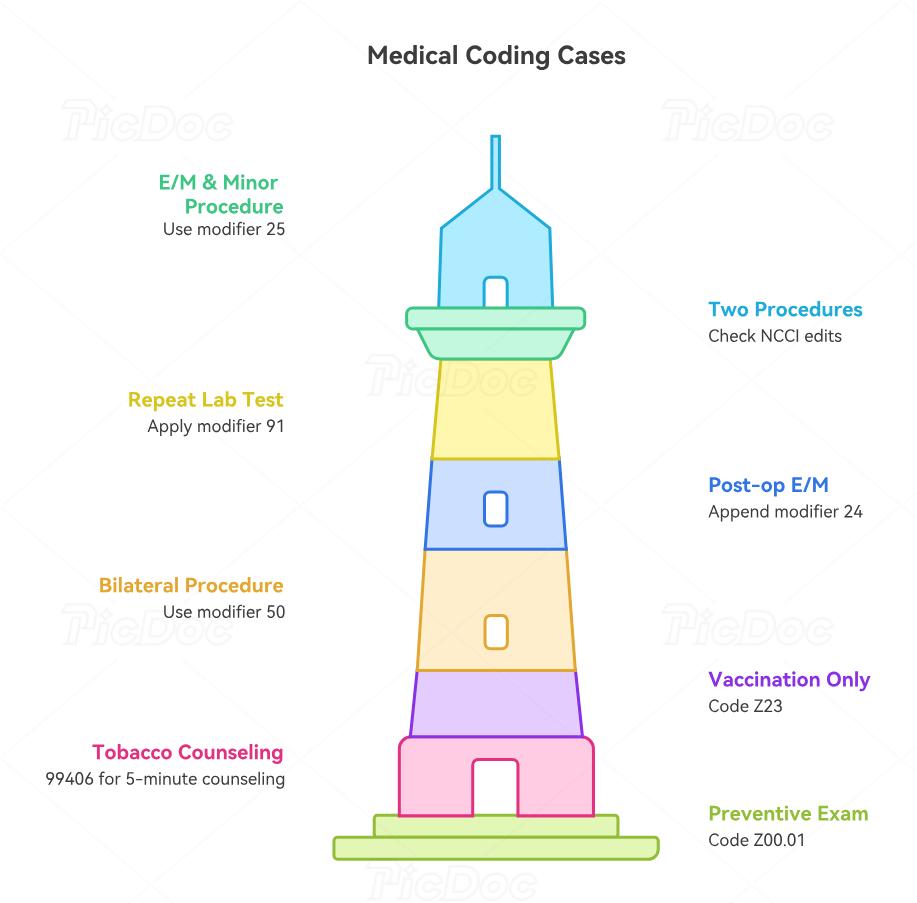
Answer: Report the supported E/M code with modifier 25 plus the procedure when all requirements are met.
Rationale: Modifier 25 belongs on the E/M line and requires separately identifiable work. Routine procedure-related assessment cannot justify it. CMS's 2026 NCCI guidance continues to require clinical circumstances supporting modifiers rather than using them merely to bypass edits. This is essential knowledge for denial management, coding auditing, and professional-fee coding.
Case 27: Two Procedures at Separate Anatomic Sites
Two procedure codes normally trigger an NCCI edit when performed together. The record clearly shows medically necessary procedures on separate anatomic sites.
Answer: Check the current NCCI PTP edit and modifier indicator. When the edit permits a modifier and the circumstances support separate structures, XS may be more specific for Medicare than generic modifier 59; payer rules must be verified.
Rationale: A modifier cannot manufacture distinctness. CMS identifies separate encounters, sites, or other qualifying circumstances as potential bases for appropriate NCCI-associated modifiers. This is high-value preparation for medical coding audits, denial work, and coding interview assessments.
Case 28: Medically Necessary Repeat Laboratory Test
A laboratory test produces a valid result. Later the same day, the patient's changing clinical condition makes repeating the same test medically necessary.
Answer: Modifier 91 may apply to the repeat clinical laboratory test when its requirements are met.
Rationale: Modifier 91 is not a repair tool for equipment failure, specimen problems, or needless confirmation of a valid result. CMS specifically distinguishes medically necessary repeat testing from those situations. This distinction helps prevent claim denials, confusing adjustment reason codes, and weak audit documentation.
Case 29: Unrelated E/M During a Postoperative Global Period
A patient is within the global period of surgery performed by the same physician. The patient now presents for an unrelated medical condition, and the physician performs a separately documented E/M service.
Answer: Append modifier 24 to the appropriate E/M service when its requirements are satisfied.
Rationale: The record must establish that the E/M service is unrelated to postoperative care. Routine surgical follow-up belongs within the global package. This distinction matters for physician reimbursement, professional-fee coding, and medical coding audit work.
Case 30: Bilateral Procedure
A physician performs a surgical procedure on both paired structures during the same session, and the applicable code is eligible for bilateral reporting.
Answer: For Medicare practitioners and outpatient hospitals, modifier 50 with one unit on one claim line generally applies when the code itself does not already describe a bilateral procedure. Confirm the individual code and payer requirements. CMS states this reporting framework in its 2026 NCCI manual.
Rationale: Bilateral coding is a reporting rule, not a reason to blindly duplicate lines. Understanding these details separates entry-level memorization from stronger professional-fee coding, claims-management knowledge, and audit capability.
Case 31: Vaccination-Only Encounter
A patient arrives specifically to receive a vaccine, and there is no separately documented illness evaluation.
Answer: Z23 is the diagnosis for an encounter for immunization. Report the applicable vaccine product and administration coding according to the vaccine, patient circumstances, and payer rules.
Rationale: Product and administration are separate coding considerations. Understanding that distinction strengthens medical billing knowledge, professional coding skills, and claims submission accuracy.
Case 32: Five Minutes of Documented Tobacco-Cessation Counseling
A current cigarette smoker receives five documented minutes of qualifying cessation counseling.
Answer: 99406 may be appropriate for qualifying intermediate tobacco-cessation counseling, with a diagnosis such as F17.210 when current uncomplicated cigarette nicotine dependence is documented. Verify coverage criteria.
Rationale: Time thresholds and patient status matter. A former smoker would require different diagnosis logic. This makes a useful cross-training case for billing concepts, CPT preparation, and outpatient coding.
Case 33: Preventive Exam With Newly Identified Elevated Blood Pressure
An adult preventive examination identifies elevated blood pressure. The physician does not diagnose hypertension.
Answer: Z00.01 for an adult general examination with abnormal findings, plus R03.0 for elevated blood-pressure reading without a hypertension diagnosis when documentation supports it.
Rationale: Avoid upgrading one elevated reading into essential hypertension. Accurate documentation interpretation matters in risk adjustment coding, coding audits, and CPC exam questions.
Case 34: Colorectal Cancer Screening With FIT
An asymptomatic average-risk patient receives a fecal immunochemical screening test for colorectal cancer.
Answer: Z12.11 supports the screening indication, with 82274 commonly used for the qualifying immunochemical fecal occult blood test when the service performed matches the code.
Rationale: Screening status matters because symptoms could turn the encounter into diagnostic evaluation instead. Students should practice linking diagnosis intent with reimbursement rules, electronic claims submission, and denial management.
Case 35: Screening Mammography
An asymptomatic patient undergoes routine screening mammography.
Answer: Z12.31 with 77067 when the performed mammography service meets that code's requirements.
Rationale: Once a patient presents with a breast symptom or known abnormality for evaluation, diagnostic coding logic changes. The ability to distinguish screening from diagnostic services is useful in professional-fee coding, outpatient coding, and claims denial prevention.
Case 36: CBC and Comprehensive Metabolic Panel for Fatigue
The clinician evaluates persistent fatigue and orders a CBC with differential and a complete metabolic panel. Both panels are actually performed.
Answer: R53.83 may support the documented symptom, with 85025 and 80053 for the performed tests when all code requirements are met.
Rationale: Report the actual panels performed and avoid separately billing included components without a valid coding reason. Panel logic is useful for CPT study, billing concepts, and NCCI-aware audit work.
Case 37: Lipid Panel for Known Hyperlipidemia
A patient with established hyperlipidemia undergoes an ordered lipid panel for disease management.
Answer: 80061 + E78.5, assuming the panel performed meets code requirements.
Rationale: Because the patient already has the disease, this encounter differs from an asymptomatic lipid screening. Distinguishing screening from disease monitoring helps with physician reimbursement, medical billing concepts, and claim denial analysis.
Case 38: Hemoglobin A1c During Diabetes Management
A type 2 diabetic patient receives a hemoglobin A1c test during routine disease monitoring.
Answer: 83036 with the appropriate diabetes diagnosis, such as E11.9 when no complication is documented.
Rationale: The diagnosis must reflect the patient's actual diabetes status rather than automatically using uncomplicated diabetes for every patient. This matters in risk adjustment work, medical coding audits, and higher-paying coding specialties.
Case 39: Office Urine Pregnancy Test
A patient presents with amenorrhea. A urine pregnancy test is performed in the office.
Answer: 81025 for the test, with an appropriate documented reason such as N91.2 when amenorrhea is the established condition and pregnancy status has not yet supplied another coding pathway.
Rationale: Code the actual reason for testing and then account for definitive results or subsequent diagnoses as appropriate. This reinforces skills used in outpatient coding, CPC practice, and professional coding interviews.
Case 40: Urine Culture for Dysuria Before UTI Is Confirmed
A patient has dysuria. The physician orders a urine culture and documents suspected UTI. The infection remains unconfirmed at coding time.
Answer: 87086 may represent the culture performed, with R30.0 as the established symptom when appropriate.
Rationale: The suspected infection remains uncertain in the outpatient setting. This scenario combines diagnostic service coding with the outpatient uncertainty rule and is excellent preparation for CPC exams, coding interview tests, and outpatient professional coding.
5. Outpatient Practice Cases 41–50: Advanced Mixed Scenarios and Documentation Traps
Case 41: “Rule Out Pneumonia” With Cough and Fever
The physician documents “rule out pneumonia.” At coding time, no definitive interpretation establishes pneumonia. The patient has documented acute cough and fever.
Answer: R05.1 + R50.9, sequenced according to the circumstances of the encounter.
Rationale: The uncertain pneumonia diagnosis does not become reportable simply because diagnostic testing was ordered. This frequently tested outpatient rule should be mastered through CPC practice questions, CPC exam preparation, and coding interview scenarios.
Case 42: Chest X-Ray Interpretation Confirms Pneumonia
The same patient undergoes outpatient chest imaging. The physician's final interpreted report available at coding confirms pneumonia.
Answer: J18.9 when pneumonia, unspecified organism, is the documented definitive diagnosis.
Rationale: For outpatient diagnostic tests interpreted by a physician with the final report available at coding, a confirmed diagnosis from the interpretation can govern rather than the pre-test symptoms. Routine symptoms explained by the definitive disease generally are not separately reported. This is a high-value distinction for outpatient coding, coding audits, and practical coding tests.
Case 43: Breast Cancer Treated Years Ago With No Current Disease
A patient previously completed treatment for breast cancer. The physician documents no current malignancy and lists the cancer only as personal history.
Answer: Z85.3.
Rationale: Active malignancy coding would misrepresent the current clinical status. Distinguishing historical from active conditions is particularly important for risk adjustment coding, coding audit work, and specialty coding advancement.
Case 44: Current Cigarette Nicotine Dependence
The provider documents that the patient currently smokes cigarettes and has nicotine dependence without a stated complication.
Answer: F17.210.
Rationale: A former-smoker history code would misstate current dependence. Status distinctions carry consequences in disease documentation, risk adjustment, professional coding, and medical coding audits.
Case 45: Obesity With Documented BMI of 34
The physician documents obesity. The chart records an adult BMI of 34.
Answer: E66.9 for documented obesity plus the applicable Z68.34 BMI code when current guidelines and documentation requirements support reporting it.
Rationale: The BMI code supplements the diagnosed condition. A number in the vitals section should not be treated as an independent substitute for a provider's obesity diagnosis. This type of documentation hierarchy matters in risk adjustment careers, coding audits, and coding interview evaluations.
Case 46: Hypertension With CKD Stage 3a
The physician documents hypertension and chronic kidney disease stage 3a.
Answer: I12.9 + N18.31, assuming the documented circumstances support hypertensive CKD coding and no more specific category applies.
Rationale: CKD stage requires additional specificity. When diabetes is also present, additional combination-code logic may enter the case. These layered relationships are valuable preparation for risk adjustment coding, higher-level coding specialties, and medical coding auditor roles.
Case 47: Encounter for Suture Removal
A patient returns after a previously treated laceration solely for scheduled suture removal. No complication is present.
Answer: Z48.02.
Rationale: The purpose of today's encounter controls. Reusing the original acute injury as though active treatment were still occurring can misrepresent the service. Encounter-purpose reasoning strengthens CPC exam performance, outpatient coding skills, and medical coding interview performance.
Case 48: Follow-Up After Completed Treatment
A patient returns after treatment of an illness has finished. The clinician performs surveillance and documents no recurrence.
Answer: Consider Z09 when the encounter meets follow-up examination requirements, together with the appropriate personal-history code when applicable.
Rationale: Follow-up coding requires completed treatment and absence of active disease requiring further treatment. Students should distinguish this from aftercare, active treatment, and routine chronic-disease management while working through CPC practice, coding study plans, and outpatient coding careers.
Case 49: Routine Gynecological Examination Without Abnormal Findings
An adult patient receives a routine gynecological examination, and the provider documents no abnormal findings.
Answer: Z01.419.
Rationale: The presence or absence of abnormal findings changes the encounter code selection. Fine distinctions such as these reward careful chart reading and can improve performance in CPC exam questions, medical coding interview tests, and high-volume outpatient coding jobs.
Case 50: Preoperative Medical Examination
A patient is seen specifically for a preoperative medical evaluation before planned surgery. The underlying condition requiring surgery remains documented.
Answer: Z01.818 may be first-listed for an encounter for other preprocedural examination, followed by the diagnosis explaining the planned surgery and any additional conditions evaluated when applicable.
Rationale: The reason for today's encounter determines sequencing. This final case combines encounter purpose, diagnosis hierarchy, and medical-necessity thinking, all of which become important when moving from CPC certification toward professional-fee coding, coding audits, and more advanced medical coding specialties.
6. FAQs About Outpatient Medical Coding Practice Cases
-
Master the uncertain-diagnosis rule early. Outpatient coders frequently see “possible,” “suspected,” “rule out,” and similar language. These diagnoses are not coded as established conditions; the coder reports the highest degree of certainty available for that encounter.
Practice this alongside CPC exam questions, a structured CPC study plan, strong medical terminology skills, and realistic coding interview assessments. One poorly understood uncertainty rule can contaminate dozens of otherwise straightforward cases.
-
Complete the cases once without answers, classify every miss, and repeat only missed concepts through fresh scenarios. Separate knowledge errors, navigation errors, documentation errors, modifier errors, E/M errors, and time-pressure errors. Candidates recovering from a failed CPC exam gain much more from root-cause analysis than repeated full tests.
Combine case work with a lean 2026 CPC preparation stack, AMBCI's first-attempt CPC strategy, focused CPC practice questions, and a realistic exam-day checklist.
-
Use modifier 25 when a qualifying E/M service performed on the same date as another procedure or service is significant and separately identifiable. CMS specifically recognizes this requirement. The documentation should show work beyond what is normally inherent in the procedure.
Appending modifier 25 automatically because two codes appear on the same date creates denial and audit risk. Coders who want deeper preparation should connect modifier practice with professional-fee coding, denial management, physician reimbursement, and coding audit careers.
-
The dangerous mistake is treating modifier 59 as a universal “unbundle” switch. CMS states that NCCI-associated modifiers should be used only when clinical circumstances genuinely justify them, and a modifier cannot be appended solely to bypass an NCCI PTP edit.
Before applying one, check the current edit, the modifier indicator, the actual sites or encounters, and whether a more specific modifier describes the circumstances. These skills directly support denial prevention, CARC interpretation, coding auditing, and advanced professional-fee coding.
-
Memorize frequently encountered structures, conventions, and decision logic while training yourself to find and verify codes efficiently. A coder who remembers a code number and skips the Alphabetic Index, Tabular List, CPT notes, NCCI edits, or payer policy can produce a confident error.
Use CPT-focused study, CPC preparation strategies, medical terminology practice, and coding interview tests to train retrieval and verification together. Workplace coding rewards reproducible accuracy far more than impressive recall.
-
Track four measures: accuracy, navigation speed, reasoning quality, and error recurrence. Then add real-world complications such as incomplete documentation, modifier decisions, payer edits, and competing diagnoses. That progression resembles the pressure new coders encounter in medical coding productivity quotas, practical interview tests, and eventual audit feedback.
After certification, strengthen your medical coding resume, research employers for new coders, and decide whether your next technical depth should come from inpatient or outpatient coding, risk adjustment, or another specialty.
