
Modifier 25 vs Modifier 59: Decision Tree + Real Coding Examples
Modifier errors often begin with a simple misunderstanding: 25 and 59 both signal separation, yet they prove entirely different kinds of separation. Modifier 25 concerns a separately identifiable E/M service; modifier 59 concerns distinct procedural services. Coders who work through CPC coding principles, prepare for medical coding interview tests, handle professional-fee coding, or move toward coding auditing need a repeatable decision process because the wrong modifier can trigger denials, repayments, and audit exposure.

1. Modifier 25 vs Modifier 59: Use This Decision Tree Before Touching the Claim
The fastest way to separate these modifiers is to identify what service needs to be distinguished.
Step 1: Is one of the services an E/M service?
If the disputed line is an office, outpatient, hospital, or other qualifying E/M service performed on the same date as another procedure or service, investigate modifier 25 first. This is especially important for coders studying CPT concepts for certification, candidates working through CPC practice questions, and professionals entering physician coding.
Ask:
Did the documentation support a medically necessary, significant, separately identifiable E/M service beyond the work normally associated with the procedure?
When the answer is supported by the record, modifier 25 belongs on the E/M code.
CMS's 2026 NCCI manual states that modifier 25 may be appended to an E/M code when that E/M service is significant and separately identifiable from other services reported on the same date. The E/M service can involve the same diagnosis as the procedure.
This distinction matters enormously. Diagnosis count cannot substitute for documented work. A patient may have one condition and still receive a separately reportable E/M service. A patient may also have several diagnoses while the E/M work remains entirely inherent to the procedure.
That is the kind of distinction that separates memorization from the reasoning employers test during coding interviews, coding productivity assessments, and eventual auditing work.
Step 2: Are you trying to distinguish two procedural services?
When the conflict involves two non-E/M procedures, move toward modifier 59 and the applicable NCCI edit analysis.
Ask four questions:
Is there an NCCI procedure-to-procedure edit?
Does the edit permit an NCCI-associated modifier when the circumstances qualify?
Were the services genuinely distinct by encounter, site, structure, lesion, procedure circumstances, or qualifying non-overlap?
Is a more specific modifier available?
CMS identifies modifier 59 as an NCCI PTP-associated modifier whose primary purpose is distinguishing procedures performed at separate anatomic sites or separate patient encounters. Documentation must support the clinical distinction, and the modifier should be used only when the circumstances justify overriding the edit.
This is why learning claim adjustment reason codes, denial management workflows, and electronic claims submission becomes valuable for coders. A modifier has consequences far downstream from code assignment.
Step 3: Determine whether an X modifier is more precise
CMS created the X{EPSU} modifiers to describe specific forms of distinctness:
XE — separate encounter
XS — separate structure
XP — separate practitioner
XU — unusual non-overlapping service
CMS says these modifiers may be used in place of modifier 59 whenever they provide the needed specificity.
A coder building stronger medical coding resume evidence should understand this layer because employers increasingly value reasoning around edits, documentation, and payer policy rather than raw code memorization. The same skill becomes especially important in inpatient versus outpatient career decisions and higher-level coding specialties.
| Coding Situation | Likely Direction | What Must Be Proven | Key Audit Question |
|---|---|---|---|
| 1. E/M plus minor procedure, same visit | Evaluate modifier 25 | Separate medically necessary E/M work | Did work exceed the usual procedure-related assessment? |
| 2. E/M only explains why procedure was performed | Usually procedure alone | Additional E/M work would need independent support | What work exists beyond procedural preparation? |
| 3. Established patient evaluated for separate problem before procedure | Modifier 25 may apply | Distinct assessment and management | Would the E/M stand on its documented work? |
| 4. New patient receives minor procedure | Apply same modifier 25 test | New-patient status alone carries no special separation | Was substantial E/M work separately necessary? |
| 5. Same diagnosis supports E/M and procedure | Modifier 25 can still qualify | Separate work, rather than separate diagnosis | Does documentation distinguish the services? |
| 6. Two diagnoses appear on same visit | Modifier depends on work performed | Clinical separation in documentation | Did a second diagnosis actually generate E/M work? |
| 7. E/M plus major-surgery decision | Evaluate modifier 57 | Decision for major surgery | Which global-surgery rule applies? |
| 8. Two procedures at same site, same encounter | Review bundling carefully | A qualifying distinct circumstance must exist | Is one service integral to the other? |
| 9. Two procedures at clearly separate structures | Consider XS or 59 | Different anatomic structures | Does the record identify each site? |
| 10. Procedures during separate encounters same day | Consider XE | Separate encounters | Can each encounter be independently established? |
| 11. Procedures performed by different practitioners | Consider XP when applicable | Practitioner distinction | Does payer policy recognize XP here? |
| 12. Unusual non-overlapping procedural work | Consider XU | Service did not overlap usual components | What exactly makes the work non-overlapping? |
| 13. Different procedure names, same operative work | Bundling may still control | True clinical distinctness | Are the procedures separate beyond their code titles? |
| 14. Separate lesions in different regions | 59 or XS may apply | Documentation of lesion location | Can each lesion and service be mapped? |
| 15. Two techniques used on one lesion | Review integral-service rules | Independent reportability | Were two distinct lesions actually treated? |
| 16. Diagnostic procedure leads to therapeutic procedure | Possible distinct-service exception | Diagnostic work independently informed treatment | Was the diagnostic service inherent to therapy? |
| 17. Diagnostic service occurs after therapy | Possible distinct-service exception | Independent post-treatment purpose | Was it routine procedural follow-up? |
| 18. Two timed services in distinct time blocks | 59/X modifier may apply | Separate documented time | Do time records prove non-overlap? |
| 19. Timed services overlap | Review units and bundling | Valid reportable time | Was any minute counted twice? |
| 20. Modifier added simply because claim denied | Re-review original documentation | Clinical justification existing on date of service | Would the modifier survive an audit? |
| 21. Separate diagnosis used to justify 59 | Diagnosis alone is insufficient | Separate site, encounter, or other valid distinction | What clinical fact separates the procedures? |
| 22. E/M code receives modifier 59 | Reassess modifier choice | E/M separation belongs under modifier 25 rules | Is the disputed service actually E/M? |
| 23. Procedure code receives modifier 25 | Reassess modifier placement | Modifier 25 attaches to qualifying E/M services | Which line represents the E/M service? |
| 24. Anatomical modifier already explains separation | Use specific modifier when appropriate | Correct site designation | Is a more precise modifier available? |
| 25. NCCI edit has modifier indicator 0 | Edit cannot be bypassed through an NCCI-associated modifier | Correct code combination | What does the current edit table permit? |
| 26. NCCI edit permits modifier under qualifying circumstances | Investigate 59/X modifier | Specific documented exception | Which exception exists in this record? |
| 27. Payer follows policy different from Medicare | Check payer-specific rules | Contract and payer guidance | Which rule governs this claim? |
| 28. Procedure note lacks location detail | Query before assuming separation | Specific site documentation | Can the distinction be proven from the record? |
| 29. E/M note duplicates procedure-related work | Modifier 25 support is weak | Independent assessment and management | What E/M work remains after procedure work is removed? |
| 30. Claim pays after modifier added | Audit logic still matters | Documented modifier criteria | Could the same claim survive post-payment review? |
2. Modifier 25: Prove That the E/M Service Stands Apart From the Procedure
Modifier 25 is fundamentally an E/M documentation test.
CMS's 2026 Medicare NCCI manual explains that minor procedures with 0- or 10-day global periods already contain normal pre-procedure, intra-procedure, and post-procedure work. Separate E/M reporting requires work that rises above those inherent services.
This is one reason coders who understand medical terminology, CPT coding principles, medical billing concepts, and professional-fee coding generally perform better than coders who rely on modifier shortcuts.
Consider an established patient who presents for knee pain. The physician evaluates the history, reviews relevant prior treatment, assesses whether symptoms have changed, considers medication response and treatment options, and decides that an injection is appropriate. The note then documents the injection.
The coding question is:
How much of that E/M work was medically necessary beyond the evaluation normally required to perform the injection?
An extensive-looking note does not automatically establish modifier 25. Template volume is weak evidence. Clinical work is the stronger evidence.
Now change the scenario. The same patient arrives for knee treatment and also reports a newly worsening unrelated condition that requires a separate history, examination, risk assessment, medication decision, or diagnostic plan. A separately reportable E/M service becomes considerably easier to defend when the record clearly demonstrates that work.
Coders experiencing accuracy and productivity pressure often get trapped by superficial indicators: two diagnoses, two sections in the note, or a provider statement saying “separately identifiable.” Stronger coding requires analyzing the actual work. That same reasoning protects coders during medical coding audits, reduces denial-management workload, and improves performance in coding assessment tests.
A useful modifier 25 audit test is:
Mentally remove the procedure note. What medically necessary E/M work remains?
If substantial documented assessment and management remain, continue evaluating modifier 25. If the remaining work merely establishes that the patient can receive the planned minor procedure, support becomes much weaker.
Different diagnoses can make the narrative easier to see, although CMS explicitly allows the E/M service and minor procedure to involve the same diagnosis.
New-patient status also deserves careful treatment. CMS states that being new to the provider does not independently justify a separate E/M service on the date of a minor procedure. A coder preparing through an online CPC program, recovering after a failed CPC attempt, or building a lean CPC study stack should learn the principle rather than associate modifier 25 automatically with new-patient visits.
One more high-risk distinction involves major surgery. When an E/M service results in the initial decision for major surgery, modifier 57 may be the relevant global-surgery modifier. Modifier selection therefore begins with the procedure's global status and circumstances, a level of reasoning that becomes increasingly important for specialty coders and future coding auditors.
3. Modifier 59: Prove Why Two Procedures Are Truly Distinct
Modifier 59 begins from a different problem: two procedure codes encounter a bundling relationship, while the actual clinical circumstances support separate reporting.
CMS describes modifier 59 as one of the most frequently misused NCCI-associated modifiers. For Medicare NCCI purposes, its central function is identifying distinct procedural services involving different anatomic sites or different encounters, subject to additional qualifying situations in NCCI policy.
The key word is distinct.
A pair of different code numbers does not create distinctness. A pair of diagnoses does not create it either. CMS specifically states that different diagnoses by themselves are inadequate criteria for modifiers 59, XE, or XS. The clinical circumstances must support the procedural separation.
This distinction matters in facility versus professional coding, higher-paying specialties, claims submission workflows, and denial management, where a modifier can directly affect adjudication.
Separate site
Suppose two ordinarily bundled procedures are performed on genuinely separate anatomic structures and the NCCI edit permits a modifier under those circumstances. Documentation should identify the exact structures and corresponding service performed at each site.
CMS says different anatomic sites can include different organs, different anatomic regions, or certain different lesions, while contiguous structures in the same organ or region do not automatically satisfy the distinction.
That is why vague documentation such as “multiple lesions treated” creates risk. An auditor needs enough information to connect procedure A to site A and procedure B to site B.
Separate encounter
A patient may receive one service in the morning and return later the same day for a genuinely separate encounter. XE can provide greater specificity than 59 when the distinction exists specifically because of the separate encounter.
This is highly useful knowledge for coders moving from entry-level medical coding toward auditing, because the audit question becomes more precise: What proves these were distinct encounters?
Separate time blocks
Timed services create another important modifier 59 scenario. CMS permits modifier 59 or appropriate X modifiers in certain situations involving services delivered during separate, distinct time blocks. All applicable Medicare timed-service reporting rules still apply.
That means time documentation has to withstand scrutiny. Coders already facing charts-per-hour expectations should resist the temptation to infer non-overlap from vague notes. This is exactly the type of pressure discussed in medical coding stress experiences and why strong employer training matters.
Diagnostic service followed by treatment
The 2026 NCCI manual also recognizes circumstances where a diagnostic procedure occurring before a therapeutic procedure can be separately reportable when the diagnostic service genuinely provides the information required to decide whether to proceed and is outside the work inherently required for the therapeutic service.
The practical lesson is powerful: sequence alone is weak evidence; function determines the answer.
4. Real Modifier 25 and Modifier 59 Coding Examples
Real cases make the difference between recognizing definitions and actually coding claims. The examples below are simplified educational scenarios. The current CPT code set, NCCI edit tables, Medicare rules, payer policy, documentation, and date of service must control the final claim.
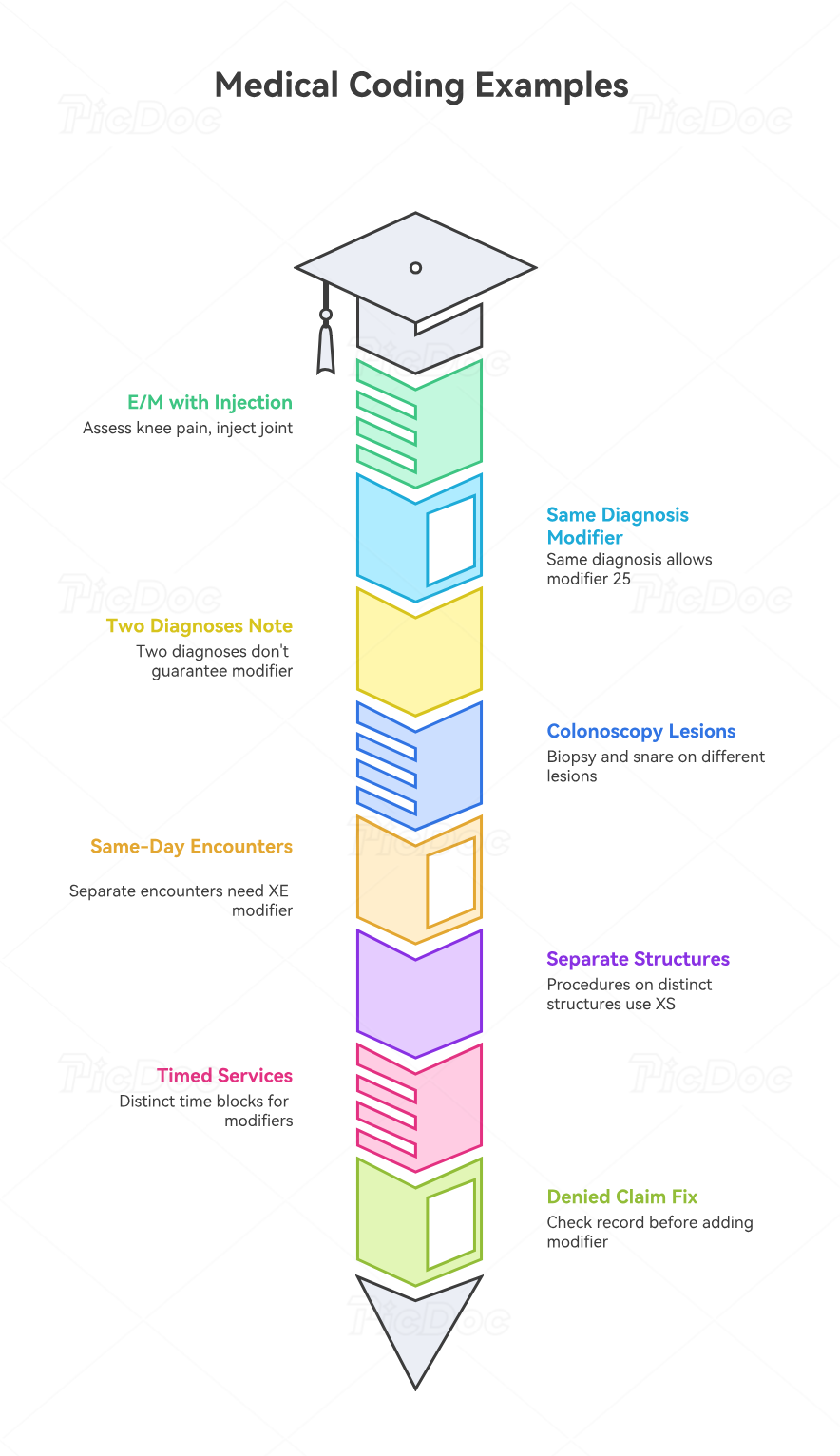
Example 1: 99213-25 with a minor office procedure
An established patient presents with chronic knee pain that has significantly worsened. The physician performs a medically necessary assessment, evaluates prior treatment response, considers current symptoms and treatment options, and separately performs a joint injection during the visit.
A potential reporting pattern is:
99213-25 + 20610
The critical issue is the documented E/M work above the usual work associated with performing the injection.
If the visit consisted primarily of confirming the planned injection and performing normal procedure-related evaluation, separate E/M support becomes weak.
This reasoning appears constantly in CPC preparation, CPT mastery, coding interview assessments, and later audit reviews.
Example 2: Same diagnosis can support modifier 25
A patient presents because of worsening symptoms from a known condition. The provider performs substantial separately identifiable E/M work, develops a treatment plan, and performs a minor procedure addressing that same condition.
The same diagnosis may appear on the E/M service and procedure.
That alone does not defeat modifier 25. CMS explicitly recognizes that the E/M service and procedure can relate to the same diagnosis.
For coders studying medical terminology, CPC exam questions, or CCS practice questions, the lesson is straightforward: diagnosis separation and service separation are different concepts.
Example 3: Two diagnoses do not automatically earn modifier 25
A patient arrives specifically for removal of a lesion. The provider briefly confirms a stable chronic condition in the history while performing the assessment inherent to the planned procedure.
The presence of two diagnoses creates no automatic entitlement to a separately billed E/M service.
The better question is whether the second condition generated a medically necessary assessment, management decision, diagnostic plan, prescription decision, risk analysis, or other qualifying E/M work.
This becomes especially important for coders under productivity quotas because code assignment based on diagnosis count can create systematic overbilling exposure.
Example 4: Colonoscopy biopsy and snare removal on different lesions
During one colonoscopy, one lesion is biopsied and a separate lesion is removed by snare technique.
When the applicable NCCI edit, code-set instructions, payer policy, and documentation support separate reporting, modifier 59 or an appropriate X modifier may be needed to establish that the services involved different lesions.
The operative report needs enough detail to identify which technique was used on which lesion.
If both techniques are applied to the same lesion, the claim has a different coding analysis because the procedures are no longer separated merely by different code descriptors.
This scenario illustrates why facility coding knowledge, coding audit skills, denial management, and claims-submission knowledge work together.
Example 5: Separate same-day encounters
A patient receives a procedure during one encounter and later returns for a separate service after a distinct clinical event.
Where the applicable NCCI rules permit separate reporting, XE may describe the circumstance more precisely than modifier 59 because the distinguishing fact is the separate encounter. CMS defines XE specifically around services that are distinct because they occurred during a separate encounter on the same date.
Strong documentation would establish the timing, reason for return, services performed, and independence of the encounters.
Example 6: Separate structures
Two otherwise bundled procedural services are performed during one encounter on clearly separate structures.
When policy supports separate reporting, XS may communicate that distinction more precisely.
This is where accurate anatomical documentation becomes crucial. Coders coming from medical assisting, nursing, or a non-healthcare background often benefit from deliberately strengthening anatomy, terminology, and documentation interpretation because modifiers depend on clinical facts that cannot be inferred safely.
Example 7: Separate timed services
Two timed procedures subject to an edit are performed in distinct documented time blocks.
CMS permits modifier 59 or applicable X modifiers in certain timed-service circumstances where separate and distinct time blocks exist.
The coding record should support exactly when each service occurred. Overlapping time creates a major vulnerability.
This is also why medical coding stress rises in environments where coders must hit aggressive throughput goals while resolving incomplete documentation.
Example 8: Denied claim with modifier 59 added afterward
A procedure pair denies as bundled. Someone suggests adding modifier 59 and resubmitting.
The proper workflow begins with the medical record and the current edit. Determine whether a legitimate distinct-service circumstance existed on the date of service.
Payment after resubmission does not prove coding correctness. Post-payment audits can revisit the documentation.
Professionals interested in medical coding auditing, denial-management services, CARC interpretation, and medical billing careers should treat modifiers as compliance statements rather than denial-removal devices.
5. How to Prevent Modifier 25 and 59 Denials, Recoupments, and Audit Findings
The strongest modifier workflow occurs before claim submission.
Start with the current code set, NCCI edits, payer policy, and documentation. CMS stresses that providers remain responsible for correct coding even when a specific NCCI edit does not exist.
That matters because coders sometimes treat an edit checker as the final authority. An edit checker is one control. Correct coding remains broader.
A high-quality prebill workflow should ask:
For modifier 25: What separate E/M work can I identify after removing the inherent procedure work?
For modifier 59/X{EPSU}: What specific fact makes these procedures distinct?
Then identify the evidence supporting that fact.
For modifier 25, look for documented assessment, management, clinical decision-making, evaluation of an additional or substantially evaluated condition, medication management, diagnostic planning, or other work that genuinely exceeds the normal procedure-related service.
For modifier 59, identify separate encounters, sites, structures, lesions, non-overlapping services, or another qualifying NCCI circumstance.
Coders developing medical coding resumes can turn this skill into valuable proof of competence. Instead of listing “knowledge of modifiers,” describe experience reviewing edit conflicts, validating documentation, resolving denials, or applying payer-specific rules. That positions a candidate more strongly for the best employers for new coders and for eventual movement into higher-paying specialties.
Denials should also be tracked by root cause.
Create separate buckets for:
modifier missing when documentation supported it;
modifier used without sufficient support;
wrong modifier selected;
modifier attached to the wrong claim line;
payer-specific edit;
anatomical documentation missing;
separate encounter insufficiently documented;
E/M documentation failed to establish separate work;
coding combination itself was incorrect;
obsolete internal coding rule caused the error.
That taxonomy gives managers something actionable. A spike in modifier-25 denials may reveal weak physician documentation. A spike in modifier-59 denials may reveal poor NCCI education. A spike concentrated with one payer may require contract-specific review.
This approach mirrors good denial-management practice, improves electronic claims workflows, strengthens medical billing knowledge, and prepares coders for auditor career paths.
The final safeguard is payer verification. Medicare NCCI rules provide a powerful framework, while commercial payers and Medicaid programs may apply their own policies, edits, and modifier preferences. CMS itself directs specific Medicaid questions to the relevant state Medicaid agency.
Coders working remotely or across multiple clients should therefore avoid relying on one payer's logic everywhere. This is particularly important as outsourcing changes medical coding work, employers demand higher productivity, and experienced coders move into specialized coding roles.
6. FAQs About Modifier 25 vs Modifier 59
-
Modifier 25 identifies a significant, separately identifiable E/M service performed on the same date as another procedure or service. Modifier 59 identifies a distinct procedural service when two non-E/M services would otherwise conflict under applicable coding edits.
Anyone preparing for the CPC exam, using CPC practice questions, or preparing for coding interviews should anchor the distinction to E/M versus procedure-to-procedure first.
-
Modifier 25 is appended to the qualifying E/M code. CMS's 2026 NCCI guidance places modifier 25 on an E/M service that is significant and separately identifiable from other same-day services.
This rule is foundational for professional-fee coding, CPT coding education, and coding auditor training.
-
Yes. CMS explicitly states that the E/M service may relate to the same or a different diagnosis from the procedure. The determining factor is whether the E/M service is medically necessary, significant, separately identifiable, and supported by documentation beyond the work inherent to the procedure.
That principle is worth mastering through CPC exam preparation and CCS coding practice.
-
A separate diagnosis provides limited evidence by itself. CMS states that different diagnoses are insufficient criteria for modifiers 59, XE, or XS. The record needs the procedural distinction required by the relevant policy, such as a separate site, encounter, or other qualifying circumstance.
This distinction becomes crucial in denial management, medical coding audits, and claims submission.
-
Use the payer's applicable policy and choose the most specific valid modifier. CMS created XE, XS, XP, and XU to provide more precise descriptions of circumstances previously reported with modifier 59 and states that these modifiers may be used in lieu of 59 whenever possible.
Knowing when to use a more specific modifier can improve performance on coding interview tests and strengthen a medical coding resume.
-
Modifier 59 is designed for distinct non-E/M procedural services. When an E/M service needs to be distinguished from another same-day service, modifier 25 is the relevant pathway when its criteria are satisfied. CMS's NCCI manual directly distinguishes these uses.
That difference is essential for anyone learning through a medical coding bootcamp, college, or self-study path.
