
Medical Coding Interview Questions: 60 Real Coding Scenarios With Answers
Medical coding interviews become difficult when the recruiter moves beyond definitions and asks, “What would you do with this chart?” Candidates preparing for medical coding interview tests, applying with no healthcare background, carrying CPC-A status, or strengthening a post-certification coding resume need to demonstrate how they reach a defensible answer. These 60 interview-style scenarios test diagnosis coding, CPT logic, modifiers, claims, inpatient reasoning, auditing, documentation, and compliance.

1. What Medical Coding Interviewers Are Actually Testing in Scenario Questions
The strongest interview answer rarely begins with a code number. It begins with the documentation.
When an employer gives you a coding scenario, they may be testing whether you can identify the setting, interpret the clinical facts, select the correct code family, apply sequencing rules, recognize missing documentation, check modifiers, and verify the result before releasing a claim. Those abilities matter whether you are pursuing professional-fee coding, comparing inpatient and outpatient coding, targeting risk adjustment, or eventually moving into coding auditing.
A useful answer structure is:
Setting → Documentation → Governing rule → Code-selection logic → Verification → Final action
That sequence prevents one of the most damaging interview habits: guessing a code from the first recognizable phrase. Candidates who have relied heavily on CPC question practice, a structured CPC study plan, and memorization can still struggle when an interviewer removes the answer choices.
Setting matters enormously. An uncertain diagnosis at the end of an outpatient encounter is handled differently from qualifying uncertain diagnoses documented at inpatient discharge. Professional and facility reporting can differ. Medicare NCCI edits introduce another layer because a modifier should reflect the actual circumstances documented rather than being appended merely to force a claim through. CMS's 2026 NCCI Policy Manual remains the governing Medicare reference for the rationale behind those edits.
E/M questions increasingly expose candidates who memorized old documentation shortcuts. Current office/outpatient E/M methodology centers on medical decision making or qualifying total time, and the MDM framework considers problems addressed, data, and patient-management risk. Candidates reviewing CPT coding principles, preparing through CPC resources, or rebuilding after a failed CPC attempt should practice explaining the decision rather than reciting a level.
The scenarios below deliberately emphasize reasoning. Exact code assignment can depend on additional documentation, setting, payer policy, current-year code files, and edits. CMS has already published FY 2027 ICD-10 files for encounters and applicable discharges beginning October 1, 2026, while HCPCS receives quarterly updates, so professional coders must verify the code set applicable to the actual date of service. That update discipline also separates someone who merely passed an exam from someone ready for real productivity expectations.
| Scenario Type | What It Tests | Strong Candidate Checks | Common Interview Mistake |
|---|---|---|---|
| Outpatient uncertain diagnosis | ICD-10-CM setting rules | Signs, symptoms and confirmed findings | Coding “rule out” condition as established |
| Inpatient uncertain diagnosis | Discharge coding rules | Final diagnostic wording and setting | Applying outpatient rules |
| Symptom plus diagnosis | Integral symptom logic | Whether symptom adds independent information | Automatically coding every symptom |
| Diabetes complication | Combination coding | Documented relationship and additional requirements | Using separate generic codes unnecessarily |
| Hypertension with CKD | Guideline relationships | Combination category plus CKD stage | Coding hypertension independently without review |
| Laterality | Specificity | Right, left, bilateral or unsupported | Assuming laterality |
| Fracture encounter | Seventh-character use | Encounter phase and healing status | Treating “initial” as first-ever visit |
| Adverse drug effect | External-cause sequencing logic | Correctly administered drug versus misuse | Confusing adverse effect with poisoning |
| Underdosing | Medication coding logic | Reason, condition and medication context | Calling every missed dose poisoning |
| Sepsis case | Sequencing | Admission reason and documented relationship | Using a memorized sequence regardless of circumstances |
| Office E/M | MDM analysis | Problems, data and management risk | Counting note length |
| Time-based E/M | Time rules | Qualifying documented time on service date | Counting staff time incorrectly |
| Modifier 25 | Separate E/M reasoning | Significant separately identifiable work | Appending modifier because a procedure occurred |
| Modifier 59/X modifiers | Distinct service logic | Anatomic, encounter or procedural distinction | Using modifier solely to bypass an edit |
| NCCI edit | Bundling knowledge | PTP edit, indicator and documentation | Assuming every edit can be overridden |
| Repeated lab test | Modifier 91 reasoning | Medical necessity for repeat testing | Using 91 for laboratory error correction |
| Global-period service | Postoperative logic | Relationship to original procedure | Assuming every postop service is bundled |
| Discontinued procedure | Setting-sensitive modifier use | Where and when procedure was stopped | Choosing modifier before checking setting |
| Add-on procedure | Code hierarchy | Eligible primary service | Reporting add-on code alone |
| Drug units | HCPCS calculation | Dose administered versus code-unit definition | Equating one vial with one billing unit |
| Diagnosis pointer | Claim construction | Procedure-to-diagnosis relationship | Pointing every line to every diagnosis |
| CARC/RARC denial | Remittance interpretation | Full adjustment message and next action | Resubmitting blindly |
| Medical necessity denial | Coverage research | Policy, documentation and diagnosis support | Changing diagnosis to obtain payment |
| Corrected claim | Revenue-cycle workflow | Whether original submission contained an error | Appealing your own coding mistake |
| Principal diagnosis | Inpatient sequencing | Condition established after study | Choosing the most expensive diagnosis |
| Provider query | Documentation integrity | Clinical indicators and neutral wording | Leading provider to desired code |
| ICD-10-PCS root operation | Procedure objective | What was actually done to body part | Coding from procedure title alone |
| Risk adjustment | Condition validation | Current encounter support | Pulling diagnoses from historical problem list blindly |
| Coding audit discrepancy | Quality control | Root cause plus corrected coding | Changing code without explaining why |
| Provider requests upcoding | Compliance judgment | Documentation, escalation and policy | Coding for revenue instead of support |
2. Medical Coding Interview Scenarios 1–20: ICD-10-CM, Diagnosis Coding and E/M
Scenario 1: The Physician Documents “Rule Out Pneumonia” in an Outpatient Visit
Answer: I would first confirm the outpatient setting. I would code the signs, symptoms, or confirmed findings supported at the end of the encounter rather than treating the uncertain diagnosis as established. Setting-specific sequencing is exactly why candidates preparing for medical coding interviews need more than exam-question memorization.
Scenario 2: The Same Uncertain Diagnosis Appears at Inpatient Discharge
Answer: I would apply the inpatient uncertain-diagnosis guideline rather than the outpatient rule, assuming the wording meets the guideline criteria at discharge. My interview answer would explicitly state that setting changes the coding rule. That distinction becomes essential for candidates comparing inpatient with outpatient coding or preparing through CCS practice cases.
Scenario 3: A Patient Has Chest Pain and a Confirmed Diagnosis Explaining It
Answer: I would determine whether the chest pain is routinely associated with the confirmed diagnosis. A symptom that is integral to an established condition is generally handled differently from an independent symptom requiring separate reporting. I would verify the applicable ICD-10-CM guidance before finalizing. This same discipline strengthens CCS coding preparation and CPC interview performance.
Scenario 4: Diabetes and Chronic Kidney Disease Are Documented
Answer: I would check the ICD-10-CM combination-code and “with” conventions, identify the appropriate diabetes-with-CKD category, and add the CKD-stage code when required. I would also check whether the provider explicitly documented an unrelated cause. Candidates developing ICD coding knowledge should practice these relationships alongside medical terminology, because literal word matching can produce the wrong result.
Scenario 5: Hypertension and Chronic Kidney Disease Are Both Present
Answer: I would evaluate the hypertensive CKD combination-category rules and add a code identifying the CKD stage. I would avoid treating the hypertension and CKD as automatically unrelated unless documentation supports a different relationship. This is the kind of guideline-based reasoning employers expect from candidates pursuing facility coding or advancing toward coding auditing.
Scenario 6: Hypertension, Heart Failure and CKD Are Documented Together
Answer: I would examine the combination category that represents hypertension with both heart and chronic kidney disease, then add codes identifying the heart-failure type and CKD stage when required. The FY 2027 guidelines continue to describe this combination approach. This level of sequencing matters in advanced coding roles and hospital-focused coding.
Scenario 7: Documentation States “Acute on Chronic” Disease
Answer: I would check whether ICD-10-CM provides separate acute, chronic, or acute-on-chronic options and follow any sequencing instruction attached to that condition. I would never assume that every acute-on-chronic diagnosis requires two codes. This is a useful example of why coding without healthcare experience requires strong reference skills and why a coding portfolio should show reasoning rather than code lists.
Scenario 8: The Note Documents a Left-Sided Condition but the Selected Code Is Unspecified
Answer: I would correct the code to the supported laterality after verifying the Tabular List. Specific documentation should drive the most specific valid code available. Using an unspecified option when laterality is clearly documented can create an avoidable accuracy problem, particularly under coding productivity quotas and employer quality audits.
Scenario 9: A Fracture Patient Comes for Routine Healing Follow-Up
Answer: I would determine the fracture type, site, laterality, encounter phase, and healing status before selecting the required seventh character. “Initial encounter” refers to active treatment rather than simply the patient's first visit to one particular coder's organization. This distinction is ideal preparation for coding assessment tests and CPC exam questions.
Scenario 10: The Chart Lists “History of Breast Cancer,” With No Current Disease
Answer: I would distinguish personal history from active malignancy and review whether ongoing treatment or current disease is documented. A historical diagnosis should not be converted into active cancer merely because it remains on a problem list. The same discipline matters in risk-adjustment coding and coding audit careers.
Scenario 11: A Correctly Prescribed Drug Causes a Rash
Answer: I would treat this as an adverse-effect scenario if the medication was correctly prescribed and properly administered, code the manifestation according to the applicable sequencing rules, and then identify the drug responsible with the appropriate external-cause coding. I would distinguish this carefully from poisoning. Strong medical terminology skills and CPC preparation help prevent that conceptual error.
Scenario 12: A Patient Takes the Wrong Medication and Develops Symptoms
Answer: I would investigate whether the facts meet poisoning criteria rather than adverse effect. The coding sequence differs because the underlying event differs. In an interview, I would ask how the medication was taken, whether it was prescribed for that patient, and whether the dose was taken correctly before selecting codes. This investigative approach is useful for new-coder interviews and coding portfolio projects.
Scenario 13: A Patient Deliberately Takes Less Medication Because of Cost
Answer: I would consider underdosing rules, code any relevant condition affected by the underdosing, identify the medication category as required, and capture the reason when supported. This scenario also demonstrates that coding intersects with real patient circumstances rather than functioning as a pure lookup exercise. Candidates moving from medical assisting or nursing into coding can often leverage that clinical context.
Scenario 14: Sepsis and a Localized Infection Are Both Documented
Answer: I would determine the circumstances of admission, the organism if documented, whether severe sepsis or organ dysfunction is present, and the applicable sequencing guideline. I would avoid giving an automatic “sepsis always goes first” answer because sequencing can depend on why the patient was admitted and the relationship among conditions. That caution is particularly important for inpatient coding careers and CCS preparation.
Scenario 15: The Physician Documents Obesity but the BMI Is Recorded by a Nurse
Answer: I would verify the current ICD-10-CM rules governing when information such as BMI can be derived from documentation by other clinicians while the associated diagnosis itself requires appropriate provider documentation. I would avoid deriving obesity solely from the BMI. This is exactly the kind of distinction that separates medical coding knowledge from simple data extraction and becomes important in audit-focused roles.
Scenario 16: The Provider's Diagnosis Conflicts With Another Part of the Record
Answer: I would avoid silently resolving a clinically significant contradiction myself. I would determine whether the discrepancy affects code assignment and, if necessary, follow the organization's compliant query process. Employers value candidates who understand documentation integrity, especially in facility coding, auditing, and higher-complexity coding specialties.
Scenario 17: The Problem List Contains Several Diagnoses Not Addressed Today
Answer: I would not automatically report every historical problem-list entry. I would review the setting, documentation, reporting rules, and evidence that each condition is relevant to the encounter. This is especially important for candidates considering risk-adjustment coding, where unsupported condition capture can become a serious compliance problem, and for coders preparing for quality audits.
Scenario 18: A Long Office Note Has Minimal Medical Decision Making
Answer: I would never choose a higher E/M level simply because the note is long. If coding by MDM, I would analyze the qualifying elements of problems addressed, data, and risk. If the service is eligible for time-based selection and properly documented, I would evaluate that separately. AMA's current E/M guidance reinforces the MDM framework. Review CPT coding principles alongside interview cases.
Scenario 19: The Clinician Spends Significant Time on an Office Visit
Answer: I would confirm that the service permits time-based selection, identify the physician/QHP time qualifying under the applicable rules on the date of service, and verify that the documented total supports the selected level. I would avoid adding nonqualifying staff activity simply to reach a threshold. Candidates preparing through CPC study resources should pair time rules with CPT fundamentals.
Scenario 20: A Preventive Visit Also Addresses a New Medical Problem
Answer: I would determine whether the additional problem-oriented work is significant and separately identifiable beyond the preventive service, then select and modify the additional E/M service only when documentation supports it. This is a classic test of separating overlapping work. It frequently matters in professional-fee coding, physician reimbursement, and coding interview assessments.
3. Medical Coding Interview Scenarios 21–40: CPT, Modifiers, Claims and Denials
Scenario 21: An Office Visit and Minor Procedure Occur on the Same Day
Answer: I would ask whether the E/M work was significant and separately identifiable from the usual evaluation inherent in the procedure. Modifier 25 should reflect documented additional E/M work rather than function as an automatic payment tool. CMS similarly describes modifier 25 around a significant, separately identifiable same-day E/M service. Candidates should connect CPT coding with physician reimbursement.
Scenario 22: Two Procedures Trigger an NCCI Edit
Answer: I would check the current NCCI edit, modifier indicator, documentation, and whether the services were genuinely distinct. I would use modifier 59 or an applicable X{EPSU} modifier only when the circumstances support separate reporting and payer requirements allow it. CMS explicitly warns that edits do not replace the provider's obligation to code correctly. This is core knowledge for denial prevention and coding audit work.
Scenario 23: An NCCI Edit Has an Indicator That Does Not Permit Override
Answer: I would respect the edit and verify that the code combination has been correctly constructed rather than appending a modifier hoping to force payment. Some NCCI code pairs are not eligible for modifier override under the edit methodology. A coder who understands this avoids the dangerous “modifier fixes everything” habit that can produce denials and problems during a coding audit.
Scenario 24: A Laboratory Test Is Repeated Later the Same Day
Answer: I would determine why the test was repeated. Modifier 91 may be appropriate when a medically necessary repeat laboratory test is performed, while repetition caused by specimen or equipment problems should not be disguised as a separately payable medical service. CMS specifically distinguishes these circumstances. This connects CPT knowledge with real claim-submission accuracy.
Scenario 25: The Same Procedure Must Be Repeated by the Same Physician
Answer: I would verify that the procedure was genuinely repeated, examine the applicable repeat-procedure modifier rules, and confirm documentation supports the second service. I would also check payer-specific instructions before billing. This is where coding interview preparation should go beyond definitions and connect each modifier to the claim workflow.
Scenario 26: A Postoperative Patient Returns for an Unrelated Condition
Answer: I would determine whether the new E/M service is truly unrelated to the original procedure and whether the applicable global-period modifier rules support separate reporting. I would document the reason for the encounter clearly. Candidates targeting professional-fee coding need strong global-package reasoning because it directly affects physician reimbursement.
Scenario 27: A Planned Staged Procedure Occurs During the Postoperative Period
Answer: I would determine whether the subsequent procedure was staged, planned prospectively, more extensive, or represented therapy following a diagnostic surgical service, then evaluate the appropriate postoperative modifier rules. I would avoid confusing this with an unrelated procedure. This distinction is useful in surgical coding specialties and coding auditor preparation.
Scenario 28: A Procedure Is Stopped Before Completion
Answer: I would determine where the procedure occurred, how far it progressed, why it was discontinued, and whether anesthesia had been administered, because modifier selection can differ by setting and circumstances. I would never select a discontinued-procedure modifier from the word “stopped” alone. That careful approach matters in facility versus professional coding and medical coding interviews.
Scenario 29: An Add-On Code Appears Without an Eligible Primary Procedure
Answer: I would review the code hierarchy and determine whether the required primary service is present. An add-on service generally cannot simply stand alone because the documentation mentions additional work. This is a good test of whether a candidate actually navigates CPT coding rules or merely searches keywords while preparing for coding employment.
Scenario 30: Two Services Look Separate in the Note but May Be Bundled
Answer: I would compare the documentation with CPT instructions and current NCCI edits rather than assuming two paragraphs equal two separately payable services. Bundling depends on coding policy and the clinical relationship between services. This is especially important for physician fee coding, denial management, and eventual audit responsibilities.
Scenario 31: The Administered Drug Dose Does Not Match One HCPCS Billing Unit
Answer: I would read the current HCPCS descriptor carefully, convert the administered dose into the code's defined billing units, and review wastage/reporting requirements when applicable. One vial does not necessarily equal one billable unit. CMS updates HCPCS throughout the year, including quarterly 2026 files. Candidates pursuing medical billing roles should pair this with reimbursement knowledge.
Scenario 32: A Claim Line Points to an Unrelated Diagnosis
Answer: I would correct the procedure-to-diagnosis linkage based on the documentation rather than merely leaving every diagnosis pointer attached to every line. Diagnosis pointers help communicate why each service was performed. This is where medical billing fundamentals, electronic claims submission, and coding accuracy meet.
Scenario 33: The Claim Is Denied, but the Code Itself Looks Correct
Answer: I would review the full ERA/EOB, CARC, RARC, payer policy, eligibility, authorization, coding, and claim data before changing anything. A technically valid code can still fail because the problem exists elsewhere in the revenue cycle. Strong candidates understand claim adjustment reason codes, denial-management workflows, and claims-submission systems.
Scenario 34: The Payer Denies a Service for Medical Necessity
Answer: I would review the applicable coverage policy, diagnosis support, documentation, frequency limitations, and whether the service actually met the payer's criteria. I would never change a diagnosis simply to make the claim payable. That response demonstrates both reimbursement knowledge and the compliance mindset needed for denial management.
Scenario 35: You Discover the Original Claim Contained a Coding Error
Answer: I would follow the payer's corrected-claim process instead of immediately writing an appeal defending an error. First correct the source data, document the reason for the change, then submit through the appropriate workflow. Candidates who understand electronic claim submission, CARCs, and denial management can distinguish correction from appeal.
Scenario 36: The Claim Is Correct but the Payer Applied the Wrong Policy
Answer: I would gather the claim, remittance, relevant documentation, contract or coverage language, and any required supporting evidence, then use the payer's reconsideration or appeal pathway. I would make the argument specific to the adjudication error. That practical skill is valuable in medical billing careers, denial-management operations, and physician reimbursement work.
Scenario 37: The Claim Was Submitted Twice
Answer: I would confirm whether the second submission represents an actual duplicate, a corrected claim that lacked the required indicator, or a genuinely separate service. I would avoid simply rebilling a duplicate denial. This demonstrates understanding of claim adjustment codes, electronic claim workflows, and the operational side of medical billing.
Scenario 38: A Procedure Was Authorized, but the Claim Still Denied
Answer: I would verify that the authorization matches the patient, date range, provider, service, units, and actual procedure billed. Authorization by itself does not prove the submitted claim matches what was approved. Candidates targeting billing jobs should understand this along with denial-management strategy and claims infrastructure.
Scenario 39: A Denial Analyst Asks You to “Just Add Modifier 59”
Answer: I would review whether the services were genuinely distinct and whether modifier 59 or a more specific modifier is supported. I would decline to add a modifier merely to obtain payment without documentation. CMS guidance treats modifier use as a coding decision tied to the circumstances of the services. That response demonstrates the integrity expected in coding audits and denial resolution.
Scenario 40: Your Code Is Correct, but a Claim Scrubber Rejects It
Answer: I would identify the edit causing the rejection, determine whether it reflects an outdated system rule, payer requirement, missing claim element, or actual coding issue, and correct the right problem. I would never change valid coding solely because software dislikes it. This distinction becomes increasingly important when working with billing software, claims platforms, and high-volume coding productivity requirements.
4. Medical Coding Interview Scenarios 41–60: Inpatient, PCS, Auditing and Compliance
Scenario 41: Two Conditions Could Potentially Be the Principal Diagnosis
Answer: I would review the complete inpatient record and determine which condition was established after study to be chiefly responsible for the admission, while applying any specific sequencing guideline that controls the case. I would explain my reasoning rather than choosing whichever diagnosis appears first. This is central to inpatient coding, CCS preparation, and hospital coding audits.
Scenario 42: The Outpatient Record Contains Several Diagnoses—Which Goes First?
Answer: I would identify the diagnosis, condition, problem, or other reason chiefly responsible for the services provided, then apply any code-specific sequencing instructions. I would not call it the “principal diagnosis” merely because that term belongs to inpatient reporting. This setting awareness is fundamental for professional-fee coding and medical coding interview tests.
Scenario 43: A Condition Is Diagnosed During the Hospital Stay—Was It Present on Admission?
Answer: I would examine the documented clinical facts and applicable POA guidance rather than equating “diagnosed later” with “developed later.” The key question is whether the condition was present at the time the inpatient admission order occurred. Candidates targeting hospital coding need this distinction alongside CCS exam preparation.
Scenario 44: Documentation Supports a More Specific Diagnosis Than the Provider Wrote
Answer: I would not independently diagnose the patient from clinical indicators. If greater specificity affects coding and the record supports a legitimate clarification opportunity, I would follow the compliant provider-query process. This answer demonstrates the boundary between coding and clinical diagnosis, which is crucial for auditors, facility coders, and candidates building a professional coding portfolio.
Scenario 45: Two Physicians Document Conflicting Diagnoses
Answer: I would determine whether the discrepancy can be resolved under official coding guidance or organizational policy. If the conflict materially affects code assignment and cannot be resolved from permitted documentation, I would query appropriately rather than choosing the diagnosis producing the preferred reimbursement outcome. That approach protects coding integrity in inpatient environments and audit-sensitive positions.
Scenario 46: In PCS, Part of a Body Part Is Cut Out
Answer: I would determine the objective of the procedure before choosing a root operation. Removing a portion and removing all of a body part represent different PCS concepts, so I would use the operative details rather than the procedure title alone. Candidates pursuing inpatient coding should practice these distinctions through CCS case questions.
Scenario 47: An Operative Note Says “Resection,” but the Actual Procedure Removes Only Part of the Structure
Answer: I would code from the documented objective and extent of the procedure under ICD-10-PCS definitions rather than assume the physician's procedural wording maps directly to the PCS root operation with the same everyday name. This is one of the best tests of true inpatient coding competence and a useful portfolio case.
Scenario 48: A Bypass Procedure Reroutes Flow
Answer: I would identify what is being bypassed from and to, along with the body part, approach, device, and qualifier required by the applicable PCS table. Bypass coding frequently exposes candidates who recognize the procedure name but cannot construct the code from its components. This matters in CCS preparation and higher-level facility coding careers.
Scenario 49: The Operative Report Title Conflicts With the Procedure Details
Answer: I would abstract what was actually performed from the body of the operative report and resolve any clinically significant conflict through the appropriate process rather than coding blindly from the title. Employers value this because real coding requires reading beyond headings. Candidates can develop that skill through medical coding portfolio cases, CCS practice questions, and interview simulations.
Scenario 50: The Same Encounter Is Being Reviewed for Professional and Facility Coding
Answer: I would establish which entity is reporting and apply the rules appropriate to that setting rather than assuming identical code-selection logic. The clinical encounter may be the same while reporting responsibilities differ. Understanding professional versus facility coding also helps candidates choose between inpatient and outpatient career paths.
Scenario 51: A Risk-Adjustment Chart Contains an Old Chronic Diagnosis
Answer: I would look for current documentation supporting the condition under the applicable reporting and risk-adjustment requirements rather than capture it simply because it appears historically. Historical carry-forward without support can create compliance risk. Candidates entering risk-adjustment coding should combine condition-validation skills with the discipline expected in coding audits.
Scenario 52: Your Audit Finds Consistent Overcoding
Answer: I would identify the specific pattern, quantify it, trace the root cause, correct affected coding through the organization's process, and recommend focused education or workflow changes. I would distinguish a knowledge gap from a system problem or intentional conduct. This is the analytical mindset needed in coding auditing, productivity environments, and advanced coding specialties.
Scenario 53: Your Audit Finds Systematic Undercoding
Answer: I would treat undercoding as a quality and compliance issue too. I would identify why supported services are being missed, quantify the pattern, verify applicable rules, and recommend corrective education or workflow changes. Compliance means reporting accurately in both directions. This is important for auditing careers and for understanding the revenue implications covered in physician reimbursement.
Scenario 54: You Are Accurate but Below the Employer's Productivity Target
Answer: I would analyze where time is being lost—navigation, unfamiliar specialties, excessive rechecking, documentation ambiguity, or workflow inefficiency—then improve those bottlenecks while protecting accuracy. Speed gained by guessing simply moves the problem into audits and denials. Candidates worried about coding productivity quotas should also understand coding-job stress before choosing employers.
Scenario 55: You Meet Productivity but Your Accuracy Is Falling
Answer: I would reduce the source of preventable errors before treating speed as success. I would categorize mistakes, identify recurring domains, retrain those areas, and monitor accuracy alongside output. This answer shows employers that you understand why productivity quotas must be balanced against quality, especially in roles that can lead toward auditing.
Scenario 56: A Code Changed Since Last Year
Answer: I would verify the code set applicable to the date of service instead of relying on memory or the newest book automatically. ICD-10 and HCPCS implementation schedules can cross calendar and fiscal-year boundaries; CMS already lists FY 2027 ICD-10 files for October 1, 2026 implementation and quarterly HCPCS updates. Continuing update discipline complements CEU resources and ongoing CPC learning.
Scenario 57: The Provider Says, “Use the Higher Code—Insurance Will Pay It”
Answer: I would code to the documentation and applicable rules, explain what documentation supports, and follow escalation/compliance procedures if inappropriate pressure continues. Payment potential never becomes the coding standard. This is the answer employers should want from someone pursuing coding auditing, physician coding, or denial-management work.
Scenario 58: The Provider Wants a Diagnosis Changed Because the Claim Denied
Answer: I would review whether the original coding accurately reflects the documentation. A payer denial does not authorize replacing a supported diagnosis with a more payable one. If documentation itself is incomplete or requires clarification, I would use the appropriate query workflow. Candidates working with denials, claim adjustment codes, and reimbursement must keep payment pressure separate from coding integrity.
Scenario 59: You Discover You Submitted the Wrong Code Yesterday
Answer: I would report the error through the organization's correction process, determine whether the claim needs correction, document what changed, and examine why the mistake occurred. Hiding a known error creates a larger compliance problem than making one. That accountability is valuable when applying to new-coder employers, preparing for coding interviews, or building a skills portfolio.
Scenario 60: The Interviewer Gives You a Code You Have Never Seen
Answer: I would resist bluffing. I would identify the code system, verify the current code book or approved reference, review the surrounding instructions, check applicable edits or guidelines, connect the result to the documentation, and explain my verification process. Employers can teach an unfamiliar specialty more easily than they can fix unsafe guessing. This response is particularly powerful for candidates with no coding experience, CPC-A status, or limited exposure outside exam preparation.
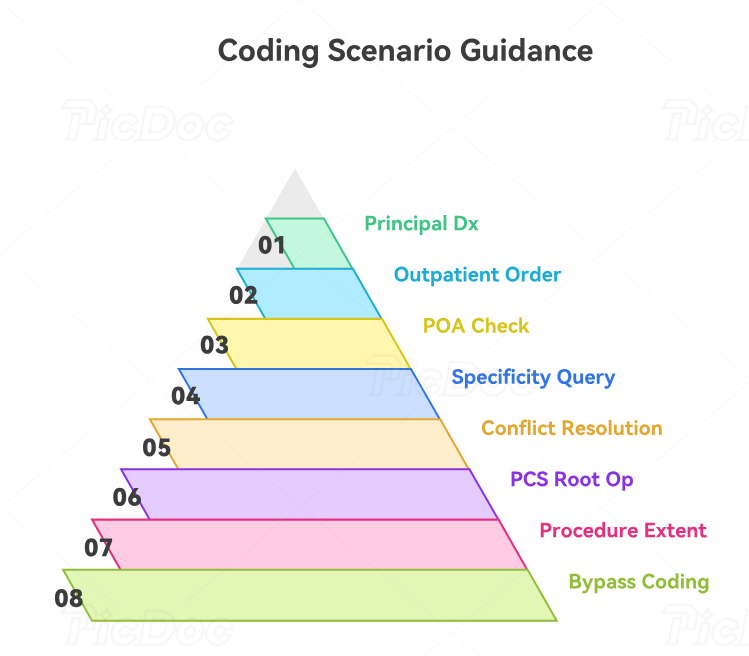
5. How to Answer Coding Interview Questions When You Do Not Know the Answer Immediately
A difficult coding interview rewards controlled uncertainty. You can say that you would verify a rule without sounding unprepared when you explain exactly what you would verify.
A weak answer sounds like: “I'm not sure. I would Google it.”
A professional answer sounds more like: “I would first confirm whether this is physician or facility reporting, verify the code in the current-year reference, review any instructional notes, check the applicable NCCI edit if two procedures are involved, and confirm the documentation supports the final selection.”
That response demonstrates a repeatable process. It also reflects the skills candidates develop through medical coding interview preparation, CPC exam strategy, medical coding portfolio projects, and deliberate coding resume development.
When practicing these 60 scenarios, give yourself three rounds.
Round one: untimed reasoning. Explain every decision completely. Use your current code books, official guidelines, and appropriate payer or CMS resources. Candidates who failed the CPC previously should identify whether mistakes come from terminology, navigation, guidelines, or decision-making rather than simply recording a wrong answer.
Round two: timed explanation. Give yourself roughly one or two minutes to explain the logic aloud. Interviews rarely allow ten minutes of silent research after every question. This also helps candidates worried about coding productivity requirements, coding-job stress, or demanding entry-level employer assessments.
Round three: defend the answer. Ask yourself what fact would change your code. Would the setting change it? Would laterality change it? Would an NCCI edit change it? Would missing documentation require a query? Would a corrected claim be more appropriate than an appeal? This produces far stronger reasoning than memorizing a final answer.
Build an interview error log using four columns:
Scenario | My mistake | Rule I missed | What I will check next time
A candidate who repeatedly misses modifiers should review CPT coding principles. Someone missing inpatient sequencing needs deeper CCS practice and inpatient coding preparation. Candidates struggling with claim outcomes should strengthen medical billing fundamentals, CARC interpretation, and denial-management reasoning.
Finally, practice saying why another answer is wrong. Employers can learn far more from hearing why you rejected an unsupported modifier, an unspecified diagnosis, or an inappropriate appeal than from hearing a memorized code. That ability also prepares you for auditing careers, stronger coding specialties, and the reality that professional coding involves defending decisions long after the certification exam ends.
6. FAQs About Medical Coding Interview Questions and Coding Tests
-
Expect a mixture of ICD-10-CM sequencing, CPT selection, modifiers, E/M, documentation gaps, denials, and questions about how you verify unfamiliar situations. The mix changes according to the employer. A professional-fee position may emphasize CPT and modifiers, while inpatient coding roles may probe sequencing and PCS. Review practical coding assessments, CPC practice questions, and relevant CPT principles.
-
A strong coder needs efficient retrieval and rule application more than encyclopedic memorization. In an interview, demonstrate that you know where to verify information and can explain what controls the decision. This is particularly important for candidates entering medical coding without healthcare experience, candidates with CPC-A status, and people building their first medical coding portfolio.
-
State the verification process you would use. Identify the setting, documentation elements, code system, current reference, guidelines, edits, and payer-specific rule that could affect the result. Avoid inventing an answer to appear confident. This method is useful during medical coding interview tests and becomes even more important under real productivity pressure.
-
Build evidence before the interview. Complete simulated cases, audit your own coding, track accuracy, practice modifier decisions, and create a small coding portfolio. Then make those projects visible on your medical coding resume. Combine that preparation with realistic expectations about CPC-A hiring barriers and target employers that train new coders.
-
Practice mixed cases using the same references you will be permitted to use, then track both time and accuracy. Record whether each delay came from code-book navigation, clinical terminology, guideline interpretation, modifier logic, or indecision. Candidates can combine CPC exam strategy, CPC practice questions, interview-test preparation, and awareness of real coding productivity quotas.
-
They can demand a different depth of reasoning because the candidate may need to understand principal diagnosis selection, inpatient uncertain diagnoses, POA reporting, ICD-10-PCS construction, and more complex record abstraction. Someone moving from outpatient to inpatient coding should prepare specifically for those differences rather than relying entirely on CPC-style knowledge. Use CCS practice questions, review facility coding differences, and develop inpatient cases for your coding portfolio.
