
Medical Coding Auditor Career Path: Reddit Experiences on Pay, Qualifications & When Coders Should Move Into Auditing
Medical coding auditing can turn years of production experience into a higher-level career built around accuracy, compliance, education, and financial risk. Yet earning a CPMA and applying for auditor jobs too early can leave even strong coders stuck behind experience requirements. Coders considering the move should understand how CPC knowledge, CCS-level coding, denial management, and reimbursement expertise translate into auditing—and when the added responsibility, productivity pressure, and career upside make the transition worthwhile.

1. What Medical Coding Auditors Actually Do—and Why Strong Coding Alone Is Not Enough
A medical coding auditor works backward from the finished coding decision. A production coder asks, “What codes does this documentation support?” An auditor asks a larger set of questions: Was the documentation sufficient? Was the correct guideline applied? Was the service appropriately reported? Was medical necessity established? Did modifier use alter reimbursement? Is the error isolated or systematic? Does the finding expose the organization to overpayment, underpayment, denial, repayment, or compliance risk?
That wider scope explains why strong CPT knowledge, medical terminology, claim adjustment analysis, and Medicare billing knowledge form only the technical base. Auditors must also know how to build a defensible finding.
AAPC's current CPMA examination reflects that broader role. The exam covers medical-record standards, compliance and regulatory requirements, coding and reimbursement, audit scope, statistical sampling, quality assurance, risk analysis, communication of findings, and medical-record abstraction across specialties. The current exam contains 100 questions completed in four hours, including approximately 15 audit cases. AAPC strongly recommends at least two years of coding experience before attempting it.
That recommendation should be taken seriously. Someone can become highly effective at CPC exam questions without yet having enough exposure to recognize an unusual billing pattern, challenge inconsistent provider documentation, distinguish a one-off coding mistake from a process failure, or explain why a finding affects physician reimbursement. Auditing requires context acquired through repeated real-world encounters.
An auditor also needs to understand scope and sampling. Reviewing ten charts from one physician, fifty high-dollar procedures, or a statistically selected population can answer completely different questions. If the sample is poorly constructed, a technically correct chart review can still produce a misleading organizational conclusion. AAPC's own 2026 coder-to-auditor training emphasizes audit methodology, scope, sampling, validation, reporting, and communicating defensible findings.
The financial side matters just as much. An incorrect procedure code can create a claim denial, an improper adjustment visible through CARCs, an overpayment requiring repayment, or a pattern affecting Medicaid reimbursement. Auditors therefore need to understand the entire electronic claims lifecycle, rather than judging code accuracy in isolation.
Communication creates another dividing line between coding and auditing. A coder can often resolve a chart and move on. An auditor may need to tell an experienced coder, physician, manager, compliance officer, or revenue-cycle leader that their interpretation is unsupported. That requires evidence, restraint, and precision. “This is wrong” is weak auditing. “This documentation does not support the reported level because these required elements are absent, and this guideline applies” is defensible auditing.
The strongest auditors therefore combine five disciplines: coding expertise, reimbursement knowledge, regulatory judgment, analytical methodology, and communication. Anyone building toward that combination should deepen coding guidelines, medical billing concepts, payer adjustment knowledge, and continuing education before expecting a credential alone to create auditor readiness.
| Skill or Situation | Auditor Readiness | Why It Matters | Next Move |
|---|---|---|---|
| Consistently high coding accuracy | Strong signal | Auditors must identify errors others miss | Track quality scores |
| Only recently certified | Early | Limited exposure to real exceptions | Build production experience |
| 2–3 years broad coding experience | Developing | Enough exposure for some entry audit roles | Seek internal audit tasks |
| 5+ years specialty coding | Strong | Deep pattern recognition | Target specialty audits |
| Strong E/M knowledge | Valuable | Common professional audit area | Practice provider-level reviews |
| Strong surgical coding | Valuable | High-dollar procedures create audit risk | Deepen modifier/NCCI expertise |
| Inpatient coding expertise | High-value | Supports DRG and facility auditing | Learn DRG validation |
| Risk adjustment experience | High-value niche | Supports HCC validation audits | Strengthen documentation validation |
| Denial experience | Useful | Shows downstream error understanding | Track denial root causes |
| Payment integrity experience | Useful | Connects coding to financial risk | Study audit methodology |
| CPMA with little coding experience | Credential ahead of experience | Employers may still demand production depth | Accumulate applied reviews |
| CPC + strong professional experience | Strong profee pathway | Matches physician audit environments | Add audit exposure |
| CCS + inpatient experience | Strong facility pathway | Supports inpatient and DRG review | Target IP audit roles |
| CRC + HCC experience | Strong RA pathway | Useful for risk-adjustment audit work | Develop compliance depth |
| Can cite authoritative guidelines | Essential | Findings must be defensible | Build source-reference habits |
| Relies mainly on memory | Risk | Audit conclusions require evidence | Document source for every finding |
| Can explain errors tactfully | Strong signal | Auditors educate and defend findings | Practice written feedback |
| Avoids disagreement | Major gap | Findings are routinely challenged | Build evidence-based communication |
| Understands audit sampling | Strong | Samples determine validity | Practice scope design |
| Only understands chart-by-chart review | Developing | Enterprise audits require trend analysis | Learn population analysis |
| Comfortable with spreadsheets | Useful | Audit findings often require data analysis | Build Excel proficiency |
| Can identify systematic errors | High-value | Auditors must detect patterns | Practice root-cause analysis |
| Knows fraud-and-abuse basics | Important | Compliance risk extends beyond coding accuracy | Study regulatory concepts |
| Understands payer policies | Important | Payer rules affect findings and payment | Track LCD/NCD/policy sources |
| Has trained junior coders | Strong signal | Shows education capability | Document coaching outcomes |
| Frequently resolves team questions | Strong signal | Shows trusted subject-matter expertise | Seek formal SME duties |
| Already performs second-level reviews | Very strong | You may already have audit-adjacent experience | Rewrite résumé accordingly |
| Main motivation is salary alone | Caution | Initial pay increase may be modest | Compare workload and ceiling |
| Enjoys researching difficult cases | Strong signal | Auditing rewards investigation | Pursue focused audits |
| Wants pathway into compliance/education | Strategic move | Auditing creates adjacent advancement routes | Build reporting and presentation skills |
2. Reddit Experiences: How Coders Actually Move Into Auditing
The most useful 2026 Reddit discussions reveal a recurring pattern: many auditors did not obtain their first audit position because they already had years of formal auditing experience. They obtained it because they had strong coding experience and someone trusted their judgment.
In a February 2026 r/MedicalCoding discussion, a coder with three years of experience asked how people overcome the familiar requirement for prior auditing experience. One experienced contributor explained that they had audited only around 30 charts over more than a decade, yet their strong inpatient background was enough to secure an auditor role. Another participant said their organization usually hires coder-auditors internally and relies heavily on coding experience, while compliance-auditor positions demand substantially broader billing, coding, communication, education, and sometimes degree requirements.
That distinction is extremely useful. A coder who has mastered CCS-style inpatient coding, CCS practice cases, reimbursement methodology, and denial analysis may be closer to an inpatient auditing opportunity than the job title suggests. The missing step may be formalizing the review work already being performed.
Internal promotion appears repeatedly. Reddit participants described becoming auditors after being strong coders, participating actively in team discussions, staying current with guidelines, filling temporary audit gaps, helping colleagues, or being selected for internal testing. One participant described moving through promotions until performing internal investigations and clinical risk-management reviews involving thousands of charts annually.
That means coders should actively build visible expertise. Volunteer to review difficult cases, contribute to coding discussions, research new guidance, help identify CARC trends, explain Medicare billing requirements, and participate in denial root-cause analysis. These activities create evidence that you already think beyond production.
The Reddit experience on pay is more nuanced than “auditors make more.” A March 2026 inpatient coder considering DRG auditing reported already being near the top of the inpatient coder pay scale and finding auditor postings that were only minimally higher. Other participants said experienced inpatient auditors can reach six figures, while another coder who had considered DRG auditing decided that nearly identical pay, higher stress, and months of training did not justify the move.
That is an important pain point because experienced coders can easily assume that promotion automatically produces a meaningful raise. Someone already highly compensated for complex inpatient coding, advanced CPT knowledge, clinical terminology, and reimbursement expertise may initially move sideways financially before gaining access to a higher long-term ceiling.
Stress also changes shape. A February 2026 professional billing auditor on Reddit described moving into auditing after five years of professional coding and finding the new role more stressful despite better compensation and benefits. The position included productivity standards and pressure to identify high-dollar opportunities. The poster missed front-end coding even though returning would likely require a pay cut.
That experience should challenge the idea that auditing is simply “coding without production pressure.” Auditors may still carry measurable productivity targets, accuracy thresholds, revenue expectations, report deadlines, provider meetings, and contested findings. A current ambulatory/professional coding auditor posting retrieved through AAPC specified 95% productivity and 95% accuracy expectations, illustrating that audit work can remain highly metric-driven.
The career upside lies in optionality. Auditing can lead toward education, compliance, documentation integrity, payment integrity, consulting, team leadership, project management, and coding management. Coders who already understand electronic claims, billing operations, denial management, and continuing education gain more ways to move laterally or upward once audit experience appears on the résumé.
3. Qualifications Employers Want: CPC, CCS, CPMA, Experience and Communication
The CPMA is useful, particularly for professional medical auditing, because it validates knowledge that ordinary coding credentials do not specifically test: audit scope, sampling, compliance, risk analysis, documentation standards, findings, and corrective action. AAPC currently treats CPMA as a stand-alone credential, so holding CPC first is not formally required. AAPC simultaneously warns that CPMA is a high-level exam intended for people with meaningful coding or professional experience and strongly recommends approximately two years in the field.
That creates an important distinction between exam eligibility and employer competitiveness. You may technically qualify to sit for CPMA while still being too inexperienced for the auditor vacancies you want.
A strong professional-auditing profile often combines CPC + several years of physician/professional coding + audit exposure, followed by CPMA where employers value it. Build depth through CPC preparation, CPT coding knowledge, physician reimbursement, and Medicare billing resources. Those skills map directly to professional documentation and reimbursement review.
For inpatient and hospital auditing, CCS, RHIT, RHIA, CIC, or equivalent facility expertise may matter more than CPMA alone. A coder who can audit DRG assignment needs deep understanding of diagnoses, sequencing, procedures, documentation, and facility reimbursement. Strengthen that pathway through CCS certification preparation, CCS practice questions, CCS exam strategy, and advanced coding study.
Experience can outweigh the perfect credential stack. A 2023 Reddit discussion included an auditor who had spent 10 years coding before moving into auditing and later earned CPMA. The person noted that most of what the CPMA covered had already been learned on the job and that only one other member of a seven-person audit team held the credential. Another participant had moved into auditing with CCS and CRC rather than CPMA.
Current employment evidence supports that nuance. One recent professional coding-auditor listing required CPC while treating CPMA and RHIA as preferred credentials. It also sought encoder and EHR experience. Employers may therefore value the credential that proves you can perform the underlying coding environment, then treat auditing certification as an enhancement.
The hidden qualification is communication. In the February 2026 Reddit discussion, an experienced contributor emphasized that auditors need strong written and verbal communication because findings may be challenged by coders, providers, managers, and leadership.
That means a coder preparing for auditing should practice writing concise findings supported by authoritative sources. Learn to explain why documentation fails to support a service, how the error affects claim reimbursement, which claim adjustment reason may follow, whether denial management is needed, and what corrective action reduces recurrence.
Auditors also need research discipline. Regulations, payer policies, NCCI edits, documentation rules, CPT guidance, ICD guidelines, LCDs, NCDs, and organizational policy can conflict or change. A confident auditor who cannot produce a source is vulnerable when a finding is challenged. Building a habit of researching Medicare billing guidance, reimbursement rules, coding principles, and continuing education updates is part of the job.
4. Medical Coding Auditor Pay in 2026: What the Numbers Actually Suggest
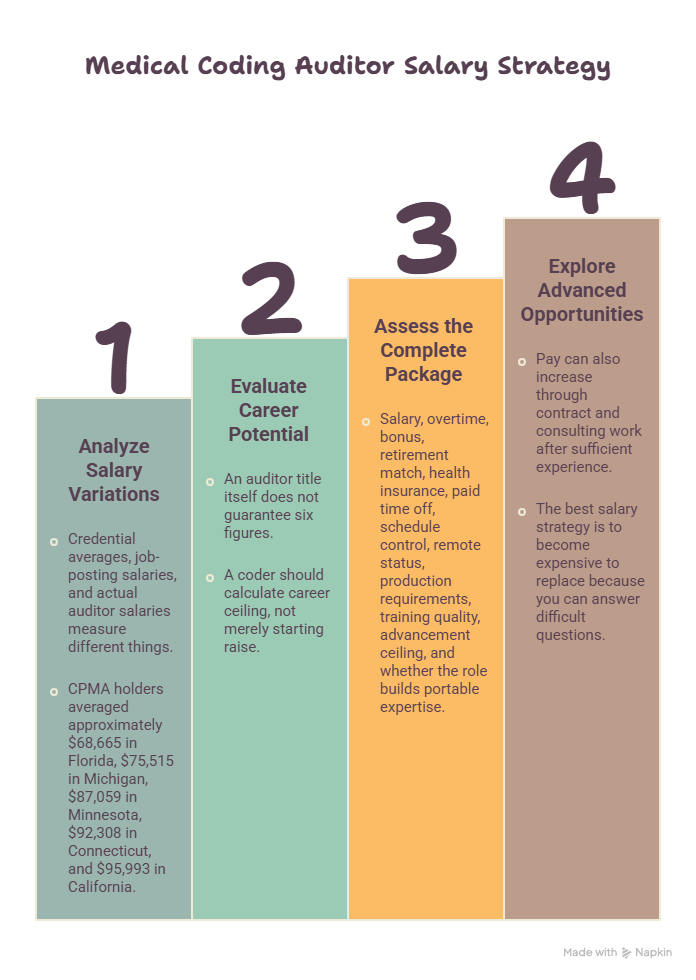
Medical coding auditor pay can exceed ordinary production coding pay, yet credential averages, job-posting salaries, and actual auditor salaries measure different things.
AAPC's 2025 salary-survey data illustrates how geography changes the picture. CPMA holders in its published state data averaged approximately $68,665 in Florida, $75,515 in Michigan, $87,059 in Minnesota, $92,308 in Connecticut, and $95,993 in California. These figures represent average salaries of surveyed people holding CPMA in those states; they are not guaranteed salaries for a newly promoted auditor and may include experienced professionals holding multiple credentials.
This is why comparing CPC training, CCS credentials, continuing education costs, and reimbursement expertise should include the career stage behind the salary number.
A recent Huron ambulatory/professional coding-auditor posting listed an estimated range of $26.44 to $37.50 per hour, equivalent to roughly $55,000–$78,000 annually at 40 hours per week before overtime. The same role required CPC, preferred CPMA, and expected 95% audit accuracy and productivity.
That real posting demonstrates the central pay lesson: an auditor title itself does not guarantee six figures.
The larger upside usually appears after specialization. Inpatient/DRG auditing, complex surgical auditing, risk adjustment, payer audit work, compliance investigations, payment integrity, consulting, and audit leadership can command more because the decisions carry greater financial and regulatory consequences. The March 2026 Reddit discussion included experienced coders reporting that seasoned inpatient auditors can reach six figures, while the original poster also observed that entry auditor postings could be only slightly above an already strong inpatient coding salary.
A coder should therefore calculate career ceiling, not merely starting raise.
Suppose you currently earn $75,000 coding and an auditor offer pays $78,000. A $3,000 increase may appear unimpressive. The move could still be rational if it creates a credible route to senior auditor, audit lead, education, compliance, consulting, or management. Conversely, if the new job pays $78,000, adds frequent provider conflict, rigid monitoring, heavier productivity targets, and removes flexibility you highly value, remaining in coding can be the better economic decision.
Assess the complete package: salary, overtime, bonus, retirement match, health insurance, paid time off, schedule control, remote status, production requirements, training quality, advancement ceiling, and whether the role builds portable expertise. Someone already proficient in inpatient coding, professional coding, denial management, and claims reimbursement may be able to wait for a stronger audit opportunity rather than accepting the first title upgrade.
Pay can also increase through contract and consulting work after sufficient experience. Audits may be project-based, specialty-specific, payer-driven, or tied to compliance reviews. That creates potential part-time and contract opportunities that ordinary full-time production roles may offer less frequently. Reddit auditors specifically pointed to part-time and contract work as one reason the skill can broaden long-term options.
The best salary strategy is therefore to become expensive to replace because you can answer difficult questions. A coder who understands medical terminology, advanced CPT, CARC patterns, Medicare rules, and denial root causes can eventually operate far beyond basic chart review.
5. When Should a Medical Coder Move Into Auditing?
A good transition point arrives when your existing coding role has become predictable enough that you can evaluate other people's reasoning without depending on an answer key.
One strong signal is that coworkers already bring difficult charts to you. Another is that your quality scores remain consistently high while you meet productivity requirements. A third is that you routinely research new guidelines, explain policy changes, identify patterns in errors, or challenge findings from auditors with well-supported evidence.
Those activities demonstrate a level of mastery that ordinary CPC exam preparation, CCS exam practice, CBCS coding study, and medical terminology study are designed to eventually support.
Another good signal is career plateau. If your coding pay is near the top of the range and the next increases are small, auditing can create a second growth curve. Reddit's 2026 inpatient discussion captured this exact dilemma: the coder was already near the top of the production range and was considering auditing primarily because the existing role offered little further salary growth.
The transition makes especially strong sense when you enjoy investigation more than volume. Auditors spend time asking why errors occurred, whether a trend is meaningful, which policy applies, whether documentation supports the claim, and what corrective action should follow. Someone fascinated by denial patterns, payer adjustments, reimbursement methodologies, and claims systems may find auditing more intellectually satisfying than repetitive production.
The transition should wait when major coding weaknesses remain. If modifiers, E/M, surgical coding, sequencing, medical necessity, documentation interpretation, or specialty rules still produce frequent errors, reviewing another coder's work can magnify those gaps. Improve through CPC practice, CCS practice cases, CPT mastery, and ongoing CEUs first.
Build audit experience before the title
Ask your manager for quality-review projects, second-level reviews, new-coder mentoring, prebill audits, focused modifier reviews, denial root-cause projects, documentation reviews, or temporary audit support. Even limited experience can matter. The February 2026 Reddit discussion included an auditor who entered the field after only occasional audit assistance because the underlying coding expertise was strong.
Document those projects on your résumé accurately. “Reviewed 50 charts for modifier accuracy and documented findings against payer and coding guidance” is stronger than “assisted auditor.”
Build an evidence portfolio
Keep de-identified examples of the type of analysis you have performed without retaining protected health information. Record audit objective, methodology, finding category, authoritative source, impact, and recommended corrective action.
Develop the same habit while studying Medicare billing, physician reimbursement, billing concepts, and CARCs. Employers want evidence that you can turn rules into defensible conclusions.
Apply internally before assuming you need five years of audit experience
Reddit repeatedly points toward internal promotion as one of the cleanest routes. Organizations already know your quality, reliability, specialty knowledge, and work habits.
Tell your manager you want audit exposure before an opening appears. Volunteer for projects. Build relationships with the audit team. Ask what competencies their strongest auditors demonstrate. Then use CPC knowledge, CCS knowledge, denial expertise, and continuing education to close whatever gaps they identify.
The ideal time to move is when auditing gives you a meaningful new skill layer, rather than merely a different title. That layer should increase your future options in compliance, education, revenue integrity, payment integrity, leadership, consulting, or specialized review.
6. FAQs About the Medical Coding Auditor Career Path
-
AAPC strongly recommends approximately two years of coding experience before taking the CPMA exam, while actual employer expectations can range substantially higher depending on audit complexity.
Reddit auditors report entering through internal promotions with relatively limited formal audit experience, while others spent six to ten years coding first.
Use CPC training, CCS preparation, coding practice, and CEUs to develop breadth before focusing solely on years worked.
-
CPMA can strengthen your profile, especially for professional medical auditing, while employers may accept other combinations of credentials and relevant experience. A recent professional audit posting required CPC and listed CPMA as preferred.
Coders targeting physician audits should strengthen CPT coding, Medicare billing, reimbursement knowledge, and denial analysis alongside any audit certification.
-
That pathway will be difficult for most new coders because auditing requires enough exposure to recognize both correct and incorrect coding across varied documentation. AAPC itself describes CPMA as a high-level certification and recommends prior coding experience.
A stronger route is to use CPC certification preparation, build production experience, master medical terminology, understand claims submission, and gradually acquire review responsibilities.
-
They often can, especially after gaining specialized audit experience, though the increase is not automatic. AAPC's state salary data shows CPMA-holder averages varying widely by geography, while recent Reddit discussions include experienced coders finding entry auditor salaries only modestly higher than their existing pay.
Compare salary against the long-term value of specialty coding, denial expertise, reimbursement knowledge, and future audit leadership.
-
A coding auditor may focus primarily on whether documented services were coded accurately and according to applicable guidelines. Compliance auditing can extend further into regulatory exposure, billing practices, fraud-and-abuse concerns, policies, investigations, and organizational risk.
A 2026 Reddit discussion described coder-auditor roles that could be filled mainly from strong coding backgrounds, while compliance-auditor roles at the same organization required broader billing experience, progressive coding experience, communication ability, and sometimes formal education.
Build broader knowledge through billing concepts, Medicare resources, CARC analysis, and denial management.
-
The better path depends on your existing expertise. A strong inpatient coder may have a natural route into DRG validation and facility auditing, while a CPC with deep physician coding experience may transition more smoothly into professional billing audits.
Use CCS preparation for hospital depth, CPC resources for professional coding, reimbursement guidance, and claims resources to understand the financial environment behind each.
