
Medical Billing vs Medical Coding as a Career: Reddit Experiences on Pay, Stress, Remote Work & Advancement
Medical billing and medical coding sit inside the same revenue cycle, yet the daily work, pressure, pay ceiling, remote-work path, and long-term advancement can feel very different. Coding rewards people who enjoy documentation analysis, rules, anatomy, and precision. Billing rewards people who enjoy payer research, claims troubleshooting, follow-up, and revenue recovery. Before choosing, compare medical billing fundamentals, CPC certification programs, CBCS certification courses, and real electronic claims workflows. The better career is the one whose everyday problems you are willing to solve for years.
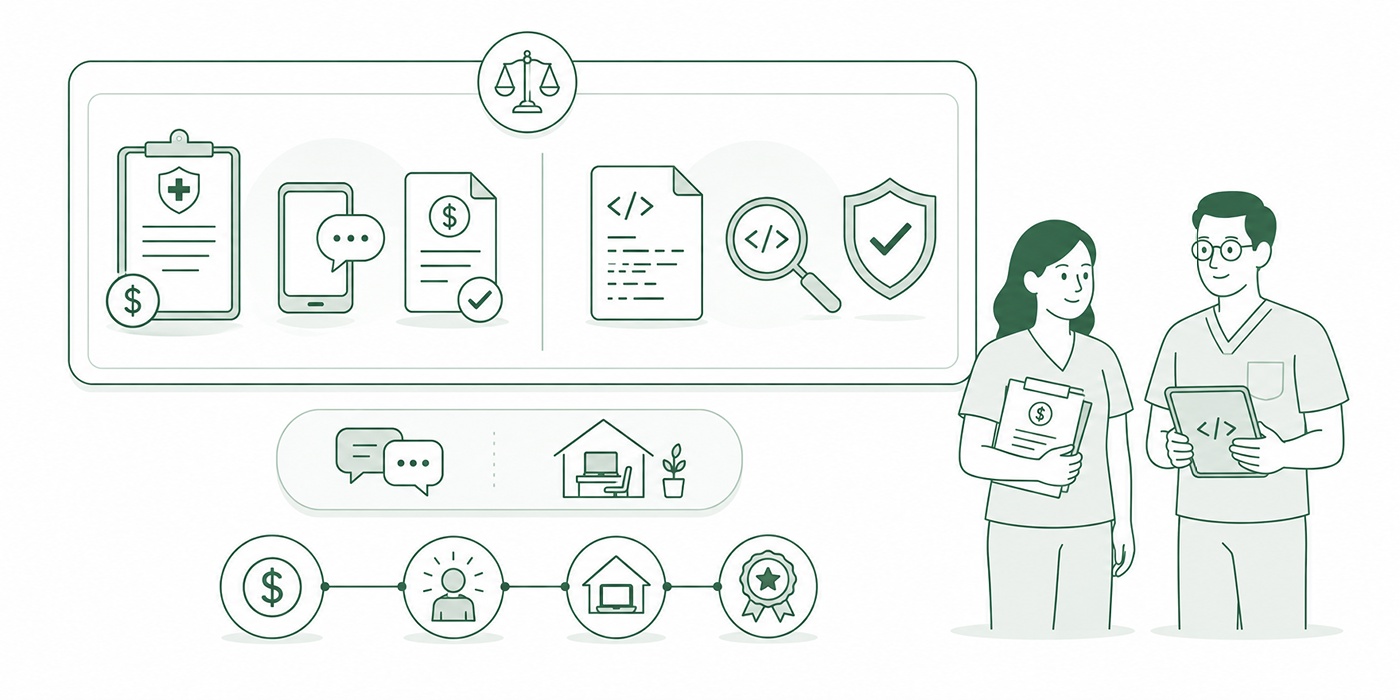
1. Medical Billing vs Medical Coding: What the Jobs Actually Feel Like
Medical coding begins with clinical documentation. A coder reviews the patient record and translates diagnoses, procedures, services, and supplies into standardized code sets such as ICD-10-CM, CPT, and HCPCS. AAPC's own training comparison describes CPC preparation as physician-office coding focused on assigning diagnosis and procedure codes from charts and operative reports. Medical billing begins farther downstream. Billers use coded information to prepare and process claims, communicate with third-party payers, work rejected or denied claims, follow balances, and help convert documented care into reimbursement. Someone exploring coding should build medical terminology, CPT coding proficiency, CPC exam skills, physician fee schedule knowledge, and an understanding of Medicare billing rules.
That difference changes the problems you face all day. A coder may spend 20 minutes deciding whether documentation supports a particular procedure, diagnosis hierarchy, modifier, E/M level, or sequencing choice. A biller may spend those same 20 minutes determining why a payer rejected a claim, whether coverage was active, whether authorization was missing, whether patient responsibility was calculated correctly, and what must happen for the account to move. Strong billers therefore benefit from CARC knowledge, denial-management expertise, electronic claims knowledge, Medicaid reimbursement knowledge, and familiarity with small-practice billing systems.
The personalities that thrive can differ too. Coding tends to suit people who enjoy focused analytical work, clinical detail, continuous rule updates, documentation interpretation, and defending decisions during audits. Billing tends to suit people who enjoy investigating financial problems, tracing transactions, communicating with insurers, managing work queues, and pushing unresolved balances toward resolution. Phone exposure varies dramatically by employer, though billers are more likely to communicate with payers or patients. A 2025 Reddit discussion included billing professionals describing insurer follow-up around eligibility, prior authorizations, denials, and patient billing questions, while a coder in the same discussion described having essentially no phone work. Building either career becomes easier when you understand medical billing concepts, claims platforms, denial causes, CPT rules, and claim adjustment codes.
The careers also overlap far more than course advertisements sometimes suggest. A coder who understands reimbursement makes better sense of edits, denials, payer policies, and documentation risk. A biller who understands coding can recognize obvious claim problems before wasting days in payer queues. AAPC explicitly says billing knowledge can expand a coder's career opportunities and help decrease denials. The strongest candidates often understand the full chain from documentation through code assignment, claim submission, payer adjudication, denial resolution, and reimbursement analysis.
| Career Factor | Medical Billing | Medical Coding | Who Has the Edge? |
|---|---|---|---|
| Core job | Turns services into payable claims and manages reimbursement | Translates documentation into diagnosis and procedure codes | Depends on preferred work style |
| Primary input | Claims, payer responses, balances, EOBs/ERAs | Clinical documentation and operative notes | Personal preference |
| Primary output | Clean claims, resolved balances, reimbursement | Defensible coded data | Different objectives |
| Daily research | Payer rules, denials, eligibility, authorization | Guidelines, documentation, code selection | Both research-heavy |
| Clinical knowledge | Useful | Central to the job | Coding |
| Insurance knowledge | Central to the job | Highly useful | Billing |
| Phone exposure | Can include payer and patient calls | Often lower | Coding for phone-averse workers |
| Concentration | Frequent queue switching can occur | Often requires longer periods of chart focus | Coding for deep-focus workers |
| Emotional friction | Payer delays, patient balances, aging A/R | Audit exposure, difficult charts, productivity pressure | Different stress profile |
| Productivity pressure | Accounts worked, collections, aging, turnaround | Charts per hour/day plus accuracy | Both |
| Accuracy pressure | High due to financial and compliance consequences | Very high due to coding and audit consequences | Coding slightly higher |
| Entry barrier | Can be lower for entry-level revenue-cycle roles | Certification and experience filters are common | Billing |
| Certification importance | Varies by employer | Frequently central to hiring | Billing for easier entry |
| Common credential | CPB, CBCS, employer-specific training | CPC, CCS, CCA, COC, RHIT/RHIA pathways | Role dependent |
| 2025 BLS wage proxy | Billing/posting clerks averaged $51,070 annually | Medical records specialists averaged $56,790 annually | Coding category |
| 2025 median hourly proxy | $23.32 | $24.59 | Coding category |
| Specialty premium | Exists in complex billing and RCM niches | Strong in inpatient, surgical and specialty coding | Coding |
| Remote potential | Strong in mature RCM operations | Very strong after experience | Coding |
| Beginner remote access | Possible in billing/AR roles | Experience filters frequently narrow access | Billing |
| Patient interaction | Possible depending on role | Usually minimal | Coding for non-patient-facing work |
| Payer interaction | Common | Less direct in many roles | Coding for lower interaction |
| Career mobility | AR, denials, revenue integrity, management | Specialty coding, audit, compliance, CDI, management | Both strong |
| Management route | Revenue cycle supervisor/manager/director | Coding supervisor/manager/director | Both |
| Audit route | Billing and revenue integrity audit | Coding audit and compliance | Coding has broader credential pathways |
| AI exposure | Routine claim tasks increasingly automated | Computer-assisted coding increasingly common | Both require upskilling |
| Best defensive skill | Complex denial and reimbursement analysis | Audit, complex coding and documentation judgment | Both |
| Best for problem solvers | Strong fit | Strong fit | Both |
| Best for detail-oriented workers | Important | Essential | Coding |
| Fastest healthcare entry | Often billing, claims, AR or patient accounts | Can take longer when experience is required | Billing |
| Long-term technical ceiling | Strong through revenue cycle and leadership | Strong through specialization, audit and compliance | Both, through different ladders |
2. Pay: Does Medical Coding Really Pay More Than Medical Billing?
The cleanest national comparison requires an important caveat. The Bureau of Labor Statistics does not publish a perfect medical-biller-versus-medical-coder wage table. Medical coders are included within medical records specialists, while medical billing commonly falls inside the broader billing and posting clerks category, which includes billing outside healthcare. These are useful national proxies rather than an exact head-to-head salary study. In May 2025, medical records specialists had a $56,790 mean annual wage and $24.59 median hourly wage. Billing and posting clerks had a $51,070 mean annual wage and $23.32 median hourly wage. Anyone comparing compensation should pair those benchmarks with CPC certification research, CBCS training, medical billing concepts, reimbursement knowledge, and local vacancy data.
The difference widens or narrows dramatically once setting, specialty, credentials, and experience enter the picture. Current remote job listings illustrate the range. Recent Indeed results included medical billing positions around $18–$22 per hour, a combined biller/coder role around $25–$30, facility coding positions around $26–$30, an outpatient coding specialist at $30–$35, and coding appeals work near $30 per hour. These are individual vacancies rather than national averages, though they show how specialized coding and advanced revenue-cycle roles can move beyond generic entry-level billing pay. Skills in denial management, claims submission, CARC interpretation, CPT coding, and Medicare reimbursement help move workers toward those higher-value functions.
Reddit experiences broadly support the idea that coding can carry a stronger technical pay ceiling, while showing how uneven individual outcomes remain. In a detailed 2024 discussion, one person described starting in billing at $18 per hour before moving toward CPC certification, while another said they moved from $15 billing work to close to $30 after becoming a coder and accumulating experience. Another commenter reported eight years in coding at $23 per hour, demonstrating how employer, region, specialty, and negotiation can overpower general salary assumptions. A recent 2026 biller described earning about $43,000 in the first year while enjoying A/R research, and said local postings often sat around $38,000–$42,000 even with experience. Those stories make continuing education, CPC preparation, CCS certification, denial expertise, and fee-schedule knowledge economically relevant.
The strongest salary strategy is therefore to choose a high-value function, rather than chasing a generic title. In billing, that can mean complex A/R, denials, appeals, revenue integrity, Medicare, Medicaid, workers' compensation, or management. In coding, that can mean inpatient, surgery, anesthesia, specialty professional-fee coding, auditing, risk adjustment, or compliance. AHIMA currently lists coding paths that include coding auditor, risk adjustment coder, and revenue-cycle specialist in addition to core medical coding. Build those options through workers' compensation billing resources, ambulance reimbursement knowledge, Medicaid reimbursement tools, CPC study resources, and CCS exam practice.
3. Stress and Remote Work: Which Career Gives You the Better Day-to-Day Life?
Medical billing stress tends to come from unfinished money problems. A denied claim remains on an aging report until someone resolves it. A payer may require another call, another portal check, supporting documentation, a corrected claim, an appeal, or proof of authorization. Accounts can be measured by aging buckets, dollars outstanding, collection targets, or turnaround time. Billing roles involving patients introduce another layer because staff may need to explain deductibles, balances, coverage decisions, and payment responsibility. The work becomes more manageable when you understand claim adjustment codes, denial workflows, Medicare tools, Medicaid reimbursement, and electronic claims systems.
Coding stress is more likely to come from the collision between accuracy and productivity. A coder may be expected to maintain a high quality score while hitting daily or hourly production requirements. Documentation can be incomplete, procedures can be complex, and the correct result may depend on guidelines, payer policy, hierarchy, sequencing, modifiers, or provider clarification. A Reddit coder described remote work as stressful because of simultaneous speed and accuracy expectations while still learning. Experienced commenters in the same discussion said coding remained demanding years into the profession. A 2026 Reddit post likewise warned prospective entrants that coding involves complex guidelines, changing rules, and an ongoing learning curve. Preparation through medical terminology, CPT principles, CPC practice questions, CCS practice questions, and exam strategy reduces the size of that learning shock.
Remote work is realistic in both careers. Coding has an especially strong structural fit because charts, encoders, EHRs, audit tools, and work queues are digital and direct patient contact is usually minimal. AAPC currently says approximately 51% of its certified medical coders work from home, while separate AAPC survey reporting has produced even higher remote percentages depending on the sample and definition used. The catch is experience: a 2026 Reddit discussion about remote coding drew a highly upvoted explanation that employers often prefer workers who already understand production because turnover can be high and workload can be intense. Build remote readiness through CPC certification, claims knowledge, denial experience, reimbursement knowledge, and continuing education.
Billing can also move home successfully, especially inside centralized revenue-cycle organizations. Current remote billing vacancies include A/R specialists, medical billing specialists, revenue-cycle specialists, and combined billing/coding roles. The daily experience varies more because some employers expect extensive payer calling, patient communication, or tightly measured collections activity. For someone choosing based primarily on lifestyle, ask specific interview questions about call volume, account quotas, chart quotas, quality thresholds, schedule monitoring, mandatory overtime, queue ownership, and whether remote employees can work across time zones. Those questions are as important as studying medical billing concepts, CARCs, payer workflows, small-practice billing systems, and insurance denials.
4. Advancement: Which Career Gives You More Ways to Move Up?
Medical billing can develop into a much broader revenue-cycle career than the entry title suggests. AHIMA currently describes revenue-cycle paths ranging from patient access and claims/denials work through revenue integrity analyst, revenue cycle manager, and director-level leadership. A biller who becomes excellent at denial management, CARC interpretation, Medicare reimbursement, Medicaid reimbursement, and electronic claims can become more valuable than someone who simply processes routine claims quickly.
A practical billing ladder might look like billing representative → senior biller → A/R or denial specialist → reimbursement analyst → revenue integrity analyst → team lead → revenue cycle manager → director. Other branches include payer contracting support, authorization management, workers' compensation, collections analytics, consulting, and practice management. The higher you move, the less the career revolves around submitting individual claims and the more it revolves around diagnosing systemic revenue leakage. Knowing small-practice billing systems, workers' compensation workflows, ambulance reimbursement, physician fee schedules, and denial root causes creates that broader business perspective.
Coding offers an equally strong ladder with a more technical center. AHIMA currently highlights careers in core coding, coding audit, risk adjustment, revenue-cycle work, compliance, and health data. A coder might progress from Coder I → Coder II/III → specialty coder → inpatient or advanced outpatient coder → auditor → quality specialist → coding educator → compliance or revenue integrity specialist → coding manager. The right advancement route depends on whether you deepen through a CPC pathway, CCS certification, CPC practice, CCS exam preparation, or continued coding CEUs.
The trade-off becomes visible when employees leave production work. A February 2026 Reddit post from a professional billing auditor described five years of previous pro-fee coding, followed by almost two years in audit. The user had stronger pay and benefits in the advanced role, yet described intense stress around productivity and finding higher-dollar opportunities and said they missed direct coding work. Advancement can therefore increase compensation while changing the character of the job. Before accepting a promotion into auditing, revenue integrity, compliance, or management, determine whether you actually enjoy the next layer of responsibility. Expertise in coding guidelines, reimbursement, denials, claims systems, and continuing education gives you options without forcing you to take every promotion.
There is also a powerful billing-to-coding bridge. Reddit users repeatedly describe beginning in front desk, billing, A/R, medical records, or claims work before moving into coding. In one discussion, a biller explained that coding knowledge helped substantially in billing before they pursued CPC certification. A billing role can therefore be strategic when a new coder struggles with the experience barrier. While working, learn CPT principles, strengthen medical terminology, use CPC practice questions, understand claim adjustment codes, and watch how denials expose coding errors in real revenue-cycle work.

5. Which Career Should You Choose? Use the Job You Want Five Years From Now
Choose medical billing when you want a potentially faster entry into healthcare operations and you enjoy solving transaction-based problems. The work fits people who can manage multiple accounts, investigate payer behavior, communicate clearly, tolerate follow-up, and find satisfaction in turning unpaid balances into resolved accounts. Start by learning medical billing concepts, CBCS certification options, electronic claim submission, CARC interpretation, and denial-management workflows.
Choose medical coding when you prefer concentrated analytical work and want a career built around clinical documentation, standardized rules, and technical specialization. Coding demands more upfront mastery of anatomy, terminology, CPT, ICD-10-CM, HCPCS, guidelines, documentation quality, and sometimes facility-specific systems. The BLS currently projects 7% growth for medical records specialists from 2024 through 2034, with roughly 14,200 openings per year, while also acknowledging that AI-assisted coding may increase efficiency and influence future demand. Prepare through an online CPC program, CPC first-attempt strategy, medical terminology training, CPT practice, and coding CEUs.
Choose a blended revenue-cycle path when both sides appeal to you. Small practices frequently combine functions, and higher-level revenue integrity work benefits from understanding documentation, coding, claims, reimbursement, and denials together. A combined role can also protect your career as automation absorbs routine transactions. AHIMA's current revenue-cycle resources emphasize coding, documentation, denials, regulatory knowledge, and AI upskilling as interconnected capabilities. Build that hybrid profile through billing fundamentals, CPC preparation, Medicare resources, denial management, and physician reimbursement.
Before paying for training, run a 50-job audit. Collect 25 billing vacancies and 25 coding vacancies you would genuinely accept. Record compensation, remote status, required experience, credential requirements, call expectations, software, specialties, productivity standards, and advancement language. Then calculate how many you currently qualify for and how many become realistic after one credential or one year of experience. That exercise can save thousands of dollars and months of frustration. Compare the results against CPC programs, CCS programs, CBCS programs, CPC exam resources, and medical billing resources.
Finally, choose based on repeated daily tasks, because salary excitement fades faster than job friction. Someone who hates phone calls may struggle in payer-heavy billing despite liking healthcare. Someone who hates reading dense documentation may struggle in coding despite wanting remote work. Someone who dislikes measurable production quotas may dislike both in high-volume environments. Reddit discussions repeatedly show satisfied and stressed professionals on both sides, which makes employer design nearly as important as occupation. Research denial workflows, coding practice, claims operations, reimbursement rules, and medical terminology before deciding which kind of pressure feels sustainable.
6. FAQs About Medical Billing vs Medical Coding Careers
-
Coding has a somewhat higher national wage proxy. BLS May 2025 data show medical records specialists, a category that includes medical coders, averaging $56,790 annually, compared with $51,070 for the broader billing and posting clerk category. Specialty, location, credential, experience, and employer can create much larger differences. Build earnings potential through CPC certification, CCS certification, denial expertise, reimbursement knowledge, and continuing education.
-
Medical billing often provides more entry points through billing assistant, claims, patient accounts, charge entry, eligibility, A/R, and revenue-cycle representative roles. Coding employers frequently add certification and production-experience filters. Someone planning a coding career can use billing as a bridge while developing CPC knowledge, medical terminology, claims knowledge, CARC expertise, and denial-management skills.
-
The stress is different. Billing pressure often comes from aging A/R, payer delays, denials, collections, calls, and unresolved balances. Coding pressure often comes from accuracy thresholds, production quotas, complicated documentation, audits, and continuous guideline changes. Reddit experiences show both careers producing stress under demanding employers. Learn billing fundamentals, coding strategy, denial resolution, CPT rules, and claims workflows before deciding which pressure profile suits you.
-
Both can support remote work. Coding has especially strong remote potential because the work is digital and usually requires little direct patient interaction. AAPC currently says approximately 51% of its certified coders work from home. Billing also has extensive remote opportunities in A/R, claims, denials, reimbursement, and centralized revenue-cycle operations. Improve your remote profile through CPC certification, billing knowledge, electronic claims, denial management, and Medicare knowledge.
-
Medical coding generally offers the lower-call path. Billers may communicate with insurance companies, patients, provider offices, authorization teams, or other revenue-cycle departments. Some billing roles are largely portal and queue based, so employer workflow still matters. Reddit workers have described this same distinction between payer-facing billing and largely phone-free coding. Build coding readiness through CPC programs, medical terminology, CPC questions, CPT principles, and exam preparation.
-
Yes. Billing can expose you to CPT, ICD-10-CM, HCPCS, payer rules, denials, medical necessity, EOBs, ERAs, claims edits, and documentation problems. Reddit career stories include workers who began in billing and later moved toward coding credentials and coding jobs. Make that bridge deliberate by studying CPC strategy, medical terminology, CPT concepts, claim adjustment codes, and denial workflows.
