
Medical Coding Productivity Quotas: Reddit Stories on Charts per Hour, Accuracy Pressure, Burnout & How Jobs Differ
Medical coding productivity can mean one complex inpatient chart per hour, 12 emergency-department encounters per hour, or dozens of straightforward ancillary records in the same period. That range explains why comparing quotas without knowing the job is almost useless. Coders evaluating a position need to examine chart complexity, accuracy requirements, counted versus uncounted work, and the employer's measurement window. Those factors matter alongside medical coding salaries in 2026, first-job employer expectations, remote coding realities, and the long-term value of a coding career.
1. What Does a Medical Coding Productivity Quota Actually Measure?
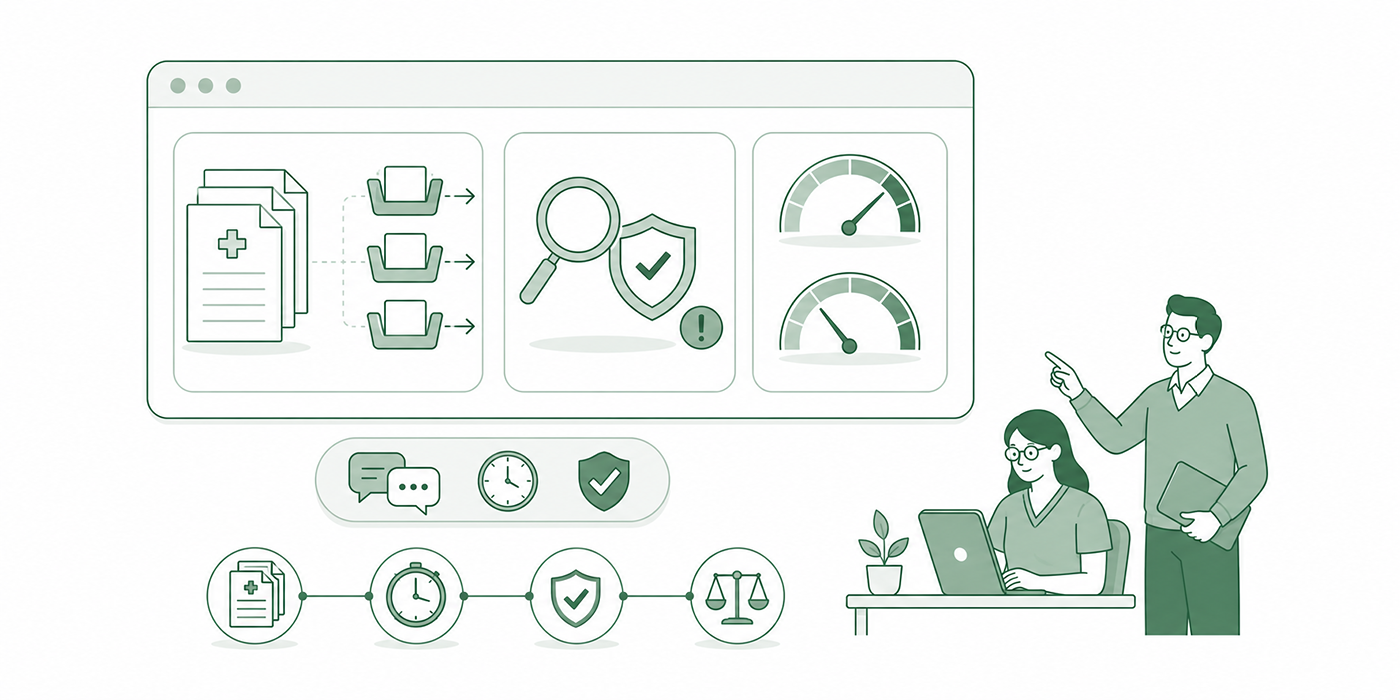
A productivity quota is an employer's expectation for how much coding work should be completed within a defined period. The metric may be charts per hour, encounters per day, records per shift, claim lines per hour, weighted cases, minutes per record, or another internally developed production unit.
The number becomes meaningful only after you know exactly what counts as a completed unit.
Consider two coders who are both told to produce 12 charts per hour. The first codes emergency-department professional claims where much of the documentation is standardized. The second reviews every facility charge, assigns diagnoses, validates infusions, determines procedures, enters facility E/M levels, and resolves documentation problems. Their headline quota is identical while the underlying workload is radically different.
That is why a prospective coder should understand professional and facility coding concepts, strengthen CPT coding knowledge, understand electronic claim workflows, and learn how denials affect revenue-cycle work before comparing production numbers.
Employers also measure different portions of the workday. One organization may divide completed charts by all paid hours. Another may exclude meetings, training, downtime, emails, queries, system problems, and assigned administrative work. A third may calculate productivity only from designated coding time.
That denominator can change the result dramatically.
A coder who finalizes 72 encounters during six true coding hours produces 12 charts per coding hour. Calculated across an eight-hour paid day, the same output becomes nine charts per paid hour. Neither number explains the workload without knowing the employer's calculation.
Accuracy creates the second half of the equation. AHIMA has published examples of healthcare organizations using greater than 95% coding accuracy, while emphasizing that quality should remain a primary focus because coding errors affect reimbursement and healthcare data. Experienced coders also commonly describe 95% accuracy requirements in community discussions. Anyone preparing through CPC certification programs, CCS programs, CPC exam preparation, or CCS practice cases should therefore train for accurate throughput, rather than raw speed alone.
Historical AHIMA productivity research also demonstrates why case type matters. An ICD-10 productivity study involving 157,248 inpatient records reported an average of roughly 11.5 inpatient records per day, 1.4 per hour, and 41.9 minutes per record. High-case-mix records averaged approximately 53.6 minutes each, compared with 38 minutes at lower case mix. Those figures should be treated as historical evidence of complexity effects rather than a universal 2026 quota.
A useful way to evaluate productivity is:
Productivity requirement + quality requirement + case complexity + counted work + measurement period = real workload
That formula tells you far more than “How many charts per hour?”
| Factor | Why It Changes Productivity | Question to Ask | Red-Flag Scenario |
|---|---|---|---|
| Coding setting | Professional, outpatient facility, and inpatient work involve different workloads. | Which exact coding setting does the quota cover? | One quota applied across unrelated coding types. |
| Specialty | Radiology, surgery, ED, cardiology, and primary care can move at very different speeds. | Is productivity specialty-specific? | Complex surgery measured like simple diagnostic work. |
| Chart complexity | More diagnoses, procedures, and documentation increase review time. | Does complexity affect the target? | Identical expectations for simple and highly complex encounters. |
| Length of stay | Long inpatient stays contain substantially more documentation. | Are long stays weighted differently? | A 14-day admission receives the same time allowance as a short stay. |
| Case mix | Higher-acuity cases generally require deeper abstraction. | Is case mix incorporated? | Trauma and low-acuity cases carry identical production weights. |
| Code assignment scope | Assigning diagnoses alone is faster than coding diagnoses, procedures, E/M, and modifiers. | Which code sets am I responsible for? | Benchmark copied from a narrower coding role. |
| Charge validation | Reviewing charges adds work beyond code assignment. | Do coders validate charges? | Charge review is invisible in productivity calculations. |
| E/M leveling | E/M review may require detailed documentation analysis. | Do I assign or validate E/M levels? | E/M work is added without adjusting the quota. |
| Modifier review | Complex modifier decisions add research and documentation review. | Are modifiers part of my coding responsibility? | Modifier-intensive specialties share generic targets. |
| Queries | Queries require research, documentation, and follow-up. | Does query time count toward productivity? | Necessary query work reduces measured output. |
| Held charts | A coder may perform substantial work before an account can be finalized. | Do held accounts receive productivity credit? | Only finalized charts count. |
| Documentation deficiencies | Missing reports create searches, follow-up, and rework. | How is incomplete documentation handled? | Coder absorbs delays they cannot control. |
| Denial review | Denials often require payer-policy and historical claim research. | Are denials included in normal production? | Complex appeals treated like routine coding. |
| Payer research | Different payer policies can require additional verification. | Is research time excluded or credited? | Research-heavy accounts carry no extra allowance. |
| Number of systems | Switching between EHR, encoder, payer portal, and billing system slows work. | How many applications are required? | Multisystem work benchmarked against one-screen workflows. |
| EHR design | Efficient chart navigation can save minutes per encounter. | Which EHR and encoder are used? | Poor workflow design becomes a coder performance problem. |
| Computer-assisted coding | Useful suggestions can accelerate review while poor suggestions create extra validation. | How much automation exists? | Automation-driven targets assume perfect tool performance. |
| New-coder ramp | Beginners need time to learn systems, policies, and specialties. | What is the productivity ramp schedule? | Full quota begins immediately after training. |
| Accuracy threshold | High quality requirements constrain how aggressively a coder can chase speed. | What audit score must I maintain? | Speed is rewarded while preventable errors are simultaneously penalized. |
| Audit methodology | Small samples can make each error disproportionately important. | How many charts are audited? | One mistake can destroy an entire monthly score. |
| Error weighting | A typo and a DRG-changing error may have very different consequences. | Are errors weighted by severity? | Every error is treated identically. |
| Daily vs monthly measurement | Longer periods allow complex and simple days to balance. | Is productivity daily, weekly, or monthly? | One difficult day triggers performance action. |
| Meetings | Required meetings remove coding time. | Are meeting hours deducted? | Quota remains unchanged during meeting-heavy weeks. |
| Education time | Guideline updates require continuing education. | Is education protected? | Coders must learn updates while maintaining full output. |
| System downtime | Technology interruptions directly reduce production. | How is downtime documented? | Outages remain inside the productivity denominator. |
| Queue assignment | Fair distribution matters when complexity varies. | Are charts assigned or self-selected? | Cherry-picking leaves difficult cases for the same coders. |
| Overtime | Persistent overtime can disguise understaffing. | How frequently is overtime needed? | Quotas are achievable only through extra hours. |
| Paid model | Hourly, salary, per-chart, and incentive systems create different pressures. | How is production connected to compensation? | Piece-rate incentives encourage unsafe rushing. |
| Support resources | Educators, auditors, CDI staff, and escalation channels reduce wasted research time. | Who helps with difficult cases? | Coders receive high quotas with little technical support. |
| Performance consequences | A target can function as a coaching benchmark or a strict disciplinary threshold. | What happens when someone misses quota? | Termination risk appears before adequate coaching or ramp time. |
2. How Many Charts per Hour Do Medical Coders Actually Report on Reddit?
The strongest conclusion from coder discussions is that there is no meaningful universal charts-per-hour number. The range changes drastically with specialty and scope.
A February 2026 MedicalCoding discussion is unusually helpful because coders from several settings reported their actual expectations in the same thread. One outpatient department reportedly used around four surgical sessions per hour versus approximately 40 radiology encounters per hour. Another commenter described ancillary work at around 24 per hour, surgery and observation around four per hour, and inpatient coding around 2.5 per hour. An inpatient coder said 12–18 records per eight-hour shift could be typical depending on length of stay and medical complexity, while another reported a 2.5-per-hour target and struggled to exceed one per hour after six months in inpatient coding.
The same discussion included a professional-fee coder whose minimum was 96 charts per day, primarily E/M visits. That coder later moved into a coding analyst role and reported a significant pay increase, illustrating how productivity-heavy entry work can still become a platform for advancement. Readers evaluating that route should compare professional coding credentials, CPC training options, medical coding salary progression, and CPC-A employment barriers.
Emergency-department coding provides another useful comparison. In a March 2026 discussion focused on ED professional coding, one coder reported 15 charts per hour, falling to 12 per hour after the workflow changed to single-path coding. A January 2025 discussion produced reports of 12, 12–15, and 17 ED charts per hour, with participants emphasizing that productivity changes depending on whether incomplete charts receive credit and whether coders must finalize every component themselves.
Those differences become easier to understand after studying emergency medicine CPT coding, CPT principles, physician reimbursement rules, and Medicare billing resources. “ED coding” can describe substantially different scopes of work.
Inpatient coding produces dramatically smaller numbers because each record can contain days or weeks of documentation. One March 2026 coder working on Level I trauma and teaching-hospital cases questioned whether a two-chart-per-hour expectation remained realistic when the queue consisted predominantly of very high-value, complex inpatient records. Another Reddit discussion described a small hospital whose corporate expectation reached four inpatient charts per hour, while a former coding manager considered approximately three per hour a more realistic performance level in that environment.
This is where CCS training, CCS coding preparation, CCS practice cases, and CCS exam strategy become especially relevant. Facility coding speed grows from repeated clinical abstraction and rule application, rather than memorizing a larger number of codes.
The practical lesson is simple: ask for the quota and the workflow in the same conversation.
“12 charts per hour” tells you almost nothing.
“12 ED professional claims per hour, including E/M, diagnoses, procedures and modifiers, with 95% accuracy, incomplete charts credited, measured over a rolling monthly average” tells you enough to judge the job.
3. Accuracy Pressure, Burnout and the Productivity Trap
The most dangerous productivity problem appears when a coder starts trading review quality for speed.
A 2025 Reddit poster described repeatedly missing codes during audits, scoring below a 95% target, and feeling caught between slowing down enough to catch mistakes and moving quickly enough to satisfy productivity requirements. The coder also described feeling burned out as the day progressed. That experience captures the central tension of production coding: additional speed eventually stops coming from efficiency and starts coming from skipped verification.
This matters financially. Missing a secondary diagnosis, applying an unsupported modifier, selecting an incorrect procedure code, or mis-sequencing diagnoses can affect reimbursement, denials, compliance, risk adjustment, and reported clinical data. Understanding claim adjustment reason codes, insurance denial management, Medicare billing tools, and electronic claims submission makes clear why one inaccurate chart can generate work far beyond the coding department.
AHIMA has specifically argued that coding quality deserves primary emphasis over raw productivity because accuracy affects reimbursement and healthcare outcomes. A well-designed employer therefore treats speed and quality as connected metrics.
A useful personal benchmark is:
Accuracy first → stable workflow second → sustainable speed third.
Speed generally increases after a coder recognizes common documentation patterns, understands specialty-specific rules, navigates the EHR efficiently, remembers frequently used codes, and knows exactly where relevant information lives. That is one reason CPC study strategy, medical terminology mastery, CPC practice questions, and CCS case practice should focus on repeatable decision processes.
Micromanagement can make the same quota feel substantially worse. A coder may tolerate a demanding monthly production standard when complex cases naturally balance against simpler ones. The same person may struggle in an environment where supervisors watch hourly output, demand explanations for every short interval, and treat ordinary research as idle time.
Reddit discussions show both models. One coder reported that productivity was tracked weekly while the employer also provided support when someone struggled. Another described environments where monitoring itself generated anxiety. People choosing between offers should therefore investigate workplace design alongside medical coding salary, remote coding opportunities, billing-versus-coding stress, and AI-driven workflow changes.
Burnout also increases when noncoding work is invisible. A new coder working denials described cases requiring multiple systems, payer-policy research, charge audits, documentation review, and collaboration before a decision could even be made. The workload expanded rapidly, creating days where breaks felt difficult to take. Counting those accounts as if they were uniform encounters creates a distorted productivity metric.
4. How Productivity Changes Across Inpatient, Outpatient, ProFee, ED, Surgery and Radiology Coding
Inpatient coding
Inpatient coding generally produces the lowest charts-per-hour numbers and some of the highest cognitive load. A coder may review an entire admission, identify the principal diagnosis, assign reportable secondary conditions, work through ICD-10-PCS procedures, evaluate POA status, determine discharge disposition, interact with queries, and ensure the final classification supports the correct DRG.
A flat two-chart-per-hour target can therefore feel very different when one queue contains uncomplicated short stays and another contains trauma, transplant, sepsis, multiple procedures, or lengthy admissions. The 2026 Reddit discussion about a Level I trauma coder confronting consistently high-dollar cases illustrates this problem directly. Coders pursuing this path need strong CCS preparation, diagnosis-coding skills, CCS practice experience, and continuing education.
Professional fee coding
Professional fee productivity can move much faster because the unit is commonly an individual practitioner encounter rather than an entire institutional stay. E/M-heavy workflows may produce relatively high daily encounter targets, while complex surgery and specialty coding can slow considerably.
A 2025 Reddit discussion about hospitalist professional coding produced reported expectations ranging from roughly 4–7 to 10–12 charts per hour, with experienced participants pointing out that specialty, hospital complexity, and multi-day services change the comparison. Strong CPC preparation, medical terminology, CPT mastery, and physician fee schedule knowledge are central here.
Emergency department coding
ED coding can sit in the middle: much faster than inpatient work, while still requiring substantial diagnosis and procedure judgment. A 2025 Reddit thread clustered several reported standards around 12–17 completed ED encounters per hour, while a 2026 professional-fee discussion described 12–15 per hour.
The largest question is scope. An ED coder assigning diagnoses alone has a different workload from someone handling diagnoses, facility leveling, infusions and injections, laceration repairs, procedures, supplies, and charge validation. That difference is why emergency CPT resources, CPT principles, claims submission knowledge, and denial-management resources materially affect performance.
Outpatient surgery and observation
Surgery and observation usually require fewer completed encounters per hour because procedural documentation and sequencing demand more review. Reddit examples have reported roughly 3.5–5 per hour for some same-day surgery, observation, or outpatient categories, although employer systems and scope vary widely.
These roles reward deeper CPT coding competence, strong CPC exam preparation, knowledge of Medicare billing rules, and familiarity with claim-adjustment logic.
Radiology and ancillary coding
Radiology, laboratory, and other ancillary records can produce the highest encounter counts because many cases contain narrow, standardized services. A February 2026 Reddit participant reported a radiology target of 43 per hour, while another commenter described departmental expectations around 40 per hour.
Those numbers should never be copied into another specialty. A radiology encounter containing a limited number of standardized services cannot be compared directly with a multi-procedure inpatient admission.
Auditing, denials and revenue-cycle work
Auditors and denial specialists may be measured by charts, claim lines, dollars reviewed, findings, or completed cases. Research time can dominate the workflow. A 2024 Reddit commenter performing inpatient audits reported that the required number had increased from 10 to 16 charts per day over roughly a decade, while other contributors described very different measures for outpatient and professional billing.
This pathway benefits from knowledge of CARCs, denial management, Medicaid reimbursement, and Medicare billing resources.

5. How to Judge a Coding Job's Productivity Requirement Before You Accept It
Ask for the actual production standard during the interview. A strong employer should be able to explain how the metric works.
Start with these questions:
What is the productivity target? Get the number in charts per hour, records per day, weighted units, or whatever metric the organization uses.
Which work counts? Ask specifically about completed charts, held charts, queries, denials, rebills, payer research, emails, meetings, education, system downtime, and documentation follow-up.
How is complexity handled? For inpatient positions, ask about length of stay, case mix, trauma, major procedures, and high-dollar records. For professional work, ask whether E/M, modifiers, surgery, charge validation, and diagnosis coding all belong to the same target.
What accuracy score is required? Then ask how accuracy is calculated. Ten audited charts create a very different statistical environment from a larger monthly sample.
How long is the training ramp? A new coder should understand what percentage of full production is expected at 30, 60, 90, and 180 days. This is particularly important for anyone entering through a CPC program, CCS program, or CBCS course and facing the first-job experience gap.
How frequently is performance reviewed? Monthly averages generally absorb normal variation better than constant hour-by-hour scrutiny.
What happens after a missed target? Look for coaching, targeted education, case review, and a reasonable improvement period. Immediate discipline without investigating case complexity or system problems suggests a weaker performance culture.
How often does the team work overtime? Occasional overtime during unusual backlogs differs from a department whose normal workload requires extra hours.
What percentage of experienced coders currently meet the standard? This may be the most revealing question. If most established employees remain below the supposed minimum, the benchmark deserves scrutiny.
One 2024 Reddit inpatient coder reported a two-chart-per-hour goal while observing that only about 30% of the group appeared to be meeting it. The coder was averaging around one per hour and routinely receiving long, complicated admissions. A target that most competent employees cannot reach deserves investigation.
For your own speed, measure where the time goes. Track 20–30 cases and classify lost minutes into chart navigation, terminology, code lookup, guideline research, modifier decisions, documentation problems, software, interruptions, and rechecking. Then attack the largest category.
Someone constantly searching familiar codes needs repetition. Someone rereading entire charts needs a stronger abstraction workflow. Someone losing time on guidelines needs targeted education. Someone spending 20 minutes waiting for documentation has an operational problem rather than a coding-speed problem.
Use CPC practice questions, the CPC first-attempt strategy, CCS practice questions, and continuing education resources to remove technical bottlenecks. Then compare career options through medical coding salaries, remote-work expectations, training ROI, and AI-related workflow changes.
The strongest coding job is therefore the one where the quota reflects the work, quality remains protected, complexity receives appropriate recognition, and competent employees can sustain the standard without living in permanent catch-up mode.
6. FAQs About Medical Coding Productivity Quotas
-
There is no useful profession-wide number. Current Reddit reports range from roughly one or two complex inpatient cases per hour to 40+ straightforward radiology encounters per hour, with ED professional coding frequently appearing around the low-to-mid teens in the discussions reviewed here.
Your comparison needs to include specialty, chart complexity, code sets, charge review, query work, accuracy standards, and which encounters receive productivity credit. Study CPC requirements, CCS requirements, coding salary differences, and first-job employer filters before comparing yourself with another coder.
-
A 95% threshold appears frequently in coding workplaces and professional discussions. AHIMA has documented an organizational standard above 95% and described greater than 95% as a common industry quality standard in that example.
The audit methodology matters just as much as the percentage. Ask about sample size, error severity, DRG accuracy, diagnosis accuracy, procedural accuracy, and whether corrected education follows audits. Build quality through CPC preparation, CPT coding practice, CCS practice questions, and coding CEUs.
-
Current Reddit reports commonly place inpatient productivity far below high-volume outpatient specialties. A February 2026 discussion included examples around 1.75–2.5 inpatient charts per hour, while complexity, length of stay, and experience changed actual performance considerably.
Historical AHIMA ICD-10 research found averages around 1.4 inpatient records per hour, with high-case-mix records taking substantially longer. These figures provide context rather than a universal contemporary target. Inpatient candidates should strengthen CCS training, diagnosis coding, CCS exam preparation, and facility coding practice.
-
The timeline varies by specialty, training quality, EHR, case complexity, and prior healthcare experience. A new professional coder handling repetitive E/M work may ramp faster than someone learning inpatient surgery and ICD-10-PCS.
Ask prospective employers for their formal 30-, 60-, 90-, and 180-day expectations. Candidates facing the experience gap should use the first-job breakthrough plan, 90-day employment plan, CPC study strategy, and medical terminology preparation to shorten the learning curve.
-
Productivity can be part of an employer's performance management process, and consequences depend on the organization, employment arrangement, local law, training status, and internal policies. Candidates should ask during the interview how missed metrics are handled and what coaching or improvement period exists.
A healthier system investigates technical weaknesses, complexity, accuracy, workflow obstacles, and training needs before escalating consequences. Compare employers through remote coding job expectations, medical coding salary data, career viability, and billing-versus-coding stress factors.
-
Remote coding frequently uses measurable production and quality metrics because output can be tracked electronically. Management intensity still varies greatly between organizations. Some teams review weekly or monthly results and intervene only when a meaningful problem appears. Others monitor production much more aggressively.
Remote candidates should ask what software records activity, which metrics supervisors see, how downtime is documented, whether meetings reduce expected production, and whether performance is judged hourly or over a longer window. Review the remote coding job guide, CPC-A employment plan, medical coding salaries, and AI's effect on coding work.
