
Professional Fee Coding vs Facility Coding: Reddit Career Experiences, Certification Paths & Which Is Easier to Enter
Professional fee coding and facility coding can involve the same patient, the same hospital visit, and completely different reimbursement logic. That distinction affects what you code, which rules you apply, which certification employers prefer, how difficult training feels, and how easily a beginner can get hired. Before choosing a path, understand the CPC, CCS, and CBCS credential differences, the first-job barriers facing new coders, realistic medical coding salaries in 2026, and whether medical coding still fits your career goals.
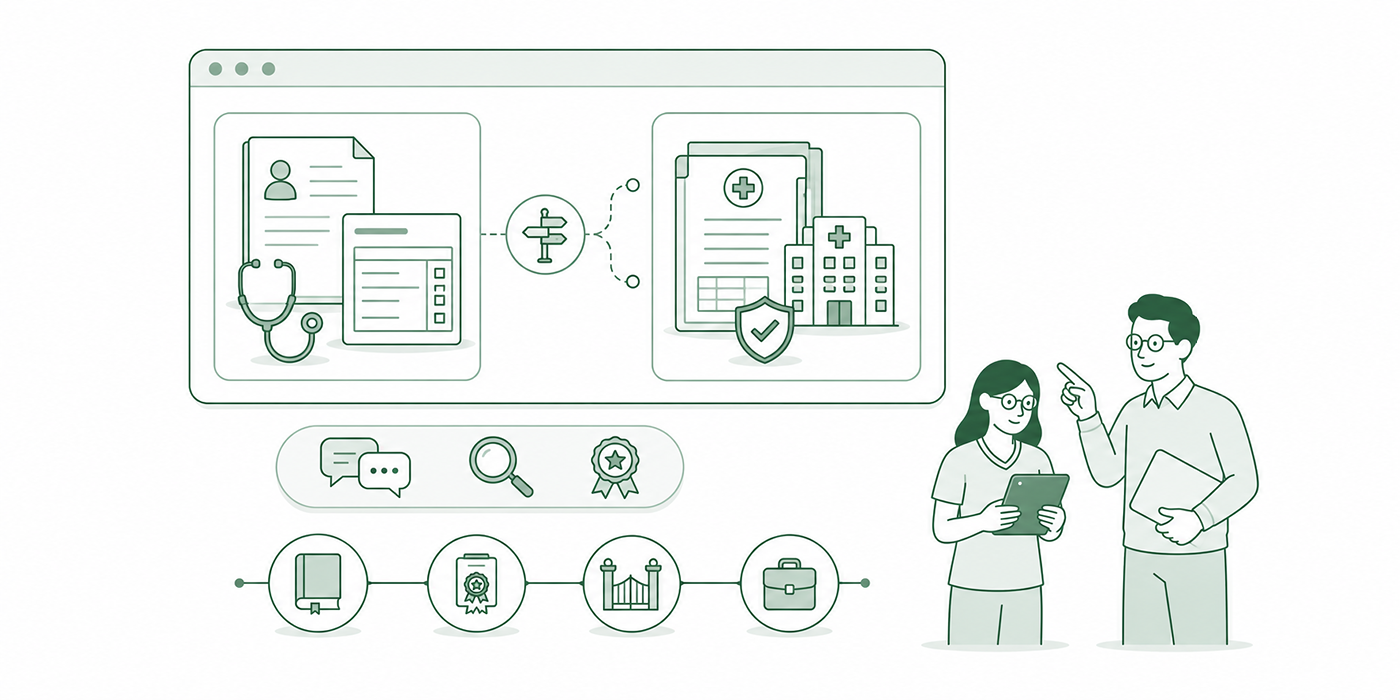
1. Professional Fee Coding vs Facility Coding: What Is the Actual Difference?
The cleanest way to understand the split is to ask whose resources are being reimbursed.
Professional fee coding, often shortened to ProFee, generally supports payment for the physician or other qualified healthcare professional's work. Medicare pays many physician and practitioner services through the Physician Fee Schedule, which incorporates physician work, practice expense, and malpractice relative value units. When physicians perform services in hospitals or other facility settings, the professional payment generally reflects the practitioner's portion because the institution separately bills for facility resources.
That means a professional coder may work on physician office visits, consultations, surgeries, radiology interpretations, anesthesia, E/M services, procedures, and other practitioner services. The strongest starting preparation usually emphasizes CPT coding concepts, medical terminology, CPC exam strategy, and detailed CPC practice questions. AAPC describes its CPC preparation as physician-office coding education, and its current CPC study guide explicitly describes the credential's content as professional fee coding concepts.
Facility coding supports the institution's claim. In a hospital outpatient department, the facility side accounts for the hospital's resources: nursing, supplies, equipment, treatment rooms, medications, technical components, and other institutional costs. CMS generally pays hospital outpatient services through the Outpatient Prospective Payment System, where services are grouped into Ambulatory Payment Classifications.
Facility coding then splits again.
Outpatient facility coding uses ICD-10-CM diagnoses plus CPT and HCPCS Level II for many hospital outpatient and ambulatory surgery services, while adding facility-specific concepts such as revenue codes, status indicators, APCs, OPPS rules, UB-04 data, packaging, medical necessity, and hospital charging structures. AAPC's COC pathway specifically targets outpatient hospitals, facilities, and ASCs. Students moving toward this area should strengthen electronic claims knowledge, Medicare billing concepts, physician reimbursement knowledge, and denial-management skills.
Inpatient facility coding changes the procedure-code system entirely. ICD-10-CM remains central for diagnoses, while inpatient procedures are coded with ICD-10-PCS rather than CPT. CMS confirms that ICD-10-PCS is used for inpatient procedures, including the October 2026 code updates applying to relevant hospital discharges. Inpatient coders also deal with principal diagnosis selection, present-on-admission indicators, sequencing, DRGs, major complications/comorbidities, extensive records, discharge documentation, and clinical documentation integrity issues.
A single hospital episode can therefore produce both professional and facility claims. The surgeon's work may appear on the professional side while the hospital separately bills its facility resources. Learning this distinction early prevents one of the most common beginner mistakes: treating “outpatient,” “inpatient,” “professional,” and “facility” as interchangeable labels.
| Comparison Point | Professional Fee Coding | Outpatient Facility Coding | Inpatient Facility Coding |
|---|---|---|---|
| Primary claim purpose | Reimbursement for practitioner services | Reimbursement for hospital outpatient resources | Reimbursement for inpatient hospital stay |
| Typical setting | Physician office, clinic, hospital-based professional group | Hospital outpatient department or ASC | Acute inpatient hospital |
| Main procedure code set | CPT / HCPCS Level II | CPT / HCPCS Level II | ICD-10-PCS |
| Diagnosis system | ICD-10-CM | ICD-10-CM | ICD-10-CM |
| Common payment framework | Physician Fee Schedule | OPPS / APC methodology | IPPS / MS-DRG methodology |
| Typical claim form environment | CMS-1500 / 837P concepts | UB-04 / 837I concepts | UB-04 / 837I concepts |
| E/M importance | Very high in many specialties | Facility-specific leveling may apply | Different focus from professional E/M coding |
| Modifier complexity | Often significant | Significant, with facility-specific application | Less CPT-modifier centered |
| Revenue codes | Usually peripheral | Important | Important institutional concept |
| APCs | Generally outside core ProFee work | Core reimbursement concept | Generally replaced by inpatient DRG methodology |
| MS-DRGs | Usually outside core work | Limited relevance | Central |
| Present-on-admission logic | Usually outside core ProFee coding | Generally less central | Major responsibility |
| Chart length | Often encounter-focused | Can range from simple to complex | Can involve an entire multi-day admission |
| Procedure abstraction | CPT-driven | CPT-driven plus hospital rules | PCS root operations and detailed abstraction |
| Medical necessity edits | Important | Highly important | Different utilization and inpatient criteria environment |
| NCCI knowledge | Frequently important | Frequently important | Less central than on CPT-based claims |
| Documentation query exposure | Varies by employer and specialty | Moderate | Often substantial |
| CDI interaction | Usually limited | Can occur | Common |
| Common AAPC credential | CPC | COC | CIC |
| Common AHIMA credential | CCS-P may align | CCS | CCS |
| Beginner learning curve | Usually most approachable | Intermediate | Usually steepest |
| Entry-level job availability | Often broader across practices and vendors | More concentrated in hospitals and systems | Often experience-gated |
| Specialty opportunities | Very broad | Broad hospital service-line options | Deep inpatient specialization |
| Production pressure | Can be high | Can be high | High complexity plus productivity expectations |
| Audit exposure | Strong in E/M and specialty coding | Strong in hospital compliance | Strong because DRGs and documentation can materially change payment |
| Best fit for CPT lovers | Strong | Strong | Lower |
| Best fit for complex chart abstraction | Varies by specialty | Moderate to high | Very high |
| Typical progression | ProFee coder → specialty coder → auditor/lead | OP facility coder → surgery/ED/complex outpatient | IP coder → senior IP → auditor/CDI/educator |
2. What Reddit Career Experiences Reveal About ProFee and Facility Coding
Reddit discussions become useful when they are treated as career-pattern evidence rather than salary guarantees. Experienced coders repeatedly describe professional, outpatient facility, and inpatient facility work as different disciplines with different learning curves.
In a 2024 MedicalCoding discussion, an experienced commenter explained that the same inpatient admission can produce an inpatient facility claim and separate professional claims for physicians. They also emphasized that professional coding continues to rely on CPT for procedures while inpatient facility coding uses ICD-10-PCS and different diagnosis rules. Another coder with inpatient hospital experience described inpatient work as extremely different from both outpatient and professional coding even after many years in the profession. That distinction is exactly why beginners should compare CPC preparation, CCS training routes, CPC versus CCS employer recognition, and realistic first-job requirements before buying training.
A January 2026 thread provides an especially useful career progression pattern. Several coders said they started in outpatient work and later moved into inpatient coding. Reasons for moving included higher pay, greater challenge, and less repetitive work. Other participants deliberately returned to outpatient coding because inpatient complexity, productivity expectations, or the difference in coding rules did not suit them. One coder described a difficult adjustment lasting months before inpatient coding finally began to click.
That experience exposes a mistake new students often make: assuming “harder” automatically means “better.” Someone who enjoys repetitive procedural workflows, CPT logic, rapid chart completion, and narrower encounters may thrive in outpatient or professional coding. Someone who likes complex disease processes, multi-day records, sequencing decisions, detailed procedures, clinical documentation interaction, and deeper abstraction may eventually prefer inpatient facility work.
The career-entry pattern also deserves attention. A Reddit discussion from a newly certified CPC-A asked whether inpatient or outpatient coding would be easier to enter. The guidance from experienced users leaned toward outpatient experience first, with inpatient work described as more complex and often easier to reach after paid experience has been established. That pattern aligns with the broader CPC-A employment problem, the difficulty of securing remote coding jobs without experience, and the importance of understanding medical coding training ROI.
A 2025 poster illustrated another useful point. After moving into inpatient coding at a larger hospital and struggling with the workload, the coder later accepted an outpatient position and reported meeting the new facility's accuracy standards while approaching its productivity expectations. The lesson is valuable for anyone choosing a career track: coding aptitude is partly domain-specific. Struggling in inpatient coding does not mean someone lacks coding ability, and excelling in professional fee coding does not guarantee an effortless transition into facility work.
Professional coding has its own advanced difficulty. Complex surgery, E/M auditing, cardiology, anesthesia, modifiers, global surgery rules, payer policies, and multispecialty coding can become highly technical. Review emergency medicine CPT coding, CPT preparation for advanced coding, claim adjustment reason codes, and physician reimbursement methodology before assuming ProFee work stays simple after entry level.
3. CPC, COC, CIC, CCS or CCS-P: Which Certification Matches Each Path?
The safest credential decision starts with the work setting you want employers to pay you to code.
CPC for professional fee coding
AAPC's CPC is the clearest mainstream professional-fee route. AAPC describes its CPC training as physician-office coding preparation and its study materials as professional fee coding concepts. CPC preparation therefore concentrates heavily on ICD-10-CM, CPT, HCPCS Level II, E/M, modifiers, anatomy, terminology, and medical necessity.
Candidates pursuing this route should combine the online CPC program directory, CPC medical terminology preparation, a strong CPC exam study strategy, and CPC first-attempt preparation. If the immediate target is physician offices, multispecialty groups, professional coding vendors, or professional components within a hospital system, CPC usually creates a more direct educational match than an inpatient-specific credential.
AHIMA's CCS-P is another physician-based credential. AHIMA describes it as designed for professionals coding in physician offices, group practices, multispecialty clinics, and specialty centers, with recommended preparation that includes advanced diagnosis and procedural coding plus relevant experience.
COC for outpatient facility coding
AAPC's COC focuses specifically on outpatient hospital and ASC facility work. AAPC says COC candidates need command of CPT, ICD-10-CM, HCPCS Level II, revenue codes, APCs, the UB-04, OPPS concepts, outpatient compliance, and facility reimbursement.
This is where knowledge from Medicare billing resources, electronic claim submission, denial-management workflows, and CARC interpretation becomes increasingly valuable. AAPC even offers an accelerated COC route aimed at existing CPCs who want to add outpatient facility expertise, which shows how closely the CPT foundation overlaps while the reimbursement environment changes.
CIC for inpatient facility coding
AAPC's CIC is dedicated to inpatient hospital/facility coding. Its preparation centers on ICD-10-CM and ICD-10-PCS rather than the CPT-heavy framework used by CPC and COC. AAPC distinguishes the tracks explicitly: CPC prepares for physician-office coding, COC for outpatient hospital/facility coding, and CIC for inpatient hospital/facility coding.
Someone whose long-term goal is inpatient coding should still build strong diagnosis fundamentals through CCS coding preparation, strengthen procedural reasoning through the CCS certification program directory, test decision-making using CCS practice questions, and prepare carefully for CCS exam-day performance.
CCS for broad facility coding
AHIMA's CCS covers both inpatient and outpatient coding. AHIMA describes CCS as a natural progression for professionals experienced in coding inpatient and outpatient records and recommends substantial preparation or related coding experience. Its recommended preparation includes anatomy, pathophysiology, pharmacology, terminology, reimbursement, intermediate or advanced diagnosis coding, procedural coding, and direct coding experience.
That recommendation is important for beginners comparing CPC versus CCS versus CBCS, CCS training programs, CCS CPT preparation, and medical coding training costs. Passing a respected credential and being immediately comfortable with complex facility charts are separate milestones.
4. Which Is Easier to Enter: Professional Fee, Outpatient Facility or Inpatient Facility Coding?
For a typical beginner, the practical entry order is usually:
1. Professional fee coding
2. Outpatient facility coding
3. Inpatient facility coding
That hierarchy reflects the size of the skill jump and the experience expectations often attached to the work. It does not mean every ProFee job is easy or every inpatient employer refuses beginners.
Professional fee coding usually offers the widest range of entry points because physician groups, multispecialty practices, coding vendors, ambulatory organizations, revenue-cycle companies, and hospital-employed physician groups all need professional services coded. CPC education also gives beginners a clear curriculum built around CPT coding, ICD diagnosis coding, CPC practice, and first-attempt exam preparation.
The challenge arrives after certification. Employers may still ask for one to three years of experience, which is why passing the CPC can lead directly into the CPC-A job-search bottleneck. New coders should therefore include physician billing support, charge entry, coding edits, denials, prior authorization, claims review, and coding-adjacent roles in the search rather than applying exclusively to perfect remote coder jobs. The remote coding job reality, billing-versus-coding career comparison, and new-coder employer filters show why flexibility matters.
Outpatient facility coding introduces additional institutional reimbursement layers. A coder may need CPT and ICD-10-CM proficiency plus OPPS, APCs, status indicators, revenue codes, packaging, device rules, facility E/M methodologies, hospital compliance, and UB-04 familiarity. That makes strong CPT coding knowledge, Medicare billing knowledge, claims-processing knowledge, and denial-management knowledge especially useful.
Inpatient facility coding generally demands the largest initial leap. A coder may review an entire admission, determine principal diagnosis, assign secondary diagnoses, interpret present-on-admission status, code procedures through ICD-10-PCS, understand DRG impact, reconcile conflicting documentation, and work with CDI or physicians when documentation needs clarification. AHIMA's current CCS recommendations themselves reflect the depth: substantial advanced coursework and direct coding experience are recommended preparation routes.
Reddit experiences echo that learning curve. In a 2026 thread, several coders described moving from outpatient into inpatient rather than beginning there, and others described inpatient as more challenging even after established coding careers. An older discussion likewise advised a learner that outpatient experience often provides a more realistic initial foothold before moving toward inpatient work.
Your first job should therefore be judged by how much future optionality it creates. A $2-per-hour difference can be less important than obtaining direct coding experience that makes you eligible for stronger medical coding salary tiers, advanced CCS opportunities, specialist CPC roles, or eventual remote coding work.

5. How to Choose the Right Coding Path Without Wasting Time or Tuition
Start with job-market reverse engineering.
Collect 30–50 coding openings that you could realistically pursue within the next two years. Separate them into professional fee, outpatient facility, inpatient facility, risk adjustment, billing/coding hybrid, denials, and other revenue-cycle categories. Record every credential requested. Then compare the pattern against the CPC, CCS and CBCS credential guide, CPC training directory, CCS program directory, and CBCS employer-recognition analysis.
Next, identify which type of reasoning suits you.
Professional coding tends to reward coders who enjoy CPT structure, modifiers, E/M logic, specialty rules, payer policies, and rapid encounter-level decisions. Facility outpatient work adds hospital reimbursement mechanics. Inpatient work rewards people who can stay oriented inside lengthy records, distinguish principal from secondary diagnoses, understand disease relationships, abstract procedures precisely, and tolerate cases where one documentation detail can materially change classification.
Test yourself before committing. Complete professional scenarios using CPC practice questions and CPC exam strategy. Then attempt more complex facility-style reasoning through CCS practice questions and CCS coding preparation. The difficulty you enjoy is more predictive than the difficulty you can merely survive.
Then calculate credential ROI. A professional route may allow a less expensive, faster entry if your prior healthcare knowledge is strong. A facility route may justify deeper education when it opens jobs unavailable with your current skills. Use the medical coding training cost framework, compare realistic coding salaries, assess medical coding career viability, and account for the first-job waiting period.
Once employed, build a career ladder rather than collecting credentials randomly:
Professional fee route: CPC → multispecialty experience → difficult specialty → auditing, education, compliance, or leadership.
Outpatient facility route: CPT/ICD foundation → COC or CCS → ED, surgery, observation, complex outpatient → audit or facility education.
Inpatient route: strong diagnosis foundation → ICD-10-PCS and DRG competence → CIC or CCS → inpatient production experience → senior coder, auditor, educator, CDI-related progression.
Revenue-cycle route: coding knowledge → claims, denials, reimbursement, charge capture → revenue integrity or management.
That ladder becomes stronger when you understand CARCs and adjustment logic, physician reimbursement, Medicaid reimbursement, and continuing education requirements.
Technology should also influence the path you choose. Routine code suggestion and automated abstraction will continue improving, so the safer long-term investment is deeper judgment: documentation interpretation, unusual procedures, specialty expertise, audits, compliance, denials, clinical validation, and reimbursement logic. The AI-versus-medical-coders analysis, 2026 coding career outlook, salary-by-specialty guide, and remote-work analysis can help you choose skills with staying power.
6. FAQs About Professional Fee and Facility Coding Careers
-
Professional fee coding is usually more approachable for a beginner, particularly when the starting work involves physician-office services and common outpatient specialties. The learning curve can still become steep in surgery, anesthesia, cardiology, E/M auditing, complex modifiers, and multispecialty work.
Facility outpatient coding adds OPPS, APCs, revenue codes, institutional billing, and hospital rules. Inpatient facility coding adds ICD-10-PCS, DRGs, principal-diagnosis logic, POA reporting, lengthy records, and deeper abstraction. Compare CPC training, CCS training, CPT preparation, and first-job hiring barriers.
-
Yes. A hospital encounter can create separate reimbursement streams. The practitioner bills for professional services while the hospital bills institutional resources. CMS explains that physicians working in facility settings receive professional payment under the Physician Fee Schedule while institutional services can be separately reimbursed through hospital payment systems.
Understanding this split becomes easier when you study physician fee schedule reimbursement, Medicare billing tools, electronic claims workflows, and denial-management processes.
-
Yes. AAPC identifies its CPC training as physician-office coding preparation, and its official CPC study guide describes the exam material as professional fee coding concepts.
Students targeting this route should build competence through CPC medical terminology, CPC exam strategy, CPC practice questions, and first-attempt CPC preparation.
-
AHIMA's CCS covers both inpatient and outpatient coding. AHIMA describes it as appropriate for professionals experienced in coding inpatient and outpatient records and recommends substantial coding preparation or direct experience.
That breadth is one reason candidates should compare the CCS certification program directory, CCS coding preparation, CCS practice questions, and the broader CPC-versus-CCS comparison.
-
For someone without direct coding experience, CPC can provide a strong and comparatively accessible foundation in CPT, ICD-10-CM, HCPCS, modifiers, and professional reimbursement. It can also open physician-office and professional coding opportunities that create the paid experience needed for later specialization.
Someone who already has hospital coding education, an HIM degree, strong facility exposure, or an employer willing to train may reasonably begin elsewhere. Review online CPC programs, CCS programs, the first-job breakthrough strategy, and training ROI before choosing.
-
Experienced coders on Reddit frequently report higher compensation on the inpatient side, especially as complexity and experience rise, but compensation varies by employer, geography, specialty, productivity expectations, credentials, and experience. In a January 2026 thread, several coders specifically cited higher pay as a reason they moved from outpatient into inpatient coding.
Use actual vacancies rather than anecdotes when making a financial decision. Compare 2026 medical coding salaries, credential recognition, medical coding training costs, and the career-value analysis.
