
Mastering Medical Billing Concepts for CBCS Success
Passing the CBCS exam requires more than memorizing code descriptions. Candidates must understand how patient registration, eligibility, documentation, coding, claim submission, adjudication, payment posting, and follow-up connect inside one revenue cycle. Weakness at any stage can produce rejected claims, delayed reimbursement, compliance exposure, or incorrect patient balances. This guide turns essential medical billing terminology, coding workflow concepts, revenue cycle fundamentals, and CBCS exam terms into a practical preparation system.

1. Understand What the CBCS Exam Actually Tests
The Certified Billing and Coding Specialist exam measures entry-level competence across the complete financial and administrative lifecycle of a healthcare encounter. The current NHA blueprint contains 100 scored questions and 25 unscored pretest questions, with three hours allotted for the examination. Its four scored domains are Revenue Cycle and Regulatory Compliance with 15 questions, Insurance Eligibility and Other Payer Requirements with 20, Coding and Coding Guidelines with 32, and Billing and Reimbursement with 33.
This distribution reveals the exam’s central demand. Coding represents a major component, while billing, reimbursement, payer requirements, and compliance collectively occupy most of the blueprint. Candidates who spend nearly all their preparation time searching ICD-10-CM and CPT codes leave major weaknesses in insurance eligibility, coordination of benefits, claim management, payment posting, and claims reconciliation.
The CBCS exam currently covers application of CPT, HCPCS Level II, and ICD-10-CM. Since September 24, 2024, outside coding manuals have been prohibited during the examination because the information needed to answer coding-application questions is supplied with the question. NHA also states that the exam is reviewed annually so deleted codes and outdated guidelines can be replaced while the underlying blueprint remains stable.
That policy changes the most effective preparation strategy. Candidates still need to understand how code sets are structured, how documentation supports selection, how modifiers affect processing, and how sequencing rules operate. They gain less from building speed with a physical manual that will be unavailable during testing. Study should emphasize accurate interpretation of documentation through medical terminology, clinical documentation improvement, problem-list analysis, SOAP-note coding, and medical necessity.
Eligibility also deserves early attention. NHA currently lists a high school diploma or equivalent plus completion of a medical billing and coding education program within the previous five years as one route. The experience route requires a high school diploma or equivalent plus either one year of supervised billing and coding experience within the previous three years or two years within the previous five years. Candidates should verify their exact circumstances against the current handbook before paying or scheduling.
Successful preparation begins with a diagnostic test tied to the four domains. Record each missed question under a specific concept such as deductible, prior authorization, modifier, diagnosis sequencing, claim form field, remittance adjustment, privacy, or appeal. A broad score such as 72% hides the operational weakness. A detailed error log connects results to coding competency assessment, audit terminology, data analytics, and professional development planning.
2. Master the Front End of the Revenue Cycle
Many claim failures begin before the provider documents a service. The front end includes scheduling, registration, identity verification, insurance capture, eligibility, benefits verification, referrals, prior authorization, and collection of expected patient responsibility. A candidate who starts thinking only when codes are assigned misses the source of demographic rejections, inactive coverage, authorization denials, and incorrect payer order.
Registration questions should be approached as data-integrity problems. Confirm the patient’s legal name, date of birth, address, contact information, guarantor, subscriber relationship, member number, group number, and payer details. Then connect those fields to the CMS-1500 form, UB-04 form, electronic claim workflow, and practice-management system. This helps you see why one incorrect field can contaminate every later transaction.
Eligibility confirms whether a patient is enrolled on a specific date. Benefits verification examines what that coverage may pay for, including network rules, exclusions, visit limits, deductibles, copayments, and coinsurance. Authorization concerns advance payer approval for designated services. Medical necessity concerns whether the service is clinically supported under applicable criteria. CBCS questions frequently become easier when each concept is given its own function rather than blended into a vague idea of “insurance approval.”
Coordination of benefits requires a disciplined sequence. Identify every active plan, determine subscriber relationships, apply the appropriate payer-order rules, submit to the primary payer, post its adjudication, and transmit the remaining eligible balance to the secondary payer with the required primary information. Study COB rules, commercial payer terminology, patient responsibility, and claims reconciliation together because each stage affects the next balance.
Patient-responsibility calculations are a common source of avoidable mistakes. Start with the payer’s allowed amount. Apply any remaining deductible. Apply coinsurance to the amount subject to coinsurance. Add the relevant copayment when the benefit design requires it. Respect the out-of-pocket maximum and avoid automatically assigning contractual adjustments to the patient. Use worked examples from the EOB guide, payment posting guide, collections terminology, and reimbursement reference.
A productive study method is to build one-page insurance profiles. For each plan type, record network design, referral rules, authorization exposure, patient cost sharing, claim order, common documentation needs, and typical denial risks. Then solve scenarios in which the patient has multiple plans, an expired authorization, an out-of-network provider, or an unmet deductible. Scenario work develops the applied reasoning tested by the CBCS blueprint more effectively than definition-only flashcards.
3. Connect Documentation, Coding, and Charge Capture
Coding begins with the record. The candidate must abstract the diagnosis, condition, procedure, service, supply, or circumstance supported by documentation and then apply the appropriate code set. NHA’s blueprint explicitly includes medical terminology, anatomy and physiology, ICD-10-CM, CPT, HCPCS, modifiers, sequencing, and evaluation and management concepts inside the coding domain.
Documentation should answer who received the service, who provided it, what occurred, why it occurred, when and where it occurred, and whether the record supports the billed complexity. Weak notes create uncertainty even when the candidate remembers the code family. Strengthen record interpretation with SOAP-note coding, problem-list documentation, clinical documentation improvement, coding query terminology, and EHR documentation terms.
ICD-10-CM questions demand specificity and sequencing. Look for laterality, encounter type, acuity, anatomical location, cause, associated manifestations, complications, and combination-code opportunities. Apply instructional notes and official conventions before choosing the most familiar diagnosis description. When documentation is incomplete, avoid inventing severity, causal relationships, or clinical detail. A compliant query may be appropriate in practice, while an exam question must be answered from the information supplied.
CPT and HCPCS questions require careful classification of the service. Determine whether the item represents a professional procedure, evaluation and management service, diagnostic test, surgery, supply, drug, durable medical equipment item, transportation service, or another reportable service. Develop specialty recognition through the emergency medicine CPT guide, radiology CPT reference, gastroenterology guide, orthopedic CPT dictionary, and dermatology coding guide.
Modifiers should communicate a supported circumstance. Study each modifier through three questions: what fact does it communicate, what documentation proves that fact, and what processing effect may follow? This method is stronger than memorizing phrases such as “distinct service” without understanding when the modifier is defensible. Use the modifier dictionary, coding edits guide, surgical compliance reference, and anesthesia terminology guide.
Charge capture connects clinical work to the bill. Every documented service must be evaluated for reportability, entered once, linked to the correct patient and encounter, and supported by appropriate codes. Missing charges reduce revenue. Duplicate charges create overbilling exposure. Incorrect dates, units, providers, or departments produce denials and reconciliation problems. Study charge capture terminology, revenue leakage prevention, medical necessity criteria, and coding compliance as one connected workflow.
4. Follow the Claim Through Submission, Adjudication, and Payment
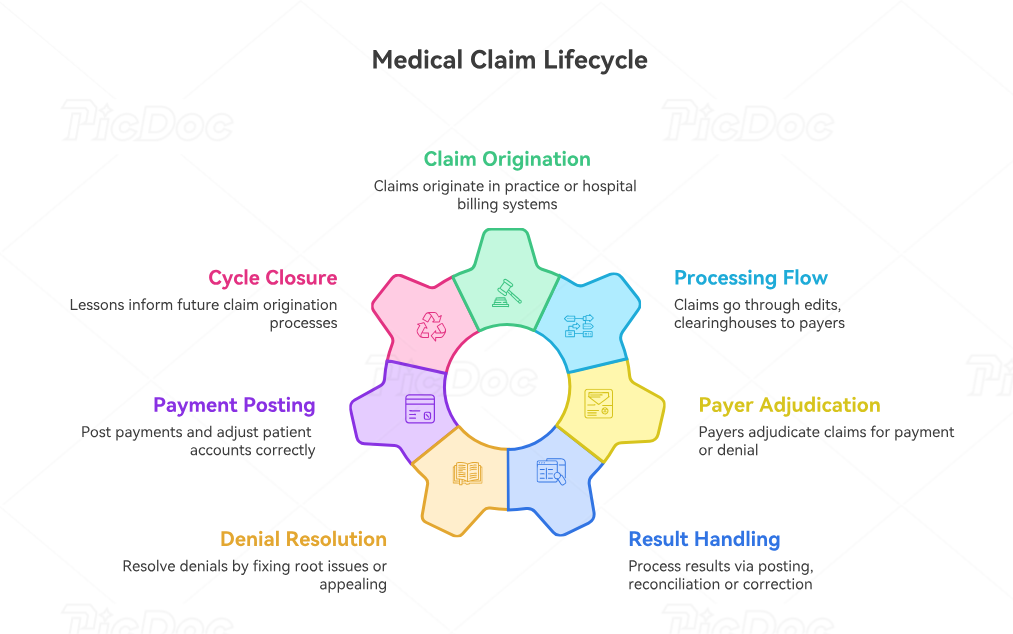
A claim should be studied as a moving record. It begins in the practice-management or hospital billing system, passes through edits, may travel through a clearinghouse, reaches the payer, undergoes adjudication, and returns as a payment or processing response. The result must then be posted, reconciled, corrected, appealed, transferred, or billed to the appropriate party.
The CMS-1500 is associated with professional claims, while the UB-04 supports institutional billing. Exam preparation should focus on the purpose of major fields and how missing or conflicting information affects processing. Pair the CMS-1500 terminology guide with the UB-04 guide, encounter forms and superbills, and EDI billing terminology.
A clearinghouse may reject a claim because required data is missing, the format is invalid, or the payer information cannot be matched. That claim has generally failed before complete payer adjudication. A payer denial occurs after the payer processes the claim and determines that payment will not be made for a stated reason. The required response depends on the cause. Corrected demographic data may resolve a rejection, while a medical-necessity denial may require documentation, policy analysis, or an appeal.
Read remittance information as a set of financial instructions. Identify the submitted charge, allowed amount, payer payment, contractual adjustment, patient responsibility, and reason codes. CARCs explain adjustment categories. RARCs provide additional detail. The CARC guide, RARC dictionary, EOB reference, and claims reconciliation guide should be studied through worked accounts rather than isolated definitions.
Payment posting must preserve the payer’s adjudication while protecting the accuracy of the patient account. Post the payment to the correct patient, encounter, claim, and service line. Apply contractual adjustments under the correct reason. Transfer valid patient responsibility. Flag unexpected underpayments, overpayments, reversals, or noncovered amounts. Then reconcile the electronic remittance, deposit, posted total, and unresolved exceptions through payment posting controls, billing reconciliation, claims management, and revenue cycle metrics.
Denial resolution should follow root cause rather than habit. First classify the problem as registration, eligibility, authorization, coding, documentation, bundling, filing, payer policy, coordination of benefits, or payment-processing error. Next determine whether correction, replacement, reopening, appeal, write-off, refund, or patient transfer is appropriate. Record ownership and deadline. Repeated denials should trigger changes in coding audits, revenue leakage controls, billing software workflows, and data reporting.
For exam practice, rebuild financial scenarios from the beginning. Write the billed charge, allowed amount, deductible, coinsurance, copayment, payer payment, contractual adjustment, and final patient balance. Then explain why every dollar moved. This technique catches the exact confusion that leads candidates to assign contractual write-offs to patients or calculate coinsurance against the wrong amount.
5. Build a CBCS Study System That Produces Reliable Scores
A strong CBCS study plan follows the exam blueprint. Allocate study time according to domain weight and diagnostic weakness. Billing and Reimbursement contains 33 scored questions, Coding and Coding Guidelines contains 32, Insurance Eligibility and Other Payer Requirements contains 20, and Revenue Cycle and Regulatory Compliance contains 15. Candidates should still cover every domain because repeated weakness in a smaller domain can erase gains elsewhere.
Begin with a baseline assessment. Build an error log containing the question topic, your answer, the correct answer, the rule you missed, the reason your reasoning failed, and one new example. Label mistakes as knowledge gaps, reading errors, calculation errors, sequencing errors, or rushed decisions. Tie the log to coding competency standards, medical coding education terms, online exam-prep resources, and career-development skills.
Use active recall for vocabulary and closed-book reasoning for processes. Flashcards work well for abbreviations, payer types, forms, code-set purposes, compliance concepts, and adjustment terminology. Flowcharts work better for coordination of benefits, authorization, claim submission, denial resolution, and appeals. Full scenarios work best for coding, reimbursement, patient responsibility, and compliance decisions. Match the study tool to the type of knowledge.
A six-week plan can be organized around increasing integration. Week one covers revenue-cycle stages, registration, privacy, and compliance. Week two covers insurance plans, eligibility, benefits, authorizations, coordination of benefits, and patient responsibility. Weeks three and four cover documentation, ICD-10-CM, CPT, HCPCS, modifiers, and claim forms. Week five covers adjudication, CARCs, RARCs, payment posting, denials, appeals, and collections. Week six focuses on timed mixed-domain examinations and targeted remediation using billing acronyms, coding workflow terms, claim adjustment codes, and CBCS terminology.
Timed practice should reproduce the cognitive pressure of the actual exam. With 125 total questions presented across three hours, candidates have an average of about 86 seconds per question, although some items will require far less and others more. Use a three-pass method. Answer clear questions first, mark uncertain questions, and reserve the final pass for calculations and difficult scenarios. The 25 pretest questions are mixed into the examination and cannot be identified, so every question deserves full attention.
Review wrong answers until you can explain the correct rule without looking at the explanation. Then create a variation in which one important fact changes. For example, change an in-network provider to out-of-network, switch the patient from subscriber to dependent, add a secondary payer, change a rejection to an adjudicated denial, or replace an unsupported modifier with documented circumstances. This forces flexible reasoning.
NHA offers online and printed preparation options, and its current practice-test products are aligned with the CBCS exam. Official preparation materials are optional and do not guarantee a passing score. Candidates may test through a school, a PSI testing center, or live remote proctoring, depending on availability and eligibility. Online examination results are generally posted to the candidate’s account within two days after scoring.
After certification, NHA currently requires renewal every two years, completion of 10 continuing education credits, and payment of the applicable renewal fee. Certification holders can complete the required credits before expiration, and an expired credential may generally be reinstated within one year. Build future learning around continuing education requirements, certification renewal, coding system updates, and professional development.
6. Frequently Asked Questions About CBCS Billing Concepts
-
The published CBCS blueprint lists 100 scored questions and 25 unscored pretest questions, giving candidates 125 total questions during a three-hour examination. The unscored questions are mixed into the exam, so candidates cannot determine which items affect the final score.
-
Billing and Reimbursement has the largest allocation at 33 scored questions, followed closely by Coding and Coding Guidelines at 32. Insurance Eligibility and Other Payer Requirements contains 20, while Revenue Cycle and Regulatory Compliance contains 15. Preparation should follow these weights while giving additional attention to personal weaknesses discovered through practice testing.
-
Current NHA guidance states that coding manuals have been prohibited since September 24, 2024. Information required to answer application-of-coding questions is supplied with the question. Candidates should confirm the latest testing policy before exam day because older test-plan documents may still contain superseded manual instructions.
-
The exam covers application of ICD-10-CM, CPT, and HCPCS Level II. Study should include the purpose of each code set, documentation requirements, specificity, sequencing, modifiers, and the relationship between diagnosis and service reporting. Strengthen applied knowledge with the CPT modifiers guide, coding edits reference, medical necessity guide, and documentation improvement dictionary.
-
A rejected claim generally fails an initial data, formatting, or transmission edit before full payer adjudication. A denied claim has reached the payer and received an adverse payment decision. A rejection commonly requires correction and resubmission, while a denial may require correction, documentation, policy review, or an appeal. Use clearinghouse terminology, claims management terms, CARC definitions, and RARC definitions to separate the workflows.
-
Begin with the allowed amount rather than the submitted charge. Apply the remaining deductible according to the benefit design, calculate coinsurance against the applicable amount, add any required copayment, and respect the out-of-pocket maximum. Contractual adjustments generally should not become patient debt. Practise these calculations with the patient responsibility guide, EOB guide, payment posting reference, and billing reconciliation terms.
