
CCS Exam Practice Questions and Detailed Answers
The CCS exam rewards coders who can interpret full records, apply inpatient and outpatient rules, defend sequencing decisions, recognize documentation gaps, and protect data integrity under pressure. These original practice questions target the reasoning demanded across medical coding workflows, clinical documentation improvement, coding compliance, and claims reimbursement. Each answer explains the decisive rule, the tempting distractor, and the study weakness exposed by an incorrect choice.

1. How to Use These CCS Practice Questions Effectively
AHIMA positions the Certified Coding Specialist credential at the mastery level for professionals working with hospital inpatient and outpatient records. The current CCS examination contains 107 questions, including 97 scored items and 10 unscored pretest items, with four hours available. Candidates may move among answered items, flag questions, and review them before submitting the examination. The passing scaled score is 300.
The published exam outline divides assessed content into five domains. Coding Knowledge and Skills represents 39–41%, Coding Documentation 18–22%, Provider Queries 9–11%, Regulatory Compliance 18–22%, and Information Technologies 9–11%. Medical scenarios are divided evenly among inpatient, outpatient, and emergency-department settings.
That blueprint explains why isolated code memorization produces fragile results. Candidates must connect principal diagnosis selection, ICD-10-PCS procedure logic, CPT modifier use, and medical necessity with documentation, reimbursement, ethics, and technology. A question that appears to test one diagnosis may also test sequencing, POA assignment, query judgment, or DRG impact.
Use each practice item in three passes. First, answer without references and record your confidence from one to five. Second, verify the governing convention, guideline, documentation requirement, or edit. Third, explain why every distractor fails. This process develops the analytical thinking tested through CCS application and analysis questions rather than rewarding recognition alone. AHIMA classifies exam questions at recall, application, and analysis levels, and it applies no scoring penalty for incorrect guesses.
Candidates testing on or after May 1, 2026 must bring approved 2026 editions of ICD-10-CM, ICD-10-PCS, and the AMA CPT Professional codebook. The testing center verifies the approved editions, and a candidate without the required books may be unable to test and may forfeit the examination fee.
That requirement should shape preparation. Practise finding answers through the Alphabetic Index, Tabular List, PCS Index, PCS tables, appendices, and CPT guidelines. Your codebooks should become navigation tools for diagnosis coding, procedure classification, coding edits, and documentation validation. Speed without verification creates expensive sequencing and specificity errors.
The following table provides a 30-point diagnostic map. Mark every row as strong, developing, or weak before beginning the detailed questions.
CCS Exam Readiness Map: 30 Concepts You Must Control
| Tested Skill | Question Cue | Common Trap | Required Decision |
|---|---|---|---|
| Principal diagnosis | “After study, chiefly responsible for admission” | Selecting the most expensive or clinically dramatic condition | Apply the inpatient principal-diagnosis definition |
| First-listed diagnosis | Outpatient reason chiefly responsible for services | Applying inpatient uncertain-diagnosis rules | Report the confirmed condition or supported symptom |
| Uncertain inpatient diagnosis | Probable, suspected, likely, or still to be ruled out at discharge | Coding only symptoms | Apply the inpatient discharge rule |
| Uncertain outpatient diagnosis | Rule-out condition in clinic or emergency department | Reporting the suspected disease | Code confirmed findings, symptoms, or reason for visit |
| Present on admission | Condition existed when the inpatient order occurred | Using diagnosis date as the sole deciding factor | Determine whether the condition was clinically present on admission |
| Combination codes | One code captures a disease, manifestation, or complication | Assigning unnecessary separate codes | Follow the Index and Tabular instructions |
| “Code first” instructions | Manifestation depends on underlying disease | Sequencing the manifestation first | Place the underlying condition before the manifestation |
| Excludes notes | Excludes1 or Excludes2 appears in the Tabular List | Treating both note types as identical | Apply the specific exclusion meaning |
| Laterality | Right, left, bilateral, or unspecified | Using unspecified despite available documentation | Select the highest supported specificity |
| PCS root operation | Objective of the procedure | Coding from the familiar surgical name | Translate the operative objective into the PCS definition |
| Excision versus resection | Partial removal compared with complete removal | Choosing from wording alone without body-part analysis | Determine whether a portion or all of the body part was removed |
| Drainage | Taking or letting out fluid or gas | Selecting excision because tissue was entered | Code the procedural objective |
| PCS approach | Open, percutaneous, percutaneous endoscopic, or via natural opening | Confusing visualization with access | Identify how the operative site was reached |
| Device character | Material remains after the procedure | Reporting temporary instruments as devices | Identify what remains when the procedure ends |
| Biopsy coding | Tissue or fluid obtained for diagnosis | Omitting the diagnostic qualifier | Apply the appropriate root operation and qualifier |
| Principal procedure | Procedure performed for definitive treatment or diagnostic resolution | Automatically selecting the first or longest procedure | Apply the sequencing rules to the admission circumstances |
| CPT parenthetical notes | “Do not report with,” add-on, or instructional language | Stopping after finding a code descriptor | Read the complete subsection and code-specific instructions |
| Modifier 59 | Distinct service may override an edit | Using the modifier to force payment | Confirm a separately reportable service supported by documentation |
| NCCI edits | Two procedures appear bundled | Assuming every edit can be bypassed | Check edit status, policy, documentation, and modifier eligibility |
| Infusion hierarchy | Multiple facility-administered infusions or injections | Selecting the first chronological service as initial | Apply the hierarchy and time rules |
| Medical necessity | Valid procedure code with questionable coverage | Equating code accuracy with reimbursement eligibility | Verify diagnosis-to-service coverage support |
| DRG impact | Secondary diagnosis may qualify as CC or MCC | Coding for financial effect without documentation support | Assign supported codes and allow the grouper to calculate impact |
| APC logic | Hospital outpatient payment classification | Applying inpatient DRG reasoning | Recognize the outpatient reimbursement framework |
| Provider query | Conflicting, incomplete, or clinically inconsistent documentation | Writing a leading question that signals the desired diagnosis | Use clinical indicators and balanced response options |
| Non-provider documentation | Information appears in nursing, dietitian, therapy, or pathology records | Assigning every diagnosis directly from ancillary notes | Apply rules governing which elements require provider documentation |
| HAC and PSI review | Condition arose during hospitalization | Assuming every hospital-acquired condition changes payment | Validate code, POA status, applicable measure, and documentation |
| HIPAA minimum necessary | User requests more PHI than the task requires | Sending the entire chart for convenience | Limit access or disclosure to the supported purpose |
| Computer-assisted coding | Software suggests codes from record text | Accepting recommendations without validation | Verify documentation, guidelines, specificity, and sequencing |
| Grouper validation | Unexpected DRG or reimbursement result | Changing a code to reach an expected payment | Investigate source data, code assignment, and grouper configuration |
| Ethical coding | Request to alter coding for payment advantage | Following operational pressure over official rules | Report the most accurate supported codes and escalate concerns |
2. Inpatient ICD-10-CM and ICD-10-PCS Practice Questions
Practice Question 1. Principal Diagnosis Selection
A patient is admitted with fever, flank pain, nausea, and hypotension. The discharge summary states, “Sepsis due to acute pyelonephritis, present on admission.” Which condition should generally be sequenced first?
A. Acute pyelonephritis
B. Sepsis
C. Hypotension
D. Fever
Correct answer: B. Sepsis
When sepsis and a localized infection are documented as present on admission and the admission is for treatment of the systemic infection, the systemic infection is generally sequenced before the localized infection. The coder would then assign the appropriate code for the pyelonephritis and evaluate any documented severe sepsis or organ dysfunction separately. The final code selection depends on the organism and the complete record.
The trap is choosing the anatomical infection because it produced the sepsis. Principal diagnosis selection follows the condition established after study as chiefly responsible for the admission. A strong CCS candidate connects principal diagnosis rules, clinical documentation, medical necessity, and hospital reimbursement before finalizing the sequence.
Practice Question 2. Uncertain Diagnosis at Inpatient Discharge
An inpatient receives antibiotics and respiratory support. The discharge summary states, “Probable gram-negative pneumonia.” Cultures remain inconclusive. What should the coder report?
A. Cough and fever only
B. Pneumonia as documented
C. Abnormal chest imaging only
D. No diagnosis until culture confirmation
Correct answer: B. Pneumonia as documented
For an inpatient discharge, a diagnosis documented as probable, suspected, likely, questionable, possible, or still to be ruled out may be coded as though it existed when the diagnostic workup, treatment, and documentation support that conclusion. This rule applies to inpatient hospital coding and differs from outpatient reporting.
The distractors test whether the candidate applies outpatient logic to an inpatient case. Review inpatient coding workflows, respiratory disease coding, documentation validation, and coding competency assessment whenever uncertain diagnoses cause repeated errors.
Practice Question 3. Present-on-Admission Assignment
A patient is admitted after a fall. A pressure injury is documented by the wound nurse six hours after admission. The physician confirms that the injury was present when the patient arrived. Which POA concept controls the decision?
A. The diagnosis was entered after admission, so the indicator must be N
B. The condition’s clinical presence at admission controls the assignment
C. Every pressure injury automatically receives Y
D. The coder should omit the diagnosis because the physician documented it late
Correct answer: B. The condition’s clinical presence at admission controls the assignment
POA assessment concerns whether the condition was present when the inpatient admission occurred. The time at which the diagnosis was formally entered does not independently decide the indicator. The coder must evaluate the full record and apply the POA guidelines after assigning the reportable diagnosis codes. CMS explains that POA indicators are assigned to the final coded diagnoses and depend on complete, consistent documentation.
A delayed note can still describe a condition that existed at admission. Automatic assumptions remain unsafe. Study the interaction among POA reporting, record chronology, coding audits, and patient-safety reporting.
Practice Question 4. Acute Blood Loss Anemia
An operative report documents substantial blood loss. Postoperative laboratory results show a large hemoglobin decrease, and the patient receives two units of blood. No provider documents acute blood loss anemia. What should the coder do?
A. Assign acute blood loss anemia from the clinical indicators
B. Assign unspecified anemia automatically
C. Query the provider when the diagnosis would affect accurate code assignment
D. Ignore the laboratory results permanently
Correct answer: C. Query the provider when the diagnosis would affect accurate code assignment
Coders may identify clinical indicators and recognize a potential documentation gap, yet the diagnosis requires appropriate provider documentation. A compliant query can present the blood loss, laboratory trend, transfusion, treatment, and relevant clinical facts without directing the provider toward one answer.
Option A turns clinical interpretation into unauthorized diagnosis assignment. Option D wastes a valid query opportunity. Effective preparation should combine provider query standards, CDI terminology, coding ethics, and medical coding audits.
Practice Question 5. PCS Excision Versus Resection
The surgeon removes a portion of the patient’s right liver lobe through an open approach. Which ICD-10-PCS root operation applies?
A. Resection
B. Excision
C. Extraction
D. Destruction
Correct answer: B. Excision
Excision means cutting out or off a portion of a body part. Resection means cutting out or off all of a body part. The PCS body-part value and the operative objective must be evaluated carefully because removal of an entire anatomical subdivision represented by its own PCS body-part value can support resection. The 2026 PCS guidelines also allow coders to correlate clearly documented “partial resection” with the PCS root operation Excision.
The familiar surgical term cannot replace the root-operation definition. Strengthen this area through surgical coding compliance, operative documentation review, encoder terminology, and coding-system update monitoring.
Practice Question 6. PCS Device Assignment
A vascular stent is permanently placed during a procedure. The catheter and guidewire are removed before the procedure ends. Which item is considered the PCS device?
A. Catheter
B. Guidewire
C. Stent
D. Every item entering the body
Correct answer: C. Stent
The device character describes material that remains after the procedure is completed. Temporary instruments used to perform the procedure are generally integral to the approach and do not become separately coded devices. The coder should still verify the device definition, body part, approach, qualifier, and any applicable PCS instructions.
Candidates often overcode instruments because they appear prominently in the operative report. The solution is disciplined abstraction through operative record analysis, procedure coding compliance, EHR coding terminology, and coding workflow controls.
3. Outpatient, Emergency Department, CPT, and HCPCS Practice Questions
Practice Question 7. Outpatient Uncertain Diagnosis
An emergency-department physician documents “possible appendicitis.” Imaging is inconclusive, and the patient is discharged with right lower-quadrant pain and nausea. What should be coded?
A. Acute appendicitis
B. Possible appendicitis
C. The documented signs and symptoms
D. No diagnosis because testing was inconclusive
Correct answer: C. The documented signs and symptoms
Outpatient and emergency-department coding does not report uncertain diagnoses such as probable, suspected, questionable, or rule out as established conditions. The coder reports the highest degree of certainty known for the encounter, which may consist of symptoms, signs, abnormal findings, or the reason for the visit.
The word “possible” is the decisive cue. Practise separating outpatient diagnosis rules, emergency medicine coding, medical necessity review, and clinical documentation verification.
Practice Question 8. Diagnostic Endoscopy Followed by Treatment
A patient undergoes colonoscopy for rectal bleeding. During the same session, the physician removes a polyp using a snare. How should the diagnostic colonoscopy generally be treated?
A. Report it separately in every case
B. Treat it as included in the therapeutic endoscopy
C. Report only the diagnostic service
D. Replace the colonoscopy with an office visit code
Correct answer: B. Treat it as included in the therapeutic endoscopy
A diagnostic endoscopy is generally included when a more extensive therapeutic endoscopic service is completed during the same encounter. The coder must review the CPT instructions, code relationships, payer policy, lesion count, removal technique, and whether additional distinct services meet separate-reporting requirements.
The trap is reporting every procedural stage independently. Build accuracy through gastroenterology coding, CPT modifier guidance, coding edit analysis, and claims compliance.
Practice Question 9. Modifier 59
Two procedures trigger an NCCI procedure-to-procedure edit. The operative note shows that the services occurred at separate anatomical sites and each service was medically necessary. What is the next step?
A. Append modifier 59 automatically
B. Delete the lower-valued service
C. Verify that a more specific modifier is unavailable and that the edit permits an override
D. Change the diagnosis until both services pass
Correct answer: C. Verify that a more specific modifier is unavailable and that the edit permits an override
Modifier 59 indicates a distinct procedural service under qualifying circumstances. Its use requires documentation and a relationship that supports separate reporting. CMS directs providers to use modifier 59 when no more descriptive modifier applies and warns against using it merely to bypass an edit.
A separate site may support an override, yet the coder must still confirm the edit indicator and payer requirements. Option D creates a serious ethical violation. Review modifier usage, NCCI edit principles, medical coding ethics, and regulatory compliance.
Practice Question 10. Facility Infusion Hierarchy
During one hospital outpatient encounter, a patient receives hydration, a therapeutic infusion, and chemotherapy administration. Which factor determines the initial service?
A. The service started first chronologically
B. The most expensive medication
C. The facility infusion hierarchy, documentation, and applicable time rules
D. The patient’s principal diagnosis alone
Correct answer: C. The facility infusion hierarchy, documentation, and applicable time rules
For hospital outpatient facility reporting, the initial administration service is selected through the applicable hierarchy rather than chronology alone. Chemotherapy administration generally ranks above therapeutic, prophylactic, or diagnostic administration, which ranks above hydration. The coder must also evaluate access sites, interruptions, concurrent services, sequential administration, and documented start and stop times.
Candidates who focus solely on timestamps frequently miss this question type. Study infusion and injection billing, charge-capture controls, outpatient reimbursement, and medical billing reconciliation.
Practice Question 11. Bilateral Procedure Reporting
A procedure is performed on both sides of the body during the same session. The CPT descriptor does not already state “bilateral.” What should the coder do first?
A. Append modifier 50 without further review
B. Submit the code twice without modifiers
C. Check CPT guidance and the payer’s bilateral reporting method
D. Report only one side
Correct answer: C. Check CPT guidance and the payer’s bilateral reporting method
Bilateral reporting varies according to the code descriptor, CPT instructions, payer edits, claim format, and payer-specific submission rules. Some payers expect modifier 50 on one line, while others may require right and left modifiers on separate lines. A descriptor that already represents a bilateral service may prohibit additional bilateral reporting.
This question tests payer awareness alongside CPT knowledge. Reinforce it with modifier definitions, commercial insurance billing, claims submission terminology, and payment reconciliation.
Practice Question 12. Medical Necessity Edit
The procedure code is technically correct, yet the submitted diagnosis does not satisfy the payer’s coverage criteria. Which description best fits the problem?
A. Code-format error
B. Medical-necessity failure
C. Duplicate claim
D. Patient-registration error
Correct answer: B. Medical-necessity failure
Technical code accuracy and coverage support answer different questions. A procedure may be correctly identified while the documented diagnosis, clinical indication, frequency, or coverage conditions fail the payer’s medical-necessity policy. The coder should verify the record, diagnosis selection, applicable coverage rule, and whether additional supported information was omitted from the claim.
Changing a diagnosis without record support creates false reporting. High-quality preparation integrates medical necessity criteria, utilization management, claims denial analysis, and revenue leakage prevention.
Quick Poll: Which CCS exam problem is costing you the most points?
4. Documentation, Provider Query, Compliance, and Technology Questions
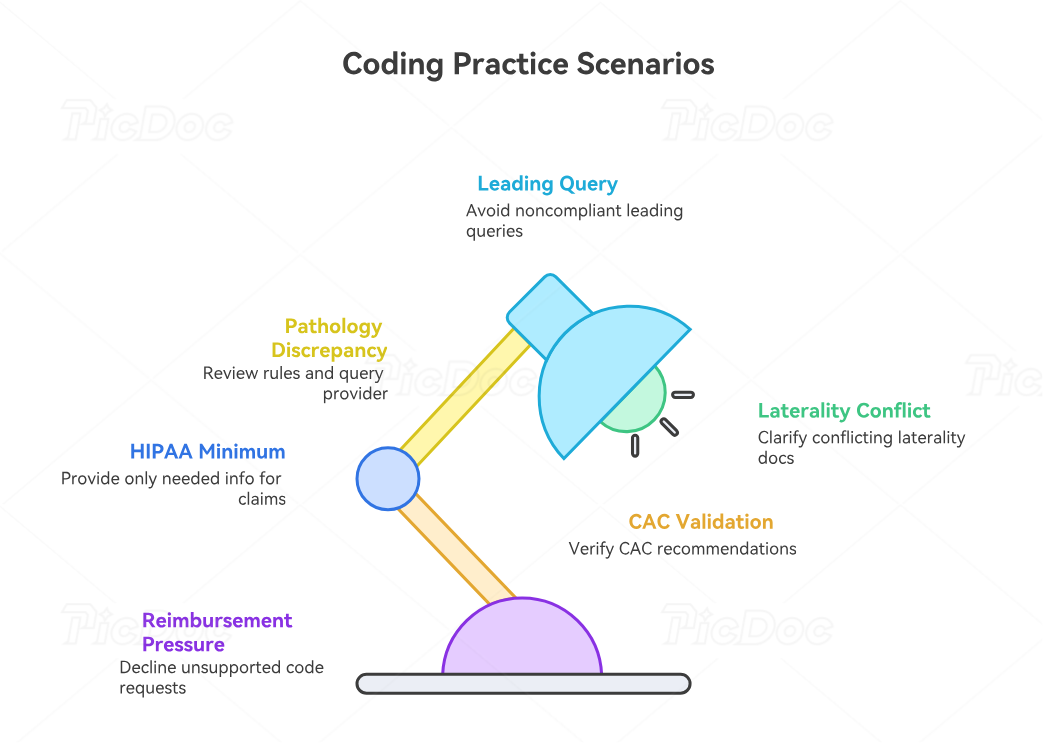
Practice Question 13. Conflicting Laterality
The emergency note documents a left wrist fracture. The radiology report and orthopedic consultation document a right wrist fracture. What is the best coding action?
A. Use the emergency note because it was written first
B. Use the orthopedic note because the specialist has greater authority
C. Assign an unspecified-side code
D. Seek clarification because the record contains a material conflict
Correct answer: D. Seek clarification because the record contains a material conflict
Laterality affects code validity, clinical meaning, claim accuracy, and data integrity. The coder should avoid resolving a direct conflict through personal preference. A query should identify the inconsistent documentation and request clarification without steering the provider toward either side.
An unspecified code does not repair contradictory evidence. It can conceal a patient-safety problem. Strengthen this area through coding query processes, clinical documentation improvement, EHR documentation controls, and coding ethics standards.
Practice Question 14. Leading Query Identification
Which query is most likely to be noncompliant?
A. “Please clarify the condition responsible for the documented confusion, fever, positive culture, and antibiotic treatment.”
B. “Based on the elevated creatinine and reduced urine output, please document acute kidney injury so the account can receive the correct DRG.”
C. “Can the documented ulcer be further specified by site and stage?”
D. “Please clarify whether the documented respiratory condition was present on admission, developed after admission, or cannot be clinically determined.”
Correct answer: B
Option B directs the provider toward a diagnosis and adds a reimbursement motive. A compliant query should present relevant clinical indicators, identify the documentation issue, and allow clinically reasonable responses. Coding exists to represent the record accurately. Financial impact cannot become the reason for manufacturing specificity.
The other options may still require careful formatting, organizational policy review, and appropriate response choices. The central lesson connects provider query compliance, coding ethics, DRG awareness, and clinical documentation integrity.
Practice Question 15. Pathology Result Without Provider Confirmation
A pathology report identifies malignancy, while the attending physician’s final documentation describes only a mass and states that pathology is pending. What should the coder do?
A. Assign the malignant diagnosis directly from pathology in every setting
B. Report the malignancy and delete the mass
C. Review applicable documentation rules and query the provider when confirmation is required
D. Ignore the pathology report because ancillary documentation never matters
Correct answer: C
Pathology findings can create a significant documentation discrepancy when the provider’s final diagnosis remains incomplete. The coder must apply the setting-specific rules governing provider documentation and seek clarification when the final diagnosis requires confirmation. Ancillary reports contribute essential clinical evidence, yet their use for assigning diagnoses depends on the reporting rule involved.
This item tests restraint. Review oncology coding, lab and pathology coding, coding query terminology, and record-completeness standards.
Practice Question 16. HIPAA Minimum Necessary
A billing employee needs one operative report to resolve a claim edit. The employee requests the patient’s complete medical record from another department. Which response best reflects the minimum-necessary principle?
A. Send the complete record because the requester works for the same organization
B. Provide the information reasonably required to resolve the stated billing purpose
C. Refuse all access to clinical information
D. Email the complete chart to save time
Correct answer: B
The HIPAA minimum-necessary standard generally requires reasonable efforts to limit uses, disclosures, and requests for protected health information to the amount needed for the intended purpose. Access should align with the user’s role and the task being performed.
Internal employment does not create unlimited access. Coders should understand healthcare data security, medical-record storage, EHR access controls, and coding ethics.
Practice Question 17. Computer-Assisted Coding Recommendation
Computer-assisted coding software recommends a diagnosis based on a phrase copied forward from an old problem list. Current progress notes state that the condition has resolved. What should the coder do?
A. Accept the recommendation because CAC software analyzed the record
B. Report the condition because it appears anywhere in the EHR
C. Validate current clinical relevance and exclude unsupported coding
D. Ask the software vendor to submit the claim
Correct answer: C. Validate current clinical relevance and exclude unsupported coding
CAC recommendations remain suggestions requiring professional validation. The coder must assess the current encounter, documentation status, reporting requirements, conflicting evidence, and sequencing. Copied-forward content can create false positives, while resolved conditions may remain visible in the record long after they stop affecting care.
The CCS exam expects basic understanding of CAC, encoders, groupers, and EHR technology. Review medical coding automation, encoder software, problem-list documentation, and EHR integration.
Practice Question 18. Pressure to Increase Reimbursement
A supervisor asks a coder to report a higher-severity diagnosis because the current DRG “does not cover the hospital’s costs.” Documentation does not support the requested diagnosis. What should the coder do?
A. Add the diagnosis because the hospital treated a complex patient
B. Select a nearby code with greater reimbursement
C. Decline unsupported code assignment and follow the escalation policy
D. Remove lower-severity diagnoses to balance the account
Correct answer: C. Decline unsupported code assignment and follow the escalation policy
Codes must reflect supported diagnoses and procedures. Operational pressure, revenue targets, and expected payment do not authorize unsupported reporting. The coder should preserve the audit trail, follow organizational compliance procedures, and escalate concerns through the appropriate channel.
The question tests whether the candidate protects data integrity when pressure becomes personal. Study coding ethics and standards, regulatory compliance, medical coding audits, and revenue integrity.
5. CCS Medical Scenarios, Answer Analysis, and Exam Strategy
Practice Question 19. Condition Developing After Admission
A patient is admitted for acute appendicitis and undergoes appendectomy. Three days later, the patient develops a catheter-associated urinary tract infection. Which condition is the principal diagnosis?
A. Catheter-associated urinary tract infection
B. Acute appendicitis
C. Postoperative pain
D. Presence of urinary catheter
Correct answer: B. Acute appendicitis
The appendicitis was established after study as chiefly responsible for the admission. A complication developing later may become an important secondary diagnosis and may require additional codes, POA assignment, HAC review, and causal documentation. Its later severity does not automatically replace the admission-driving condition as principal diagnosis.
The scenario tests sequencing stability under distraction. Review principal diagnosis selection, POA documentation, hospital-acquired condition analysis, and inpatient reimbursement.
Practice Question 20. Diabetes and Chronic Kidney Disease
An outpatient record documents type 2 diabetes mellitus and stage 3 chronic kidney disease. The provider does not state that the conditions are unrelated. What should the coder investigate?
A. Whether the classification presumes a relationship under the “with” convention
B. Whether CKD can be ignored because diabetes is more important
C. Whether a symptom code can replace both conditions
D. Whether the laboratory can choose the diagnosis sequence
Correct answer: A
ICD-10-CM contains circumstances in which the classification presumes a causal relationship between diabetes and certain conditions linked by “with,” unless the documentation states that they are unrelated or another guideline applies. The coder should verify the Index and Tabular List, assign the appropriate diabetes-with-kidney-complication code, and add the code identifying the CKD stage when required.
This question rewards codebook verification. Strengthen the skill through ICD coding standards, dialysis and kidney coding, clinical documentation review, and medical necessity analysis.
Practice Question 21. Malnutrition Query Opportunity
A dietitian documents severe malnutrition using recognized assessment criteria. The attending physician documents weight loss and poor intake without stating malnutrition. What is the strongest coding action?
A. Assign severe malnutrition directly in every case
B. Omit the issue because dietitian documentation has no value
C. Query the provider using the documented clinical indicators
D. Code unspecified malnutrition without clarification
Correct answer: C. Query the provider using the documented clinical indicators
The dietitian’s assessment supplies meaningful clinical evidence and may identify a legitimate documentation opportunity. The coder should apply the rules governing diagnosis assignment and use a compliant query when provider confirmation is needed. The query should include weight change, intake, physical findings, assessment results, treatment, and balanced response options.
Options A and D bypass documentation requirements. Option B discards valuable evidence. Review coding query processes, CDI terms, coding ethics, and record-quality auditing.
Practice Question 22. Unexpected DRG Result
After accurate code entry, the grouper produces an unexpected DRG. What should the coder do first?
A. Add a diagnosis known to increase severity
B. Change the principal diagnosis until the expected DRG appears
C. Validate the codes, sequence, discharge status, grouper version, and source data
D. Submit the claim because grouper results cannot be reviewed
Correct answer: C
An unexpected DRG may result from incorrect code selection, sequencing, discharge disposition, missing demographic information, an outdated grouper, a configuration problem, or an incorrect expectation. The coder should investigate the inputs and software environment. Code alteration requires documentation and guideline support rather than a desired reimbursement result.
This reasoning joins encoder software, coding-system updates, reimbursement analysis, and claims reconciliation.
Practice Question 23. Deleted or Revised Code
A practice examination uses a code that does not appear in the candidate’s current codebook. What should the candidate do?
A. Memorize the old code because practice books are always authoritative
B. Verify the encounter date, code-set year, addendum, and current Tabular List
C. Assume the current book contains an error
D. Select the closest available code without further research
Correct answer: B
Code validity depends on the service or discharge date and the applicable code-set year. Practice resources can become outdated, and midyear or annual releases can change descriptions, instructions, or available codes. The candidate should identify the date context and verify the official code set.
For 2026 testing after May 1, AHIMA requires approved 2026 ICD-10-CM, ICD-10-PCS, and CPT books. This makes coding update monitoring, encoder validation, coding education quality, and professional development essential.
Practice Question 24. Long Medical Scenario Strategy
A CCS medical scenario contains several pages of clinical information followed by six questions. What is the strongest approach?
A. Memorize the entire chart before reading any questions
B. Read each question’s task, extract the relevant evidence, and return to the record as needed
C. Code every diagnosis and procedure before viewing the questions
D. Spend equal time on every detail in the record
Correct answer: B
Scenario questions often test different elements from the same record. One may ask for principal diagnosis, another for a PCS root operation, another for a documentation conflict, and another for compliance action. Reading the task first helps the candidate identify the evidence required for that decision while preserving time for verification.
AHIMA’s medical scenarios include inpatient, outpatient, and emergency-department content, and CCS scenario items may include multiple-response questions. Practise with coding competency assessments, online exam-preparation resources, medical coding workflows, and clinical documentation analysis.
A useful four-hour plan reserves approximately 180 minutes for the first pass and 60 minutes for flagged items, scenario rechecks, unanswered questions, and final review. Individual pacing will vary, so candidates should test their strategy through full-length simulation. The critical rule is answering every question because AHIMA applies no deduction for an incorrect answer.
Build an error log with seven columns: domain, question type, your answer, correct answer, governing rule, reason for error, and corrective drill. Categorize the cause as knowledge gap, codebook-navigation delay, documentation misread, sequencing error, unsupported assumption, distractor confusion, or time pressure. This converts a disappointing score into a focused plan built around coding competency, continuing education, professional development, and career advancement.
6. Frequently Asked Questions About CCS Exam Preparation
-
The current CCS exam contains 107 questions. Ninety-seven are scored and ten are unscored pretest items distributed throughout the examination. Candidates cannot identify which questions are pretest items, so every item deserves a serious response. The examination allows four hours, and the passing scaled score is 300.
Prepare across inpatient coding, outpatient coding, provider queries, and regulatory compliance rather than trying to predict which items are unscored.
-
Coding Knowledge and Skills deserves the largest allocation because it represents 39–41% of the exam. Coding Documentation and Regulatory Compliance each account for 18–22%, while Provider Queries and Information Technologies each represent 9–11%.
Your personal score profile should refine that allocation. A coder strong in diagnosis coding may need more work in PCS procedures, coding queries, or health information technology.
-
These are original educational practice questions developed around the publicly available CCS content domains and current coding concepts. They are designed to reproduce the reasoning style candidates need without claiming to reproduce secured examination content.
Use them alongside the current coding-system references, exam-preparation resources, coding competency tools, and education-quality criteria.
-
For CCS examinations delivered on or after May 1, 2026, candidates must bring one approved 2026 ICD-10-CM codebook, one approved 2026 ICD-10-PCS codebook, and the approved AMA CPT 2026 Professional Edition. AHIMA publishes the permitted titles and ISBNs.
Confirm the exact edition before purchasing. Build navigation skill across ICD diagnosis terminology, surgical procedure coding, CPT modifier guidance, and coding edits.
-
Memorize recurring rules, definitions, hierarchies, and navigation pathways. Verify exact codes through the required references. Heavy code memorization can become dangerous when descriptions, laterality, seventh characters, instructional notes, and annual updates change.
Prioritize coding conventions, medical terminology, PCS root-operation logic, and CPT instructional guidance. Speed should come from organized verification.
-
Question volume becomes useful when every incorrect answer receives analysis. Completing 1,000 questions while repeating the same sequencing mistake produces less value than completing 300 questions with a disciplined error log and targeted correction.
Your practice set should cover inpatient records, outpatient claims, institutional billing, provider queries, and full medical scenarios. Continue until scores remain stable under timed, closed-note conditions.
