
Failed the CPC Exam? Reddit Retake Stories, Weak-Area Patterns & a Smarter Second-Attempt Study Plan
Failing the CPC exam gives you something your first study plan never had: evidence about where your preparation broke down under real exam conditions. A second attempt should use that evidence rather than simply repeating more hours of the same studying. AAPC currently requires 70 correct answers out of 100 questions, gives candidates four hours, and reports weaker exam categories after an unsuccessful attempt. Combine that feedback with a stronger CPC exam strategy, targeted CPC practice questions, exam-anxiety management, and a better exam-day checklist.
1. What Does Failing the CPC Exam Actually Tell You?
An unsuccessful CPC attempt rarely means every part of your coding knowledge is equally weak. The exam tests 17 areas of knowledge, primarily through application-based questions involving CPT, ICD-10-CM, HCPCS Level II, guidelines, anatomy, terminology, compliance, and related professional coding concepts. Candidates receive four hours for 100 multiple-choice questions, which works out to approximately 2.4 minutes per question. AAPC says unsuccessful candidates are notified of study categories in which their sub-score is 65% or lower, giving them a practical starting point for retest preparation.
That score report should become the foundation of your second plan.
If your weak sections cluster around anatomy and medical terminology, spend less time grinding random full-length tests and strengthen the clinical language behind the codes through CPC medical terminology preparation, CPC practice questions, and a structured CPC study plan.
If surgery sections repeatedly fall below target, the problem may involve CPT hierarchy, parenthetical instructions, approach, anatomy, bundled services, modifiers, or difficulty distinguishing similar procedure descriptions. Strengthen that layer through CPT coding principles, broader CPT mastery, and procedure-heavy CPC exam preparation.
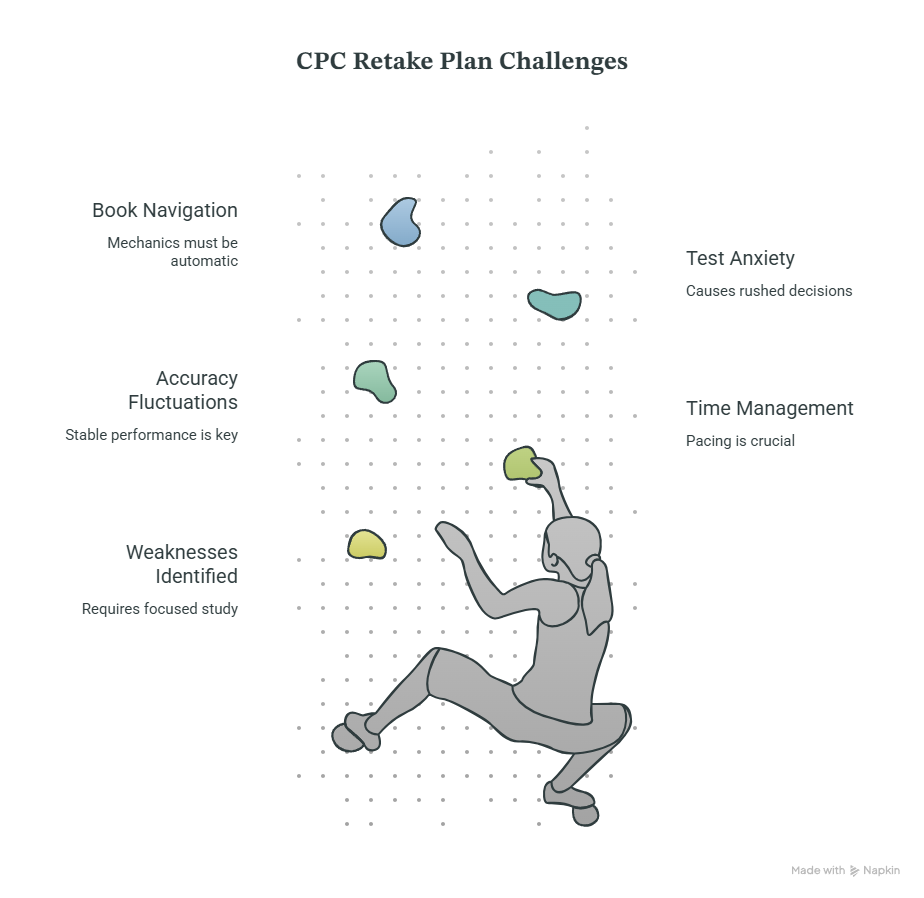
If you understood the material yet ran out of time, your main deficiency may be exam execution.
A 2025 Reddit poster scored 56% after running short on time and guessing the final 20 questions. Commenters repeatedly focused on practice exams, moving efficiently through easier material, using elimination, and avoiding excessive time on individual questions. That pattern deserves attention because someone who spends five minutes obtaining one difficult answer may sacrifice enough time to lose several easier points later.
Another Reddit poster described improving from 40% to 69% across attempts and specifically identified anatomy as a major weakness. The post was later updated to say the candidate passed. The useful lesson is that a near-pass deserves precision. At 69%, the goal is not rebuilding an entire coding education. The goal is locating the small number of recurring errors preventing the final few correct answers.
A different 2026 poster described scores of 64%, 62%, and 65% before passing on a fourth attempt, after changing study resources and focusing more closely on personally weak material. That progression shows why repeating the same study loop can produce nearly identical results.
Before purchasing another course, compare your gaps against the online CPC program directory, the true cost of medical coding training, CPC versus CCS versus CBCS, and the CPC first-attempt preparation guide. A failed attempt should lead to more targeted studying, rather than automatically more expensive studying.
| Failure Pattern | What It Usually Signals | Retake Fix | How to Measure Improvement |
|---|---|---|---|
| Weak anatomy score | Difficulty translating documentation into body system, site, approach, or procedure detail. | Rebuild anatomy alongside medical terminology. | Reach 80%+ on anatomy-focused timed sets. |
| Weak medical terminology | Too much time is spent decoding clinical language. | Study roots, prefixes, suffixes, abbreviations and procedural terminology. | Recognize clinical meaning before opening the code book. |
| Low integumentary score | Confusion around lesion removal, repairs, grafts, wound dimensions, or coding hierarchy. | Practice section-specific CPT cases and parenthetical instructions. | Complete 20–30 mixed cases without repeating the same error. |
| Low musculoskeletal score | Anatomy, laterality, fracture treatment, or procedure distinctions remain weak. | Pair anatomy review with CPT procedure practice. | Explain why every incorrect option is wrong. |
| Low cardiovascular score | Complex anatomy, catheter placement, vessels, or procedural families are causing errors. | Study cardiovascular anatomy before memorizing coding patterns. | Code timed cases without repeatedly rereading the entire section. |
| Low respiratory score | Confusion around endoscopy, surgical approach, diagnostic versus therapeutic services. | Create procedural comparison tables. | Identify service differences from documentation quickly. |
| Low digestive-system score | Scope location, technique, anatomy, or bundled service rules are unclear. | Practice endoscopy families and CPT notes. | Reduce lookup time across repeated scenarios. |
| Low urinary/reproductive score | Terminology and anatomy may be creating procedure-selection errors. | Review anatomy alongside actual coding scenarios. | Score consistently above the passing margin. |
| Low nervous-system score | Procedure detail and anatomical terminology are slowing decisions. | Break questions into anatomy, approach, procedure and modifier components. | Solve cases using the same decision sequence each time. |
| Weak E/M | Current E/M concepts or documentation requirements are not automatic yet. | Practice E/M independently before returning to full mocks. | Complete E/M questions quickly with high accuracy. |
| Weak anesthesia | Base units, time, modifiers, or physical-status concepts may be confused. | Create a short anesthesia decision workflow. | Complete repeated cases without formula confusion. |
| Weak radiology | Professional/technical components or service combinations may be unclear. | Practice component and modifier logic. | Explain complete versus component billing correctly. |
| Weak pathology/lab | Panel rules, test families, or terminology remain unfamiliar. | Study common panels and section organization. | Locate services without excessive page flipping. |
| Weak medicine section | A broad collection of smaller service families is creating inconsistency. | Divide medicine into manageable service groups. | Track accuracy by subgroup. |
| Weak HCPCS Level II | Supply, drug, DME, modifier, or code-book navigation needs work. | Practice fast index-to-code verification. | Complete HCPCS questions faster than your overall average. |
| Weak ICD-10-CM | Index, tabular verification, sequencing, instructional notes or specificity are being missed. | Practice full index-to-tabular workflow every time. | Zero unverified index-only answers during practice. |
| Modifier mistakes | You know the service but miss circumstances affecting reporting. | Create a modifier-error log tied to real cases. | Explain modifier rationale before selecting the answer. |
| Bundling mistakes | Separate procedure principles or included services are being overlooked. | Review CPT notes and coding edits conceptually. | Identify bundled services before looking at answer choices. |
| Guideline mistakes | Codes are familiar but official rules are not sufficiently internalized. | Read and annotate relevant guidelines. | State the governing rule after each practice error. |
| Two similar answer choices | A key documentation distinction is being overlooked. | Underline differentiating words before code lookup. | Record the exact overlooked word in your error log. |
| Correct code family, wrong final code | Specificity or tabular instructions are being missed. | Slow down during final verification. | Track “family right/final code wrong” separately. |
| Running out of time | Research depth exceeds the exam's time budget. | Use timed sets and a hard move-on rule. | Finish every 100-question mock within four hours. |
| Finishing far too early | Speed may be coming from shallow verification. | Use spare time to recheck flagged uncertainty. | Improve accuracy while preserving comfortable time reserve. |
| Repeated second-guessing | Confidence and decision discipline are weak. | Change an answer only when you find specific contradictory evidence. | Track how often changed answers become wrong. |
| Overusing the index | Code-book familiarity is still slow. | Practice navigating major CPT sections directly. | Reduce average lookup time each week. |
| Poor book organization | You lose seconds repeatedly finding guidelines and sections. | Prepare permitted books for efficient navigation. | Locate frequently used sections almost immediately. |
| Practice scores vary wildly | Knowledge is inconsistent rather than exam-ready. | Use multiple fresh mixed tests. | Achieve stable passing margins across several mocks. |
| Practice scores high, real score low | Anxiety, timing, familiarity with repeated questions, or testing conditions may be distorting practice. | Simulate real conditions using fresh questions. | Complete multiple unfamiliar timed exams successfully. |
| Mental fatigue late in exam | Endurance has not been trained. | Practice complete four-hour sessions. | Compare first-half and second-half accuracy. |
| Multiple weak categories | Foundational preparation may need rebuilding before another attempt. | Return to a structured CPC curriculum selectively. | Require improvement in each weak section before another full mock. |
2. What Reddit CPC Retake Stories Reveal About Why People Fail
Reddit retake stories consistently point to four failure patterns: time management, weak foundational knowledge, overconfidence from familiar practice questions, and broad studying that ignores the actual score report.
The time problem is especially expensive because the CPC gives every question the same point value. Spending six minutes on one difficult surgical scenario does not earn more credit than answering a straightforward terminology or HCPCS question correctly.
AAPC itself recommends saving harder questions for later and answering every question, even when a guess is necessary. Build that behavior into CPC practice exams, your CPC study schedule, and your final exam-day preparation.
The 2025 Reddit candidate who scored 56% described choosing answers for the final 20 questions after running out of time. Other users advised taking practice tests, working on lower-scoring categories, and developing a deliberate strategy for questions that require too much research. For this candidate profile, another month of untimed reading would fail to address the central weakness.
A second pattern involves near-passing scores.
One poster reached 69% after previously scoring 40%, with anatomy still creating problems, and later updated the thread to report passing. Another 2025 poster failed a second attempt at 67% after improving from the first attempt and expressed concern about the financial cost of purchasing additional exam attempts. For candidates in this range, studying everything equally can dilute the effort that should go toward the few categories responsible for most lost points.
AAPC's current pricing also makes weak retake planning expensive. As of August 2026, AAPC lists core-exam pricing at $425 for one attempt or $499 for two attempts, while student pricing is $400 for one or $475 for two. Voucher terms matter, so check what you already purchased before assuming another attempt is automatically included. That financial reality is another reason to calculate medical coding training ROI, compare online CPC programs, and use free or already-owned CPC resources before buying another large course.
A third Reddit pattern is changing study methods only after repeated similar scores. A March 2026 poster reported 64%, 62%, and 65% across three attempts before passing on the fourth. The breakthrough came after finding a study resource that presented concepts differently, taking targeted notes, and turning weak material into flashcards. Repeated scores within a narrow band often indicate that your current method has reached its ceiling.
A fourth pattern involves different weak areas appearing on different attempts. One Reddit user who failed twice said the second score improved by only one percentage point even after heavily reviewing the first attempt's weakest sections; areas that had previously been strong then became weak. This happens because a retest is a fresh exam and because temporary memorization may improve one section without building durable overall skill.
The answer is a two-layer plan:
Repair the identified weak categories while continuing mixed practice across the entire CPC blueprint.
That balance protects your previously strong areas while concentrating additional effort where your score report says it is needed. Use CPC terminology review, CPT coding preparation, CPC exam questions, and first-attempt exam techniques as separate tools rather than one giant study pile.
3. How to Turn Your CPC Score Report Into a Retake Study Plan
Start by dividing your result into three categories:
Red: 65% or below, especially sections reported by AAPC as weak.
Yellow: areas you passed narrowly or felt uncertain answering.
Green: sections you consistently perform well on under timed conditions.
Your study hours should follow the same hierarchy.
For example, someone with weak cardiovascular, anatomy, and ICD-10-CM performance and strong E/M and HCPCS results should spend most of the next two weeks on cardiovascular anatomy, related CPT questions, and diagnosis-code navigation. E/M and HCPCS still need short maintenance sets, because abandoning them completely can create the “my previous strong section became weak” pattern described in Reddit retake discussions.
Build an error log rather than simply recording scores.
For every wrong practice question, classify the reason:
Knowledge gap
Misread documentation
Missed guideline
Wrong code-family selection
Correct family but insufficient specificity
Modifier mistake
Index/tabular mistake
CPT instructional-note mistake
Anatomy mistake
Rushed guess
Excessive time
Changed correct answer to incorrect
Pure unfamiliarity
After 100–200 practice questions, patterns become visible.
If 18 mistakes come from overlooked wording and only four come from actual code ignorance, another code-memorization course has poor value. Your fix is question reading, elimination, and final verification.
If your errors repeatedly involve anatomy, use the CPC medical terminology guide, then immediately apply the knowledge through CPC questions. Passive reading becomes useful when it changes performance on the next case.
If CPT surgery is responsible for most errors, work section-by-section through CPT coding principles and CPT certification preparation. Build comparison notes around the exact distinctions that keep defeating you.
If the main problem is anxiety, incorporate the medical coding exam-anxiety guide, while using timed CPC preparation to reduce uncertainty through repetition.
Then measure timing by question category.
The four-hour CPC gives you an average of 2.4 minutes per question. Your actual allocation can vary. A terminology question may take seconds, leaving additional time for surgical cases. What matters is avoiding a small number of difficult questions consuming an outsized portion of the exam.
A simple practice rule works well:
If you are still researching one question after roughly three minutes and do not feel close to an answer, choose the strongest available option, flag it if the testing interface permits review, and keep moving.
Your full-length practice scores should also exceed the bare 70% passing threshold before you schedule the retake. A candidate averaging exactly 70% in familiar practice material has almost no buffer for anxiety, unfamiliar wording, or a difficult question mix. Aim for a stable margin, such as repeated scores comfortably above passing across fresh question sets.
That is more valuable than one spectacular practice score.
Before retesting, combine CPC study strategy, CPC practice questions, medical terminology review, exam-day planning, and exam-anxiety preparation into one measurable plan.
4. A Smarter 21-Day CPC Second-Attempt Study Plan
A three-week retake plan works best for someone who has already completed full CPC preparation and has identifiable weaknesses. Candidates with major foundational gaps may need longer. The purpose of the schedule is to correct the failed attempt rather than recreate the original course.
Days 1–3: Diagnose before studying
Review your AAPC score report and write down every category identified at 65% or below. AAPC specifically provides those weaker categories to guide retest preparation.
Take one fresh mixed practice set under timed conditions. Do not use questions you have memorized.
Create your error log and assign each miss to a cause: terminology, anatomy, code lookup, guideline, modifier, procedure distinction, poor reading, rushing, time management, or second-guessing.
Use the results alongside CPC practice questions, the CPC strategy guide, medical terminology preparation, and your existing CPC training materials.
Days 4–8: Repair your two weakest areas
Give each weak category focused study blocks. Read the applicable guidelines, review anatomy, study relevant code-family organization, and complete small practice sets immediately afterward.
Someone weak in cardiovascular coding should spend these days understanding the cardiovascular system and procedural distinctions rather than attempting five unrelated full mocks.
Someone weak in ICD-10-CM should focus on index use, tabular verification, instructional notes, sequencing and specificity.
Someone weak in CPT surgery should combine CPT coding principles, CPT mastery, and CPC question practice.
Do not move on because the chapter feels familiar. Move on after your timed accuracy improves.
Days 9–12: Reintroduce mixed coding
Begin combining repaired sections with previously strong material.
Complete 25- to 50-question timed blocks. Review every incorrect answer and every answer you guessed correctly.
That second category matters. A lucky correct answer can hide a weakness until exam day.
Track time as carefully as score. AAPC's official four-hour limit means successful candidates need to manage approximately 2.4 minutes per question across the complete exam. Practice using the CPC exam strategy guide and exam-day checklist until pacing feels routine.
Days 13–16: Full-exam simulation
Complete a fresh 100-question practice exam under a four-hour limit.
Use the same permitted books and approximately the same physical setup you expect on exam day. Avoid casual breaks, checking unrelated resources, pausing the timer, or looking up explanations while testing.
Then perform a postmortem.
Where did the first 25 questions go wrong?
Where did fatigue appear?
Which questions consumed the most time?
Did accuracy fall during the final hour?
Which weak sections from your original report remain weak?
A strong practice score combined with poor timing still requires work. Excellent timing combined with borderline accuracy also requires work.
Days 17–19: Final repair
Use the full mock to select the last two weak areas.
Review your error log instead of rereading everything. The log should now tell you exactly which mistakes are still recurring.
If modifiers remain problematic, study modifiers.
If anatomy remains problematic, return to medical terminology and anatomy preparation.
If test anxiety causes rushed decisions, use the exam-anxiety guide.
If coding-book navigation remains slow, rehearse locating frequently used CPT, ICD-10-CM, and HCPCS sections until the mechanics become automatic.
Day 20: Final timed simulation
Take one final fresh mock.
Your goal is stable performance, rather than barely hitting 70 once.
A candidate who scores 82%, 78%, and 80% on fresh timed practice has stronger evidence of readiness than someone who scores 61%, 73%, and 68%.
Day 21: Reduce cognitive load
Perform a short review of guidelines, book navigation, difficult concepts, and your most common mistakes. Prepare identification, permitted materials, testing equipment, water, travel logistics, or home-proctoring setup according to the rules for your exam format.
AAPC currently offers testing-center and at-home proctored options. Follow the medical coding exam-day checklist and the exam-anxiety preparation guide rather than trying to learn an entirely new chapter the night before.
5. When Should You Retake the CPC Exam—and When Should You Wait?
The best retake date is determined by evidence of readiness, rather than frustration with the first result.
A candidate who scored 68% or 69%, finished comfortably within four hours, and has one obvious weak category may need a relatively short correction period.
A candidate who scored in the 50s, guessed the last 20 questions because time expired, and has several categories below 65% should usually give the second attempt more preparation.
A candidate with repeated scores clustered around the same level should change something fundamental in the study method before paying for another attempt.
The 2026 Reddit candidate who eventually passed on attempt four had previously scored 64%, 62%, and 65%. Those similar results suggested a plateau. The later pass came after a different learning approach was introduced.
Contrast that with the Reddit candidate who progressed from 40% to 69% and then passed. That trajectory showed substantial improvement, meaning the final stage called for targeted refinement.
Your retake readiness checklist should therefore include:
You know exactly which categories caused the first failure.
Those categories now perform comfortably better on fresh questions.
You can finish 100 questions inside four hours.
Your practice scores repeatedly exceed 70%, rather than crossing it once.
You understand why your wrong answers were wrong.
Previously strong categories remain strong.
Your testing setup and book navigation feel familiar.
You have a plan for difficult questions instead of allowing one question to consume several minutes.
AAPC says a 70% overall score is required and identifies weaker study categories after an unsuccessful attempt. Use that structure instead of treating the exam as an emotional pass/fail verdict.
Financial timing matters too. Current AAPC pricing distinguishes single-attempt and two-attempt vouchers, so check the voucher already attached to your account before buying anything else. Then compare the cost with your broader medical coding training investment, CPC training options, medical coding career value, and expected medical coding salary.
Passing also begins a second challenge: getting hired.
Reddit contains examples of people passing after multiple attempts and later working as coders. One 2025 commenter said they failed their first two CPC attempts, passed on the third, and were working in coding. Another poster passed after initially failing by four questions while already holding a coding job that required certification within six months.
Once you pass, shift quickly from exam preparation into the CPC-A first-job strategy, the new-coder hiring breakthrough plan, the best employers for new coders, and realistic remote coding expectations.
The exam is one gate. Your second-attempt study plan should get you through that gate without creating another six months of unnecessary study.
6. FAQs About Failing and Retaking the CPC Exam
-
AAPC currently requires an overall score of 70% or higher, which means answering at least 70 of 100 questions correctly.
That also means a score of 69% can come down to one additional correct answer. Candidates close to passing should focus on the categories identified in their results, recurring error patterns, and time-management losses rather than rebuilding every subject. Use CPC practice questions, a stronger CPC study strategy, and the CPC first-attempt guide.
-
AAPC's current exam guidance says unsuccessful candidates are notified of categories or study areas with sub-scores of 65% or below. Candidates should expect category-level diagnostic information rather than a complete answer key showing every missed live exam question.
A 2025 Reddit discussion similarly reported that candidates could identify lower-performing sections while the exact missed questions were unavailable. Build your own detailed error analysis through CPC practice tests, medical terminology preparation, and targeted CPT practice.
-
You should prepare for different questions, rather than memorizing the first attempt. Reddit users discussing retakes report receiving different questions, and AAPC's exam structure is designed to assess proficiency across the credential's content areas rather than reward memorization of one question set.
That is why redoing familiar practice tests until you know their answers can produce false confidence. Use multiple question sources, practice applying guidelines, and strengthen CPC coding strategy, CPT reasoning, and CPC exam preparation.
-
Retake when your weak categories show measurable improvement and you can complete fresh 100-question practice exams inside the four-hour limit with a comfortable passing margin.
Someone who scored 69% with one specific weakness may be ready much sooner than someone who scored 50–55%, ran out of time, and has several weak categories. Use your CPC study plan, exam-day checklist, exam-anxiety strategy, and practice-question performance to decide.
-
AAPC currently lists core exam vouchers at $425 for one attempt and $499 for two attempts. Student pricing is listed at $400 for one attempt and $475 for two. Your actual next cost depends on the voucher package you already purchased and its validity, so check your AAPC account before paying again.
Include retakes in your broader medical coding training cost, compare online CPC programs, and weigh the investment against medical coding salaries.
-
Start with the sections AAPC identifies as 65% or below, then compare those sections with your own practice-error log.
If anatomy is weak, use medical terminology preparation. If CPT surgery is weak, use CPT coding principles. If timing is weak, prioritize timed CPC practice questions. If anxiety interfered, incorporate the medical coding exam-anxiety guide.
