
CPC preparation gets expensive and inefficient when candidates confuse having more resources with being more exam-ready. Recent Reddit passers repeatedly point toward a smaller set of high-yield tools: official practice exams, fast code-book navigation, guideline fluency, targeted anatomy review, and ruthless analysis of missed questions. That matters whether you are choosing a CPC exam strategy, attempting to pass the CPC on your first attempt, working through CPC practice questions, or rebuilding after a failed CPC attempt.

1. CPC Exam Prep in 2026: Start With the Exam You Actually Have to Pass
The leanest CPC study plan begins with the test architecture. AAPC currently gives candidates four hours for 100 multiple-choice questions, which creates an average budget of about 2.4 minutes per question. A passing score is 70%, so the target is at least 70 correct answers. The exam spans 17 coding-knowledge areas and includes 10 cases requiring candidates to interpret medical documentation and choose appropriate codes.
Those numbers change how you should prepare.
Someone who understands medical terminology for CPC success but needs six minutes to resolve a surgery question remains vulnerable. Someone who has completed hundreds of CPC exam questions but repeatedly misses guideline exceptions has a different problem. Candidates coming from medical assisting into coding may need less anatomy remediation than candidates entering medical coding without a healthcare background.
The exam therefore requires four separate abilities:
Recognition: understand terminology, anatomy, compliance concepts, modifiers, and coding conventions.
Navigation: know where the governing rule or code family lives.
Application: interpret the documentation and choose the answer that follows the guideline.
Speed: execute those three steps without letting difficult questions consume the exam.
Recent Reddit discussions reinforce that distinction. A January 2026 candidate described being able to find codes when given enough time but feeling unprepared for exam speed. A responder who had already passed specifically recommended AAPC practice exams because they closely replicated the certification-test experience. Other recent passers repeatedly emphasized guideline knowledge, book navigation, timed mock exams, tabbing, and process of elimination.
That is why purchasing another generic course can be the wrong response to a weak mock score. Before spending more, determine whether your misses come from knowledge, navigation, interpretation, or timing. Candidates comparing a bootcamp, community college, or self-study path should judge resources by the deficit they solve, especially when deciding how much to spend on medical coding training.
Your CPC prep stack should therefore earn its place. Every resource needs a job.
| Resource / Habit | Why It Earns a Place | Best Use | Cut or Limit When... |
|---|---|---|---|
| Current CPT book | Core procedure-code reference | Daily timed navigation drills | Never cut |
| Current ICD-10-CM book | Diagnosis coding and guidelines | Index-to-tabular verification | Never cut |
| Current HCPCS Level II book | Supplies, drugs and services | HCPCS-specific scenarios | Never cut |
| AAPC CPC study guide | Exam-focused consolidation | Identify weak domains | Limit rereading after concepts are stable |
| AAPC practice exams | Tests exam-style application | Timed benchmarking | Do not burn attempts casually |
| Error log | Converts mistakes into study targets | Review after every mock | Never cut |
| Guideline notebook | Captures recurring rule failures | Record rules you repeatedly miss | Avoid copying entire guidelines |
| Book tabs | Reduces navigation friction | Major sections and high-use references | Stop when tabs become visual clutter |
| Selective highlighting | Draws attention to decisive wording | Parentheticals, exclusions, sequencing rules | Avoid highlighting whole paragraphs |
| Timed 10-question drills | Builds speed without four-hour fatigue | Daily pacing work | Increase difficulty once pace is stable |
| Timed full mock | Tests endurance and pacing | Weekly near exam date | Avoid taking mocks without reviewing them |
| Untimed question sets | Useful for learning new logic | Early preparation | Phase out as exam approaches |
| Anatomy review | Supports code-family recognition | Weak body systems only | Skip broad A&P relearning if already strong |
| Medical terminology review | Improves scenario comprehension | Roots, procedures and pathology terms | Avoid memorizing low-frequency trivia |
| E/M drills | Targets a common friction point | Repeated rule-based practice | Stop mass-drilling once accuracy stabilizes |
| Modifier drills | Tests subtle distinctions | Contrast easily confused modifiers | Avoid isolated flashcard memorization only |
| ICD-10 guideline drills | Prevents rule-based diagnosis errors | Excludes, sequencing and combination coding | Never completely cut |
| YouTube explanation videos | Can clarify stubborn concepts quickly | One weak concept at a time | Avoid binge-watching general playlists |
| Flashcards | Useful for compact factual recall | Terminology and high-yield distinctions | Avoid thousands of low-value cards |
| Quizlet sets | Cheap supplemental repetition | Terminology and concept review | Verify outdated or questionable material |
| Study group | Exposes reasoning errors | Explain why answers are right or wrong | Leave groups that become social sessions |
| Long lecture course | Adds structure for true beginners | Major foundational gaps | Skip if mocks show targeted weaknesses only |
| Daily rereading | Low testing value once familiarity develops | Short early review only | Replace with retrieval and questions |
| Mass code memorization | Poor return for an open-book exam | Only naturally recurring codes | Cut deliberate code-list memorization |
| Beautiful rewritten notes | Often creates false productivity | Only if rewriting improves retention | Cut if it replaces question practice |
| Multiple prep platforms | Can broaden question exposure | Only after core materials are exhausted | Cut when explanations conflict or overwhelm |
| Random free mock exams | Adds volume cheaply | Supplemental drilling | Avoid using them as readiness benchmarks |
| Exam-day checklist | Protects against logistical failure | Final 48-hour preparation | Never leave logistics to exam morning |
2. What Reddit CPC Passers Actually Used: The High-ROI Core
The strongest recurring Reddit signal is official practice under realistic conditions. A 2025 first-time passer who reported a 96% score strongly credited the AAPC study guide and practice-exam bundle, while another passer said the AAPC practice tests gave a strong feel for the real exam. Multiple candidates also described official practice questions as similar in structure to the certification test.
That makes practice exams more useful than simply collecting additional CPC certification study resources. They provide a diagnostic environment where you can separate content weakness from execution weakness. Candidates preparing through self-study rather than a formal program especially need this benchmark because completing chapters does not prove exam readiness.
The most valuable practice-exam review question is therefore never merely, “What score did I get?”
For every missed or guessed question, identify:
Did I misunderstand the clinical language?
Did I enter the wrong code family?
Did I miss a parenthetical instruction?
Did I ignore an ICD-10-CM convention?
Did I choose the right code but wrong modifier?
Did I fail to verify in the tabular list?
Did I know the method but spend too long executing it?
Did I eliminate two options correctly and then mishandle the remaining distinction?
This kind of analysis turns CPC practice questions into a learning system rather than a scoreboard.
Book navigation is part of the tested skill
Reddit passers also repeatedly discuss annotating, highlighting and tabbing their coding books. One recent passer described marking parent codes, differentiating similar procedures, connecting parenthetical instructions to code blocks, and adding concise cross-references that made navigation faster. Another emphasized familiarity with ICD-10-CM chapter guidelines and terminology such as Excludes1 and Excludes2.
This matters because the CPC is open book. The winning skill is not remembering every CPT number. It is reaching the correct rule quickly enough to protect your 2.4-minute average.
That means your CPC exam study plan should deliberately train lookup speed. Your medical terminology knowledge helps identify what is happening clinically. Your book structure tells you where to verify it. Your knowledge of coding ethics and standards prevents you from choosing an answer merely because it produces a convenient reimbursement outcome.
Strong candidates annotate for decisions, not decoration
Useful annotations answer questions such as:
What distinction makes these neighboring codes different?
Which service is bundled?
When is a modifier required?
Which guideline overrides the intuitive answer?
Where is the related code located?
What documentation element changes code selection?
Candidates who later want to compete for entry-level coding jobs or perform well on medical coding interview tests benefit from this method because it develops reasoning that survives beyond the credential.
3. What Reddit Passers Skipped or De-Emphasized: Remove Low-Yield Study Before It Eats Your Time
A lean CPC stack also requires knowing what not to keep doing.
Recent Reddit comments contain several examples of candidates finding parts of formal courses less useful than practice exams, realizing they had copied anatomy information already available inside their books, or feeling that passive coursework had not prepared them for exam execution. One medical biller said the employer-funded prep course contributed less than the practice exams. Another passer described wasting time copying extra anatomy material before discovering useful information already printed in the ICD-10-CM book.
The lesson is resource-specific.
Stop rereading material you can already apply
If you score 90% on terminology questions, another three hours of broad medical terminology study has low marginal value. Put those hours into whichever category keeps generating errors.
Candidates moving from nursing into medical coding may already possess substantial anatomy and clinical vocabulary. Candidates entering coding from medical assisting may have similar advantages. Their study time belongs elsewhere if their actual weakness is CPT surgery guidance or ICD-10 sequencing.
Stop building enormous flashcard decks
Flashcards are efficient for compact recall targets such as terminology, anatomy, modifier distinctions, abbreviations, or regulatory concepts. They become inefficient when candidates attempt to transform entire code books into memory cards.
The exam already gives access to approved code books. AAPC currently permits approved CPT, ICD-10-CM and HCPCS Level II references, subject to its book rules.
A better use of memory is learning what sends you to the correct place in the book.
Stop collecting random practice tests
Quantity becomes misleading when question quality varies.
Free questions can support drilling. They should not automatically become your readiness benchmark because older materials may use outdated code sets, inconsistent assumptions, or question construction that differs from the current certification exam. This is especially important for candidates trying to control medical coding training costs.
Use high-confidence materials to measure readiness. Use miscellaneous materials to increase repetitions.
Stop treating every missed question equally
A careless miss is different from a knowledge gap.
A nine-minute question is dangerous even when you eventually answer it correctly.
A guessed answer that happened to be right still exposes a weakness.
Someone preparing after failing the CPC exam should therefore track four categories: wrong, guessed, slow, and confidently correct. That produces far better remediation than reviewing only incorrect answers.
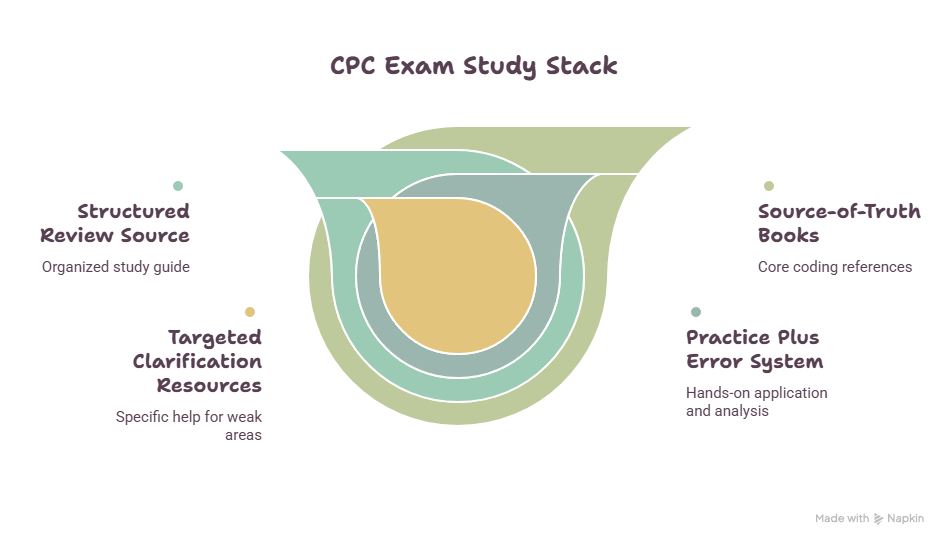
4. How to Build a Lean CPC Study Stack: Four Layers and a Six-Week Operating System
A lean stack can be built in four layers.
Layer 1: Your source-of-truth books
Use the CPT, ICD-10-CM and HCPCS Level II books allowed for your exam. AAPC currently recommends current-year editions, although its published exam policy permits certain current-year/preceding-year combinations. Candidates should verify the exact policy before their test date because code sets change annually.
Your goal during preparation is to make these books operational.
When working through CPC exam questions, record only navigation aids and concise coding notes that comply with AAPC's rules. Candidates should also understand how professional coding decisions connect to coding ethics and standards, health information management terminology, and the documentation logic later encountered in professional-fee versus facility coding.
Layer 2: One structured review source
Use one primary CPC study guide or course.
Its purpose is to expose coverage gaps, organize domains, and give you structured explanations. Candidates deciding between expensive programs and self-study should compare that need against the real ROI of medical coding training.
Once a concept is understood, move on.
Do not repeatedly consume an hour-long lecture about something you can already answer correctly in 90 seconds.
Layer 3: High-quality practice plus an error system
This is where the largest improvement usually happens.
Your error log can use five columns:
Question type | What I chose | Correct rule | Why I missed it | What I will do differently
If you confuse code-family concepts relevant to outpatient versus inpatient coding, record the distinction. If documentation language causes the error, strengthen medical terminology. If your mistake exposes weak claim logic, reviewing CMS-1500 terminology or healthcare claims-management concepts may provide useful context.
Layer 4: Targeted clarification resources
Use videos, instructor help, study groups or extra questions only when your error log creates a reason.
This prevents YouTube from becoming entertainment disguised as studying.
A candidate missing five E/M questions needs an E/M intervention. A candidate struggling with sequencing needs an ICD-10-CM intervention. A candidate failing to interpret documentation may need medical terminology remediation.
A practical six-week CPC plan
Week 1: Establish the baseline.
Take a representative question set. Categorize every weak area. Begin tabbing and annotating only where navigation friction exists. Review your CPC exam strategy before adding more resources.
Week 2: Repair rule-heavy weaknesses.
Prioritize ICD-10 conventions, CPT guidelines, modifiers, parentheticals and categories where errors come from rules rather than ignorance of individual codes.
Week 3: Repair clinical comprehension.
Target anatomy and medical terminology only where question performance proves the need.
Week 4: Introduce aggressive timing.
Run 10-question sets at approximately the exam's overall pace. Record questions exceeding your target even when correct.
Week 5: Full-condition mocks.
Use serious practice exams. Practice question triage, flagging, answer elimination and book navigation. Candidates dealing with repeated low scores should use the same type of forensic review recommended in a CPC retake study plan.
Week 6: Stabilize rather than expand.
Do not add three new courses. Review your highest-frequency errors, complete another timed simulation, rehearse exam logistics, and use a medical billing and coding exam-day checklist.
5. CPC Exam Week and Exam Day: Convert Preparation Into 70+ Correct Answers
AAPC's current format gives you 240 minutes for 100 questions. That average of 2.4 minutes creates an important constraint: some questions deserve less time so harder questions can receive more. AAPC itself recommends considering the answer choices first and saving difficult questions for later rather than allowing one question to consume excessive time.
A strong exam-day approach uses three passes.
Pass 1: Capture efficient points
Answer questions where the governing concept or lookup path is immediately clear.
Candidates who have practiced CPC questions with detailed explanations should recognize many familiar decision patterns. Use elimination aggressively when answer choices reveal impossible code combinations or obviously wrong code families, a tactic also highlighted in recent Reddit discussions.
Pass 2: Resolve questions requiring deeper lookup
Return to questions where you know how to solve them but need additional verification.
This is where your tabbing, highlighting and compact notes pay for themselves. AAPC permits tabs that earmark pages and allows certain handwritten coding-related notes, while prohibiting copied practice questions, exam questions and long supplemental passages. Candidates should check the published rule set immediately before sitting the exam rather than relying on old Reddit descriptions.
Pass 3: Protect against blanks
AAPC explicitly recommends answering every question because an informed guess can still earn the point.
Your objective therefore becomes maximizing expected correct answers rather than proving that you can solve every scenario perfectly.
That distinction is especially important for anxious candidates. Someone experiencing medical coding exam anxiety can lose points through fixation, second-guessing and poor pacing even when the underlying knowledge is adequate.
The final 48 hours should therefore be boring.
Review your recurring errors. Confirm exam requirements. Organize permitted books. Rehearse navigation. Sleep appropriately. Use your exam-day checklist. Avoid destroying confidence with an uncontrolled marathon of questionable free questions.
Passing is also only one career checkpoint. Candidates should understand CPC-A apprentice status, prepare a stronger medical coding résumé after certification, and understand why some newly certified coders still struggle with the first-job hiring barrier.
A credential helps create access. Your ability to apply coding rules accurately and efficiently determines what happens after the exam.
6. FAQs About CPC Exam Prep in 2026
-
A full course can be valuable when you need structured instruction in anatomy, terminology, coding fundamentals and guideline application. Recent Reddit passers include people who used formal courses as well as candidates who emphasized study guides, official practice exams and self-directed preparation.
Choose based on your starting point. Someone pursuing medical coding with no healthcare background may need more foundational structure than an experienced biller. Before purchasing another program, compare bootcamp, college and self-study outcomes and calculate your training ROI.
-
The useful number depends on how thoroughly you review them. Three mocks taken and forgotten can produce less improvement than one carefully analyzed exam.
For every practice set, classify incorrect, guessed and slow answers. Use CPC practice questions for additional repetition, then use official-style exams to evaluate whether your CPC study strategy survives realistic timing.
-
AAPC requires 70% on the actual exam.
For practice, aim for enough margin that a harder question mix, nerves or pacing problems do not immediately push you below 70%. More important than a single percentage is repeatability. A candidate repeatedly performing above the passing threshold under timed conditions has stronger evidence than someone scoring 82% once and 61% twice.
If you remain in the 60s, use the diagnostic method from a CPC retake plan before buying more content.
-
AAPC currently allows tabs intended to earmark pages and permits handwritten notes in print code books when they pertain to daily coding activity. It prohibits long copied passages and practice or exam questions.
Use annotations to speed decisions. Your CPC exam preparation benefits more from concise navigation cues than pages packed with rewritten textbook content.
-
Prioritize structure, conventions, terminology, frequently encountered patterns and lookup speed.
The exam permits approved code books, so memorizing thousands of codes produces weak returns compared with learning how to move from documentation to index, guideline, tabular confirmation and final code choice. Strengthen CPC medical terminology and complete high-quality CPC question practice instead of building giant code-number flashcard decks.
-
Videos can be excellent for resolving a specific concept. They provide weaker proof of readiness than timed application.
Use videos when your error log says, “I still do not understand this concept.” Use CPC practice questions and timed mocks to determine whether the explanation actually changed performance.
Someone spending hours watching prep content while avoiding timed questions may feel increasingly familiar with coding while remaining unprepared for the exam.
