
Directory of Online CPC Certification Programs
Choosing an online CPC program is a money decision, a time decision, and a career-direction decision. A weak program can leave students memorizing codes without understanding payer rules, documentation, modifiers, compliance, claim adjustment reason codes, CPT coding, ICD coding standards, medical necessity, or reimbursement logic. This directory shows what to compare before enrolling, what each online CPC training style actually offers, and how to avoid paying for a program that looks polished but leaves you unready.

1. How to Use This Online CPC Program Directory Before You Enroll
The CPC credential is issued by AAPC, and AAPC describes the CPC as demonstrating proficiency with ICD-10-CM, CPT, HCPCS Level II, compliance, payer rules, and documentation. That matters because many online schools advertise “CPC certification training,” while the actual exam and credential pathway still run through AAPC. A smart student compares programs by exam alignment, coding practice depth, instructor support, code book training, medical coding workflow, coding audit terms, coding ethics, and medical billing reimbursement.
A strong online CPC program should train students to read documentation like a coder, not hunt for keywords like a beginner. Real outpatient coding requires diagnosis-to-procedure logic, modifier judgment, place-of-service awareness, payer-specific edits, and clean claim thinking. That means the curriculum should connect CPT code families, HCPCS supply coding, clinical documentation improvement, CMS-1500 claim fields, and EOB interpretation.
The CPC exam currently requires a 70% passing rate, which AAPC explains as at least 70 correct answers out of 100 questions. That score threshold exposes students who studied definitions without timed application. The best programs build speed through case questions, operative-note practice, E/M decision-making, modifier drills, specialty scenarios, and explanation review. Good training should feel uncomfortable in the right way: it should force students to defend answers using medical necessity criteria, modifier usage, coding edits, problem lists, and SOAP note coding.
Online CPC Program Directory: What to Compare Before You Pay
| Program Type | Best For | What It Should Include | Hidden Risk to Check |
|---|---|---|---|
| AAPC official CPC exam preparation | Students who want the most direct CPC-aligned route. | CPT, ICD-10-CM, HCPCS, compliance, exam-style questions, and code book use. | Confirm whether books, exam fee, membership, and practice exams are included. |
| Self-paced CPC course | Working students who need flexible study hours. | Recorded lessons, chapter quizzes, case practice, and timed exam drills. | Weak students can fall behind without instructor accountability. |
| Virtual instructor-led CPC course | Students who need structure, deadlines, and live explanations. | Live classes, office hours, homework review, and guided coding corrections. | Class pace may move too fast if anatomy and terminology are weak. |
| College-backed online medical coding certificate | Students who want academic structure and transcript value. | Medical terminology, anatomy, coding systems, reimbursement, and compliance. | Some certificates prepare broadly rather than directly for the CPC exam. |
| Career school CPC preparation program | Students who want packaged training with career support. | Coding curriculum, resume help, mock interviews, and externship guidance. | Marketing may overpromise job placement or salary outcomes. |
| Community college online coding track | Budget-focused students who want recognized institutional training. | Semester pacing, instructor grading, foundational billing, and coding modules. | Course calendar may delay exam readiness if enrollment windows are limited. |
| CPC bootcamp | Students with coding background who need exam sharpening. | High-volume question practice, timing strategy, and weak-area review. | Beginners may need deeper basics before a compressed bootcamp works. |
| CPC practice exam bundle | Students close to test day. | Timed questions, rationales, topic scoring, and missed-question review. | Practice tests cannot replace actual coding instruction. |
| Anatomy and physiology prerequisite course | Students struggling to understand body systems. | Body system vocabulary, disease process basics, and procedure context. | It supports CPC readiness but does not teach full coding by itself. |
| Medical terminology prerequisite course | Students who lose time decoding documentation language. | Prefixes, suffixes, root words, abbreviations, and clinical phrase patterns. | Memorization without documentation practice gives limited exam value. |
| Outpatient coding certificate | Students focused on physician office, clinic, and ambulatory coding. | CPT procedure coding, E/M, diagnosis coding, modifiers, and claims logic. | Check whether inpatient PCS content dilutes CPC-focused study time. |
| Medical billing plus coding program | Students aiming for revenue cycle roles beyond coding alone. | Claims, denials, posting, payer rules, coding basics, and compliance. | Billing-heavy programs may undertrain complex CPT application. |
| CPC plus CPB dual-prep program | Students interested in both coding and billing credentials. | Coding systems, claims, payer rules, reimbursement, denials, and posting. | Dual prep requires more time and can overwhelm new learners. |
| Exam review webinar series | Students who already completed a full course. | High-yield exam reminders, common errors, and timing tips. | Short review sessions rarely build missing fundamentals. |
| Specialty-focused CPC supplement | Students weak in surgery, cardiology, radiology, or E/M. | Specialty cases, documentation examples, and modifier practice. | Use it after core CPC study, not before foundational training. |
| E/M coding workshop | Students losing points on office visits and documentation levels. | MDM, time rules, documentation review, and level selection. | E/M-only study leaves gaps in surgery, medicine, pathology, and radiology. |
| Modifier mastery course | Students repeatedly missing bundled or distinct-service questions. | Modifier intent, payer edits, examples, and claim outcome logic. | Modifier lists alone are weak without documentation-based cases. |
| ICD-10-CM diagnosis coding course | Students who struggle with specificity and sequencing. | Guidelines, chapter rules, laterality, combination codes, and exclusions. | Diagnosis-only training must connect back to CPT medical necessity. |
| HCPCS Level II coding course | Students unfamiliar with supplies, drugs, DME, and payer reporting. | HCPCS structure, modifiers, units, supplies, and coverage context. | Many beginners overlook HCPCS until exam practice exposes the gap. |
| Compliance-focused coding course | Students aiming for safer coding judgment. | Fraud risk, documentation standards, query behavior, and payer rules. | Compliance theory needs coding scenarios to become useful. |
| Audit-focused coding course | Students preparing for quality review or future auditor roles. | Error patterns, documentation comparison, coding rationale, and reporting. | Audit training usually expects stronger coding basics. |
| Physician office coding program | Students targeting clinic, private practice, or outpatient groups. | Office visits, procedures, preventive care, modifiers, and claims flow. | Confirm the course covers enough surgical and medicine-section practice. |
| Hospital outpatient coding program | Students interested in facility outpatient coding. | Facility billing context, charge capture, CPT, modifiers, and documentation. | CPC is physician/professional-coding focused, so facility content should support rather than replace exam prep. |
| Risk adjustment coding supplement | Students planning future HCC or payer work. | Chronic condition capture, documentation support, specificity, and validation. | Risk adjustment is useful after core CPC foundations are stable. |
| Externship-supported online coding program | Students needing practical experience for resumes. | Case exposure, simulated records, productivity practice, and feedback. | Verify whether the externship is guaranteed, simulated, or competitive. |
| Job-readiness coding program | Students who need portfolio, resume, and interview support. | Mock productivity, employer-style assessments, coding samples, and interview prep. | Career support cannot compensate for weak coding accuracy. |
| Subscription learning platform | Students who want low-cost supplemental practice. | Videos, quizzes, flashcards, and topic refreshers. | Subscriptions can become passive watching instead of active coding. |
| Private CPC tutoring | Students who failed once or have specific weak domains. | Personal diagnostics, missed-question review, and targeted drills. | Quality varies sharply; ask for methodology and sample feedback. |
| Employer-sponsored CPC pathway | Revenue cycle staff moving into coding roles. | Paid study time, internal cases, coding standards, and mentor review. | Training may focus only on the employer’s specialty mix. |
| Hybrid online plus local lab program | Students who want online theory with occasional live support. | Remote lessons, live labs, instructor review, and exam prep sessions. | Travel or fixed lab dates may reduce flexibility. |
2. Best Online CPC Program Types and Who Each One Fits
The most direct option is an AAPC-aligned CPC preparation course because the CPC is an AAPC credential and the exam focuses on professional coding. AAPC advertises self-paced and virtual instructor-led preparation options, and its support page describes the self-paced CPC exam preparation option as allowing up to six months while the live instructor-led version runs sixteen weeks. This path fits students who want clear exam alignment, direct terminology, and a coding-first structure. It should still be paired with strong study of CPT procedure coding, HCPCS reporting, diagnosis coding, medical documentation, and coding workflow.
College-backed online coding certificates work well for students who want a slower academic pathway with broader health information context. AHIMA describes its Medical Coding and Reimbursement Online program as self-paced with 13 courses covering coding, health information, and biomedical concepts, and says it prepares learners for AHIMA credentials such as CCA, CCS, and CCS-P. That route is valuable for students comparing CPC with other coding credentials, especially if they want deeper exposure to health information management, data analytics, documentation integrity, medical record retention, and regulatory compliance.
Career-school programs can be useful when they combine CPC prep with employability support. The valuable version includes coding drills, medical terminology, anatomy, claims, denial basics, resume support, and job-readiness assignments. The risky version sells “certification” language without enough timed CPC-style practice. Students should ask whether the program includes real chart scenarios, code book navigation, modifier explanations, and feedback on wrong answers. A career-focused CPC path should strengthen revenue cycle management, claims management, payment posting, denial codes, and professional development.
Bootcamps and exam-review programs fit students who already understand code sets and need exam control. They work best after a full course, during the final stretch, or after a failed attempt where the student knows the weak areas. A serious review program should diagnose domain gaps instead of throwing random questions at the student. It should build confidence in E/M coding, radiology CPT coding, surgical coding compliance, lab and pathology coding, and preventive medicine coding.
3. What a Serious CPC Curriculum Must Teach
A real CPC curriculum must teach students how codes behave inside claims, not just how they appear in books. CPT is where many students lose time because they know the general section but struggle with parenthetical notes, bundled services, add-on codes, separate procedures, modifiers, and payer edits. Strong programs force repeated practice across surgery, medicine, radiology, pathology, anesthesia, E/M, and specialty cases. That practice should connect to cardiology CPT, emergency medicine codes, gastroenterology CPT, dermatology procedures, and pediatric CPT.
Diagnosis coding must go beyond finding a disease name. CPC students need guideline logic, specificity, laterality, acute versus chronic distinctions, complications, combination codes, documentation support, and linkage to medical necessity. A student who cannot defend the diagnosis cannot defend the claim. The curriculum should include cross-training with ICD mental health coding, neurological disorder coding, respiratory coding, oncology coding, and infectious disease coding.
Documentation training is the difference between exam survival and workplace readiness. Students need practice reading notes, identifying missing support, recognizing when a query may be needed, and understanding why the provider’s words control the code. A good program teaches how a diagnosis, procedure, order, result, and payer rule work together. That means training with CDI terminology, coding query process terms, EMR documentation, encounter forms and superbills, and problem lists.
A complete CPC program also needs reimbursement awareness. Coders who understand denials, remittances, payer rules, and claim edits make fewer expensive mistakes. The exam is coding-centered, but the workplace rewards coders who understand why clean claims pay. Curriculum should introduce EOBs, CARCs, RARCs, coordination of benefits, and charge capture.
Quick Poll: What is your biggest fear before choosing an online CPC program?
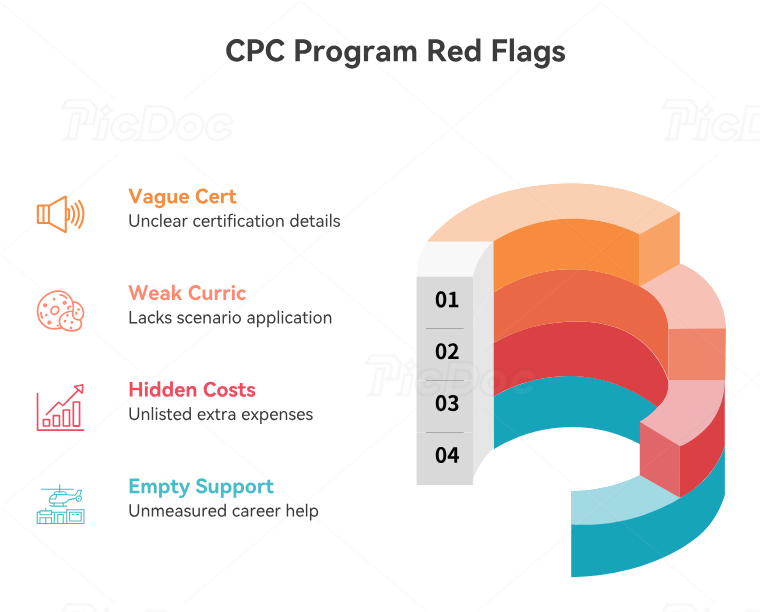
4. Red Flags That Make an Online CPC Program Risky
The first red flag is vague “certification included” wording. Students should ask exactly which credential the program prepares for, who awards it, whether the CPC exam fee is included, and whether the program provides a certificate of completion or prepares for the AAPC CPC credential. Confusing language can cost students months. A trustworthy program explains the pathway clearly and connects training to medical coding certification terms, coding education terms, credentialing organizations, CBCS exam terms, and coding career development.
The second red flag is a curriculum that teaches code lookup without documentation review. CPC readiness depends on applying guidelines to real scenarios, not recognizing chapter names. Students should see sample lessons, practice questions, rationales, case notes, operative examples, and instructor explanations before committing. Weak programs often hide behind polished dashboards while giving little actual coding feedback. Better programs train students through medical necessity, coding edits, coding audit concepts, medical abbreviations, and healthcare data security.
The third red flag is hidden cost. CPC students may need current code books, practice exams, membership, exam application, extensions, retake planning, and sometimes prerequisite courses. Before enrolling, students should ask for a written cost sheet and a timeline from first lesson to exam date. Cost clarity also helps compare CPC with adjacent paths such as CBCS or AHIMA credentials. NHA describes CBCS as a certification pathway for billing and coding specialists, while AHIMA lists coding credentials including CCA, CCS, and CCS-P. Students should compare pathways through certification renewal, CEU requirements, professional development, coding competency, and career resources.
The fourth red flag is career support that sounds big but measures nothing. “Job assistance” should mean resume review, mock interviews, employer assessment practice, productivity expectations, portfolio examples, and realistic entry-level role guidance. Students should ask whether graduates practice coding from documentation, receive feedback on accuracy, and learn how coding connects to claims management, payment posting, revenue cycle metrics, denial management, and RCM software.
5. A Practical 90-Day Plan for Choosing and Completing an Online CPC Program
During days 1–10, compare three to five programs using a written checklist. Confirm the credential pathway, total cost, course length, instructor access, practice question volume, code book training, refund policy, extension policy, and career support. Ask for a sample lesson and one sample rationale. A serious program should make its structure easy to understand. Use this period to refresh medical terminology, anatomy-related coding, ICD standards, CPT modifiers, and billing acronyms.
During days 11–45, build foundations aggressively. Study by body system and coding task rather than passively watching videos. Each week should include diagnosis coding, CPT coding, modifier drills, anatomy review, and at least one set of timed questions. Wrong answers should be tracked by reason: misunderstood guideline, missed documentation clue, wrong modifier, wrong code family, sequencing error, or timing pressure. This turns study into a feedback loop using coding workflow, encoder software terms, EHR coding terms, EMR documentation terms, and coding system updates.
During days 46–75, shift from learning to performance. Students should complete timed question sets, review explanations in detail, and rebuild weak domains. A student who misses modifier questions needs modifier drilling. A student who misses medical necessity questions needs documentation-linkage practice. A student who misses specialty questions needs targeted CPT section review. This phase should include radiology billing, behavioral health billing, hospice coding, telemedicine coding, and speech-language pathology coding.
During days 76–90, simulate test conditions and clean up exam logistics. Students should know their approved books, tabbing rules, timing rhythm, weakest domains, and recovery strategy when stuck. They should also prepare for after the exam by understanding entry-level roles, employer assessments, and how coding touches reimbursement. That final stage should connect CPC readiness with charge capture, claims reconciliation, commercial insurance billing, patient responsibility, and collections.
6. FAQs About Online CPC Certification Programs
-
The best online CPC program is the one that matches your current skill level, schedule, budget, and need for instructor support. Beginners usually need a full course with medical terminology, anatomy, CPT, ICD-10-CM, HCPCS, modifiers, compliance, and timed practice. Experienced billers or coders may benefit from bootcamps or review courses. Before enrolling, compare the program against medical coding certification terms, coding education terms, coding competency assessment, CPT modifier rules, and medical necessity criteria.
-
Yes, many CPC-prep pathways are available online, including self-paced courses, virtual instructor-led courses, bootcamps, tutoring, review programs, and practice exam bundles. AAPC advertises self-paced and virtual instructor-led CPC preparation options. Students should choose online training that includes code book navigation, instructor feedback, practice explanations, and exam timing strategy. Online learning works best when students actively code cases, review missed questions, and connect lessons to claims management, coding workflow, EOBs, and reimbursement rules.
-
Timeline depends on background. Students with medical terminology, anatomy, and billing experience may move faster than complete beginners. AAPC states that its self-paced CPC exam preparation option gives students up to six months, while its live instructor-led option is sixteen weeks. A realistic plan should include time for medical abbreviations, ICD coding standards, CPT coding, HCPCS familiarity, and timed practice.
-
A strong online CPC program should include anatomy, medical terminology, ICD-10-CM, CPT, HCPCS Level II, E/M coding, modifiers, compliance, documentation review, timed questions, answer rationales, and instructor support. The program should also explain how coding affects claims, denials, payment, and reimbursement. Students should look for training that connects clinical documentation improvement, coding query process, coding edits, charge capture, and revenue cycle metrics.
-
CPC is commonly chosen by students targeting professional outpatient coding, physician office coding, and procedure-heavy coding roles. CBCS is more billing-and-coding administrative focused, while AHIMA’s CCA, CCS, and CCS-P credentials belong to the health information and coding credential pathway. AHIMA lists CCA, CCS, and CCS-P among its certification options, and NHA identifies CBCS as a billing and coding specialist certification pathway. Compare each route through CBCS terms, credentialing organizations, career development, and HIM terms.
-
A program is worth considering when it provides transparent pricing, clear CPC alignment, enough practice questions, instructor access, code book training, refund terms, extension terms, and realistic career support. Ask for a syllabus, sample lesson, sample rationale, total cost sheet, and exam-readiness plan. The best value comes from programs that teach accuracy, speed, documentation judgment, and claim impact together. That means students should graduate with stronger command of coding ethics, medical coding audits, RCM terms, denial prevention, and professional development.
