
Best Employers for New Medical Coders: Reddit Experiences Compared by Training, Remote Access, Pay & Advancement
A first medical coding employer can shape the next five years of your career. The strongest beginner jobs give newly certified coders enough training to become accurate, enough production exposure to become employable elsewhere, and a visible route into specialties, auditing, facility coding, or leadership. That matters when new coders already face an experience barrier, remote positions attract heavy competition, productivity quotas vary sharply, and credential choice affects hiring access.

1. What Makes an Employer Good for a New Medical Coder?
A beginner-friendly coding employer solves one problem above everything else: how do you turn certification knowledge into credible production experience without being thrown into a queue you were never trained to handle?
The answer requires more than a recognizable company name. Evaluate the employer across training, case difficulty, supervision, productivity ramp, audit feedback, credential acceptance, remote access, compensation, benefits, and internal mobility. Someone comparing CPC training options, CCS certification programs, CBCS training routes, and the true cost of medical coding training should apply the same scrutiny to the first employer.
Training quality comes first. Look for structured orientation, specialty education, access to coding educators, practice charts, audited feedback, written policies, and a defined period before full productivity expectations begin. A supervisor who says “ask whenever you need help” can be valuable; a documented 30-, 60-, and 90-day ramp is stronger evidence.
Direct coding experience comes second. A role becomes especially valuable when your daily work involves reviewing documentation, selecting ICD-10-CM, CPT, HCPCS, or ICD-10-PCS codes, resolving edits, assigning modifiers, interpreting guidelines, or working coding denials. That experience gives future employers something concrete to evaluate. It also strengthens the career transition described in the 90-day employment plan after CPC, the medical-assistant-to-coder pathway, the professional versus facility coding comparison, and the 2026 medical coding salary analysis.
A realistic productivity ramp is another major signal. New coders need time to learn an employer's EHR, encoder, specialty rules, client policies, query process, and audit methodology. Ask how quickly a trainee must reach full production and what happens if accuracy is strong while speed develops more slowly. The difference becomes clearer after reviewing coding productivity quotas, CPC exam strategy, CPC practice questions, and CCS practice cases.
Finally, prioritize internal mobility. Your first salary matters. Your second role inside the same organization may matter even more. A company with professional coding, outpatient facility coding, inpatient coding, denials, risk adjustment, auditing, education, CDI, revenue integrity, and leadership creates multiple ways to turn one year of experience into a substantially stronger career position.
| Employer / Target | Beginner Value | Remote Reality | Best Career Use | What to Verify |
|---|---|---|---|---|
| Optum through CSI Companies | Reddit reports describe risk-adjustment contracts being used as genuine first coding jobs. | Remote contracts have appeared, though availability is seasonal and project-specific. | Build the experience needed to escape the new-coder experience trap. | Contract length, furlough risk, benefits, conversion probability, production targets. |
| Optum direct hire | Large coding operation with multiple specialties and credentials accepted in many postings. | Current postings include nationwide or state-based remote work. | Move from entry coding toward specialty, facility, analytics, audit, or other higher-value coding work. | Many direct positions still request prior specialty experience. |
| HCA Healthcare / Parallon | Its official coding career page identifies clinical denials as an entry point and shows multiple coding ladders. | HCA advertises work-from-home coding opportunities. | Progress from denials or coding into ProFee, audit, education, team lead, or management. | Geographic restrictions, credential requirements, experience requirements for each opening. |
| Local hospital systems | Potentially overlooked source of trainee, coding support, HIM, and internal-transfer opportunities. | Remote status may be missing from outdated job descriptions. | Build facility exposure before pursuing advanced CCS-level roles. | Contact coding leadership when job descriptions appear stale or unrealistic. |
| Academic medical centers | Deep specialty mix creates strong long-term learning potential. | Remote access varies by system and state. | Gain exposure to surgery, oncology, cardiology, trauma, complex outpatient, or inpatient coding. | Entry-level openings may be less frequent than experienced-coder roles. |
| Cleveland Clinic | Visible internal coding levels create a clear progression model. | Professional and specialty remote coding positions have been advertised. | Develop from coding levels into more complex professional or facility work. | Public Coder III roles can require several years of experience. |
| Regional hospital networks | Smaller applicant pools may create better access than national remote jobs. | Often hybrid or remote after training. | Use local access to solve the remote experience problem. | Whether onsite training can convert to remote work. |
| Physician multispecialty groups | Strong fit for CPC holders and professional-fee beginners. | Remote possibilities increase once productivity is proven. | Learn E/M, modifiers and specialties through CPC-aligned work. | Number of specialties, training support, expected charts per hour. |
| Large primary-care groups | Repetition can help beginners build speed and confidence. | Central coding teams may operate remotely. | Create the foundation for later specialty or auditing roles. | E/M volume and productivity pressure. |
| Risk-adjustment vendors | Seasonal HCC projects sometimes create accessible first coding experience. | Remote work is common in the segment. | Get direct ICD-10-CM production experience. | Seasonality, contract status, training depth, whether the role teaches more than HCC abstraction. |
| Medical coding staffing agencies | Can connect certified beginners with projects that large employers fill through contractors. | Remote access varies by client. | Acquire the first 6–12 months required by future employers. | Who employs you, benefits eligibility, contract end date, conversion policy. |
| Revenue-cycle management companies | Offer coding, billing, denials, edits, charge review, and claims roles. | Many operations are centralized or remote. | Bridge through billing and coding hybrid work. | Whether coding experience is genuine or mostly data entry. |
| Clinical denials departments | Can expose beginners to code validity, payer policy, documentation and reimbursement. | Frequently compatible with remote workflows. | Build toward coding, audit, revenue integrity, or payer work through denial-management expertise. | Coding-versus-call-center balance. |
| Claim edit teams | Strong exposure to CPT, modifiers, NCCI, payer edits, and rejected claims. | Often centralized. | Learn how claim adjustment codes connect to coding decisions. | Depth of coding judgment required. |
| Charge capture teams | Useful bridge into coding when direct coder openings remain inaccessible. | Remote eligibility varies. | Build procedure, charge, and revenue-cycle knowledge. | Whether certification creates a path into coding. |
| Emergency-department coding vendors | High repetition can accelerate CPT and diagnosis experience. | Remote production models are common. | Develop speed using emergency medicine coding knowledge. | Charts-per-hour target and scope of each chart. |
| Radiology coding groups | Narrow specialty repetition can build efficient coding habits. | Often remote once competency is established. | Develop a marketable specialty. | Very high volume expectations may apply. |
| Ambulatory surgery centers | Valuable procedural exposure for CPC or COC pathways. | Varies widely. | Strengthen CPT procedural coding. | Surgery experience requirements can be strict. |
| Federally qualified health centers | Broad primary-care and reimbursement exposure. | Often onsite or hybrid. | Learn E/M, preventive services, payer rules, and government-program billing. | Local salary and staffing resources. |
| Community health systems | Smaller teams can create cross-training opportunities. | Often less nationally competitive than fully remote roles. | Move among HIM, billing, coding and denial functions. | Mentorship and succession planning. |
| Medicare Advantage plans | Risk-adjustment roles can use CPC or CRC knowledge. | Many payer operations support remote work. | Develop payer-side expertise using Medicare resources. | Experience requirements and seasonal hiring patterns. |
| Medicaid managed-care plans | Offers payer, claims and coding-adjacent career routes. | Remote or hybrid models are common in many organizations. | Build reimbursement knowledge through Medicaid reimbursement work. | Direct coding availability may be limited for beginners. |
| Centene and similar national payers | Strong long-term destinations for coding, payment integrity and review. | Current coding-review jobs include remote configurations. | Move into DRG review, policy, SIU or payment integrity. | Many current coding positions require several years of experience. |
| Government health departments | Some agencies can be more flexible about transferable healthcare experience. | Remote access depends on agency policy. | Gain stable coding or reimbursement experience. | Civil-service hiring timelines and credential requirements. |
| County or public hospital systems | Can provide structured pay grades and internal mobility. | Varies by system. | Develop facility coding and government-payer knowledge. | Search the employer's own careers site rather than relying solely on aggregators. |
| Workers' compensation billing teams | Useful for coders with billing or claims backgrounds. | Remote availability varies. | Learn specialized reimbursement through workers' compensation resources. | How much direct coding is performed. |
| Specialty physician practices | A medical assistant or biller may transfer internally into coding. | Usually onsite or hybrid initially. | Leverage the medical-assisting-to-coding pathway. | Formal training, salary ceiling, and whether one person handles too many functions. |
| Hospital HIM departments | HIM, records, release-of-information, and coding-support jobs can become internal bridges. | Remote access usually improves in dedicated coding roles. | Move toward outpatient or inpatient facility coding. | Internal transfer policy and certification support. |
| Internal employer coding academies | Potentially the strongest beginner model when available. | Training may begin onsite, hybrid, or virtually. | Convert education directly into supervised production experience. | Employment commitment, repayment clauses and passing benchmarks. |
| Your current healthcare employer | Existing reputation can offset limited direct coding experience. | Internal remote opportunities may appear after transfer. | Use existing clinical or billing experience to bypass part of the post-certification job barrier. | Tuition reimbursement, shadowing, cross-training and internal posting rules. |
2. Which Employers Stand Out Most for New Medical Coders in 2026?
Optum through CSI Companies: one of the clearest contractor on-ramps
Optum appears repeatedly in new-coder discussions because some risk-adjustment projects are staffed through contractors, including CSI Companies. One 2025 Reddit commenter described Optum through CSI as a first coding job, with approximately four weeks of training, a large training class, and continued opportunities for one-on-one coaching. The same commenter had worked close to two years without receiving a full-time Optum conversion, which highlights the trade-off between accessible experience and contractor uncertainty.
That makes this route particularly relevant to someone dealing with the CPC-A employment catch-22, pursuing remote coding without experience, deciding whether medical coding remains worth entering, or calculating training ROI.
Contract work needs careful due diligence. Ask whether training is paid, how long the assignment is funded, whether furloughs occur between projects, whether benefits are provided through the staffing agency, and what proportion of contractors eventually move into permanent roles. Another Reddit discussion from late 2025 illustrates how contractor policies can create confusion around schedules and holidays, even when the coder otherwise viewed the job positively.
Optum also remains a major destination after the first contract. Current 2026 Optum postings for cardiology, oncology, urology, and hospitalist coding advertise remote work, comprehensive benefits, education reimbursement, and career-development language. Several accept CPC-A among qualifying credentials, while still requesting significant specialty experience. One current specialty posting lists $20.38–$36.44 per hour, depending on factors such as location and experience. That combination captures a crucial career reality: the credential can satisfy one requirement while direct experience remains the decisive filter.
HCA Healthcare / Parallon: unusually clear internal coding pathways
HCA Healthcare's Parallon coding operation deserves attention because its official careers material lays out specific coding career paths rather than presenting coding as one generic job family. The organization advertises work-from-home coding opportunities and identifies clinical denials coding as a strong entry point into coding. Its published pathways show movement from clinical denials into ProFee coding, audit, E/M coding, team leadership, and other roles. Parallon also describes progression from coding integrity positions into team-lead and leadership work.
That structure is especially valuable for someone comparing professional and facility coding, learning denial management, strengthening claims knowledge, or studying CARCs and claim adjustments.
HCA's own career stories also show internal movement from entry-level coding into management, quality review, education, and operational leadership. Those are employer-provided testimonials, so treat them as examples rather than guaranteed outcomes. The underlying organizational ladder is still visible in the company's published role structure.
Local hospital systems: the most underestimated beginner target
One of the most useful 2026 Reddit discussions came from a coding professional who investigated why a hospital claimed it could not find coders while new coders said they could not find jobs. The hospital's public job descriptions apparently still referenced outdated requirements, failed to mention that coding had been remote since the pandemic, and listed more experience than management would actually accept. The poster advised candidates to check hospital websites directly and contact coding leadership.
This matters enormously for anyone sending dozens of applications through national job boards. A local health system may offer a better first opening than a famous nationwide remote employer because the applicant pool is smaller and internal hiring managers can evaluate healthcare experience, CPC preparation, billing knowledge, and coding-adjacent experience more flexibly.
Cleveland Clinic and other major health systems: stronger after you gain experience
Large systems can provide excellent long-term coding careers while setting higher bars for many publicly advertised positions. A Cleveland Clinic Professional Fee Coder III posting, for example, lists remote work, a $20.77–$31.68 hourly range, qualifying AHIMA or AAPC credentials, and three years of coding experience including complex coding. The posting also references an internal Professional Coder II pathway and required training, quality, and productivity benchmarks, which demonstrates a formal progression structure.
For a brand-new coder, the practical move is to search the same employer for lower coding levels, HIM roles, charge review, billing, coding support, and internal trainee opportunities. The long-term payoff becomes clearer when paired with medical coding salary progression, continuing education, CPT specialization, and facility-coding development.
Payers such as Centene: powerful second-step employers
National payers can offer strong remote pathways into payment integrity, DRG review, coding policy, fraud/waste/abuse, and reimbursement analysis. The barrier is experience. A current Centene remote DRG reviewer posting requires four or more years of MS-DRG/APR-DRG coding experience and lists a $70,100–$126,200 salary range. A separate coding-policy role also requires four or more years in medical coding.
For a beginner, that makes payer work an excellent career destination to plan toward. Build the foundation through facility coding, Medicare reimbursement, Medicaid reimbursement, and denial-management experience, then use that experience to move from production coding into higher-complexity review work.
3. Training, Remote Access, Pay and Advancement: What Should New Coders Prioritize?
For a first coding job, rank these four factors in this order:
1. Quality of experience
2. Training and feedback
3. Advancement potential
4. Starting pay and remote convenience
A first job paying $2 more per hour can become a weaker career move when the work provides little transferable coding experience. A role paying slightly less may become far more valuable when it gives you direct CPT, ICD-10-CM, facility, specialty, denial, or audit exposure that unlocks a higher-paying second role.
A 2026 Reddit example makes this progression concrete. A CPC-A reported starting through CSI in risk adjustment at approximately $22 per hour, then later receiving an offer for a local-government Medical Coder III position at $37 per hour. The coder openly acknowledged lacking much of the inpatient DRG and ICD-10-PCS background the new role described, while the employer was reportedly willing to train. That is an individual outcome rather than a normal salary progression, yet it demonstrates how valuable the first line of direct coding experience can become.
When comparing pay, use the 2026 coding salary guide, calculate your training investment and break-even period, compare CPC, CCS and CBCS recognition, and account for the difficulty of landing the first role.
Remote access also needs the right weighting. A fully remote first job can be an excellent outcome. An August 2026 Reddit poster reported finally securing a 100% remote coding specialist position after nine months of unemployment and more than 800 applications. That example demonstrates the competition around beginner remote work. Someone pursuing remote coding immediately should also consider hybrid, onsite, contract, denials, billing-coding, HIM, and internal-transfer opportunities that create the experience employers use to approve remote work later.
Training deserves equal scrutiny. Ask whether the employer provides specialty instruction, live educators, audited charts, individual coaching, workflow documentation, and protected learning time. Also ask when coding productivity quotas begin. A program that requires full production during the first week creates a fundamentally different environment from one that gradually increases output while monitoring accuracy.
4. How to Get Hired by a Beginner-Friendly Coding Employer
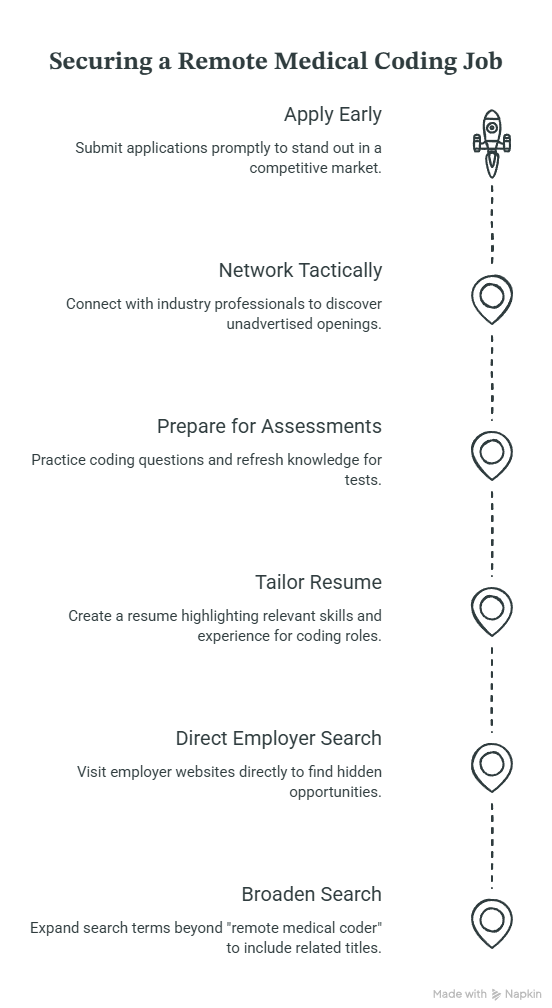
Start by changing the way you search.
Searching only “remote medical coder” produces one of the most competitive versions of the job market. Add titles such as coding specialist I, coding associate, professional coder I, risk adjustment coder, HCC coder, charge review specialist, coding edits specialist, clinical denials specialist, coding account resolution specialist, revenue-cycle specialist, HIM technician, coding support, billing and coding specialist, and medical records specialist.
That strategy complements the first-job breakthrough plan, CPC-A 90-day employment strategy, remote coding guide, and billing-versus-coding career comparison.
Next, search employer websites directly. Reddit's August 2026 hospital example shows why this matters: job descriptions can be stale, remote status may be missing, and formal experience requirements may exceed what the coding manager will actually accept. Build a target list of hospitals, physician groups, payers, RCM companies, government employers, and staffing firms within your state. Check each careers page weekly.
Then create a coding-specific resume. A resume for a newly certified coder should emphasize credential, code sets, chart practice, healthcare documentation, payer knowledge, specialties, EHRs, claims experience, denials, prior authorization, medical terminology, anatomy, and measurable coding accuracy. A medical assistant should translate relevant experience through the medical-assisting-to-coding guide. A biller should highlight transferable knowledge from claims submission, Medicare billing, denial management, and physician reimbursement.
Prepare aggressively for coding assessments. Employers may care more about your test performance than the perfect wording on your resume. Review CPC practice questions, strengthen medical terminology, refresh CPT coding principles, and use CCS case questions when pursuing facility work.
Networking should also become tactical. Contact coding managers, HIM directors, revenue-cycle managers, or recruiters with one concise message: identify your credential, relevant healthcare experience, target area, and willingness to complete an assessment or trainee period. The goal is to discover openings that HR filters, stale descriptions, or job boards may hide.
Finally, apply early. A fully remote coding posting can accumulate a large pool quickly. Set alerts and apply within the first 24–48 hours when you meet the core requirements. Use the CPC program directory, CCS program directory, CBCS course directory, and credential comparison to ensure your applications align with the credential employers actually request.
5. Red Flags to Check Before Accepting Your First Coding Job
A first offer can feel impossible to reject after months of applications. That makes pre-offer questions even more important.
Ask exactly how training works. Determine its length, whether it is paid, who teaches it, whether you code practice charts, how often charts are audited, and whether you receive individual feedback. Compare the answer with the demands described in the medical coding productivity guide and the preparation standards in the CPC exam strategy guide.
Ask when full quota begins. Someone learning a new EHR, encoder, client policy, specialty, and audit system may need months to reach experienced-coder speed. Ask what percentage of the full target is expected after 30, 60, and 90 days.
Ask how quality is scored. A 95% accuracy requirement means little until you know sample size, error weighting, audit frequency, and whether education follows mistakes.
Ask who controls your employment. Contract coders need to know whether benefits, PTO, payroll, performance management, and termination decisions sit with the staffing company or the healthcare client. Clarify project end dates and what happens when volume drops.
Ask about remote restrictions. “Remote” can mean national remote, remote within selected states, remote within commuting distance of a hospital, or remote after onsite training. HCA, for example, currently has work-from-home roles that require employees to live within a defined distance of an HCA facility in specified states.
Ask where people go after 12–24 months. Strong answers include specialty coder, senior coder, facility coder, auditor, educator, team lead, CDI, reimbursement, denials, revenue integrity, or management. Weak advancement can turn a convenient first job into a salary plateau.
Use the medical coding salary guide, training ROI analysis, professional-versus-facility career comparison, and AI-and-coding outlook to evaluate where the job can take you.
The strongest first employer gives you marketable evidence: coded charts, audited accuracy, measurable production, specialty knowledge, EHR experience, payer knowledge, and supervisors who can confirm that you performed real coding work. That evidence is what turns “newly certified” into “experienced coder.”
6. FAQs About the Best Employers for New Medical Coders
-
Optum contractor projects through staffing firms such as CSI are worth monitoring because Reddit users have described them as first coding jobs with structured training. HCA/Parallon also deserves attention because its official coding careers page explicitly identifies clinical denials as an entry point and publishes several internal coding career paths.
Your search should still include local hospital systems, remote coding alternatives, billing-to-coding pathways, and post-CPC employment strategies.
-
Current Optum postings list CPC-A among accepted professional coding credentials for several roles. Many of those openings also require substantial coding or specialty experience, so CPC-A acceptance should be read as credential eligibility rather than guaranteed entry-level status.
Beginners can also investigate contracting routes, then build toward permanent roles using the CPC-A job plan, CPC certification resources, coding productivity preparation, and 2026 salary data.
-
Parallon's official coding page identifies clinical denials coding as an entry point into coding and describes advancement into ProFee coding, clinical denials leadership, auditing, E/M coding, coding quality, mentoring, and management. It also advertises work-from-home opportunities for coding colleagues.
Applicants should compare each specific opening against their credential path, professional-versus-facility goals, denial-management knowledge, and claims experience.
-
Large healthcare organizations, hospital systems, RCM companies, risk-adjustment vendors, coding contractors, and payers all advertise remote coding work. Current examples include remote roles through Optum, HCA/Parallon, Cleveland Clinic, and Centene, although experience and state restrictions differ substantially by position.
A beginner should combine remote-job research, first-job strategy, CPC preparation, and salary expectations rather than treating remote status as the only filter.
-
A contract coding role can be highly valuable when it provides real chart coding, structured training, audited feedback, and enough project duration to create credible experience. It deserves additional scrutiny around benefits, PTO, project stability, furloughs, equipment, production expectations, and conversion opportunities.
Compare the offer against the medical coding training ROI framework, CPC-A employment plan, productivity quota guide, and salary data.
-
Training should cover the employer's EHR, encoder, specialty rules, client policies, workflow, coding queries, audit standards, productivity system, escalation process, and documentation requirements. The amount of coding fundamentals taught depends on how entry-level the position truly is.
Before accepting, ask how many weeks training lasts, how many charts are reviewed with an educator, whether production ramps gradually, and whether one-to-one coaching continues after orientation. Your preparation through CPC study strategy, medical terminology, CPC practice, and CCS practice should supply the coding foundation.
