
CBCS Exam: Key CPT Coding Principles Explained
Passing the CBCS exam requires more than recognizing procedure codes. You must understand how documentation, code hierarchy, modifiers, bundled services, units, and payer edits interact before a claim reaches adjudication. Strong preparation connects medical coding workflow, accurate reimbursement, claims management, and coding ethics. This guide converts high-yield CPT principles into practical decision rules so you can identify exam traps, defend code selection, and avoid the errors that create denials, recoupments, or compliance exposure.

1. Why CPT Principles Carry So Much Weight on the CBCS Exam
Current Procedural Terminology, commonly called CPT, supplies a uniform language for reporting services and procedures performed by physicians and other qualified healthcare professionals. The CBCS exam assesses coding alongside revenue-cycle operations, payer requirements, regulatory compliance, billing, and reimbursement. Candidates therefore need to connect CPT selection with the complete claim rather than treating each code as an isolated answer.
A coder may identify the correct procedure family and still lose the question by overlooking laterality, service components, an add-on relationship, a conflicting modifier, or unsupported units. These errors also cause real financial damage. They disrupt payment posting, complicate claims reconciliation, inflate accounts sent to collections, and weaken the practice’s ability to identify whether a denial originated in coding, documentation, registration, authorization, or payer processing.
The most productive CBCS mindset follows a controlled sequence:
Identify exactly what the provider performed.
Confirm why the service was medically necessary.
Locate the most specific CPT code supported by the record.
Apply all instructional notes and code-family rules.
Determine whether another service is bundled, separately reportable, or represented by an add-on code.
Assign modifiers only when the documentation proves the modifier’s circumstances.
Validate units, diagnosis relationships, payer edits, and claim-form placement.
This sequence joins CPT coding knowledge with CMS-1500 claim logic, electronic claims submission, and revenue-cycle terminology. It also prevents a common study failure: memorizing hundreds of disconnected facts without developing a repeatable method for applying them.
CBCS CPT Principles Map: Meaning, Exam Trap, and Best Action (30 Rows)
| Principle | What It Means | High-Risk Exam Trap | Best Coding Action |
|---|---|---|---|
| CPT purpose | Reports professional medical services and procedures using standardized terminology. | Choosing CPT to represent a diagnosis rather than a service. | Separate procedure reporting from diagnosis reporting using the appropriate code-set framework. |
| Category I codes | Five-digit codes used for widely performed services and procedures. | Confusing Category I with tracking or emerging-technology codes. | Determine the code category before evaluating reimbursement. |
| Category II codes | Optional supplemental codes commonly used for performance measurement. | Assuming they replace the primary procedure code. | Use them as supplemental reporting when applicable, particularly in quality measurement. |
| Category III codes | Temporary codes for emerging technologies, services, and procedures. | Selecting an unlisted Category I code when a specific Category III code exists. | Search active Category III options before choosing an unlisted service. |
| Code specificity | The chosen code should capture the documented service at the greatest supported detail. | Upcoding beyond the clinical record or undercoding through excessive caution. | Match the final code to the complete EHR documentation. |
| Section guidelines | Instructions governing a CPT section or subsection. | Reading only the code description and skipping controlling guidance. | Review section rules before comparing individual codes. |
| Parenthetical instructions | Directions following codes that identify restrictions, companion codes, or reporting relationships. | Reporting an excluded combination because both services appear in the note. | Read every nearby instruction before final selection. |
| Code hierarchy | Related codes often progress by complexity, extent, time, anatomy, or service components. | Choosing the middle option because one familiar keyword matches. | Compare every material distinction in the code family. |
| Separate procedure | A service usually included in a more extensive related procedure. | Billing it routinely with the comprehensive service. | Report separately only when distinct circumstances are documented and coding rules permit. |
| Unlisted procedure | A code used when no existing specific code accurately represents the service. | Using an unlisted code before completing a thorough index and tabular search. | Exhaust specific options and prepare supporting documentation. |
| Add-on code | Represents additional work performed with an eligible primary procedure. | Reporting the add-on code alone. | Verify the required primary code and add-on relationship. |
| Modifier | Adds information about how, where, why, or under what circumstances a service occurred. | Using a modifier to force payment for an otherwise bundled service. | Apply a modifier only when supported by modifier criteria and documentation. |
| Modifier 25 concept | Identifies a significant, separately identifiable E/M service associated with another service on the same day. | Appending it whenever an office visit and procedure share a date. | Confirm separately documented cognitive work beyond the usual pre-service and post-service work. |
| Modifier 59 concept | Indicates a distinct procedural service when coding edits would otherwise bundle services. | Using it automatically after a claim edit appears. | Prove the separate encounter, site, lesion, session, or other qualifying distinction. |
| Anatomical modifiers | Identify side, digit, eyelid, coronary vessel, or another anatomical distinction. | Reporting bilateral units when payer rules require separate line items. | Follow anatomy, code, and payer-specific reporting instructions. |
| Professional component | Represents interpretation or professional work when a service has separable components. | Billing the full global service when only interpretation was performed. | Confirm who owned the equipment and who performed the professional work using radiology coding principles. |
| Technical component | Represents equipment, supplies, technicians, and related technical resources. | Reporting it when another entity supplied the technical resources. | Validate service ownership and place of service. |
| Global service | Combines professional and technical components where permitted. | Billing global and component claims for the same work. | Determine which entity performed each component before submission. |
| Bundling | Combines services when one is integral to another. | Separately reporting every documented task. | Use surgical coding rules and current payer edits. |
| NCCI edits | CMS coding edits identify code pairs that generally should not be paid together. | Assuming every edit can be bypassed with a modifier. | Review the edit rationale and modifier indicator before changing the claim. |
| Medically Unlikely Edit | Establishes a maximum unit threshold for many services under Medicare rules. | Confusing a unit limit with a frequency rule or coverage guarantee. | Validate units, documentation, adjudication indicator, and payer policy. |
| Units of service | Reports the quantity associated with a code’s defined measurement. | Converting time, dosage, or quantity incorrectly. | Identify the code’s unit basis before performing the calculation. |
| Time-based coding | Uses documented time when the code family permits or requires it. | Rounding up to the next code level without reaching its threshold. | Calculate qualifying time using the governing rules for that service family. |
| E/M medical decision-making | Many E/M levels depend on the documented level of medical decision-making. | Counting note length as a substitute for complexity. | Evaluate problems, data, and risk under the applicable E/M guidance. |
| Medical necessity | The service must be reasonable and necessary for the patient’s condition and circumstances. | Assuming detailed documentation automatically establishes necessity. | Connect the service to the clinical problem and relevant utilization criteria. |
| Diagnosis linkage | Connects each procedure line to the diagnosis or diagnoses supporting it. | Linking every procedure to every diagnosis on the claim. | Assign the most defensible diagnosis pointer for each service line. |
| Place of service | Identifies the setting in which the service occurred. | Selecting a code correctly while submitting the wrong service setting. | Reconcile the encounter location with the claim and payer rules. |
| Global surgical package | Includes defined services associated with a surgical procedure during a specified period. | Separately billing routine postoperative care. | Determine whether the later service is included, unrelated, staged, or separately reportable. |
| Payer policy | Coverage and billing instructions can differ across Medicare, Medicaid, and commercial plans. | Treating CPT code availability as guaranteed coverage. | Check applicable commercial payer rules or government program guidance. |
| Annual updates | CPT codes, descriptors, guidelines, and related edits change over time. | Using a deleted or revised code from an older study source. | Study current materials and maintain an update process through coding release management. |
2. How to Read CPT Questions as Structured Decisions
A strong candidate does not begin by hunting for a familiar code. Start with the clinical facts. Identify the patient status, service setting, provider type, anatomical site, laterality, technique, extent, number of lesions or units, documented time, and whether another service occurred during the same encounter. This fact extraction method is especially valuable for dermatology procedures, pediatric services, preventive medicine coding, and emergency medicine CPT selection.
Build a clinical fact grid
Before evaluating answer choices, mentally sort the documentation into six categories:
Who: New patient, established patient, physician, qualified healthcare professional, therapist, facility, or independent supplier.
What: Examination, treatment, test, interpretation, surgery, injection, therapy, or supply.
Where: Office, hospital outpatient department, emergency department, inpatient setting, home, laboratory, or telehealth environment.
Why: Symptom, confirmed condition, screening purpose, preventive service, postoperative issue, or chronic-disease management.
How: Technique, approach, equipment, guidance, anesthesia, complexity, or service component.
How much: Time, dosage, units, lesions, specimens, sessions, anatomical sites, or repeated services.
This grid exposes hidden distinctions. For example, a telemedicine service may require attention to patient status, communication method, service duration, location, and payer policy. A laboratory or pathology claim may hinge on the test methodology, specimen, panel composition, technical work, and professional interpretation. A speech-language pathology service may depend on timed units and discipline-specific reporting rules.
Distinguish documentation facts from answer-choice bait
CBCS questions often contain clinically interesting details that do not affect CPT selection. A chronic diagnosis may establish medical necessity while the procedure code depends on technique and extent. A medication list may influence risk in an E/M question while contributing nothing to a straightforward diagnostic test code. A previous surgery may matter only when determining whether current care falls inside a global period.
Mark each fact as one of three types:
Code-defining fact: Changes which CPT code should be selected.
Claim-supporting fact: Supports medical necessity, diagnosis linkage, or payer review.
Background fact: Adds context without changing the coding decision.
This classification is crucial when working through behavioral health billing, sleep medicine coding, hospice and palliative services, and clinical decision support terminology. Each field contains details that can distract candidates who lack a structured reading process.
3. The CPT Rules Most Likely to Produce Costly Errors
Specificity must come from documentation
Select the most specific code supported by the record. Greater specificity can involve anatomical site, laterality, approach, procedure extent, patient status, service type, or complexity. Specificity cannot be manufactured from what usually happens during the procedure. The provider’s note must establish the coded detail.
This rule prevents both upcoding and undercoding. Upcoding reports work beyond the documented service. Undercoding assigns a lower or less specific code despite sufficient support for the accurate option. Both distort healthcare data analytics, reduce the reliability of health information management, create misleading payment reconciliation results, and expose weaknesses during payer or regulatory review.
Bundled services require a reason for separation
Many tasks are integral to a larger procedure. Local preparation, routine access, minor closure, standard supplies, or usual pre-procedure work may already be represented by the primary code. Reporting every task separately can create unbundling, duplicate payment, or denial risk.
CMS uses National Correct Coding Initiative procedure-to-procedure edits to prevent improper payment for code combinations that ordinarily should not be reported together. A modifier may be available for certain edit pairs, but its presence does not independently establish separate payment. The clinical circumstances must satisfy the modifier’s definition and be documented clearly.
When two services appear together, ask:
Is one service inherent in the other?
Did the services involve separate anatomical sites, lesions, encounters, or sessions?
Does a parenthetical note prohibit or direct the combination?
Does an NCCI edit apply?
Does the edit permit a modifier under qualifying circumstances?
Does the documentation establish those circumstances?
These questions should become automatic when studying CPT modifiers, claims reconciliation, denial-management services, and claim adjustment reason codes.
Add-on codes depend on eligible primary services
An add-on code represents additional work beyond a designated primary service. It generally cannot stand alone. The central exam question is therefore broader than “Was extra work performed?” You must establish that the primary service qualifies, the additional work meets the add-on definition, and the reporting relationship is permitted.
A common trap presents a valid add-on service with an incompatible primary code. Another supplies the additional work while omitting the base procedure entirely. Treat the primary-add-on relationship as a matched structure. This same relational thinking strengthens performance in medical coding competency assessments, CPC exam preparation, CCS coding preparation, and CBCS course selection.
Units must match the code’s measurement basis
Units may represent time blocks, medication quantities, tests, lesions, sessions, or defined increments. The coder must understand what one unit represents before calculating the claim quantity. Five common errors are:
Reporting the total documented quantity instead of converting it into billable increments.
Rounding a partial increment contrary to code or payer instructions.
Counting overlapping time twice.
Reporting bilateral or multiple-site services with the wrong line structure.
Ignoring an applicable unit edit.
CMS describes an MUE as the maximum units of service reported for a CPT or HCPCS code for most correctly reported claims by the same provider, for the same beneficiary, on the same date. MUEs help reduce improper payments, although not every code has one.
The calculation must then flow correctly into EDI billing data, electronic claim submission, CMS-1500 service lines, and payment-posting review.
Quick Poll: Which CPT Principle Is Costing You the Most Practice Questions?
4. How to Apply CPT Principles Across High-Yield Service Families
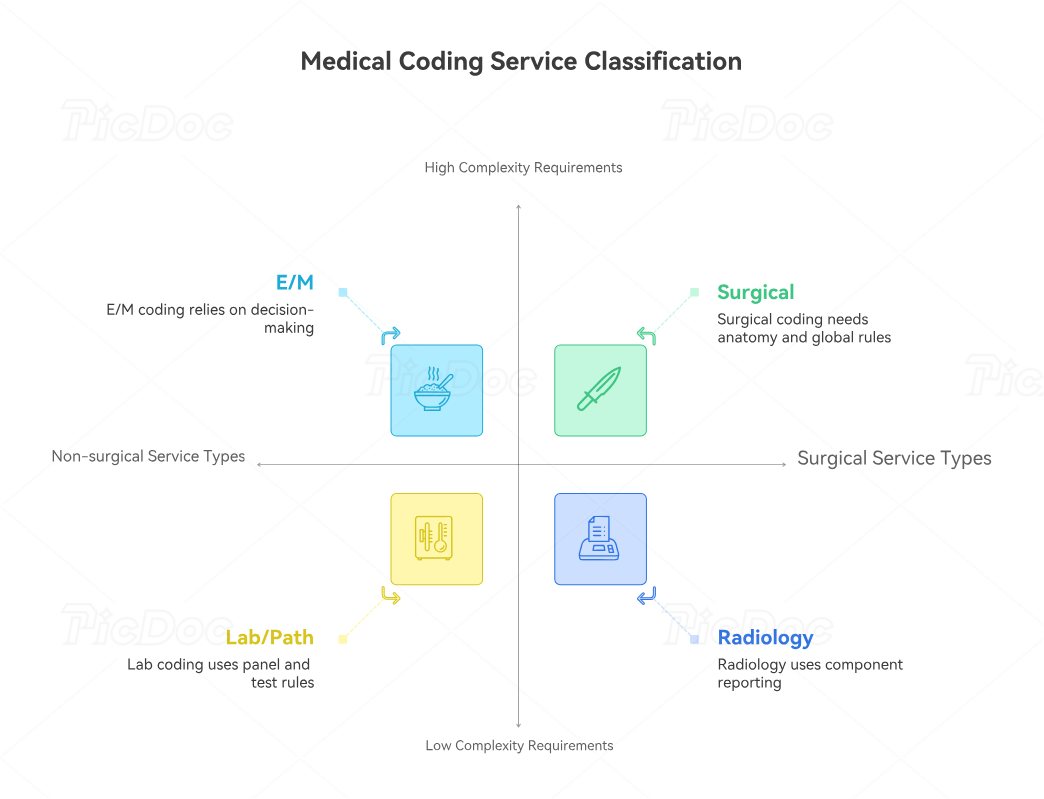
Evaluation and management services
E/M questions test judgment rather than note length. For many E/M services, the candidate must determine the correct service family, patient status, care setting, and level-selection method. When medical decision-making governs the level, evaluate the number and complexity of problems addressed, the amount or complexity of data reviewed and analyzed, and the risk associated with patient management.
Medical necessity remains a central payment criterion. CMS warns against billing a higher E/M level when the patient’s needs support a lower service, even when documentation contains additional detail. The service should be documented during or soon after the encounter to maintain an accurate medical record.
For exam purposes, keep four ideas separate:
Medical necessity explains why the service was reasonable.
Medical decision-making may determine the E/M level.
Time may determine the level when the relevant guidelines allow time-based selection.
Documentation volume never guarantees a higher level.
Connect this reasoning with EHR coding terminology, medical abbreviations, encounter forms and superbills, and accurate medical reimbursement.
Surgical coding
Surgical questions frequently combine anatomy, approach, extent, technique, bundled work, multiple procedures, and global-package rules. Begin with the operative note’s objective facts. Determine the exact site, approach, procedure performed, number of lesions or structures treated, and whether another service represents distinct work.
Never infer a more extensive procedure from the diagnosis alone. A severe condition can be treated with a limited procedure, while a less dramatic diagnosis may require more complex intervention. The operative note controls CPT selection. Use surgical compliance terminology, coding ethics standards, claims-management principles, and denial-management resources to understand the consequences of unsupported procedure reporting.
Radiology services
Radiology questions often test whether the provider furnished the technical component, professional interpretation, or complete global service. Ownership of equipment, employment of technical staff, performance of the study, and interpretation responsibility all influence reporting.
A report may support the professional component while the facility bills the technical component. A physician’s brief review of an image may fail to satisfy the requirements for a separately reportable interpretation when no complete report exists. Candidates should connect radiology coding terms, professional and technical billing, place-of-service reporting, and payer reimbursement rules.
Laboratory and pathology services
For laboratory coding, identify the specific test, methodology, specimen, number of tests, and whether the service forms part of an established panel. A candidate can recognize every individual test and still overreport the claim by ignoring a panel code that represents the complete combination.
Pathology may also involve professional interpretation, technical preparation, specimen-specific coding, and multiple units. Follow laboratory and pathology coding, medical coding workflow rules, reconciliation terminology, and data-security requirements when reviewing how test results become billable claim data.
Medicine and specialty services
Medicine-section questions may involve injections, infusions, vaccines, dialysis, cardiology, rehabilitation, psychiatry, allergy services, and other specialty procedures. Each subsection has its own hierarchy and measurement rules. General CPT knowledge cannot replace subsection instructions.
Create specialty-specific decision sheets using preventive medicine coding, behavioral health billing, sleep medicine terminology, pediatric CPT guidance, and speech-language pathology coding. For each specialty, record the service hierarchy, unit basis, frequent modifiers, bundled elements, and documentation elements that change code selection.
5. A CBCS Exam Method That Reduces Avoidable CPT Errors
Step 1: Identify the question’s actual task
Determine whether the question asks for a CPT code, modifier, coding principle, correct code combination, claim correction, compliance response, or denial cause. Candidates often solve the clinical scenario correctly and answer the wrong operational question.
The wording may ask which service should be reported, which claim should be corrected, which modifier is supported, or which documentation element is missing. These are distinct tasks. Train with CPC practice questions, CBCS course resources, CCS certification programs, and coding competency assessments to build task recognition.
Step 2: Extract only code-changing facts
Underline or mentally capture the patient type, location, anatomy, laterality, procedure, technique, extent, time, units, and associated services. Then identify which details change the answer.
A disciplined extraction method prevents a dramatic diagnosis or long narrative from overpowering the actual coding variables. It also supports faster analysis of medical terminology, healthcare acronyms, HIM terminology, and EHR documentation language.
Step 3: Eliminate structurally impossible answers
Remove options that violate a foundational rule
An add-on code without an eligible primary service.
A modifier unsupported by the scenario.
A diagnosis code offered when CPT reporting is requested.
A global service when only one component was performed.
A time-based level beyond the documented threshold.
A bundled code combination without a documented distinction.
A code from the wrong service family or care setting.
This approach is faster than proving every option from the beginning. It also mirrors how billers analyze CARC denial information, rejected electronic claims, payer billing terminology, and payment discrepancies.
Step 4: Test the remaining answer against documentation
Ask one decisive question: “Which exact words in the scenario support every element of this answer?” Any required element lacking support creates an assumption. Exam questions reward the answer fully established by the facts, even when another option appears clinically plausible.
This documentation-first habit also protects real practices from unsupported billing, weak appeals, and repayment demands. It should be reinforced through coding ethics education, utilization-management terminology, data-security practices, and professional coding development.
Step 5: Audit the complete claim logic
Before committing to an answer, complete a five-second audit:
Correct CPT family?
Correct level and specificity?
Modifier supported?
Units calculated correctly?
Bundling and add-on rules satisfied?
Medical necessity and diagnosis linkage defensible?
Setting and provider type consistent?
A correct procedure code can still produce an incorrect claim. The final audit connects CPT selection to CMS-1500 reporting, UB-04 institutional billing, claims reconciliation, payment posting, and bad-debt prevention.
The CPT code set changes as medical practice evolves. The AMA’s 2026 release included new, revised, and deleted codes, while Category III codes may be released electronically on a biannual schedule. Candidates should therefore use current preparation materials rather than relying on old screenshots, inherited notes, or outdated answer banks.
6. Frequently Asked Questions
-
Build recognition of code families, terminology, hierarchy, modifiers, units, and instructional logic rather than attempting to memorize the full code set. Memorization is most useful for highly recurring concepts, such as code categories, component modifiers, add-on relationships, separate-procedure logic, medical necessity, and common claim errors.
Your study system should combine CPT exam strategy, medical terminology preparation, coding workflow knowledge, and CBCS training options. NHA identifies CPT, HCPCS Level II, and ICD-10-CM application among the coding content associated with CBCS preparation.
-
CPT describes the services and procedures provided. ICD-10-CM describes diagnoses, conditions, symptoms, and reasons for encounters. The procedure code tells the payer what was done, while diagnosis coding helps explain why the service was necessary.
A claim becomes vulnerable when the CPT service and diagnosis lack a defensible relationship. Study accurate billing and reimbursement, claims-management terminology, CMS-1500 diagnosis pointers, and medical abbreviations for coders together rather than learning the code sets in isolation.
-
A valid CPT code establishes a standardized way to report a service. Coverage depends on the patient’s plan, benefit rules, medical-necessity criteria, provider status, authorization requirements, service setting, frequency limits, and payer policy.
Candidates should distinguish coding, coverage, and payment. Coding asks whether the service has been represented correctly. Coverage asks whether the plan includes the service under the patient’s circumstances. Payment asks how the allowed claim will be priced and adjudicated. Review commercial insurance terms, Medicare billing tools, Medicaid reimbursement resources, and the physician fee schedule.
-
Look for an E/M service that required significant, separately identifiable work beyond the usual evaluation associated with the procedure. The record should establish a distinct assessment and management service. A separate diagnosis may help explain the distinction, though diagnosis count alone does not prove modifier eligibility.
Avoid attaching Modifier 25 simply because an office visit code and procedure code appear on the same date. Use the CPT modifiers guide, EHR documentation terminology, coding compliance principles, and denial-management resources to evaluate the full circumstances.
-
Modifier 59 may identify a distinct procedural service when two services would normally be bundled and documented circumstances establish a legitimate separation. The distinction may involve a separate encounter, anatomical site, lesion, session, or other qualifying circumstance under applicable instructions.
Begin with the edit and clinical facts. Determine whether the code pair conflicts, whether a modifier is permitted, and whether the record supports the precise reason for separation. Modifier 59 should never function as a generic denial-clearing tool. Reinforce this through claims reconciliation, surgical compliance, CARC analysis, and healthcare claims management.
-
Review errors by cause rather than by score. Label every missed question as a terminology error, wrong code family, missed guideline, specificity error, modifier error, bundling error, unit error, E/M error, or claim-process error. Then practice several questions targeting that exact weakness.
A candidate who repeatedly rereads broad chapters may feel productive while preserving the same blind spots. Focused correction builds transferable judgment. Combine CPC practice questions, first-attempt exam strategy, coding competency assessment, and professional development planning.
