
CPC vs CCS vs CBCS in 2026: Reddit Experiences, Employer Recognition & Which Credential Fits Which Job
Choosing between CPC, CCS, and CBCS can determine which medical billing and coding jobs even make it through your application filters. A learner comparing online CPC certification programs, a CCS certification pathway, and a CBCS certification course needs to look beyond exam difficulty. In 2026, employers increasingly separate professional coding, hospital/facility coding, and broader revenue-cycle work. The smartest credential is the one aligned with the records, code sets, reimbursement workflows, and job descriptions you actually want to handle.
1. CPC vs CCS vs CBCS: The Career Difference That Matters in 2026
The fastest way to understand these credentials is to stop treating them as three interchangeable versions of “medical coding certification.” They validate overlapping knowledge, yet they point toward different parts of the healthcare revenue cycle. That distinction should influence your medical terminology preparation, coding exam strategy, practical training, and first-job search.
CPC — Certified Professional Coder, from AAPC — is heavily associated with professional-fee and physician-office coding. Its core environment is the physician side of healthcare: ICD-10-CM diagnosis coding, CPT procedure and service coding, HCPCS Level II, E/M services, modifiers, medical necessity, compliance, and payer rules. AAPC describes CPC as its flagship credential and a starting point for coders, while its current exam remains 100 questions with a 70% passing requirement.
That makes CPC especially relevant when your target jobs involve physician practices, specialty groups, professional surgical coding, risk adjustment, professional auditing, or claims review. Someone preparing for CPC should be comfortable moving between CPT coding principles, physician reimbursement rules, claim adjustment reason codes, and electronic claim submission workflows. Those connections matter because coding accuracy eventually has to survive edits, payer policy, and reimbursement logic.
A major entry-level complication is the CPC-A apprenticeship designation. A new candidate can pass the CPC examination while still carrying apprentice status until AAPC's experience requirements are satisfied. That distinction creates one of the recurring frustrations visible in Reddit discussions: certification proves foundational coding competence, while many employers still want production experience. A current UnitedHealth Group posting does show that CPC-A can be accepted for some coding positions, demonstrating that apprentice status does not automatically eliminate a candidate.
CCS — Certified Coding Specialist, from AHIMA — reaches more directly into complex hospital coding. AHIMA describes CCS as appropriate for professionals working with inpatient and outpatient records, and its recommended preparation includes advanced ICD diagnostic coding, procedural coding, reimbursement methodology, and direct coding experience. The CCS exam also covers coding documentation, provider queries, regulatory compliance, information technology, and inpatient/outpatient medical scenarios.
The critical technical difference is ICD-10-PCS and inpatient facility logic. If your goal is acute-care inpatient coding, DRG assignment, complex hospital charts, facility coding, or a future path into coding validation and inpatient auditing, CCS becomes much more strategically aligned. Studying CCS coding concepts, CPT preparation for CCS, CCS practice questions, and CCS exam-day strategy can therefore serve a different career objective from simply collecting another credential.
One coding-system clarification is essential: U.S. reimbursement work and the 2026 CCS examination continue to use the applicable ICD-10-CM and ICD-10-PCS code sets. Broader ICD-11 reference resources can support classification knowledge, but candidates should follow the codebooks specifically required for their examination and employer. AHIMA states that CCS examinations delivered on or after May 1, 2026 require its specified 2026 codebooks.
CBCS — Certified Billing and Coding Specialist, from NHA — combines coding with the broader billing cycle. NHA's published scope includes reviewing documentation, assigning diagnosis and procedure codes, submitting claims, auditing billing, and supporting reimbursement. Eligibility can be met through recent billing-and-coding education or qualifying supervised work experience.
That mixed scope makes CBCS particularly logical for medical billing specialists, small-practice revenue-cycle staff, front-to-back billing roles, claims support, payment and denial workflows, and people whose first job may combine responsibilities. A candidate learning core medical billing concepts alongside CBCS coding essentials, CBCS exam questions, and small-practice billing systems is preparing for a wider revenue-cycle footprint.
| Career Situation | Best Credential Fit | Reason | Priority Skill to Build |
|---|---|---|---|
| Physician-office coder | CPC | Strong professional-fee alignment | CPT, E/M, modifiers |
| Professional surgical coder | CPC | Procedure-heavy physician coding | Surgical CPT and NCCI |
| Primary-care coder | CPC | Frequent E/M and diagnosis coding | E/M documentation |
| Specialty practice coder | CPC | Strong CPT specialization path | Specialty-specific guidelines |
| Risk-adjustment coder | CPC | Useful professional coding foundation | ICD-10-CM and documentation |
| Professional coding auditor | CPC first | Strong base before audit specialization | Compliance and chart validation |
| Acute-care inpatient coder | CCS | Hospital inpatient alignment | ICD-10-PCS and MS-DRG |
| Hospital facility coder | CCS | Facility records are central to CCS | Facility coding guidelines |
| Inpatient DRG coder | CCS | DRG work requires inpatient depth | Principal diagnosis and PCS |
| Hospital outpatient coder | CCS or CPC | Employer requirements vary | CPT plus facility rules |
| Complex chart reviewer | CCS | Greater medical-record complexity | Documentation interpretation |
| Inpatient coding auditor | CCS | Supports facility coding credibility | DRG validation and compliance |
| Medical billing specialist | CBCS | Billing is part of credential scope | Claims and payer workflow |
| Small-practice billing/coding hybrid | CBCS | Role often combines functions | Coding plus A/R |
| Claims-submission specialist | CBCS | Strong revenue-cycle relevance | Clean-claim workflow |
| Denial-resolution specialist | CBCS or CPC | Depends on coding depth required | CARCs, appeals, documentation |
| Accounts-receivable specialist | CBCS | RCM knowledge carries more weight | A/R aging and follow-up |
| Payment-posting specialist | CBCS | Coding depth is secondary | ERA/EOB reconciliation |
| Revenue-cycle coordinator | CBCS | Broad billing exposure is useful | End-to-end RCM |
| Revenue-cycle manager track | CBCS + experience | Operations experience drives advancement | KPIs, denials, collections |
| No healthcare experience | CPC or CBCS | Choose according to job target | Terminology and real workflows |
| Already working in medical billing | CBCS or CPC | Credential should support next role | Coding depth |
| Already coding physician claims | CPC | Direct match to existing work | Specialty expertise |
| Already coding hospital charts | CCS | Strongest alignment with facility work | PCS and DRGs |
| Want remote coding eventually | CPC or CCS | Experience usually remains decisive | Production accuracy |
| Want first job as quickly as possible | Job-market dependent | Local openings should drive choice | Search jobs before enrolling |
| CPC holder moving inpatient | Add CCS | Fills inpatient knowledge gap | ICD-10-PCS and DRGs |
| CBCS holder targeting coding-only jobs | Consider CPC or CCS | Match employer credential filters | Choose professional or inpatient track |
2. What Reddit Experiences Reveal About CPC, CCS, and CBCS
Reddit is most useful here as a friction detector. It exposes where candidates discover that the credential they earned and the credential employers request are different. It should be read alongside current job postings rather than treated as a substitute for them.
One recurring 2026 discussion involves candidates seeing CPC and CCS explicitly named in job advertisements and wondering why both exist. That confusion disappears once the work setting is considered. CPC is heavily connected to professional coding; CCS has stronger inpatient and hospital-record depth. Current Reddit discussions about moving from CPC into inpatient coding frequently point candidates toward CCS because inpatient work introduces ICD-10-PCS and DRG concepts that are outside the ordinary CPC emphasis.
That is also why someone studying CPC exam questions, CPC first-attempt strategy, CCS exam practice, and medical coding exam-day preparation should define the intended job before choosing an exam. Passing a respected credential can still leave a skills mismatch if your target employer needs a different coding environment.
A second Reddit theme is more painful: certification does not automatically solve the experience requirement. CPC-A holders report job searches lasting anywhere from weeks to many months, and experiences differ sharply depending on geography, prior healthcare employment, internal transfers, and whether an employer is willing to train. One 2025 discussion included reported first-job timelines ranging from a few weeks to six months, while other new coders described losing opportunities because more experienced applicants were selected.
That means the practical entry strategy should extend beyond passing the CPC exam. Build familiarity with claims submission systems, denial management workflows, Medicare billing resources, and physician reimbursement mechanics. A candidate who understands how a code affects claim edits, medical necessity, payment, and denials is easier to train than someone whose knowledge stops at selecting an answer on an examination.
CBCS produces a different Reddit warning. Some CBCS holders report discovering that coding vacancies in their market specifically request AAPC or AHIMA credentials. A recent CodingandBilling discussion, for example, advised a CBCS-certified job seeker that CPC or AHIMA credentials were more commonly requested for coding work. That is anecdotal evidence rather than an industry-wide rule, but it captures a real search-risk: an accredited credential can still have weaker recognition for a particular job category.
NHA itself reports that 94% of surveyed employers require or encourage certification for medical billing and coding specialists, based on its 2025 Industry Outlook. That statistic speaks to certification broadly; it should not be interpreted as evidence that 94% specifically demand CBCS. NHA's own scope shows why CBCS can remain useful for combined billing-and-coding positions, where billing concepts, claim adjustment codes, Medicaid reimbursement, and billing software may be as important as pure code assignment.
The strongest lesson from Reddit is therefore procedural: search the jobs first, count the requested credentials, then buy the training. Ten local or remote vacancies can tell you more about your immediate credential ROI than ten generic certification rankings.
3. Which Credential Fits Which Medical Billing and Coding Job?
For professional-fee coding, CPC usually provides the cleanest match. Current Mayo Clinic surgical and procedural coding positions explicitly accept CPC alongside credentials such as CCS-P, RHIT, and RHIA. The work involves physician documentation, CPT, diagnostic coding, NCCI edits, coverage policies, and specialized procedures.
A CPC candidate should therefore go deeper than memorizing codebook navigation. Learn how CPT codes affect reimbursement, how physician fee schedules translate coded services into allowed amounts, how CARCs explain adjustments, and how denial-management teams identify recurring coding failures. That turns certification knowledge into revenue-cycle competence.
For acute-care inpatient coding, CCS has the strongest fit among these three credentials. Hospital inpatient work requires a different mental model: principal diagnosis selection, secondary diagnoses, present-on-admission considerations, ICD-10-PCS procedure construction, sequencing, DRG impact, documentation gaps, and compliant provider queries. AHIMA explicitly positions CCS for experienced inpatient and outpatient coders and tests coding documentation and provider queries in addition to code selection.
A future inpatient coder should combine CCS preparation with medical terminology mastery, reimbursement methodology, and disciplined exam preparation. Hospital coders are interpreting an entire clinical episode, so weak anatomy, pathophysiology, or documentation reasoning becomes much more expensive than a missed memorization question.
For billing-first and mixed revenue-cycle positions, CBCS can make more sense. Consider jobs involving insurance verification, charge entry, claim submission, payment posting, denial follow-up, A/R, patient balances, and basic coding support. In those roles, understanding the path from documented service to paid claim may create more immediate value than advanced inpatient coding expertise.
That is where electronic claims platforms, small-practice billing solutions, Medicare billing tools, Medicaid billing software, and denial-management resources become career-building knowledge rather than supplementary reading.
The dangerous choice is selecting a credential because it appears easiest. The better question is: What will I be expected to do at 10:00 a.m. on a normal workday? If the answer is coding physician encounters, CPC has a strong argument. If it is coding acute-care hospital stays, CCS deserves serious priority. If it is getting claims built, submitted, corrected, followed up, and paid, CBCS may align better.
4. Employer Recognition in 2026: What Current Job Listings Actually Show
Employer recognition should be measured through job-description evidence, because recognition changes by department and work type.
Current UnitedHealth Group postings provide a useful example. A July 2026 Senior Medical Coder position accepted professional coding certification from AAPC or AHIMA and explicitly listed credentials including CPC, CCA, CCS, and CCS-P. Another current remote medical-coder posting accepts CPC, CPC-A, COC, CCS, CCS-P, CCA, RHIA, and RHIT.
Mayo Clinic shows a similar pattern. Its 2026 surgical and procedural coding vacancies explicitly identify CPC or CCS-P alongside RHIT/RHIA pathways, while the required experience remains substantial. That second part is critical: the credential can get you through the certification filter while specialized experience determines whether you are competitive for the actual role.
This is why candidates should read job advertisements as skill maps. When a posting repeatedly mentions CPT, E/M, modifiers, NCCI, NCDs, LCDs, and physician documentation, strengthen CPT coding, physician reimbursement, Medicare billing knowledge, and claims-submission knowledge.
When the advertisement emphasizes acute-care inpatient experience, ICD-10-PCS, DRGs, complex procedures, trauma charts, and hospital facility coding, the skills are pointing toward CCS-style preparation. A March 2026 UnitedHealth Group Senior Inpatient Medical Coder role, for example, required an AHIMA/AAPC professional credential and three or more years of acute-care inpatient coding experience, with specific experience in ICD-10-CM/PCS and DRG coding.
For these jobs, build beyond CCS exam preparation into coding terminology, reimbursement concepts, and claim-denial analysis. Employers ultimately need coders who can produce accurate work under real documentation, productivity, compliance, and audit pressure.
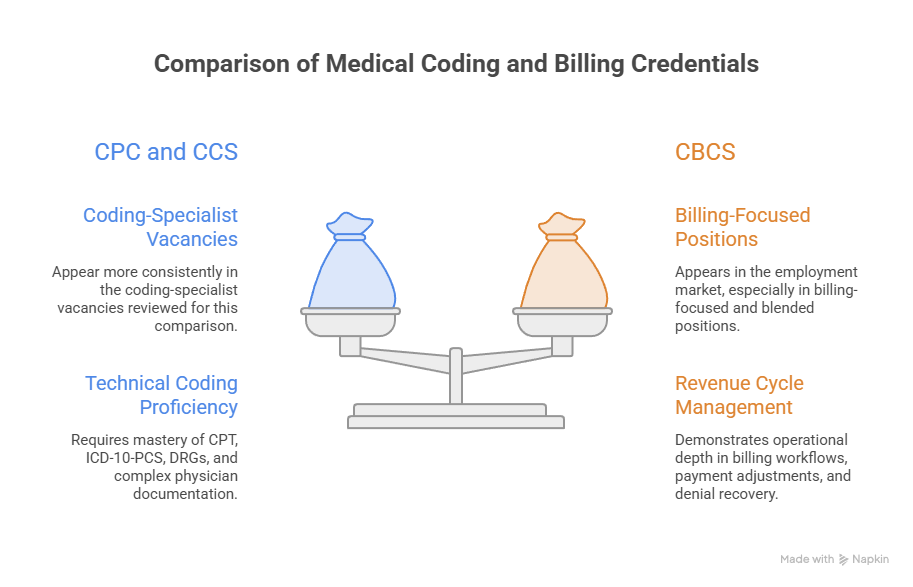
CBCS appears in the employment market too, especially in billing-focused and blended positions. Current job-search results include medical billing specialist roles specifically naming CBCS and RCM postings that list CBCS alongside CPC and CCS. The pattern is important: CBCS has practical recognition, while CPC and CCS appear more consistently in the coding-specialist vacancies reviewed for this comparison.
A CBCS holder can improve employability by demonstrating operational depth in billing workflows, payment adjustments, denial recovery, and reimbursement calculations. Those skills make the credential more meaningful because they connect directly to money moving through the practice.
International candidates should perform the same job-posting audit in the market they intend to serve. Recognition can differ between local healthcare systems and companies handling U.S. revenue-cycle work from abroad. AMBCI's guides for medical billing and coding in India, Pakistan, the Philippines, and the UAE can help frame those regional differences before you invest in an exam.
5. How to Choose CPC, CCS, or CBCS Without Wasting Money or a Year
Use a job-backward decision process.
First, collect 20–30 genuine vacancies you would realistically apply for. Separate them into professional coding, hospital/facility coding, and billing/RCM. Record every credential explicitly listed as required, preferred, or acceptable. Then record the experience requirement and repeated technical skills. This gives you a personal market sample instead of relying on generic claims that one credential is universally “best.”
Next, calculate your credential gap and experience gap separately. If 18 of 25 target jobs accept CPC but 21 require two years of experience, buying a second certification may solve the wrong problem. Your stronger move could be obtaining healthcare-adjacent experience through billing, claims, patient accounts, authorization, charge entry, or A/R while strengthening denial management, claims submission, Medicare workflows, and CARC interpretation.
If professional coding clearly dominates your target list, choose CPC and prepare for the CPC-A transition deliberately. Use CPC practice questions, a disciplined CPC study plan, first-attempt exam preparation, and an exam-day checklist. Build applications around transferable healthcare and claims skills rather than expecting the credential alone to substitute for experience.
If acute-care inpatient or hospital facility coding dominates, CCS deserves stronger priority. AHIMA recommends substantial coding knowledge or experience before the exam, even though the listed experience pathways are recommendations rather than mandatory prerequisites. The current exam has 107 total items, four hours of testing time, a scaled passing score of 300, and 2026 codebook requirements for exams delivered from May 1, 2026 onward.
Prepare through CCS-focused study, CCS practice questions, CPT review, and exam-day strategy. Spend additional time on inpatient guidelines, ICD-10-PCS construction, DRG logic, compliant queries, and complete-record interpretation.
If billing, A/R, claims, denial resolution, or small-practice RCM dominates, CBCS becomes more defensible. NHA requires qualifying education or supervised work experience for eligibility and requires renewal every two years with continuing education requirements.
A CBCS path becomes much stronger when paired with practical knowledge of billing concepts, billing software, claim submission platforms, and insurance denial management. If your eventual target changes to coding-only positions and those employers repeatedly specify CPC or CCS, you can then add the credential that matches that new destination.
Finally, budget for maintenance, because certification expense continues after the exam. AHIMA requires CEUs during a two-year recertification cycle for CCS, while NHA requires CBCS renewal every two years with 10 continuing-education credits. Candidates should account for renewal costs, membership where applicable, codebooks, and continuing-education resources before comparing sticker prices alone.
The useful decision rule is simple: CPC for a professional-coding destination, CCS for a hospital/inpatient destination, and CBCS for a billing-plus-coding or broader RCM destination. Your local employer sample gets the final vote.
6. FAQs: CPC vs CCS vs CBCS in 2026
-
For pure medical coding positions, CPC and CCS currently show the strongest recognition in the employer postings reviewed for this guide. Current UnitedHealth Group and Mayo Clinic vacancies repeatedly list AAPC and AHIMA credentials, including CPC and CCS-family credentials. CBCS is recognized in billing and coding, particularly for mixed billing/RCM positions, but candidates targeting coding-only work should verify how often CBCS appears in their actual job market.
Before committing, compare CPC program options, CCS programs, and CBCS programs against 20–30 real job descriptions.
-
CPC can be a practical starting credential for candidates aiming at physician and professional coding, and AAPC itself describes CPC as a strong starting credential. The tradeoff is apprentice status for inexperienced candidates, which means your first-job strategy deserves as much attention as passing the CPC exam.
A beginner who specifically wants inpatient hospital coding may instead build toward CCS with stronger preparation in anatomy, pathophysiology, ICD-10-CM, ICD-10-PCS, and reimbursement. AHIMA describes prior coding knowledge and experience as recommended preparation for CCS.
-
Yes, some employers and billing-focused positions recognize CBCS, and current listings exist for roles specifically requesting it. Your opportunities will depend heavily on the job category. A CBCS holder targeting medical billing operations, claims processing, A/R and denials, or small-practice RCM may have a more direct fit than someone applying exclusively to hospital coding vacancies.
-
That sequence makes sense when you want to begin in professional coding and later move into hospital or inpatient work. Recent Reddit discussions include CPC holders considering CCS specifically to expand into inpatient coding.
The second credential should correspond to a genuine career expansion. Strengthen your first credential through CPC study, gain relevant experience, and add CCS preparation when inpatient work becomes the next realistic target.
-
A universal difficulty ranking is misleading because the examinations emphasize different coding environments. CCS requires comfort with inpatient and outpatient scenarios, documentation, provider queries, and ICD-10-PCS-related hospital coding knowledge, while CPC concentrates heavily on physician/professional coding. AHIMA currently gives CCS candidates four hours for 107 items and recommends substantial prior coding preparation.
Your perceived difficulty will depend on whether your background is closer to CPT-focused coding or hospital record analysis.
-
CPC-A can make the entry-level search harder because many employers still request experience, yet current openings demonstrate that some organizations accept CPC-A. UnitedHealth Group has recently listed CPC-A among acceptable active certifications for a remote medical coder position. Reddit also contains examples of CPC-A holders obtaining coding jobs, including candidates who entered risk-adjustment work soon after certification.
Treat the apprenticeship period as a targeted experience-building phase. Learn claim workflows, denial resolution, Medicare billing, and specialty-specific coding while applying broadly.
