
How to Overcome Exam Anxiety for Medical Coding Certification
Exam anxiety can turn familiar code sets into visual noise, make straightforward guidelines feel ambiguous, and convince prepared candidates that every difficult question signals failure. Medical coding exams add another layer of pressure because candidates must manage terminology, code-book navigation, compliance rules, timing, and multi-step reasoning at once. The solution begins with a controlled preparation system built around coding competency assessment, targeted CBCS course preparation, realistic CPC exam strategy, and repeatable test-day routines that protect concentration under pressure.
1. Why Medical Coding Exams Trigger So Much Anxiety
Medical coding certification exams test more than memory. Candidates must interpret documentation, distinguish closely related diagnoses, apply conventions, locate codes efficiently, recognize modifier requirements, and reject answer choices designed around common mistakes. Someone may understand medical terminology and still freeze when a question combines unfamiliar wording with a strict time limit. Another candidate may know CPT coding principles yet repeatedly reopen completed questions because anxiety weakens confidence in sound decisions.
The pressure often begins long before exam day. Candidates may be studying while working, handling family responsibilities, completing a medical coding internship, or preparing for a career transition. Every missed practice question can start feeling like evidence that certification is out of reach. That interpretation creates unproductive study behavior: rereading chapters without testing recall, switching resources constantly, memorizing isolated answers, and avoiding timed exercises that expose weaknesses.
Anxiety also increases when candidates treat every mistake as equally serious. Misreading one word, forgetting a modifier rule, choosing the wrong code family, and running out of time are different problems. Each requires a different correction. A candidate who groups them together as “I am bad at coding” loses the diagnostic information needed to improve. A structured coding error log should separate knowledge gaps, navigation delays, documentation errors, calculation mistakes, and test-taking errors.
Medical coding exams can also punish perfectionism. Candidates may believe they must feel completely certain before moving forward. Real testing conditions rarely provide that luxury. Strong performance depends on reaching a defensible answer efficiently, flagging genuine uncertainty, and preserving enough time for review. This is the same disciplined judgment required in claims management, coding ethics, and medical billing reconciliation.
The first practical step is to identify the exact form your anxiety takes. Some candidates experience physical tension. Others lose concentration, reread questions, rush through easy items, catastrophize difficult sections, or become trapped in endless answer changing. Naming the pattern converts a vague emotional threat into a performance problem that can be trained.
Medical Coding Exam Anxiety Action Map: Triggers, Warning Signs, and Immediate Responses
| Anxiety Trigger | How It Usually Appears | Hidden Performance Risk | Best Corrective Action |
|---|---|---|---|
| Unfamiliar terminology | The candidate freezes when a diagnosis uses an unexpected synonym. | A solvable coding question feels impossible before code-book research begins. | Build synonym lists using a medical abbreviations reference. |
| Long clinical scenarios | The candidate reads every detail with equal attention. | Relevant diagnoses, procedures, and exclusions become harder to identify. | Underline the coding target, clinical condition, site, status, and encounter type. |
| Strict time limits | The candidate checks the clock after nearly every question. | Attention shifts from reasoning to panic-driven speed. | Use timed question blocks during exam preparation. |
| Code-book navigation | The candidate knows the topic but cannot locate the rule quickly. | Navigation delays consume review time. | Practice index-to-tabular verification until the sequence becomes automatic. |
| Modifier confusion | Several modifier options appear equally plausible. | The candidate selects based on familiarity rather than documentation. | Review a focused CPT modifiers dictionary. |
| Early difficult questions | The candidate assumes the whole exam will be equally hard. | One item damages confidence across the remaining section. | Flag it, continue, and judge performance only after completing a full block. |
| Practice-score fluctuations | A lower score causes the candidate to abandon the study plan. | Resource switching prevents deep correction of recurring weaknesses. | Track error categories rather than reacting to one overall percentage. |
| Fear of failing | Every study session feels like a prediction of the final result. | The candidate avoids realistic mock exams. | Treat practice tests as diagnostic tools within a competency assessment. |
| Overstudying | The candidate studies late into the night and skips recovery. | Recall, reading accuracy, and patience deteriorate. | Set a stopping time and protect the final hours before sleep. |
| Passive rereading | Study time feels productive because pages are being covered. | Recognition is mistaken for retrieval ability. | Close the material and explain the rule from memory. |
| Answer memorization | The candidate remembers practice-test choices without understanding the rule. | A differently worded exam question defeats the memorized response. | Explain why every incorrect option fails. |
| Comparison with others | The candidate becomes discouraged by another learner’s speed or score. | Study priorities shift away from personal weaknesses. | Measure navigation time, accuracy, and error recurrence against your own baseline. |
| Too many study resources | The candidate keeps opening new courses, videos, and question banks. | Conflicting explanations reduce confidence. | Choose one core CBCS learning pathway and limited supplements. |
| Weak guideline recall | The candidate knows individual codes but misses sequencing instructions. | Correct code identification still produces the wrong final answer. | Study rules through cases rather than isolated definitions. |
| Changing correct answers | The candidate replaces a supported answer because uncertainty feels uncomfortable. | Review time lowers the original score. | Change an answer only when a specific rule or overlooked fact justifies it. |
| Blanking on familiar content | A known rule becomes temporarily inaccessible. | Panic expands the recall block. | Write the known facts, eliminate options, and return after completing easier items. |
| Calculation pressure | Units, percentages, or reimbursement figures feel harder under time pressure. | Simple arithmetic errors contaminate an otherwise correct process. | Write each step and verify the unit before selecting an answer. |
| Documentation ambiguity | Two diagnoses or procedures appear supportable. | The candidate guesses without identifying the decisive phrase. | Separate documented facts from assumptions using coding ethics principles. |
| Unfamiliar specialty | A question about surgery, radiology, or pathology feels outside the candidate’s comfort zone. | The candidate overlooks transferable coding rules. | Identify the universal task first: diagnosis, procedure, modifier, sequencing, or billing rule. |
| Technology concerns | The candidate worries about login problems, navigation, or testing software. | Mental energy is spent rehearsing technical disasters. | Complete system checks and organize credentials several days early. |
| Testing-center uncertainty | Travel, parking, identification, and check-in remain unresolved. | Preventable logistics create stress before the exam begins. | Confirm the route, arrival time, identification, and permitted materials. |
| Poor pacing | Too much time is spent on a few complex questions. | Answerable questions remain unseen near the end. | Use checkpoints based on questions completed rather than constant clock watching. |
| Fear of “trick” questions | The candidate searches for hidden meanings in clear wording. | Straightforward items become unnecessarily complicated. | Answer the documented question and rely on explicit coding rules. |
| Weak elimination strategy | All four options are evaluated repeatedly from the beginning. | Working memory becomes overloaded. | Remove choices that violate anatomy, code family, sequencing, or documentation first. |
| Negative self-talk | One difficult item triggers thoughts of inevitable failure. | The candidate stops using available evidence. | Replace predictions with an instruction: identify the task, find the rule, eliminate options. |
| Inconsistent sleep schedule | Study and wake times change dramatically near the exam. | The candidate feels mentally slow at the scheduled test time. | Practice at the same time of day as the examination when possible. |
| Post-exam rumination | The candidate mentally replays uncertain answers immediately afterward. | Recovery is delayed and conclusions are based on incomplete memory. | Record useful observations once, then wait for the official result. |
| Repeated mock-test failure | Scores remain below target despite long study hours. | The candidate increases study volume without changing method. | Audit errors through a structured skills assessment. |
| Last-minute cramming | New topics are introduced during the final evening. | Confidence falls because unfinished material dominates attention. | Use the final evening for familiar rules, logistics, and recovery. |
| Persistent severe anxiety | Distress disrupts sleep, daily functioning, or repeated exam attempts. | Study tactics alone may be insufficient. | Seek support from a qualified healthcare or mental-health professional. |
2. Build a Preparation System That Reduces Uncertainty
Anxiety grows when the study plan has no clear finish line. “Study coding” is too broad to guide a productive session. Replace it with defined tasks such as completing 20 diagnosis-coding questions, reviewing missed CPT modifier scenarios, practicing five CMS-1500 form cases, or explaining four reimbursement terms from memory. Each session should end with evidence of what improved and what still needs attention.
Begin with a baseline test under realistic conditions. Its purpose is to locate weaknesses across content knowledge, code-book navigation, reading accuracy, pacing, and decision-making. Record every incorrect answer in an error log with five columns: topic, error type, missed clue, governing rule, and corrective drill. A missed diagnosis caused by unfamiliar vocabulary requires medical terminology review. A wrong procedure code may require deeper CPT coding practice. A rushed answer requires pacing work.
Use a three-pass learning cycle. The first pass builds understanding through concise instruction and worked examples. The second pass requires untimed questions where accuracy and reasoning receive priority. The third pass uses timed mixed questions that force knowledge retrieval under pressure. Candidates who jump directly from reading to full mock exams often experience avoidable anxiety because they have skipped the stage where rules become usable.
Create a weekly scoreboard that tracks more than percentage accuracy. Measure average time per question, number of answers changed, number of questions left incomplete, repeated error categories, and code-book navigation delays. These indicators reveal whether improvement is coming from stronger knowledge or risky guessing. The same analytical mindset supports healthcare claims management, data reporting, and billing reconciliation.
Study in question families. Complete a focused block on diagnosis selection, then sequencing, modifiers, claim forms, insurance concepts, compliance, reimbursement, and denial causes. Follow these focused blocks with mixed sets that prevent the mind from relying on topic clues. This creates both depth and flexibility. Candidates preparing for different credentials can use CPC exam questions, CCS coding guidance, and a CBCS course directory without mixing incompatible exam priorities.
Schedule full-length simulations only after shorter timed blocks become manageable. Early simulations should diagnose pacing. Later simulations should rehearse the complete testing routine, including wake time, meals, breaks, materials, and start time. Familiarity with the entire sequence reduces the number of unknowns competing for attention on exam day.
3. Train Your Brain to Perform Under Exam Conditions
Confidence should come from repeated evidence. Reading an explanation and thinking “that makes sense” creates recognition. Certification exams require retrieval and application. After studying a rule, close the material and explain it aloud. Then solve a fresh scenario and justify why each incorrect option fails. This method exposes gaps that passive review can hide.
Timed practice should progress gradually. Begin with five-question blocks using a generous limit. Reduce the time only after accuracy stabilizes. Move to 20-question mixed sets, then half-length simulations, and eventually full mock exams. Sudden exposure to a full timed test can reinforce panic when the candidate lacks pacing habits. Controlled progression builds tolerance while protecting the quality of learning.
Develop a fixed question routine:
Identify what the question is asking.
Extract the diagnosis, procedure, site, encounter, payer, or documentation clue.
Predict the relevant code family or rule.
Eliminate clearly incompatible choices.
Verify the remaining answer using the appropriate source.
Select, flag only when necessary, and continue.
This routine prevents anxious improvisation. It also mirrors the disciplined sequence used in accurate reimbursement workflows, claims reconciliation, coding compliance, and payment posting review.
Practice uncertainty deliberately. Include questions you have never seen, unfamiliar specialties, incomplete-looking documentation, and answer choices that differ by one detail. The goal is to remain methodical while certainty is incomplete. During review, classify the question by decision quality. A correct answer supported by the right rule is strong. A correct guess requires follow-up. An incorrect answer reached through sound reasoning may reveal a narrow knowledge gap. An incorrect answer based on panic reveals a process failure.
Use a strict answer-change rule. Change a selected response only when you discover a missed fact, remember a governing guideline, identify a code-book instruction, or detect a calculation error. Discomfort alone is insufficient. This rule protects candidates who repeatedly convert defensible answers into incorrect ones during review.
Create short recovery drills. Set a timer for 60 seconds, release physical tension, slow the exhale, restate the coding task, and resume with the easiest available step. Practice this during mock exams so it becomes familiar. A recovery routine should return attention to action rather than demand an immediate feeling of calm.
Quick Poll: What Causes Your Medical Coding Exam Anxiety?
4. Control Anxiety During the Medical Coding Exam
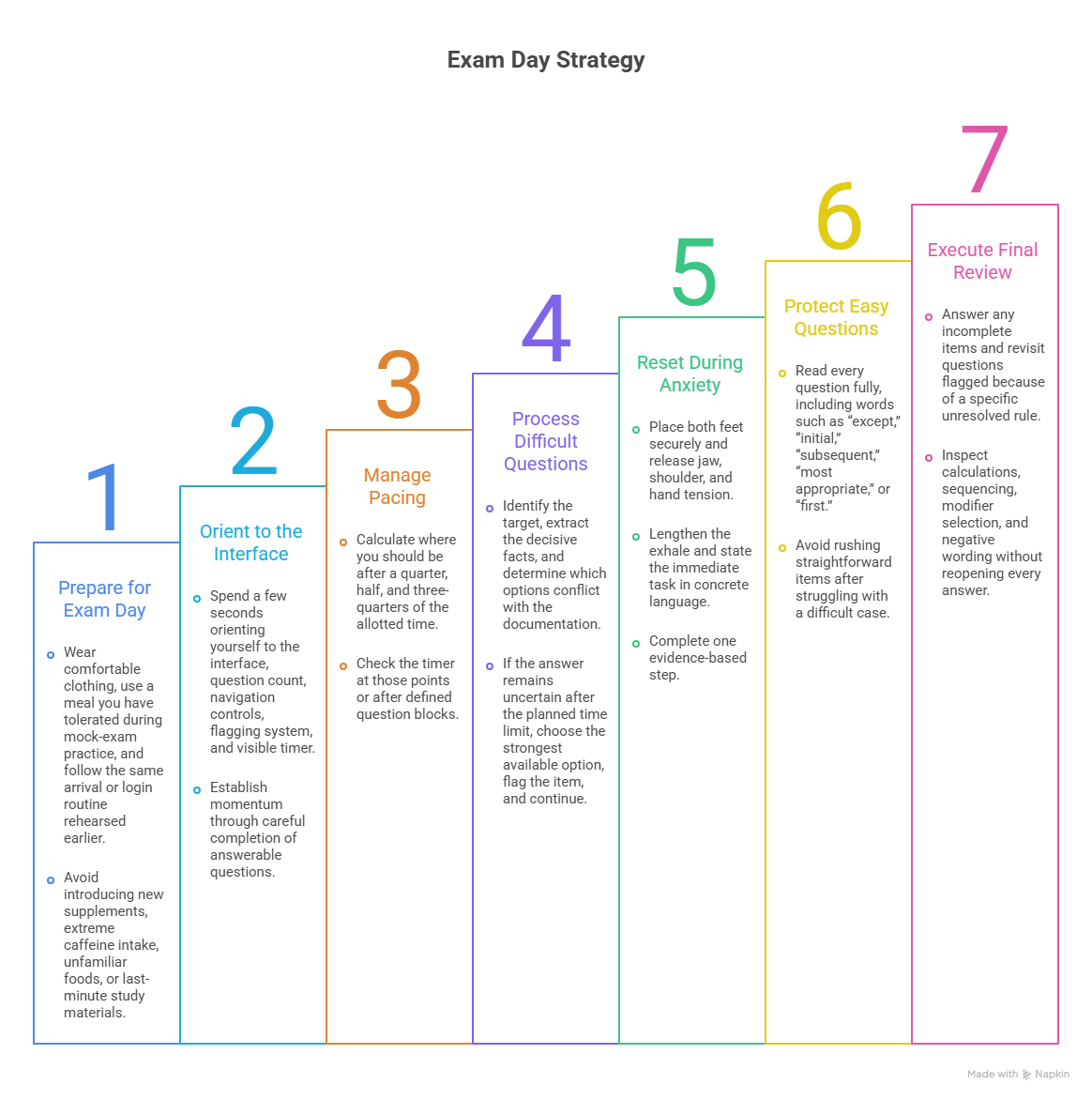
Start exam day with familiar decisions. Wear comfortable clothing, use a meal you have tolerated during mock-exam practice, and follow the same arrival or login routine rehearsed earlier. Avoid introducing new supplements, extreme caffeine intake, unfamiliar foods, or last-minute study materials. The objective is to reduce variables before the first question appears.
When the exam begins, spend a few seconds orienting yourself to the interface, question count, navigation controls, flagging system, and visible timer. Then begin. Excessive preparation inside the testing window can become another form of avoidance. The first goal is to establish momentum through careful completion of answerable questions.
Use section checkpoints instead of constant clock monitoring. Calculate where you should be after a quarter, half, and three-quarters of the allotted time. Check the timer at those points or after defined question blocks. This provides pacing information without repeatedly interrupting concentration.
A difficult question deserves a process, not an emotional verdict. Identify the target. Extract the decisive facts. Determine which options conflict with the documentation, anatomy, guideline, form requirement, or code family. Consult permitted materials efficiently. If the answer remains uncertain after the planned time limit, choose the strongest available option, flag the item, and continue.
When anxiety rises, use a brief reset:
Place both feet securely.
Release jaw, shoulder, and hand tension.
Lengthen the exhale without forcing a dramatic breathing exercise.
State the immediate task in concrete language.
Complete one evidence-based step.
For example: “The question asks for the correct modifier. The procedure is bilateral. I will compare the remaining modifier choices with the documented service.” This instruction is more useful than telling yourself to stop being anxious.
Protect easy questions from panic. Candidates sometimes rush straightforward items after struggling with a difficult case. Read every question fully, including words such as “except,” “initial,” “subsequent,” “most appropriate,” or “first.” The exam may test distinctions found in CPT modifier guidance, patient responsibility terms, insurance billing terminology, or claim adjustment reason codes.
Use the final review strategically. First answer any incomplete items. Next revisit questions flagged because of a specific unresolved rule. Then inspect calculations, sequencing, modifier selection, and negative wording. Avoid reopening every answer. Broad review driven by anxiety can erase good decisions and consume the time needed for genuine corrections.
5. A 14-Day Plan for Calmer, More Reliable Performance
Fourteen days before the exam, preparation should shift from broad content collection to targeted execution. Complete a realistic diagnostic test and identify the three error categories costing the most points. Rank them by frequency and fixability. A recurring code-book navigation delay may improve quickly. A weak specialty area may need focused reading and practice. A broad feeling of “I forget everything” must be broken into specific evidence.
During days 14 through 10, complete focused repair blocks. Study one weak area, answer related questions, review every option, and record the governing rule. Use resources such as CPC practice questions, CCS coding preparation, CPT coding instruction, and coding terminology guidance according to the credential being pursued.
During days 9 through 6, move into mixed timed sets. Practice selecting the correct workflow when the topic is unknown in advance. Review pacing after every block. Record questions that consumed excessive time even when answered correctly. A correct answer reached in eight minutes may still reveal an exam-day risk.
During days 5 and 4, complete the final full simulation under realistic conditions. Use the scheduled test time when possible. Apply the same food, break, materials, and pacing plan intended for exam day. Review the simulation once, identify a small number of final corrections, and stop opening new content areas.
Day 3 should focus on high-yield rules, repeated mistakes, navigation shortcuts, and commonly confused terms. Day 2 should include a short confidence-building question set and a complete logistics check. Confirm identification, location, travel time, testing requirements, computer compatibility, permitted materials, and contact information.
The final day should contain limited review. Examine your error summary, essential formulas, modifier distinctions, sequencing reminders, and exam routine. Pack materials or verify the testing environment. Choose a stopping time. Candidates often damage readiness by studying deep into the night because stopping feels irresponsible. At this stage, additional volume can increase fatigue without correcting meaningful weaknesses.
Seek professional support when anxiety is severe, persistent, or disruptive beyond the exam itself. Warning signs may include repeated panic episodes, prolonged sleep disruption, inability to function during normal responsibilities, or avoidance that prevents attendance. A qualified healthcare or mental-health professional can evaluate the situation and recommend appropriate support. Certification coaching and professional development planning can strengthen study execution, while clinical concerns deserve qualified clinical care.
6. Frequently Asked Questions
-
Use performance evidence. Complete several mixed practice sets under realistic conditions and review accuracy, pacing, and error categories. Consistently weak results across major domains suggest preparation gaps. Strong untimed performance combined with sharp declines under timed conditions suggests that pacing and anxiety management deserve more attention. A formal coding competency assessment, structured CPC exam strategy, and detailed error log provide clearer answers than feelings alone.
-
Pause briefly and reduce the task. Identify what the question asks, write down the facts you still know, and eliminate obviously incompatible answers. Skip and flag the question when recall remains blocked after your planned time limit. Completing easier questions often restores momentum and allows the missing rule to return later. Practice this response during mock exams so the first blank moment on test day does not feel unfamiliar.
-
Use the final evening for short, familiar review rather than new material or a full mock exam. Revisit repeated errors, high-yield distinctions, code-book navigation, and the exam-day checklist. Protect sleep and stop at a predetermined time. The last evening should reinforce an established medical coding workflow, terminology knowledge, and practiced routine.
-
Adopt a strict evidence rule. Change an answer only after identifying a specific missed detail, coding instruction, calculation error, or contradiction. General doubt does not justify revision. Track answer changes during practice tests and compare how many improve the score against how many reduce it. This creates objective evidence about your review habits.
-
The useful number depends on how carefully each exam is reviewed. Two thoroughly analyzed simulations can provide more value than six rushed attempts. Complete full exams after building accuracy through focused and mixed question blocks. Review every incorrect answer, every guess, every excessive delay, and every unnecessary answer change. Use focused CBCS preparation resources, CPC exam questions, and CCS coding guidance according to your credential.
-
Use a gentle pattern that feels comfortable and has already been practiced. Release physical tension and allow the exhale to become slightly longer than the inhale for several cycles. The purpose is to create enough space to restart the question routine. Avoid waiting for all anxiety to disappear. Resume by identifying the coding target and completing one concrete step.
-
A low practice score can expose weaknesses while there is still time to correct them. Its value depends on the review. Categorize each missed question by knowledge, interpretation, navigation, pacing, calculation, or test-taking error. Then assign a corrective drill. This approach turns disappointment into a targeted coding development plan and strengthens future professional competency.
