
Medical Coding Salary in 2026: Reddit Pay Reports vs Job Listings by Credential, Specialty & Experience
Medical coding salary numbers can look almost useless until you separate career stage, credential, specialty, employer, and geography. One person reports $19 an hour while another makes $45 doing work both call “medical coding.” In 2026, the better question is what skills employers are actually paying for. Current wage data, AAPC salary research, job listings, and Reddit reports show very different earning paths depending on whether you hold a CPC credential, understand CPT coding, work with claims, or move into specialty, audit, inpatient, and reimbursement-heavy work.

1. What Medical Coders Are Actually Making in 2026
The cleanest national starting point comes from the Bureau of Labor Statistics, which includes medical coders within Medical Records Specialists, SOC 29-2072. The latest May 2025 Occupational Employment and Wage Statistics available in 2026 show 194,720 workers, a $24.59 median hourly wage and $56,790 mean annual wage. The corresponding median annual wage is approximately $51,140. These figures cover a wider occupational category than certified coders alone, which is exactly why somebody comparing them with CPC salary expectations, CCS career paths, medical billing knowledge, and reimbursement expertise should avoid treating the BLS number as a universal coder salary.
The wage distribution matters more than the single median. Current May 2025 data place the bottom tenth around $37,000, the 25th percentile around $43,490, the median at $51,140, the 75th percentile around $64,820, and the 90th percentile around $81,150. That spread immediately explains why a new CPC-A reviewing entry-level coding material can encounter $19-$24 hourly jobs while experienced professionals working with complex CPT services, payer denials, CARCs, or inpatient coding can move considerably higher.
Credentialed-coder data shifts the benchmark upward. AAPC's 2025 salary research, published in February 2026, reports $67,147 for CPC holders in its certification examples. It also reports an average of $74,557 for members with two or more AAPC credentials and $81,227 for those with three or more. These figures should be interpreted alongside CPC certification preparation, CCS preparation, continuing education, and actual work experience because additional credentials often accumulate after people have already developed higher-value skills and seniority.
Reddit pay reports show why averages can feel disconnected from individual careers. One coding compensation discussion includes a CPC-A starting around $20 per hour, a first-job outpatient coder around $21-$22, an ED Coder II at $22 after six months, a risk-adjustment coder around $24, an experienced physician coder around $30, an inpatient coder around $31, a coding lead around $36, and a contract inpatient specialist around $40. These anecdotes become much more useful when read beside claims workflows, Medicare billing resources, denial management, and physician reimbursement: compensation rises when responsibility, specialization, independence, and financial risk rise together.
2026 Medical Coding Pay Reality Check: 30 Salary Signals Worth Comparing
| Salary Signal | Observed Pay / Benchmark | Experience / Credential Context | What the Number Actually Tells You |
|---|---|---|---|
| BLS national median | $24.59/hr; about $51,140/year | Medical Records Specialists | Useful broad baseline before comparing certified coding roles |
| BLS national mean | $27.30/hr; $56,790/year | All workers in SOC 29-2072 | Higher earners pull the mean above the median; compare against higher-value coding work |
| BLS 10th percentile | About $37,000 | Lower-paid segment | Shows why some early offers trail typical CPC expectations |
| BLS 25th percentile | About $43,490 | Lower quartile | Reasonable reference for candidates still developing revenue-cycle experience |
| BLS 75th percentile | About $64,820 | Upper quartile | Often requires stronger experience, location, responsibility, or technical depth |
| BLS 90th percentile | About $81,150+ | Top tenth | Possible within the broader occupation; stronger audit and denial skills can support advancement |
| AAPC CPC example | $67,147 | CPC credential | Credentialed population differs from the broad BLS pool; build CPC-level competence |
| Two or more AAPC credentials | $74,557 average | Multi-credential members | Additional credentials often accompany deeper professional development |
| Three or more AAPC credentials | $81,227 average | Experienced multi-credential group | Credential stacking works best when tied to real payer expertise |
| AAPC CDEO example | $83,611 | Documentation-focused credential | Documentation expertise can move work beyond routine coding interpretation |
| Current CPC-A job listing | $24-$26/hr | Apprentice-level certified coder | Shows that a new CPC-level candidate can occasionally enter near the national median |
| Current HCC/risk-adjustment listing | $25-$26.50/hr | CPC/CCS; 3+ years HCC experience | Specialty alone does not guarantee elite pay; employer and contract structure matter alongside Medicare knowledge |
| Current CRC risk-adjustment contract | $27/hr | Experienced CRC | Credential value depends on the actual payer environment |
| Reddit first outpatient coding job | Around $21-$22/hr | CPC-A; early career | Real-world starting pay can sit below broad certified averages while CPT experience accumulates |
| Reddit ED Coder II report | $22/hr | About six months in coding | Title progression can arrive before major pay progression; continue developing ED coding knowledge |
| Reddit first risk-adjustment role | About $24/hr | CPC; first coding job | A specialty can provide entry, though long-term mobility also requires maintaining CPT competence |
| Reddit physician coder | About $30/hr | Five years reported experience | Experience plus professional-fee knowledge can materially change the pay discussion |
| Reddit inpatient coder | About $31/hr | 4-5 years experience | Facility complexity and independence support stronger earnings; consider CCS-oriented development |
| Reddit coding lead | About $36/hr | Six years experience | Leadership and quality responsibility can move compensation beyond routine production coding |
| Reddit contract inpatient specialist | About $40/hr | Eight years; CCS/RHIT/CDIP | Contract premium must be compared against benefits and complex-case responsibility |
| Current senior inpatient listing | $39.66-$49.86/hr | Senior; complex inpatient coding | Advanced ICD-10-CM/PCS, appeals, and denial knowledge command a different market |
| Current profee auditor listing | $35-$45/hr | CPC; 5+ years experience | Auditing monetizes judgment, coaching, and reimbursement accuracy |
| Current inpatient auditor listing | $70,000-$85,000/year | Experienced audit role | Quality-control responsibility can outperform ordinary denial follow-up work |
| Current anesthesia coding listing | $30-$35/hr | Specialty coding | Niche expertise can increase bargaining power when paired with strong CPT knowledge |
| Reddit California orthopedic coder | $15.50 start; $21 after three years | Certified; small private clinic | Specialty experience can still be underpriced when employer size and mobility are weak; understand small-practice economics |
| Reddit HCC coder report | $27/hr | Risk adjustment | Common real-world figure near current HCC listings; build CMS-oriented knowledge |
| 0-1 years AAPC survey | $45,377 average | Early-career respondents | Certification does not instantly create senior-level revenue-cycle value |
| 31+ years AAPC survey | $80,479 average | Very experienced respondents | Experience produces a large long-term gap when paired with continued professional education |
| Remote coding | No universal premium | Ranges from entry to senior | Remote status is a work arrangement; pay follows competence in independent workflow |
| Contract coding | May show higher hourly rates | Benefits and stability vary | Compare hourly pay with insurance, PTO, retirement, workload, and case complexity |
2. How Much Does Credential Choice Really Change Medical Coding Salary?
A CPC has meaningful market value because it signals knowledge of professional-fee coding, CPT, ICD-10-CM, HCPCS Level II, guidelines, and reimbursement concepts. AAPC's current salary material lists $67,147 for CPC-certified professionals, considerably above the current BLS median for the broader medical-records occupation. Someone building toward that earning level should connect CPC certification with medical terminology, CPT proficiency, and physician reimbursement, because an employer ultimately pays for usable competence rather than an acronym by itself.
CPC-A candidates should use a different benchmark. A current AAPC job-board result for an apprentice-certified medical coder advertises $24-$26 per hour, showing that CPC-A pay can reach roughly the national occupational median in the right opportunity. Reddit reports still show early-career pay around $19-$22 in many individual situations. That gap makes CPC practice questions, billing knowledge, claims familiarity, and denial knowledge especially important during the first-job stage.
CCS and inpatient-oriented credentials often appear around more complex hospital work. A current senior inpatient listing requiring substantial inpatient expertise advertises $39.66-$49.86 per hour, while current AAPC search results show senior inpatient roles asking for several years of inpatient experience and CCS certification. The salary opportunity comes from the complete package: complex records, ICD-10-CM/PCS, reimbursement implications, appeals, and independent judgment. Anyone considering a facility path should pair a CCS certification program with CCS practice questions, coding principles, and knowledge of claim adjustments.
Multiple credentials correlate with higher reported compensation, though credential count should never be treated as a guaranteed raise formula. AAPC's 2025 survey reports $74,557 on average for members holding at least two AAPC credentials and $81,227 for those holding three or more. People accumulating multiple credentials are also more likely to have years of experience, specialized responsibilities, auditing exposure, or leadership duties. The profitable strategy is therefore to add credentials that unlock a specific type of work, while using continuing education, Medicare tools, denial-management knowledge, and reimbursement expertise to make those credentials commercially useful.
3. Which Medical Coding Specialties Pay More in 2026?
Inpatient coding has one of the clearest paths toward higher compensation because the work can involve lengthy records, ICD-10-CM and ICD-10-PCS, DRG logic, discharge documentation, appeals, and significant reimbursement exposure. A current New York-area senior inpatient posting lists $39.66-$49.86 per hour and asks for substantial inpatient experience. Reddit reports also include experienced inpatient coders around $31-$40 per hour, while some users describe considerably higher opportunities in high-cost hospital markets. Building this path through CCS preparation, CCS questions, denial management, and CARC knowledge creates a stronger salary case.
Professional-fee and specialty coding can also pay well once a coder develops enough depth to handle complex CPT work with limited supervision. A current remote profee auditor listing advertises $35-$45 per hour for a CPC with at least five years of experience, while specialty categories on AAPC's job board include cardiology, orthopedics, surgery, anesthesia, and other procedural disciplines. A coder who understands CPT principles, physician fee schedules, claims submission, and denial patterns becomes harder to replace than someone who simply recognizes code families.
Risk adjustment/HCC coding deserves a more nuanced salary discussion. Current listings show CPC/CCS risk-adjustment positions around $25-$27 per hour, including jobs requiring several years of HCC experience and positions preferring CRC credentials. Reddit also contains recent reports around $27 an hour. Risk adjustment can provide valuable exposure to Medicare Advantage and diagnosis capture, although recent Reddit discussions warn that coders who spend years working almost exclusively with ICD-10-CM can lose broader CPT flexibility. Maintaining CPT knowledge, Medicare resource familiarity, billing fundamentals, and claims knowledge protects career mobility.
Auditing, compliance, documentation, and education create another salary ceiling because employers pay these professionals to prevent errors across other people's work. A current remote profee auditing listing reaches $35-$45 per hour, and a current inpatient medical coding auditor posting lists $70,000-$85,000 annually. AAPC also lists $83,611 for its CDEO salary example. These jobs combine coding knowledge with documentation interpretation, denial analysis, payer rules, and reimbursement consequences.
Quick Poll: What Is Keeping Your Coding Pay Too Low?
4. How Experience Changes Your Medical Coding Salary
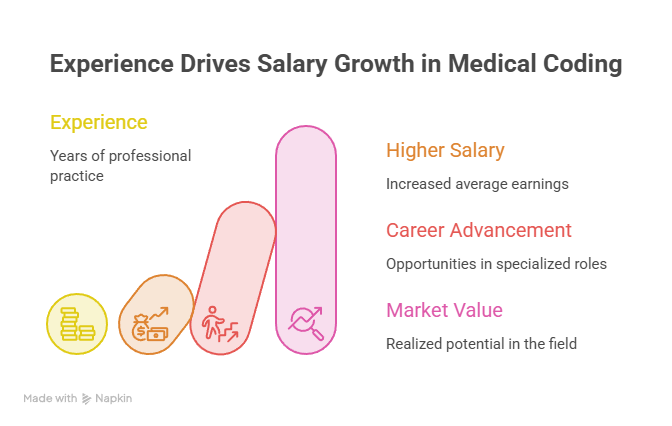
AAPC's 2025 salary survey shows one of the clearest long-term pay patterns. Professionals with 0-1 years of experience averaged $45,377, while those with 31 or more years averaged $80,479. The survey also reports meaningful pay growth through intermediate experience bands. Experience gains value when it creates demonstrable independence: resolving complex documentation, recognizing CPT issues, researching payer rules, understanding claim outcomes, and preventing avoidable denials.
During year zero through year two, the biggest salary objective should be acquiring experience that will still matter in your next job. A $22 coding position with structured training, direct coding production, audits, multiple specialties, and measurable accuracy may create greater career value than a $25 role that keeps you inside one narrow repetitive task. Current CPC-A listings around $24-$26 show that stronger starting opportunities exist, while Reddit reports demonstrate that lower offers remain common. Prioritize access to coding practice, billing workflows, claims systems, and reimbursement logic.
Around years three through five, coders should begin asking whether their responsibilities have advanced faster than their pay. Reddit provides a striking example of a certified orthopedic coder in California who started at $15.50 per hour and reached only $21 after three years despite performing additional billing-related work. Staying too long inside an employer's compressed pay scale can leave market value unrealized. At this point, benchmark jobs requiring your exact CPT specialty, denial experience, claims knowledge, and payer expertise.
At five years and beyond, salary growth increasingly depends on how you use experience. Current postings show five-plus-year professionals moving into auditing around $35-$45 per hour and senior inpatient work reaching roughly $40-$50 per hour in some markets. The strongest salary moves often come from deeper specialty competence, auditing, education, quality, CDI, compliance, leadership, or complex reimbursement work. Build those directions through continuing education, CCS development, claim adjustment knowledge, and physician reimbursement expertise.
5. How to Know Whether Your 2026 Medical Coding Offer Is Actually Good
Start by benchmarking the job rather than the title. “Medical Coder” can describe a CPC-A assigning routine professional codes, an experienced inpatient specialist, an HCC coder, a surgical coder, a denial coder, or somebody auditing other coders. Current listings range from roughly the mid-$20s for risk-adjustment production work to $35-$45 for experienced profee auditing and nearly $40-$50 for certain senior inpatient roles. Compare the offer against its actual CPT complexity, denial responsibility, claim impact, and reimbursement exposure.
Next, price benefits separately from hourly rate. A $31-per-hour employee role with health insurance, employer retirement contributions, paid holidays, PTO, equipment, education reimbursement, and stable hours may have greater total value than a $38 contract role where you fund several of those items yourself. Current AAPC postings show coding employers offering combinations of employer-paid insurance, retirement contributions, bonuses, and other benefits, demonstrating why base salary alone can misrepresent compensation. Compare salary alongside continuing-education support, remote workflow expectations, billing responsibility, and denial workload.
Then benchmark geography and employer type. BLS data has long shown substantial wage variation among industries and locations, while Reddit reports repeatedly identify cost of living and health-system pay scales as major drivers. A coder in a small physician office can experience a different compensation ceiling from somebody employed by a large hospital system, payer, consulting organization, or university medical center. Learn how small-practice billing, Medicare reimbursement, Medicaid reimbursement, and physician reimbursement shape the employer's revenue environment.
Finally, negotiate using evidence of reduced employer risk. Strong bargaining evidence includes years coding the exact specialty, sustained accuracy, productivity above target, low audit-error rates, provider-education experience, successful appeals, multi-specialty coverage, new-coder training, and expertise in difficult reimbursement scenarios. A credential supports the conversation, while measurable results justify the number. Strengthen that evidence through CPC mastery, CPT expertise, CARC interpretation, and denial-management experience.
6. FAQs About Medical Coding Salary in 2026
-
The latest BLS May 2025 wage data available in 2026 show Medical Records Specialists at a $24.59 median hourly wage, with a mean annual wage of $56,790 and a median around $51,140. Certified-coder populations can run higher: AAPC currently lists $67,147 for CPC professionals in its salary examples. Compare those benchmarks with your CPC credential, CPT capability, claims knowledge, and reimbursement responsibility.
-
Current evidence supports a broad starting range rather than one guaranteed number. A current AAPC CPC-A listing advertises $24-$26 per hour, while Reddit discussions mention entry offers around $18-$23 and individual CPC-A coding jobs around $20-$22. Your leverage improves with CPC exam competence, medical terminology, billing knowledge, and claim-cycle understanding.
-
The CPC is associated with stronger earnings in AAPC salary data, with the organization's current certification example showing $67,147. Employers still price the complete candidate: experience, specialty, accuracy, location, employer, and responsibility. Someone combining CPC preparation, CPT knowledge, denial expertise, and payer knowledge has a stronger salary case than someone relying on the credential alone.
-
AAPC's 2025 survey reports $74,557 on average for two or more AAPC credentials and $81,227 for three or more. The relationship includes experience and job complexity, so choose credentials that expand what you can actually do. A CCS pathway, stronger CPT knowledge, useful CEUs, and deeper reimbursement expertise should support a deliberate career direction.
-
There is no single universally highest-paying specialty because location, employer, seniority, and job function can overpower specialty labels. Current evidence shows strong compensation in senior inpatient coding, auditing, documentation, compliance, and advanced professional-fee work, including listings around $35-$45 per hour for profee auditing and $39.66-$49.86 for senior inpatient coding. Those paths reward CCS-level knowledge, CPT mastery, denial expertise, and reimbursement knowledge.
-
Yes, current data show that level is attainable in parts of the profession. The May 2025 BLS wage distribution places the 90th percentile for Medical Records Specialists around $81,150, while AAPC reports $81,227 average compensation among members with three or more credentials and $80,479 among respondents with 31+ years of experience. Reaching that range generally involves much more than completing CPC training: build specialty expertise, audit knowledge, and complex reimbursement skills.
