
Medical Billing & Coding Exam Day Checklist: Comprehensive Guide
A medical billing and coding certification exam can expose preparation gaps that never appeared during untimed practice. A missing ID, outdated admission instructions, weak time control, unfamiliar claim-form terminology, or panic around a difficult coding scenario can erase months of study. This guide combines an actionable exam-day checklist with strategies for medical terminology, CPT coding, claims management, billing reimbursement, and test-day decision-making so every avoidable risk is controlled before the timer begins.
1. Why Medical Billing and Coding Exam Day Requires Its Own Strategy
Exam preparation and exam execution are separate skills. Preparation builds knowledge of coding workflows, healthcare billing acronyms, payer requirements, and revenue-cycle operations. Execution determines whether you can retrieve that knowledge under time pressure, navigate ambiguous answer choices, recover from difficult questions, and complete the examination without sacrificing easier points.
Many candidates enter the testing environment with enough technical knowledge to pass. Their performance deteriorates because they spend ten minutes searching for an answer that should have been flagged, misread a negative question stem, overanalyze a straightforward insurance scenario, or discover during check-in that their identification details conflict with their registration. These failures have little connection to coding competency. They come from weak operational preparation.
Your first responsibility is to identify the exact examination you are taking. CBCS, CPC, CPB, CCA, CCS, and CCS-P exams can use different testing vendors, reference-resource policies, formats, identification requirements, code-book rules, and scheduling procedures. A checklist copied from another certification can create a serious problem. The correct source is always the current candidate handbook, appointment confirmation, test-center instructions, and certification-specific policy page.
For example, the current NHA CBCS examination can be taken through a school, a PSI testing center, or live remote proctoring. NHA requires identity verification with an acceptable government-issued photo ID. Its current CBCS FAQ also states that coding manuals have been prohibited since September 24, 2024 because the information required for application-of-coding questions is supplied within the examination.
That policy differs sharply from examinations requiring physical code books. AHIMA states that candidates taking the CCS exam on or after May 1, 2026 must bring the approved 2026 code books; candidates arriving without them may be denied admission and lose their fees. This single difference demonstrates why candidates should verify their own rules instead of relying on advice from a classmate taking another credential.
The administrative checklist also protects your mental bandwidth. When your ID, route, appointment, permitted resources, clothing, food, and timing are settled in advance, your attention remains available for CPT modifier decisions, CMS-1500 questions, claim adjustment reasoning, and payment-posting problems.
Medical Billing & Coding Exam Day Master Checklist: 32 Critical Checks
| When | Checklist Item | Exact Action | Failure It Prevents |
|---|---|---|---|
| 7–14 days before | Confirm certification | Verify the exact exam abbreviation, sponsor, vendor, delivery method, date, time, and time zone. | Preparing under rules belonging to a different credential. |
| 7–14 days before | Read the candidate handbook | Review identification, rescheduling, prohibited-item, break, resource, and misconduct policies. | Admission refusal or accidental rule violation. |
| 7–14 days before | Check registered name | Compare the registration name character by character with the approved photo ID. | Name mismatch during check-in. |
| 7–14 days before | Inspect photo ID | Confirm that the document is current, readable, undamaged, and accepted by the testing sponsor. | Expired or unacceptable identification. |
| 7–14 days before | Verify permitted resources | Determine whether code books, printed materials, calculators, scratch paper, or electronic tools are allowed. | Arriving with prohibited materials or missing required books. |
| 7–14 days before | Confirm code-book year | Check the sponsor’s approved edition and publication list rather than assuming the newest book is accepted. | Using an unapproved or outdated edition. |
| 7–14 days before | Review book annotations | Remove loose notes, prohibited inserts, excessive handwritten material, or unapproved attachments. | Resource inspection delays or confiscation. |
| 7–14 days before | Confirm accommodations | Verify that approved accommodations appear in the testing appointment and vendor record. | Discovering at check-in that extra time or assistance was never activated. |
| 7 days before | Complete a timed simulation | Reproduce the exam length, question pacing, breaks, and permitted resources. | Running out of time despite strong content knowledge. |
| 7 days before | Create an error log | Sort missed questions into coding, billing, payer, claim-form, compliance, and terminology errors. | Repeating the same reasoning failure during the real exam. |
| 5–7 days before | Test the route | Confirm the test-center entrance, parking, public transport, security procedures, and expected travel time. | Late arrival caused by navigation or parking. |
| 5–7 days before | Run remote system test | Test the approved computer, operating system, camera, microphone, internet, browser, and proctoring software. | Technical rejection on exam day. |
| 3–5 days before | Review claim forms | Refresh high-yield fields in the CMS-1500 and UB-04. | Losing points on familiar forms under pressure. |
| 3–5 days before | Refresh denial logic | Review eligibility, authorization, coding, bundling, coverage, and filing-limit denials. | Treating every denial as a coding error. |
| 3–5 days before | Refresh modifier rules | Review modifier purpose, documentation support, service components, and distinct-procedure logic. | Selecting a familiar modifier without proof. |
| 48 hours before | Confirm appointment | Reopen the official confirmation and verify date, clock time, time zone, address, and check-in instructions. | Relying on an outdated calendar entry. |
| 48 hours before | Resolve policy questions | Contact the sponsor or vendor while support remains available. | Seeking help after the cancellation or rescheduling deadline. |
| 48 hours before | Stabilize sleep | Use the same sleep and wake schedule planned for exam day. | Fatigue, slow reading, and poor impulse control. |
| Night before | Pack approved items | Prepare ID, appointment details, permitted books, glasses, layers, and any approved accommodation items. | Morning panic and forgotten materials. |
| Night before | Remove distractions | Place prohibited electronics, smartwatches, notes, and unnecessary belongings outside the exam bag. | Check-in delays and security concerns. |
| Night before | Stop heavy studying | Use a short confidence review of formulas, claim sequences, modifiers, and common payer terms. | Mental fatigue caused by late-night cramming. |
| Exam morning | Eat familiar food | Choose a normal meal with enough energy for the full testing period. | Hunger, discomfort, or an energy crash. |
| Exam morning | Control fluid intake | Hydrate early and avoid excessive fluids immediately before check-in. | Urgent breaks during timed testing. |
| Exam morning | Dress in layers | Wear comfortable clothing that can handle an unexpectedly warm or cold room. | Concentration loss caused by temperature. |
| Before departure | Check ID again | Physically touch and inspect the ID before leaving. | Assuming the ID is already packed. |
| Before remote check-in | Clear the room | Remove notes, extra screens, electronic devices, visible papers, and unauthorized people. | Failed workspace inspection. |
| At check-in | Follow proctor instructions | Ask procedural questions before the examination begins. | Uncertainty about navigation, flags, breaks, or submission. |
| During the exam | Use time checkpoints | Compare elapsed time with the portion of the exam completed at planned intervals. | Discovering pacing problems during the final minutes. |
| During the exam | Flag expensive questions | Move forward when a question begins consuming disproportionate time. | Sacrificing several answerable questions for one difficult item. |
| During the exam | Read the final sentence first | Identify whether the item asks for a code, denial reason, modifier, payer action, or compliance response. | Solving the scenario while answering the wrong task. |
| Before submission | Review flagged items | Return with a fixed time budget and change answers only when a specific rule supports the revision. | Emotion-driven answer switching. |
| After submission | Preserve confidentiality | Avoid recording, sharing, or reconstructing protected exam content. | Certification misconduct or score invalidation. |
2. The Seven-Day Medical Billing and Coding Exam Checklist
Confirm the exact rules attached to your examination
Start by reopening your official appointment record. Confirm the credential, testing sponsor, test vendor, delivery mode, appointment date, start time, time zone, and testing address. Candidates taking a remotely proctored exam should verify which computer and room will be used. Candidates testing in person should confirm the building entrance, parking restrictions, floor number, and expected security process.
This step deserves more attention than it usually receives. A candidate preparing for the CBCS exam may have read advice written for the CPC or CCS. Those examinations can have materially different resource rules. The current NHA CBCS exam supplies coding information inside relevant questions and does not allow candidates to bring coding manuals. AAPC and AHIMA examinations may require or permit specific code books, subject to their own edition and annotation policies. AAPC currently advises candidates that its exams use current-year code sets and restricts books older than the preceding year.
Create a one-page rules sheet containing:
Approved identification
Required arrival or login time
Permitted reference materials
Calculator availability
Scratch-paper or whiteboard policy
Break policy
Appointment-change deadline
Testing-vendor support details
Accommodation confirmation
Result-release procedure
Keep this sheet separate from your study material. It is an operational document, just like a claims-management checklist, EDI submission protocol, coding compliance process, or payment reconciliation procedure.
Audit your identification
Compare the name in your exam account with the name printed on your approved ID. Look for middle initials, hyphens, spacing differences, maiden names, shortened names, and spelling errors. Verify that the ID remains valid on the examination date.
NHA requires identity verification for in-person and remotely proctored examinations using a current government-issued photo ID. Its handbook states that the ID should include a current photograph, signature, and permanent address; additional proof of address may be required when the registered address differs. Other sponsors and vendors can use different documentation rules, which makes direct confirmation essential.
A candidate who discovers a name discrepancy on the morning of the exam has limited options. Correct it while support teams and rescheduling windows remain available. Treat identification as seriously as insurance eligibility verification, patient demographic accuracy, claim data integrity, and healthcare data security.
Complete one realistic timed simulation
A final practice test should measure execution under realistic constraints. Use the permitted resources, follow the expected question navigation, avoid unscheduled interruptions, and apply the same time limit you will face during the examination. Record how much time remains at the halfway and three-quarter points.
Afterward, classify every incorrect answer:
Knowledge gap
Misread question stem
Wrong code family
Missed modifier condition
Bundling error
Unit calculation error
Claim-form error
Payer-sequence error
Compliance error
Changed correct answer without evidence
Time-pressure guess
This classification converts a raw score into a repair plan. Review CPC practice questions, CPC exam strategy, CCS coding preparation, and CBCS course resources according to the weaknesses exposed.
Repair high-frequency mistakes first
A candidate missing repeated questions about diagnosis pointers gains more from one concentrated review of the CMS-1500 form than from rereading an entire billing textbook. Repeated errors reveal the rules that fail to remain accessible under pressure.
Prioritize mistakes that affect several topics:
Confusing coding accuracy with coverage
Treating every rejection as a denial
Ignoring coordination of benefits
Using modifiers without documentation
Linking every diagnosis to every procedure
Miscalculating timed units
Missing bundled services
Confusing patient responsibility with payer liability
Selecting code specificity unsupported by the note
These principles connect patient responsibility, claim reconciliation, denial management, payment posting, and accurate reimbursement.
3. What to Do During the Final 24 Hours
Replace broad studying with controlled retrieval
The final day should strengthen access to knowledge already learned. Use short recall sessions covering the concepts most likely to become confused:
CPT, ICD-10-CM, HCPCS Level II, and claim-form roles
Copay, coinsurance, deductible, and allowed amount
Rejection, denial, appeal, adjustment, and write-off
Primary, secondary, and tertiary payer order
Prior authorization and referral requirements
Clean claim and timely filing
Modifier purpose and documentation
Global, professional, and technical service components
Medical necessity and diagnosis linkage
Fraud, abuse, waste, and compliance distinctions
A compact review can draw from the medical abbreviations dictionary, medical coding workflow guide, RCM terminology guide, and commercial insurance glossary. Stop when your retrieval becomes slower and careless. Continued exposure after fatigue begins can weaken confidence without creating useful retention.
Prepare the physical exam kit
Place all approved materials together. Your kit may include:
Valid identification
Appointment confirmation
Approved code books
Approved accommodation documents
Prescription glasses
A light sweater or jacket
Necessary medication stored according to the testing policy
Travel directions and parking details
Keep phones, watches, earbuds, personal calculators, loose paper, and electronic accessories outside the testing room unless the sponsor expressly permits them. NHA currently prohibits personal electronics and personal calculators in the exam room, while providing an embedded calculator when needed. In-person PSI candidates receive a whiteboard, marker, and eraser; remotely proctored candidates receive access to a digital whiteboard.
Prepare the remote environment
A remote candidate should run the official system test on the exact computer, network, camera, and microphone planned for exam day. A successful test on another laptop provides little protection. Disable automatic software updates, connect the power cable, improve lighting, test camera positioning, and remove extra monitors.
Clear the desk and surrounding walls of notes, calendars, whiteboards, books, and visible healthcare material. Inform everyone in the home that entry is prohibited during the session. NHA’s live remote proctoring rules require candidates to remain in the room, prohibit breaks during the session, and prohibit other individuals from entering the testing space.
Prepare for controllable failures:
Keep the computer connected to power.
Use the strongest stable network available.
Close background applications.
Disable notifications.
Confirm webcam permissions.
Confirm microphone permissions.
Restart the computer early enough to resolve updates.
Keep vendor support information available outside the cleared workspace.
This level of preparation reflects the discipline used in EHR data management, electronic claims submission, healthcare data security, and coding quality assurance.
Protect sleep and physical stability
Sleep supports reading accuracy, memory retrieval, emotional control, and resistance to impulsive answer changes. Use the same bedtime and wake time you need for the examination. Prepare clothing, breakfast, travel items, and identification before sleeping so the morning contains few decisions.
Eat familiar food. Extreme caffeine intake can create restlessness, frequent restroom needs, racing thoughts, or an energy drop during the later portion of the exam. Moderate hydration before check-in reduces physical distraction. Candidates managing a medical condition should confirm approved accommodations before test day rather than expecting the proctor to create an exception.
Quick Poll: What Could Derail Your Medical Billing and Coding Exam?
4. How to Manage Time and Questions During the Exam
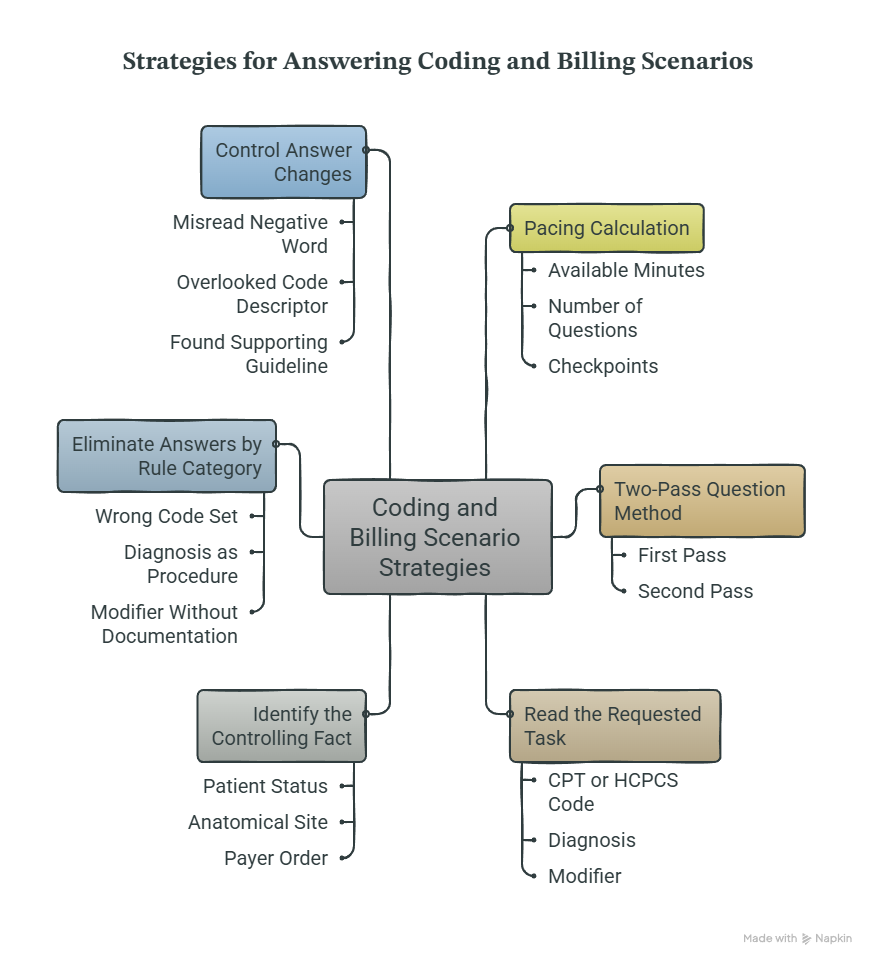
Begin with a pacing calculation
Divide the available minutes by the number of questions to estimate your average time per item. Treat the result as a pacing guide rather than a rigid limit. Short terminology and claim-sequence questions can be answered rapidly, creating additional time for coding scenarios and calculations.
Set three checkpoints:
At 25% of the total time, aim to complete roughly 25% of the questions.
At 50% of the total time, compare your actual progress with halfway completion.
At 75% of the total time, protect enough time for unfinished and flagged questions.
Checkpoints reveal a pacing problem while it can still be repaired. Waiting until the final ten minutes creates rushed reading, blind guessing, and unanswered items.
Use a two-pass question method
During the first pass, answer questions you can solve within a reasonable time. Flag items involving uncertain code hierarchy, complex coordination of benefits, long claim calculations, or unclear compliance details. A difficult question should receive a genuine attempt, followed by a controlled decision to move forward.
During the second pass, return to flagged questions with the security that easier points have already been captured. This prevents one intimidating surgical coding scenario, radiology component question, laboratory coding problem, or denial-management case from consuming time needed for several manageable items.
Read the requested task before processing the scenario
Start with the final sentence or direct question. Determine whether you are being asked to identify:
The correct CPT or HCPCS code
The diagnosis supporting a procedure
A modifier
The cause of a rejection
The cause of a denial
The next billing action
The responsible payer
The patient’s financial responsibility
A compliance violation
A claim-form field
A documentation deficiency
Then read the scenario with that target in mind. This method filters irrelevant details and reduces cognitive load. A question asking for the next revenue-cycle action requires a different reading approach from one asking for the correct CPT modifier, diagnosis pointer, CARC interpretation, or patient-responsibility amount.
Identify the controlling fact
Most scenario questions contain several correct facts and one controlling fact. That fact determines the answer.
Examples include:
Patient status determining an E/M family
Anatomical site determining a procedure variation
Payer order determining claim submission
Authorization status determining the next action
Timely-filing expiration determining appeal viability
Documentation determining modifier support
Place of service determining claim reporting
Ownership of equipment determining technical or professional billing
Remittance information determining payment-posting action
Train yourself to ask: “Which fact changes the answer?” This question helps separate clinically interesting background information from the coding or billing detail the item is testing.
Eliminate answers by rule category
When two answers appear plausible, identify the rule each option would require.
Eliminate an option when it:
Uses the wrong code set
Reports a diagnosis as a procedure
Ignores a required primary code
Uses a modifier without documented circumstances
Bills an included service separately
Assigns patient liability before payer adjudication
Appeals a claim that was rejected before adjudication
Submits secondary insurance before the primary payer processes
Posts the full charge as the allowed amount
Treats a contractual adjustment as collectible patient debt
Releases protected information without authorization
This method joins coding ethics, claims reconciliation, collections and bad debt, and payment-posting controls.
Control answer changes
Change an answer when you can identify a concrete reason:
You misread a negative word such as “except.”
You overlooked a code descriptor.
You found a guideline supporting another option.
You calculated the units incorrectly.
You confused rejection with denial.
You reversed primary and secondary payer order.
You recognized a documentation requirement.
Anxiety alone provides weak evidence. Candidates frequently abandon a defensible first answer because a later option sounds more technical. Anchor changes to a rule, calculation, or documented fact.
5. In-Person, Remote, and Post-Exam Procedures
In-person testing checklist
Arrive according to the testing vendor’s required check-in window. Build extra time for traffic, parking, security, elevators, restroom use, and identity verification. Entering the building at the scheduled start time can already count as late.
During check-in:
Present the approved ID.
Follow personal-belonging storage instructions.
Remove prohibited electronics and watches.
Allow required security inspection.
Confirm how to request proctor assistance.
Confirm whether breaks are available.
Confirm whether the timer continues during breaks.
Learn how to flag and revisit questions.
Check the supplied whiteboard or scratch materials.
Report equipment problems before beginning.
The proctor can explain testing procedures and technical controls. The proctor cannot interpret medical terminology, explain CPT guidelines, resolve payer terminology, or help select an answer. NHA explicitly states that proctors will not answer questions about examination content.
Remote testing checklist
Log in early enough to complete the identity and room-verification process. Keep your ID within reach. Follow every request to rotate the camera, show the desk, move objects, close doors, adjust lighting, or disconnect extra devices.
When a technical problem occurs:
Remain visible to the proctor.
Describe the problem through the approved communication channel.
Follow the proctor’s restart or reconnection instructions.
Avoid opening unauthorized programs.
Record the support ticket or incident details after the session.
Preserve appointment emails and error messages if rescheduling becomes necessary.
Leaving the camera view, using a phone, speaking with another person, or accessing notes can be interpreted as a security violation. Remote convenience requires stricter environmental control.
After completing the exam
Review the submission screen carefully. Confirm that the exam has been submitted before leaving the room or closing the testing application. Follow the sponsor’s instructions for preliminary or official results.
NHA states that computer-based exams taken through a school may provide preliminary results immediately, while PSI testing-center and live remote-proctored results are generally posted within 48 hours. Preliminary results can remain subject to final review. AHIMA and AAPC follow their own reporting processes, so use the timeline attached to your credential.
Protect examination confidentiality. Avoid posting remembered questions, screenshots, answer choices, or reconstructed cases. Ethical conduct after the exam reflects the same standards expected in health information management, healthcare data security, coding compliance, and professional development.
When the result is successful, save the official certificate, update your résumé, verify credential-use rules, and plan future continuing education and certification renewal. When the result falls below the passing standard, use the diagnostic report to build a domain-specific recovery plan rather than immediately restarting broad study.
6. Frequently Asked Questions
-
Bring the approved identification, appointment information, permitted reference materials, required code books, and approved accommodation items specified by your exam sponsor. Requirements differ across CBCS, CPC, CPB, CCA, CCS, and CCS-P examinations.
For the current NHA CBCS exam, candidates should not bring coding manuals because required code information is supplied within the examination. AHIMA CCS candidates taking the exam on or after May 1, 2026 must bring the approved 2026 code books. Review your confirmation and candidate handbook alongside the CBCS course directory, CCS program directory, CPC certification resources, and coding-update guidance.
-
Use a brief retrieval-focused review. Concentrate on frequently confused terms, claim sequences, modifier conditions, payer responsibilities, and calculation methods. Stop before fatigue reduces accuracy.
Avoid beginning a new subject or completing several hours of difficult practice. A final review should reinforce healthcare billing acronyms, patient-responsibility terms, claim-form terminology, and modifier rules already studied.
-
Follow the time stated in your official appointment instructions. Plan enough additional travel time to absorb traffic, parking, building security, room location, and check-in procedures. Remote candidates should also begin their login process according to the vendor’s instructions rather than opening the platform at the scheduled start.
A late arrival can cause admission refusal and fee loss. Confirm the exact requirements because they can differ among testing organizations and locations.
-
Calculator rules depend on the certification. Some computer-based examinations provide an embedded calculator and prohibit personal devices. The current NHA handbook states that candidates may use the built-in examination calculator when needed and cannot use a personal calculator or the computer’s separate calculator. AAPC also states that an online calculator is provided in its electronic testing platform while physical calculators are prohibited.
Practice calculations using the same type of basic tool expected during the exam. Focus on patient responsibility, payment posting, reimbursement calculations, and claims reconciliation.
-
Identify the task, eliminate structurally incorrect options, choose the most defensible remaining answer, flag the item when permitted, and continue. Set a limit on how much time one question may consume.
When you return, ask which option is supported by a specific guideline, documentation detail, payer rule, calculation, or claim sequence. Apply the same method used in coding competency assessments, CPC practice questions, claims-management analysis, and coding ethics decisions.
-
Change an answer when you identify a concrete mistake or controlling rule that supports another choice. Examples include finding a missed word in the question stem, correcting a unit calculation, recognizing a bundled service, or discovering that the scenario asks for a rejection response rather than a denial appeal.
Keep the original answer when doubt is based only on nervousness. Record this behavior during practice because repeated unsupported answer changes may reveal an exam-execution weakness rather than a knowledge problem.
