
Remote Medical Coding Jobs With No Experience: Reddit Reality, Employer Filters & the Fastest Credible Path to WFH
Remote medical coding is a legitimate career goal in 2026, yet the first work-from-home role sits behind several filters beginners often discover after certification: coding experience, credential fit, specialty exposure, accuracy, and employer geography. A smarter route starts with the right CPC certification pathway, strong medical terminology, practical medical billing knowledge, and familiarity with electronic claims workflows. The fastest credible path focuses on becoming employable first and remote-ready immediately afterward.
1. The 2026 Reality of Remote Medical Coding With No Experience
Remote coding itself is firmly established. AAPC reports that 65.7% of medical records specialists work remotely based on its salary-survey data, and its current work-from-home guidance identifies hospitals, physician practices, payers, and coding outsourcing companies as common remote employers. The larger occupation also continues to grow: the U.S. Bureau of Labor Statistics projects 7% growth for medical records specialists from 2024 through 2034, with approximately 14,200 openings per year. That supports long-term demand for candidates building CPC coding skills, CPT knowledge, claims expertise, Medicare billing knowledge, and denial-management skills.
Beginner access becomes much tighter once three filters are combined: remote + coding + zero experience. On August 19, 2026, Indeed's highly specific search for “medical coder CPC-A no experience remote” surfaced only three openings. Search counts change constantly and cannot represent the entire labor market, yet the snapshot illustrates how dramatically a remote-only, zero-experience filter can shrink the pool. A broader entry-level search currently includes a fully remote Junior Coding Associate position accepting 0–1 year of coding experience, including internships and training programs, which confirms that genuine beginner opportunities do appear. Applicants should therefore combine CPC exam preparation, CPC practice questions, billing knowledge, CARC interpretation, and intelligent vacancy tracking rather than assuming entry-level remote roles appear continuously.
The most revealing current employer example comes from UnitedHealthcare. Its nationwide remote Medical Coder position accepts several credentials, including CPC-A, while requiring at least one year of medical coding experience and facility-based coding exposure. Other current remote roles move the requirement higher: UnitedHealth Group has positions requiring two years of specialty coding experience, three years of pro-fee experience, and five years in orthopedics and podiatry. This experience ladder explains why candidates benefit from combining a recognized online CPC program, medical terminology preparation, physician reimbursement knowledge, claims-submission fluency, and denial-resolution knowledge.
Remote employers also evaluate independence. A current UnitedHealth Group senior remote posting explicitly describes the successful candidate as a self-starter who is technically capable and says previous remote success is preferred. Current AAPC listings show remote coding roles requesting specialty experience, Medicare knowledge, coding credentials, EHR proficiency, and the ability to work accurately without close supervision. The hiring question therefore extends beyond whether you understand code books. Employers need confidence that you can process real queues, recognize documentation problems, interpret claim adjustment reason codes, resolve insurance denials, navigate Medicare billing rules, understand electronic claims, and maintain coding education.
| Employer Filter | What Employers Are Testing | Why Beginners Get Filtered | Fastest Credible Response |
|---|---|---|---|
| Recognized credential | Baseline coding competence | Course completion alone may carry limited hiring weight | Target CPC/CPC-A, CCA, CCS, COC, or the credential employers repeatedly request |
| CPC-A designation | Certified knowledge with apprentice status | Some vacancies accept CPC-A while still requiring experience | Apply where CPC-A is explicitly accepted and build qualifying experience |
| One year coding experience | Production exposure | Common threshold in remote roles | Target entry-level coding, internal transfer, practicum, or bridge roles |
| Two years experience | Ability to work with less supervision | Eliminates many newly certified applicants | Build one specialty continuously instead of job-hopping randomly |
| Three-plus years | Independent production capability | Common in advanced remote coding | Treat these vacancies as future target-role intelligence |
| Specialty experience | Depth in cardiology, orthopedics, surgery, radiology, etc. | General classroom coding provides limited specialty depth | Choose one service line and practice it deeply |
| Pro-fee experience | Professional CPT/HCPCS/ICD-10-CM coding | Facility-focused training may not transfer cleanly | Target physician practices and professional billing operations |
| Facility experience | Hospital outpatient/inpatient workflows | Different reimbursement and coding complexity | Use HIM and facility coding roles as stepping stones |
| Inpatient coding | ICD-10-CM/PCS, DRGs, POA and complex records | High technical barrier | Build facility foundation before targeting inpatient WFH |
| Outpatient coding | ICD-10-CM, CPT, modifiers and facility charging | Employers often request prior outpatient production work | Target Coder I and outpatient HIM positions first |
| E/M knowledge | Correct professional service leveling | Weak E/M reasoning creates audit risk | Practice documentation-based E/M scenarios |
| Modifier knowledge | Correct reimbursement and edit handling | Memorization without documentation logic breaks down quickly | Study modifier application through real scenarios |
| Medicare knowledge | Payer-specific reimbursement understanding | Beginners may know coding rules without payer context | Learn Medicare edits, coverage and reimbursement workflows |
| Medicaid knowledge | State and payer reimbursement processes | Rules can differ from commercial workflows | Build payer-literacy alongside coding study |
| Denials knowledge | Whether you understand downstream coding consequences | Pure code lookup skills provide limited revenue-cycle context | Learn CARCs, appeals, corrected claims and root-cause analysis |
| EHR experience | Ability to navigate real documentation systems | Classroom work may lack live EHR exposure | Prioritize healthcare employers using major EHR platforms |
| Encoder/CAC exposure | Production coding technology fluency | Codebook-only experience looks incomplete | Learn workflow concepts even when software access is limited |
| Coding accuracy | Compliance and financial reliability | Certification score does not prove workplace accuracy | Track accuracy across timed chart exercises |
| Productivity | Cases completed within production expectations | Correct coding can still be too slow | Build speed after accuracy becomes stable |
| Pre-employment coding test | Whether knowledge survives real-case pressure | Applicants may pass certification and fail employer testing | Practice timed charts, guidelines and rationale |
| Remote experience | Self-management and communication | Some employers prefer proven remote workers | Show measurable independent work from previous roles |
| State restrictions | Payroll, employer registration and operational eligibility | “Remote” may cover only selected states | Read location eligibility before applying |
| U.S.-only restriction | Legal, privacy and employment requirements | International applicants may misunderstand “remote” | Target employers hiring in your actual country |
| Home privacy setup | Ability to protect sensitive patient information | Shared or insecure workspace can create concerns | Prepare a private, reliable work environment |
| Internet reliability | Continuous access to EHR and employer systems | Remote production cannot tolerate frequent disruption | Use reliable primary internet and a backup plan |
| Billing experience | Understanding of the revenue cycle | Beginners often overlook it because the title is not “coder” | Use billing as a strategic bridge into coding |
| Denials/AR experience | Ability to diagnose payer and claim problems | Often ignored during coding-only searches | Target denial, AR and coding-edit positions |
| Healthcare-system experience | Familiarity with clinical and administrative workflows | External beginners compete with internal employees | Enter the hospital system through an adjacent role |
| Internal mobility | Existing performance and manager trust | External applicants must prove more from a résumé | Track internal coding openings after establishing yourself |
| Remote-only job search | Candidate flexibility | Creates the smallest and most competitive beginner pool | Use hybrid/on-site work to accelerate WFH eligibility |
2. The Employer Filters That Actually Decide Who Gets a Remote Coding Interview
The first filter is usually credential fit. Current UnitedHealthcare remote coding vacancies accept combinations of CPC, CPC-A, CCA, CCS, CCS-P, COC, RHIT, RHIA, and other recognized coding credentials depending on the role. The exact credential matters because professional-fee, outpatient facility, and inpatient coding involve different knowledge. Before choosing certification, compare online CPC programs, CCS certification programs, available CBCS programs, CPC exam preparation, and the credentials listed across 30–50 jobs you would genuinely accept.
The second filter is production experience, and this is where many remote ambitions stall. UnitedHealthcare's current nationwide Medical Coder role accepts CPC-A and still requests one year of coding experience. A current TeamHealth remote Hospital Medicine Coder listing asks for at least one year of medical coding and/or medical terminology and billing experience, providing an important clue: some employers value adjacent revenue-cycle experience alongside direct coding. A beginner can strengthen that profile through medical billing concepts, electronic claim submission, insurance denial management, CARC research, and practical Medicare billing knowledge.
The third filter is specialty alignment. Current remote vacancies request experience in orthopedics, podiatry, anesthesia, surgery, radiology, professional-fee coding, inpatient coding, risk adjustment, and outpatient facility work. A general certification gives you a foundation; the employer's actual queue determines whether you can produce. Someone targeting physician coding should deepen CPT coding principles, physician fee schedule knowledge, CPC medical terminology, CPC practice questions, and payer-facing denial knowledge.
The fourth filter is accuracy under production conditions. A current outpatient coder listing on AAPC's board specifies a 97% accuracy expectation, showing how workplace coding is measured after hiring. Accuracy also intersects with speed: remote employers need workers who can clear queues while preserving compliance. That makes chart-based practice more valuable than repeatedly memorizing isolated codes. Build a timer into CPC question practice, use a structured CPC preparation plan, strengthen medical terminology, study billing concepts, and review claim adjustment codes so you understand downstream consequences.
The fifth filter is geography, even when the listing says remote. Current AAPC listings include remote positions limited to specified states. HaysMed, for example, lists a remote HIM Coder II position open to candidates in Arizona, Colorado, Kansas, Kentucky, Ohio, and Louisiana. Another remote anesthesia position limits residence to Arizona, Texas, Tennessee, New Hampshire, or North Carolina. Apply after checking residency requirements, then use location-relevant billing knowledge, Medicaid reimbursement resources, claims platforms, denial-management resources, and continuing education to strengthen the rest of the application.
3. Reddit Reality: How Coders Actually Reach Work From Home
Reddit's medical-coding community repeatedly describes experience accumulation as the turning point for remote work. In one discussion, a coder with roughly a year and a half of experience asked whether they were ready to apply for work-from-home positions after originally expecting to need about two years. The discussion reflects a common career sequence: certification, production experience, then stronger remote access. This aligns closely with current employer requirements requesting one, two, three, or five years depending on specialty. Beginners can shorten the distance by pairing CPC preparation with billing knowledge, electronic claim workflows, denial management, and Medicare resources.
First-job Reddit threads also show how frequently coders enter through adjacent healthcare roles. Contributors describe starting in billing, medical records, charge entry, accounts receivable, claims work, internships, other hospital departments, and internal transfers before obtaining dedicated coding positions. That route works because each role removes a different hiring uncertainty. Billing proves payer familiarity. Medical records proves EHR exposure. Denials prove claim investigation. Internal employment proves workplace performance. Strengthen each bridge with small-practice billing knowledge, claim adjustment code expertise, Medicaid reimbursement knowledge, claims-submission fluency, and insurance denial skills.
Recent success stories show that the first coding line can change the market quickly. One CPC-A holder reported earning the credential in July 2025 and starting risk-adjustment coding the following month. After gaining experience and later being furloughed, the poster received an offer for a Medical Coder III position despite lacking several listed qualifications. This is one person's outcome and should never be treated as a normal timeline. Its career lesson is still useful: once a candidate can point to real coding work, later employers evaluate an entirely different résumé. Build that progression with CPC study resources, CPT principles, physician reimbursement knowledge, CARC expertise, and CEU development.
Another recurring Reddit problem is searching for the dream job too early. Newly certified CPC-A holders regularly ask where to find remote positions immediately after passing the exam. Current vacancy data explains the frustration: the remote market contains abundant opportunities for experienced coders, while the narrow no-experience remote query currently returns only a handful of openings. An effective beginner search should therefore include CPC-qualified roles, medical billing roles, denial operations, claims work, and workers' compensation billing.
4. The Fastest Credible Path From Zero Experience to a Remote Coding Job
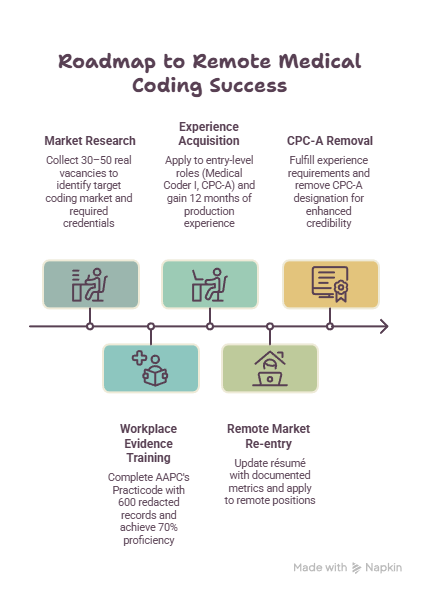
Phase 1: Choose the coding market before buying the credential. Spend a week collecting 30–50 real vacancies across the setting you want. Professional-fee coding generally points more strongly toward CPC, while facility coding frequently includes CCS, CCA, RHIT, RHIA, COC, or related credentials. Current employer postings demonstrate this variation clearly. Compare CPC certification programs, CCS certification programs, CBCS certification options, CPC study strategy, and medical terminology preparation against those vacancies.
Phase 2: Train with workplace evidence in mind. A certification exam tests knowledge; your future employer may test chart interpretation, code selection, documentation support, modifiers, medical necessity, and accuracy under time pressure. AAPC's Practicode provides 600 redacted medical records, requires 70% overall proficiency, and can count as one year toward removal of the CPC-A apprentice designation. It should be treated as structured practicum evidence rather than a promise that employers will count it identically to paid production work. Pair it with CPC practice questions, CPT principles, claims workflows, CARC research, and denial-management knowledge.
Phase 3: Attack the experience bottleneck from several directions at once. Apply to Medical Coder I, Junior Coder, CPC-A Coder, Coding Representative, Risk Adjustment Coder, Coding Edit Specialist, Medical Records Specialist, HIM Technician, Billing Specialist, Charge Entry Specialist, Denial Specialist, Accounts Receivable Specialist, Claims Specialist, Authorization Specialist, and Revenue Cycle Representative positions. AAPC's current CPC-A board includes apprentice-level vacancies, and Indeed currently shows a remote Junior Coding Associate role accepting 0–1 year of experience. Prepare for that broader market through billing concepts, electronic claims, Medicare tools, insurance denial workflows, and CARC interpretation.
Phase 4: Use an on-site or hybrid role as an accelerator when your circumstances allow it. Twelve months of relevant production experience can unlock remote vacancies currently inaccessible to a zero-experience candidate. UnitedHealthcare's current nationwide remote coder role illustrates the threshold clearly by accepting CPC-A while requesting one year of medical coding experience. During that year, record the exact account types you code, specialties handled, EHRs used, coding accuracy, productivity, payer exposure, modifiers, denials resolved, and audits passed. Develop alongside the work through physician fee schedule knowledge, Medicare resources, Medicaid reimbursement knowledge, CEU providers, and denial-management resources.
Phase 5: Re-enter the remote market with evidence instead of hope. Your résumé should now say far more than “CPC-A” or “completed medical coding course.” It should show something like: professional-fee coding, family medicine, ICD-10-CM/CPT/HCPCS, Epic exposure, 96–98% internal accuracy where legitimately documented, average daily volume where legitimately documented, Medicare payer exposure, E/M coding, modifier review, denial research, and provider-query experience. Never invent metrics. Use actual proof gathered on the job. Strengthen your application through CPC continuing study, CPT coding knowledge, claim-adjustment expertise, reimbursement knowledge, and electronic claims understanding.
For CPC-A holders, apprentice removal can also strengthen presentation. AAPC currently requires two years of qualifying experience for progression from CPC-A to CPC, while approved education can count for one year and Practicode can satisfy another year component under the applicable pathways. Follow AAPC's current documentation requirements rather than relying on forum advice. At the same time, keep strengthening CPC exam knowledge, medical terminology, coding CEUs, Medicare knowledge, and denial expertise.
5. How to Build a Remote-Ready Résumé and Job Search That Produces Interviews
A remote-coding résumé should be built around evidence categories employers screen for: credential, setting, specialty, code sets, payer knowledge, technology, accuracy, productivity, compliance, and independence. Place your credential prominently, then surface transferable healthcare experience before unrelated employment. Someone with billing experience should explicitly show claims submission, EOB/ERA review, payer follow-up, denials, payment posting, eligibility, authorization, and reimbursement work. Those experiences connect naturally to medical billing fundamentals, electronic claim submission, CARC interpretation, denial management, and physician reimbursement.
Use the employer's language accurately. If the vacancy says pro-fee, your résumé should make professional coding exposure easy to find. If it requests E/M, ICD-10-CM, CPT, HCPCS, modifiers, Medicare, Epic, or risk adjustment, surface genuine matching experience near the top. Current postings demonstrate how specific these filters become. Someone targeting these positions can improve relevance through CPT coding principles, medical terminology, Medicare billing resources, physician fee schedules, and claim-adjustment knowledge.
Track your applications like an analyst. Create columns for company, role, date, remote geography, credential requirement, minimum experience, specialty, setting, EHR, payer requirements, compensation, application stage, rejection point, and follow-up date. After 30–50 applications, look for the dominant failure pattern. If nearly every target job asks for one year of experience, another general certificate may provide poor immediate ROI. If your experience qualifies and CPC appears constantly while you hold a different credential, credential alignment deserves attention. Compare CPC programs, CCS programs, CBCS programs, continuing education, and practical claims experience against the actual bottleneck.
Prepare separately for the coding assessment. Certification study often rewards exam pacing and guideline recall; employer tests can expose weaknesses in documentation interpretation, specialty conventions, modifier logic, and code sequencing. Practice unfamiliar charts without immediately looking at answers. Record why each wrong answer occurred: guideline error, terminology gap, documentation oversight, codebook navigation, modifier error, sequencing error, or time pressure. Use CPC practice questions, a structured CPC study plan, CPT principles, exam-day preparation, and exam-anxiety techniques to develop disciplined performance.
Finally, search employers directly alongside job boards. Large health systems, physician groups, payers, RCM companies, coding outsourcing firms, federal contractors, and specialty practices frequently maintain their own career pages. AAPC's current remote board contains experienced positions across multiple specialties, while UnitedHealth Group continues to advertise nationwide remote coding work at different seniority levels. Build saved searches around medical billing roles, claims-related work, denial-management positions, Medicare-related jobs, and coding roles aligned with your CPC training.
6. FAQs About Remote Medical Coding Jobs With No Experience
-
Yes, genuine entry-level remote openings exist, and they are scarce relative to experienced remote positions. On August 19, 2026, Indeed's highly specific CPC-A/no-experience/remote search showed three openings, while a broader entry-level search included a Junior Coding Associate role accepting 0–1 year of experience, including training and internships. Strengthen your odds through CPC certification preparation, medical terminology, medical billing knowledge, claims-submission expertise, and denial-management skills.
-
Current postings show a broad range. Some beginner roles accept 0–1 year, UnitedHealthcare currently has a nationwide remote coder role requiring at least one year, other remote specialty jobs request two or three years, and advanced positions can ask for five years. Your target specialty determines the meaningful benchmark. Build toward it with CPC study, CPT preparation, Medicare knowledge, physician reimbursement knowledge, and CEU development.
-
Yes. Current remote postings explicitly accept CPC-A, including UnitedHealthcare's nationwide Medical Coder position. That particular job also requires at least one year of medical coding experience, showing why CPC-A acceptance and experience requirements must be checked separately. AAPC's CPC-A job board also currently contains apprentice-level opportunities. Strengthen your profile through CPC practice questions, medical terminology, billing concepts, CARC knowledge, and denial-management expertise.
-
AAPC says successful completion of CPC-A Practicode counts as one year toward removal of the apprentice designation. The program uses 600 redacted medical records and requires at least 70% proficiency. Individual employers decide how they evaluate practicum experience compared with paid production employment, so describe Practicode accurately on the résumé. Use it alongside CPC exam preparation, CPT coding principles, claims knowledge, Medicare resources, and CEU providers.
-
Prioritize jobs that expose you directly to documentation, claims, payer rules, coding edits, or EHR workflows. Medical billing, denials, charge entry, claims, medical records, HIM, authorizations, accounts receivable, coding support, and revenue-cycle roles all create transferable evidence. Reddit first-job discussions repeatedly describe these kinds of pathways into dedicated coding. Build your bridge through medical billing fundamentals, electronic claims submission, CARC analysis, insurance denial management, and Medicaid reimbursement knowledge.
-
An on-site or hybrid coding role can be one of the fastest routes to competitive remote eligibility because current remote postings commonly request one or more years of production experience. Use the role deliberately: build specialty depth, learn the EHR, track accuracy and productivity, understand payer rules, participate in audits, and document real accomplishments. Strengthen the experience with physician fee schedule knowledge, Medicare billing tools, claims-submission knowledge, denial-management resources, and continuing education.
