
HCC Coding Practice Cases: Risk-Adjustment Scenarios With Answers
HCC coding becomes difficult when the chart contains real disease, stale history, vague documentation, overlapping conditions, or diagnoses that changed under the newer CMS-HCC model. Coders preparing for risk-adjustment coding roles, strengthening a medical coding resume, practicing for coding interview assessments, or planning a coding-auditor career need to decide what the documentation actually supports. These cases are built to train that judgment.

1. Use the 2026 CMS-HCC Model and Solve Every Case From Documentation First
For non-PACE Medicare Advantage organizations, 2026 completes the transition to the 2024 CMS-HCC model, commonly called V28, with CMS calculating 100% of the applicable risk score under that model. That matters because coders trained on older V24 categories can carry outdated HCC numbers, hierarchies, and assumptions into current work. Anyone pursuing risk-adjustment coding, improving CPC coding skills, studying CPT and coding principles, or preparing for medical coding interviews should verify mappings against the current CMS files.
CMS publishes dedicated 2026 ICD-10-CM mappings and model software, along with the current list of risk-adjustment-eligible CPT/HCPCS codes. The practical consequence is simple: never assume that a diagnosis mapping you memorized several years ago still produces the same payment HCC.
Use this six-step sequence on every practice case:
1. Identify what the provider actually diagnosed.
Do not build diagnoses from medication lists, lab values, imaging findings, or assumptions. This skill matters in professional-fee coding, coding audits, high-productivity coding environments, and complex coding specialties.
2. Determine whether the condition is current for this encounter.
A problem-list entry alone can be misleading. CMS's RADV guidance specifically warns that electronic problem lists may retain diagnoses after a condition is no longer active.
3. Apply ICD-10-CM rules before thinking about RAF.
Risk-adjustment coding remains diagnosis coding. Correct sequencing, combination-code rules, causal relationships, specificity, and current ICD-10-CM guidance come first. Someone learning through CPC exam preparation, CCS practice questions, medical terminology study, or coding without healthcare experience should resist coding backward from an HCC.
4. Verify whether the diagnosis maps to a payment HCC in the applicable model.
5. Apply hierarchy logic.
A patient can have multiple related diagnoses while only the higher category contributes under a hierarchy.
6. Ask whether the chart could survive validation.
CMS RADV confirms whether diagnoses submitted for risk adjustment are supported in the medical record, and unsupported diagnoses can lead to overpayment recovery. That makes defensibility central to coding auditing, risk-adjustment careers, remote coding employment, and a strong medical coding resume.
| Scenario | Coder Decision | Main Risk | What to Verify |
|---|---|---|---|
| 1. Type 2 diabetes with documented CKD | Use diabetic CKD combination coding plus CKD stage | Missing complication specificity | Current CKD stage |
| 2. Diabetes listed only as “controlled” | Code documented diabetes accurately | Inventing complications | Any documented manifestation |
| 3. CKD stage 4 documented | Capture N18.4 when supported | Using unspecified CKD | Provider-stated stage |
| 4. eGFR suggests stage 4 but provider says CKD unspecified | Do not independently assign stage 4 from lab alone | Coding from clinical inference | Provider clarification |
| 5. ESRD with chronic dialysis | Code documented ESRD and applicable dialysis status | Incomplete status coding | Current dialysis dependence |
| 6. Chronic diastolic heart failure | Capture documented current heart failure | Dropping chronic condition | Type and acuity |
| 7. Past CHF appears only on old problem list | Do not assume current heart failure | Stale problem-list capture | Current encounter evidence |
| 8. COPD assessed as stable | Stable chronic disease may still be current | Ignoring stable disease | Provider assessment |
| 9. Shortness of breath plus inhalers, no COPD diagnosis | Code documented condition/symptom only | Diagnosing from medication | Provider diagnosis |
| 10. Active breast cancer under treatment | Code active malignancy to documented specificity | Underspecification | Site, laterality, current status |
| 11. Breast cancer treated years ago, no current disease | Use history coding when appropriate | False active-cancer capture | Current oncology status |
| 12. “History of prostate cancer” | Do not convert history into active malignancy | Unsupported HCC | Evidence of active disease |
| 13. Residual hemiplegia after old stroke | Code current neurologic deficit when documented | Ignoring ongoing sequela | Laterality and dominance |
| 14. Old stroke with no residual deficit | Use appropriate history/sequela logic | Assigning hemiplegia without evidence | Current residuals |
| 15. Severe recurrent major depression documented | Code severity and recurrence accurately | Defaulting to unspecified depression | Severity, recurrence, psychosis |
| 16. PHQ-9 high but no depression diagnosis | Do not independently diagnose MDD | Coding from screening score | Provider conclusion |
| 17. Amputation documented as current status | Capture applicable status code when reportable | Missing long-term status | Level and laterality |
| 18. Wheelchair use without paraplegia diagnosis | Do not infer paralysis | Inferring disease from equipment | Reason for wheelchair use |
| 19. Pressure ulcer documented without stage | Seek supported specificity | Incomplete severity | Site, side, stage |
| 20. Healed pressure ulcer on problem list | Do not report as active solely from stale list | Unsupported current disease | Present condition |
| 21. Morbid obesity inferred from BMI | Use provider diagnosis requirements | Diagnosing solely from BMI | Provider documentation and BMI code rules |
| 22. Protein-calorie malnutrition copied forward | Confirm current diagnosis | Stale diagnosis capture | Current clinical assessment |
| 23. Metastatic cancer documented | Code primary/secondary malignancy as supported | Missing metastatic site | Current primary and metastasis |
| 24. Cancer medication appears, diagnosis absent | Do not infer active cancer from medication alone | Unsupported diagnosis | Provider documentation |
| 25. Diabetes with neuropathy explicitly documented | Use supported combination code | Separating linked disease unnecessarily | Type and manifestation |
| 26. Neuropathy and diabetes appear separately | Apply ICD-10-CM relationship rules carefully | Incorrect causal assumption | Index/tabular guidance and provider statements |
| 27. COPD exacerbation documented | Code exacerbation specificity | Using uncomplicated COPD | Exacerbation vs infection |
| 28. Severe depression documented as “in remission” | Code documented remission status correctly | Coding past severity as current episode | Current disease state |
| 29. Diagnosis maps in old V24 list | Check 2026 V28 mapping | Outdated HCC capture | Current CMS mapping file |
| 30. HCC-generating diagnosis lacks valid encounter support | Do not treat mapping alone as sufficient | RADV exposure | Provider, date, record, eligible encounter |
2. Practice Cases 1–6: Diabetes and Chronic Kidney Disease
These cases test exactly the type of reasoning employers expect from candidates moving into risk-adjustment coding, preparing for coding interview tests, building proof of coding skill, or progressing toward medical coding auditing.
Case 1: Type 2 Diabetes With CKD Stage 4
Scenario: The assessment states: “Type 2 diabetes with diabetic CKD. CKD stage 4, stable. Continue nephrology follow-up.”
Answer: Report E11.22 and N18.4, assuming the remainder of the record supports the documented diagnoses. E11.22 maps to V28 HCC 37, Diabetes with Chronic Complications, while N18.4 maps to the V28 severe CKD category, HCC 327.
The high-value lesson is that the stage code should accompany diabetic CKD. A coder trained through medical terminology, CPC preparation, CCS practice, and risk-adjustment training should capture the documented disease picture rather than stopping after the diabetes code.
Case 2: eGFR Suggests Stage 4, but the Provider Documents “CKD”
Scenario: Laboratory data show an eGFR consistent with severe renal impairment. The provider documents only “chronic kidney disease” without a stage.
Answer: Do not independently upgrade the diagnosis to CKD stage 4 from the laboratory value. Code from provider documentation under applicable ICD-10-CM rules or obtain clarification where appropriate.
Risk-adjustment pressure can tempt coders to chase the highest category, especially under productivity quotas, remote coding demands, outsourcing pressure, or audit-focused roles. The correct target remains documentation accuracy.
Case 3: Type 2 Diabetes Without a Documented Complication
Scenario: “Type 2 diabetes mellitus, stable on metformin.” No nephropathy, neuropathy, retinopathy, hyperglycemia, or other complication is documented.
Answer: Code the documented uncomplicated diabetes rather than manufacturing a complication. Under V28, diabetes categories include HCC 36 for severe acute complications, HCC 37 for chronic complications, and HCC 38 for glycemic, unspecified, or no complications.
This hierarchy is important for medical coding interview preparation, CPC practice questions, coding career advancement, and coding audits.
Case 4: Diabetes With Neuropathy
Scenario: “Type 2 diabetes with diabetic polyneuropathy; burning foot pain persists. Continue gabapentin.”
Answer: Use the applicable diabetes-with-polyneuropathy combination code, E11.42, when the full documentation supports it. Verify the current CMS mapping rather than copying an old V24 HCC.
The important skill is recognizing a documented complication while maintaining ICD-10 specificity, medical terminology accuracy, risk-adjustment discipline, and the defensibility expected in coding-auditor careers.
Case 5: CKD Stage 5
Scenario: “CKD stage 5. Patient has not yet started chronic dialysis.”
Answer: N18.5 is appropriate when supported. In V28, N18.5 maps to HCC 326, Chronic Kidney Disease, Stage 5.
Do not automatically assign dialysis dependence. Status codes represent actual patient status, not what commonly happens in patients with the same disease. That distinction matters in CCS coding practice, medical coding interviews, high-level coding specialties, and audit review.
Case 6: ESRD on Chronic Dialysis
Scenario: “End-stage renal disease. Hemodialysis Monday, Wednesday, Friday.”
Answer: Capture N18.6 for ESRD and the applicable dialysis-status coding when documentation supports it. N18.6 maps to V28 HCC 326.
The coder should also understand that the full risk-adjustment result depends on model logic, patient characteristics, and accepted diagnoses, which is why risk-adjustment coding requires more judgment than merely locating HCC-producing codes.
3. Practice Cases 7–12: Heart Failure, COPD, and Cancer
Case 7: Chronic Diastolic Heart Failure
Scenario: “Chronic diastolic CHF, clinically stable. Continue diuretic; monitor weight.”
Answer: The documented chronic heart failure is current even though it is stable. Assign the appropriate I50.- code to the documented type. Chronic non-acute heart failure generally falls within V28 HCC 226, Heart Failure, Except End-Stage and Acute.
“Stable” should not be interpreted as “resolved.” This distinction is critical in risk-adjustment coding jobs, coding productivity environments, medical coding audits, and specialty coding careers.
Case 8: Heart Failure Exists Only on an Old Problem List
Scenario: The problem list contains CHF from four years ago. Today's assessment addresses hypertension, arthritis, and a skin complaint. Heart failure appears nowhere else.
Answer: Do not automatically capture heart failure merely because the EHR retained it. CMS has specifically warned that problem lists may continue displaying diagnoses after the patient no longer has the condition.
An experienced coder should seek current encounter support rather than inflate risk through stale entries. That is the kind of judgment tested in coding interviews, demanded in audit careers, and valuable to new-coder employers.
Case 9: Stable COPD
Scenario: “COPD stable. No recent exacerbations. Continue maintenance inhaler.”
Answer: The condition remains current and reportable when the encounter and coding requirements are satisfied. COPD codes such as J44.- map to V28 HCC 280, Chronic Obstructive Pulmonary Disease, Interstitial Lung Disorders, and Other Chronic Lung Disorders.
Risk-adjustment coding is full of cases where medical terminology, CPC training, coding interview skills, and audit judgment matter more than memorizing a list of diagnoses.
Case 10: Inhaler Use Without COPD Documentation
Scenario: The medication list includes tiotropium and albuterol. The patient reports occasional dyspnea. The provider never diagnoses COPD.
Answer: Do not assign COPD from the medication list. Medication use can support understanding of a documented condition, but it does not authorize the coder to create the diagnosis.
This is a classic trap for someone entering medical coding without healthcare experience, switching from medical assisting to coding, moving from nursing into coding, or pursuing a risk-adjustment specialty.
Case 11: Active Breast Cancer
Scenario: “Active left breast carcinoma. Patient currently receiving oncology treatment.”
Answer: Code the active malignancy to the highest specificity supported by the documentation. Breast malignancy codes in this family can map to V28 HCC 23, Prostate, Breast, and Other Cancers and Tumors. For example, C50.919 maps to HCC 23, although a coder should choose a more specific laterality/site code when documentation supports it.
The priority remains accurate ICD-10 coding, clinical terminology, risk-adjustment coding, and audit defensibility.
Case 12: History of Breast Cancer
Scenario: “Breast cancer treated with surgery and chemotherapy eight years ago. No evidence of disease. Continue routine surveillance.”
Answer: Do not report active breast cancer. Use the appropriate personal-history coding when indicated.
CMS RADV guidance specifically cautions that a notation of history of cancer may fail to validate an active cancer HCC when current cancer status or treatment is absent. That distinction is essential for medical coding auditors, risk-adjustment specialists, candidates facing coding interview scenarios, and coders protecting themselves from workplace stress and audit pressure.
4. Practice Cases 13–18: Neurologic, Psychiatric, and Documentation Traps
Case 13: Residual Hemiplegia After Stroke
Scenario: “History of CVA with persistent left nondominant hemiplegia. Requires assistance with transfers.”
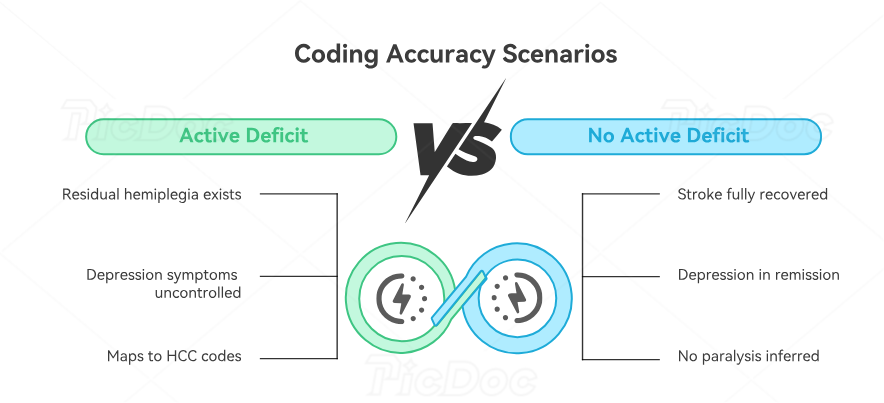
Answer: The stroke may be historical, while the current residual deficit remains active. When documentation supports G81.94, that code maps to V28 HCC 253, Hemiplegia/Hemiparesis.
This scenario illustrates why risk-adjustment coders, CCS candidates, coding interview candidates, and future auditors must distinguish the old event from its present consequences.
Case 14: Old Stroke, No Current Deficits
Scenario: “CVA in 2018. Fully recovered. No residual weakness or neurologic deficit.”
Answer: Do not assign hemiplegia or another residual neurologic diagnosis. Code the history or applicable status according to current documentation and ICD-10-CM guidance.
The HCC opportunity never overrides accuracy. This principle is essential for professionals experiencing coding productivity pressure, entering remote coding roles, navigating outsourcing concerns, or developing auditing expertise.
Case 15: Severe Recurrent Major Depression
Scenario: “Major depressive disorder, recurrent, severe without psychotic features. Symptoms remain poorly controlled.”
Answer: F33.2 matches that documented diagnosis when all coding requirements are met. Under V28 it maps to HCC 155, Major Depression, Moderate or Severe, without Psychosis.
Specificity matters. A coder should preserve recurrence, severity, remission status, and psychotic features when documented rather than collapsing everything into unspecified depression. This is exactly the depth expected in medical coding interviews, coding auditor roles, higher-paying coding specialties, and risk-adjustment positions.
Case 16: High PHQ-9 Score Without a Depression Diagnosis
Scenario: The patient's PHQ-9 score is 19. The provider writes “positive depression screen” and schedules follow-up but makes no definitive major-depression diagnosis.
Answer: Do not convert the screening score into severe major depressive disorder yourself.
This case tests the boundary between clinical evidence and coding authority. Professionals coming from nursing backgrounds, medical assisting, non-healthcare careers, or CPC training all need the same discipline: translate documentation accurately rather than diagnose.
Case 17: Wheelchair Dependence With No Paralysis Diagnosis
Scenario: The patient uses a wheelchair and needs help transferring. The record attributes mobility limitation to severe osteoarthritis. No hemiplegia, paraplegia, or other paralysis is documented.
Answer: Do not infer paralysis from functional limitation.
A wheelchair can result from many conditions. This is a common overreach in chart review, particularly when a coder is conditioned to search aggressively for risk-adjusting diagnoses, work against productivity targets, prepare for practical coding tests, or transition into auditing.
Case 18: Severe Depression Documented as in Remission
Scenario: “Recurrent major depressive disorder, previously severe, currently in full remission.”
Answer: Code the current remission status supported by the encounter. Do not assign the code representing a current severe episode merely because past records describe severe symptoms.
This captures one of the central rules of risk adjustment: today's documentation controls today's diagnosis coding. The same principle protects accuracy across CPC coding, CCS coding, risk-adjustment work, and medical coding audits.
5. Use an Audit-Ready Method to Answer HCC Coding Cases
The strongest answer to an HCC case should contain more than a diagnosis code.
Use this structure:
Documentation → ICD-10-CM code → Current HCC mapping → Hierarchy → Validation risk
Suppose the record states: “Type 2 diabetes with CKD stage 4.” A weak answer says, “E11.22.”
A stronger answer explains that E11.22 captures diabetic CKD, N18.4 identifies stage 4, E11.22 maps to V28 HCC 37, N18.4 maps to HCC 327, and both diagnoses must be supported by an eligible current record. That reasoning is far more valuable during medical coding interviews, when building a coding portfolio or resume, applying to employers hiring coders, or progressing toward coding auditing.
Treat MEAT carefully. “Monitor, Evaluate, Assess/Address, Treat” is widely used as a chart-review mnemonic, but it should not be presented as a universal CMS rule that automatically validates every diagnosis. The defensible question is whether the medical record supports the submitted diagnosis under applicable CMS, coding, encounter, provider, and data-submission requirements.
CMS emphasizes that risk-adjustment diagnoses must be supported by medical records and that acceptable records involve appropriate provider sources, data-collection dates, and other validation requirements. Someone working in low-patient-contact coding roles, remote risk adjustment, medical coding auditing, or high-productivity environments should therefore ask whether another coder or auditor could reconstruct the same conclusion from the same record.
Also watch hierarchies. Reporting several related diagnoses does not mean every mapped category contributes independently. HCC systems are hierarchical precisely because a more severe manifestation can supersede a less severe category within the same disease family. CMS's 2024 model contains 115 HCCs included in the payment model, while many other condition categories do not contribute directly to payment. That makes current-model knowledge important for anyone investing in coding education, comparing coding training routes, maintaining coding certifications, or moving into higher-value specialties.
6. FAQs About HCC Coding Practice Cases
-
For CY 2026, CMS completed the transition for non-PACE Medicare Advantage organizations to 100% of the 2024 CMS-HCC model, commonly called V28. Coders pursuing risk-adjustment jobs, preparing for coding interviews, maintaining coding education, or developing audit skills should use current 2026 mapping files.
-
CMS maps diagnosis codes into condition categories, while only a subset of categories are included in the payment model. CMS reported that the finalized 2024 model contains 115 payment HCCs, with many other HCCs outside the payment model. That is why risk-adjustment coders, CPC candidates, CCS candidates, and coding auditors must verify rather than assume.
-
Medication may help explain a documented diagnosis, but the coder should not create a disease diagnosis solely from the medication list. A diabetic medication, inhaler, anticoagulant, antidepressant, or cancer drug can have multiple indications. This distinction is especially important for people moving from nursing into coding, medical assisting into coding, non-healthcare careers, or risk-adjustment specialties.
-
A chronic condition does not become historical merely because it is stable. The record must establish the current diagnosis in a manner that satisfies applicable coding and risk-adjustment requirements. Stable COPD, heart failure, diabetes, or another chronic illness can remain current. This principle matters in medical coding interviews, coding audits, productivity-driven jobs, and remote coding.
-
An old problem-list entry should never be treated as automatic evidence of a current diagnosis. CMS's own RADV guidance warns that diagnoses may remain on electronic problem lists after patients no longer have the condition. Review the current encounter and supporting record. This is particularly important in risk-adjustment coding, medical coding auditing, coding interview tests, and high-pressure coding environments.
-
Active malignancy and personal history of malignancy represent different clinical states. CMS RADV guidance specifically cautions that a history notation without evidence of current cancer may fail to validate an active cancer HCC. Coders working toward risk-adjustment roles, auditing roles, specialty coding positions, or coding interviews should verify current disease status.
