
Medical Coder Resume: ATS Template + 40 Skills and Achievement Examples
A medical coder resume has one job before a recruiter ever reads it: survive the applicant tracking system and prove that you can code accurately, efficiently, and defensibly. That requires more than listing CPC, ICD-10-CM, and CPT. Your resume must connect credentials with measurable work, technical systems, coding environments, and outcomes. This matters even more for candidates carrying CPC-A apprentice status, entering medical coding without healthcare experience, preparing for medical coding interview tests, or competing for new-coder employers.

1. Build a Medical Coder Resume Around Evidence, ATS Keywords, and the Exact Job
The biggest resume mistake in medical coding is writing one generic document and sending it to every employer. A hospital hiring inpatient coders, a physician group hiring professional-fee coders, and a vendor recruiting risk-adjustment coders are looking for materially different signals. A candidate targeting inpatient or outpatient coding should therefore tailor the resume differently from someone pursuing professional-fee versus facility coding, risk adjustment coding, or a longer-term medical coding auditor career.
Start with the job posting and extract keywords into five groups:
Credential keywords: CPC, CPC-A, CCS, CBCS, RHIT, or specialty credentials.
Code-set keywords: ICD-10-CM, CPT, HCPCS Level II, ICD-10-PCS where applicable.
Environment keywords: outpatient, physician, facility, hospital, emergency department, surgery, risk adjustment.
Performance keywords: accuracy, productivity, charts per hour, denial reduction, audit compliance.
System keywords: EHR, encoder, claims platform, coding software, payer portals, Microsoft Excel.
Those keywords should appear where they are factually supported. Do not dump twenty unrelated terms into a skills block. ATS software may locate keywords, but a human recruiter will quickly see whether they are supported by work history, projects, education, or certification. Candidates who have completed a medical coding training program, invested heavily in coding education, or followed a structured CPC exam study plan should translate that effort into proof of application, rather than expecting the credential alone to carry the resume.
The strongest bullets answer four questions:
What did you code? How much did you handle? How accurately did you do it? What changed because of your work?
For example:
“Reviewed outpatient encounters for ICD-10-CM and CPT accuracy while maintaining 97% audit accuracy.”
That carries more weight than:
“Responsible for medical coding.”
If you do not have paid coding experience, replace unsupported employment claims with projects, training cases, practicums, volunteer work where permitted, and structured coding simulations. This is especially important for candidates building a medical coding portfolio, removing the CPC-A designation, or transitioning from medical assisting into coding and nursing into coding.
Your resume also needs a technically clean structure. Use one column, standard headings, normal fonts, simple bullet points, and searchable text. Avoid decorative icons, graphics, star ratings, text boxes, multi-column sidebars, or placing essential information inside headers and footers. Follow the employer's requested file type. When no instruction exists, a clean DOCX is generally safe for ATS parsing; a text-based PDF may also work well when accepted. Never submit a resume as an image.
40 ATS-Ready Medical Coding Skills and Achievement Examples
| # | Skill / Keyword | Resume Achievement Example | What to Prove |
|---|---|---|---|
| 1 | ICD-10-CM | Assigned ICD-10-CM diagnoses across [X] outpatient practice cases with [X%] verified accuracy. | Volume + accuracy |
| 2 | CPT Coding | Applied CPT coding to office and procedural documentation while verifying instructional notes and service requirements. | Application |
| 3 | HCPCS Level II | Reviewed HCPCS Level II coding for supplies, drugs, and services during structured coding exercises. | Relevant categories |
| 4 | Outpatient Coding | Coded [X] outpatient encounters covering chronic disease, preventive visits, diagnostics, and office procedures. | Encounter mix |
| 5 | Professional-Fee Coding | Applied diagnosis and procedure coding principles to physician services and professional claims. | Setting |
| 6 | Facility Coding | Practiced facility-oriented coding scenarios with attention to documentation, service setting, and reporting requirements. | Relevant training |
| 7 | E/M Coding | Evaluated office E/M documentation using supported MDM or applicable time criteria. | Current-rule use |
| 8 | Modifiers | Applied modifiers only when documentation supported separately identifiable or distinct services. | Reasoning |
| 9 | NCCI Edits | Reviewed procedure combinations for bundling considerations and modifier eligibility. | Compliance knowledge |
| 10 | Medical Terminology | Interpreted clinical terminology across multiple specialties to support accurate code selection. | Breadth |
| 11 | Anatomy and Physiology | Used anatomical site, laterality, body-system, and procedural details to improve code specificity. | Practical use |
| 12 | Documentation Review | Extracted diagnoses, procedures, laterality, complications, and encounter details from clinical documentation. | Chart-reading skill |
| 13 | Coding Accuracy | Maintained [X%] coding accuracy across [X] audited charts during [period]. | Verified metric |
| 14 | Productivity | Processed an average of [X] encounters per hour/day while maintaining [X%] accuracy. | Speed + quality |
| 15 | Coding Audits | Reviewed coded encounters against documentation and identified recurring accuracy risks. | Audit involvement |
| 16 | Denial Analysis | Analyzed coding-related denials and identified documentation or modifier issues requiring correction. | Root-cause work |
| 17 | Claim Corrections | Corrected coding and claim issues while preserving documentation-supported reporting. | Rework quality |
| 18 | Compliance | Applied official coding guidance and internal compliance requirements during code assignment. | Rule-based work |
| 19 | Payer Policy | Reviewed payer requirements when coding, correcting, or evaluating claim issues. | Policy awareness |
| 20 | Revenue Cycle | Connected coding accuracy with clean claims, denial prevention, and reimbursement outcomes. | Business impact |
| 21 | Risk Adjustment | Reviewed chronic-condition documentation for supported diagnosis capture in risk-adjustment practice cases. | Specialty exposure |
| 22 | HCC Knowledge | Applied documentation-first reasoning to HCC-related diagnosis review without inferring unsupported conditions. | Compliance |
| 23 | Surgical Coding | Interpreted operative documentation to identify procedure, approach, site, and reportable services. | Operative skill |
| 24 | Cardiology Coding | Completed cardiology-focused coding exercises involving diagnostic and therapeutic services. | Specialty experience |
| 25 | Emergency Department Coding | Practiced diagnosis and service selection across emergency-department scenarios. | Setting knowledge |
| 26 | Encoder Software | Used encoder tools to support efficient code research while independently validating code selection. | Tool proficiency |
| 27 | EHR Systems | Navigated electronic health records to retrieve documentation and supporting clinical information. | Named systems if true |
| 28 | Claims Platforms | Reviewed claim status, coding issues, and remittance information through electronic billing workflows. | System experience |
| 29 | Excel | Tracked coding accuracy, productivity, or denial patterns using structured spreadsheets and filters. | Functions used |
| 30 | Quality Assurance | Performed second-pass review of complex cases before finalizing assignments. | Quality process |
| 31 | Error Reduction | Reduced recurring [modifier/diagnosis/documentation] errors from [X] to [Y] after targeted review. | Before/after metric |
| 32 | Denial Reduction | Helped reduce coding-related denials by [X%] through root-cause correction and documentation feedback. | Verified impact |
| 33 | Turnaround Time | Reduced average coding turnaround from [X] to [Y] while maintaining quality targets. | Time improvement |
| 34 | Backlog Reduction | Cleared [X] aged charts/claims over [period] without falling below required accuracy. | Volume + quality |
| 35 | Provider Queries | Escalated documentation gaps requiring clarification rather than assigning unsupported specificity. | Judgment |
| 36 | Team Collaboration | Worked with billing, clinical, or audit teams to resolve recurring coding discrepancies. | Cross-functional role |
| 37 | Training | Created reference materials or coached peers on recurring coding-rule errors. | Training scope |
| 38 | HIPAA Awareness | Handled protected health information according to organizational privacy and security procedures. | Relevant setting |
| 39 | Remote Work | Maintained productivity, secure workflows, and communication standards in a remote environment. | Remote evidence |
| 40 | Continuous Education | Completed [X] hours of coding education and incorporated updated guidance into ongoing practice. | CEUs/training |
2. Use This ATS-Friendly Medical Coder Resume Template
Your resume should make the hiring manager's first thirty seconds easy. A recruiter should immediately see your credential, coding environment, strongest code sets, experience level, and measurable evidence. Applicants exploring online CPC programs, CCS certification options, or CBCS training should list credentials accurately and avoid presenting coursework as professional certification.
Use this structure:
Your Name, Credential
City, State | Phone | Professional Email | LinkedIn
Professional Summary
Certified medical coder with [X years / newly certified] experience in [outpatient, professional-fee, facility, specialty]. Skilled in ICD-10-CM, CPT, HCPCS Level II, documentation review, modifier application, and coding compliance. Demonstrated [X%] accuracy across [X] encounters / training cases and experience with [EHR, encoder, specialty, claims platform]. Seeking to contribute accurate, efficient coding within [target employer setting].
A summary should occupy three to four lines. Avoid phrases such as “hardworking professional looking for an opportunity.” They consume valuable space without proving anything. A candidate navigating CPC-A apprentice status can state the credential directly and then shift attention toward practical capability, portfolio evidence, and readiness for coding interview tests.
Core Skills
ICD-10-CM | CPT | HCPCS Level II | E/M Coding | Modifier Application | Outpatient Coding | Documentation Review | Medical Terminology | Anatomy | Coding Compliance | NCCI Awareness | Denial Analysis | EHR | Encoder
Tailor this section to the posting. An applicant for risk adjustment coding may emphasize diagnosis capture, chronic-condition documentation, and HCC familiarity. An applicant targeting coding auditing should emphasize audit accuracy, root-cause analysis, provider documentation, and compliance.
Professional Experience
Medical Coder | Employer | City, State | Dates
Assigned ICD-10-CM, CPT, and HCPCS Level II codes for [X] outpatient encounters per day.
Maintained [X%] audit accuracy while meeting [X] charts-per-hour productivity expectations.
Reviewed documentation for laterality, specificity, modifier support, and reportable procedures.
Resolved coding edits and collaborated with billing teams to reduce preventable claim rework.
Analyzed recurring denial patterns and escalated documentation or payer-policy issues.
Employees already working under coding productivity quotas should show both speed and accuracy because volume without quality is weak evidence. Candidates concerned about coding stress and audit pressure can strengthen the resume by demonstrating consistency, error correction, and process discipline.
Medical Coding Projects
For candidates without coding employment, this section can replace a thin work history:
Outpatient Coding Practice Portfolio | Independent Project
Completed [X] de-identified or fictional outpatient coding cases across E/M, surgery, radiology, laboratory, medicine, and chronic-disease scenarios.
Documented code selection, supporting guidelines, rejected alternatives, and quality-control checks.
Tracked errors by category and improved verified accuracy from [X%] to [Y%].
Practiced timed coding sets to improve code-book navigation and decision speed.
This approach is particularly strong for applicants entering medical coding without prior healthcare experience, developing a new-coder resume, or preparing for first-role coding tests.
Certifications
CPC-A, AAPC — Year
CCS, AHIMA — Year
CBCS — Year
Other relevant credentials
Do not list an exam you plan to take as though you already hold the credential. If useful, state “CPC exam scheduled: Month Year.”
Education
Program | School | Completion Date
Relevant coursework: Medical Terminology, Anatomy and Physiology, ICD-10-CM, CPT, HCPCS, Reimbursement, Compliance
Candidates comparing coding bootcamps, community colleges, and self-study should prioritize the completed credential, relevant coursework, and practical results rather than assuming the institution's name will overcome a weak skills section.
3. Turn Medical Coding Duties Into Achievement Bullets That Recruiters Can Evaluate
Resume bullets should communicate outcome, scale, complexity, or quality. Every bullet does not need a percentage, but a resume made entirely of responsibilities gives recruiters little basis for comparing candidates.
Use one of these formulas:
Action + scope + quality
“Coded an average of 85 outpatient encounters daily while maintaining 97% audit accuracy.”
Action + problem + result
“Reviewed recurring modifier errors and helped reduce related rework by 18% over three months.”
Action + complexity + control
“Reviewed multi-diagnosis encounters for sequencing, combination-code requirements, and documented specificity before final code assignment.”
Action + collaboration + financial consequence
“Partnered with billing staff to analyze coding-related denials and correct documentation-supported claim issues.”
The last formula is particularly valuable because coding sits inside a larger revenue-cycle system. Understanding medical billing concepts, claim adjustment reason codes, insurance denial management, and electronic claims workflows helps you explain why accurate coding matters financially.
Avoid empty claims such as:
“Excellent attention to detail.”
Replace them with evidence:
“Performed secondary review of high-risk modifier cases before claim release.”
Avoid:
“Strong knowledge of coding.”
Replace it with:
“Applied ICD-10-CM, CPT, and HCPCS Level II coding across [X] verified practice cases spanning E/M, surgery, radiology, and medicine.”
Avoid:
“Reduced denials.”
Replace it with:
“Analyzed coding-related denial categories and contributed to a [verified X%] reduction in preventable rework.”
People moving from medical assisting or nursing should also translate prior work selectively. Documentation review, medical terminology, anatomy, EHR navigation, clinical workflows, provider communication, privacy procedures, and quality assurance may transfer strongly. Bedside responsibilities that do not strengthen the coding application can be compressed.
Similarly, billers pursuing coding should emphasize transferable experience with claim submission systems, denial management, CARCs, physician reimbursement, and documentation defects that create claim problems.
4. Build a Strong Resume With No Coding Experience, CPC-A Status, or a Career Change
New coders often try to hide their lack of experience. A stronger strategy is to give employers alternative evidence of readiness.
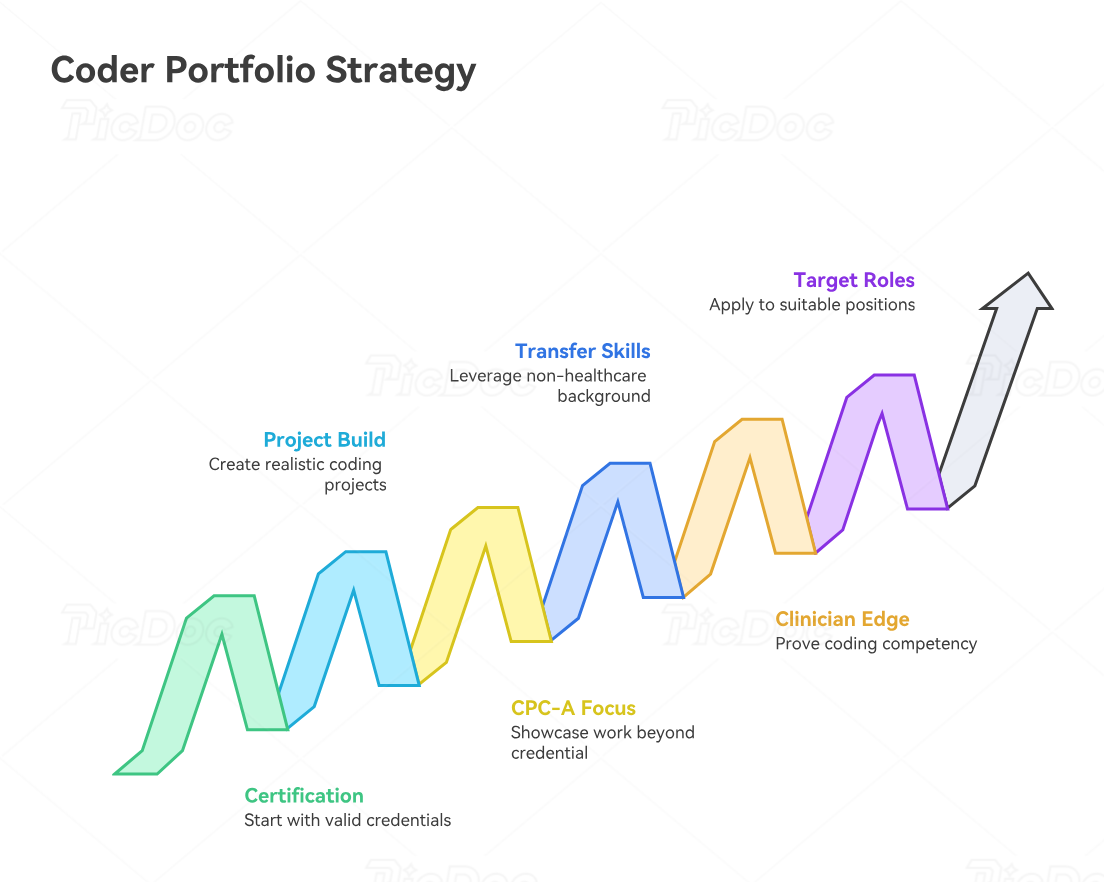
Start with certification, then build a projects section containing realistic, de-identified or fictional coding work. Document the number of cases completed, specialties covered, code sets used, accuracy achieved, and the quality-control method. Someone following a self-study coding path can still demonstrate disciplined work if the portfolio shows clear reasoning. A candidate who has invested in CPC preparation, completed CPC practice questions, and passed the exam should convert that knowledge into cases rather than stopping at the credential line.
For CPC-A candidates, state the credential accurately. Then immediately show the work that makes the apprentice designation less concerning: coding projects, practicum hours, chart-review exposure, specialty study, accuracy tracking, and ongoing experience accumulation. The CPC-A experience problem becomes easier to manage when employers can see actual coding activity.
If you have no healthcare background, use your previous career only where it strengthens the coding application. Transferable evidence can include quality-control work, data accuracy, regulated documentation, analytical review, claims processing, financial reconciliation, secure information handling, or high-volume productivity. Someone entering medical coding with no healthcare experience should avoid filling half the resume with unrelated responsibilities merely to make the document look longer.
Clinicians need the opposite correction. A nurse or medical assistant may have extensive healthcare experience, but the resume should still prove coding competency. A background in nursing before medical coding provides strong clinical interpretation, while medical assisting experience may contribute documentation, terminology, EHR, and workflow knowledge. Neither should replace proof that you can actually assign codes correctly.
Target realistic employers as well. Review employers known to consider newer coders, understand whether the opening is professional-fee or facility coding, and examine whether the role is inpatient or outpatient. Applying indiscriminately to senior inpatient, auditing, or specialized surgical roles can make a strong new-coder resume appear ineffective when the actual problem is role mismatch.
5. Run This ATS and Recruiter Checklist Before Every Medical Coding Application
A strong medical coder resume should be tailored, searchable, measurable, and defensible.
First, compare the job description against your resume. If the employer asks for outpatient physician coding, your first page should not force the recruiter to infer that you have outpatient exposure. State it directly. If the position emphasizes risk adjustment, surface relevant risk-adjustment experience. If the employer wants audit experience, emphasize your coding audit work.
Second, remove unsupported adjectives. “Meticulous,” “excellent,” “detail-oriented,” and “highly skilled” are weak unless the resume proves them. Use accuracy rates, productivity, error reduction, audit results, chart volume, denial recovery, training scope, or documented projects.
Third, inspect dates and credentials. Recruiters will notice inconsistencies. Certification names, dates, employers, and job titles should match what you can substantiate during background checks or interviews.
Fourth, eliminate keyword stuffing. Repeating ICD-10-CM fifteen times does not make you fifteen times more qualified. Place terms naturally across the summary, skills, projects, and employment sections. Candidates preparing for medical coding interview tests should assume anything listed as a skill may be tested.
Fifth, review the resume for career-direction coherence. If you want higher-paying coding specialties, the resume should show progression toward those specialties. If you prefer roles with minimal patient interaction, review medical coding jobs without phone calls and emphasize independent chart review, accuracy, software proficiency, and written communication.
Sixth, proofread at the level expected from a coder. A resume selling attention to detail loses credibility when dates are inconsistent, bullets use mixed tenses, or certification names are misspelled.
Finally, prepare evidence for every major claim. If your resume says 98% accuracy, know how it was measured. If you say you reduced denials, be ready to explain your role. If you claim proficiency in an encoder or EHR, expect questions about how you used it. Your resume should make the interview easier because its strongest claims can survive examination.
6. FAQs About Medical Coder Resumes
-
Prioritize skills that appear in the target job and that you can actually demonstrate: ICD-10-CM, CPT, HCPCS Level II, E/M coding, modifiers, documentation review, medical terminology, anatomy, coding compliance, NCCI awareness, EHR systems, encoders, auditing, denial analysis, and specialty-specific coding.
Someone targeting outpatient coding should emphasize different strengths from someone pursuing facility coding, risk adjustment, or auditing.
-
Replace missing employment evidence with structured coding projects, certification, relevant coursework, practicum experience, measurable practice accuracy, and transferable skills. A candidate entering medical coding without healthcare experience can build evidence through realistic practice cases and a strong post-certification resume.
Then prepare for practical coding interview tests and target employers open to newer coders.
-
Yes. List the credential exactly as held. Hiding the apprentice designation can create a credibility problem later. The better strategy is to pair it with substantial evidence of coding practice, ongoing experience-building, and technical competence.
Review common CPC-A employment barriers, strengthen your new-coder resume, prepare for coding interviews, and apply strategically to entry-level-friendly employers.
-
One page works well for many newer coders. Two pages can be appropriate when you have substantial relevant coding, auditing, billing, healthcare, specialty, or supervisory experience. Length should follow evidence rather than an arbitrary target.
An experienced coder working across multiple specialties, auditing, professional-fee coding, or risk adjustment may genuinely need the additional space.
-
Include them when the figures are real and defensible. Accuracy, charts per hour, daily volume, denial reduction, audit outcomes, and turnaround improvements can dramatically strengthen a coding resume.
The strongest candidates understand that coding productivity expectations must coexist with quality. Employers dealing with coding stress, audits, and denials generally want evidence that you can maintain both.
-
Use keywords present in the actual posting when they truthfully describe your skills. Common terms include ICD-10-CM, CPT, HCPCS Level II, E/M, outpatient coding, professional-fee coding, facility coding, modifiers, NCCI, medical terminology, coding compliance, EHR, encoder, audit accuracy, denial analysis, and specialty-specific terminology.
Applicants should also align wording with the exact role. Someone applying for risk adjustment coding needs different terminology from someone pursuing inpatient coding or professional-fee coding.
